
Femtosecond laser-induced Cu plasma spectra at different laser polarizations and sample temperatures
2022-10-26 09:46:48YitongLiu劉奕彤QiuyunWang王秋云LuyunJiang蔣陸昀AnminChen陳安民JianhuiHan韓建慧andMingxingJin金明星
Chinese Physics B 2022年10期
Yitong Liu(劉奕彤) Qiuyun Wang(王秋云) Luyun Jiang(蔣陸昀) Anmin Chen(陳安民)Jianhui Han(韓建慧) and Mingxing Jin(金明星)
1Institute of Atomic and Molecular Physics,Jilin University,Changchun 130012,China
2State Key Laboratory of Laser Propulsion&Application,Department of Aerospace Science and Technology,Space Engineering University,Beijing 101416,China
Keywords: laser-induced breakdown spectroscopy,femtosecond pulse,laser-polarization,target temperature,plasma temperature,electron density
1. Introduction
Laser-induced breakdown spectroscopy(LIBS)is a good technique for detecting and analyzing material elements because it uses the interaction of lasers and substances. A highpower laser pulse is used as an energy source to cause the ablation of atoms from a sample surface. The sample surface in the laser radiation region quickly melts and vaporizes,generating a high-temperature and high-pressure plasma.The laser-induced plasma emits characteristic spectral lines or bands during continuous cooling. The spectra from the plasma are detected and analyzed to obtain useful information about the material elements that will be measured. LIBS has the advantages of low cost, easy operation, detection of samples in any physical state(including solids,liquids,gases,particles, and aerosols), and simultaneous detection of multiple elements.[1–9]Therefore, LIBS has a place in the field of material element detection and analysis. However, it is not a perfect detection technology; it still has many shortcomings that need to be improved, such as low detection sensitivity and accuracy. There have been many research results on enhancing the sensitivity and accuracy of LIBS, such as dual-pulse LIBS,[10–12]spatial confinement,[13]spark-assisted LIBS,[14–16]and resonance-enhanced LIBS.[17–19]In addition,heating is a feasible way to enhance the optical signal of LIBS.[20]Lednevet al.reported the effect of ablated material temperature on the detection capability of LIBS,[21]finding that higher material temperature produced higher atomic/ionic spectral emissions. Darbanet al.investigated the emission spectra and plasma parameters of metal alloys for different target temperatures,[22]finding that the spectral signal of LIBS improved when the temperature increased to 200°C.Gragossianet al.investigated the plasma emission spectra of aluminum alloy targets at different temperatures,[23]finding that the spectra increased significantly as the aluminum temperature increased; therefore, raising the aluminum’s temperature could improve the detection accuracy of LIBS.Liuet al.discussed the influence of the temperature of semiconductor material for optical signals in LIBS,[24]finding that the spectral signal increased significantly as the material’s temperature increased. Their discussion included the influence of semiconductor material temperature on plasma plumes, and their results showed that the plasma size increased significantly by imaging the plasma as the sample temperature. All the experiments mentioned above indicate that the temperature of the ablated material has a significant influence on the analytical capability of LIBS, and raising the temperature of the ablated material can significantly improve the analytical ability of LIBS. In addition, the experiments above were carried out using a nanosecond laser. Wanget al.considered that the nanosecond laser has “thermal ablation” and that increasing the target temperature helps the thermal ablation processes, enhancing the spectral intensity of LIBS.[25]Because the width of the femtosecond (fs) laser is short,[26,27]and it is a“cold ablation”,[28–30]the influence of the sample temperature on the optical signal of LIBS was studied using the fs laser.[25,31]The corresponding results indicated that the ablation depth of the fs laser increased when raising the sample temperature, and both the plasma spectra and spectral signalto-noise ratio increased.[25,31]
Moreover,the signal of fs-LIBS may be improved by adjusting the pulse polarization. The change in polarization can be achieved by changing the angle of a quarter-wave plate(QWP). Furthermore, the spectral emission excited by the fs laser with circular polarization (CP) is stronger than the case with linear polarization (LP).[32]Many researchers have performed related studies. Lemoset al.investigated the plume expansion produced under CP and LP lasers,[33]finding that the plasma under the CP expanded faster than the one under the LP. Mitryukovskiyet al. found that the kinetic energy of electrons excited by the fs pulse under the LP was low when compared to under the CP.[34]Because the acceleration processes of free electrons are different for CP and LP, the LP laser alternately freely accelerates the electrons in each optical cycle, while the laser with CP can continuously accelerate electrons. These free electrons with higher kinetic energy have an increased probability of collision. Corkumet al.investigated the plasma under the CP and LP;[35]their results suggested that free electrons with CP obtained a higher kinetic energy and a higher plasma density than the case with the LP,and controlling the laser-polarization may control the excitation temperature. Mohideenet al.found that the plasma with the CP was hotter and more energetic by studying the energy spectra above threshold ionization with CP and LP lasers.[36]In summary,increasing target material temperature and changing laser-polarization can improve the plasma energy. Currently, there are few studies on the influence of fs pulse with different laser-polarization states for a LISB optical signal at high sample temperatures.
This study experimentally investigated the influence of fs laser-polarization on the optical signal of LIBS at different sample temperatures. The combination of the two methods allows for a superimposed enhancement of the spectral intensity,which is far more effective than either of the two enhancement methods. This is a change from the previous single method to the present multiple enhancement methods. The paper selected a Cu target as the ablated material. Then, the detected spectral lines from fs-LIBS were Cu (I) 510.55 nm,515.32 nm,and 521.82 nm. We measured the variation of the lines with different laser polarizations for different Cu temperatures. Moreover, the plasma temperature (PT) and electron density(ED)with varying laser polarizations for different Cu temperatures were calculated.
2. Experimental details
Figure 1 shows the experimental setup of the fs-LIBS.The fs pulse system used was an 800-nm and 50-fs ultrafast Ti:sapphire amplifier (Coherence, Libra). The pulse energy was first set to the desired value using a polarizer and a halfwave plate, and then the angle of a QWP was adjusted to change the laser polarization. Finally,the fs laser was focused vertically on the sample surface by a lens with a 20 cm focal length. The laser spot diameter at the sample surface was approximately 100 μm,and the laser fluence was approximately 24.2 J/cm2.The target material(Cu)was attached to a thermostatic heating table(consisting of a heating resistor and a thermocouple). The heating element heats the sample from room temperature to 150°C.During laser irradiation,the target and heating table were fixed on a 3D motorized translation stage(Thorlabs,PT3/M-Z8). A lens with a 75-mm focal length and 50-mm diameter collected optical signals from a laser-induced plasma.It focused the collected light to a fiber,which was coupled to a spectrometer (SP500i, PIActon, 1200 grooves/mm)equipped with an ICCD camera (PIMAX4, Princeton Instruments, 1024×1024 pixels)with 0.1-μs gate delay and 10-μs gate width.Each spectral data was a sum of 10 laser shots,and the measurement was performed in the air.
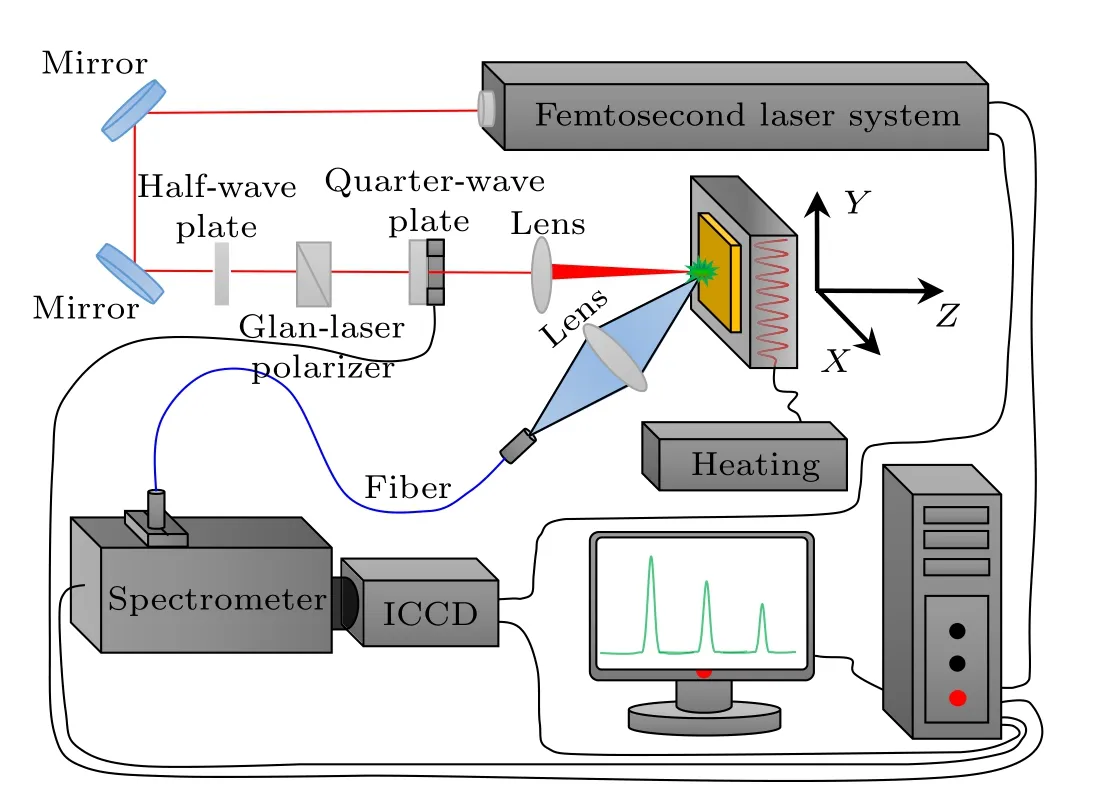
Fig.1. Experimental details for fs-LIBS of Cu.
3. Results and discussion
Figure 2 compares the intensity of an fs laser-ablated Cu plasma spectra with CP and LP for the sample temperatures of 25°C and 150°C.From the figure,the circularly polarized laser-induced Cu plasma emission is higher than the plasma emission with LP at the same Cu temperature(25°C)for the same polarization(CP).As the Cu temperature(25°C)rises to 150°C,the three Cu atomic lines become stronger compared to the case with the circular polarization and the 25°C sample temperature.

Fig.2. Comparison of line emissions from fs-LIBS with CP and LP at 25 °C and 150 °C.The laser pulse energy is 1.9 mJ.
To know the influence of fs laser-polarization on the Cu atomic lines, we followed the variation of the peak emission of 521.82-nm atomic emissions with the angle of the QWP for the Cu temperatures of 25°C and 150°C presented in Fig. 3. The 521.82 nm line intensity of the Cu changes with the change in the angle of the QWP. As the QWP angle is 45°+n×90°(n=0,1,2,3),the fs laser is circularly polarized,and the line intensity is maximized. When the angle isn×90°(n=0,1,2,3),the fs laser is linearly polarized,and the line intensity is minimized. For the remaining angles,the fs laser is elliptically polarized,and the line emission is between CP and LP.The acceleration mechanisms of pulsed lasers with CP and LP are different for free electrons.The fs laser field with LP alternately accelerates and decelerates free electrons in the laser field, and the two processes are periodic. Unlike the fs laser field with LP, the fs laser with CP continuously accelerates free electrons in the laser field;[32]these electrons can achieve greater velocities and kinetic energy under the laser field with CP. Figure 3 proves that changing fs laser-polarization may control the line intensity of fs-LIBS.
Figure 4 displays the intensities of the Cu 521.82 nm atomic emission as functions of the angle of the QWP for four Cu temperatures. In Fig.4,the higher the Cu temperature,the higher the Cu atomic line emission. Increasing the Cu temperature can significantly enhance the energy coupling between the laser and samples.[23,37]Therefore,the higher the Cu temperature,the higher the absorbed laser energy. Increasing the temperature of the sample reduces the reflectivity of the sample so that the Cu target can absorb more energy, generating stronger plasma emissions.To observe the phenomena clearly,we presented the peak intensities of Cu lines as functions of the Cu temperature in Fig.5.
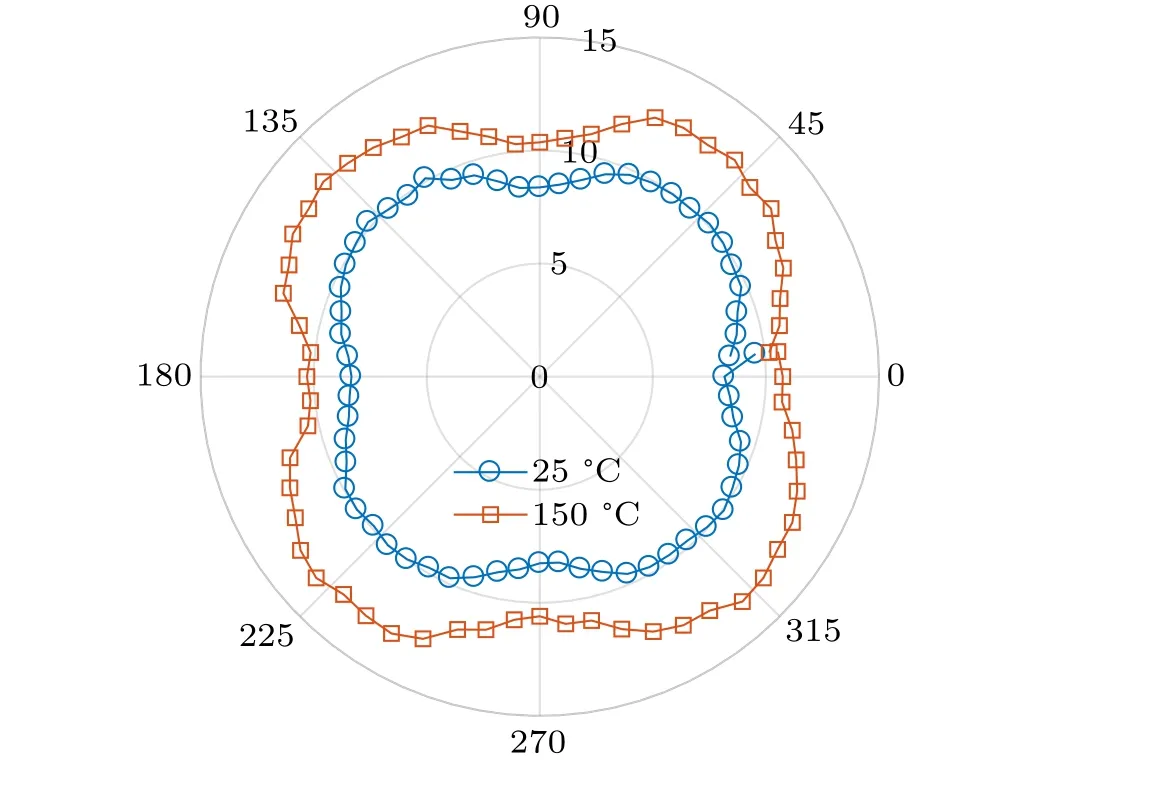
Fig. 3. Variation of Cu (I) 521.82 nm spectral line with laser-polariztion at the Cu temperature of 25 °C and 150 °C.The laser pulse energy is 1.9 mJ.

Fig.4. Variation of spectral intensity of Cu(I)521.82 nm with the angle of QWP at different Cu temperatures.
Figure 5 compares the peak emission intensities of Cu atomic lines with CP and LP fs lasers as functions of the Cu temperature. The line emission with CP is always stronger than that with LP as the Cu temperature increases, and the line emission intensities with CP and LP show an increasing trend. The experimental results show that changing LP to CP and increasing the Cu temperature can improve the line emission of fs-LIBS.The fs pulse with CP gives free electrons produced more kinetic energy after excitation than LP.[38]The probability of electron collisions with atoms is greater,and the thermal motion of microscopic particles is stronger,leading to higher-temperature plasma. Therefore, for the interaction between electrons and lasers, an fs laser with CP continuously accelerates electrons. Electrons excited by a circularly polarized laser have high energies compared to those excited with LP. Then, electrons transfer these energies to the lattice by electron-lattice relaxation,and the lattice rises to a higher temperature, forming higher temperature plasma. Subsequently,the plasma temperature was obtained.

Fig. 5. Comparison of the peak intensities of Cu (I) 510.55 nm (a) and 521.82 nm (b) with CP and LP fs lasers, respectively, as functions of Cu temperature.
Under local thermodynamic equilibrium,[39]the PT is calculated by Boltzmann plot with the following equation:[40,41]

whereλkiis the central wavelength,Ikiis the integrated intensity,gkis the statistical weight,Akiis the transition probability,kBis the Boltzmann constant,Teis the PT, andCis the intercept. The Cu atomic lines at 510.55 nm, 515.32 nm,and 521.82 nm can guarantee the calculation results.[42,43]The parameters involved in Eq.(1)can be found in Table 1.[44–46]Next,the ED is also calculated. The relationship between the ED and spectral width can be used for calculating the ED:[47]

where Δλ1/2is the full width at half maximum (FWHM),ωis the collision coefficient, andNeis the ED. The Cu (I)521.82 nm is the strongest among the three spectral lines measured above;hence,we chose Cu(I)521.82 nm to calculate theNe.ωis weakly dependent on the temperature[48]and taken as 0.22 nm.[49].

Table 1. Spectral parameters.

Fig.6. Variation of Te (a)and Ne (b)with the angle of QWP at different Cu temperatures.
Figure 6 presents the distribution of theTeandNeby rotating the QWP and raising the Cu temperature. The trends of theTeandNeare consistent with the trends of the line emission intensities when turning the QWP. TheTeandNewith CP are higher than those with LP. TheTeandNeunder elliptically polarized pulses are between those of circularly and linearly polarized pulses. During the interaction between femtosecond laser and metal,the optical absorption mechanism is the inverse bremsstrahlung.[50]Free electrons within the metal mainly absorb the femtosecond laser energy. In addition,electron energy within the metal can be affected by the laser polarization. A significant difference between CP and LP in the fs laser field is the kinetic energy of free electrons remaining after laser irradiation. With an LP pulse, free electrons are left with low kinetic energy because they experience alternative acceleration and deceleration by the laser field during each pulse’s optical cycle. In contrast, electrons are always accelerated with a CP laser and obtain more kinetic energy.[32]When the fs laser with CP irradiated the copper,the laser field could continuously accelerate free electrons within the copper. The electrons obtained higher energy compared to the case under LP. Therefore, the laser with CP could produce a higher-temperature plasma than LP. Figure 6 shows that theTeincreases and theNedecreases as the Cu temperature increases. To observe the phenomena clearly,we plotted theTeandNeas functions of the Cu temperature for different laser polarizations.
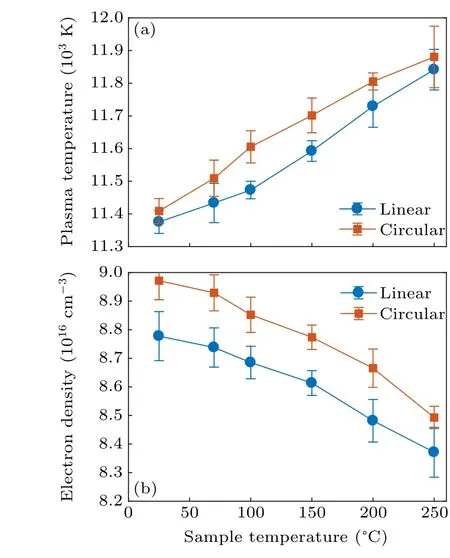
Fig.7. The Te (a)and Ne (b)with CP and LP as functions of Cu temperature.
Figure 7 presents theTeandNeof the CP and LP fs laserinduced plasmas. From Fig. 7(a), theTeincreases with increasing Cu temperature; that is, increasing the temperature can increase theTe. The increase of theTeincreases the number of particles at the upper levels of the plasma. Firstly, as the temperature increases, the damage threshold of the material surface decreases,while the original internal energy of the material increases. More mass is excited from the material for the same laser pulse energy.[51]Hence,theTeincreases. Secondly, increasing the sample temperature leads to a decrease in the surface reflectivity,which can absorb more laser energy and eject a denser plasma to enhance the thermal motion of the particles and increase the plasma temperature.[52]Thirdly,increasing the sample temperature increases the initial energy of the particles, resulting in a rapid expansion of the excited plasma and an increased probability of internal particle collisions. Thus, the high-temperature plasma is produced by heating the sample. However, the higher the Cu temperature,the lower theNe. Eschlb¨ock-Fuchset al.discussed the effect of material temperature on plasma expansion.[53]The plume area increased with increasing sample temperature, while the mean plume intensity decreased slightly. This trend indicated that the plasma density should decrease with the increase of the sample temperature. Sambriet al.reported the heating influence on plume expansion.[54]At high temperatures, the first stages of the plasma presented an arrow expansion,which became spherical at a longer time due to the breaking of the ambient gas. Moreover,at larger delay times,the plasma was progressively longer for a higher temperature than for room temperature, revealing a decrease in the resistance from the background gas when raising the temperature. Thus, the decrease in theNeis due to the rapid expansion of the plasma at higher Cu temperatures. In the current experiment, the measurements are performed in air. Heating the sample warms the air. From the ideal gas law, we know that the temperature in the atmospheric environment is inversely proportional to the density of air;[55]the air density around the sample at 150°C is roughly 70% that at 25°C. Therefore, as the Cu temperature increases,the air density around the Cu sample decreases.The reduction in the air density decreases the resistance of the plasma expansion, enhancing the plasma expansion velocity.The plasma will rush to fill this low-density gas environment,lowering the plasma density. Therefore, theNein the plasma also decreases as the Cu temperature increases.
4. Conclusion
We investigated the influence of laser-polarization on the emission spectra of fs-LIBS of Cu for different target temperatures. The experiment indicated that increasing the Cu temperature enhanced the emission of fs-LIBS significantly.The laser-polarization played a crucial role in improving the spectral emission intensity. Compared to the fs laser with LP, the fs laser with CP excited a stronger spectral emission.Since the circularly polarized laser pulse could excite electrons with high kinetic energy, the electrons had a high probability of collision with Cu atoms within the plasma, enhancing the plasma emission intensity.We combined the two enhancement methods of increasing the target temperature and adjusting the laser-polarization. The results showed that the enhancement effect of the combination of raising the target temperature and changing the laser-polarization was much stronger than that of increasing the target temperature or changing the laser-polarization alone.
Acknowledgments
Project supported by the National Key Research and Development Program of China (Grant No. 2019YFA0307701)and the National Natural Science Foundation of China(Grant Nos.11974138,11674128,and 11674124).
- Chinese Physics B的其它文章
- Design of vertical diamond Schottky barrier diode with junction terminal extension structure by using the n-Ga2O3/p-diamond heterojunction
- Multiple modes of perpendicular magnetization switching scheme in single spin–orbit torque device
- Evolution of the high-field-side radiation belts during the neon seeding plasma discharge in EAST tokamak
- Phase-matched second-harmonic generation in hybrid polymer-LN waveguides
- Circular dichroism spectra of α-lactose molecular measured by terahertz time-domain spectroscopy
- Recombination-induced voltage-dependent photocurrent collection loss in CdTe thin film solar cell