
微量潤滑賦能霧化與供給系統關鍵技術研究進展
2022-09-27 12:43:32王曉銘李長河張彥彬楊敏周宗明陳云劉波王大中
表面技術 2022年9期
王曉銘,李長河,張彥彬,楊敏,周宗明,陳云,劉波,王大中
特邀綜述
微量潤滑賦能霧化與供給系統關鍵技術研究進展
王曉銘1,李長河1,張彥彬1,楊敏1,周宗明2,陳云3,劉波4,王大中5
(1.青島理工大學 機械與汽車工程學院,山東 青島 266520;2.漢能(青島)潤滑科技有限公司,山東 青島 266100;3.成都工具研究所有限公司,成都,610500;4.四川明日宇航工業有限責任公司,四川 什邡 618400;5.上海工程技術大學 航空運輸學院,上海 201620)
傳統金屬切削液會對環保、人體健康及制造成本產生負面影響,難以滿足綠色制造的發展需求。微量潤滑是一種介于澆注式和干式加工的潤滑劑綠色供給技術,利用壓縮空氣將少量可降解的生物潤滑劑霧化,形成微液滴,從而起到潤滑和抗磨減摩的作用。然而,尚無相關研究針對霧化微液滴精準輸運技術的規律進行總結,無法為微量潤滑供給參數提供科學指導。為此,綜述了微量潤滑賦能霧化和供給系統關鍵技術的研究進展。揭示了微量潤滑兩相流氣動霧化液滴粒徑和霧化錐角隨供給參數的演變規律,提出了靜電霧化微量潤滑賦能供給新方法,分析了靜電賦能霧化性能調控機制和荷電流體滲透特性,闡述了超聲賦能霧化液滴均一化機理和工藝參數優化策略。進一步分析了基于流體動力學模型的刀具/砂輪–工件界面流場分布規律,闡明了噴嘴結構對液滴輸運的影響規律,為噴嘴位姿參數的選取提供了理論支撐。此外,論述了噴嘴位姿參數化調控裝置的研究進展,解決了潤滑介質參數化供給難題。最后,展望了微量潤滑復合增效和智能供給關鍵技術,以期為微量潤滑技術的工程應用提供理論支持和技術指導。
微量潤滑;霧化;切削;磨削;流場;噴嘴

掃碼查看文章講解
在金屬切/磨削過程中,伴隨著材料去除,刀具/砂輪–工件接觸界面會發生劇烈摩擦,單位體積材料的去除需要消耗大量的能量[1-2],因而切/磨削區內部存在較高的熱流密度[3-4]。熱量積聚使工件處于高溫狀態,進而導致工件發生熱損傷,如燒傷、微裂紋、殘余應力、組織變化等[5-8]。采用金屬切削液來提升零件切/磨削性能已有數百年的應用歷史。傳統金屬切削液通常采用礦物油作為基礎潤滑劑,通過液壓管路輸運澆注至切削摩擦界面,并經凈化裝置處理后循環使用。雖然傳統澆注式供給實現了冷卻潤滑作用,但會產生不可忽視的負面影響。礦物基油的生物降解性較差,一些企業非法泄露、排放和燃燒礦物基油,這會對土壤環境、水資源、大氣環境造成不可逆轉的負面影響[9]。在加工過程中,技術人員接觸冷卻潤滑劑、細菌及各種化學添加劑后容易罹患皮膚疾病[10]。同時,切削液的處理成本較高[11]。此外,受到刀具撞擊及切/磨削區高熱量載荷的影響,金屬切削液易飄散、蒸發至空氣中,從而對操作人員的呼吸道系統造成損傷[12]。
傳統制造模式粗放式發展帶來的環境影響已經不能滿足當前綠色制造的發展需求。自工業革命后,礦物油的普及使用改善了切/磨削加工過程的潤滑。然而,在碳達峰、碳中和要求的嚴峻國際大背景下,傳統制造向綠色、可持續制造轉變勢在必行。為了消除傳統金屬切削液帶來的嚴重負面影響,研究人員對綠色切/磨削技術進行了深入的研究。20世紀90年代,有學者提出將潤滑介質通過氣動霧化方式噴射至切削區,將微量的潤滑介質供給至摩擦區域[13]。潤滑介質以微液滴的形式被輸運至切/磨削區界面,以實現刀具/砂輪–工件間的有效潤滑,從而保證了工件的表面完整性[14]。微量潤滑技術在保障加工精度的同時也兼顧了綠色制造,是一項澆注式切削液供給方式較為理想的替代技術[15-16]。
微量潤滑技術已在航空航天、軌道交通等領域得到了廣泛推廣與應用[17]。典型的工件材料包括鋁合金、碳素鋼、低合金鋼、灰口鑄鐵和球墨鑄鐵等。微量潤滑供給參數的選取與潤滑介質微液滴的穿透性和冷卻能力緊密相關,如果參數選取不當,通常會導致高熱量的產生[18-21]。這不僅會促進刀具/砂輪的快速磨損,還會降低工件的表面完整性[22-23]。為了實現微量潤滑介質的精準輸運,有必要針對微量潤滑霧化系統及切/磨削加工流場開展科學研究,以提升有效流量率,進而解決切削/磨削熱損傷技術的瓶頸問題。文中擬揭示微量潤滑兩相流霧化性能及其隨參數的演變規律,包括氣動霧化、靜電賦能霧化和超聲賦能霧化,進一步分析切/磨削區內的流體動力學行為,闡述噴嘴優化的設計思路,擬為噴嘴位姿優化調整提供理論支撐。此外,還擬剖析國內外微量潤滑介質智能供給裝置,對微量潤滑復合增效和智能供給關鍵技術進行展望,旨在為微量潤滑技術基礎研究和工程應用提供參考。
1 微量潤滑霧化方式
潤滑劑的霧化性能與其在切削區的潤滑成膜特性密切相關[24]。最早微量潤滑切/磨削加工通過將壓縮空氣霧化成微液滴,并噴射至摩擦區域,以改變材料去除力學行為[25-27]。隨著技術的應用,學者們發現氣動霧化液滴的粒徑分布不均,且具有一定的隨機性。在較高氣壓霧化過程中產生的微細液滴易產生懸浮可吸入顆粒,這會威脅操作技術人員的身體健康。由此,將靜電與超聲場賦能于霧化過程,從而提升微液滴的粒徑可控性,已成為技術發展的趨勢[28-29]。靜電賦能霧化和超聲賦能霧化降低了液滴粒徑分布跨度,進而降低了懸浮可吸入小液滴的質量濃度[30]。
1.1 氣動霧化
氣動霧化指微量潤滑介質在與壓縮氣體相互作用下破裂分散為微小液滴的過程。噴嘴氣液兩相流霧化示意圖如圖1所示,在軸向主要分為霧化區、液滴密集區和液滴稀疏區[31]。在霧化區,微量潤滑介質被分解成液塊、液絲和液滴。液滴密集區包括液塊、液絲的二次破裂及液滴間的相互作用,例如碰撞和聚結。液絲通常存在于霧化區和液滴密集區,表現為非球形液片。液滴稀疏區以球狀液滴為主。氣動霧化是氣液兩相相互作用的過程,是外力與液滴的表面張力和黏滯力之間動態作用的結果。霧化微液滴的分布取決于壓縮空氣壓力、霧化器尺寸、微量潤滑介質的流量及理化特性。在氣動霧化中,霧化微液滴呈錐形分布。液滴速度在噴霧軸線處最大,因與周圍空氣的相互作用,液滴速度在徑向上較小[32]。
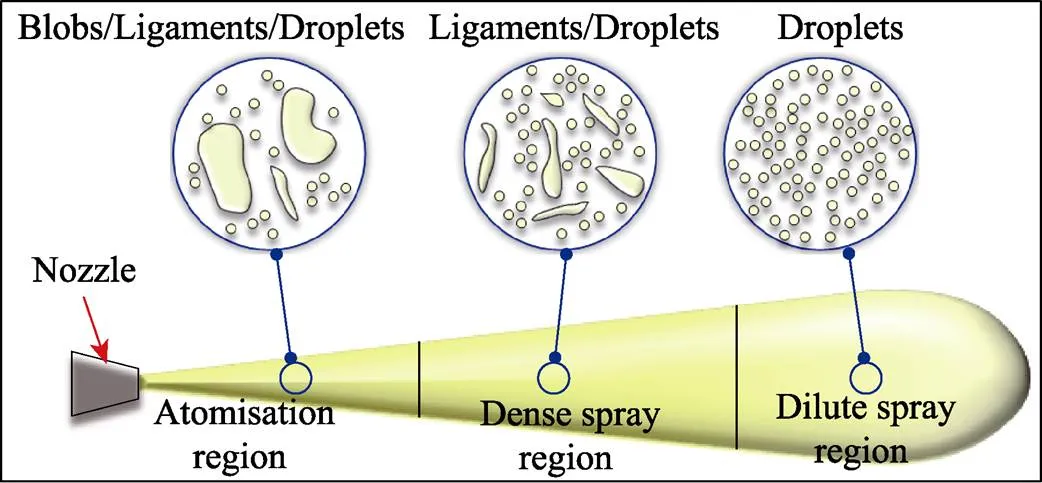
圖1 兩相流氣動霧化[31]
微量潤滑微液滴輸運可依據兩相流輸運管路的不同,分為單通道系統和雙通道系統。如圖2a所示,單通道系統將潤滑介質霧化為微液滴后儲存在容器內,然后利用壓差將容器內的微液滴通過管路和常規噴嘴輸運至切削區。如圖2b—c所示,雙通道系統通過霧化噴嘴將液相破裂為微液滴后,直接噴射至切削區的摩擦界面。單通道系統的結構簡單、維護方便,但它對輸運通道提出了要求。單通道系統液滴群的輸運易受到液滴碰撞凝結、管道液滴破裂、管道內壁油膜形成、管道內壁油膜破裂等因素的影響[33],這些影響因素使得潤滑介質的性質(黏度和表面張力)、管道長度、液滴分布密度等受到了限制。由此可見,使用雙通道系統更便捷,限制條件更少,對輸運管路的要求更低。此外,根據雙通道系統液相的輸運方式,將其分為有泵式和無泵式。無泵式利用文丘里效應控制液體的流量,有泵式通過精密潤滑泵控制微量潤滑介質的流量[34-37]。在該系統中,可分別調節壓縮空氣和潤滑介質的流量,并在專用噴嘴中混合,使霧化微液滴通過壓縮空氣噴射至切/磨削區。在微量潤滑技術發展早期,由于泵和閥承受沖擊的脈沖頻率較高,雙通道系統部件的可靠性備受關注。在近30年的實踐中,微量潤滑泵的可靠性已被證實能夠滿足工業生產的需求。此外,連續供給精密潤滑泵的推廣應用改善了液相脈沖供給導致的不連續霧化缺陷。與其他潤滑介質供給方式相比,采用連續供給的精密潤滑泵輸運能夠實現霧化性能的精準控制。
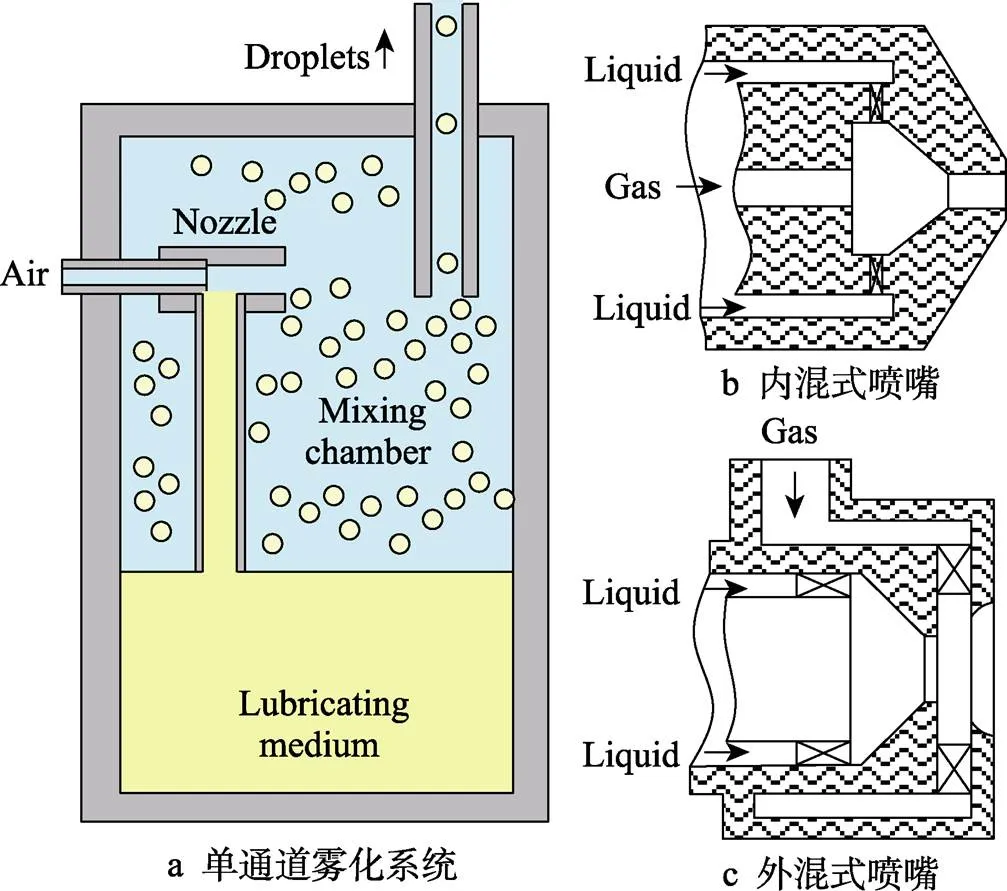
圖2 單通道與雙通道霧化器結構[33]
與雙通道系統相比,單通道系統的霧化液滴粒徑更小,通常能夠達到10 μm以下。雙通道微液滴粒徑較大,一般在數十微米至上百微米。液滴粒徑的大小主要受到霧化器尺寸、壓縮氣體和潤滑劑理化特性的影響。在目前的研究中,雙通道供給系統的霧化壓力一般為0.4~0.8 MPa,潤滑介質的流量為10~200 mL/h。Park等[38]通過小波變換研究了微量潤滑霧化微液滴粒徑及分布隨噴嘴距離和氣壓的變化規律,研究結果表明,噴嘴壓力越高,提供的液滴數量越多;隨著噴嘴距離的增加,獲得的液滴尺寸越小,且沉積在表面的液滴越少。Balan等[39]通過數值模擬也發現,液滴尺寸隨著霧化壓力的增加而減小,數值模擬結果與現有經驗模型和實驗測量值一致。霧化壓力較高的中等直徑液滴可穿透高壓氣障層,并有效潤滑磨削區。Emami等[40]研究發現,微量潤滑氣動霧化中的液滴尺寸受到潤滑介質的流速、氣體流速和所用潤滑劑的物理性質等的影響,通過增加進入霧化氣體的壓力,氣體流速呈指數增加。隨著壓縮空氣流速的增加,噴嘴出口處的液滴尺寸減小。此外,潤滑介質流速的增加會導致液滴尺寸的增加。高速相機捕獲的圖片也顯示,低氣體流速會導致液滴尺寸變大,高氣體流速會導致液滴尺寸變小、射流速度升高和液滴數量的大幅提高。印度學者Sai等[41]研究發現,液滴的平均直徑和中值直徑均隨著霧化空氣壓力的增加而顯著降低。Maruda等[42]認為,較大的霧化錐角使得液滴不會在空氣中產生相互作用,確保液滴的直徑更小。
在氣動霧化中,通常以較高的霧化氣壓提高其霧化性能,包括降低液滴粒徑、增加液滴速度等,進而提升液滴的浸潤性能,改善界面摩擦性能。隨著霧化壓力的增大,霧滴譜的均勻性、霧滴的表面能、浸潤特性、霧滴的運動軌跡不能實現主動、有效、可控,微量潤滑劑不能發揮最大的效能。在霧化過程中會產生大量可吸入的霧滴粒子,細小的霧滴粒子在高速氣流的擾動下很容易飛逸飄散。飄散的霧滴粒子會對環境和工人健康造成傷害,因此工業生產應用面臨極大的技術瓶頸和環保壓力挑戰[43-44]。
1.2 靜電賦能霧化
為了解決氣動霧化不能實現參數化可控輸運的技術難題,青島理工大學李長河教授團隊和浙江工業大學許雪峰教授團隊在國內率先開展了靜電賦能霧化微量潤滑加工探索性研究。靜電賦能霧化技術是利用高壓靜電場將液體霧化并荷電的一項新型技術。霧化后的液滴經過高壓靜電場形成的電暈區與帶電粒子碰撞,從而獲得電荷,荷電后的潤滑介質在庫侖力的影響下使得表面張力降低,液滴產生了二次或多次破碎,進而形成荷電液滴群。靜電賦能霧化所產生的液滴粒徑較小,均一化程度較高,同時還可改變電場強度,實現對液滴粒徑的調控。將靜電場賦能于微量潤滑中,能夠極大地改善微液滴粒徑的可控性。該技術顯著提高了潤滑劑液滴的穿透性和潤濕性,并減小了液滴尺寸[30]。
青島理工大學李長河教授團隊開展了靜電賦能霧化微量潤滑磨削加工的研究工作。Guo等[45]發現,電壓幅值對工件所受磨削力的影響較大,隨著電壓的增大,工件所受磨削力逐漸減小。工件表面粗糙度也隨著電壓幅值的增大呈現逐漸下降的趨勢。張曉陽等[46]建立了靜電霧化微量潤滑下的霧化動力學模型,并發現霧化液滴粒徑呈駝峰式分布。如圖3所示[47],施加電壓分別為0、?20、?25、?30、?35、?40 kV,橫坐標表示液滴粒徑,縱坐標表示液滴粒徑的概率密度()。靜電賦能霧化液滴粒徑分布隨著電壓的變化產生了顯著變化,隨著施加電壓的增加,霧化錐角隨之上升,峰值粒徑變小,峰值間距變小,峰值概率增加。與常規氣動霧化相比,靜電賦能霧化粒徑變小且分布集中。此外,靜電霧化錐角大于氣動式霧化錐角。當電壓為?60~0 kV時,在電壓為?50 kV時得到了最大霧化錐角。賈東洲等[48]發現,荷電大豆油在磨削區微通道內產生了電潤濕效應,提升了微量潤滑介質在磨削區內的遷移活性,改善了磨削區砂輪/工件接觸界面的潤滑效果。此外,賈東洲等[49]還研究了卵磷脂對大豆油表面張力、動態黏度、電導率和液滴質荷比的影響,揭示了植物油霧化成膜潤滑過程中靜電場和卵磷脂的作用機理,并確定了最佳的卵磷脂混合比例。浙江工業大學許雪峰教授團隊在靜電霧化微量潤滑車削/銑削加工中開展了廣泛研究。許雪峰教授等[50]研究發現,電壓和氣壓是影響靜電賦能霧化技術應用的重要因素,靜電賦能霧化不僅能降低刀具磨損和切削力,還能延長刀具壽命、改善表面質量。黃水泉等[51]發現,靜電場的存在改善了液滴的潤濕和滲透能力,減小了液滴直徑,提升了潤滑劑進入接觸界面的能力。呂濤等[52]發現,石墨烯納米流體的油霧濃度低于油基靜電霧化微量潤滑,石墨烯的存在使得帶電液滴的沉積性能得到改善。此外,許雪峰教授團隊還發現,水基氧化鋁和二氧化硅納米流體具有較強的荷電能力,表現出更低的表面張力和接觸角,以及更好的油霧抑制能力[43-44]。江蘇科技大學研究團隊蘇宇等[53]發現,與氣動霧化微量潤滑相比,靜電賦能霧化潤滑與靜電賦能霧化納米流體潤滑的刀具磨損和油霧濃度顯著降低,油霧濃度隨著電壓的增加而降低。同時,油水復合靜電賦能霧化荷電性能高于常規靜電賦能霧化,更易產生小粒徑液滴[54]。此外,增加水基納米流體的電壓、流速和納米顆粒的體積分數,以及減小噴嘴靶距,可以顯著增強靜電霧化的臨界熱流量[55]。
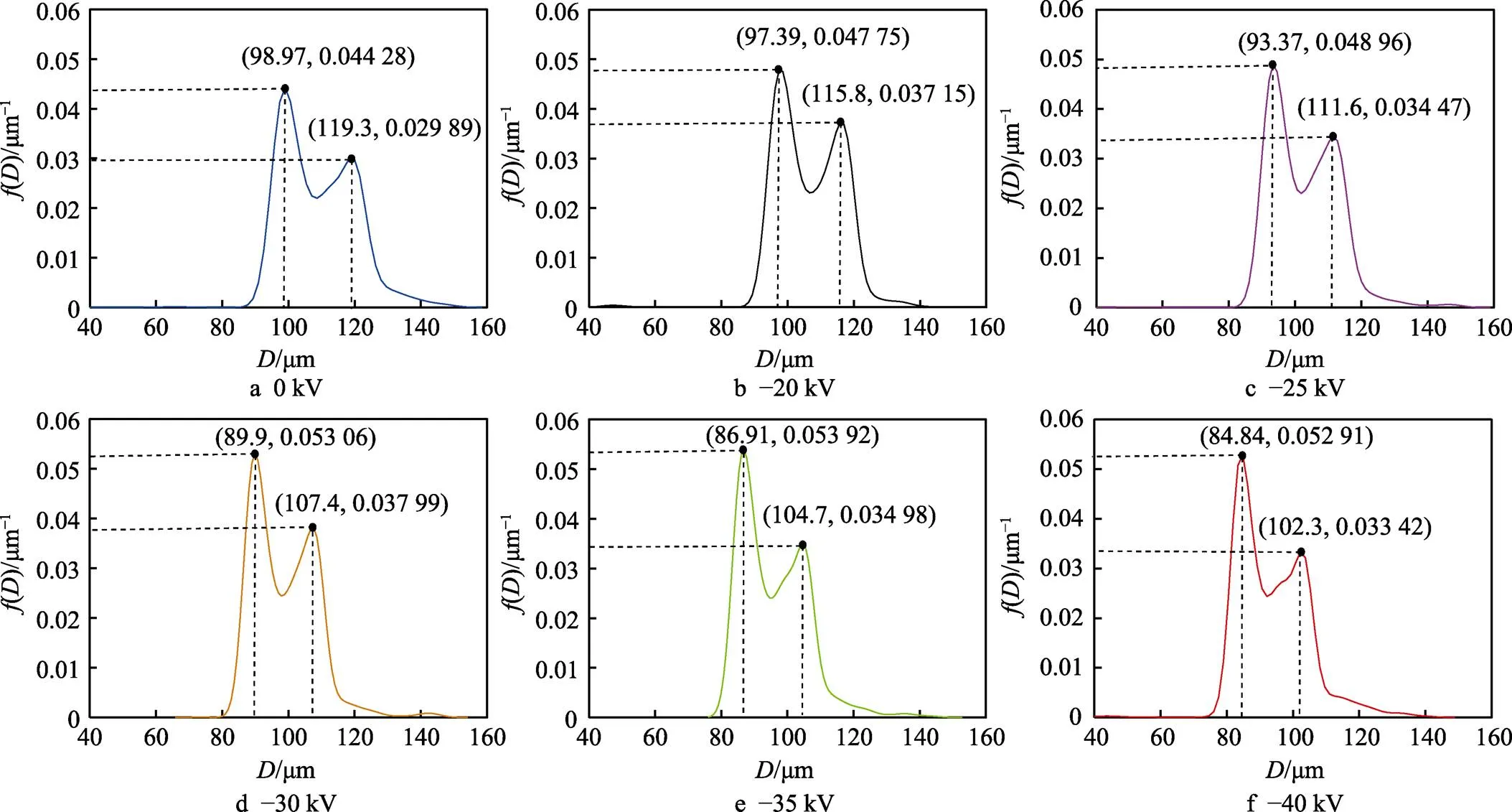
圖3 靜電賦能霧化液滴粒徑分布[47]
國外學者也針對靜電賦能微量潤滑技術開展了相關工作。Bartolomeis等[56]在第五屆CIRP CSI會議上報告了靜電賦能微量潤滑加工鎳基合金的切削實驗研究,報告指出,靜電賦能微量潤滑在航空航天領域難加工材料的切削加工方面具有很強的競爭力。韓國學者Lee等[57]認為,納米流體液滴可以更有效、穩定地注入砂輪–工件接觸區域。印度學者Shah等[58]研究發現,靜電賦能微量潤滑技術改善了工件的表面粗糙度。此外,Shah等[59]研究還發現,當電壓為0~ 25 kV時,在電壓20 kV下觀察到了相對最佳的摩擦學和加工性能。與傳統微量潤滑工況相比,在靜電霧化微量潤滑工況下刀具的磨損降低了38%。靜電賦能霧化微量潤滑技術改善了霧化質量,提升了液滴進入切削區的穿透能力。
施加靜電場具有改善液相霧化效果及提高潤滑性能的作用。靜電賦能霧化的效果優于氣動霧化,隨著電壓的升高,霧化錐角呈現變大的趨勢,但在電壓增大到一定值時,霧化錐角反而下降。隨著氣壓的升高,霧化錐角呈現逐漸減小的趨勢。液滴粒子的平均直徑隨著氣體壓強、噴嘴距離的增大而減小[47]。
1.3 超聲賦能霧化
超聲賦能霧化利用高頻次的微小的定向振動沖擊使微量潤滑介質表面隆起并破裂,從而形成微液滴。超聲賦能霧化技術已應用于吸入藥物輸送、燃料燃燒和空氣凈化等方面。液滴直徑可以通過改變超聲波換能器的功率和頻率來控制。相較于傳統氣動霧化微量潤滑,超聲賦能霧化在控制液滴粒徑及分布方面具有優勢。
青島理工大學楊敏等[60]開發了一種超聲聚焦輔助三級霧化冷卻裝置,將醫用納米流體經氣動?超聲?靜電三級霧化后得到超細液滴,利用超聲聚焦作用將霧化微液滴注入磨具/骨楔形約束空間,有效地對磨削區進行冷卻潤滑。此外,賈東洲等[61]、Gao等[62]研究發現,微量潤滑介質在超聲振動表面液滴的浸潤性能得到了大幅提升。蘇州科技大學李華教授團隊[63]提出了由縱向振動系統與彎曲振動圓盤組成的縱彎轉換超聲振動霧化系統的新型結構,并進一步提出球面聚焦超聲輔助汽霧冷卻系統[64],基于超聲賦能霧化技術,利用聚焦超聲將微液滴匯聚至切/磨削區。磨削加工實驗表明,聚焦超聲有助于強化中心區汽霧換熱,進一步提高聚焦超聲賦能霧化系統的換熱能力。山東理工大學Meng等[65]對比了干切削和超聲賦能霧化微量潤滑車削Ti6Al4V的切削性能,研究結果表明,與干切削相比,超聲賦能霧化微量潤滑有助于提高刀具壽命、改善表面粗糙度。屏東科技大學學者Huang等[66-69]開展了水基納米流體超聲賦能霧化加工,先后針對磨削[66-67]、微銑削[68-69]工藝參數開展了優化研究。研究表明,納米石墨烯具有優異的導熱系數,切/磨削區熱量被納米流體攜帶出,減少了對刀具的熱損傷,進而降低了刀具磨損。超聲賦能霧化有效分散了納米流體中的納米顆粒,實現了換熱性能的最大化。
美國伊利諾伊大學Kapoor教授團隊對超聲賦能霧化微量潤滑技術開展了大量研究。Jun等[70]研究發現,在低進給量下,采用超聲賦能霧化微量潤滑技術對刀具壽命的提高更為顯著,這是因為此工況下犁耕/摩擦占主導地位。Nath等[71]研究發現,均勻分布的液滴在加工過程中能夠形成均勻的液膜,較大的噴霧距離可降低切削界面處的摩擦因數,并改善加工過程中的刀具壽命和表面質量。Hoyne等[72]研究表明,在鈦合金加工過程中,超聲賦能霧化微量潤滑產生的潤滑劑能夠有效滲透至刀具?切屑界面,并改善其摩擦因數。此外,Hoyne等[73]還基于Navier?Stokes方程建立了超聲賦能霧化微量潤滑系統的三維流體潤滑膜解析模型。伊朗德黑蘭大學Hadad等[32]開發了一種超聲賦能霧化微量潤滑噴嘴,利用文丘里效應產生一次霧化,并由噴嘴尖端共振表面高頻振動強化二次霧化。與傳統的氣動霧化系統相比,超聲賦能霧化后的潤滑介質微液滴粒徑更小,分布更均勻。如圖4所示,車削加工結果表明,超聲賦能霧化顯著改善了工件的表面粗糙度,并優于傳統澆注式切削。韓國學者Lefebure等[74]開展了可降解生物潤滑劑超聲賦能霧化微量潤滑的霧化性能研究,結果表明,超聲賦能霧化液滴尺寸分布受到網孔尺寸、驅動電壓和潤滑劑黏度等的影響。電壓的增加有利于液滴尺寸的減小,在低電壓工況下,黏度對平均液滴直徑基本無影響,但在高電壓下存在明顯的正相關關系,振動網孔徑的增大會大幅增加液滴尺寸。
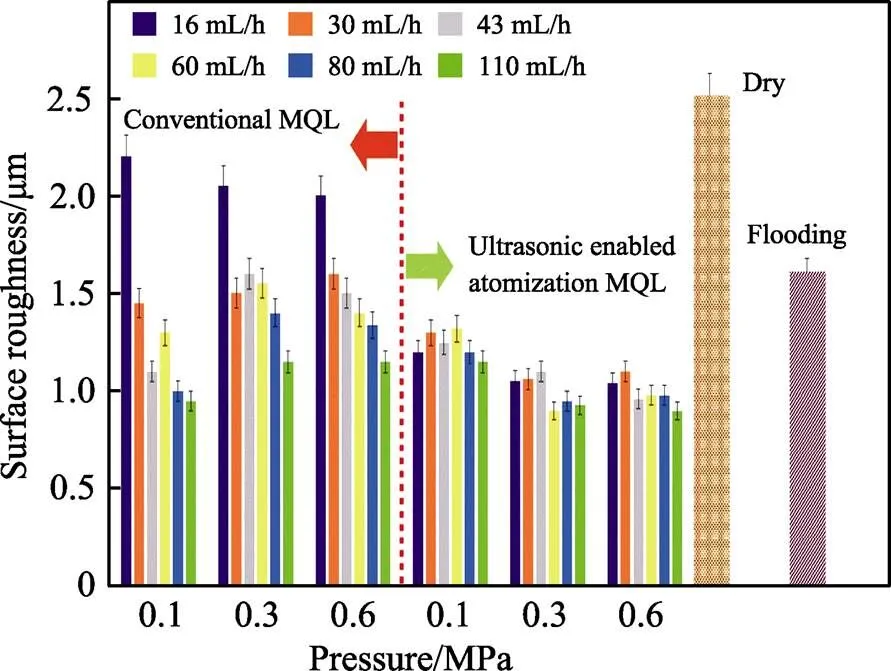
圖4 不同潤滑工況下工件的表面粗糙度[32]
different lubrication conditions[32]
超聲賦能霧化強化了常規氣動霧化過程的二次破碎行為,改善了液滴粒徑的均一性問題。Hoyne等[73]建立的三維流體潤滑膜模型實現了超聲賦能微量潤滑工藝參數的優化。Lefebure等[74]推進了較高黏度生物潤滑油超聲賦能霧化的發展。
2 微量潤滑供給系統
根據潤滑劑的噴射方式,微量潤滑供給系統主要包括內噴式和外噴式等[75]。外噴式相對簡單,成本較低,無需對機床進行改造也可以與常規刀具/砂輪共同使用[76-78]。在一些噴嘴易受切屑或機床零件干涉而產生位移的工況下,外噴式供給不僅會造成潤滑劑的浪費,還難以保證切削刃的潤滑。內噴式供給需要對機床主軸或刀柄部件進行單獨改造,因此其結構相對較復雜[79-80]。內噴式輸運尤其適用于鉆削加工,特別在深孔鉆削加工中,潤滑介質可被直接輸送到切削刃。在所有供給方式下,潤滑劑供給通道和切/磨削區的相對位姿是影響微量潤滑介質的關鍵參數。通過對加工過程中的流體動力學行為進行分析,可為液滴參數化可控輸運提供理論依據。液滴的有效浸潤可最大限度地發揮抗磨、減摩性能[62,81-82]。為此,學者們針對微量潤滑噴嘴界面、刀具/工件與砂輪/工件界面的流體動力學行為進行了分析,并進一步提出了噴嘴位姿隨加工參數改變的微量潤滑參數化可控輸運系統。
2.1 切/磨削區流場分布
如圖5所示,在切/磨削加工中,高速旋轉的工件/刀具/砂輪會引發氣流擾動,形成環狀氣障域,阻礙霧化微液滴進入切/磨削區摩擦界面[83-84]。揭示刀具/砂輪?工件界面氣流場的分布規律,分析切削區速度、壓力場分布對噴嘴位姿的影響,為潤滑介質定向輸運提供理論支撐,可有效提升微量潤滑介質的有效流量率。
青島理工大學殷慶安等[16]揭示了微量潤滑端面銑削加工過程中銑刀轉速、螺旋角和直徑對流場分布的影響規律,結果表明,旋轉銑刀周圍的氣流場主要有進入流、圓周流、返回流、徑向流和氣障層等;銑刀轉速會影響噴嘴靶距,螺旋角主要影響入射角度,銑刀直徑不影響噴嘴的相對位置。Duchosal等[85]在銑削加工過程中得到了相同的結論,噴嘴的入射角度不隨轉速發生變化。青島理工大學段振景等[83]在端面銑削流場動力學分析的基礎上,開展了型腔銑削加工氣流場分布研究,建立了方形、圓形、四角形和不規則形型腔的流場分布模型,并開展了實驗驗證。研究結果表明,型腔形狀基本不影響流場分布。北京航空航天大學朱光遠等[86]通過數值分析優化了微量潤滑銑削過程的噴嘴距離。青島理工大學張彥彬等[84]通過流體動力學分析發現,在砂輪?工件楔形區存在邊界線,邊界線上為進入流,有利于潤滑介質的進入;邊界線下為返回流,不利于潤滑介質的進入。Stachursk等[87]模擬了滾刀端面刃磨中磨削區流場的分布,研究結果表明,減小噴嘴傾角會增加滾刀?砂輪接觸界面的氣流量。Emami等[40]也認為,在微量潤滑磨削加工中,砂輪表面氣障層存在進入流,有利于微量潤滑介質進入砂輪?工件接觸區。江蘇大學沈玉杰等[88]研究發現,在微量潤滑端面車削加工中,工件旋轉在后刀面?工件楔形區產生了負壓,有利于潤滑介質的進入;霧化噴嘴的作用改變了流場分布,形成負壓?增壓區復合分布,優化噴嘴位姿可降低增壓區的影響,有利于提升潤滑介質的浸潤性能。上海交通大學陳明等[89]研究發現,在外圓車削加工時,工件轉動的相對速度遠小于微量潤滑介質由噴嘴射流出的速度。
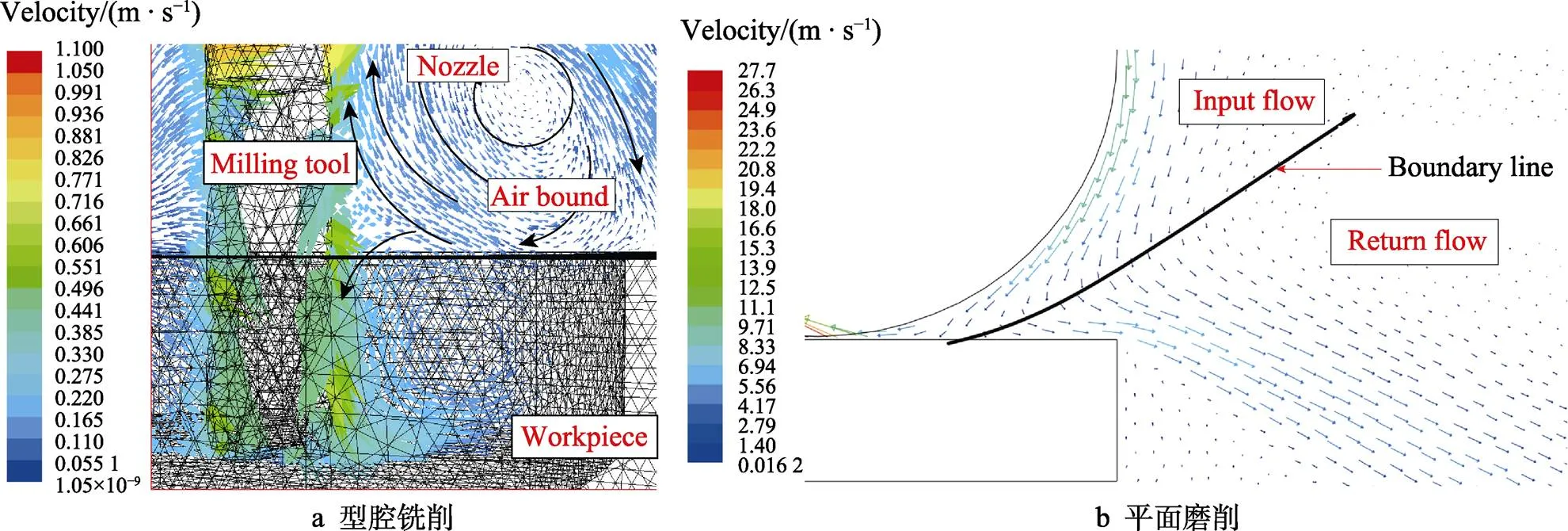
圖5 銑削/磨削區流場分布[83-84]
受到刀具、砂輪或工件高速旋轉引發的氣流擾動的影響,切/磨削區存在復雜的氣流場分布,包括氣障層、進入流、返回流、圓周流等。依據流場隨加工參數的演變規律,可測算出噴嘴最佳射流位置和角度。此外,基于流體動力學分布模型,可為新型刀具/磨具及噴嘴幾何參數優化提供理論依據。
2.2 噴嘴結構優化
由于不同加工方式的邊界條件存在差異,學者們對不同加工方式下的噴嘴霧化流體動力學行為進行了數值模擬,并開展了參數優化工作。青島理工大學賈東洲等[90]通過流體動力學分析發現,微量潤滑噴嘴射流速度峰值隨著氣壓和氣液比的增大而增大,隨著噴嘴直徑的增大而減小。長沙理工大學毛聰教授等[91]開發了一種雙出口噴嘴,與單出口噴嘴相比,它在液滴大小、均勻性和液滴速度方面獲得了更優異的霧化性能。北京航空航天大學朱光遠等[92]從降噪機理的角度分析了射流速、氣液流速比和方位角等因素對噪聲的影響。通過安裝降噪裝置,減小了整體噴射流場湍流強度的分布范圍,使噴射流場湍流強度的分布明顯呈收縮趨勢,將較大湍流強度控制在狹窄的區域內。同時,顯著減小了射流混合區長度,減緩了湍流向周圍的擴散。北京航空航天大學Shi等[80]基于離心霧化原理,提出了一種具有噴霧冷卻效果的砂輪結構,仿真與試驗結果均表明,新型砂輪能夠在低能耗下顯著降低難加工材料的磨削溫度。
馬來西亞學者Rahim等[93]對比了氣動霧化微量潤滑在不同噴嘴出口直徑的霧化性能,如圖6所示,噴嘴出口直徑越大,在較高氣壓下可以獲得更大的霧化錐角和更低的索特平均直徑。日本學者Obikawa等[79]對比了常規噴嘴、蓋板直噴和蓋板斜噴等3種類型內冷刀柄在精車加工中的性能表現,流體動力學分析表明,蓋板斜噴式內冷刀柄具有較大的油霧輸送速率,切削性能對比實驗也驗證了仿真分析結果。西班牙學者Alberdi等[94]利用計算流體動力學研究了噴嘴結構對速度和壓力場的影響,對Webster噴嘴[95]進行了優化設計,磨削實驗表明,改進后的噴嘴可以提高AISI D2工具鋼的表面粗糙度和砂輪壽命。
兩相流霧化噴嘴的幾何邊界決定了出口處液膜的撕裂行為,進而影響霧化性能。噴嘴結構的優化能夠實現潤滑劑的可控輸運,降低潤滑劑消耗,改善工件表面質量,延長刀具/砂輪的壽命。然而,針對靜電與超聲賦能的霧化噴嘴結構優化方面的研究較少,多物理場耦合仿真模型的開發是相關工作的關鍵。
2.3 噴嘴位姿參數化調控裝置
通過噴嘴及切/磨削區流場分析可知,在改變加工參數后,最佳射流位姿可能會發生改變。為了實現噴嘴隨刀具或工件運動的精準調整,保持最佳的噴射角度,需要針對噴嘴裝置進行智能化改造,實現可智能隨動的微量潤滑供給系統,進而提升切/磨削的加工性能。
國外對噴嘴固定裝置的開發起步較早,且以企業研發為主。美國企業Reishauer[96]發明了一種監控磨床冷卻液噴嘴位姿的工藝,通過監測磨床主軸驅動器的功耗變化,對磨削加工性能進行評價。當主軸功率超出預期時,噴嘴隨鉸鏈轉動或隨滑塊平移,經過循環測試實現最佳噴嘴位姿的確定。日本企業住友重機械テクノフォート株式會社[97]發明了一種通過擺臂控制鍛壓過程潤滑劑供給噴嘴的伸縮裝置,利用擺臂旋轉控制潤滑劑的供給位置。德國企業Hahnemann Peter[98]發明了一種微量潤滑噴嘴定位裝置,通過氣動肌肉運動帶動拉索和連桿運動,從而實現噴嘴位姿的改變。美國企業Illinois Tool Works[99]發明了一種潤滑劑噴嘴定位系統,利用C形臂桿元件將噴嘴連接到噴嘴定位器上,并進行負載補償,通過氣動方式驅動噴嘴定位器移動,從而實現噴嘴位置隨加工參數的變化。
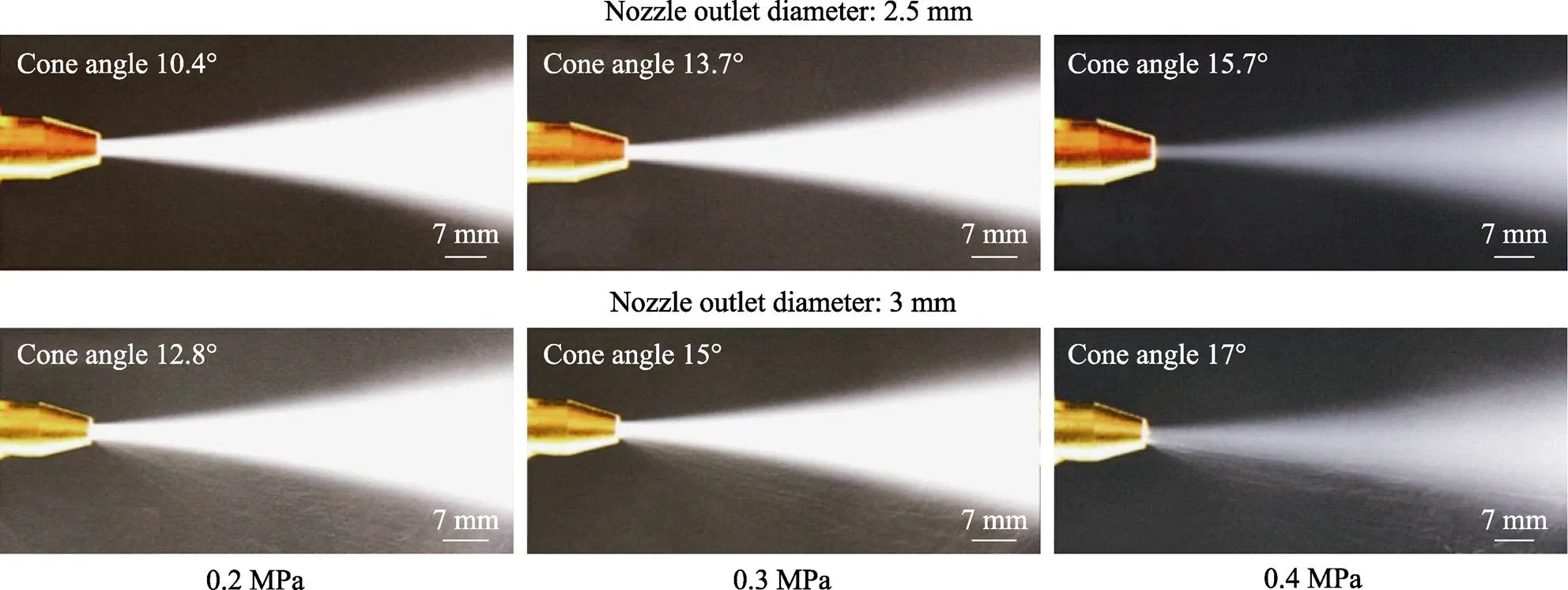
圖6 不同噴嘴出口直徑的霧化行為[93]
國內研究團隊對智能化隨動噴嘴的開發較為深入。青島理工大學李長河教授團隊開發的微量潤滑參數化供給裝置如圖7所示。武文濤等[100]發明了基于數控銑床的微量潤滑多自由度智能噴頭系統,通過絲杠導軌機構實現了橫向、縱向的移動,通過齒輪?齒圈機構實現了噴嘴射流角度的調節。隋孟華等[101]發明了CNC銑床多自由度微量潤滑智能噴頭系統,橫向旋轉以步進電機為驅動,縱向角度調整和噴頭跟進調整以壓縮空氣為驅動,將智能噴嘴安裝臺與旋轉臂連接,并隨旋轉臂一起運動,該系統具有紅外溫度檢測模塊,可以調節噴嘴的最佳射流位置和角度。此外,隋孟華等[102-103]還設計了數控臥式車床微量潤滑智能噴頭系統,其橫向移動部分由L型固定支架和絲杠系統構成,通過步進電機給絲杠提供橫向移動所需動力,縱向伸縮部分由桶型固定外框架和絲杠系統構成。其中,絲杠系統由1根動力絲杠和3根輔助滑桿組成,旋轉部分由電機或氣缸驅動。重慶大學曹華軍等[104]發明了一種可編程微量潤滑噴射角相位調節裝置,并介紹了其使用方法,通過控制同步帶調節噴嘴的噴射相位角。四川大學趙武等[105]發明了一種外冷式微量潤滑機械手,包括懸掛結構、機械臂、控制器和油霧生成裝置,懸掛結構用于機械臂與機架的固定連接,機械臂的自由端設置有噴嘴;油霧生成裝置與噴嘴連接,控制器能夠控制機械臂運動,使得噴嘴將油霧噴到加工區域。上海大學吳一平等[106]發明了一種適用于微量潤滑銑削加工的精準噴射潤滑裝置,設置一個冷卻環,并將其套裝在刀具主軸下端,其下端面連接噴嘴;冷卻環通過一個大型滾珠絲桿機構連接主軸箱,實現了噴嘴高度的調節。
隨動噴嘴裝置改變了傳統噴嘴手動固定調節方式,實現了隨監測參數自動調整的優化。通過對生產大數據進行數據分析和數據挖掘,開發了制造知識提取與凝練算法,可實現不同加工參數下噴嘴最佳射流位姿的預測。同時,通過機床主軸功率[96]、切削區溫度監測[101]可對噴嘴位姿進行實時反饋優化。此外,隨動噴嘴系統與機床系統的通信技術的發展,也將促進微量潤滑技術在智能制造領域內的應用。
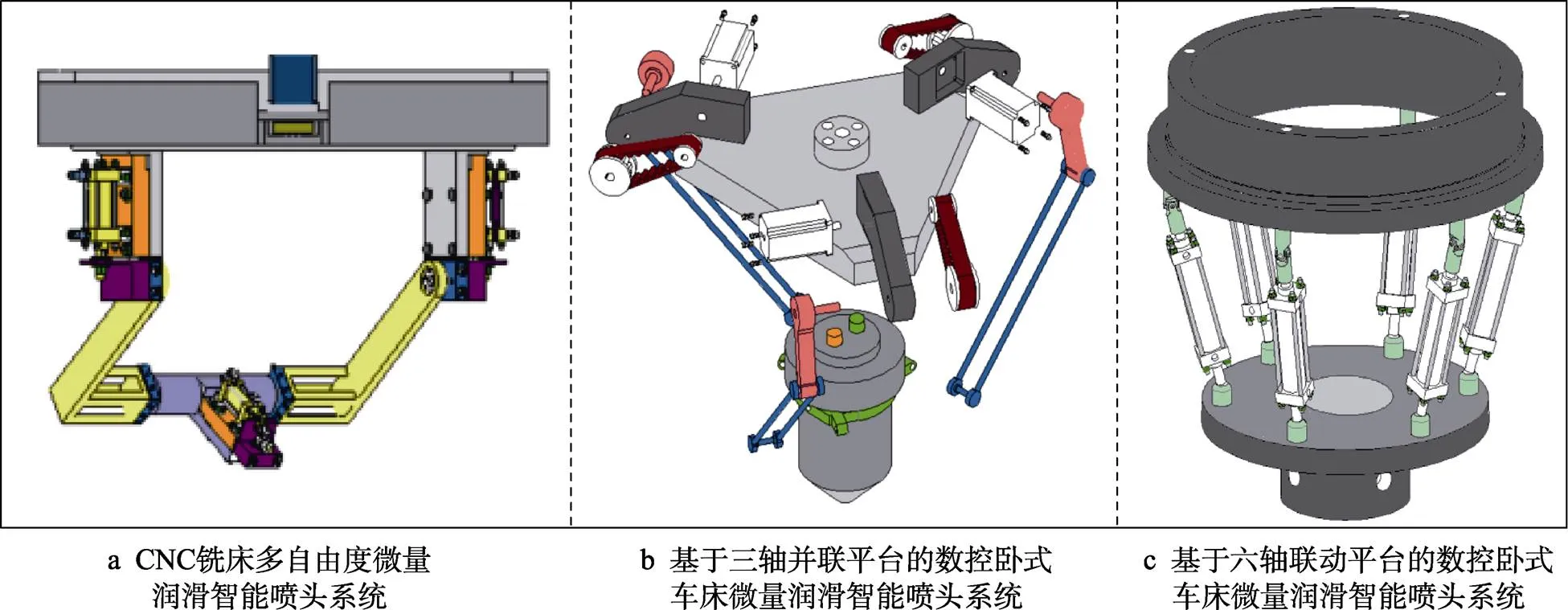
圖7 參數化供給裝置[101-103]
3 結語
可降解生物潤滑劑微量潤滑技術的應用大幅降低了傳統金屬切削液的消耗成本,實現了高效、清潔的材料去除加工。微量潤滑霧化方式和射流供給位姿是影響潤滑劑有效流量率的關鍵,有效流量率的提升有利于切/磨削加工性能。采用連續供給精密潤滑泵的雙通道微量潤滑系統可實現兩相流霧化的參數化調控。對傳統微量潤滑兩相流氣動霧化進行靜電/超聲場賦能,可改善液滴在切/磨削區的浸潤性能,同時提升霧化液滴粒徑的可控性,從而解決了生物潤滑劑的飄散難題。計算流體動力學仿真促進了新型噴嘴及內冷刀具/砂輪的出現。不同材料去除方式(如車削、銑削、磨削加工)由于其邊界條件的改變,流場分布差異較大。改變噴嘴的靶距和射流角度可以改善切/磨削的加工性能,隨動噴嘴裝置的應用將成為微量潤滑參數化可控供給技術的發展趨勢。
近年來,微量潤滑賦能霧化與供給系統關鍵技術在制造領域已經取得了顯著成果,并且關于微量潤滑技術應用的文獻數量呈上升趨勢。根據前文系統性的綜述,未來的研究可能集中于微量潤滑復合增效技術、微量潤滑智能供給關鍵技術等。微量潤滑復合增效技術包括以下幾方面。
1)納米流體微量潤滑。納米流體能夠有效提升換熱效率,降低切削過程中傳入刀具?工件界面的熱載荷,使得難加工材料的可加工性得到改善。同時,納米增強相的添加還能夠降低摩擦界面的摩擦磨損行為,因此納米流體有望在精密制造領域進一步推廣應用。此外,還需要依據切/磨削加工工況調配出不同油膜承載能力、不同浸潤性能和不同相變溫度的極壓抗磨環保可降解生物潤滑劑,建立不同工況下最優潤滑劑映射數據庫。
2)低溫微量潤滑。通過低溫冷卻介質與微量潤滑介質的耦合作用,既能夠保證摩擦界面的有效潤滑,又能夠降低切削溫度。微量潤滑介質內冷供給系統(包括內冷刀柄、主軸改造和微量潤滑機床等)需要進一步優化和推廣應用。此外,還需要領域內主要研究團隊探討建立量化評估標準,以實現統一的參數優化策略。
3)超聲振動輔助微量潤滑。超聲振動產生的分離特性打開了刀具?切屑間的禁區,使微量潤滑介質在瞬時真空的作用下因泵吸作用而被吸入刀具?切屑分離空間內,充分發揮了其潤滑作用。有必要對超聲振動輔助微量潤滑的浸潤性能進行完整的量化評價,包括振動界面的液滴破碎、毛細波等對潤滑介質鋪展面積的影響機制。
4)織構刀具輔助微量潤滑。合理排布的微織構可以有效降低刀具?切屑接觸長度,減小摩擦接觸面積。此外,微切屑可以儲存在織構內部,避免工件被碎屑刮傷和塑性變形。織構可以作為潤滑介質的儲存空間,減少潤滑介質側流,并在切削過程中釋放潤滑劑,以減少摩擦。在未來的研究中,需要進一步揭示非均勻潤濕性表面和仿生微織構表面的潤滑增效行為。
微量潤滑智能供給關鍵技術包括以下幾方面。
1)工藝參數數據庫。搭建微量潤滑切/磨削參數智能感知平臺,實現切削參數、加工參數、評價參數的自動化提取。建立難加工材料切/磨削工藝標準化公開數據庫,包括刀具參數(材料參數、幾何參數)、工件材料、潤滑介質參數(基礎潤滑劑化學配方、納米添加相參數、潤滑介質供給量、氣壓、靶距、入射角)、切削參數(切削速度、進給量、切削深度)、加工性能評價參數(切削力、切削溫度、工件表面完整性),有望為微量潤滑技術產業應用提供技術指導。
2)大數據驅動的參數優化策略。構建微量潤滑切/磨削加工輸入?輸出參數映射關系圖譜,闡明微量潤滑切/磨削加工參數優化策略。利用公開數據庫實現人工智能算法優化模型的訓練,并應用于機械制造加工生產線的工藝參數優化,有望為智能制造領域發展提供新思路。
3)離散制造噴嘴位姿調控策略。離散制造工藝參數較為復雜,常規優化策略并不能提供有效的指導。建立機床?隨動噴嘴系統通信標準,實現加工參數的在線提取,有望提升噴嘴位姿調控的效率。此外,建立多自由度隨動噴嘴系統動力學分析模型,優化隨動噴嘴裝置結構,可最大限度地發揮潤滑介質的抗磨減摩效果。
4)微量潤滑切/磨削加工智能生產線。傳統零件加工生產線尚未考慮微量潤滑介質供給系統的空間布局。通過對零部件加工工藝進行分析,設計微量潤滑切/磨削加工專用夾具,配合物料智能傳輸系統,實現清潔切/磨削加工智能產線布局的密集性和功能的可拓展性,有望為高端裝備和綠色制造提供技術支持。
[1] YANG Min, LI Chang-he, ZHANG Yan-bin, et al. Maxi-mum Undeformed Equivalent Chip Thickness for Ductile- Brittle Transition of Zirconia Ceramics under Different Lubrication Conditions[J]. International Journal of Ma-chine Tools & Manufacture (Design, Research and Appli-cation), 2017(122): 55-65.
[2] ZHANG Yan-bin, LI Chang-he, JI He-ju, et al. Analysis of Grinding Mechanics and Improved Predictive Force Model Based on Material-Removal and Plastic-Stacking Mechanisms[J]. International Journal of Machine Tools and Manufacture, 2017, 122: 81-97.
[3] ZHANG Jian-chao, WU Wen-tao, LI Chang-he, et al. Convective Heat Transfer Coefficient Model under Nano-fluid Minimum Quantity Lubrication Coupled with Cr-yogenic Air Grinding Ti-6Al-4V[J]. International Journal of Precision Engineering and Manufacturing-Green Tech-nology, 2021, 8(4): 1113-1135.
[4] YANG Min, LI Chang-he, LUO Liang, et al. Predictive Model of Convective Heat Transfer Coefficient in Bone Micro-Grinding Using Nanofluid Aerosol Cooling[J]. In-ter-national Communications in Heat and Mass Transfer, 2021, 125: 105317.
[5] HUANG Bao-teng, LI Chang-he, ZHANG Yan-bin, et al. Advances in Fabrication of Ceramic Corundum Abrasives Based on Sol-Gel Process[J]. Chinese Journal of Aeronau-tics, 2021, 34(6): 1-17.
[6] 盧守相, 郭塞, 張建秋, 等. 高性能難加工材料可磨削性研究進展[J]. 表面技術, 2022, 51(3): 12-42.
LU Shou-xiang, GUO Sai, ZHANG Jian-qiu, et al. Grin-da-bility of High Performance Difficult-to-Machine Mate-rials[J]. Surface Technology, 2022, 51(3): 12-42.
[7] 康仁科, 宋鑫, 董志剛, 等. 鎢合金超聲橢圓振動切削表面完整性研究[J]. 表面技術, 2021, 50(11): 321-328.
KANG Ren-ke, SONG Xin, DONG Zhi-gang, et al. Study on Surface Integrity of Tungsten Alloy Processed by Ult-ra-sonic Elliptical Vibration Cutting[J]. Surface Techno-logy, 2021, 50(11): 321-328.
[8] 梁志強, 李蒙招, 陳碧沖, 等. 基于微磨削方法的微織構刀具制備與切削性能研究[J]. 表面技術, 2020, 49(2): 143-150.
LIANG Zhi-qiang, LI Meng-zhao, CHEN Bi-chong, et al. Fabrication and Cutting Performance of Micro-Textured Tools Based on Micro-Grinding[J]. Surface Technology, 2020, 49(2): 143-150.
[9] PERVAIZ S, KANNAN S, KISHAWY H A. An Extensive Review of the Water Consumption and Cutting Fluid Ba-sed Sustainability Concerns in the Metal Cutting Sec-tor[J]. Journal of Cleaner Production, 2018, 197: 134-153.
[10] MARCHAND G, LAVOIE J, RACINE L, et al. Evalua-tion of Bacterial Contamination and Control Methods in Soluble Metalworking Fluids[J]. Journal of Occupational and Environmental Hygiene, 2010, 7(6): 358-366.
[11] SANCHEZ J A, POMBO I, ALBERDI R, et al. Machi-ning Evaluation of a Hybrid MQL-CO2Grinding Techno-logy[J]. Journal of Cleaner Production, 2010, 18(18): 1840-1849.
[12] LILLIENBERG L, BURDORF A, MATHIASSON L, et al.Exposure to Metalworking Fluid Aerosols and Determi-nants of Exposure[J]. The Annals of Occupational Hygie-ne, 2008, 52(7): 597-605.
[13] STEPHENSON D, AGAPIOU J. Metal Cutting Theory and Practice, Third Edition[M]. Boca Raton: CRC Press, 2016: 803-833.
[14] GAO Teng, LI Chang-he, JIA Dong-zhou, et al. Surface Morphology Assessment of CFRP Transverse Grinding Using CNT Nanofluid Minimum Quantity Lubrication[J]. Journal of Cleaner Production, 2020, 277: 123328.
[15] SUI Meng-hua, LI Chang-he, WU Wen-tao, et al. Tempe-ra-ture of Grinding Carbide with Castor Oil-Based MoS2Nanofluid Minimum Quantity Lubrication[J]. Journal of Thermal Science and Engineering Applications, 2021, 13(5): 051001.
[16] YIN Qin-gan, LI Chang-he, DONG Lan, et al. Effects of Physicochemical Properties of Different Base Oils on Friction Coefficient and Surface Roughness in MQL Milling AISI 1045[J]. International Journal of Precision Engineering and Manufacturing-Green Technology, 2021, 8(6): 1629-1647.
[17] 徐帥強, 張彥彬, 周宗明, 等. 汽車輪轂潔凈制造自動化生產線設計[J]. 制造技術與機床, 2022(4): 32-37.
XU Shuai-qiang, ZHANG Yan-bin, ZHOU Zong-ming, et al. Design of Automated and Cleaner Production Line for Wheel Hub in Automobile Manufacturing[J]. Manufac-turing Technology & Machine Tool, 2022(4): 32-37.
[18] 施壯, 郭樹明, 劉紅軍, 等. 生物潤滑劑微量潤滑磨削GH4169鎳基合金性能實驗評價[J]. 表面技術, 2021, 50(12): 71-84.
SHI Zhuang, GUO Shu-ming, LIU Hong-jun, et al. Expe-rimental Evaluation of Minimum Quantity Lubrication of Biological Lubricant on Grinding Properties of GH4169 Nickel-Base Alloy[J]. Surface Technology, 2021, 50(12): 71-84.
[19] 王曉銘, 張建超, 王緒平, 等. 不同冷卻工況下的磨削鈦合金溫度場模型及驗證[J]. 中國機械工程, 2021, 32(5): 572-578.
WANG Xiao-ming, ZHANG Jian-chao, WANG Xu-ping, et al. Temperature Field Model and Verification of Tita-nium Alloy Grinding under Different Cooling Condi-tions[J]. China Mechanical Engineering, 2021, 32(5): 572- 578.
[20] 王曉銘, 張建超, 王緒平, 等. 冷風微量潤滑納米粒子體積分數對鈦合金磨削性能的影響[J]. 金剛石與磨料磨具工程, 2020, 40(5): 23-29.
WANG Xiao-ming, ZHANG Jian-chao, WANG Xu-ping, et al. Effect of Nanoparticle Volume on Grinding Perfor-mance of Titanium Alloy in Cryogenic Air Minimum Quantity Lubrication[J]. Diamond & Abrasives Enginee-ring, 2020, 40(5): 23-29.
[21] 王德祥, 趙齊亮, 張宇, 等. 離子液體在微量潤滑磨削界面的摩擦學機理研究[J]. 中國機械工程, 2022, 33(5): 560-568.
WANG De-xiang, ZHAO Qi-liang, ZHANG Yu, et al. Investigation on Tribological Mechanism of Ionic Liquid on Grinding Interfaces under MQL[J]. China Mechanical Engineering, 2022, 33(5): 560-568.
[22] 黃保騰, 張彥彬, 王曉銘, 等. SG砂輪磨削鎳基合金GH4169砂輪磨損機理與磨削性能的實驗評價[J]. 表面技術, 2021, 50(12): 62-70.
HUANG Bao-teng, ZHANG Yan-bin, WANG Xiao-ming, et al. Experimental Evaluation of Wear Mechanism and Grinding Performance of SG Wheel in Machining Nickel- Based Alloy GH4169[J]. Surface Technology, 2021, 50(12): 62-70.
[23] 丁文鋒, 奚欣欣, 占京華, 等. 航空發動機鈦材料磨削技術研究現狀及展望[J]. 航空學報, 2019, 40(6): 022763.
DING Wen-feng, XI Xin-xin, ZHAN Jing-hua, et al. Research Status and Future Development of Grinding Technology of Titanium Materials for Aero-Engines[J]. Acta Aeronautica et Astronautica Sinica, 2019, 40(6): 022763.
[24] ZHANG Yan-bin, LI Hao nan, LI Chang-he, et al. Erratum to: Nano-Enhanced Biolubricant in Sustainable Manufacturing: From Processability to Mechanisms[J]. Fri-c-tion, 2022: 1-2.
[25] DUAN Zhen-jing, YIN Qin-gan, LI Chang-he, et al. Mil-ling Force and Surface Morphology of 45 Steel under Dif-fe-rent Al2O3Nanofluid Concentrations[J]. The Interna-tional Journal of Advanced Manufacturing Technology, 2020, 107(3): 1277-1296.
[26] DUAN Zhen-jing, LI Chang-he, DING Wen-feng, et al. Milling Force Model for Aviation Aluminum Alloy: Aca-demic Insight and Perspective Analysis[J]. Chinese Jour-nal of Mechanical Engineering, 2021, 34(1): 18.
[27] GAO Teng, LI Chang-he, YANG Min, et al. Mechanics Ana-lysis and Predictive Force Models for the Single- Diamond Grain Grinding of Carbon Fiber Reinforced Po-ly-mers Using CNT Nano-Lubricant[J]. Journal of Mate-rials Processing Technology, 2021, 290: 116976.
[28] 李長河. 清潔切削加工及賦能技術研究進展與展望[J]. 金屬加工(冷加工), 2022(3): 6-8.
LI Chang-he. Research Progress and Prospect of Clean Cutting and Energizing Technology[J]. Metal Working (Metal Cutting), 2022(3): 6-8.
[29] WANG Xiao-ming, LI Chang-he, ZHANG Yan-bin, et al. Vegetable Oil-Based Nanofluid Minimum Quantity Lubri-cation Turning: Academic Review and Perspectives[J]. Journal of Manufacturing Processes, 2020, 59: 76-97.
[30] 賈東洲, 張乃慶, 劉波, 等. 靜電霧化微量潤滑粒徑分布特性與磨削表面質量評價[J]. 金剛石與磨料磨具工程, 2021, 41(3): 89-95.
JIA Dong-zhou, ZHANG Nai-qing, LIU Bo, et al. Particle Size Distribution Characteristics of Electrostatic Mini-mum Quantity Lubrication and Grinding Surface Quality Evaluation[J]. Diamond & Abrasives Engineering, 2021, 41(3): 89-95.
[31] JIANG X, SIAMAS G A, JAGUS K, et al. Physical Mo-del-ling and Advanced Simulations of Gas-Liquid Two- Phase Jet Flows in Atomization and Sprays[J]. Progress in Energy and Combustion Science, 2010, 36(2): 131-167.
[32] HADAD M, BEIGI M. A Novel Approach to Improve Environmentally Friendly Machining Processes Using Ul-tra-sonic Nozzle-Minimum Quantity Lubrication Sys-tem[J]. The International Journal of Advanced Manufac-turing Technology, 2021, 114(3): 741-756.
[33] CABANETTES F, FAVERJON P, SOVA A, et al. MQL Machining: From Mist Generation to Tribological Beha-vior of Different Oils[J]. The International Journal of Ad-van-ced Manufacturing Technology, 2017, 90(1): 1119- 1130.
[34] 隋孟華, 張乃慶, 李長河, 等. 納米流體微量潤滑磨削硬質合金溫度場模型與實驗驗證[J]. 制造技術與機床, 2020(3): 85-91.
SUI Meng-hua, ZHANG Nai-qing, LI Chang-he, et al. Theoretical Analysis and Experiment on Temperature Field of Nano-Fluid Micro-Lubrication Grinding Cemen-ted Carbide[J]. Manufacturing Technology & Machine Tool, 2020(3): 85-91.
[35] ZHANG Yan-bin, LI Chang-he, JIA Dong-zhou, et al. Ex-perimental Evaluation of the Lubrication Performance of MoS2/CNT Nanofluid for Minimal Quantity Lubrication in Ni-Based Alloy Grinding[J]. International Journal of Machine Tools and Manufacture, 2015, 99: 19-33.
[36] ZHANG Yan-bin, LI Chang-he, JIA Dong-zhou, et al. Ex-perimental Evaluation of MoS2Nanoparticles in Jet MQL Grinding with Different Types of Vegetable Oil as Base Oil[J]. Journal of Cleaner Production, 2015, 87: 930-940.
[37] 梁賜樂, 袁堯輝, 王成勇, 等. 微量潤滑系統油霧調控及霧粒特性研究[J]. 中國機械工程, 2022, 33(5): 607- 614.
LIANG Ci-le, YUAN Yao-hui, WANG Cheng-yong, et al. Study on Oil Mist Control and Oil Mist Particle Charac-teristics of MQL Systems[J]. China Mechanical Enginee-ring, 2022, 33(5): 607-614.
[38] PARK K H, OLORTEGUI-YUME J, YOON M C, et al. A Study on Droplets and Their Distribution for Minimum Quantity Lubrication (MQL)[J]. International Journal of Machine Tools and Manufacture, 2010, 50(9): 824-833.
[39] BALAN A S S, KULLARWAR T, VIJAYARAGHAVAN L, et al. Computational Fluid Dynamics Analysis of MQL Spray Parameters and Its Influence on Superalloy Grin-ding[J]. Machining Science and Technology, 2017, 21(4): 603-616.
[40] EMAMI M, SADEGHI M H, SARHAN A A D. Inves-tigating the Effects of Liquid Atomization and Delivery Parameters of Minimum Quantity Lubrication on the Grinding Process of Al2O3Engineering Ceramics[J]. Jour-nal of Manufacturing Processes, 2013, 15(3): 374-388.
[41] SAI S S, MANOJKUMAR K, GHOSH A. Assessment of Spray Quality from an External Mix Nozzle and Its Im-pact on SQL Grinding Performance[J]. International Jour-nal of Machine Tools and Manufacture, 2015, 89: 132-141.
[42] MARUDA R W, KROLCZYK G M, FELDSHTEIN E, et al. A Study on Droplets Sizes, Their Distribution and Heat Exchange for Minimum Quantity Cooling Lubrication (MQCL)[J]. International Journal of Machine Tools and Manufacture, 2016, 100: 81-92.
[43] LV Tao, XU Xue-feng, YU Ai-bing, et al. Oil Mist Con-cen-tration and Machining Characteristics of SiO2Water- Based Nano-Lubricants in Electrostatic Minimum Quan-tity Lubrication-EMQL Milling[J]. Journal of Materials Processing Technology, 2021, 290: 116964.
[44] XU Xue-feng, LV Tao, LUAN Zhi-qiang, et al. Capillary Penetration Mechanism and Oil Mist Concentration of Al2O3Nanoparticle Fluids in Electrostatic Minimum Quan-tity Lubrication (EMQL) Milling[J]. The Interna-tional Journal of Advanced Manufacturing Technology, 2019, 104(5): 1937-1951.
[45] GUO Shu-ming, LI Chang-he, ZHANG Yan-bin, et al. Ana-lysis of Volume Ratio of Castor/Soybean Oil Mixture on Minimum Quantity Lubrication Grinding Performance and Microstructure Evaluation by Fractal Dimension[J]. Industrial Crops and Products, 2018, 111: 494-505.
[46] 張曉陽, 李長河, 張彥彬, 等. 電場參數對霧化特性及微量潤滑磨削性能影響的實驗研究[J]. 制造技術與機床, 2018(10): 105-111.
ZHANG Xiao-yang, LI Chang-he, ZHANG Yan-bin, et al. Experimental Study of Effect of Electric Field Parameters on Atomization Characteristics and Grinding Performance of Minimal Quantity Lubrication[J]. Manufacturing Tech-no-logy & Machine Tool, 2018(10): 105-111.
[47] 張曉陽. 植物油基靜電霧化微量潤滑磨削的霧化機理與潤滑性能實驗研究[D]. 青島: 青島理工大學, 2018: 49-79.
ZHANG Xiao-yang. Experimental Study and Atomization Mechanism on Vegetable Oil Based Electrostatic Ato-miza-tion and MQL[D]. Qingdao: Qingdao Tehcnology University, 2018: 49-79.
[48] 賈東洲, 李長河, 張彥彬, 等. 鈦合金生物潤滑劑電牽引磨削性能及表面形貌評價[J]. 機械工程學報, 2022, 58(5): 198-211.
JIA Dong-zhou, LI Chang-he, ZHANG Yan-bin, et al. Grinding Performance and Surface Morphology Evalua-tion of Titanium Alloy Using Electric Traction Bio Micro Lubricant[J]. Journal of Mechanical Engineering, 2022, 58(5): 198-211.
[49] JIA Dong-zhou, ZHANG Yan-bin, LI Chang-he, et al. Lubrication-Enhanced Mechanisms of Titanium Alloy Grinding Using Lecithin Biolubricant[J]. Tribology Inter-national, 2022, 169: 107461.
[50] XU Xue-feng, HUANG Shui-quan, WANG Ming-huan, et al. A Study on Process Parameters in End Milling of AISI- 304 Stainless Steel under Electrostatic Minimum Quantity Lubrication Conditions[J]. The International Journal of Advanced Manufacturing Technology, 2017, 90(1): 979- 989.
[51] HUANG Shui-quan, LV Tao, WANG Ming-huan, et al. En-hanced Machining Performance and Lubrication Me-chanism of Electrostatic Minimum Quantity Lubri-cation- EMQL Milling Process[J]. The International Journal of Advanced Manufacturing Technology, 2018, 94(1): 655- 666.
[52] LV Tao, HUANG Shui-quan, LIU En-ting, et al. Tribo-logical and Machining Characteristics of an Electrostatic Minimum Quantity Lubrication (EMQL) Technology Using Graphene Nano-Lubricants as Cutting Fluids[J]. Journal of Manufacturing Processes, 2018, 34: 225-237.
[53] SU Yu, LU Qiong, YU Tong, et al. Machining and Envi-ron--mental Effects of Electrostatic Atomization Lubri-cation in Milling Operation[J]. The International Journal of Advanced Manufacturing Technology, 2019, 104(5): 2773-2782.
[54] SU Yu, JIANG Hai, LIU Zhi-qiang. A Study on Environ-ment-Friendly Machining of Titanium Alloy via Com-posite Electrostatic Spraying[J]. The International Journal of Advanced Manufacturing Technology, 2020, 110(5): 1305-1317.
[55] SU Yu, JIANG Hai, LIU Zhi-qiang. An Experimental In-ve-stigation on Heat Transfer Performance of Elec-trostatic Spraying Used in Machining[J]. The International Journal of Advanced Manufacturing Technology, 2021, 112(5): 1285-1294.
[56] BARTOLOMEIS A D, NEWMAN S T, SHOKRANI A. Initial Investigation on Surface Integrity when Machining Inconel 718 with Conventional and Electrostatic Lubrica-tion[J]. Procedia CIRP, 2020, 87: 65-70.
[57] LEE P H, KIM J W, LEE S W. Experimental Characteri-za-tion on Eco-Friendly Micro-Grinding Process of Titan-ium Alloy Using Air Flow Assisted Electrospray Lubrica-tion with Nanofluid[J]. Journal of Cleaner Production, 2018, 201: 452-462.
[58] SHAH P, KHANNA N, ZADAFIYA K, et al. In-House Development of Eco-Friendly Lubrication Techniques (EMQL, Nanoparticles+EMQL and EL) for Improving Ma-chining Performance of 15-5 PHSS[J]. Tribology In-ternational, 2020, 151: 106476.
[59] SHAH P, GADKARI A, SHARMA A, et al. Comparison of Machining Performance under MQL and Ultra-High Voltage EMQL Conditions Based on Tribological Proper-ties[J]. Tribology International, 2021, 153: 106595.
[60] 楊敏, 李長河, 李潤澤, 等. 一種神經外科超聲聚焦輔助三級霧化冷卻與術后創口成膜裝置: 中國, 10778-9030A[P]. 2018-03-13.
YANG Min, LI Chang-he, LI Run-ze, et al. Neurosurgical Ultrasonic Focusing Assisted Three-Stage Atomization Cooling and Postoperative Wound Film Forming Device: China, 107789030A[P]. 2018-03-13.
[61] JIA Dong-zhou, LI Chang-he, ZHANG Yan-bin, et al. Ex-perimental Evaluation of Surface Topographies of NMQL Grinding ZrO2Ceramics Combining Multiangle Ultra-sonic Vibration[J]. The International Journal of Ad-vanced Manufacturing Technology, 2019, 100(1): 457-473.
[62] GAO Teng, ZHANG Xian-peng, LI Chang-he, et al. Sur-face Morphology Evaluation of Multi-Angle 2D Ultra-sonic Vibration Integrated with Nanofluid Minimum Qua-n-tity Lubrication Grinding[J]. Journal of Manufac-turing Processes, 2020, 51: 44-61.
[63] 李華, 任坤, 殷振, 等. 縱彎轉換超聲振動霧化系統的振動特性與設計研究[J]. 振動工程學報, 2015, 28(3): 462-469.
LI Hua, REN Kun, YIN Zhen, et al. The Vibration Cha-rac-teristics and Design of Ultrasonic Atomization System Based on Longitudinal-Flexural Vibration Conversion[J]. Journal of Vibration Engineering, 2015, 28(3): 462-469.
[64] 曹洋, 李華, 任坤, 等. 球面聚焦超聲輔助汽霧冷卻系統換熱特性研究[J]. 中國機械工程, 2018, 29(11): 1279- 1284.
CAO Yang, LI Hua, REN Kun, et al. Research on Heat Transfer Performances of Spherical Focused Ultrasound Assisted Ultrasonic Atomizing Cooling System[J]. China Mechanical Engineering, 2018, 29(11): 1279-1284.
[65] MENG Jian-bing, HUANG Bing-qi, DONG Xiao-juan, et al. Experimental Investigation on Ultrasonic Atomization Assisted Turning of Titanium Alloy[J]. Micromachines, 2020, 11(2): 168.
[66] HUANG Wei-tai, LIU Wei-shu, TSAI J T, et al. Multiple Quality Characteristics of Nanofluid/Ultrasonic Ato-mi-za-tion Minimum Quality Lubrication for Grinding Hardened Mold Steel[J]. IEEE Transactions on Automation Science and Engineering, 2018, 15(3): 1065-1077.
[67] HUANG Wei-tai, TSAI J T, HSU C F, et al. Multiple Per-formance Characteristics in the Application of Taguchi Fuzzy Method in Nanofluid/Ultrasonic Atomization Mini-mum Quantity Lubrication for Grinding Inconel 718 Al-loys[J]. International Journal of Fuzzy Systems, 2022, 24(1): 294-309.
[68] HUANG Wei-tai, CHOU F I, TSAI J T, et al. Optimal Design of Parameters for the Nanofluid/Ultrasonic Atomi-zation Minimal Quantity Lubrication in a Micromilling Process[J]. IEEE Transactions on Industrial Informatics, 2020, 16(8): 5202-5212.
[69] HUANG Wei-tai, CHOU F I, TSAI J T, et al. Application of Graphene Nanofluid/Ultrasonic Atomization MQL Sys-tem in Micromilling and Development of Optimal Predic-tive Model for SKH-9 High-Speed Steel Using Fuzzy- Logic-Based Multi-Objective Design[J]. International Journal of Fuzzy Systems, 2020, 22(7): 2101-2118.
[70] JUN M B G, JOSHI S S, DEVOR R E, et al. An Ex-perimental Evaluation of an Atomization-Based Cutting Fluid Application System for Micromachining[J]. Journal of Manufacturing Science and Engineering, 2008, 130(3): 031118.
[71] NATH C, KAPOOR S G, SRIVASTAVA A K, et al. Study of Droplet Spray Behavior of an Atomization-Based Cutting Fluid Spray System for Machining Titanium Al-loys[J]. Journal of Manufacturing Science and Enginee-ring, 2014, 136(2): 021004.
[72] HOYNE A C, NATH C, KAPOOR S G. On Cutting Tem-pe-ra-ture Measurement during Titanium Machining with an Atomization-Based Cutting Fluid Spray System[J]. Journal of Manufacturing Science and Engineering, 2015, 137(2): 024502.
[73] HOYNE A C, NATH C, KAPOOR S G. Characterization of Fluid Film Produced by an Atomization-Based Cutting Fluid Spray System during Machining[J]. Journal of Manufacturing Science and Engineering, 2013, 135(5): 051006.
[74] LEFEBURE A, SHIM D. Ultrasonic Atomization of Hi-gh-ly Viscous Biodegradable Oils for MQL Applica-tions[J]. Journal of Mechanical Science and Technology, 2021, 35(12): 5503-5516.
[75] 劉明政, 李長河, 曹華軍, 等. 低溫微量潤滑加工技術研究進展與應用[J]. 中國機械工程, 2022, 33(5): 529- 550.
LIU Ming-zheng, LI Chang-he, CAO Hua-jun, et al. Re-search Progresses and Applications of CMQL Machining Technology[J]. China Mechanical Engineering, 2022, 33(5): 529-550.
[76] WANG Yao-gang, LI Chang-he, ZHANG Yan-bin, et al. Experimental Evaluation of the Lubrication Properties of the Wheel/Workpiece Interface in Minimum Quantity Lubrication (MQL) Grinding Using Different Types of Vegetable Oils[J]. Journal of Cleaner Production, 2016, 127: 487-499.
[77] GUO Shu-ming, LI Chang-he, ZHANG Yan-bin, et al. Experimental Evaluation of the Lubrication Performance of Mixtures of Castor Oil with other Vegetable Oils in MQL Grinding of Nickel-Based Alloy[J]. Journal of Cleaner Production, 2017, 140: 1060-1076.
[78] LI Ben-kai, LI Chang-he, ZHANG Yan-bin, et al. Heat Transfer Performance of MQL Grinding with Different Nanofluids for Ni-Based Alloys Using Vegetable Oil[J]. Journal of Cleaner Production, 2017, 154: 1-11.
[79] OBIKAWA T, ASANO Y, KAMATA Y. Computer Fluid Dynamics Analysis for Efficient Spraying of Oil Mist in Finish-Turning of Inconel 718[J]. International Journal of Machine Tools and Manufacture, 2009, 49(12/13): 971- 978.
[80] SHI Chao-feng, LI Xun, CHEN Zhi-tong. Design and Experimental Study of a Micro-Groove Grinding Wheel with Spray Cooling Effect[J]. Chinese Journal of Aero-nautics, 2014, 27(2): 407-412.
[81] GAO Teng, LI Chang-he, ZHANG Yan-bin, et al. Disper-sing Mechanism and Tribological Performance of Vegeta-ble Oil-Based CNT Nanofluids with Different Surfac-tants[J]. Tribology International, 2019, 131: 51-63.
[82] WANG Xiao-ming, LI Chang-he, ZHANG Yan-bin, et al. Tribology of Enhanced Turning Using Biolubricants: A Comparative Assessment[J]. Tribology International, 2022, 174: 107766.
[83] DUAN Zhen-jing, LI Chang-he, ZHANG Yan-bin, et al. Milling Surface Roughness for 7050 Aluminum Alloy Cavity Influenced by Nozzle Position of Nanofluid Mini-mum Quantity Lubrication[J]. Chinese Journal of Aero-nautics, 2021, 34(6): 33-53.
[84] ZHANG Yan-bin, LI Chang-he, ZHANG Qiang, et al. Improvement of Useful Flow Rate of Grinding Fluid with Simulation Schemes[J]. The International Journal of Ad-van-ced Manufacturing Technology, 2016, 84(9): 2113- 2126.
[85] DUCHOSAL A, SERRA R, LEROY R. Numerical Study of the Inner Canalization Geometry Optimization in a Milling Tool Used in Micro Quantity Lubrication[J]. Me-cha-nics & Industry, 2014, 15(5): 435-442.
[86] ZHU Guang-yuan, YUAN Song-mei, CHEN Bo-chuan. Numerical and Experimental Optimizations of Nozzle Distance in Minimum Quantity Lubrication (MQL) Mil-ling Process[J]. The International Journal of Advanced Manu-facturing Technology, 2019, 101(1): 565-578.
[87] STACHURSK I W, SAWICK I J, KRUPANEK K, et al. Application of Numerical Simulation to Determine Abi-lity of Air Used in MQL Method to Clean Grinding Wheel Active Surface during Sharpening of Hob Cutters[J]. International Journal of Precision Engineering and Manu-facturing-Green Technology, 2021, 8(4): 1095-1112.
[88] 沈玉杰, 裴宏杰, 王貴成. MQL外圓車削數值模擬及流場分析[J]. 機械設計與制造, 2012(8): 208-210.
SHEN Yu-jie, PEI Hong-jie, WANG Gui-cheng. The Nu-me-rical Simulation and Flow Field Analysis of MQL Cylindrical Turning[J]. Machinery Design & Manufac-ture, 2012(8): 208-210.
[89] CHEN Ming, JIANG Li, SHI Bo-wen, et al. CFD Ana-lysis on the Flow Field of Minimum Quantity Lubrication during External Thread Turning[J]. Materials Science Fo-rum, 2012, 723: 113-118.
[90] 賈東洲, 李長河, 張彥彬, 等. 納米粒子射流微量潤滑磨削霧化噴嘴下游流場數值模擬與實驗研究[J]. 組合機床與自動化加工技術, 2015(9): 5-9.
JIA Dong-zhou, LI Chang-he, ZHANG Yan-bin, et al. Numerical Simulation and Experimental Research about Downstream Flow Field of Atomizing Nozzle in Nano-particle Jet MQL Grinding[J]. Modular Machine Tool & Automatic Manufacturing Technique, 2015(9): 5-9.
[91] MAO Cong, ZHOU Xin, YIN Lai-rong, et al. Investiga-tion of the Flow Field for a Double-Outlet Nozzle during Minimum Quantity Lubrication Grinding[J]. The Interna-tional Journal of Advanced Manufacturing Technology, 2016, 85(1): 291-298.
[92] ZHU Guang-yuan, YUAN Song-mei, KONG Xiao-yao, et al. Flow and Aeroacoustic Characteristics Evaluation of Microjet Noise Reduction Concept in the Nozzle Design for Minimum Quantity Lubrication[J]. Journal of Sound and Vibration, 2020, 488: 115638.
[93] RAHIM E A, DORAIRAJU H. Evaluation of Mist Flow Characteristic and Performance in Minimum Quantity Lubrication (MQL) Machining[J]. Measurement, 2018, 123: 213-225.
[94] ALBERDI R, SANCHEZ J A, POMBO I, et al. Strategies for Optimal Use of Fluids in Grinding[J]. International Journal of Machine Tools and Manufacture, 2011, 51(6): 491-499.
[95] IRANI R A, BAUER R J, WARKENTIN A. A Review of Cutting Fluid Application in the Grinding Process[J]. International Journal of Machine Tools and Manufacture, 2005, 45(15): 1696-1705.
[96] GRETLER M, PEIFFER K. Process for Monitoring the Setting of the Coolant Nozzle of a Grinding Machine: USA, 7452261[P]. 2008-11-18.
[97] YOSHINOBU Y. Nozzle Advancing/Retreating Mecha-nism: Japan, 2003186887A[P]. 2003-06-30.
[98] HAHNEMANN P. Positioning Unit for Minimum Quan-tity Lubrication Nozzles: Germany, 000029915499U1[P]. 2000-01-05.
[99] GOLDMAN F M, CHAMBERS R V, CLIPPARD W L, et al. Lubricant Nozzle Positioning System and Method: USA, 5444634[P]. 1995-08-22.
[100] 武文濤, 李長河, 李潤澤, 等. 基于數控銑床的微量潤滑多自由度智能噴頭系統: 中國, 208773153U[P]. 2019-04-23.
WU Wen-tao, LI Chang-he, LI Run-ze, et al. Minimum Quantity Lubrication Multi-Freedom-Degree Intelligent Spray Head System Based on CNC Milling Machine: China, 208773153U[P]. 2019-04-23.
[101] 隋孟華, 武文濤, 李長河, 等. CNC銑床多自由度微量潤滑智能噴頭系統: 中國, 208496526U[P]. 2019-02-15.
SUI Meng-hua, WU Wen-tao, LI Chang-he, et al. CNC Milling Machine Multi Freedom Minimal Quantity Lubrication Intelligence Spray Nozzle System: China, 208496526U[P]. 2019-02-15.
[102] 隋孟華, 武文濤, 李長河, 等. 基于三軸并聯平臺的數控臥式車床微量潤滑智能噴頭系統: 中國, 209110-704U[P]. 2019-07-16.
SUI Meng-hua, WU Wen-tao, LI Chang-he, et al. Nu-merical Control Horizontal Lathe Minimal Quantity Lub-ri-cation Intelligent Spray Head System Based on Three- Axis Parallel Platform: China, 209110704U[P]. 2019-07- 16.
[103] 隋孟華, 李長河, 武文濤, 等. 基于六軸聯動平臺的數控臥式車床微量潤滑智能噴頭系統: 中國, 109093-442A[P]. 2018-12-28.
SUI Meng-hua, LI Chang-he, WU Wen-tao, et al. Six- Axis Linkage Platform Based Intelligent Spray Head Sys-tem for Minimum-Quantity Lubrication of Numerical Con-trol Horizontal Lathe: China, 109093442A[P]. 2018-12- 28.
[104] 曹華軍, 陳二恒, 鞠文杰, 等. 一種可編程微量潤滑噴射角相位調節裝置及其使用方法: 中國, 1081154-62A[P]. 2018-06-05.
CAO Hua-jun, CHEN Er-heng, JU Wen-jie, et al. Prog-rammable Minimum Quantity Lubrication Jet Angle Phase Adjusting Device and Using Method Thereof: China, 108115462A[P]. 2018-06-05.
[105] 趙武, 于澤源, 張子達, 等. 外冷式微量潤滑機械手、機床及潤滑方法: 中國, 109648396A[P]. 2019-04-19.
ZHAO Wu, YU Ze-yuan, ZHANG Zi-da, et al. Outer Cooling Type Miniature Lubrication Manipulator, Mac-hine Tool and Lubrication Method: China, 1096483-96A[P]. 2019-04-19.
[106] 吳一平, 陳勇, 白玉璽, 等. 一種適用于MQL銑削加工的精準噴射潤滑裝置: 中國, 112720051A[P]. 2021- 04-30.
WU Yi-ping, CHEN Yong, BAI Yu-xi, et al. Precise Spraying Lubrication Device Suitable for MQL Milling: China, 112720051A[P]. 2021-04-30.
Research Progress on Key Technology of Enabled Atomization and Supply System of Minimum Quantity Lubrication
1,1,1,1,2,3,4,5
(1. School of Mechanical and Automotive Engineering, Qingdao University of Technology, Shandong Qingdao, 266520, China; 2. Hanergy (Qingdao) Lubrication Technology Co., Ltd., Shandong Qingdao 266100, China; 3. Chengdu Tool Research Institute Co., Ltd., Chengdu 610500, China; 4. Sichuan Future Aerospace Industry Co., Ltd., Sichuan Shifang 618400, China; 5. School of Air Transportation, Shanghai University of Engineering Science, Shanghai 201620, China)
Traditional metal cutting fluids have negative impact on environmental protection, human health and manu-facturing costs and cannot meet the requirements of green manufacturing. Minimum quantity lubrication (MQL) is a green lubricant supply technology between flooding and dry processing. A small amount of degradable bio-lubricant is atomized by compressed air to form micro droplets, which plays the role of lubrication and wear resistance. However, there is no relevant research to summarize the law of precise transportation technology of atomized droplets, which fails to provide scientific guidance for minimum quantity lubrication supply parameters. For this purpose, the research progress on enabled atomization and transportation system of MQL was reviewed. The evolution law of droplet size and atomization angle of MQL two-phase flow pneumatic atomization with supply parameters was revealed. A new lubrication method of electrostatic enabled atomization MQL supply was proposed. The regulation mechanism of electrostatic enabled atomization performance and the permeation characteristics of charged fluid were analyzed. The homogenization mechanism of ultrasonic enabled atomized droplets and the optimization strategy of process parameters were expounded. Furthermore, the flow field distribution law of tool/grinding wheel-workpiece interface based on hydrodynamic model was analyzed, and the effect law of nozzle structure on droplet transportation was clarified, which provided theoretical support for the selection of nozzle placement parameters. Moreover, the research progress of the parameterized control device of the nozzle placement was discussed, and the problem of parameterized supply of the lubricating medium was solved. Finally, the key technologies of MQL compound synergism and intelligent supply were prospected in order to provide theoretical support and technical guidance for the engineering application of MQL technology.
minimum quantity lubrication; atomization; cutting; grinding; flow field; nozzle
2022-05-18;
2022-06-10
WANG Xiao-ming (1997-), Male, Doctoral candidate, Research focus: sustainable and precision manufacturing.
李長河(1966—),男,博士,教授,主要研究方向為智能與潔凈精密制造。
LI Chang-he (1966-), Male, Doctor, Professor, Research focus: intelligent and sustainable precision manufacturing.
王曉銘, 李長河, 張彥彬, 等. 微量潤滑賦能霧化與供給系統關鍵技術研究進展[J]. 表面技術, 2022, 51(9): 1-14.
TH16
A
1001-3660(2022)09-0001-14
10.16490/j.cnki.issn.1001-3660.2022.09.000
2022–05–18;
2022–06–10
國家重點研發計劃(2020YFB2010500);國家自然科學基金(51975305、51905289);山東省自然科學基金重點項目(ZR2020KE027);山東省自然科學基金(ZR2021QE116)
Fund:National Key Research and Development Program of China (2020YFB2010500); National Natural Science Foundation of China (51975305, 51905289); Key Projects of Natural Science Foundation of Shandong Province (ZR2020KE027); Natural Science Foundation of Shandong Province (ZR2021QE116)
王曉銘(1997—),男,博士研究生,主要研究方向為潔凈精密制造。
WANG Xiao-ming, LI Chang-he, ZHANG Yan-bin, et al. Research Progress on Key Technology of Enabled Atomization and Supply System of Minimum Quantity Lubrication[J]. Surface Technology, 2022, 51(9): 1-14.
責任編輯:彭颋
