青綠與少年
2022-08-26 09:42:22文/孫雯
文化交流 2022年8期
文 /孫 雯
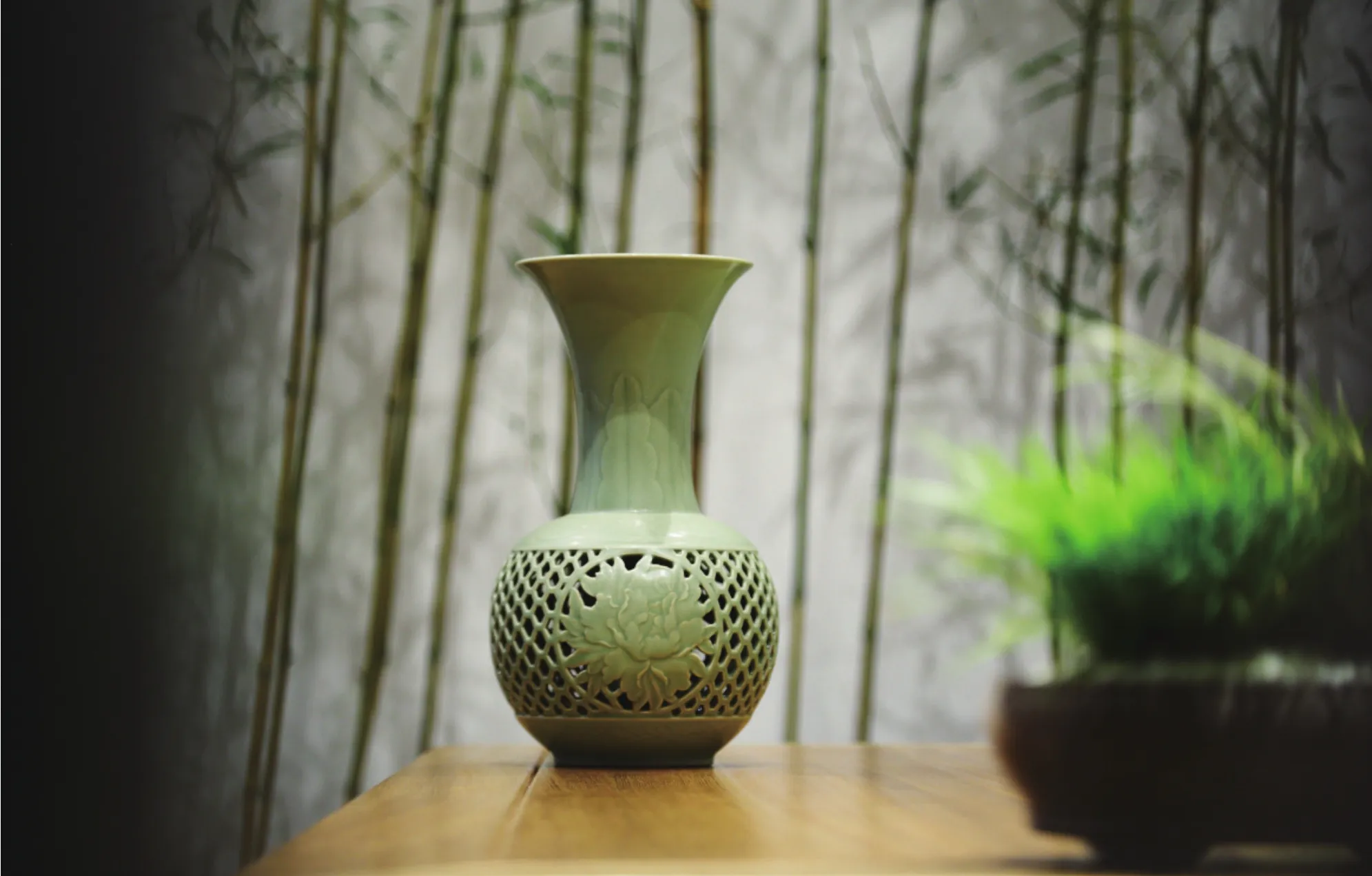
慈溪越窯青瓷燒制技藝傳承人孫威的作品《落日——牡丹天球瓶》。Sunset — Peony Vase, a work by Sun Wei, inheritor of the Cixi Yue kiln site celadon- firing craft.
宋代不遠。
在臺州黃巖沙埠竹家嶺下,似乎只要穿過那位安保大哥銳利的眼神,就能落腳于宋代的大地上。即使不曾跨進那一扇鐵柵門,在山腳下的柏油路旁,一抬頭,也能望見它。
黃巖窯,從西周時期開始,歷經了三次集中生產高潮,遺留下埠頭堂、下圓山、沙埠三處從東漢至兩宋時期相對連續的窯址群。其中,沙埠窯青瓷燒造時間長,規模大,堪稱浙東一大青瓷名窯。而沙埠竹家嶺窯址的“龍窯”盤踞在山坡上,由它燒制出的盤碗缽盂,盛出千年前沙埠溪畔那些熱氣騰騰的百姓生活。之后,深淺不一的青綠,順水而行,去永寧江,去椒江,再乘東海的碧波,去往日本、高麗(新安)、菲律賓、印尼等國,行至世界。
站在山頂高翹的“龍尾”處轉身俯瞰—
山巒之間,有大片平地,如同北宋少年畫家王希孟筆下“千里江山”的平闊之處。可以想見,幾百年前的今天,那里定是水波蕩漾,舟船往來。
初夏到黃巖,滿眼亦是青綠,其間,淺色的花樹從密林中站了出來,正如竹家嶺窯址出土的兩宋青瓷,綠得合乎時令,又讓錚錚鐵骨的精氣神兒在釉面上開出了冰花。
去黃巖之前,我還去了一趟慈溪。
從上林湖到沙埠溪,在夏天里回憶冬天的行程,只有東海邊的這一趟“尋瓷之旅”,穩坐于腦海之中。
慈溪的瓷與黃巖的瓷,若以專業的眼光去看,有諸多不同。但如我這樣的普通觀者,只是愛它們流暢的青綠色調,深綠淺綠,帶有匠人的莊重或俏皮。
當然,青綠與青綠是不同的。
同是對“千峰翠色”的孜孜以求,上林湖與沙埠都留下滿載時光密碼的器物,它們端坐于博物館的玻璃柜中,以安靜的講述等候懂它的人。
它們等來的人,不但懂它,還使之重生。
不知是否巧合,在我踏進那些古窯址附近的村子時,總會遇到“隱居”的年輕人。他們操持著這片土地上古老的物事,當然,理念是新的,設備也是新的。他們以滿腔熱切,將凝聚中國人最高審美的器物,置于今天更廣泛的日常。
在上林湖畔的匡堰鎮倡隆村,我遇到孫威。其時,他正小心翼翼地將幾只青瓷小件從窯爐中取出,捧到工作室的大桌子上。

臺州黃巖沙埠窯遺址(竹家嶺窯址)。The Shabo kiln (Zhujialing kiln) site in Huangyan district, Taizhou city.

孫威。Sun Wei.
這些來自游人的“作品”,摸上去還有熱乎乎的爐溫,有些甚至并不具有完整的器型,但孫威很在意它們,小心翼翼地將其置于桌面的空闊處,隨后,它們將被一一送至“創作者”手中。
其實我有點失望。
一位越窯青瓷燒制技藝傳承人,竟然毫無我事先想象的歲月感。
孫威是一位80后。而他的青瓷人生,在經過兒時跟隨父母的耳濡目染之后,正式開啟于二十八九歲—那是他從大學里的體育專業畢業,當了兩個月的體育老師,又經歷數次創業失敗而“認命”的結果。
我被他的經歷震撼,甚至被催生了一種妄想—是不是我也可以改變,改變既定的人生軌跡,去尋找截然不同的生活?
孫威就是這樣的年輕人,在給予青瓷之美的同時,又給出某種人生啟示。當如我這般的“妄想”化為行動,說不定,真的可以。
大概所有的成功故事,都離不開勤奮投入的細節。
所以,當我幾乎忘記這次不期而遇的全部時,有一點卻始終不能忘懷。
孫威的義父,著名陶瓷藝術家高峰曾問他—你想怎么做陶瓷啊?孫威回答—反正拉胚拉好,刻花刻好,燒窯燒好就好了嘛。
不行。
要做好陶瓷,高峰的建議是先得把上林湖周邊的山都跑一跑,把那些泥都挖回來燒一燒。孫威照著義父的話,把上林湖周邊凡是曾經有古窯的山,都跑了一遍,把那些泥土挖回來,淘洗、燒制。
跑完上林湖周圍的山,再開始備料拉胚,孫威就得心應手了。
一方水土,造就一種器物的形態。
所以,沙埠與上林湖的青瓷,有肉眼可見的不同。
在黃巖博物館,看那些宋時瓷器,我又想到王希孟的《千里江山圖》。黃巖的多數青瓷,比青翠淺,比鵝黃深,有時光印刻之下的堅硬痕跡,對應的是“千里江山”中山峰與大地之間最為廣大且普通的顏色—那正是江山的本色。
黃巖沙埠窯青瓷與上林湖越窯青瓷,二者的胎釉化學成分組成大致相似。在考古專家的論文中,我讀到它們都是用本地產的瓷石單一原料配制而成。但細究起來,沙埠窯青瓷的胎釉氧化鋁含量偏高,其硬度就高。二者色澤的差異,則源于釉中的氧化鈦和氧化鐵成分有異。
是的,每一種色彩都是大自然的無私饋贈。正如沙埠竹家嶺青瓷坊的主人謝振威發在微信朋友圈的那句話:瓷是土的一種極致表現。

謝振威在研究青瓷器型。Xie Zhenwei looks at an unglazed ware.
謝振威是一位90后,“返鄉創業者”是他對自己的形容。
失傳800多年的沙埠青瓷制作技藝,正在這位年輕人主持的青瓷坊中得以重生。以青瓷香爐、青瓷執壺領銜的沙埠青瓷精品,不斷在竹家嶺青瓷坊中成型、生長。
不得不佩服這一代年輕人的信念與勇氣—在多數人看來,一處窯址的發掘與保護,除了和當地人的耕種與居住有所關聯,大抵對人生并無太大影響。但家距竹家嶺窯址僅有200米的謝振威卻因此作出一個重大決定。
那是2019年,在考古專家的挖掘與研究中,包括竹家嶺窯址、鳳凰山窯址在內的7座晚唐、北宋時期沙埠窯址群名聲大噪,并獲評國家重點文物保護單位。謝振威開始重新打量那些童年時在田間地頭輕易就能撿拾到的瓷片。他想的是,能否重燃沙埠的窯火。
在此之前,3位來自龍泉的青瓷匠人租賃了謝振威家的房子,用以生產青瓷,但生意未如想象中順遂,就在他們準備退出之時,謝振威接下了這個作坊。
青瓷是文化,是生活,也是這一代年輕人不避諱談及的一門有“錢途”的生意。別人做不好的事情,從零開始的謝振威是否能做得好?
謝振威有他的路徑。這一代人有這一代人的路徑。顯然,他們對時代脈動與人生現場,有更為強大的感受力。
現代制瓷工藝,各地大致相同。差別的產生,在于材質,在于手感,在于匠人對于美的感知。所以,對還是門外漢的謝振威而言,重生沙埠青瓷,難,也不難。
除了一趟趟去龍泉、景德鎮等地請教制瓷高人,他與身居上林湖畔的孫威一樣,花大量時間泡在博物館中,以目光觸摸那些“鎮館之寶”的紋理、色彩,感受其與眾不同的氣質。
竹家嶺青瓷坊的主打產品,是沙埠青瓷工藝最為復雜的青瓷香爐。那件黃巖博物館的北宋沙埠窯青瓷香爐,謝振威不記得去看過多少次。它的底盤與蓋子分離,鏤空的半球型的蓋子飾以三瓣卷葉纏枝忍冬紋,要呈現那些彎彎繞繞的線條,需要鏤空、刻劃、浮雕等諸多手法并用。
對于那些繁復,如今的謝振威已經了然于胸。于是,各種尺寸的青瓷香爐,也由這間青瓷坊邁進普羅大眾的生活。
上林湖,沙埠溪,在不同的水畔聽聞年輕人對青瓷的追尋,總讓人想起舞劇《只此青綠》中王希孟對一紙青綠的追求。
十八歲的少年王希孟,在宋徽宗的點撥下,揮就一卷青綠江山,而后躍入時光的長河,杳然無蹤。
如果不是借由一方舞臺的想象,我們無法沉浸于宋代的“青綠”與江山,也無法體會一位年輕畫家那些具體的猶疑、陳思、暢懷、狂歌……而青綠,由畫中氣象凝身為一位美麗的女性,她的每一次隱與現,都蘊含畫家的求索或悵然。
天下之大,即使回到千年之前,王希孟這樣的天才型少年也并不稀缺,可他為何能獲得宋徽宗的青睞,宰相蔡京的托舉,又讓不為人知的身世承載無盡的迷思?
后世學人都在構建著王希孟的形象,可那些,未必就是真正的他。即便如此,我們還是記住了這位從北宋走來的少年,歷史僅為他留下三言兩語,他卻穿過千年,叫人惦念。其原因,就是《只此青綠》里表達的那樣—除了他,還有誰能為紙上的千里江山拼盡全力。
在屬于青瓷的青綠當中,我同樣看到了年輕人的全力以赴。
回到我踏足的那片竹家嶺窯址,800多年前,它度過了北宋中期到南宋初期的興盛時代,窯火漸熄。可是,當我們走近并了解它的故事,會覺得它是越窯的延續,龍泉窯的號角。即使騰挪場地,技術一直在流傳,疊加,遇到合適的土壤,就會迸發光華。
正因如此,走進那些古窯附近的村落,總會不經意間遇見年輕的手藝人創造的傳奇—往昔的青綠,煥發著今日的色彩。
千年前的王希孟孤身一人,但為青瓷而生的“王希孟”就在今天這一片水土之上。
他們的故事,臥在山坡的“龍窯”一定知道。

謝振威的青瓷作品《青瓷薰爐》。Celadon Incense Burner, a work by Xie Zhenwei.
Verdent Green and Young Craftsmen
By Sun Wen
The Song dynasty (960-1279) is not far away.
At the bottom of the Zhujialing, it seems that if you could walk past the sharp stare of the security guard, you could land on the great land of Song. Even if you don’t step inside the iron gate,at the foot of the hill next to the asphalt road you can also look up and see it right there.
A dragon kiln perches on the hillside of the Zhujialing kiln site at Shabu township, Huangyan district, Taizhou city. Looking at the wares fired by the dragon kiln, you could see vividly the lives of people living by the creek of Shabu. And then, the ceramics fired by the dragon kiln coming in different shades of green have traveled along the water to the Yongning River and the Jiaojiang River, and then rode the blue waves of the East China Sea to the rest of the world.
Stand at the top of the mountain and look down —
You could find between the mountains, there is a large flat area, just like the flat expanse depicted inby Wang Ximeng (1096-1119), a young painter of the Northern Song dynasty (960-1127). It is not hard to visualize the busy water traffic here hundreds of years ago.
I arrived at Huangyan on an early summer day, and my view was fully filled with verdant and green. There were scattered lightcolored flower trees interspersed in the dense forest, showing a color arrangement coinciding with that of celadon unearthed in Zhujialing.
Before going to Huangyan, I also went to Cixi in Ningbo city.
Cixi porcelain and Huangyan porcelain, viewed professionally,are different in many ways. But to an amateur like me, I just love their smooth green tones, whether dark or light, rendered with craftsmen’s solemnity or playfulness.
I don’t know whether it is a coincidence or not, but when I step into the villages near those ancient kiln sites, I always meet young people who “live in seclusion”. They are taking care of the old things of the land, but of course, with a new concept and new equipment.
I met Sun Wei in the village of Zhanlong in the town of Kuanyan, on the shores of the Shanglin Lake. He was carefully removing several small celadon pieces from the kiln and bringing them to the large table in his studio.
These “works” from tourists still felt warm from the kiln and some could not even be counted as fully shaped. But Sun cared about them and carefully placed them on the table — later they would be delivered to their “creators” one by one.
I was in fact a little disappointed. An inheritor of celadon firing techniques of Yue kiln is not weathered as I had imagined.
Sun is a post-80s (born after the 1980s) generation, whose career in celadon, under his parents’ influence since his childhood,officially started at the age of 28 or 29. That is, after he graduated from college in physical education, taught as a PE teacher for two months, and failed in several entrepreneurial attempts.
Suni’s adoptive father, a famous ceramic artist named Gao Feng, once asked him, “How do you want to make ceramics?” Sun replied, “Perform well in molding, carving, kiln firing, and that’s it.”
And that is far from enough.
To do a good job in ceramics, Gao advised him to first go to the mountains around the Shanglin Lake, to dig back some clay from there and put it into the kiln to see the results. Sun followed Gao’s words. After familiarizing himself with the mountains around the lake, Sun started to prepare the materials for molding,and then he was able to do it with ease.
Water and soil of a particular region creates a unique form of wares.
Take the celadon of Huangyan Shabu kiln and the celadon of Shanglin Lake Yue kiln as an example. In general, their glaze chemical compositions are similar — I read in some archaeological expert’s paper that they are both made of locally produced porcelain stone as the single raw material. However,on closer examination, the Shabu kiln has a relatively higher alumina content in its glaze, and is thus harder. And they are a little different in color because of they have different amounts of titanium oxide and iron oxide in their glaze.
Xie Zhenwei was born in the 1990s and he describes himself as a “home-returning entrepreneur”.
The celadon-making skills of Shabu celadon, which have been lost for more than 800 years, are being reborn in the celadon workshop presided over by this young man. The Shabu celadon products, represented by incense burners and pots, continue to take shape and grow in the Zhujialing celadon workshop.

孫威作品《桃之夭夭》。Splendid Peach Blossoms, celadon works by Sun Wei.
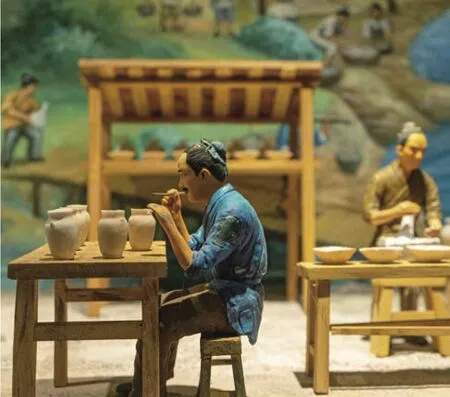
沙埠青瓷制作過程模型。A miniature model showing the celadon-making process in Shabu.
I have to admire the vision of this generation of young people— in the majority’s view, the excavation and protection of a kiln site, apart from having something to do with local people’s farming and housing, generally do not have much impact on people’s lives.
But Xie, whose home is only 200 meters away from the kiln site in Zhujialing, made a major decision accordingly.
It was 2019, during the excavation and research by archaeologists, a group of seven Shabu kiln sites from the late Tang(618-907) and Northern Song dynasties including the Zhujialing kiln site and the Fenghuang mountain kiln site, became wellknown and was recognized as a National Key Cultural Relics Protection Unit.
Xie began to re-examine the porcelain pieces that he could easily pick up in the wilderness as a child. He wondered if he could rekindle the kiln fire in Shabu.
Before that, three celadon craftsmen from Longquan rented Xie’s house to produce celadon, but their business did not go as smoothly as expected. When they were ready to quit, Xie took the workshop over.
Modern porcelain production processes across different regions are pretty much the same, for the differences lie in material, texture, and the artisan’s perception of beauty. So, for Xie the layman, reproducing Shabu celadon could be difficult — or not difficult at all.
Apart from travelling to Longquan, Jingdezhen and other major porcelain-producing places to consult the masters, Xie spends a lot of time in the museum, closely examining “treasures of the town” for their texture and color and feeling their distinctive temperament.
The main product of the Zhujialing celadon workshop is celadon incense burner, most complex to make of all Shabu celadon. Xie can’t remember how many times he has visited the Huangyan Museum for observing its Shabu kiln celadon incense burner of the Northern Song dynasty. Its chassis is separated from the lid, and the hollowed-out, hemispherical lid is decorated with a pattern of three-valve scrolling leaves entwining with branches.To reproduce those curved lines requires many techniques of hollowing, incising and relief carving.
Now Xie is already a master in achieving such complexity. As a result, celadon incense burners of various sizes keep coming out of this celadon workshop and into local people’s daily lives.
Young people’s pursuit of making the best celadon always reminds me of Wang Ximeng’s pursuit of presenting the utmost green in his painting.
The 18-year-old Wang Ximeng, under the guidance of Emperor Huizong (1082-1135) of the Song dynasty, put up a scroll featuring a beautiful green tone and then leapt into the river of time, disappearing without a trace. Scholars of later generations have never stopped trying to construct an image of Wang, which,however, may not be the real him.
Even so, we still remember this young man who came from the Northern Song dynasty, who has dedicated himself to creating a vast, magnificent stretch of rivers and mountains of his motherland with his paint brush.
In the young celadon artists, I also saw the full commitment.Walking into the villages near those ancient kilns, one will always be surprised to see beautiful celadon created by young craftsmen— the celadon started off as a green legend of the past but is now glowing with the hues of modern times.

永寧江。蔡志敏/攝The Yongning River. Photo by Cai Zhimin.