
Superfluid to Mott-insulator transition in a one-dimensional optical lattice
2022-08-01 06:01:20WenliangLiu劉文良NingxuanZheng鄭寧宣JunJian蹇君LiTian田麗JizhouWu武寄洲YuqingLi李玉清YongmingFu付永明PengLi李鵬VladimirSovkovJieMa馬杰LiantuanXiao肖連團andSuotangJia賈鎖堂
Chinese Physics B 2022年7期
Wenliang Liu(劉文良), Ningxuan Zheng(鄭寧宣), Jun Jian(蹇君), Li Tian(田麗), Jizhou Wu(武寄洲),?,Yuqing Li(李玉清), Yongming Fu(付永明), Peng Li(李鵬), Vladimir Sovkov,4,Jie Ma(馬杰),?, Liantuan Xiao(肖連團), and Suotang Jia(賈鎖堂)
1State Key Laboratory of Quantum Optics and Quantum Optics Devices,Institute of Laser Spectroscopy,Shanxi University,Taiyuan 030006,China
2Collaborative Innovation Center of Extreme Optics,Shanxi University,Taiyuan 030006,China
3School of Science,Key Laboratory of High Performance Scientific Computation,Xihua University,Chengdu 610039,China
4St. Petersburg State University,7/9 Universitetskaya nab.,St. Petersburg 199034,Russia
Keywords: Bose–Einstein condensate,optical lattice,superfluid,Mott-insulator phase
1. Introduction
Since an atomic Bose–Einstein condensate (BEC) was firstly produced in a laboratory in 1995, the study of ultracold Bose and Fermi gases has become one of the most active areas in contemporary physics.[1–3]BEC confined in an optical lattice has opened a versatile research field that lies at the interface of condensed matter physics, statistical physics,atomic, molecular, and optical physics.[4–6]The phase transition from superfluid to Mott insulator in an optical lattice is one of the particular interesting phenomena.[7]The first observation of the phase transition occurred in a three-dimensional(3D) case.[8]Under a depth lattice, the BEC transfers from a superfluid state to a state with a definite number of atoms in each isolated lattice well with no coherence characteristic of the BEC.The stability of superfluid currents in a system of ultracold bosons was studied using a moving optical lattice at the phase transition critical point of a first-order superfluid-Mott insulator (SF-MI) phase transition.[9,10]The phase transition could be used to research quantum quench and nonequilibrium dynamics in a quantum gas.[11–13]The Mott insulator state could also provide a means to entangle neutral atoms and form a quantum register for a quantum computer.[14]Mott insulator with two atoms per site[15]can be used to create molecules by Feshbach resonances, which could lead to a molecular BEC,[16,17]eventually. Transitions from a quantum gas to a Mott insulator in two-dimensional(2D)[18,19]and 3D[8,20]optical lattices were reported by several laboratories. Although the existence of a 1D Mott insulator has been verified in a cold atom system,[21,22]it has remained largely unexplored.Transition from a strongly interacting 1D superfluid to a Mott insulator was only researched with the87Rb Bose–Einstein condensate. In order to get the Mott insulator transition,a deep lattice as well as high laser power and narrowly focused beams are required. Demonstrating the transition from a BEC to a 1D Mott insulator is highly complicated by the need of a deep lattice.[23,24]
In this letter, we experimentally investigate the superfluidity of a 3D sodium BEC in a 1D lattice. We load the sodium BEC into a 1D optical lattice. With an increase of the lattice depth,the transition from superfluid to Mott insulator appears.The reverse process of restoring the superfuidity is confirmed as well when the depth of the lattice ramps down to zero again.
2. Experimental setup
The experiment starts with a23Na BEC of~8×10⁴atoms in a crossed optical dipole trap. Our BEC apparatus is described in Ref. [25]. The optical trap was derived from a single-mode 1064-nm laser (1064 nm, YLR-100-1064-LP),with the two beams detuned by 220 MHz through two acoustooptic modulators. The two dipole trap beams were in the horizontal direction. The dipole trap beam 1 propagates along thexdirection. The angle between the dipole trap beam 2 and the dipole trap beam 1 is 45°. The beam waists were 31 μm and 39 μm,measured by the parametric heating method under the full dipole trap laser power, respectively. By the end of the evaporation stage, the beam power of each of the two dipole traps was nearly 70 mW, and the optical potential depth was nearly 2.6 μK including the gravity potential.
The 1D optical lattice is formed by a retro-reflected,faroff-resonance laser beam with wavelength 1064 nm;power up to 500 mW after passage through an optical fiber. The fiber is employed to keep the Gaussian shape of the beam power.The beam is focused onto a spot with an intensity full-width at half-maximum of 60 μm. The laser beam was then recollimated with a lens pair and retroreflected to form a 1 dimensional standing wave interference pattern at the position of the BEC. The polarization is controlled by double pass through aλ/4 wave plate. In order to further verify the overlap of the two lattice beams, we measure the power of output laser from the income terminal of optical fiber. When the power is high enough, we can assure that the two beams have a good standing-wave overlap condition. In the experiment, we also control the loading of the atoms into the lattice beam. If the two beams have a good enough overlap, the hot atoms will escape from the potential and the two beams will properly interfere and form a lattice.
3. Results and discussion
We generate two identical laser beams of peak intensityIpand make them counter propagate in such a way that their cross sections overlap completely as shown in Fig.1. Furthermore,we arrange their polarizations to be parallel.In this case,the two beams create an interference pattern, with a distanced=λL/2(λLis the laser wavelength)between two maxima or minima of the resulting light intensity. The 1D optical lattice adds an extra potential[26]

whereV0is the lattice depth. One uses the saturation intensityI0of the transition and obtains

where the prefactorξon the order of unity depends on the level structure of the atom in question through the Clebsh–Gordan coefficients relating to various possible transitions between sublevels,Δis the frequency offset between the transition frequency and the frequency of the light field,Γis the natural decay rate of an excited state. Two obvious quantities associated with this potential are the lattice depthV0,i.e.,the depth of the potential from a peak to a trough, and the lattice spacingd. Typically,the lattice depth is measured in units of the recoil energy,

wheremis the mass of an atom.
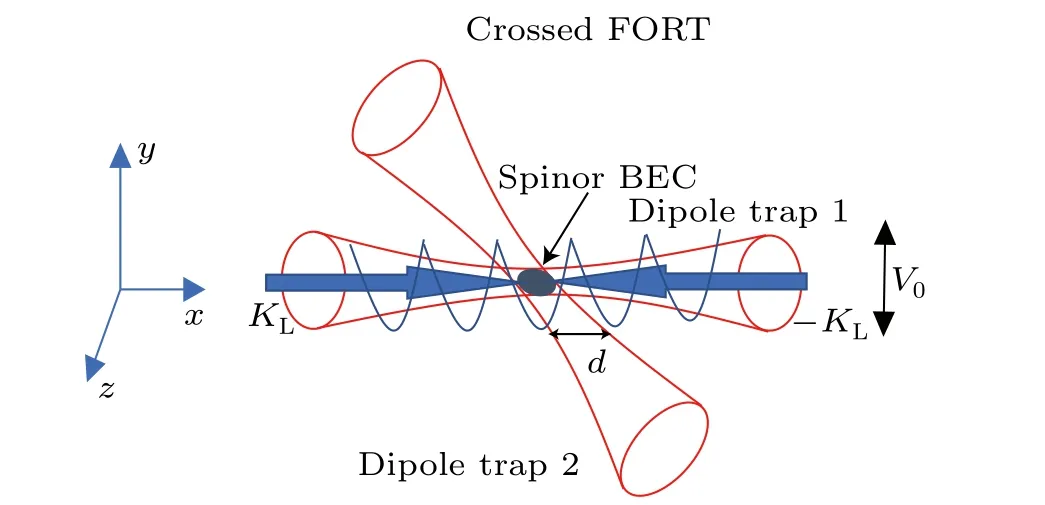
Fig.1. Schematic setup of the experiment. A 1D lattice potential is formed by overlapping an optical standing wave along the horizontal axis (x axis)with a Bose–Einstein condensate in a crossed dipole trap. The parameters V0 is the lattice depth and d is the lattice spacing.
We use the amplitude modulation of an acousto–optic modulator to control the power of the lattice beams.The power of the lattice beam is ramped up from zero to its final value over 2 ms. Then, we simultaneously turn off the lattice and the dipole trap,and take a 7-ms time of flight(TOF)measurement. Figure 2(a) shows a typical TOF interference pattern of a condensate released from an optical lattice plus harmonic trap for a lattice depthV0=2.4Er. We make the ramp timet=2 ms to satisfy the intraband adiabaticity condition.As can be seen in Fig.2(b),for small lattice depths, the BEC is only slightly modulated by the lattice,corresponding to the appearance of only two weak side peaks,at±2πˉh/λLin the momentum space. Figure 2(a)shows the parabolic density profile of the central momentum peak.The central momentum peak was analyzed with a 2D distribution consisting of a Gaussian function for the thermal fraction and an inverted parabolic function for the condensate component.[27]
The ramp sequence was stopped at different instants,then both the trap and the lattice were abruptly switched off. Absorption images were then taken after 7 ms time of flight. The well-to-well phase coherence is lost with the increase of the lattice depth,as shown in Fig.3. The ramp speed is conserved in order to keep the same intraband adiabaticity condition. In Fig.3(a)the time step is 3 ms;when the depth gets to 13.7Er,the time is 15 ms. In Fig.3(b),the time step is 2 ms,the total ramp time to the maximum depth is 10 ms. The side peaks disappear and the central peak broadens, reflecting the momentum distribution of atoms in an isolated single lattice well.There is no long-range coherence between different atoms in this state, so no interference fringes will be seen when taking TOF measurements.The disappearance of the interference pattern as the lattice depth was increased indicated the loss of the phase coherence and a transition from the superfluid state to the Mott insulator state. Here, we find that the superfluidity is totally lost for lattices deeper than about 13.7Er. After reaching the peak value, the lattice was ramped back down again. The phase transition from Mott insulator to superfluidity is observed. After the lattice was fully ramped down,most of the atoms remained in the condensed fraction. This means that the atoms are still the coherent quantum system rather than hot atoms that has been decoherent.
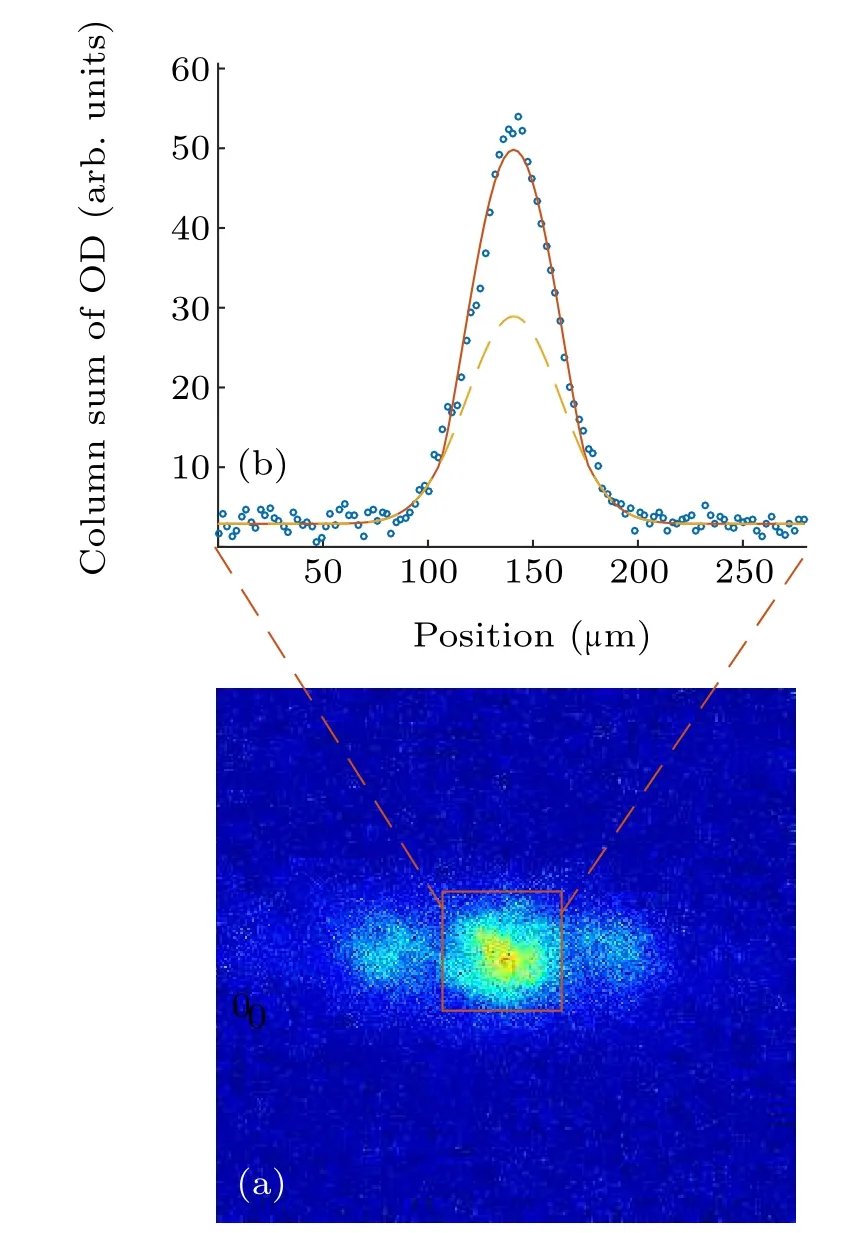
Fig.2.(a)Interference pattern of the Bose–Einstein condensate released from a 1D optical lattice of the depth V0=2.4Er after a time of flight of 7 ms. (b)The fit(solid line)and the column sum of the optical density(OD)(circles).The dashed line is the Gaussian fitting for the distribution of thermal gas.
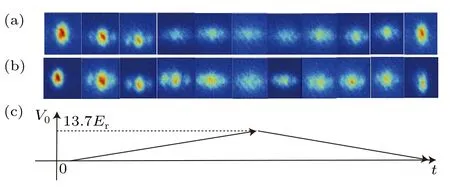
Fig. 3. (a) and (b) Observation of the superfluid to Mott insulator transition: The lattice depths for the sequence of images from left to right are(0, 2.4, 5.5, 8.2, 11, 13.7, 11, 8.2, 5.5, 2.4, 0)Er. (c)Time dependence of the lattice depth. For Fig.3(a),the time step is 3 ms for each depth,while for Fig.3(b),it is 2 ms. The total ramp time is 30 ms and 20 ms.
To study the dynamics of the dephasing in the 1D optical lattice, we ramp the lattice to its final depth within 4 ms,leave the lattice on for a varying holding time, and take TOF images as functions of the holding time, as shown in Fig. 4.The final depth for Fig.4 is 2.4Er. A snapshot of the resulting interference pattern is obtained via absorption imaging after a varying holding time. The three atom clouds expand slowly,decreasing the optical density for the atom cloud.The expanding of the atom cloud is mainly induced by the heating of the optical lattice.The two weak side peaks can be observed under comparably short holding time.In this situation,the BEC simply remains superfluid, permanently maintaining a superfluid phase across the individual lattice wells.
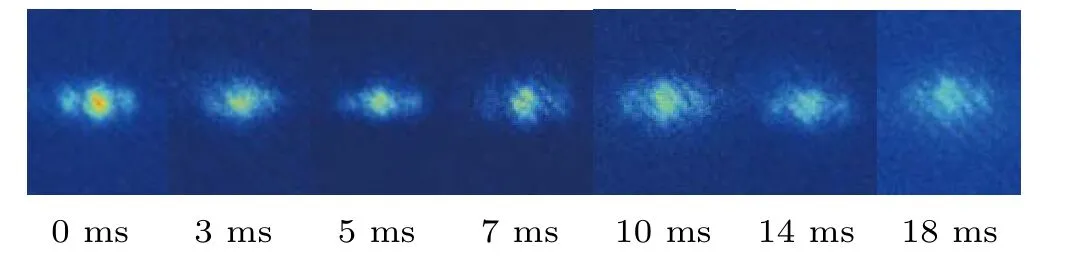
Fig. 4. Interference pattern of a Bose–Einstein condensate released from a 1D optical lattice of depth V0=2.4Er with various holding time after a time of flight of 7 ms.
4. Conclusion
In conclusion,the sodium BEC was loaded into a 1D optical lattice,the superfluid to Mott insulator transition was observed in a Na BEC by changing the depth of the optical lattice. We observed a complete loss of superfluidity at 13.7Er.The BEC will remain superfluid with the depth of 2.4Erfor a long time. Dephasing of superfluid under higher optical depth remained to be further researched. The result paves the way for the study of quantum quench and nonequilibrium dynamics in 1D lattice-confined spinor condensates.
Acknowledgments
Project supported by the National Key Research and Development Program of China(Grant No.2017YFA0304203),the National Natural Science Foundation of China (Grant Nos. 62020106014, 62175140, 61901249, 92165106, and 12104276), PCSIRT (Grant No. IRT-17R70), the 111 Project(Grant No. D18001), the Applied Basic Research Project of Shanxi Province, China (Grant Nos. 201901D211191 and 201901D211188), the Shanxi 1331 KSC, and the Collaborative Grant by the Russian Foundation for Basic Research and NNSF of China (Grant No. 62011530047 and Grant No. 20-53-53025 in the RFBR Classifcation).

- Chinese Physics B的其它文章
- Solutions of novel soliton molecules and their interactions of(2+1)-dimensional potential Boiti–Leon–Manna–Pempinelli equation
- Charge density wave states in phase-engineered monolayer VTe2
- High-pressure study of topological semimetals XCd2Sb2(X =Eu and Yb)
- Direct visualization of structural defects in 2D semiconductors
- Switchable down-,up-and dual-chirped microwave waveform generation with improved time–bandwidth product based on polarization modulation and phase encoding
- Machine learning potential aided structure search for low-lying candidates of Au clusters