
High-pressure study of topological semimetals XCd2Sb2(X =Eu and Yb)
2022-08-01 06:02:56ChuchuZhu朱楚楚HaoSu蘇豪ErjianCheng程二建LinGuo郭琳BinglinPan泮炳霖YeyuHuang黃燁煜JiaminNi倪佳敏YanfengGuo郭艷峰XiaofanYang楊小帆andShiyanLi李世燕
Chinese Physics B 2022年7期
Chuchu Zhu(朱楚楚), Hao Su(蘇豪), Erjian Cheng(程二建), Lin Guo(郭琳), Binglin Pan(泮炳霖),Yeyu Huang(黃燁煜), Jiamin Ni(倪佳敏), Yanfeng Guo(郭艷峰),?,Xiaofan Yang(楊小帆),?, and Shiyan Li(李世燕),3,4,§
1State Key Laboratory of Surface Physics and Department of Physics,F(xiàn)udan University,Shanghai 200438,China
2School of Physical Science and Technology,ShanghaiTech University,Shanghai 201210,China
3Collaborative Innovation Center of Advanced Microstructures,Nanjing 210093,China
4Shanghai Research Center for Quantum Sciences,Shanghai 201315,China
Keywords: high pressure,topological semimetal,magnetism,superconductivity
1. Introduction
Topological materials have been widely investigated in recent years due to their novel physical properties and the potential application in electronic devices.[1–6]By introducing magnetism into the topological materials,the initial electronic structure is modified by the broken time-reversal symmetry.[7]The combination of intrinsic magnetic order and nontrivial topology provides a platform for the investigations of exotic quantum states, such as Weyl semimetals,[8–11]anomalous Hall effect,[12,13]and axion insulators.[1,14]
In this context, the topological semimetals EuCd2M2(M=As and Sb)have recently attracted a lot of attention due to its special A-type AFM configuration.[15–26]The Eu spins order ferromagnetically in theabplane and stack antiferromagnetically alongcaxis below N′eel temperatureTN=9.5 K forM=As and 7.4 K forM=Sb.[15–17]First-principle theoretical calculations predicted that EuCd2M2(M= As and Sb) is an AFM Dirac semimetal candidate with unbrokenC3symmetry,[18]and a single pair of Weyl nodes could be generated by splitting the Dirac cone close to Fermi surface in ferromagnetic(FM)state.[19]Experimentally,in AFM phase,the EuCd2M2was revealed to hold several nontrivial topological states including axion insulator, AFM topological crystalline insulator, and higher order topological insulator.[15,16,20]In spin-polarized FM phase induced by an external magnetic field alongcaxis, a single pair of Weyl nodes is generated near Fermi level due to the break of nonsymmetric time-reversal symmetry.[17,20]In the paramagnetic phase aboveTN, quasistatic FM fluctuations lift the Kramers degeneracy, indicating a centrosymmetric Weyl semimetal state of EuCd2M2.[22]Furthermore, the magnetic order in EuCd2M2can be suppressed by substituting europium atoms with non-magnetic atoms,for instance,ytterbium. The Yb-based compounds behave paramagnetically and theC3symmetry is maintained,becoming ideal Dirac semimetal candidates.Therefore,XCd2M2(X=Eu and Yb,M=As and Sb)has provided an ideal platform for exploring the intriguing interplay between topology and magnetism.[23–25]
Applying pressure is a clean and effective method of tuning crystal structure and electronic state. Under pressure,the magnetic ordering may be suppressed and novel ground states such as superconductivity may emerge.[27–32]In this paper, we report the high-pressure electrical transport studies on EuCd2Sb2and YbCd2Sb2. It is found that the AFM transition temperatureTNof EuCd2Sb2increases from 7.4 K at ambient pressure to 50.9 K at 14.9 GPa, then the magnetism disappears. No sign of superconductivity is observed down to 300 mK. In contrast, superconductivity emerges in YbCd2Sb2at 1.94 GPa, manifesting a superconducting dome in the temperature-pressure phase diagram. High-pressure xray diffraction (XRD) measurements on YbCd2Sb2show no structural phase transition at low pressure,but a crystalline-toamorphous phase transition at about 16 GPa.Similar structural phase transition may cause the disappearance of magnetism in EuCd2Sb2.
2. Materials and methods
The EuCd2Sb2single crystals were grown by using tin as flux.[16]High-quality single crystals of YbCd2Sb2were grown by self-flux method using a mixture of Yb(purity 99.9%),Cd(purity 99.99%),and Sb(purity 99.999%)powders with a molar ratio of 1:20:2. The mixture was loaded into a corundum crucible which was further sealed in a quartz ampoule under vacuum. Subsequently,the ampoule was heated at 730°C for 5000 minutes and then slowly cooled down to 430°C at a rate of 1°C/h. Single crystals can be obtained by removing excess flux in a centrifuge and cooling down to room temperature.
High pressure was generated by a diamond anvil cell(DAC),in which diamond anvils with a culet size of diameter 300 μm and a non-magnetic Be–Cu gasket were employed.Cubic boron nitride (c-BN) and NaCl powders were used as insulating material and pressure transmitting medium,respectively.XCd2Sb2(X=Eu and Yb)single crystals were crashed into small pieces and loaded inside of a hole (120 μm in diameter) in the center of the gasket. Subsequently, four electrodes of 4-μm-thick platinum thin foils were laid on the sample. With applying pressure, the small single crystals were crashed into powder and compressed together solidly, allowing a standard ohmic contact between sample and electrodes.The solid pressure transmitting medium provides a quasihydrostatic condition.The pressure inside the DAC was scaled by monitoring the Ruby fluorescence at room temperature each time before and after the measurement.[33]High pressure resistance of EuCd2Sb2and YbCd2Sb2were measured in a physical property measurement system(PPMS,Quantum Design)and a3He cryostat with Van der Pauw method.
The XRD measurement at ambient pressure was performed by using an x-ray diffractometer (D8 Advance,Bruker). The high-pressure synchrotron XRD experiments were carried out using a symmetric DAC with a 260-μm culet diamond. A rhenium gasket was pre-compressed to 30 μm in thickness followed by drilling the central part by laser to form a 90-μm diameter hole as the sample chamber. The sample chamber was filled with a mixture of the sample,a ruby chip,and silicone oil as the pressure transmitting medium. The experimental pressures were determined by the pressure-induced fluorescence shift of ruby. Synchrotron XRD measurements were carried out at beamline BL15U1 of the Shanghai Synchrotron Radiation Facility (SSRF) using a monochromatic beam of 0.6199 ?A.
3. Results and discussion
Figure 1(a)shows the crystal structure ofXCd2Sb2(X=Eu and Yb)at ambient pressure.XCd2Sb2crystallizes in trigonal structure with a space group ofP3m1 (No. 164).[34,35]The ionic [Cd2Sb2] slab is sandwiched between layers of ytterbium/europium cations alongcaxis. From the XRD patterns in Fig.1(b),only(00l)Bragg peaks are detected,demonstrating that the largest natural surface of as-grownXCd2Sb2single crystals isabplane. Typical resistivityρ(T) curves ofXCd2Sb2single crystals at ambient pressure are plotted in Fig. 1(c). At high temperature, the resistivity of EuCd2Sb2exhibits a metallic behavior. Below 100 K, with decreasing temperature the resistivity increases rapidly to a maximum atTN=7.4 K and then drops sharply.The low-temperature resistivity behavior of EuCd2Sb2resembles previous report on its sister compound EuCd2As2, which attributed the sharp drop belowTNto the reduced scattering from the ordered state of the Eu moments.[23]For paramagnetic YbCd2Sb2,its resistivity exhibits a weakly metallic behavior.
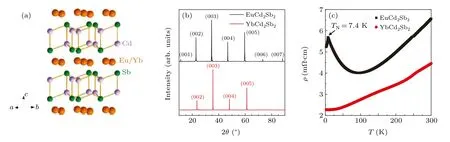
Fig.1. (a)Schematic crystal structure of XCd2Sb2 (X =Eu and Yb). Green,purple,and orange balls represent Sb,Cd,and Eu/Yb atoms,respectively. (b)Room-temperature x-ray diffraction pattern of XCd2Sb2 (X =Eu and Yb) single crystals, showing that the largest natural surface is ab plane. (c) Typical resistivity curves of XCd2Sb2 (X =Eu and Yb)single crystals at ambient pressure. The peak at 7.4 K denotes the antiferromagnetic transition of EuCd2Sb2.
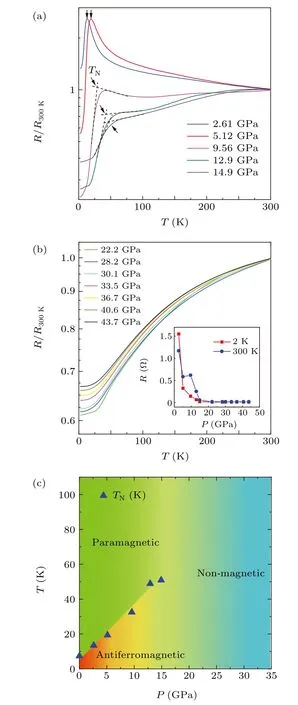
Fig.2. Temperature dependence of the normalized resistance under different pressures for EuCd2Sb2(a)below 14.9 GPa and(b)above 14.9 GPa in a temperature range of 2 K–300 K,respectively. The arrows denote the N′eel temperature TN. The inset of(b)depicts the pressure dependence of R at T =2 K(red squares) and 300 K (blue circles). (c) The temperature–pressure phase diagram of EuCd2Sb2. The values of TN are obtained from panel(a).
Figures 2(a)and 2(b)present the temperature-dependence normalized resistanceR/R300Kof EuCd2Sb2up to 43.7 GPa.The data are obtained from two samples with two experimental runs, which have consistent results. The application of 2.61 GPa and 5.12 GPa shiftTN(the peak position) towards higher values. For 9.56 GPa and above, the AFM peak becomes broader and lower, therefore we redefine the value ofTNas the point of intersection of two lines extrapolated from theR(T)curve below and above the temperatures of the broad peak. The value ofTNincreases substantially to a maximum of 50.9 K at 14.9 GPa, about 6.8 times of that at ambient pressure. When the pressure is above 14.9 GPa, the AFM peak completely vanishes,indicating the absence of magnetic phase transition. The absolute resistancesR2KandR300Kalso decrease to very small values, as shown in the inset of Fig. 2(b). From these results, we construct the temperaturepressure phase diagram of EuCd2Sb2in Fig. 2(c). There are two main features in the phase diagram: (i)TNincreases monotonously with the applied pressure up to 14.9 GPa,then drops to zero. A similar phase diagram has recently been reported in EuIn2As2, in which the increase ofTNis mainly attributed to the enhancement of intralayer ferromagnetic exchange coupling by pressure.[36](ii)A non-magnetic state appears after the collapse of AFM phase above 14.9 GPa. Similarly, for EuIn2As2, with increasing pressure up to 17 GPa,a crystalline-to-amorphous phase transition occurs,which impedes further enhancement ofTN.[36]This will be discussed later. In order to further check whether there is pressureinduced superconductivity in EuCd2Sb2,we also measure another sample down to 300 mK and no sign of superconductivity is observed(data not shown here).
The resistanceR(T)from 0.3 K to 300 K for YbCd2Sb2sample A under pressures up to 29.2 GPa is plotted in Fig.3(a).At low temperature, a resistance drop is clearly observed under 1.94 GPa,and becomes more pronounced with increasing pressure, as shown in Fig. 3(b). The value ofTc(defined at the 10%drop of normal-state resistance,),first increases to a maximum of 1.67 K at 5.22 GPa then decreases, eventually drops to below 0.3 K at 29.2 GPa. Noting that no zero resistance is observed for YbCd2Sb2sample A in the whole pressure range. To confirm that theRdrop is due to superconducting transition,we measure the resistance of sample A at different magnetic fields under 10.0 GPa. TheRdrop is gradually suppressed upon increasing magnetic field and completely disappears at 0.6 T. The upper critical fieldμ0Hc2(T)as a function of temperature is extracted and plotted in the inset of Fig. 3(c). It can be well fitted by the empirical Ginzburg–Landau(GL)formula[37]

The zero-temperature upper critical fieldμ0Hc2(0) is determined to be 0.41 T,which is much lower than the Pauli paramagnetic limit fieldHp(0)=1.84Tc≈1.86 T,[38,39]indicating the absence of Pauli pair breaking.
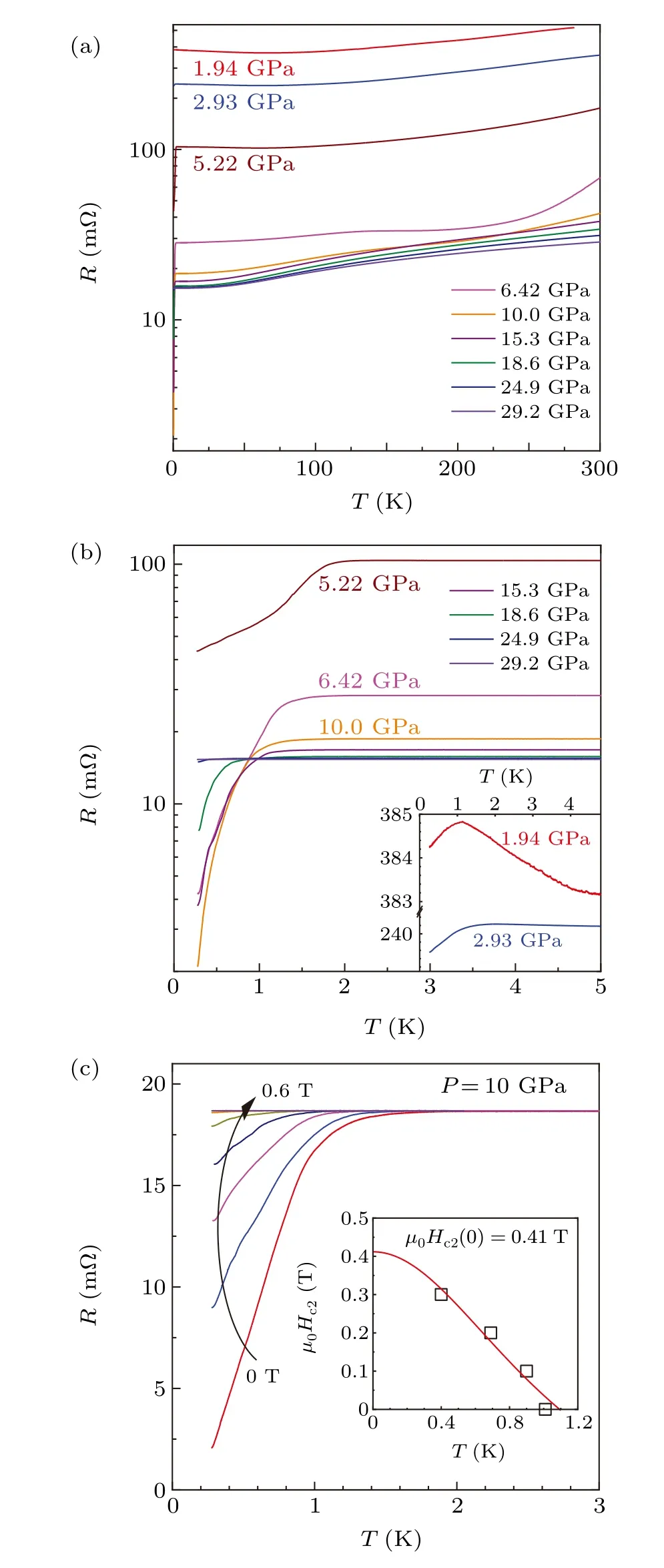
Fig. 3. High-pressure resistance curves of YbCd2Sb2 sample A. (a) Temperature dependence of resistance under different pressures up to 300 K.(b)Low-temperature resistance shows the superconducting transition. The inset in panel (b) demonstrates that pressure-induced superconductivity emerges at 1.94 GPa. (c)Temperature dependence of resistance at different magnetic fields under 10.0 GPa. The superconducting transition temperature Tc is defined at the 10%drop of normal-state resistance(T10%c ).The inset in panel(c)depicts the upper critical field μ0Hc2 as a function of Tc, which can be well fitted by Ginzburg–Landau formula.
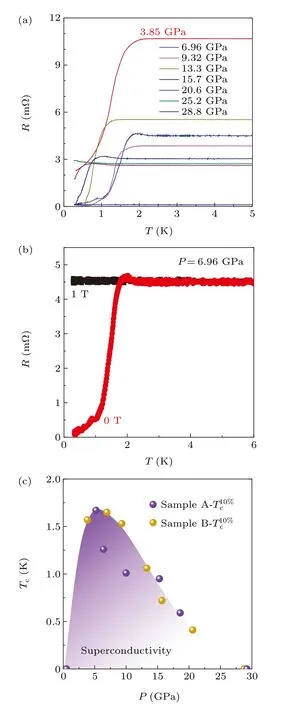
Fig. 4. (a) Low-temperature resistance under different pressures for YbCd2Sb2 sample B. (b) Temperature dependence of resistance under 0 T and 1 T at 6.96 GPa. (c)Temperature–pressure phase diagram of YbCd2Sb2,showing a dome-shaped pressure-induced superconductivity.
In order to reproduce the pressure-induced superconductivity in YbCd2Sb2, a new sample B obtained from a different batch was measured under pressures from 3.85 GPa to 28.8 GPa, as shown in Fig. 4(a). For sample B, zero resistance is observed and the highestTcis 1.65 K under 6.96 GPa, consistent with sample A. When an external field 1 T is applied, theRdrop of sample B under 6.96 GPa is completely suppressed, as shown in Fig. 4(b).These results confirm the pressure-induced superconductivity in YbCd2Sb2. Combining the results of sample A with sample B, the temperature–pressure phase diagram of YbCd2Sb2is mapped out in Fig.4(c),which shows a clear superconducting dome. Note that the data points of 24.9 GPa for sample A and 25.2 GPa for sample B are not shown,since theTcs are below our lowest temperature 0.3 K.For the data points of 29.2 GPa for sample A and 28.8 GPa for sample B,we estimate that theTcs are very close to zero.These do not affect the overall shape of the superconducting dome in Fig.4(c).
To check whether the pressure-induced superconductivity arises from a structural phase transition, we performed high-pressure synchrotron XRD measurements on YbCd2Sb2sample, shown in Fig. 5(a) for different pressures. The ambient–pressure phase persists up to 12.3 GPa,since no new diffraction peaks appear. Therefore, the superconductivity in YbCd2Sb2is not related to a pressure-induced structural phase transition. The pressure dependence of lattice parametersa,b,and unit-cell volumeV/Zare plotted in Figs. 5(b) and 5(c),obtained by fitting the XRD data with GSAS software. There is no anomaly ina,b,andV/Zexcept that the volume is compressed by 15.3%. Below 12.3 GPa,the evolution ofV/Zcan be well fitted by Birch–Murnaghan equation[40]
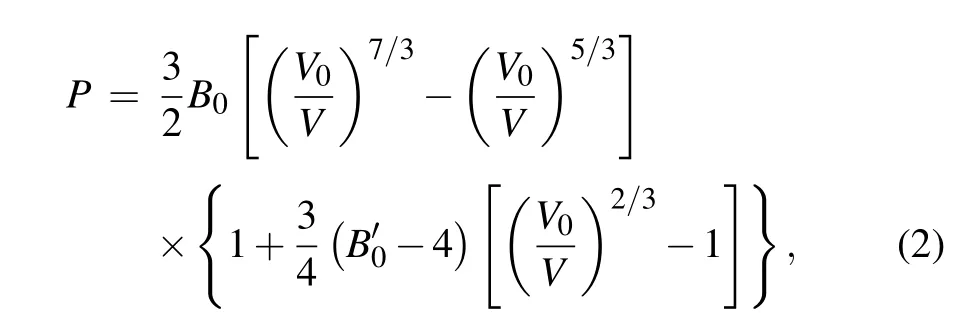
whereB0,B′0,andV0are the bulk modulus,first-order derivative of the bulk modulus, and the derived zero-pressure volume, respectively. The fitting givesV0= 145.2 ?A3,B0=34.6 GPa,andB′0=9.1.
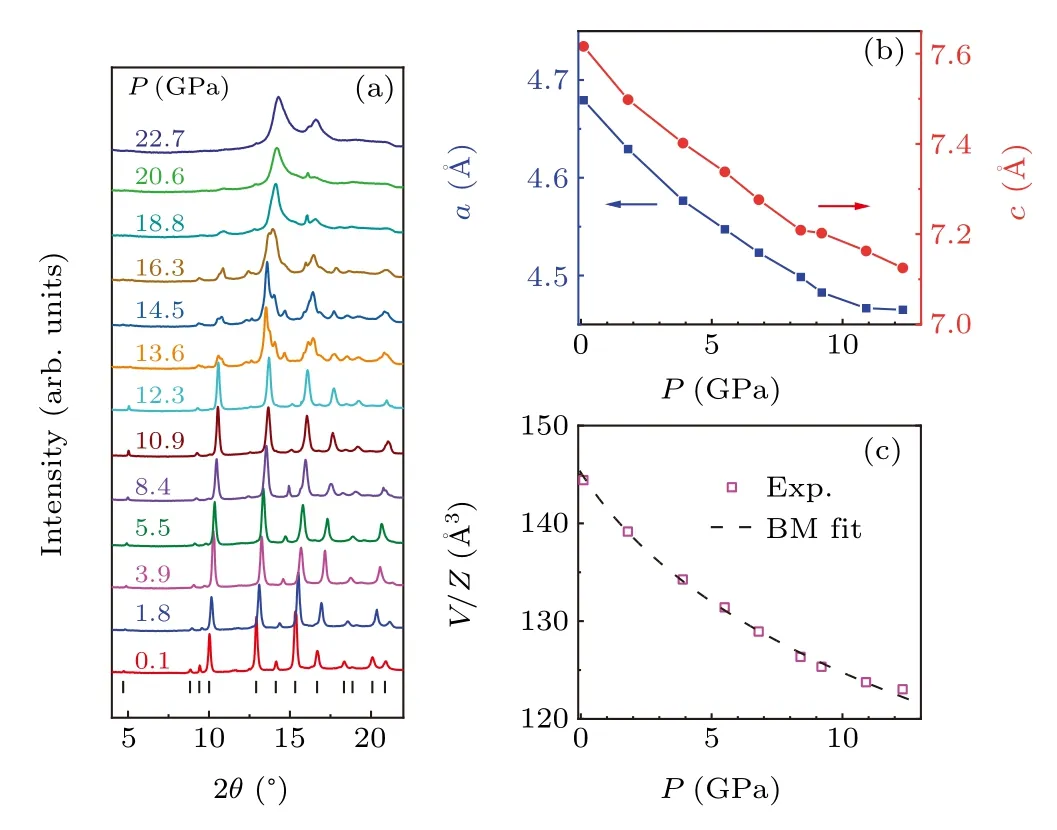
Fig. 5. (a) High-pressure x-ray diffraction (λ = 0.6199 ?A) patterns of YbCd2Sb2 under pressures ranging from 0.1 GPa to 22.7 GPa. (b) and (c)Pressure dependence of the lattice parameters a,c,and V/Z for YbCd2Sb2,respectively. The black dashed line is the fitting of third-order Birch–Murnaghan equation, which derives zero-pressure volume V0 =145.2 ?A3,bulk modulus B0=34.6 GPa,and the first-order derivative of the bulk modulus B′0=9.1.
Above 12.3 GPa, the pristine trigonal phase still exists,but the peak intensity decreases and some small diffraction peaks appear around major splitting peaks, which is resembling of EuCd2As2,[41]suggesting the instability of crystal structure and the emergence of new phase. However,it is hard to determine the space group of the high-pressure phase due to the complex diffraction spectra. When the pressure is higher than 16.3 GPa, the original diffraction peaks gradually vanish and only two humps are detected at 22.7 GPa. This is reminiscent of the crystalline-to-amorphous phase transition in EuIn2As2at~17 GPa.[36]For YbCd2Sb2, the superconductivity persists into the amorphous phase. Considering the structure similarity of EuCd2Sb2, YbCd2Sb2, and EuIn2As2,such crystalline-to-amorphous phase transition should also occur in EuCd2Sb2. Since the amorphous phase has no lattice period thus absence of magnetic order, this may explain the sudden disappearance of AFM order around 14.9 GPa in EuCd2Sb2. On the other hand, considering the energy difference between divalent and trivalent Eu ionic state is not extremely large and the ion radius of Eu3+is smaller than Eu2+,Eu2+state could thus be easily destabilized and pushed towards Eu3+state with external energy like pressurization in some Eu-based compounds,[42]leading to the collapse of antiferromagnetism. Whereas we did not detected the thermal hysteresis on cooling and warming resistance curves (as a hallmark of valence transition),[43–45]more high-pressure xray photoemission spectroscopy(XPS),x-ray absorption nearedge spectroscopy (XANES), and XRD measurements that could directly monitor valence and structure transition are further needed.
The superconducting dome found in YbCd2Sb2is quite interesting. Usually, such a superconducting dome is associated with the suppression of magnetic order[46]or chargedensity wave.[47]However, no magnetic order and chargedensity wave have been observed in YbCd2Sb2. In this sense,its superconducting dome may be due to a Lifshitz transition(related to electrical topological transition and Fermi surface reconstruction), as observed in WTe2.[28]More Hall coefficient measurement on single crystal and electronic band structure calculation under pressure are needed to further clarify this issue.
4. Conclusion
We have systematically measured the resistance of topological semimetalsXCd2Sb2(X= Eu and Yb) under high pressures.For EuCd2Sb2,it is found that pressure strongly enhances the AFM transition up to~15 GPa,then the magnetic order suddenly disappears. The increase ofTNis attributed to pressure-enhanced intralayer FM exchange coupling and a crystalline-to-amorphous phase transition may cause the disappearance of magnetic order. For paramagnetic YbCd2Sb2,a clear superconducting dome is observed in the temperature–pressure phase diagram, which may relate to some kind of Lifshitz transition. Our results demonstrate thatXCd2Sb2(X=Eu and Yb)is a novel platform for exploring the interplay among magnetism,topology and superconductivity.
Acknowledgments
Project supported by the National Natural Science Foundation of China (Grant No. 12174064) and the Shanghai Municipal Science and Technology Major Project (Grant No. 2019SHZDZX01). Yanfeng Guo acknowledges the research fund from the State Key Laboratory of Surface Physics and Department of Physics, Fudan University (Grant No.KF202009).

- Chinese Physics B的其它文章
- Solutions of novel soliton molecules and their interactions of(2+1)-dimensional potential Boiti–Leon–Manna–Pempinelli equation
- Charge density wave states in phase-engineered monolayer VTe2
- Direct visualization of structural defects in 2D semiconductors
- Switchable down-,up-and dual-chirped microwave waveform generation with improved time–bandwidth product based on polarization modulation and phase encoding
- Machine learning potential aided structure search for low-lying candidates of Au clusters
- Switchable and tunable triple-channel bandpass filter