
Characteristic of red eye related diseases of Han and Uygur population in Urumchi compared with Shanghai,China
2022-07-30 10:03:40HuiZhaoYiShaoShiNanWuLiYingTangQiZhangChenZhaoXueYiChenJingFu
關(guān)鍵詞:綠色
INTRODUCTION
Compared with other systemic diseases, eye diseases are thought to be less associated with gender. Therefore, little ophthalmological research exists on gender as a factor in ocular disease. This may be due in part to the fact that there is little difference in eye shape between males and females,and to the relatively small number of ocular diseases showing sex-specific differences. However, studies have suggested that estrogen plays an important role in the etiology of certain eye diseases
and have shown that sex hormones are an important factor in controlling corneal thickness
. In addition, estrogen plays an important role in down-regulating inflammatory genes and thus inhibiting acute anterior uveitis
. In the present study, the age of onset of red-eye in females was significantly later than in males. Perhaps the relatively high estrogen levels in premenopausal women inhibit ocular inflammation, and after menopause this protective effect abates, equalizing red eye susceptibility in males and females. This may explain the later onset of red eye in females than males in the present study. Gender difference was also found in young patients,with higher incidence of red eye in males than females 1-18 years old. Therefore, clinical ophthalmologists also need to pay attention to red-eye conditions in children, especially boys. Matossian
indicated that the prevalence of dry eye increased from 14% in females aged 50 to 22% in those aged 80 and over, while this increase was not significant for males. Other research indicates that on average dry eye may be diagnosed at an earlier age in females than males,and identified female gender as a risk factor for dry eye
.This is consistent with our finding that in Urumchi red eye is related to conjunctival disease and dry eye in females, but conjunctival disease and trauma or surgery in males. A 2017 epidemiological study of dry eye by the Tear Film and Ocular Surface society noted a significant increase in the prevalence of dry eye every decade
. Therefore, we can further speculate that dry eye is an important factor influencing the varied incidence of red-eye-related diseases with age. This is in alignment with the increased proportion of dry eye with age in our sample of patients with red eye.
魚類越冬密度主要根據(jù)越冬池冰下有效水量(指冰凍到最大厚度時(shí)冰下的實(shí)際水量)、有無(wú)補(bǔ)水條件、越冬池底質(zhì)情況(淤泥、雜草多少)等來(lái)確定。在采取生物增氧措施和有機(jī)械增氧措施保證的前提下,越冬密度一般為:有補(bǔ)水條件的越冬池,按冰下有效水體,可放魚0.4~0.5kg/m3水;無(wú)補(bǔ)水條件的越冬池,按冰下有效水體,可放魚0.25kg/m3水。
SUBJECTS AND METHODS
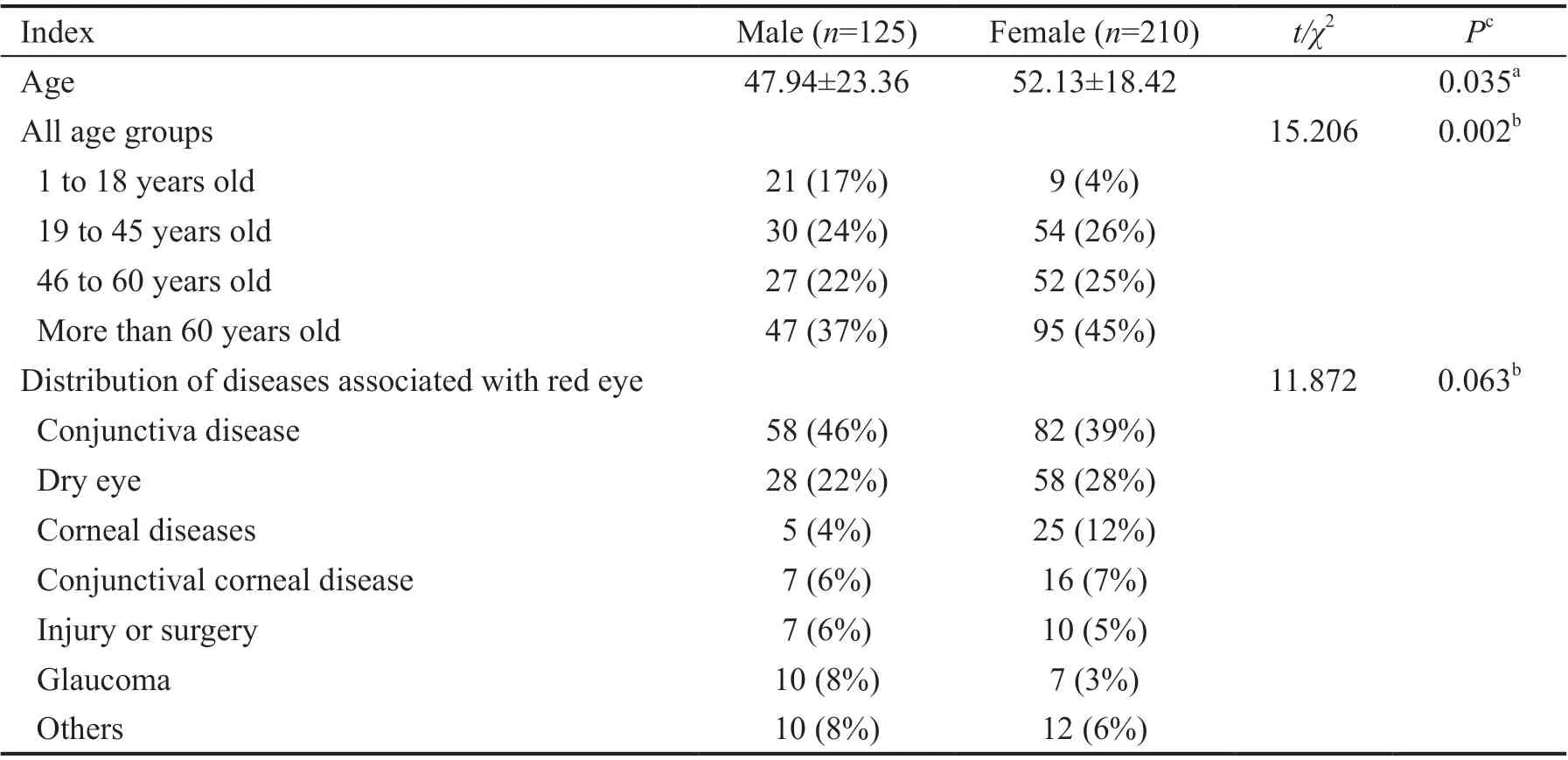
The range of red-eye-related conditions included conjunctival disease, dry eye, corneal disease, conjunctival corneal disease,trauma or surgery, glaucoma, and other ocular diseases. Due to the very low prevalence of progressive pterygium, scleritis,and uveitis in in the Shanghai data, these were classified as‘others’. No significant difference in disease distribution wasfound between males and females (
=11.872,
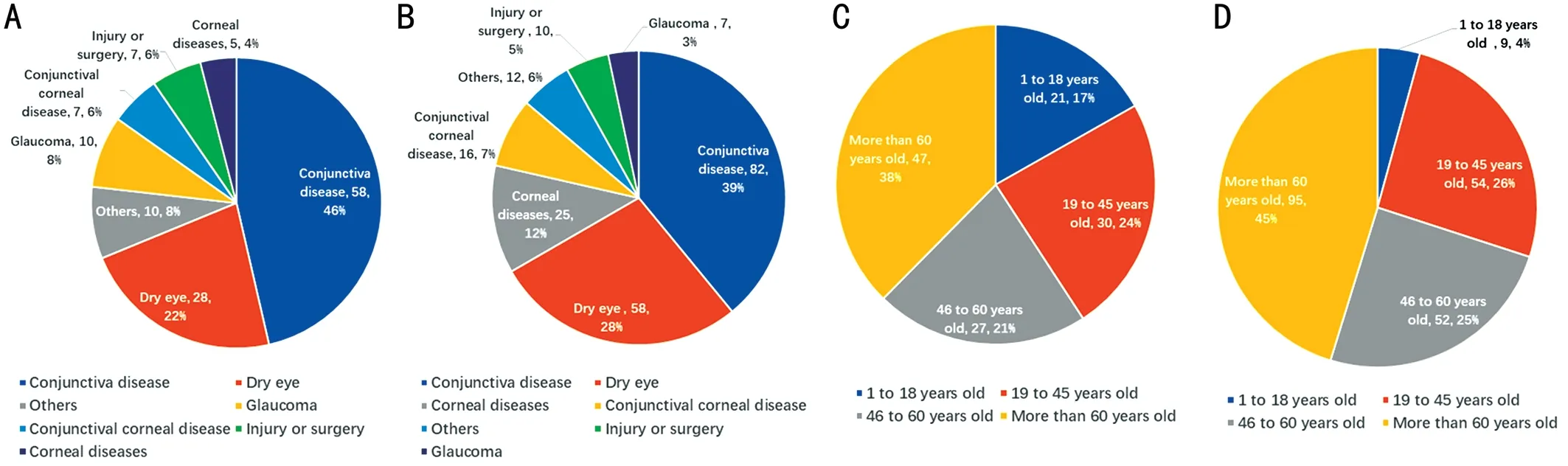
=0.063).In both genders, the most frequent causes of red eye were conjunctival disease and dry eye. The above data are shown in Table 1, Figures 1 and 2.
Clinical Data Data were collected from continuous cases of red-eye patients admitted to the Ophthalmology Center of Xinhua Hospital Affiliated to Shanghai Jiao Tong University and the First Affiliated Hospital of Xinjiang Medical University between November 2018 and September 2019. Demographic and clinical data were analyzed and compared between the two hospitals.
Incidence of red eye and related disease distribution in different ethnic groups in Urumchi center Red eye cases at the ophthalmology clinic of Urumchi center included data from 314 Han people and 101 Uygur people, aged 39.87±22.47y and 43.72±20.18y, respectively (
=0.126).Significant differences were found in the age distribution of red eye incidence and the distribution of red-eye-related diseases between the two ethnic groups (
=8.903,
=0.031,and
=24.576,
=0.002 respectively). Conjunctival diseases accounted for a large proportion in the distribution of red-eyerelated diseases in both ethnic populations. The incidence of red eye in children (1-18 years old) was higher in the Han than the Uygur population. Trauma or surgery explained a higher proportion of red-eye in the Uygur patients than the Han patients. No significant differences were found in the types of conjunctival and corneal diseases causing red eye in the two ethnic groups (
=2.753,
=0.225, and
=5.992,
=0.068).Results can be seen in Table 3 and Figure 5.
Incidence of Red Eye in Different Sexes and the Distribution of Related Diseases in Shanghai Clinic Data were gathered from records of 125 males and 210 females aged 47.94±23.36 and 52.13±18.42, respectively (
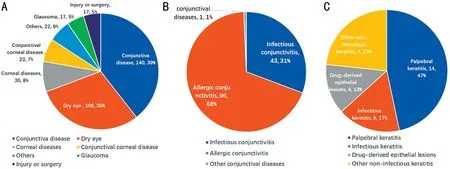
=0.035) at the Shanghai Ophthalmology Clinic and included in the study. Of these, conjunctival diseases accounted for 39%, the majority(68%) of these being allergic conjunctivitis, followed by dry eye diseases accounting for 30%. Among cases of corneal disease, palpebral keratitis accounted for the largest proportion,at 47%. When cases were categorized by age a significant gender difference was found in the age of onset of red-eye(
=15.206,
=0.002). In children (aged 1 to 18y) the prevalence of red eye was 17% in males and only 4% in females.
Diagnostic criteria for conjunctivitis were as follows:inflammation or infection of the conjunctiva characterized by dilation of the conjunctival blood vessels, with conjunctival congestion and edema, with or without secretions. Ocular discharge type and symptoms were used to determine the cause of conjunctivitis. For example, purulent secretions are usually caused by bacterial conjunctivitis, while watery secretions are characteristic of viral conjunctivitis, and itching is also associated with allergic conjunctivitis
. The type of secretions or other clinical symptoms are not unique to one type of conjunctivitis. All other diagnoses of red-eye related diseases were differentiated by ophthalmologists with rich clinical diagnosis experience.
Statistical Methods In this study, SPSS26.0 software was used for statistical analysis of the data of each center. For the comparison of male and female ages, the independent
-test method was used. For other different groups of cases, we used the Chi-square test. Besides, we performed a binary Logistic regression analysis of risk factors for allergic conjunctivitis.All statistical thresholds were
<0.05.
Red eye was defined as a general term to describe irritated or bloodshot eyes
. It was an identifiable marker of acute or chronic inflammation of the ocular surface, local or systemic inflammation. The main pathophysiological changes of red eye are the changes of corneal morphology due to potential inflammatory reaction on the eye surface, the influence of sub-basal plexus on the regeneration and coverage of corneal epithelium, and the effect of hormone or local mechanicalcompression on the formation of tear film. inflammatory mediators and hypersensitivity can lead to high permeability of tear film
. In the ophthalmology clinic, red eye is one of the most common symptoms of ocular discomfort. Red-eye patients usually seek urgent care, and their clearly apparentsymptoms may be the first indicators of local or systemic disease at an early stage. For ophthalmologists, it is important to identify the various causes of red eye so that appropriate treatments are prescribed. Therefore, understanding the epidemiological characteristics of red eye is very important for the treatment of related disease.
RESULTS
Diagnostic Disease Records of all patients presenting with ocular disease during the study period were collected. Eligible ocular conditions included infectious conjunctivitis, allergic conjunctivitis, trachoma, blepharitis, dry eye, progressive pterygium, other conjunctival diseases, infectious keratitis,palpebral keratitis, drug-derived epithelial lesions, other non-infectious keratitis, scleritis, glaucoma, uveitis, trauma,and other ocular diseases caused by eye surgery. Infectious conjunctivitis includes bacterial, fungal, and viral conjunctivitis as well as infectious conjunctivitis of indeterminate type.
Ethical Approval All research methods were approved by the committee of the medical ethics of Xinhua Hospital Affiliated to Medical College of Shanghai Jiao Tong University and were in accordance with the Helsinki declaration and its later amendments or comparable ethical standards (XHEC-D-2020-023). All subjects were explained the purpose, method, potential risks and signed an informed consent form.
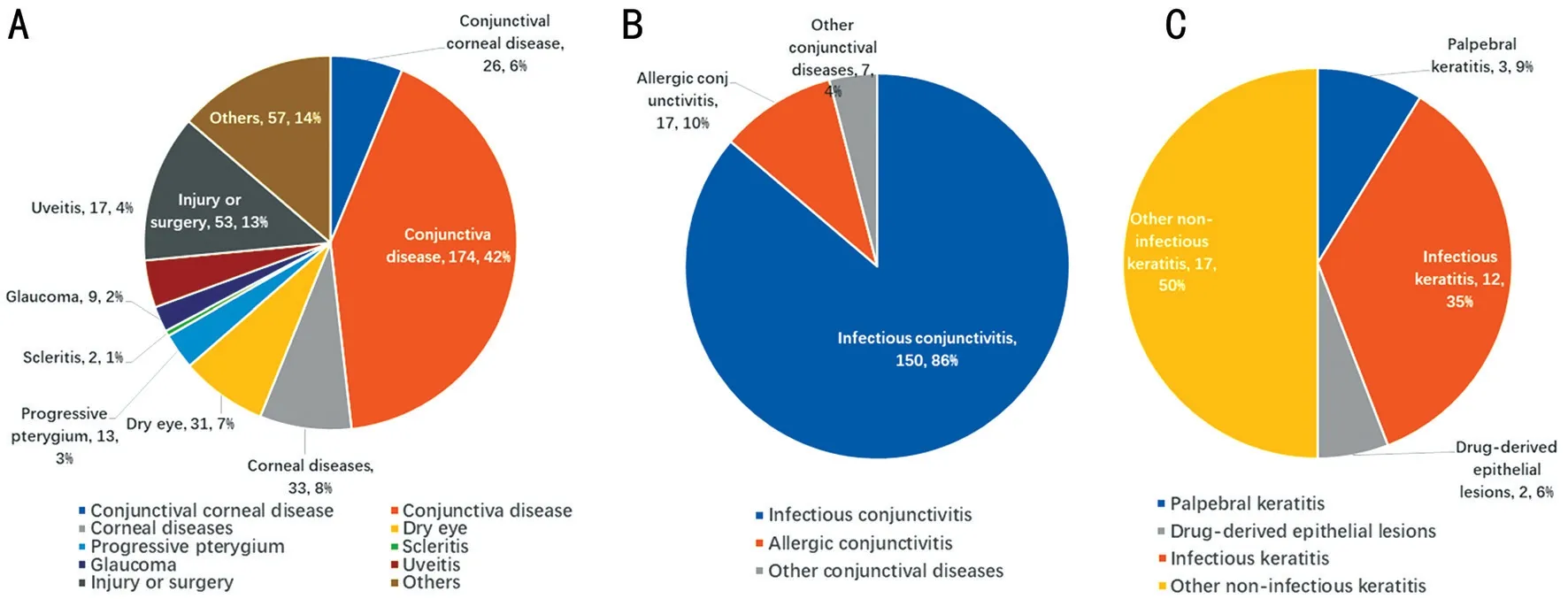
Incidence of Red Eye in Different Genders and the Distribution of Related Diseases in Urumchi Center Data from 202 males (aged 37.98±23.11y) and 213 females (aged 43.50±20.53y;
=0.010) were gathered at the ophthalmology clinic of Xinjiang hospital, and included in the study.Conjunctival diseases accounted for the largest proportion of cases, at 42%. Among these, infectious conjunctivitis accounted for the largest proportion at 86%, and allergic conjunctivitis a relatively small 10%. In the category of corneal disease, non-infectious keratitis accounted for the largest proportion at 50%, followed by infectious keratitis,and corneal diseases caused by palpebral keratitis accounted for only 9%. Data were grouped according to the same age categories used for data at the Shanghai clinic, and a significant difference was again found in the age of onset of red eye between men and women (
=10.651,
=0.014). Male children(aged 1 to 18y) accounted for 21 percent of all cases and females in this age group accounted for 10 percent. Due to the relatively high prevalence of progressive pterygium, scleritis,and uveitis among the subjects in the Urumchi center, these were categorized separately and not grouped as “others”. A significant difference in disease distribution was found between males and females (
=24.969,
=0.002). In men, conjunctival diseases accounted for the largest proportion (38%), followed by trauma or surgery (19%). Conjunctival disease was also the most common cause of red-eye in women (45%), followed by dry eye and other causes (11%). Results are shown in Table 2,Figures 3 and 4.
Patient and Public Involvement By collecting the ophthalmic clinical outpatient information of the subjects, we screened out the patients with red-eye as the chief complaint and studied the specific etiology of red eye. None of the subjects were recruited for this study. The results of this study can be used to analyze the specific etiology of red eye patients and contribute to the prevention of red eye and recurrence.This study was not a randomized controlled study. It is an epidemiological study of red eye in ophthalmology.
Comparison of Corneal and Conjunctival Diseases in Shanghai and Urumchi Centers Data from both centers indicated that red eye was related to infectious and allergic conjunctivitis, other conjunctival diseases, palpebral, infectious and non-infectious keratitis, and drug-derived epithelial lesions. A comparative analysis of the disease composition ratio between the two centers showed significant differences in the proportions of conjunctival and corneal diseases(
=123.477,
<0.001 and
=14.608,
=0.001). Specific data are shown in Table 4.
再有人找老崔,老崔就說(shuō),我反正不行了,我只能做縮頭烏龜了。業(yè)主生氣說(shuō),既然物業(yè)都撒手不管,我們也亂來(lái)了。說(shuō)著就真的亂來(lái)了,也不管地上有沒(méi)有固定的車牌號(hào)碼,看見空當(dāng)就停,先來(lái)先搶。也有人干脆將原先地上寫著的別人的車牌號(hào),改成了自己的車牌號(hào)。再有業(yè)主以購(gòu)房合同相威脅,老崔就說(shuō),我不客氣了,我要以牙還牙了,你們不是拿購(gòu)房合同說(shuō)事嗎,我們也拿購(gòu)房合同說(shuō)事,反正購(gòu)房合同上沒(méi)有寫保證停車的條款,你們告不倒我。
Results of Binary Logistic Regression Analysis of Allergic Conjunctivitis in Different Seasons and Different Genders in Shanghai Center Binary Logistic regression indicated that,spring, summer and autumn were all important risk factors for the occurrence of allergic conjunctivitis, compared with winter (
=0.042,
=0.020;
=0.007 respectively), with highest risk in spring. No significant difference in risk for allergic conjunctivitis was found between genders (
=0.657). Specific statistical results can be seen in Table 5.
根據(jù)6上105-2工作面支架工作阻力實(shí)測(cè),r=12 834 kN,p0=5 563 kN,Δhi=600 mm,ΔhA=1 394 mm,計(jì)算得K=3 130 kN。
DISCUSSION
黨的十九大報(bào)告指出,要推進(jìn)能源生產(chǎn)和消費(fèi)革命,構(gòu)建清潔低碳、安全高效的能源體系,這是我國(guó)新一輪能源革命的核心目標(biāo),對(duì)電網(wǎng)企業(yè)轉(zhuǎn)型升級(jí)、改革創(chuàng)新提出了新的要求。云南綠色能源產(chǎn)業(yè)發(fā)展前景廣闊,未來(lái)幾年,以水電為基礎(chǔ)的云南能源產(chǎn)業(yè)發(fā)展步伐將不斷加快,新的能源發(fā)展格局,將對(duì)電網(wǎng)企業(yè)的運(yùn)營(yíng)管理、供電服務(wù)等產(chǎn)生深刻影響。南方電網(wǎng)云南電網(wǎng)公司通過(guò)準(zhǔn)確把握能源發(fā)展的變革趨勢(shì),深入落實(shí)做強(qiáng)做優(yōu)云南綠色能源產(chǎn)業(yè)的部署要求,超前做好工作,以“優(yōu)化主網(wǎng)、做強(qiáng)配網(wǎng)、升級(jí)農(nóng)網(wǎng)”為主線,大力提高云南電網(wǎng)的技術(shù)裝備水平,加快建設(shè)安全、可靠、綠色、高效的智能電網(wǎng)。……
登錄APP查看全文
猜你喜歡
品牌研究(2022年29期)2022-10-15 08:01:00
品牌研究(2022年26期)2022-09-19 05:54:46
品牌研究(2021年31期)2022-01-25 06:41:46
品牌研究(2021年36期)2022-01-21 09:29:28
品牌研究(2021年34期)2022-01-18 10:54:04
品牌研究(2021年35期)2022-01-18 08:45:18
品牌研究(2021年20期)2022-01-11 04:07:56
品牌研究(2021年27期)2022-01-04 06:41:14
品牌研究(2021年17期)2021-12-09 05:06:54
海峽姐妹(2019年3期)2019-06-18 10:37:10
 International Journal of Ophthalmology
2022年7期
International Journal of Ophthalmology
2022年7期
- International Journal of Ophthalmology的其它文章
- Relative peripheral refraction and its role in myopia onset in teenage students
- Incidence and risk factors for vitreous loss in residents performing manual small-incision cataract surgery
- Comparison of minimally invasive glaucoma surgery with trabecular micro-bypass stent and microhook ab interno trabeculotomy performed in conjunction with cataract surgery
- A new bleb-independent surgery namely penetrating canaloplasty for corticosteroid-induced glaucoma: a prospective case series
- Dynamic changes of inducible nitric oxide synthase expression in rat’s retina and its role on blood-retinal barrier injury after acute high intraocular pressure
- Neuromyelitis optica spectrum disorders and anti-myelin oligodendrocyte glycoprotein positive optic neuropathies