
Virtual reality training improves accommodative facility and accommodative range
2022-07-30 10:02:42DongYuGuoYuanYuanShenMiaoMiaoZhuYangYangZhanXiaWeiWangJianHuaXiaBoJiangYangShunGuYanLong
關鍵詞:手術
INTRODUCTION
Virtual reality (VR) refers to the user’s interactive experience with the virtual three-dimensional (3D)world through head-mounted displays and wearable devices.The technology has been widely used in the fields of education, entertainment, medicine, industrial engineering, and commerce, as well as in various civil fields
.
使用 78X-2型顆粒強度測定儀測試成型后秸稈炭的抗壓強度。測量工作在干燥環境下進行,消除潮濕環境對顆粒強度的影響。強度測試過程應迅速,3次測量取其平均值。
In China, more than 600 million people have myopia, with an epidemiological survey indicating that approximately 80% of primary and secondary school students suffer from the condition
; while in Asia, the incidence rate reaches 60%
. Meanwhile, it has been predicted that without any intervention, the myopia prevalence among Chinese students in primary schools, junior schools, and high schools can reach 45.6%, 81.3%, and 90.5%, respectively by 2030
. Moreover,myopia can induce a series of complications including glaucoma, cataract, retinal detachment blindness
, and even mental health complications, such as depression and lower cognitive function
. Therefore, devices that can control or prevent myopia are likely to have a broad market in China.Several investigators have reported that VR devices can ideally simulate outdoor light
, train ciliary muscle, relieve ciliary spasms to release visual fatigue
, and slow down the development of myopia. Furthermore, Shibata
revealed that visual acuity increased after viewing stereoscopic 3D images on developed displays, which subsequently prompted Zhao
to hypothesize that specially designed VR devices may help to prevent myopia. However, multiple studies have reported inconsistencies between accommodation and convergence when viewing 3D videos, which may be due to functional eye conditions such as visual fatigue, dry eyes,transient accommodative strabismus, phorias, amblyopia,and video terminal syndrome
. Interestingly, Kim
reported that watching 3D videos can lead to transient myopia.Currently, the effects of VR device use on vision are not clear,and it is unknown if a specially designed VR training device can eliminate visual fatigue or improve myopia.
Sixty subjects ranged 18 to 60 years old admitted to the First Affiliated Hospital of Zhejiang University or Shulan Hospital from November 2018 to July 2019, who were willing to participate in this clinical trial, were enrolled, and all of them were capable of cooperating with all procedures. The inclusion criteria were a corrected visual acuity in both eyes of >0.8, binocular stereopsis, -6.00 D≤ spherical equivalent≤6.00 D, -3.00 D≤ astigmatism ≤+3.00 D, and no evidence of anisometropy. Subjects had no history of organic ophthalmic diseases, ophthalmic surgeries, or serious systemic diseases,and they had normal cognitive ability.
SUBJECTS AND METHODS
Ethical Approval The study protocol was approved by the University Research Ethics Committee, and this clinical trial has been registered in the Chinese Clinical Trial Registry(ChiCTR2000029793).
The aim of this study was to evaluate the visual acuity,diopter, pupil size, accommodative range, accommodative facility, and visual fatigue symptoms, as well as correlations among these parameters, before and after use of a VR training device specially designed for accommodation training. We also determined the effects of the VR training device on accommodation and convergence.
Parameters of VR Training The VR training device used in this study was produced by Hangzhou Look Technology Co., Ltd. The main body of the device was comprised of a VR headset and a mobile phone (Figure 1). The VR headset lens was constructed with optical polymethyl methacrylate(PMMA) materials. The single field of view angle was 110°(55° for half field of view), and the distance of the virtual image displayed on the mobile phone screen from human eyes was 25 cm. The LeTV Max 2 mobile phone (1440×1280 p)was used. The brightness of the mobile phone screen was set to automatic mode before the test.
VR video was produced by Hangzhou Look Technology Co.,Ltd. The device used “depth of field synchronization” and“focus follow-up” to produce videos and real-time binocular images, which simulated the subtle differences in the angle,path, and light intensity of the incident glasses in distant and nearby views. In the video, the subject moved back-andforth and turned around. In the long-range view (
, infinity),the subject had an infinite convergence angle of 0°. In the short-range view, the convergence angle was 30°, which was approximately 11.6 cm away from the human eyes (calculated using a pupil distance of 62 mm, which is slightly different in individuals with different pupil distances). The subject was located in front of the eyes and turned around three times with a half viewing angle of 30°. The total length of the video was 15min, and the frame rate was 60 frames per second. One cycle consisted of one forward and backward motion each at low speed, as well as one forward and backward motion each at high speed, with the subject turning around three times.Each cycle lasted approximately 30s (Onlin supplementary,Video 1).
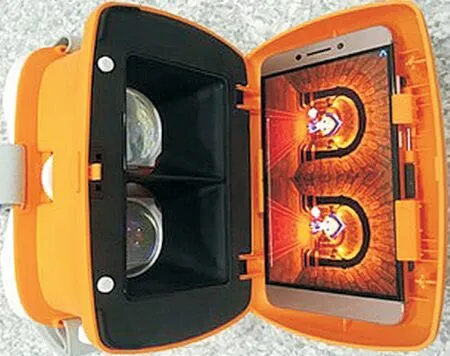
Treatments The short-term treatment group consisted of 40 randomly assigned subjects (11 males and 29 females) with an average age of 33.5±13.4y. Baseline data were measured after a short shut-eye rest for approximately 5min when subjects were involved. The subjects wore the VR device for 15min,during which they gazed at the moving object in the video.Then, they closed their eyes and rested for 5min. Last, the subjects underwent the 6 main observation indexes tests.
According to our results from the long-term treatment group, after one-month continuous use of the VR device,no significant changes were found in naked distant vision,corrected visual acuity, diopter, pupil size, or visual fatigue. In a previous study involving individuals (32 subjects aged 20±1y and 12 subjects aged 46.6±3.5y) exposed to 6min use of a VR device for 11 consecutive days, it was reported that the distant vision improved in both the young and the old groups after 5d, with the myopic diopter decreasing in the young group
.However, the authors failed to provide details about the VR device, the number of training sessions per day, and the other specific endpoints. Therefore, it was difficult to conduct indepth comparative analyses. Based on our results in this study,we assumed that the visual acuity measurements were taken immediately after the VR training, and speculated that the improvement in distant vision was caused by light adaptation to myosis instead of myopia relief.
Main Observation Indexes and Examination Methods The 6 main observation indexes included: 1) naked distant vision; 2) best-corrected visual acuity; 3) diopter (using the ARK-1S automatic computer optometer, which recorded the spherical equivalent); 4) accommodative range (using the ARK-1S automatic computer optometer); 5) accommodative facility (performing with the flipper glasses, recording cycles per minute); 6) visual fatigue symptoms (
a questionnaire including 11 items: eye dryness, double vision, lacrimation,puffy eyes, photophobia, eye-strain, headache, dizziness,nausea, drowsiness, and difficulty concentrating; each parameter was divided according to the degree of subjective feeling, and scores of 0 to 5 corresponded to “completely no”,“uncertain”, “a little”, “feeling”, “stronger feelings”, and “very strong feelings”; the total score of all the items was the visual fatigue score).
每個人都希望它帶來愉悅、飽足、和諧、舒適、溫暖、安全。這是一廂情愿的念頭。這條河流的方向,最終遠方是獲得釋然和自由。真正的自由,則是放棄我們對他人的要求和期望,放棄對外在形式的依賴和需索。最終,是對自己所堅持的意愿和妄想的放棄。這種放棄,并不令她覺得婚姻使人頭破血流或者一蹶不振。這是命運賜予給人的一次機會。給予休憩、完成以及思省。

Statistical Analysis SPSS 22.0 Software was used for data analysis. For the 6 main observation indexes, the Kolmogorov-Smirnov test was conducted to determine the normal distribution of the data. If the data conformed to normal distribution, the results were presented as means±SD, and paired sample
-test was performed to compare the differences before and after VR device use; otherwise, the results were presented as medians (P25-P75), and Wilcoxon sign rank sum test of paired samples was performed to compare the differences. For visual acuity, diopter, and pupil size, in-pair correlation tests were performed to examine the correlation between the two groups. If the data from both groups conformed to normal distribution, the Pearson’s test was used; otherwise, the Spearman’s test was used.
<0.05 were considered statistically significant.
RESULTS
This clinical trial is one of the studies that comprehensively evaluated the impact of VR training on vision and explored the relationship among various influential indicators. Unlike other studies, this trial introduced the parameters of the VR training device, which can aide in subsequent analyses. However,multiple limitations are involved in this study. First, this trial did not include juveniles younger than 18 years old due to ethical constraints. Given that ciliary muscle accommodation was improved in adults, and no cases of pseudomyopia or other disorders were found, the conclusion that VR training has no effect on the diopter of human eyes might not be applicable to juveniles. Second, the follow-up was short due to time constraints. Further clinical trials with an observation time of not less than half a year are necessary. Last, the population size was small and subgroup analyses were not performed, which might serve as one of the future directions of further studies.
基于數字圖像處理技術的干制紅棗品種識別方法有利于降低鑒別成本,具有較高的應用價值。研究表明,通過提取干制紅棗的顏色和紋理特征,采用遺傳算法優化支持向量機的方法可以完成山東大棗、新疆灰棗、新鄭大棗以及稷山板棗等4類品種紅棗品種分類。采用遺傳算法優化的支持向量機有利于避免參數選擇的盲目性,有效提高了紅棗分類的穩定性和準確性。在今后的研究中將考慮增加紅棗品種和實驗樣本,提升紅棗品種分類模型的泛化能力。
The accommodative range and accommodative facility of the subjects in the long-term treatment group increasedsignificantly by 0.69 (95%CI, 0.26 to 1.11,
=0.002) and 0.90(95%CI, 0.45 to 1.35,
<0.001), respectively. No changes were observed in distant vision, corrected visual acuity, spherical equivalent, pupil size, or visual fatigue (
>0.05; Table 3).

DISCUSSION
基于T>MIC計算模型評價亞胺培南的臨床方案及療效…………………………………………………… 張 丹等(15):2105

The long-term treatment group consisted of 20 randomly assigned subjects (7 males and 13 females) with an average age of 30.4±11.7y. Following the baseline examinations, the subjects were asked to use the VR device 3-4 times a day for 15min each time. Each intervals between the training sessions were longer than 2h. The individuals were asked to visit the hospital 1mo later (±7d) for the 6 main observation indexes tests. They were asked not to use the VR device or come to the hospital on the same day that baseline measurements were collected. All the tests were completed by professional technicians who were not involved in this research study.
Furthermore, we found that the accommodative range and accommodative facility were significantly increased after using the VR device for 15min, as well as after one-month continuous use of the device, which is consistent with the results of Zhang
. These findings indicate that VR device can improve eyes’ ability to accommodate the lens and delay the development of presbyopia to a certain extent. Due to the unchanged display position in VR devices, stereoscopic images were produced based on the parallax principle, while the real impact of VR device on the accommodative function of the subjects remains controversial
. Shibata
have combined 3D displays with optometric instruments to measure the real-time changes in diopter when subjects were watching 3D films. Although the position of the actual display was not changed, the results showed that the diopter of human eyes accommodated to the distance of the virtual image, suggesting that VR training might play a role in accommodation
.It should be noted that VR training for more than 30min significantly increased visual fatigue while decreased accommodative range and accommodative facility.
羊巴氏桿菌病屬于條件致病菌,廣泛存在于自然界和羊體內,屬于羊體內的一種常在菌群,通常該種致病菌并不表現出明顯的致病能力,但因飼養管理不當,身體抵抗能力下降,會為該種致病菌產生提供條件。
登錄APP查看全文
猜你喜歡
環球時報(2022-12-23)2022-12-23 09:28:37
昆明醫科大學學報(2022年1期)2022-02-28 07:45:04
中老年保健(2021年11期)2021-08-22 03:13:36
昆明醫科大學學報(2021年2期)2021-03-29 07:42:46
河北畫報(2020年10期)2020-11-26 07:20:50
小學閱讀指南·低年級版(2017年1期)2017-03-13 20:07:35
中國衛生標準管理(2015年3期)2016-01-14 03:41:47
中國醫療美容(2015年1期)2015-07-12 10:06:38
鄭州大學學報(醫學版)(2015年2期)2015-02-27 14:50:54
西南軍醫(2014年5期)2014-04-25 07:42:48
 International Journal of Ophthalmology
2022年7期
International Journal of Ophthalmology
2022年7期
- International Journal of Ophthalmology的其它文章
- Relative peripheral refraction and its role in myopia onset in teenage students
- Incidence and risk factors for vitreous loss in residents performing manual small-incision cataract surgery
- Comparison of minimally invasive glaucoma surgery with trabecular micro-bypass stent and microhook ab interno trabeculotomy performed in conjunction with cataract surgery
- A new bleb-independent surgery namely penetrating canaloplasty for corticosteroid-induced glaucoma: a prospective case series
- Dynamic changes of inducible nitric oxide synthase expression in rat’s retina and its role on blood-retinal barrier injury after acute high intraocular pressure
- Neuromyelitis optica spectrum disorders and anti-myelin oligodendrocyte glycoprotein positive optic neuropathies