藏經洞所出千佛刺繡研究
2022-06-30 00:07:51趙豐王樂
敦煌研究
2022年2期
趙豐 王樂


內容摘要:本文所論藏經洞所出千佛刺繡殘長81.3cm、寬63.5cm,現收藏于印度國家博物館。作品以紅、藍、紫、橘等色絲線采用劈針繡出小坐佛、傘蓋坐佛和供養人。小坐佛有頭光,結禪定印,身披袈裟結跏趺坐于蓮花之上。傘蓋坐佛的造型與小坐佛基本一致,用色也基本一致,只是頭頂上方有傘蓋,上下方有白色聯珠帶。繡像上的供養人有三處,男性供養人身穿左衽窄袖圓領袍,系腰帶,足穿皮靴。貴族女供養人身穿長袍,下露裙擺及高頭履頭部。侍女則著圓領窄袖上衣,外套長裙。男女供養人冠式或發式都表現為山形的尖狀物,頭頂均有傘蓋。從技術和造型來看,這件刺繡很可能在山西太原或是山東一帶生產的,年代可能是6世紀末到7世紀初。刺繡原本為掛飾,破損后重新剪裁拼縫,改作袈裟或經巾。
關鍵詞:藏經洞;刺繡;千佛;供養人
中圖分類號:K879.41? 文獻標識碼:A? 文章編號:1000-4106(2022)02-0021-12
Study on a fabric Embroidered with the Thousand-Buddha Motif Found in the Library Cave
ZHAO Feng1 WANG Le2
(1. College of Fashion and Design, Donghua University, Shanghai, 200051;
2. China National Silk Museum, Hangzhou zhejiang, 310002)
Abstract:An incomplete piece of embroidery, 81.3 cm long and 63.5 cm wide, embroidered with a Buddhist pattern,is currently kept in the National Museum of India. The embroidery depicts a small seated Buddha, a seated Buddha under a parasol, and various donor figures using split stitches and red, blue, purple, and orange thread. The small seated Buddha has a halo and wears a kasaya and is seated on a lotus flower in the lotus position with his hands in dhyana mudra. The Buddha under the parasol is similar to the small Buddha in both style and color except that over his head there is a parasol with white bands of linked beads. There are three donors depicted in thescene: a male donor wearing leather boots and a narrow-sleeved, round-collared robe with the front part covering his left side and tied by a belt, a noble female donor wearing a long robeand high-toed boots, and a maid servant wearing a round-collared, narrow-sleeved coat and a long dress. The headwear and hairstyle of both the male and female donors resembles a mountain with a pointed top, above which they hold parasols. Judging from the techniques and styles used to depict this image,it is very likely that the embroidery was produced either in Taiyuan in Shanxi Province, or in Shandong Province between the late 6th century and the beginning of the 7th century. This embroidered fabric was originally used as a decorative hanging. When it became worn out, it was cut into pieces and reused as a kasaya or a cover for Buddhist scriptural texts.
Keywords:Library Cave; embroidery; Thousand Buddhas motif; donors
(Translated by WANG Pingxian)
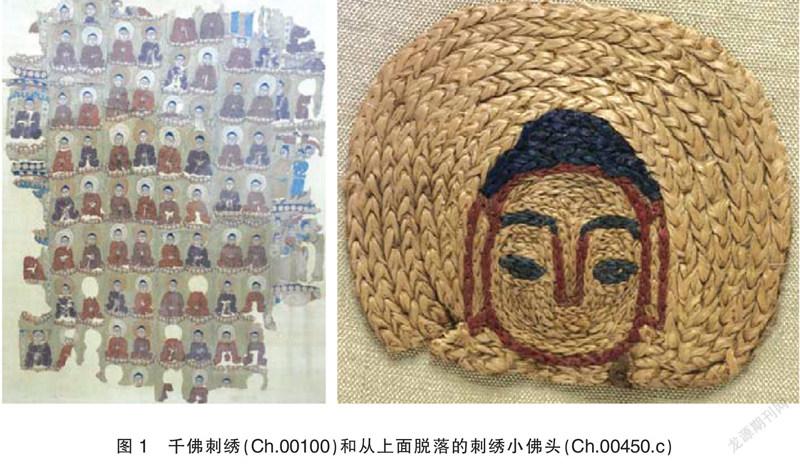
1907年,奧雷爾·斯坦因(Aurel Stein)到達敦煌,從道士王園箓手中獲取了一批藏經洞發現的文物,其中包括一件編號為Ch.00100的刺繡佛像,上面滿繡多尊坐佛及三組供養人像,已殘損,我們將其命名為千佛刺繡。另有一塊編號為Ch.00450.c的刺繡佛頭,被認為可能脫落自前述刺繡佛像[1]。這件刺繡佛像后來收藏于印度國家博物館,但刺繡佛頭被英國的維多利亞與艾爾伯特博物館(以下簡稱V&A)長期借用并存放在倫敦(圖1)。關于這件千佛刺繡,斯坦因在《西域考古圖記》(Serindia)曾有介紹,巫新華博士團隊也對其進行了翻譯。……
登錄APP查看全文