
Neutron activation cross section data library
2022-06-29 09:24:18XiaoLongHuang黃小龍ZhiGangGe葛智剛YongLiJin金永利HaiChengWu吳海成XiTao陶曦JiMinWang王記民LiLeLiu劉麗樂(lè)YueZhang張玥andXiaoFeiWu吳小飛
Chinese Physics B 2022年6期
Xiao-Long Huang(黃小龍), Zhi-Gang Ge(葛智剛), Yong-Li Jin(金永利), Hai-Cheng Wu(吳海成), Xi Tao(陶曦),Ji-Min Wang(王記民), Li-Le Liu(劉麗樂(lè)), Yue Zhang(張玥), and Xiao-Fei Wu(吳小飛)
China Nuclear Data Center,China Institute of Atomic Energy,Beijing 102413,China
Keywords: neutron reaction cross section, unified Hauser–Feshbach and exciton model (UNF), evaluation,activation data library
1. Introduction
The neutron activation cross sections are of importance for a variety of nuclear applications and nuclear physics studies. They are widely used in neutron activation analysis, isotope production, medical technology, oil well logging, and mineral exploration and so on.
For reactor neutron metrology applications,reactor physicists are interested in updating and improving the multigroup nuclear data input to neutronic codes and point-data input to Monte Carlo codes. For example, the famous Geant4 simulation package relies on the evaluated cross section files seriously. To improve the flexibility of Monte Carlo simulations, update of the evaluated neutron cross section libraries with high precision is required. Meanwhile,the accurate neutron activation cross section is one of the important factors to select suitable materials for reactors. Another application of activation cross sections is that some reactions can be used as threshold detectors to measure neutron spectra of reactors or some neutron fields, which may provide significant information for reactor shielding calculations and for other purposes.
To meet these requirements,some neutron activation data libraries have been developed. There are two famous and widely used activation data libraries in the world. One is the newly issued activation cross section library which is named IRDFF. It contains about 79 dosimetry reactions within the neutron energy range from 10-5eV to 20 MeV. So its application is limited. Another important activation data library is called EAF-2010. It covers 816 target nuclei in the energy range between 10-5eV and 60 MeV.Recommended neutron reaction data for many targets are from TALYS calculations with global parameters directly. The most important initiative of EAF-2010 is designed for fusion applications.
In this paper, we present the first activation data library developed at China Nuclear Data Center (CNDC). It covers 818 target nuclei including unstable target or isomeric target nuclei within the induced neutron energy range region from 10-5eV to 20 MeV. It is somewhat different compared to the similar activation data libraries in the world. Because the newly or best experimental data sources published within recent years are considered and a series of sophisticated nuclear reaction model codes are used for data production in our issued high quality library. Also data testing against the cross section systematics are included.The full evaluated dataset containing the evaluated activation cross sections in this paper is openly available at http://doi.org/10.57760/sciencedb.j00113.00024.
2. Evaluation procedures
When the experimental data are not enough to provide all nuclear reaction cross sections or target nuclei is unstable, theoretical calculation is necessary. In order to perform the evaluations,CNDC has developed a series of methods and techniques which include the experimental data evaluation,the nuclear reaction model codes[1–3]and systematics. Regarding the available tools, the most important result of this exercise is the improvement of the systematic cross section formula. A new systematic[4]has been derived which is based on the most recent recommended experimental values.
Generally, the following main evaluation procedures are considered. All available experimental data have been examined and analysed carefully. If there were many experimental data for a reaction channel, the evaluated experimental data were selected for curve fitting by using a program of orthogonal polynomial fit or spline function fit from threshold to 20 MeV.The fitting results were adopted as the recommended cross sections for this reaction channel. If the experimental data were not enough for curve fitting, the theoretical model calculations were performed using a series of nuclear reaction model codes, UNF, FDRR, APMN, etc. For model calculation, there are two different cases. One is a very detailed calculation with various adjusted parameters so as to reproduce these specific experimental data. Another is the so-called large scale, default calculations for many nuclides, in which case adjustment to experimental data is impossible. Finally the systematics were used to re-normalize the calculated cross section for some reaction channels.
2.1. Experimental data
Experimental data in EXFOR[5]library were collected and used for the evaluation of reaction cross sections or a guidance of theoretical analysis and calculations. Usually there are two procedures of evaluation experimental data. One is the physically evaluations, where the relevant details were analyzed carefully and some corrections were done. Another is the mathematics processing which deduced the optimum data.Generally if there are enough experimental data that cover the whole energy region for a certain reaction channel, the evaluated experimental data can be adopted as the recommended cross sections for this channel. Otherwise parameters adjustment to experimental data will be made by model calculations.
2.2. Optical model and optical potential parameters
The local optical potential parameters play an important role in theoretical calculations and evaluations for a certain nuclei. In order to obtain a set of local neutron optical model potential parameters for a certain element or nuclei,the automatically searching optimal neutron optical potential parameters(APMN[3])code was used. APMN code can search automatically the optimal neutron potential parameters using measured(n, total), (n, non), (n, el) reaction cross sections and elastic scattering angular distributions of these nuclei.
When there was no experimental information or little experimental data,the relevant measured data of neighbor nuclei were used to obtain the local optical potential parameters. If any experimental data was impossible for a nuclide or neighbor nuclei,global parameters of Ref.[6]were used.
2.3. FDRR model calculations
The FDRR[2]code with the full diagonalR-matrix approach and LUNF[1]code with the nuclear statistical model were combined to generate the complete neutron data for the light mass region.
FDRR is the short expression of full and diagonal reducedR-matrix. It includes fourR-matrix applications. They are multiple level and reducedR-matrix method (MLBW),diagonal energy shift reducedR-matrix method, fullRmatrix method,and un-diagonal energy shift reducedR-matrix method. It can be used to calculate cross sections,angular distributions,and polarization data of 2-bodies reactions.
LUNF[7]code was developed and used for 1p-shell light elements, which was based on the unified Hauser–Feshbach,exciton model, the statistical theory of light-nucleus reaction and application(STLN).Angular momentum and parity conservations were considered in equilibrium and pre-equilibrium processes. Cross sections, angular distributions, and double differential cross sections in the fast neutron region can be calculated by this code.
2.4. UNF series model calculations
UNF[1]is short for unified Hauser–Feshbach and exciton model, which is compiled by FORTRAN language. It is a modern nuclear model code system for the theoretical calculation of nuclear reaction cross sections, which consists of two series. One is the so-called UNF code which is used to obtain the reaction cross sections in the medium heavy mass region(structural materials nuclei,fission product nuclei). The other is called FUNF which is used for actinides or fission nuclides.
The optical model, the unified Hauser–Feshbach with width fluctuation correction and angular momentum dependent exciton model are included in the common UNF codes system. For the level density,the composite formula proposed by Gilbert and Cameron, consisting of a constant temperature law at low energies and a Fermi gas expression at high energies, is applied. Energy-dependent shell effects are included. Discrete levels are from the Reference Input Parameter Library-3(RIPL-3).[8]In addition,the fission rate adopts the Bohr–Wheeler formula in FUNF code,and the fission process occurs only in the equilibrium process when the incident neutron energies are below 20 MeV.
UNF only considers gammas, neutrons, protons,deuterons, tritons, helions, alpha-particles and fission emission below 20 MeV. Usually there are two selections when using UNF codes. The first selection is a detailed theoretical analysis and calculations with various adjusted parameters(related initial parameters selected from RIPL-3)to reproduce the experimental well.Another case is a default calculation for many nuclides especially for unstable target when there are no or few experimental data.
The most straightforward validation of evaluated data library is a direct comparison with differential data. As an example,the evaluated cross sections of93Nb(n,2n)92mNb reaction is showed in Fig. 1. The present result is shown by red lines. Experimental data[9–14]are marked by various symbols.As seen in the figure clearly,the evaluated cross sections show a good agreement with the experimental data.

Fig.1. Cross section of the 93Nb(n,2n) 92mNb reaction.
2.5. Resonant channel and resonance parameters
The induced-neutron energy is from 10-5eV to 20 MeV in the present data library.In so large energy range,if there exists a resonant channel,the reaction cross sections are divided into two regions: “resonance” and “smooth” at the boundary energy about several keV to hundreds keV depending on the target nuclide. The thermal neutron cross sections and resonance parameters are taken from TENDL-2019 or JENDL-4.0 library directly because CNDC has no ability of dealing with resonance parameters. For convenience in applications, all resonance parameters are already converted into a linearised point-wise format,and reasonably connected at the boundary energy. To calculate the point-wise cross section from resonance parameters,the ENDF/B pre-processing codes(PREPRO)[15]were used.
The PREPRO package consists of 18 computer codes.They are developed to convert ENDF/B formatted neutron data to a form in which the data can be used in applications. In the present work, three codes, LINEAR,RECENT and SIGMA1 from PREPRO package are adopted to produce the point-wise cross section from resonance parameters. The main function of LINEAR code is designed to convert ENDF/B file 3 data to linear–linear interpolable form. The main function of RECENT code is designed to reconstruct the resonance contribution to the cross section in linearly interpolable form, add in any linearly interpolable background cross section and output the result in the ENDF/B format. The resonance contribution is calculated for capture (MT=102) and fission (MT=18)channels. The main function of SIGMA1 code is designed to Doppler broaden neutron induced cross sections. Each section of cross sections(file 3)is read from the ENDF/B format. The data is Doppler broadened,thinned and output in the ENDF/B format.
3. Data format and contents of the data library
The standard ENDF-6 data format is adopted to store the recommended data. Brief states about the evaluation method,model codes used for calculation and reaction channels are presented in the file MF=1 with MT=451. The individual reaction cross section is given in MF=3,MF=9 or MF=10.When a reaction populates the ground state only, MF=3 is usually used. When a reaction can populate isomeric state,the individual reaction cross sections are given in MF=9 or MF=10 dependent on its reaction threshold value. For the resonant channel, the total reaction cross section is stored in MF=3 and the branching isomeric ratio in MF=9 when it exists. MF=8 specifies residual nucleus where the isomeric or non-isomeric state information can be found.
The activation data library contains 818 stable and unstable target nuclei from1H to257Fm within the neutron energy region of 10-5eV–20 MeV.All the resonant channels are already converted into a linearised point-wise format. Table 1 gives the general contents for each nucleus. Table 2 gives all nuclear reaction channels(MT numbers)in MF=3,MF=9 or MF=10.
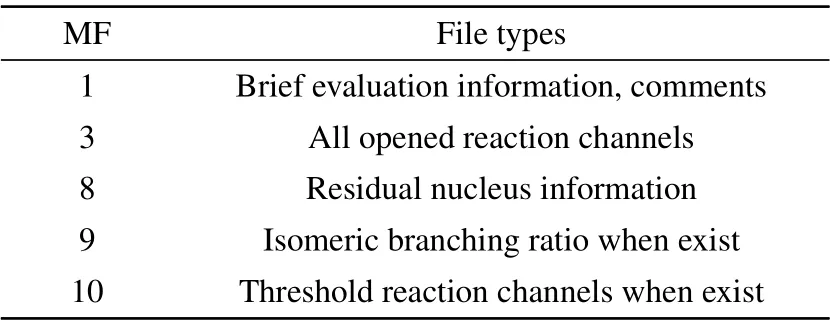
Table 1. File types in activation data library.
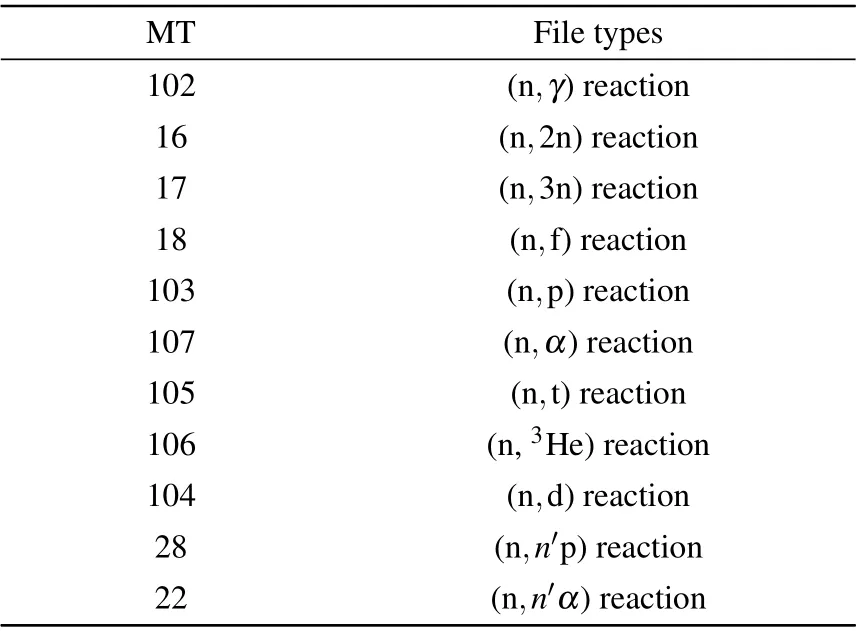
Table 2. Nuclear reaction channels in activation data library.
4. Validation
Format and physics checking have been performed for the activation data library using CHECKR, FIZCON and PSYCHE codes. It is shown that no significant error messages occurred. Meanwhile activation data library can be tested by the validation for consistency with the available experimental database or with predictions from systematics,theoretical calculations.

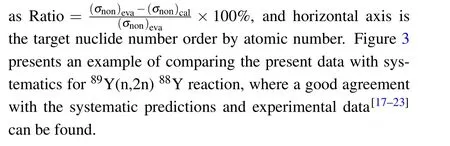
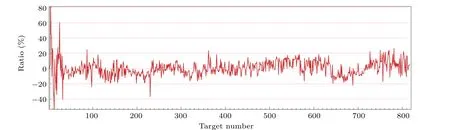
Fig.2. Comparing the relative deviation between the calculated and evaluated(n,non)reaction cross sections.
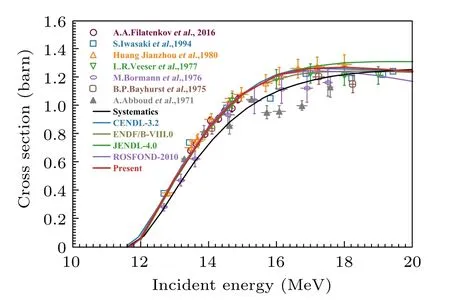
Fig. 3. Comparison the present data with systematics for 89Y(n,2n) 88Y reaction.
5. Conclusion
The Neutron Activation Cross Section Data Library has been established at CNDC for the first time. 818 stable and unstable target nuclei from1H to257Fm are included in this library within neutron energy region of 10-5eV–20 MeV.Compared with EAF-2010 library, the present activation data are evaluated on the basis of the best experimental data sources within recent years and a series of sophisticated nuclear reaction model codes calculations. Meanwhile, a data testing or normalizing is made by systematics. Reactions with no experimental data are default calculated by global parameters using UNF code system. Analysis of these UNF calculations shows that the theoretical results are of a very high quality,producing excitation function curves with a physically good shape.
Some improvement processes of cross section evaluations were specially considered in the present neutron activation data library. When there were many experimental data that cover the whole energy region for a certain reaction channel,the best experimental data were selected to do curve fitting by using a program of orthogonal polynomial or spline function fit from threshold to 20 MeV.The best fitted values were adopted as the final evaluations. Otherwise if the relevant experimental data were not enough for curve fitting, the best evaluation or possible existing evaluation was adopted. These evaluations were usually based on UNF model calculations with local parameter and adjusted to fit the available experimental data; or other library is taken, for example a resonant channel in some case. Especially for a nuclide with no experimental information, large scale model calculations using the UNF code system with global parameters were performed. In this case, adjustment to experimental data is impossible. The evaluated neutron activation data are from these default model calculations and in some cases these have been renormalized to cross section systematics.
The recommended data are stored by standard ENDF-6 format in activation data library.
Data availability
The data that support the findings of this study are openly available in Science Data Bank at http://doi.org/10.57760/sciencedb.j00113.00024.
- Chinese Physics B的其它文章
- Switchable terahertz polarization converter based on VO2 metamaterial
- Data-driven parity-time-symmetric vector rogue wave solutions of multi-component nonlinear Schr¨odinger equation
- Multi-phase field simulation of competitive grain growth for directional solidification
- A novel similarity measure for mining missing links in long-path networks
- Effects of electrical stress on the characteristics and defect behaviors in GaN-based near-ultraviolet light emitting diodes
- Dynamically controlled asymmetric transmission of linearly polarized waves in VO2-integrated Dirac semimetal metamaterials