CLOSE ENCOUNTERS
2022-06-19 05:49:26
漢語(yǔ)世界 2022年3期
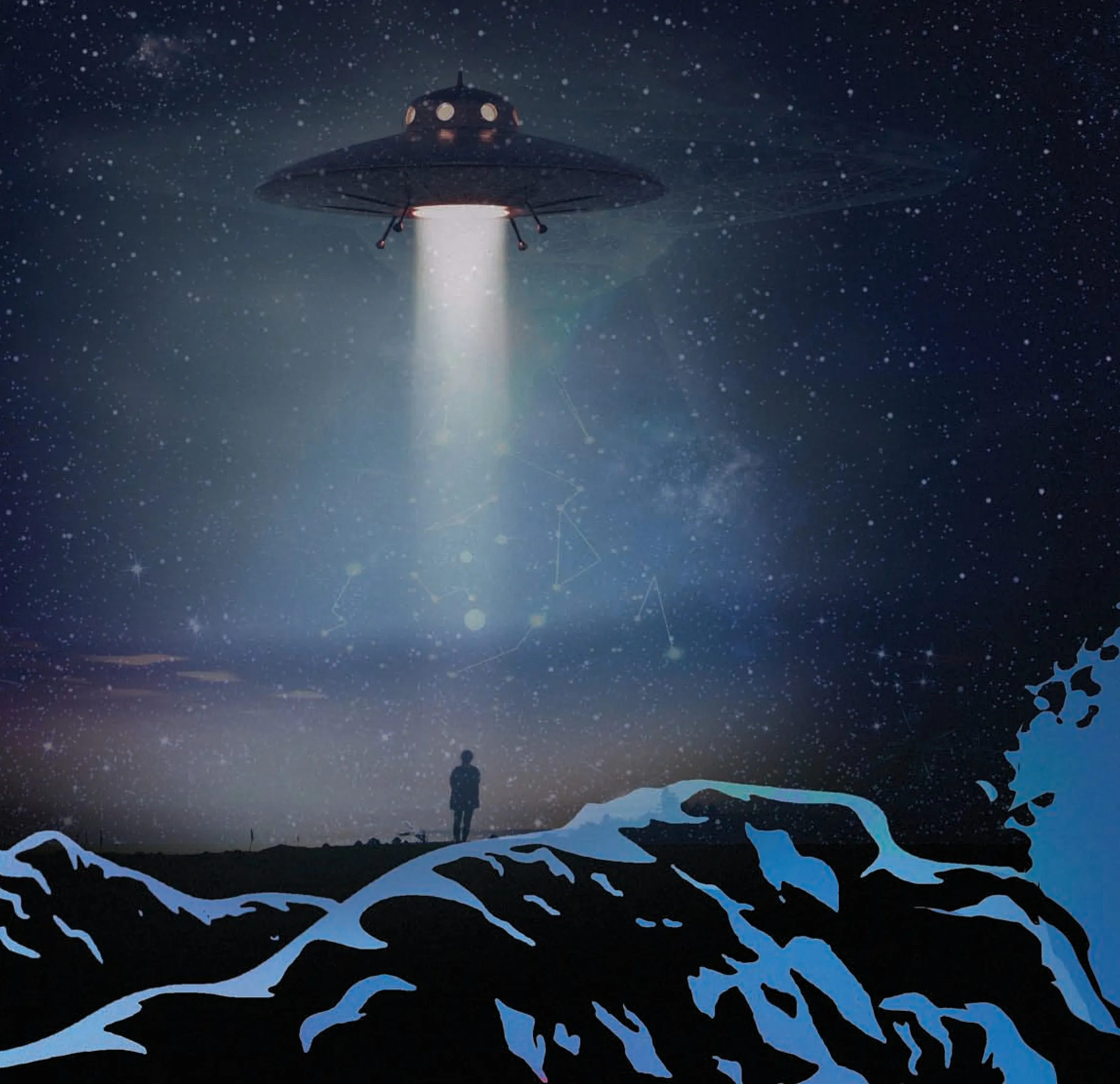
TEXT BY SAM DAVIES ILLUSTRATION BY CAI TAO PHOTOGRAPHS FROM VCG AND DOUBAN
As interest in science fiction and space exploration grows, China’s grassroots UFO enthusiasts continue to search for answers
除了科幻小說(shuō)家和太空科學(xué)家,還有人一直在尋找著外星人
Zhang Jingping had never thought about becoming an ambassador, but once the aliens from Planet Dongsheng got in touch, he couldn’t refuse.
“Their empress Li Guanyin sent a direct message saying that I should be the ambassador of their planet…it’s one of the most important things I do now,” the 52-year-old amateur UFO researcher tells TWOC during a three-hour long conversation, in which he speaks effusively about his many close encounters of the third kind over the past three decades.
According to Zhang, his alien employers hail from the Sirius solar system, are 1.9 meters tall, may be able to pass through solid walls, and only communicate with him through a select few human intermediaries (Zhang has never spoken to them directly). They’ve tasked him with establishing diplomatic relations between their planet and some countries on Earth, promoting science and technology, and predicting and alleviating natural disasters.
They are just one of the alien civilizations Zhang claims to have come across since he began investigating UFO sightings and reports of alien contact in 1990. This was the beginning of a decade when UFO clubs and research groups in China boomed, magazines and publications about aliens flourished, and reports of sightings multiplied.
The 90s boom in UFO enthusiasm has since died down, but the research groups aren’t totally extinct: The catch is they now have to register with a government body such as the China Association for Science and Technology, pushing many UFO organizations to close. But dedicated hobbyists like Zhang, whose day job is running an advertising agency (aptly named Beijing Flying Saucer Advertising), are still hunting for more proof that ETs live among us, despite skepticism from officials and disdain from the mainstream scientific community.
Interest in visitors from another planet could be primed to soar once more in China. Social media and smartphones with cameras have made reporting alleged UFO sightings easier than ever, while Chinese science fiction has seen a renaissance through writers such as Liu Cixin, whoseThree-Body Problemimagines chaos when people on Earth attempt to make contact with alien civilizations. Among the general public, there’s booming interest in space travel, extraterrestrials, and celestial phenomena: There’s a “Mars Camp” in a desert in Qinghai province for tourists to experience what life might be like on the red planet, while millions tuned in to watch a livestreamed physics lesson for middle-schoolers led by astronauts on China’s Tiangong Space Station in December last year.
Likewise, China’s space program, which put the Tiangong Space Station into orbit above the Earth in April 2021, has driven public interest in space exploration with a string of launches in recent years. The country’s researchers now have access to the Five-hundred-meter Aperture Spherical Telescope (FAST), the world’s largest radio telescope of its kind, which was constructed in Guizhou province to scan the vast emptiness of space for radio signals that might indicate alien life.

A “Mars Camp” in Qinghai province taps into growing curiosity about space and sci-fi to attract tourists
In the 32 years Zhang has been investigating UFOs, there has been no shortage of strange incidents for him to probe. In 1994, Meng Zhaoguo, a farmer from Heilongjiang province, said he saw a UFO parked on Fenghuang Mountain one evening. When he and his niece’s husband tried to approach the craft, he says a powerful but invisible force, which felt like an electric current moving through his body, stopped him from getting any closer. Later, he claimed the aliens took him from his bed onto their spaceship and that a three-meter-tall female alien had sex with him for 40 minutes, telling him their child would be born 60 years later.
Zhang investigated and concluded that the incident really took place, citing the fact that the ground and trees at the alleged UFO landing site were scorched even months later, a Geiger counter appeared to go haywire in Meng’s home, and that Meng had “nothing to gain” from lying.
In 1999, Cao Gong, a school principal in Beijing, claimed aliens took him into their flying saucer where they performed a procedure on him that healed a sick girl also abducted by ETs. More recently, in 2012 Xiang Kuansong, a retired soldier who first reported contact with the Dongsheng aliens, and his sons Xiang Yusheng and Xiang Yuyi, built a “l(fā)iaison station” for their alien friends in Mayang village, Hunan province; and last September a Beijing man reported to Zhang that aliens repeatedly abducted him in his sleep, took him to their spacecraft, and made him drink a green, grassflavored liquid.
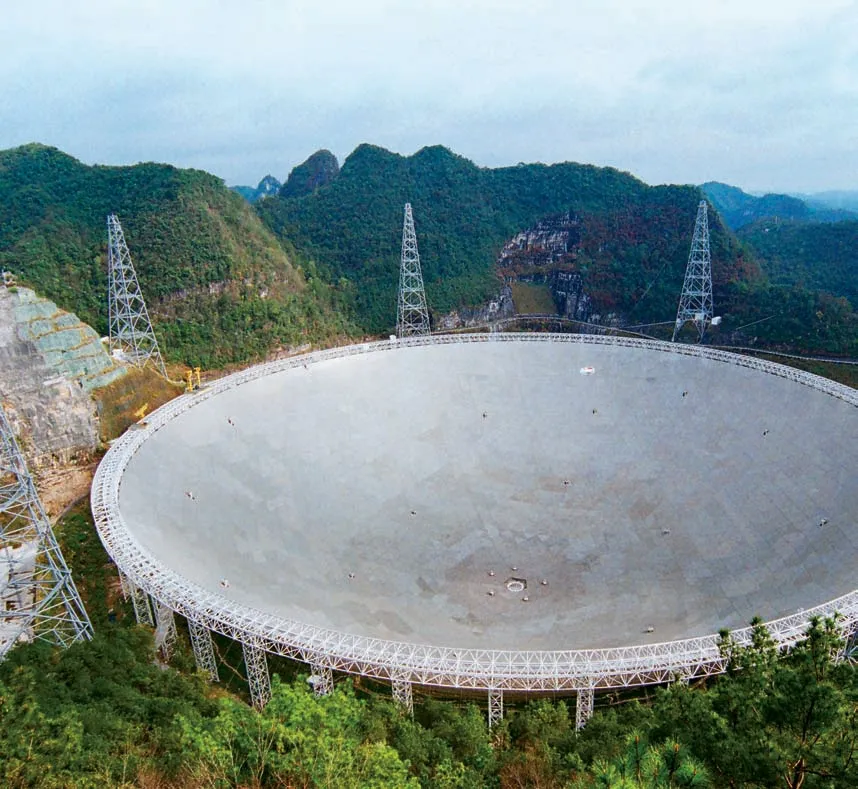
One of FAST’s six publicly stated goals is to search for interstellar communication signals
Zhang is not alone in believing these stories and thinking aliens have visited China multiple times. “I think UFOs came to China long ago already,” 27-year-old video blogger “Brother Ta” (real name Lu Chen), who runs a Bilibili channel conducting interviews with space and UFO researchers, tells TWOC, referencing records of strange sightings in the Jin, Tang, and Song dynasties. “The number of visits is immeasurable, and I’m inclined to think that some governments on Earth have already had contact with aliens, but they haven’t made this public yet.”
Zhang claims to have sent multiple reports of his findings to China’s highest leaders, though he has never had a reply. He suggests a lack of “l(fā)egal framework” and protocols for dealing with such alien contact makes it difficult for countries to process alien communications.
China has a long tradition of astronomy, and an even longer one of recording curious and unexplained celestial phenomena. According to theBook of Han(《漢書(shū)》), in summer of 139 BCE, a bright light that looked like the sun suddenly appeared in the sky over the capital Chang’an (present day Xi’an) one night. In 1071, scholar Su Dongpo (蘇東坡) mentioned in the poem “Traveling Jinshan Temple (《游金山寺》)” that “a great flame in the river lit up the mountains and frightened the birds.”
Astronomy was a key part of the imperial bureaucracy in China, as celestial phenomena were believed to be portents of natural disaster or heaven’s judgment on imperial rule. Descendants of court astronomers were prohibited from changing their jobs, and Beijing’s Ancient Observatory, one of the oldest in the world, was established in 1442 and later expanded with the cooperation of Jesuits such as Ferdinand Verbiest. In 1892, painter Wu Youru (吳友如) created what many call China’s first illustration of a UFO, which showed a fireball above Zhuque Bridge in Nanjing, with an inscription detailing how a bright red object had appeared in the sky and hovered there for some minutes before fading away.
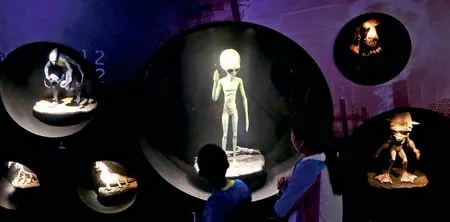
Professional scientists in China now take seriously the possibility of extraterrestrial life, as shown by this museum exhibition in Tianjin
In the 1950s and 60s, search for extraterrestrial life took a backseat as China set about earthbound mega projects and developing a nuclear weapons program. But after China’s market reforms, as the public encountered foreign films, books, and scientific knowledge, enthusiasm for outer space took off again. In September 1979, Wuhan University students established the China UFO Enthusiasts’ Liaison Office. In less than a year, it became the China UFO Research Association, and began opening branches in other cities.
Gradually, as publishing restrictions relaxed and even state media began covering the subject, interest in UFOs and alien life began to boom in the 90s. Zhang became interested in extraterrestrial life after reading an article in the party-run People’s Daily newspaper on “the world’s biggest mysteries” which included a section on UFOs. Yang Ping, a sci-fi novelist from Beijing who began writing in the 90s, became interested in space and alien civilizations after “reading a lot of foreign publications about cutting-edge technology” in high school, and watching foreign films likeStar Wars,Man From Atlantis, andSuperman.
Brother Ta started to pay attention to UFOs when he was in elementary school. “I used to read The Journal of UFO Research when I was a kid…that sparked my curiosity: The universe is so big, so are we really alone? If we are not alone, then where are ‘they’? Who are they?”
Zhang taught himself astrophysics and joined one of the burgeoning UFO clubs and research associations in the country in 1992. “In that era, there were about 30 provinces or cities with UFO research institutions, even some national UFO research organizations,” he recalls. “The internet wasn’t developed then, but people were very enthusiastic…we would have regular meetings around once a month.” Zhang was a member of the Beijing UFO Research Organization until a few years ago, when he left so that he had more freedom to conduct his own research. Nowadays, while interest in sci-fi content has boomed, many of the UFO associations that thrived in the 90s have disbanded or reduced the frequency of their meetings.
The Journal of UFO Research, which was published by the Gansu People’s Publishing House, was founded in Lanzhou in 1981. By the 90s, it was the most widely read UFO research magazine in Asia, according to current editor-in-chief Ma Wenruo, with a circulation of 300,000 according to the South China Morning Post. Since then, its readership has steadily declined, and the magazine stopped printing for a year in 2019, before returning with a circulation of 10,000, says Ma.
In its heyday, the magazine reported on UFO sightings, and printed research on alien crafts and alien contact along with speculative science fiction articles where “the story was stronger than the science,” Ma tells TWOC. After 2013, however, the journal turned toward “popularizing theoretical and serious science” with content “mainly on aerospace, planetary science, life sciences, and archaeology.” UFO sightings and little green men rarely feature nowadays.
UFO associations still operate in a number of cities around China, and enthusiasts have moved to social media and video streaming platforms, according to Zhang, who has appeared in multiple interviews online by popular video bloggers.
Brother Ta has over 33,000 followers on Bilibili and has published nearly 25 videos since April last year, mainly interviews with extraterrestrial researchers. Besides Zhang, he has spoken to Chen Gongfu, a former professor of aerospace at Harbin Institute of Technology who believes Sanxingdui, a culture discovered in Sichuan province which dates back to the 11th and 12th centuries BCE, was possibly an alien civilization; and Avi Loeb, a professor of astrophysics at Harvard University, who has suggested there could be an artificial origin to ?Oumuamua, an interstellar object discovered passing through our solar system in 2017.
What constitutes “l(fā)egitimate” and “scientific” research in the field of UFOs, aliens, and interstellar communication is a topic of debate among scientists in China. “I am a professional…I’m not one of those hobbyists; I’m one of those doing real scientific research,” Zhang Tongjie, a professor of cosmology at Beijing Normal University, declared when TWOC contacted him to discuss UFOs. Professor Zhang’s work belongs to the “search for extraterrestrial intelligence (SETI)” field, and he scans the skies with powerful satellite dishes for radio signals that might come from other civilizations in space.
He is unconvinced by UFO sightings and reports of alien contact like those of the Mayang villagers or Meng Zhaoguo: “Up to now, none of these reports of people saying they met aliens have any scientific explanation, and the media that report on UFOs in China are not the standard ones…like People’s Daily or CCTV.”
Footage of UFOs—even, for example, videos taken by the US navy—“is very shaky, generally speaking, or the UFO is something stuck to the camera lens. It’s obviously fake…you can’t trust it,” says Professor Zhang. While Zhang Jingping believes his investigations are scientific, using “research methods” and equipment such as Geiger counters and lie detectors to discern whether a sighting is true or false, Professor Zhang (no relation) argues there is little value to researching UFO sightings.
Professor Zhang instead relies on data pulled from Guizhou’s FAST, completed in 2016 at a cost of 1.2 billion yuan. He has discovered four or five potentially interesting signals recently, but “we’re not sure what they are…these signals could be interference,” he tells TWOC. “Now we’re developing some ways to identify these signals…I think we’ll be able to in five years.”
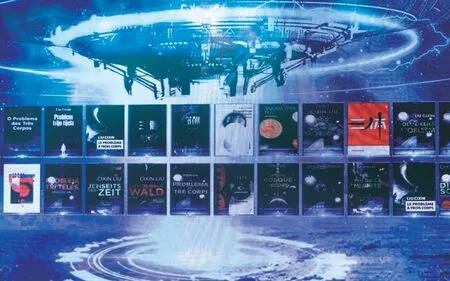
Chinese writers have shot to the forefront of international sci-fi writing, with Liu Cixin’s Three-Body Problem translated into over 30 languages
Professor Zhang began his postgraduate studies in cosmology in 1993, but did not pivot to SETI research until he visited the University of California, Berkeley, home to the Berkeley SETI Research Center, in 2013. That was just two years before the center launched its Breakthrough Listen program, a 100 million dollar, ten-year project to search for alien communications in space.
At the time, Professor Zhang was one of the only Chinese scientists researching SETI, but now “our country has the facilities, so we ought to search. And we also have a telescope that is more sensitive than any other on Earth…it can conduct very sensitive screening of signals.” He believes China will be the first country to detect and analyze any potential contact with alien life.
Zhang Jingping, the hobbyist, is not fazed about the disdain shown to his field by some of those researching SETI. “The formal scientific community doesn’t think that UFOs or aliens are a question that needs to be studied,” he says. “They may think that there are aliens in the universe, but that there is no conclusive evidence in this regard, and they think even less of the idea that aliens have come to Earth.”
Unlike these scientists, Zhang Jingping conducts UFO research in his spare time using his own money—though he says he occasionally receives donations from other enthusiasts. He had hoped to leverage his contact with the Dongsheng aliens to raise funds for further research, such as by charging a fee from Earth governments for enlisting the Dongsheng aliens’ help in mitigating natural disasters (he believes they’ve been helping humanity for years by “moving” earthquakes from densely populated areas to remote regions where they cause less damage, though he is still investigating how they do this). Last year, he tried to send a service agreement to Turkish president Recep Erdo?an via the Chinese ambassador in Ankara, asking payment for a large earthquake that allegedly would have taken place in the city of ?zmir had he not asked the aliens to move it.
So far, Zhang Jingping has yet to monetize his interest, while the costs can be significant. He has, for example, “been back and forth [from Mayang village to Beijing] nine times, and a round trip is about 4,000 kilometers.” The trips are nearly all self-funded.
Others have sunk vast sums into alien hunting for little return. To build the “l(fā)iaison station” for the Dongsheng aliens, Xiang and his two sons spent 17 years and 200,000 yuan, according to a China Daily report from 2012. Their station is little more than a few stone buildings, similar to Daoist temples, with information about the Dongsheng planet displayed inside. Similarly, Jin Fan, who founded the Dalian UFO Research Society in 1984, along with three retiree friends, spent over 200,000 yuan so they could turn a barren patch of land into a farm where they could live and watch for UFOs. However, without farming knowledge, they failed to grow sufficient crops.
While UFO associations have struggled with restrictions, and UFO enthusiasts risk losing money on their hobby, China’s sci-fi market has boomed. Liu Cixin is one of a recent generation of writers, many of whom were also swept up by the UFO enthusiasm in the 90s, according to Yang Ping.
Yang, who studied astrophysics at university and has published numerous sci-fi books and short stories on topics like the prospect of finding aliens on Mars, became obsessed with space from a young age. “I have loved the stars since I was a child,” he recalls. “When I was in elementary school, the school took us to the playground to look at the stars. The teacher pointed to a moving star and told us that it was a satellite. At that moment, I felt that I had some kind of connection with the stars.”
Now, “the rise of sci-fi in China is correlated with the development of Chinese society,” Yang believes, suggesting that as Chinese science improves, so too will its works of science fiction.
Meanwhile, Professor Zhang Tongjie is preparing to receive another batch of data from FAST to analyze. If a signal is confirmed as an alien civilization, “we need a new concept, because…originally we thought our world is the only one with life, but then there would already be other life in existence, so we would have to change our conception.” But it’s clear that some don’t need any more convincing, like an ordinary Beijing advertising agent who believes he’s an emissary for the aliens already among us.
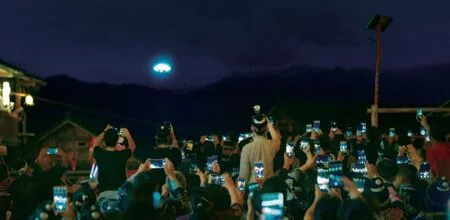
Even the patriotic film My People, My Homeland featured a segment about UFO sightings…though they turned out to be fake in the movie