中國對全球環境秩序的貢獻
2022-05-11 08:13:14DouglasdeCastro巴西王湘玥
國際人才交流 2022年4期
文/Douglas de Castro(巴西) 譯/王湘玥
當前,人類活動引發的全球極端自然事件正給我們帶來生存威脅。同時,有一種說法認為,中國對于可持續發展的承諾可為解決此問題作出貢獻。
在其情節虛構但靈感來源于現實的《西方文明的崩潰》一書中,奧萊斯基和康韋清晰地描述了有關氣候變化的種種事項的性質。書中講述了西方文明究竟是如何對待氣候危機的,以至于其最終使人類陷入不可逆轉、令人不適的境地。該書共分為三個部分:半陰影期的到來(否認氣候變化是“真正”問題的時期),化石燃料的肆虐(認為消耗化石燃料不是問題所在),以及市場失靈(如《歷史之終結與最后一人》中揭示的,資本主義的發展不受約束。“滴滴涕、酸雨、臭氧層消耗和氣候變化等問題帶來的毒害作用都很嚴重,然而市場并沒有對此提出解決方案”)。
在描繪了以上無法避免的黑暗情景之后,作者為我們點明了唯一一個有機會在全球大崩潰中幸存的國家:中國。其理由是,中國在走向自由的同時擁有強有力的中央政府,因此在面臨環境災難時可以調動全部資源來保護公民和經濟。這難道不正如我們本次看到中國成功抗擊新冠肺炎疫情一樣嗎?
自然的物化
在一篇學術文章中,我闡述了萬隆精神對于全球南方國家間合作的重要性,即擁有團結合作和抵抗壓迫精神的重要性。無論是在1995年還是今天,這兩種精神都是必要的。眾多發展中國家與發達國家打交道時面臨相似境況,收到的只是更多的空頭承諾,都讓他們越來越失望。例如2009年哥本哈根會議上,發達國家承諾為幫助發展中國家適應和減緩氣候變化而投資。
目前,環境問題的處理都以復雜而冷酷的現實主義國際關系理論為基礎,即認定國際體系處于無政府狀態;因此,每個國家都在不惜一切代價謀求生存。但是與此同時,中國國家主席習近平提出:“要摒棄零和游戲、你輸我贏的舊思維,樹立雙贏、共贏的新理念,在追求自身利益時兼顧地方利益,在尋求自身發展時促進共同發展。”
There is a clear understanding of the existential threat faced by mankind due to extreme natural events around the globe caused by anthropogenic activities. Also, there is an understanding that China can contribute due to its commitment to sustainable development.
In the fictional yet based on reality book, Oreskes and Conway provided a clear picture of the nature of things regarding climate change. The authors tell how Western civilization approached the climate crisis that ultimately led to mankind’s irreversible and unpleasant state of things. The book has three parts: The Coming of the Penumbral Age (the state of denial that climate change is a “real” problem);The Frenzy of Fossil Fuels (consumption is not the problem);and Market Failure (there is no limitation for capitalism as revealed in. “The toxic effects of DDT, acid rain, the depletion of the ozone layer, and climate change were serious problems for which markets did not provide a spontaneous remedy” ) .
After laying down the unavoidable and dark scenario, the authors present the only country that had the chance to survive the Great Collapse: China. The logic behind the county’s survival is the steps towards liberalization while retaining a strong central government that could mobilize all the resources to protect its citizens and the economy in a period of environmental disaster. Isn’t this the same we observe how successfully China is handling Covid-19?
The Objectification of Nature
In one of my academic writings, I have argued the vital role of the spirit of Bandung in the cooperation among countries in the Global South, based on the premises of solidarity and resistance. Both premises are as essential today as they were in 1955.But unfortunately, the developed countries’ shared experiences in their dealings with the developed ones continue to cause disappointment and more empty promises, such as the investment commitments made by the developed countries in Copenhagen in 2009 to finance climate change adaptation and mitigation in the developing ones.

本文作者,蘭州大學法學院國際法教授Douglas de Castro
發達國家和發展中國家對發展的認識和期望存在分歧,自然界還被認為是一種可以被攫取和利用的資源。下面我將闡述一些我對于這種差異的思考。
自歐洲大航海時代初期,就出現了將自然界與人類社會的概念分開的系統性思想運動。能夠囊括人類在內的“自然”一詞,被指人類周遭事物的“環境”一詞取代。甚至我們今天使用“自然”一詞時,也是在將人定義為某物的外部觀察者。正如雷蒙德·威利安在其影響深遠的《自然的思想》一書中指出:“我們說,自然界的小小震動能使整個世界緊密相連,但通常情況下,當我們使用‘自然’一詞的時候,也把自己包括進去了嗎?”
這種現象被稱為自然的物化,即只將它視作服務于人類意圖的物體,并且如今人們對自然的掠奪和中世紀歐洲帝國強取豪奪的行為一樣兇猛。想要占有更多的無盡欲望使自然界處于危險之中,因此,他們將感知到的世界定義成一種由盲目、無止境和惡性形而上學的欲望催生的產物,而這種欲望最終將導致我們死亡。
出于管理和規范自然界和人類社會互動行為的需要,國際法誕生了。對此,我直接引用馬考·穆圖阿的原話:“國際法的制度是不合法的。”真是直截了當。他接著解釋了為何對國際法作出如此激烈的評論:
“它是一個掠奪性系統,將西方對第三世界的掠奪以及后者相對于前者的從屬地位合法化,還讓這種情況不斷重現、一直持續。無論是它的普遍性還是其對全球秩序和穩定的承諾,都沒有使國際法成為對第三世界而言公正、公平和合法的全球治理準則。”
Dealing with the environment nowadays is based on the complex and cold realist theory of global relations, which assumes that the international system is anarchical; thus, each country seeks its survival at all costs. But on the other hand, Chinese president, Xi Jinping, explained that we should do away with the zero-sum game and win-or-lose mentality, establish a new concept of win-win and all-win, and care for other’s interests while seeking one’s interests and promote joint development while pursuing one’s development.
In addition to the dissociation between developed and developing countries regarding perceptions and expectations of overdevelopment, the natural world is perceived as a source of things to grab and use. Let me lay down some considerations about this dissociation.
Since the dawn of the European navigations period, there has been a systematic movement to detach the natural world from the social one. The term “nature,” which includes the human species, has been substituted by “the environment,” which implies the things surrounding humanity. Even the usage of the term nature nowadays implicates positioning the man as an outside observer of an object, which Raymond Williams has noted in his seminal work: “One touch of nature may make the whole world kin, but usually, when we say nature, do we mean to include ourselves?”
This phenomenon is known as the objectification of nature, a mere object to serve the purposes of mankind, which nowadays possess the same ferocity as in the plundering initiated by the European empires in the medieval. The unstoppable desire to keep more and more puts the natural world at risk, thus, characterizing the perceived world as the product of a blind, insatiable, and malignant metaphysical desire that ultimately leads to death.
The need to regulate and provide some order to the encounter between the natural and social worlds provided the grounds for the emergence of international law. There is no easy or polite way to say this, so I will reproduce what Makau Mutua uttered:“The international law regime is illegitimate.” He continues to explain the reasons for such a strong statement about international law:
“It is a predatory system that legitimizes, reproduces, and sustains the plunder and subordination of the Third World by the West. Neither universality nor its promise of global order and stability makes international law a just, equitable, and legitimate code of global governance for the Third World.”
For instance,(1900) was drafted by European hunters interested in the “sustainability” of hunting resources in Africa. Nowadays,(CITES-1973) has the sustainability of the trade as its core business.
例如,《保護非洲野生動物、鳥類和魚類公約》(1900年)是由對非洲狩獵資源的“可持續性”感興趣的歐洲獵人起草的。如今,《瀕危物種國際貿易公約》(CITES-1973)將該貿易的可持續性作為核心業務。
這一趨勢同樣也適用于氣候變化問題和有關生物多樣性的國際制度。到目前為止,我所闡述的評論包含兩層含義:一是讓人們意識到現行國際機構中的陷阱,二是尋找替代方案(我不是一個為了解構而解構的后實證主義者——我們確實需要承認國際機構中有好的地方,但也迫切需要找到替代方案來使它更完善)。
正如開頭提到的《西方文明的崩潰》所述,我認為該替代方案需要理解兩個概念,對這兩個概念的理解也是中國在過去十年中成功處理環境問題的根本原因,即生態文明建設和人類命運共同體。
推進生態文明建設
習近平主席在2013年5月24日十八屆中共中央政治局第六次集體學習時強調,要“樹立尊重自然、順應自然、保護自然的生態文明理念,堅持節約資源和保護環境的基本國策,堅持節約優先、保護優先、自然恢復為主的方針”。
此后,習近平主席的講話都是在兩個維度上落實生態文明的理念:一是在敘述上,將自然、環境、生態等詞語在意義上進行關聯性的發揮;二是提供能夠組織和規范社會力量的法律框架,來完成這一目標。接下來,我將探討最新的法律框架。
2018年3月,新修訂的中國憲法吸納了“生態文明建設”的概念,這是中國自1954年以來第五次修憲。該修正體現了最高法律層面對于生態問題的高度重視,也體現了中國特色社會主義事業總體布局——“五位一體”的憲法化進程。
生態文明的理念在于,人類可以從自然中獲益,同時為自然創造財富。換句話說,人類必須在與自然的和諧互動的同時保護自然。
這次修憲沒有采取傳統的在“環境權”上做改動的方法,而是采用了“國家目標條款”的形式來保證“生態文明建設”,通過規定強制義務讓公民保護環境。人類在利用自然資源獲得經濟利益的時候,不可避免地會對環境造成傷害,這個矛盾也是短期內經濟繁榮與長期不經濟之間的矛盾。因此,人口、經濟、資源和環境會失去最佳平衡。這時,就需要政府這只“看得見的手”進行合理干預,平衡這些方面,從而達到建設生態文明的目的。
The trend is true to climate change and biodiversity international regimes. The arguments I laid down so far have a twofold strategy: first, generate awareness of the existing traps in international institutions; second, question the existence of alternatives (I am not a post-positivist that wants to deconstruct just for the sake of deconstruction. On the contrary, it is necessary to recognize that there are good things in the international institutions and an urgent need to find alternatives to improve them).
As inthat I mentioned at the beginning, I believe that the alternative is to understand two concepts that are the essence of the success of China in dealing with the environmental issues in the last decade: ecological civilization and a community of shared future for mankind.
Promoting Ecological Civilization
President Xi Jinping, during the speech at the sixth group study session of the Political Bureau of the 18CPC Central Committee on May 24, 2013, uttered: “We must raise awareness of the need to respect, accommodate, and protect ourselves to nature,follow the basic state policy of resource conservation and environmental protection, and give high priority to conserving, protecting the environment and promoting its natural restoration.”
Since then, his speeches have been in the sense of operationalizing the concept of ecological civilization in two dimensions: one is in the narrative, which plays with the words nature, environment, and ecology as related in their meaning; and two, providing the legal framework to organize and regulate the societal efforts to accomplish the goal. I explore the latest legal framework below.
In March 2018, the Chinese Constitution was amended for the fifth time since 1954 to incorporate the “ecological civilization development” concept. The amendment marks a high degree of concern for ecological issues at the highest legal level and the constitutionalizing process of the Five-Sphere Integrated Plan for socialism with Chinese characteristics.
This Constitutional Amendment did not adopt the traditional “environmental rights” method. However, it used the form of a“national objective clause” to guarantee the “ecological civilization development” and realize the environmental protection of citizens by imposing obligations on the state. While gaining economic benefits in harvesting natural resources, humans inevitably cause harm to the environment, which is the conflict between economic blossoms in the short term and economic busts in the long run. As a result, the population, economy,resources, and environment lose the optimal balance. At this point, the government’s “visible hand” is needed to intervene reasonably to balance those aspects, thus, emerging the purpose of the concept of ecological civilization.
目前,新修訂的憲法構成了中國處理“生態文明建設”的高級法律體系,其規范性和實質性的規定貫穿于整個法律框架,用以指導政府在所有領域的行動。接下來,我將介紹相關的憲法條款。
憲法序言介紹了更多與生態文明相關的概念,如“新發展理念”“富強民主文明和諧美麗”“社會主義現代化強國”“實現中華民族偉大復興”。序言體現了中國的國家使命和價值目標,也統領著各項條款。
第9、10和26條提及了生態環境宏觀調控的“總則”。從法律規范的結構來看,這些條款具有激勵人民、法人和政府行為的綱領性意義(體現了序言的精神),具體內容如下。第9條規定:“國家保障自然資源的合理利用,保護珍貴的動物和植物。”第10條規定:“一切使用土地的組織和個人必須合理地利用土地。”第26條規定:“國家保護和改善生活環境和生態環境,防治污染和其他公害。”
第89條是以正面列舉的形式對國務院的職能和權力進行的強制性規范。它是國家機關履行憲法序言中“生態文明建設”義務的具體形式,規定了“(六)領導和管理經濟工作和城鄉建設、生態文明建設”。
2018年的憲法修正案包括了以發展中國特色社會主義為特征的“五位一體”總體布局,包含經濟建設、政治建設、文化建設、社會建設和生態文明建設。該布局被提升至憲法地位,也使得現代中國的發展理念,如習近平主席關于建設社會主義生態文明的思想,和中國的傳統價值觀聯系得更加緊密。
2017年,中國中央政府出臺了一份比起綱領性更偏實際性的文件——《生態保護紅線劃定指南》。文件包含了相關執行規定,強調通過一致的標準來管理所有重要的環境空間。
生態保護紅線是國家生物安全的生命線,對空間規劃至關重要。對該紅線的規劃和執行是落實生態功能區劃和其用途管制系統的關鍵舉措,在保障中國生物安全的同時,促進提高生態產品供給能力以及為生態系統提供服務。這是一種在促進中國綠色發展的同時也能推動生態文明建設的制度創新。
分階段來看,2005—2011年,<,盡管海南省旅游經濟發展滯后于生態環境的保護和建設力度,但是增長速度較快,且蘊含著極大的發展潛力;2012—2015年,>,海南省生態環境的保護和建設滯后于旅游經濟的發展,表明自2010年國際旅游島建設上升為國家戰略以后,旅游經濟繼續保持穩定大幅度增長,但是隨著旅游業規模的不斷擴大和發展,生態環境質量也在不斷下滑,不過從2015年開始出現的小幅上升表明了海南省對于生態環境保護意識的覺醒。
The Constitution currently forms the higher legal system in the land dealing with the “ecological civilization development” by normative and substantive regulation that permeates the entire legal framework and directs the government’s actions in all spheres of power. In the following paragraphs, I will introduce the constitutional provisions related to the concept.
The preamble of the Constitution brings additional concepts that are connected to the ecological civilization, such as “new development,” “beautiful China,” “a great modern socialist country,” “realize the great rejuvenation of the Chinese nation.”It belongs to the part of China’s national tasks which embodies China’s value goals and plays a commanding role in the articles of the Constitution.
Articles 9, 10, and 26 refer to the “General Principles” of the Constitution related to macro-control of the ecological environment. From the perspective of the structure of the legal norms,these articles are programmatic in the sense of incentivizing the behavior of people, legal entities, and government. Article 9 states that “the state shall ensure the rational use of natural resources and protect rare animals and plants.” Article 10 prescribes that “all organizations and individuals using land must use it appropriately.” Article 26 utters that “the state shall protect and improve living environments and the ecological environment, and prevent and control pollution and other public hazards. The state shall organize and encourage afforestation and protect forests.”
Article 89 is a mandatory norm for the functions and powers of the State Council in the form of positive enumeration. It is the specific form in the state institutions of the state’s obligation of“ecological civilization development” in the preamble of the Constitution, stating the duty in “(6) directing and managing economic work, urban and rural development, and ecological conservation.”
The amendment of the Constitution of 2018 includes the Fivesphere Integrated Plan that features the development of so-cialism with Chinese characteristics encompassing economic,political, cultural, social, and ecological development, thus, elevating the plan to constitutional status. Furthermore, the plan brings closer the traditional values and modern understandings of China as encapsulated in the thoughts of President Xi Jinping about the socialist approach to an ecological civilization.

2018年3月,新修訂的中國憲法納入“生態文明建設”的概念。圖為在大熊貓國家公園拍攝到的野生大熊貓活動畫面(新華社發 甘肅白水江國家級自然保護區管理局供圖)
構建人類命運共同體
人類命運共同體的理念已經被納入中國政策,成為新時代中國特色社會主義理論體系的一部分。
2013年3月23日,習近平主席在莫斯科國際關系學院發表演講,首次提出了“人類命運共同體”的概念。此后,中共中央和習近平總書記不斷推廣其內涵,包括修改法律。
在黨的十九屆四中全會上,習近平總書記強調要“堅持獨立自主和對外開放相統一,積極參與全球治理,繼續為構建人類命運共同體不斷作出貢獻”。這一概念已成為中國特色社會主義理論體系和法律體系的一部分。
人類命運共同體的概念對全球政策的影響力與日俱增,特別是在“一帶一路”倡議(BRI)上,其向“綠色立場”的轉變受到了“一帶一路”綠色發展國際聯盟的支持,也因此得到了聯合國的全力支持。近年來,這一概念出現在《對外投資合作建設項目生態環境保護指南》中,出于加強環境保護的目的,對向金磚國家的投資進行了調整。
在國際法領域,人類命運共同體發揮著以下幾個作用。第一,是全球治理的組成部分,對當代國際法的發展至關重要。第二,共商共建共享的“三共”原則是構建人類命運共同體的基石;因此,它們可能有助于改善現行的國際法原則。第三,是一個能使聯合國進行改革、支持多邊立場的契機。
From a programmatic stance to a more practical one, the Chinese central government issued a guideline for an ecological red line strategy in 2017, which contains provisions to enforce the lines for the protection of the ecosystems, to manage all significant environmental spaces with consistent standards.
The red lines are the lifelines of state biological security, essential for space planning. Drawing and enforcing them are critical moves to implement the systems of functional zoning and use control of the ecological space, which are adequate to help expand the capacity to supply eco-products and provide services to the ecosystems while building up China’s biological security.It constitutes an institutional innovation that can also boost the building of the ecological civilization while promoting China’s green development.
Building a Community of Shared Future for Mankind
The vision of building a community of shared future for mankind was incorporated into the Chinese policies. It became part of the theoretical system of socialism with Chinese characteristics in the new era.
The concept of a community of shared future for mankind was first proposed on March 23, 2013, when President Xi Jinping delivered a speech at the Moscow State Institute of International Relations. Since then, the Party Central Committee and General Secretary Xi Jinping have propagated its tenets, including introducing changes in the legislation.
At the Fourth Plenary Session of the 19Central Committee of the CPC, General Secretary Xi Jinping emphasized the need to “adhere to the integration of independence and openness,actively participate in global governance, and continue to contribute to the building of a community with a shared future for mankind”. As a result, the concept has become an integral part of the theoretical and legal system of socialism with Chinese characteristics.
Its global influence as a policy has been increased gradually,especially considering the shift in the Belt Road Initiative (BRI)to a green stance that received full support from the United Nations through the Belt and Road Initiative International Green Development Coalition. More recently, the concept emerged in, which calibrates the investments in BRI countries to increase environmental protection.
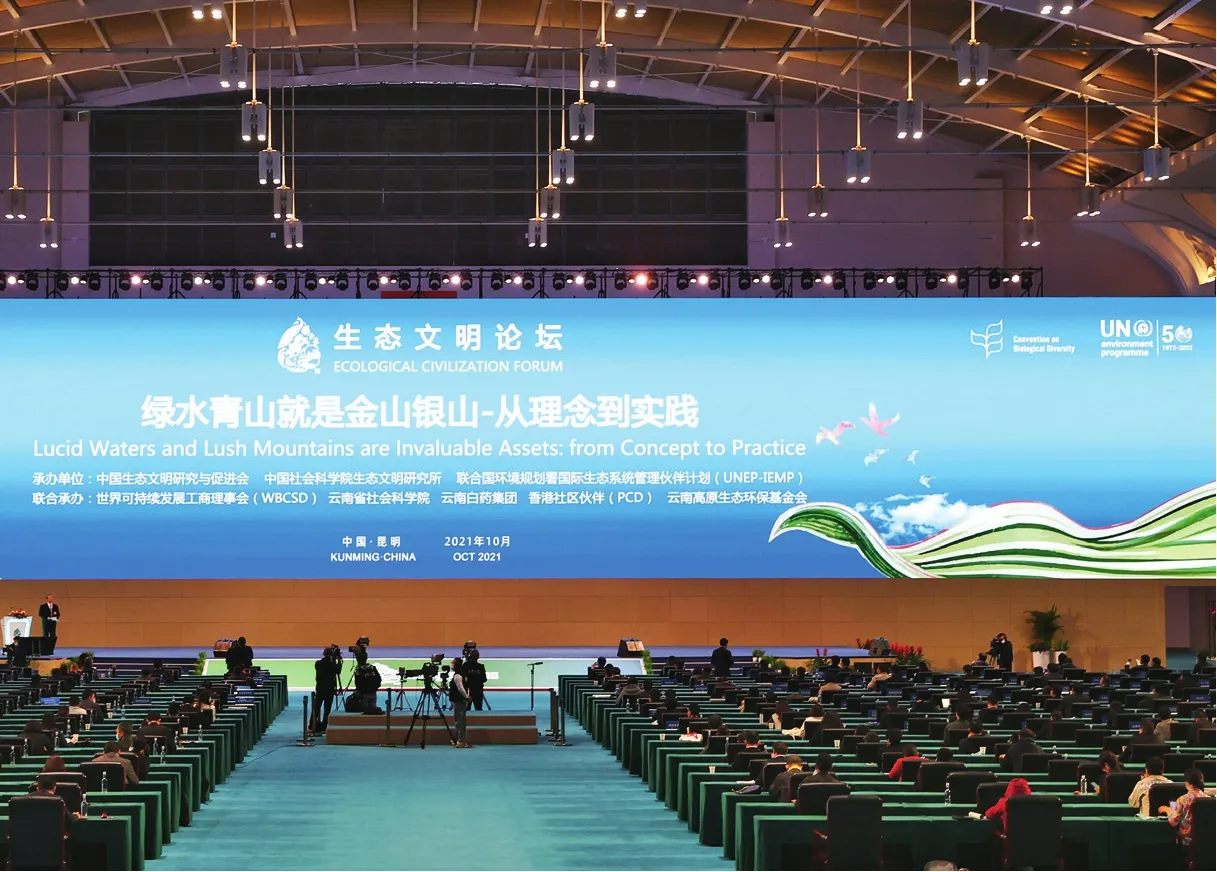
2021年10月,2020年聯合國生物多樣性大會生態文明論壇在昆明舉行(新華社記者 王南 攝)
總體而言,目前法學界對人類命運共同體理念的研究,大多是從宏觀層面來探討構建人類命運共同體的法律路徑,缺乏對經濟、文化、生態環境等具體領域的研究。在人類命運共同體的五個組成部分——經濟、文化、政治、安全、生態中,生態占據基礎性地位。一個干凈美麗的世界和適宜的生活環境是享受其他方面的絕對前提。
當今全球日益嚴峻的環境挑戰對發展中國家的影響不容忽視。并且,這些潛在的影響正不分國界沖擊著所有國家。
由于國際機構在面對需要緊迫性和特定處理方式的全球環境問題時相對效率低下,我開始了尋找替代方案的研究。而在這些替代方案中,生態文明建設和人類命運共同體成為我的首選,為我提供了不同的理論視角和可觀察的實驗論據。
中國正在成為國際體系中制定未來方案的國家。盡管這一事實給其他國家尤其是美國,帶來了一些不適,但中國正在為全球環境治理作出重大貢獻。首先是通過自己做功課,其次是將這些成果在國際層面上推廣。
在我看來,這非常有可能提高國際環境法的監管效率,因為它納入了建設生態文明和人類命運共同體這樣不同的世界觀和價值觀;肯定會使傳統的國際法更具包容性。
A community of shared future for mankind assumes several directions in international law. First, it is a building block to global governance, essential to the concept of development in contemporary international law. Second, the “three communist principles” of consultation, joint construction, and sharing are the cornerstone of building a community of shared future for mankind; thus, they might help create traction with the existing principles of international law. Third, it is an opportunity to pass reforms in the United Nations that incorporate its multilateral stances.
Most current research on the community of shared future in the legal field explores the legal path of constructing a community of shared future for mankind from the macro level and lacks research in specific areas such as economy, culture, and ecological environment. Among the five components of a community of shared future for mankind: economy, culture, politics, security,and ecology, the ecological environment is in a fundamental position. A clean and beautiful world and a suitable living environment are essential for enjoying other aspects.
In today’s increasingly global severe environmental challenges, the impacts on developing countries cannot be disregarded or left behind. Moreover, the insidious effects are hitting all the nations with no respect for territorial boundaries of sovereignty.
The relative inefficiency of the international institutions in dealing with the global environmental issues with the urgency and manner required led me to explore alternatives in my research agenda. Among the other options, the ecological civilization and a community of shared future for mankind become the top of my list, opening different theoretical perspectives and observable empirical evidence.
China is becoming an agenda-setting country in the international system. Although this reality brings some discomfort to other nations, especially the United States, China is making significant contributions to the global governance of the environment, first, by doing its homework, and second, by projecting these gains to the international dimension.
There is solid potential to increase the regulatory efficiency of international environmental law by incorporating alternative worldviews and values of ecological civilization and a community of shared future for mankind. That for sure will make traditional international law a more inclusive institution.
猜你喜歡
大科技·百科新說(2021年6期)2021-09-12 02:37:27
銀潮(2021年8期)2021-09-10 09:05:58
保健醫苑(2021年7期)2021-08-13 08:48:02
好孩子畫報(2020年5期)2020-06-27 14:08:05
農村百事通(2020年11期)2020-06-27 14:05:13
學生天地(2020年36期)2020-06-09 03:12:30
小學科學(學生版)(2020年5期)2020-05-25 07:11:32
意林·全彩Color(2019年6期)2019-07-24 08:13:50
作文周刊·小學一年級版(2016年42期)2017-06-06 22:20:27
小天使·一年級語數英綜合(2016年5期)2016-05-14 12:21:05