
A MATTER OF IMPORT
2022-04-20 01:36:54TEXTBYSAMDAVIES
漢語世界 2022年2期
TEXT BY SAM DAVIES
PHOTOGRAPHS FROM VCG
GRAPHICS FROM SHETUWANG

“Gu Ailing is standing on the top of the podium,using her actions to show the whole world:Selfconfident Chinese are the most beautiful of all!”shouted the exhilarated commentator for Tencent Sport as Gu Ailing,the San Francisco-born freestyle skier competing for China,stepped atop the podium to receive her gold medal in the Big Air event at the Beijing Winter Olympic Games in February.
Gu,also known as Eileen Gu,would go on to win a silver and another gold at the Games.As she gave interviews in fluent Putonghua and ate steamed buns on camera,she became the undisputed star of China’s Olympic team.But beneath the euphoria,there was a constant stream of controversy about Gu’s citizenship status on both sides of the Pacific,as the 18-year-old’s decision to compete for China (the country where her mother was born)placed new scrutiny on the country’s naturalization policies for sporting talents.
“I found that she probably has dual nationality,so my opinion of her tanked,”Wang Xinjun,a 22-yearold student from Henan province in central China,tells TWOC.While Gu’s true citizenship status is unclear,Chinese law stipulates that people who become Chinese citizens must renounce any other citizenship.“We can’t have double standards before the law,”Wang believes.
In sports communities,the term“naturalized athlete”refers to those who compete for a country other than the one they were born in.Different sporting federations and national governments have different rules on athletes switching nationalities,while country-specific citizenship laws may also apply.The International Olympic Committee states that competitors“must be a national of the country”for which they wish to compete (but makes no reference to citizenship).FIFA,the international governing body for soccer,considers a player eligible to represent a nation if they were born in its territory,have at least one biological parent or grandparent born in the territory,or have lived in the territory for at least five years.
Athletes who’ve already represented one country in international competitions can switch to another,but must typically wait for a period before they can compete internationally,depending on the rules of the federation governing their sport—for the Olympics,the waiting period is three years.Naturalizing athletes has a long history globally—even the ancient Greeks reportedly swapped between city-states when they competed in the original Olympics.The practice has accelerated in recent decades,in part because of liberalizing citizenship rules worldwide.
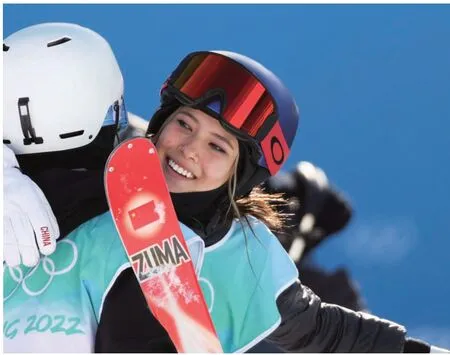
Gu Ailing,shown hugging a fellow competitor during the 2022 Winter Olympics,is one of the highest-profile naturalized athletes in recent years
But naturalized athletes have only emerged in China in the last few years.In 2019,as part of its strategy to improve the national men’s team,the Chinese Football Association published rules for the naturalization of players in China’s professional soccer leagues,setting off a wave that has seen at least 11 foreign players become Chinese citizens since,and six called up to represent China’s national team.
Some of these players have family ties to China,but not all:Brazilians Elkeson,now known as Ai Kesen,Fernando (Fei Nanduo),and Aloísio (Luo Guofu) have no Chinese ancestry,while UK-born Nico Yennaris (Li Ke) has a Chinese mother and Tyias Browning (born in Liverpool) has a grandfather who immigrated from Guangdong province.The CFA requires these players to undergo classes on Chinese culture,history,and language.
Unlike Gu,most of these players have confirmed they renounced their previous citizenship and publicly displayed their Chinese passports,but critics have still lambasted their perceived lack of ties to China.“They have Chinese names like Luo Guofu and Ai Kesen,but they haven’t set up a home in China,they don’t have family in China,their wives and children are not in China,”says Chen Bo,a journalist who writes about soccer for Beijing Home Ground,a public WeChat account,who wished to be known by a pseudonym.
“They don’t speak Chinese,they don’t eat Chinese food,they don’t understand Chinese culture,”he complains.“They have nothing to do with us and nothing to do with the Chinese nation.”
But those with Chinese heritage also come under close scrutiny.Los Angeles-born figure skater Zhu Yi,previously known as Beverly Zhu,decided to compete for China in 2018,but faced attacks online after poor results in the team skate event at the Winter Olympics in February.Some commenters targeted her for her lack of Mandarin skills,and even claimed she only got into the team(ahead of a“homegrown”Chinese athlete) due to her influential father.
Others have been dubbed“mercenaries”for allegedly only competing for China for monetary gain.Media reports have claimed it costs some Chinese football clubs over 600 million yuan per year to employ their naturalized players,adding to this reputation.
Worsening perceptions is the fact that China’s national men’s football team has seen no noticeable improvement in results:The team once again failed to qualify for the FIFA World Cup in the latest qualifying rounds,losing to Vietnam in February this year while fielding three naturalized players.Meanwhile,the women’s team,which contains no naturalized players,has had more promising international results.
But cash is not the only potential motivator for the athletes themselves.“The money never really mattered to me,”Paris O’Brien,a 22-yearold Canadian Chinese ice hockey player who competed for China at the Winter Olympics earlier this year,tells TWOC.“It was more about having the honor of being[at the Olympics]…to represent my heritage.”
O’Brien,whose is also known by his Chinese name Ouban Yongli,was born and raised in Vancouver.His maternal grandparents come from Zhongshan,Guangdong,and he says he“basically grew up around Chinese culture,Chinese food.”O’Brien began playing ice hockey in Vancouver as a child,and considers the chance to compete at the Winter Olympics“a once in a lifetime opportunity,”regardless of country.

China’s men’s national ice hockey team practicing for the 2022 Winter Olympic Games
At 17,O’Brien attended a two-day training camp set up by Kunlun Red Star,a professional ice hockey team based in China and part of the Kontinental Hockey League (KHL),which aimed to identify“heritage players”(with Chinese background) to play in China.Camp organizers had pitched the possibility of attending the Olympics to O’Brien and his parents.O’Brien moved to Kunlun Red Star in 2017,and during the first year,he lived in China and tried to immerse himself in the language.
O’Brien was one of 28 naturalized players on China’s men’s and women’s hockey squads for the Winter Olympic Games,out of a total of 48 players.Six of those 28 naturalized players had no Chinese ancestry.
There are plenty of fans who appreciate Gu and other foreign-born athletes competing for China.Zhang Yifan (pseudonym),a Guangzhou native who runs a Gu Ailing fan group on Weibo,says Gu inspires her to be“self-confident and brave.”Another of her idols is Nina Li Zheng (Nina Schultz),a naturalized athlete of Chinese heritage who once won a Commonwealth Games silver medal for Canada in the heptathlon,but now represents China and finished tenth at the Tokyo Olympics in 2021.“I don’t have an opinion on the nationality issue…I just like the athletes themselves,”says Zhang.
China is not the only nation to wrestle with athlete naturalization controversies.US-born basketball player Becky Hammon attracted criticism when she agreed to play for the Russian national team in 2008,allegedly in return for a two-milliondollar contract,despite having no Russian ancestry,not speaking the language,and not being a full-time resident of the country.A number of athletes who were naturalized to compete for Great Britain at the London 2012 Olympic Games were labeled“Plastic Brits”for their supposed lack of ties to the country.
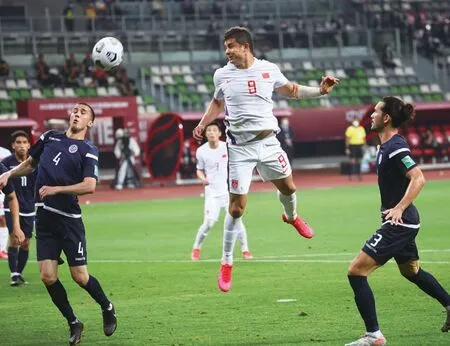
Brazilian-born soccer player Elkeson (Ai Kesen) playing for China against Guam earlier this year
China has also been a source of naturalized athletes for other countries:At the Rio Olympics in 2016,44 of 172 competitors in the table tennis event,representing 22 federations in addition to the PRC,were born in China.The International Table Tennis Federation changed their rules on nationality in 2019 to make it more difficult for athletes to switch countries,in part because Chinese players competing for other countries was considered damaging for the development of table tennis in those nations.
Chen similarly believes that naturalized athletes do not reflect the growth of Chinese sport,nor help build domestic sporting talent in the future:“I don’t care which country they are from,which nationality they are,what color they are...but they should be trained through our own sports system in China,”he says.He worries that clubs,national teams,and parents won’t want to invest in training young players domestically if their opportunities to compete may be taken away by foreign-born athletes.
Recently,other risks of relying on important talent became apparent when many naturalized players on the Chinese soccer team,including Elkeson,returned to Brazil either due to Covid-19 restrictions or newly implemented salary caps in China’s professional leagues.In February this year,online news publication Zmconnect alleged that all of Kunlun Red Star’s players have yet to have their contracts renewed for the new season for no clear reasons,which may mean a number of naturalized players are left without a team to play for in China.
Like Gu Ailing,who has talked of her desire to inspire young girls in China to take up snow sports,O’Brien believes he can help grow China’s domestic talent.He has been involved in promoting ice hockey camps and clinics in China,and taught ice hockey to children on school visits in Zhongshan,which he calls his“hometown.”
Now,he is busy preparing to compete with the national team in the World Championships in Croatia in April.“After the Olympics,our goal is to continue these initiatives to help bring more awareness to hockey,”O’Brien says.“The biggest thing we can do is to open more opportunities to the Chinese people to help develop the game in China,and help China become a better hockey country.”
