
WHERE EMPIRES MEET
2022-04-20 01:36:54TTEEXXTANDPHOTOGRAPHYBYNINGYIXI席寧憶
漢語世界 2022年2期
TTEEXXT AND PHOTOGRAPHY BY NINGYI XI (席寧憶)
ADDITIONAL PHOTOGRAPHS FROM VCG
Lüshun’s history of colonial entanglement attracts visitors looking for stunning photo backdrops,but its story is difficult to tell
在大連旅順,網紅景點背后有難講的故事
Photogra Phby VCG
L üshun Railway Station no longer teems with passengers and cargo,and since 2014,no whistles from trains have punctuated the stillness at what was once the southern terminus of the South Manchurian Railway,the lifeline of three empires that jockeyed for control of China’s Northeast.
Yet arriving on a September morning in 2021,I am surprised to see a gaggle of fashionably dressed women posing in front of the gabled entrance.Rebuilt in 2005 according to its original Russian design,the station’s exotic yellow walls crisscrossed with white timbering,slanted green roofs,ornate white cornices underneath,and a domed tower with a cupola overlooking the rails are regularly featured on“top photo-taking destination”lists for the city of Dalian,Liaoning province,on Instagram-like app Xiaohongshu.
Located in the port of Lüshunkou,now a district of Dalian 50 kilometers from the city center,the Russian-built station has been central to the great power struggles that left visible marks on the cultural and architectural heritage of the region.For millennia,this northeastern territory was mostly the periphery of Chinese empires,but in the second half of the 19th century,the Russian and Japanese empires both began to extend their influence on the border regions of the Qing dynasty (1616–1911).Because of its excellent harbor,ice free in winter,and its strategic location at the tip of the Liaodong peninsula guarding the Bohai Sea,Lüshun became a hotly contested spot between the three powers.
In 1895,after the Qing dynasty lost the First Sino-Japanese War,it agreed to cede Lüshun,together with the rest of Dalian,to Japan through the Treaty of Shimonoseki.Then,Russia,France,and Germany jointly pressured Japan to withdraw its troops from the peninsula.In the power vacuum that followed,the Russians signed a treaty with the Qing government in 1898 to lease the area as well as the right to extend its railways to Lüshun.But in 1905,just three years after running its first train from Lüshun to St.Petersburg(the first international train in Chinese history),Russia lost the region again in the Russo-Japanese War,leaving the Japanese to finish the half-completed station.Japan in turn lost control of the station to the Soviet Union after World War II,and it did not return to full Chinese control until 1952.
As a result of this history,the landscape of Lüshun today is a hodgepodge of hybrid influences:Like the former Russian district in the center of Dalian,as well as the Russian-influenced city of Harbin in the Northeast and the formerly German-controlled port of Qingdao in Shandong province,Lüshun has redeveloped its historic buildings into scenic sites and attracted social media influencers making videos and photographs captioned“time-travel”and“exotic charm.”
Yet there is cognitive dissonance in accepting that the colonizers may have created beauty,which runs contradictory to history textbooks that state imperialists did nothing but evil in China during the“Century of Humiliation,”perplexing local authorities today on how to present these sites to tourists—if at all.
Some have chosen to not preserve the architecture,or even to destroy it.During the Japanese occupation of northeastern China from 1905 to 1945,over 1.4 million Japanese settled in the region,and built close to 300 Shinto shrines and Buddhist temples.Most were destroyed after the Japanese surrender,and the ones that remain are visibly neglected compared to historical sights pertaining to Chinese history,or even the history of other colonizers:Dalian has only two remaining,the now-empty Nanzan Temple (formerly used as a storage site for the Dalian Library) and Prince Shotoku’s Memorial Temple,now converted into offices inside Zhongshan Park.
Only six Japanese religious structures remaining can be considered“wellpreserved,”according to a Chinese media brand called Traveling in the Northeast,with the rest a mix of ruined foundation stones,lonetoriigates,or derelict temple halls,shuttered or repurposed,inside empty fields or residential communities from Changchun to Shenyang to Fuxin.
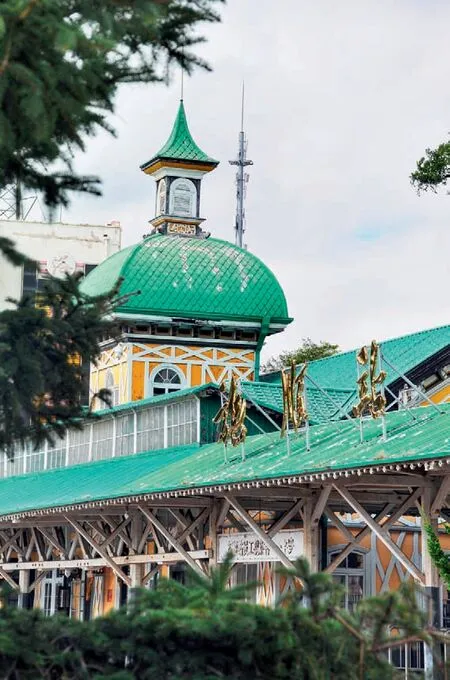
Lüshun Railway Station’s exotic design attracts young visitors to take photos
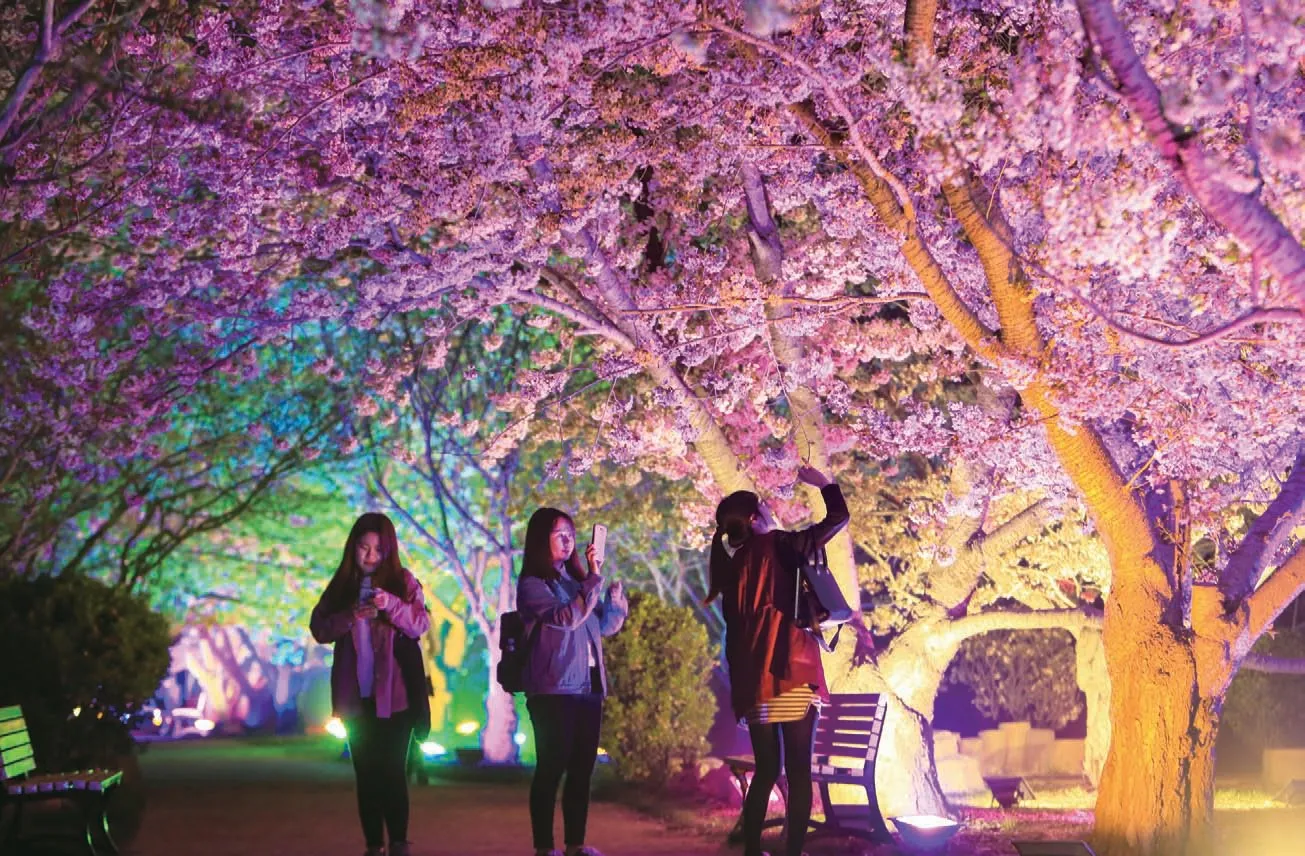
Lüshun’s popular cherry trees were first introduced during the Japanese occupation
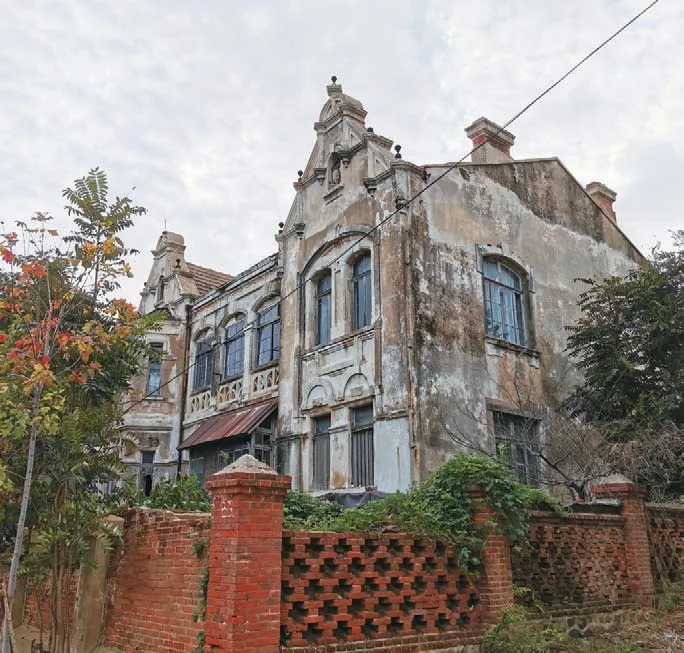
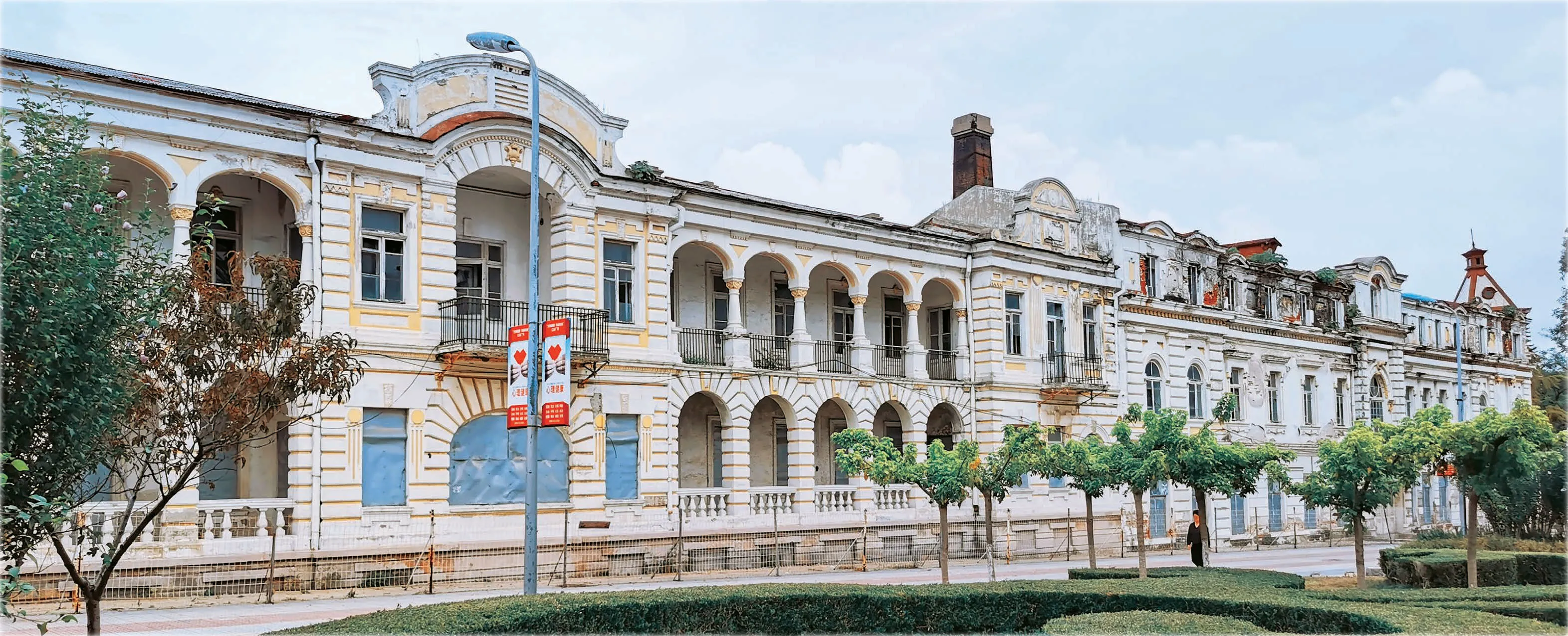
Questions about historical memory are also present in the residential streets of Lüshun.With bugle sounds from the navy base nearby,I walk from the railway station westwards to Taiyanggou neighborhood,first developed by the Russians at the turn of the 20th century as a Europeanstyle neighborhood:with wide,straight avenues lined with leafy gingko trees,and red-brick villas that later served as the headquarters of the Kwantung Army during the Japanese occupation.According to local historian Li Huajia,who runs the WeChat account“Old Man Li From Lüshun,”one can differentiate buildings’ construction period by looking at the foundation stones:greenish-white granite blocks date to the Russian occupation period(1898–1905),and red clay bricks for the Japanese (1905–1945).
On my Gaode Maps app,the neighborhood is labeled as the“Taiyanggou Scenic Area,”and a tourist map on a plaque by the street marks the notable historic sites,including the former Kwantung Army Headquarter and Yamato Hotel,where ex-Emperor Puyi once stayed.But except for the outdoor monuments and Lüshun Museum,few of the other buildings seem to have been renovated as historic sites or opened for public visits.On the sidewalks,some residents are drinkingbaijiuin front of formerly grand mansions decorated with columns,gables,porticos,and cornices,now missing window panes and covered in peeling paint.If not for the vegetable gardens out front,I would have thought the homes were abandoned.
One structure that has seen some revitalization is the Lüshun Phonograph Museum,a private operation showcasing the collection of local vinyl enthusiast and amateur music historian Wang Xinwei.Newly moved close to the public Lüshun Museum from a commercial building in Taiyanggou,with a fa?ade consisting of white timbering and a green cupola reminiscent of the railway station,the museum houses over 20,000 phonographs,records,and other musical paraphernalia that Wang’s family collected from antique markets and donations from local residents.As Wang expressed to TWOC in 2018,the museum’s collections are“loyal eyewitnesses”that can awake powerful memories of the upheavals the city experienced in the 19th and 20th centuries,and the warmth and culture that existed despite the turmoil.
Other attempts to memorialize the era,though,have met with resistance.Compared to Russian heritage,Japanese colonial history is even more controversial in China,not least because it is the more recent and the most violent.Apart from the Japanese war atrocities between 1931 and 1945 that still drive a wedge between the countries today,during the First Sino-Japanese War,Lüshun itself (then Port Arthur) saw the massacre of 2,600 to 20,000 Chinese civilians and soldiers by the Japanese army in 1894.

Some of Lüshun Museum’s“Silk Road”themed exhibits werebought from ōtani Kozui,a Japanese Buddhist known for expeditions to Buddhist sites in Central Asia
On the other side of Dalian,in Jinzhou District,Tang Little Kyoto,a shopping district that replicated the architecture of the former Japanese capital,was forced to close its doors this year after Chinese web users accused it of dishonoring compatriots killed by the Japanese during the wars.A vlogger was chastised by her followers for dancing in front of the Lüshun Museum in a Lolita(a Japanese subculture) costume,and in 2011,a memorial wall with the names of“deceased Japanese pioneers,”newly constructed in the Sino-Japanese Friendship Garden in Fangzheng county,Heilongjiang province,was vandalized a month after it was put up,forcing the local government to quietly tear down the memorial amid fierce criticism from state media.“Although some of [the memorialized Japanese] are women and children who had no direct role in the war,they should be remembered by the Japanese,not the Chinese,”states an op-ed by blogger Zhang Min,republished by China.org in English with the title“Japanese Settlers Should Not be Remembered.”
Li acknowledges similar politics when writing about his poignant encounters with a number of former Japanese residents of Lüshun,who’d left the city after Japan’s surrender in 1945.He recounts a story he heard from a friend about an elderly Japanese couple who came back to see the house where they’d gotten married.As they left,the old man said that this would be their last visit to Lüshun during this lifetime,and he and his wife were both in tears.“Many of them were born[in Lüshun],so it is not surprising that they have feelings for this place,”observes Li sympathetically.
If Taiyanggou were to develop into a scenic area,how would it tell its story?How would tour guides speak of the Russians and Japanese who used to live here? I ponder these questions as I walk past the Former Kwantung Army Headquarters,which is not open to the public,and the Sino-Soviet Friendship Monument,a 22-meter-tall stele with a golden dove at its top,and arrive at Lüshun Museum.
Behind rows of Chinese junipers like torches of green flames,Lüshun Museum is a grand stone building with a Roman-style fa?ade and stone reliefs in the shape of sakura,or cherry blossoms,a prominent Japanese symbol.This architectural style combining elements of various origins,also known as eclecticism,was particularly popular in northeastern China during the Japanese-occupation period,when architects saw the new colony as ground for experimentation and designed city halls,hospitals,banks,and other buildings that are still in use in many major cities today.
Japanese architect Shigemitsu Matsumuro was commissioned to design a hall to showcase treasures from the Japanese empire,which was encroaching on vast territories in China,on the foundation of a military officer’s club left unfinished by the Russians.The spacious interior is equally captivating:chandeliers hanging from arched or vaulted ceilings,and wooden cabinets with glass panes stand almost three meters tall,decorated with the same sakura patterns as on the museum’s exterior walls.
The collections in these cabinets span well outside of Lüshun or Dalian’s geographical and historical scope,including clay musician figurines from Han tombs,a Kangxiperiod famille-rose ewer in the shape of the legendary sea creature makara,vessels dating back to the Bronze Age,and the centerpiece of the museum:mummies excavated from the ruins of Gaochang,an ancient oasis city near the Taklamakan Desert in today’s Xinjiang.The text on the wall states that these mummies were sold to the museum by ōtani Kozui,the 22nd Abbot of the West Honganji temple of the Jodo Shinshu Buddhism sect in Kyoto,who financed Japanese expeditions to Central Asia at the beginning of the 20th century.The colonial origins of the collection remain mostly unmentioned in placards around the museum.
While many Western museums have to face their problematic history of showcasing looted objects from imperialism,Lüshun Museum likewise grapples with the legacy of its inherited colonial acquisitions,still displayed in the building designed to house colonial ambitions.While some sites in Lüshun,like the Russian-Japanese Prison located uphill from Taiyanggou,where the occupying forces kept and tortured prisoners of war,are easy to narrate as evidence of military imperialism and tokens of shame,others like Lüshun Museum are difficult to fit into the patriotic narratives.
Official plaques designate Lüshun’s historical sites as“patriotic education bases,”education tools to remember China’s history of humiliation,yet locals and visitors also enjoy their beauty.“This [place] was selected in China’s 20th century architectural heritage list.Why wouldn’t you visit such an important historical site with no walls and no entry tickets?”asks a visitor’s review of the Lüshun Railway Station on Xiaohongshu.But she adds,“I hope we never forget this history,that there’s no diplomacy for a weak nation,that a strong country requires a strong military.”
Pondering on these cognitive dissonances,I walk out of the museum towards Baiyu Hill.On the top of the hill stands a 65-meter-tall stone tower built by the Japanese to honor soldiers who died for the empire.After the end of the World War II,a number of such monuments in Taiyanggou have been removed,but this tower remains,overlooking the port.In his WeChat account,Li documents debates among residents and government officials about whether the tower should be demolished,including an attempt by radical Red Guards during the Cultural Revolution to blow it up.
At the tower,I can’t find any information on these histories,so I just pace around the tower to snap some photos of the architecture details.An elderly man taking a time-lapse video of the sunset gestures to me to avoid walking in front of his camera.When he is done,he gently reproaches me for not paying attention to the angles from which I take my photos.“Here,let me help you take some good shots,”he says cordially with a heavy local accent,giving me instructions on how to hold my umbrella and where to place my feet.I wonder if he knows about the history of the monument,and whether he is able to separate it from the stunning backdrop of his photos.
I think of Li’s commentary on Baiyu Tower.“I always think that architecture is innocent,”he writes.“If all of the architecture associated with [China’s] humiliation is removed,then Lüshun would not be Lüshun anymore.”

Built in 1907 after the Russo-Japanese War by forced Chinese labor,the Baiyushan Tower was originally named“Loyalty Tower”
