
PHOTO SHOP
2022-04-20 01:36:44
漢語世界 2022年2期
Museums in China increasingly rely on social media to bring in visitors,but is there a cost to going viral?
“Be casual,”a security guard in a video on Xiaohongshu tells the glamourously swathed young woman in black dress and sunglasses.He leans against the slate-smooth,off-white concrete wall,tilting his head back to demonstrate the perfect pose.“Now,turn around and put your hand over there,”he advises while she walks over to follow his lead.“Oh,beautiful!”On hot sunny days over summer last year,two lines of phone-swiping millennials snaked 15 meters down a ramp leading to the cave-like entrance of the Xie Zilong Photography Museum in Changsha,Hunan province.They weren’t queueing to get exhibition tickets (as TWOC mistakenly thought),but to get selfies on two ledges built either side of the front door:lounging with the gray sky behind them,later editing in a background of a sunset or blue sky before posting it on social media app Xiaohongshu (RED).
Many snappers seem to be tourists,as a lot of social media accounts“checking in (打卡)”at this location are registered to major cities like Beijing,Shanghai,Chengdu,or Guangzhou.By March this year queues had stretched to an hour’s wait,according to review app Dianping.The museum’s review page is still flooded with discussions of how nice the museum coffee shop is,or wonders at why this cavernous entrance,and its friendly posing security guard,had gone viral.
Today,most respectable art museums in China engage in a balancing act,both trying to profit from viral trends and provide art education to the public(or at least make it more accessible).But that involves catering to what the public wants,which can be vastly different from the high-brow gallery tradition.
“Young people all like beautiful photos…somehow the art museums became an option,”says Xiang Yejing,a 27-year-old Shanghai-based supermodel.Xiang is a regular visitor to art exhibitions,dressing up specially and taking between five and ten photos per exhibition.These photos are a blend of her and the artwork,and she uploads them to her 2.5 million followers on the microblogging site Weibo,236,000 followers on Douyin(the Chinese version of TikTok),and 238,000 on Xiaohongshu.“My friends tell me that they go to art exhibitions because they want to take photos.”

A visually striking exhibition of Shiota Chiharu at Long Art Museum,Shanghai,has gone viral on Xiaohongshu

American artist Austin Lee attracts with bright colors at M Woods 798,Beijing
The same phenomenon is evident at 798,a popular visual art zone in Beijing.On a weekend in early March,a queue wound round the block for Galleria Continua’s latest show,where artist Giovanni Ozzola creates a giant floor-to-ceiling picture in the space,of the sea around Spain’s Canary Islands.Four and five-star reviews on Dianping enthuse about how beautiful it is to have your pictures taken at this free exhibition,pretending you are by the sea.
Next door,at the M Woods 798 annex,is an exhibition of American artist Austin Lee,whose scruffilydrawn,vibrantly-colored CGI doodles are displayed in a brightly-colored space full of photo-takers.“I really like the strong contrast in colors,”says a woman in a stylish dress and handbag,who had found out about the exhibition via Xiaohongshu.“It’s very childlike.”“Douyin told us to come,”says another woman in a gray-pleated skirt,reviewing her boyfriend’s photos of her.
Although art museums across the world are reckoning with influencers and Instagram,in China it’s arguably accelerated and more obvious.The relatively late establishment of private galleries since the 1990s means older generations did not grow up in a culture of visiting art museums and rarely go even now,so that young people make up the demographic that curators are trying to woo.“For all the museums,especially the non-profit ones,the way they earn money is through selling tickets,”says Xiang.
The vast majority of China’s population now access information and tips on places to visit through a gaggle of social media apps,many of which reward businesses as well as users for generating traffic.Dianping,for example,gives users exclusive offers if they have been registered for over three months and published four reviews of over 100 words.Positive user reviews and ratings vault the business higher up on Dianping’s lists of recommended places,boosting its visitor numbers or ticket sales.The same can be said for Douyin—the greater the number of likes and comments on a video,the more it is recommended to people.
Enter the Key Opinion Leader,or KOL,social media influencers in particular fields.Depending on the field,they may have just 5,000 followers or several million.Like Western influencers,they regularly recommend products or tourist destinations to their fans.“You really rely on the power of the KOL to boost your visibility online now,”says Rory Mencin,a Chengdu-based freelance art curator.
TWOC confirmed with representatives in art museums from Hangzhou,Shanghai,and Beijing that their institutions privately message KOLs,offering free tickets in return for a visit and some snaps of the artwork in their social media accounts.“It’s free advertisement,”says Xiang.Her posts can reach a wide audience—one on Douyin about a Joan Cornellà exhibition at the HOW Art Museum in Shanghai was viewed 32,000 times.
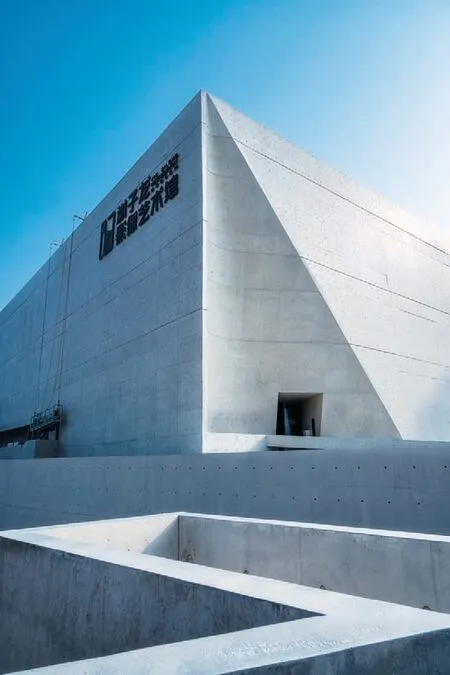
The front entrance of the Xie Zilong Photography Museum,Changsha,which has gone viral
Mencin also says it’s common for smaller museums to pay KOLs to attend.In fact,he cites the inability of a Chengdu gallery space to pay KOLs to attend a recent exhibition he co-curated with his wife,Tracy Lee Mencin,for a swift decline in visitor numbers after opening—he estimates it halved in two weeks.“If you can pay people to generate hype,then your exhibition will be more successful and it doesn’t matter so much about the merit of the exhibition.”
Many art museums across the country have embraced social media marketing strategies to varying degrees in order to go viral.To promote an exhibition on Italian artist Maurizio Cattelan,the UCCA Center for Contemporary Art in Beijing (which has a target audience of 25-to-35-yearolds) challenged Douyin users to video themselves“Killing a Banana”(based on Cattelan’s most famous piece of an ordinary banana gaffer-taped to a wall),and gained 100 million impressions on the app.“We thought it might go viral on a short video platform,”says Danyu Xu,deputy director of communications at UCCA,“because you don’t really need a lot of artistic background to create a video about a banana.”
Visual arts education in China has historically been limited.Xiang,who studied art history in university,remembers only having one 40-minute class per week for art growing up in her elementary and middle school in Hangzhou,with little focus on art history.“We needed to focus on the[examination] scores and those don’t include art.”She remembers one of her followers saying to her that she didn’t go to art museums because she was“afraid”of art.
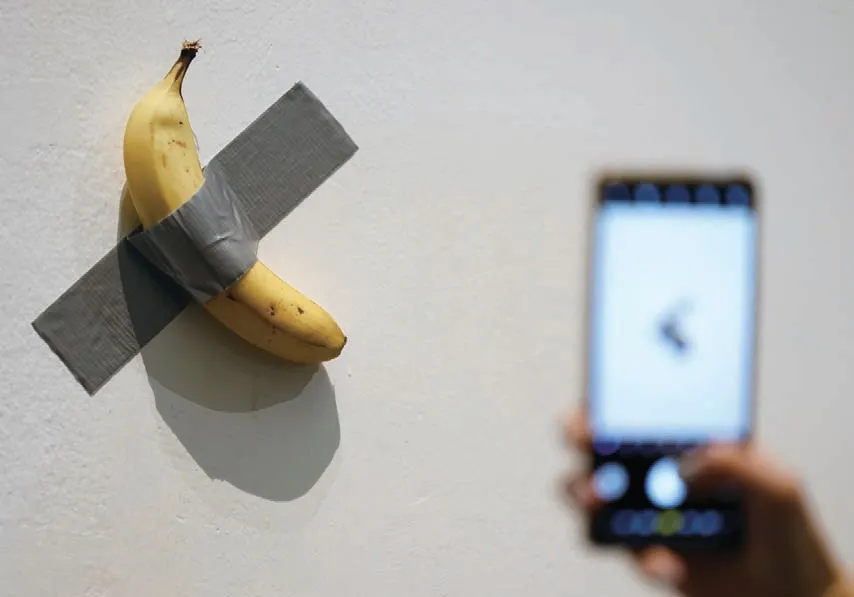
A visitor takes a photo of Maurizio Cattelan’s viral banana art“Comedian”during his exhibition in Beijing’s UCCA Center for Contemporary Art in 2021
Censorship can also make it more challenging to stage unconventional or thematically complex exhibitions.China’s Museum Regulations,approved by the State Council in 2015,require the content of museum exhibitions be approved by local government culture departments,and must promote socialist agendas,such as“popularizing scientific knowledge”and“promoting social harmony.”A piece at UCCA’s Cattelan exhibition,originally entitled“Him”and featuring Adolf Hitler as a child kneeling in prayer,was retitled“No”for the exhibition,with a paper bag placed over Hitler’s head.
Some art museums which have more of a reputation for high-brow art,including public museums,have embraced trends to various degrees.Beijing’s Red Brick Art Museum,a private institution which Dianping users praise for its photogenic red brick architecture (but criticize for 140 yuan ticket prices),has also focused on featuring artists who are more interactive,such as Olafur Eliasson,a well-known Scandinavian artist whose installations fashioned out of natural phenomena are both photogenic and immersive.The National Museum of China launched an“immersive”Van Gogh exhibition in summer 2019 with no physical paintings,but projected animations instead.
Not everyone in the art world is on board with these strategies.“I think this trend isn’t good,”says Huang Wenlong,an assistant curator at Beijing’s Inside-Out Art Museum.“In general,it weakens the function of art museums and makes them places for entertainment.”She says her museum does not want to becomewanghong,but is open to having KOLs promote their exhibitions—only stopped by a lack of staff to arrange this.“Some museums have several positions dedicated to[KOL outreach].”
Others hope trendy exhibitions can introduce traditional gallery culture to netizens.In 2019,Xiang set up an account each on Xiaohongshu and Instagram dedicated to art education,as she was shocked at her followers not knowing of Cai Guoqiang,a major Chinese artist specializing in using fireworks whose work was featured in the 2008 Beijing Olympics opening ceremony.
On these accounts,which are separate from her personal accounts,she gives recommendations of exhibitions worth seeing (including those with niche or challenging content),livestreamed art lectures from a gallery,and lengthy descriptions of the artist and art movement beneath photos of artworks.She hopes these will broaden her followers’ exposure to visual art and artistic education.
But these posts are the exception in KOL interactions with visual art,rather than the norm.Xiang’s personal account,where posts about exhibitions are few and superficial,has nearly 238,000 followers,compared to the 10,000 followers on her educational account.Xiang believes she won’t really change popular attitudes to art unless a bigger group of KOLs start doing the same thing:“You can’t really change people’s interests directly from beauty to art.”
China is experiencing a museumbuilding boom.Exact figures vary,but the National Bureau of Statistics totted up 1,600 new institutions established between 2015 and 2020.Real estate companies like to build art and history museums for tax rewards,creating phenomena like the Unicorn Star Art Museum,a privately owned chain with outlets in at least 15 major Chinese cities,usually in shopping malls.Local governments welcome these museum-building projects to meet their cultural development targets—even if they lack artworks or artifacts to exhibit.
Physical interaction,in the form of photo areas or the selection of engaging visual artists,is more and more important even in serious art institutions.The Today Art Museum in Beijing ran an exhibition last year on Japanese animation artist Hayao Miyazaki (with weekend tickets at 128 yuan a pop) that Mencin says comprised mainly selfie zones,focusing on“moving animatronic characters and plastic,painted set pieces.”This is exacerbated in cities where there is a weaker presence for art museums—in Chengdu,the capital of Sichuan province with a“less developed”art scene according to Mencin,there is a more commercial element to museum culture,making selfie zones an integral part of the process.
This was what he and Tracy Lee Mencin realized when they co-curated their exhibition in Chengdu,which focused on American and Chinese street art in the city.Although the exhibition tackled a serious subject,and was laid out in a traditional gallery fashion,they added special featured areas—graffitied backdrops looking like a shuttered American side-street,and later an artist’s studio and a mock-up of a New York subway car when the exhibition moved to a mall in Shanghai—to cater to visitor demand.He says the Shanghai venue also paid KOLs to attend.
The Shanghai mall,a relatively new build at only sixth months old,“had a greater hand and interest in keeping visitor numbers up,”says Rory Mencin.“For an [established]museum they don’t need to because they have an institution…but there are [new] museums popping up all the time,and they definitely need exposure.”Or,perhaps,just a security guard with an eye for what makes a good selfie.

A visitor to Beijing's branch of the Unicorn Star Art Museum,livestreaming the experience to followers
