
High-performance coherent population trapping clock based on laser-cooled atoms
2022-04-12 03:46:06XiaochiLiu劉小赤NingRu茹寧JunyiDuan段俊毅
Chinese Physics B 2022年4期
Xiaochi Liu(劉小赤) Ning Ru(茹寧) Junyi Duan(段俊毅)
Peter Yun(云恩學)2, Minghao Yao(姚明昊)1,3, and Jifeng Qu(屈繼峰)1
1Center for Advanced Measurement Science,National Institute of Metrology,Beijing 100029,China
2National Time Service Center,Chinese Academy of Sciences,Xi’an 710600,China
3College of Metrology and Measurement Engineering,China Jiliang University,Hangzhou 310018,China
Keywords: coherent population trapping,atomic clock,cold atoms,microwave synthesizer
1. Introduction
Microwave (MW) interrogation can be performed optically in atomic clocks based on coherent population trapping(CPT).[1-3]Thus, no microwave cavity is required in a CPT clock system, and compact, miniature atomic clocks can be developed based on CPT physics.[4-7]
The key component of a typical CPT clock is an alkali atom glass vapor cell. In recent years, vapor-cell-based CPT clocks have demonstrated high short-term frequency stability performance.[8-10]Generally, vapor cells in CPT clocks are filled with buffer gases, such as nitrogen, neon, and argon,to prevent the collision between the alkali atoms and the cell wall. However, the long-term frequency stability of CPT clocks is limited due to pressure- and temperature-dependent shifts,which are introduced by high-pressure buffer gases,as well as resonant light shifts. The resonant light shifts are due to the formation of dark states and the ac Stark shifts when CPT light interacts with alkali atoms.[11-13]The alkali atoms in the vapor cell cannot be completely trapped in the dark state due to ground state decoherence.
The collisional shifts caused by the buffer gases in the vapor cell can be eliminated by performing a CPT clock with laser-cooled atoms.[14-16]The cold atoms can also achieve a long free-evolution time in Ramsey interrogation, which can narrow the linewidth of the central Ramsey fringe and reduce the resonant light shifts. The mitigation of frequency shifts with cold atoms can improve the long-term frequency stability of clocks. As reported in Ref.[15],the resonant light shift could be significantly reduced based on high-coherence excitation fields.
In addition to the collisional and resonant light shifts,the off-resonant light shift needs to be considered as the dominant systematic shift. This shift is caused by the interactions of all detuned energy levels and the light fields. Particularly in CPT clocks,the off-resonant shift strongly depends on the intensity ratio of the two light fields in the CPT interrogation,which are used to couple the hyperfine splitting of the ground states to the excited state in aΛ-system.[17]
This study demonstrates a high-performance Rb CPT atomic clock based on laser-cooled atoms. The atoms are cooled and trapped within three-dimensional compact glass magneto-optical traps (MOTs). An optimizedσ+-σ-pumping scheme is employed in the CPT interrogation to enhance the atomic population involved in the clock transition. The clock is based on a Ramsey interrogation with a free-evolution time of 16 ms,and the linewidth of the central Ramsey fringe is narrowed to 31.25 Hz. An MW synthesizer with low phase noise and high-power stability is applied in the clock system to suppress the noise via the Dick effect and the intensity ratio fluctuations of the CPT bichromatic light fields.
The remainder of the paper is organized as follows. Section 2 describes the experimental apparatus in detail.Section 3 discusses the Rabi- and Ramsey-type CPT resonance signals and the frequency stability of the cold atom CPT clock. Section 4 present the experimental results and the potential for developing compact high-performance CPT clocks with miniature cold atom physical packages,concluding the paper.
2. Experimental setup
The clock is performed with theσ+-σinterrogation,[18,19]which uses alternative left-right circularly polarized counter-propagating beams to couple the hyperfine splitting of the ground states to the excited state in aΛ-system(Fig.1). This pumping scheme optimizes the atomic population involved in themF=0 clock transition and enhances the signal-to-noise ratio of the CPT resonance.
The experimental apparatus of the cold atom CPT clock is shown in Fig. 2. The apparatus can be divided into four main basic blocks defined as laser systems. These systems are a CPT interrogation laser,an optical sideband generation system,a compact MOT system that mainly consists of a cooling light and a vacuum system, and aσ+-σ-interrogation and detection system. These blocks are described in detail in the following sections.
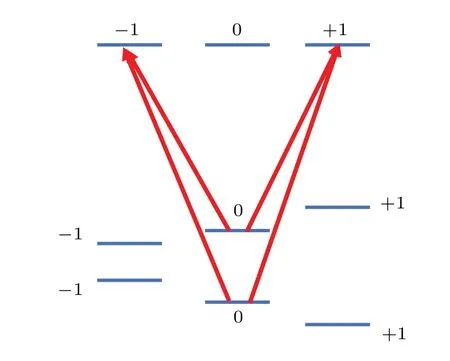
Fig.1. Scheme of σ+-σ- interrogation.
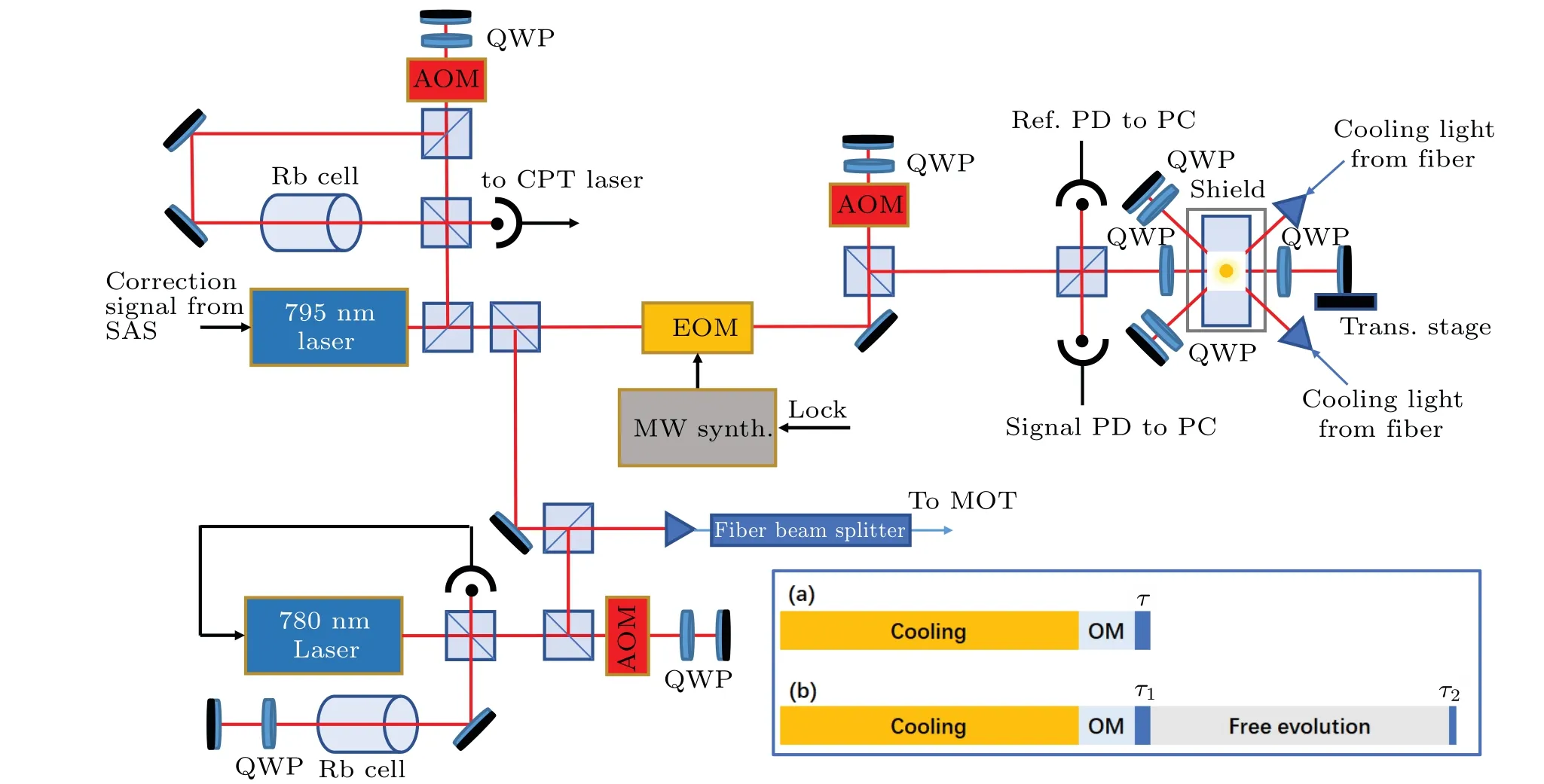
Fig. 2. Architecture of experimental apparatus. SAS: saturated absorption spectroscopy; EOM: electro-optical modulator, AOM: acousticoptical modulator; MOT: magneto-optical trap; QWP: quarter-wave plate; PD: photodiode; PC: personal computer. OM: optical molasses.Insets: interrogation sequence for(a)continuous wave and(b)pulse mode.
The CPT interrogation laser source is a 1-MHz-width distributed feedback(DFB)laser that is resonant on the87Rb D1line at 795 nm. The laser is frequency-stabilized by saturated absorption spectroscopy (SAS) with an auxiliary vapor cell.The frequency is lock at 160 MHz redshifted from the|F=1〉to|F'=1〉optical transition. The laser frequency is shifted by the double passing of an acousto-optic modulator(AOM).The frequency stability is evaluated by comparing the DFB laser with an optical comb referred to a hydrogen clock. The results are plotted in Fig.3,which indicate a stability of 5×10-12at 1 s,which changes to 2×10-12at 100 s.The CPT light is split into two beams: one is overlapped with the cooling light as a repump light field for laser cooling, and the other is injected into a pigtailed electro-optical modulator(EOM).
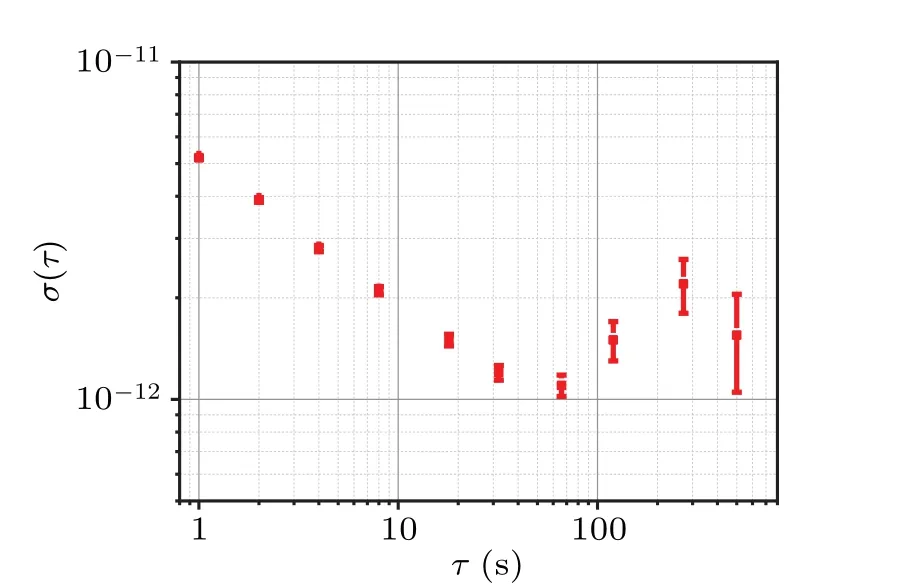
Fig.3. Frequency stability of CPT interrogation laser.
The cooling light is also stabilized by an SAS technique and detuned by-12 MHz from the87Rb D2optical transition at 780 nm. The vacuum system of the MOT is a 40-cm3hightransmission glass cell connected to a mini-ion pump. The glass cell is surrounded by a pair of anti-Helmholtz coils and a pair of constant-magnetic-field coils. A constant magnetic field of 40 mG is applied parallel to the CPT beam direction.The entire glass cell is isolated from external magnetic perturbations with a double-layer mu-metal shield. The diameter of the cold atoms is 4 mm. Approximately 106atoms are cooled and trapped with the MOT system.
CPT sidebands are created by modulating the monochromatic CPT light with the EOM drive via a 6.834-GHz MW signal. The noise of the relative phase between the CPT sidebands that interrogate theΛ-system of the cold87Rb atoms can degrade the short- and long-term frequency stability of the clock. Thus, we employ an EOM-based approach, which can generate a much higher coherence optical sideband than the conventional optical phase-locked loop approach by phaselocking a slave laser onto a master laser.
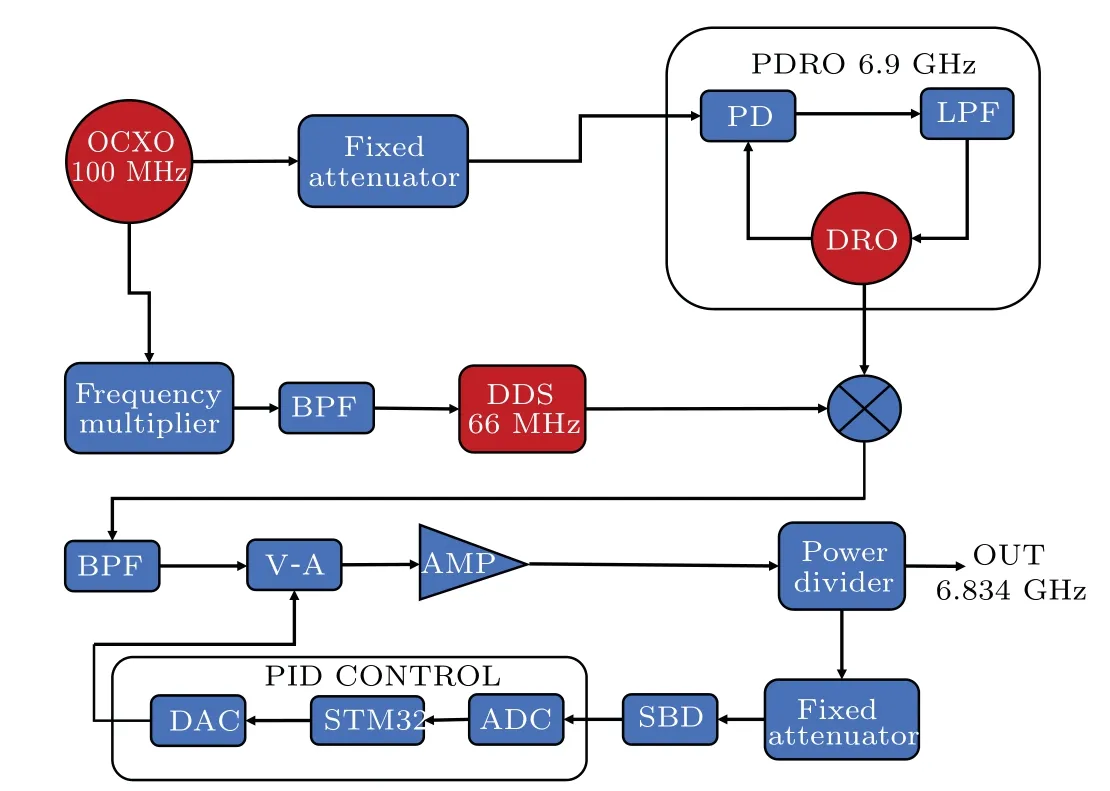
Fig. 4. Basic architecture of a 6.834-GHz microwave synthesizer.OCXO: oven-controlled crystal oscillator; BPF; bandpass filter; LPF:lowpass filter; DDS: direct digital synthesizer; DRO: dielectric resonator oscillator; V-A: voltage control attenuator; DAC: digital-toanalog converter;ADC:analog-to-digital converter;SBD:Schottky barrier diode.
The phase noise of the MW signal can also limit the short-term frequency stability of the CPT clock via the Dick effect.[8,20-23]The frequency stability limitation due to the MW synthesizer is given by
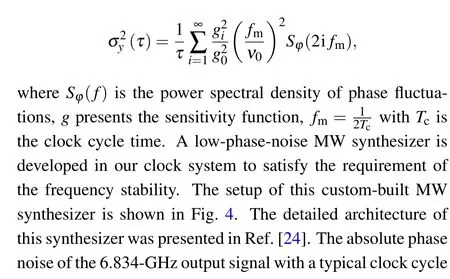
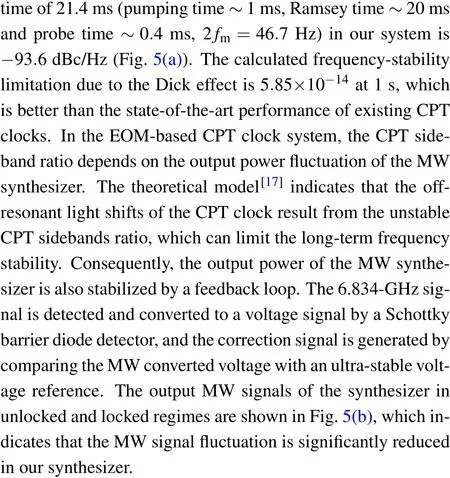
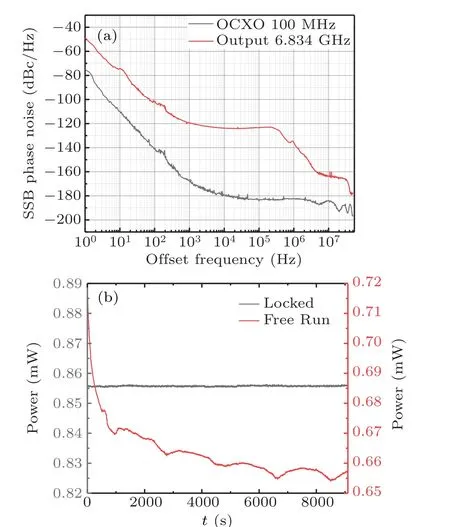
Fig.5. Performance of the microwave synthesizer. (a)Absolute phase noise of the 100-MHz OCXO (black) and 6.834-GHz output signal(red).(b)Power stability of output signal in free-running regime(black)and stabilized regime(red).
At the output of the EOM,the CPT bichromatic beam is sent to a double-pass AOM. The AOM is driven by an 80-MHz signal and used as an optical switch and an optical intensity stabilizer with a feedback loop. Then, the CPT light field is coupled into a polarization-maintaining fiber and split into two sub-beams via a beam splitter. One sub-beam is sent to the reference photodiode to stabilize the optical intensity using the previous AOM and feedback loop. The other subbeam is the CPT interrogation light. The linear polarized CPT light is left-circularly polarized by a quarter-wave plate placed after the beam splitter. The interrogation light propagates through the MOT to interact with the cold atoms. At the other side of the MOT,the beam is reflected after passing through a quarter-wave plate and a mirror fixed onto a translate stage. Theσ+-σ-interrogation scheme is formed with these counter-propagating circularly polarized beams. The CPT signal amplitude depends on the distance between the cold atoms and the mirror effects due to the interference of the CPT resonance.[18]The position of the translate stage is optimized by maximizing the signal amplitude.
The frequency of the local oscillator is locked onto the central fringe obtained in Ramsey spectroscopy.In our system,the light pulse is generated with the AOM by switching the rf signal.The time sequences of the continuous wave regime and pulse regime are given in the inset of Fig.2.
In the pulse regime with a switched-on magnetic trap,after a cooling time of~20 ms with the cooling light,the magnetic trap switches off,and the frequency of the cooling light is shifted to form optical molasses. The first CPT pulseτ1of 1 ms pumps the atoms into the dark state. Then, a Ramsey time lasts 16 ms with all lights switched off and renders the atoms to evolve freely in the dark. The atoms are probed by another CPT pulseτ2of 0.04 ms,which is detected via the signal photodiode. The beam size of the CPT light field is 5 mm,and the optical power is 10μW.
3. Results
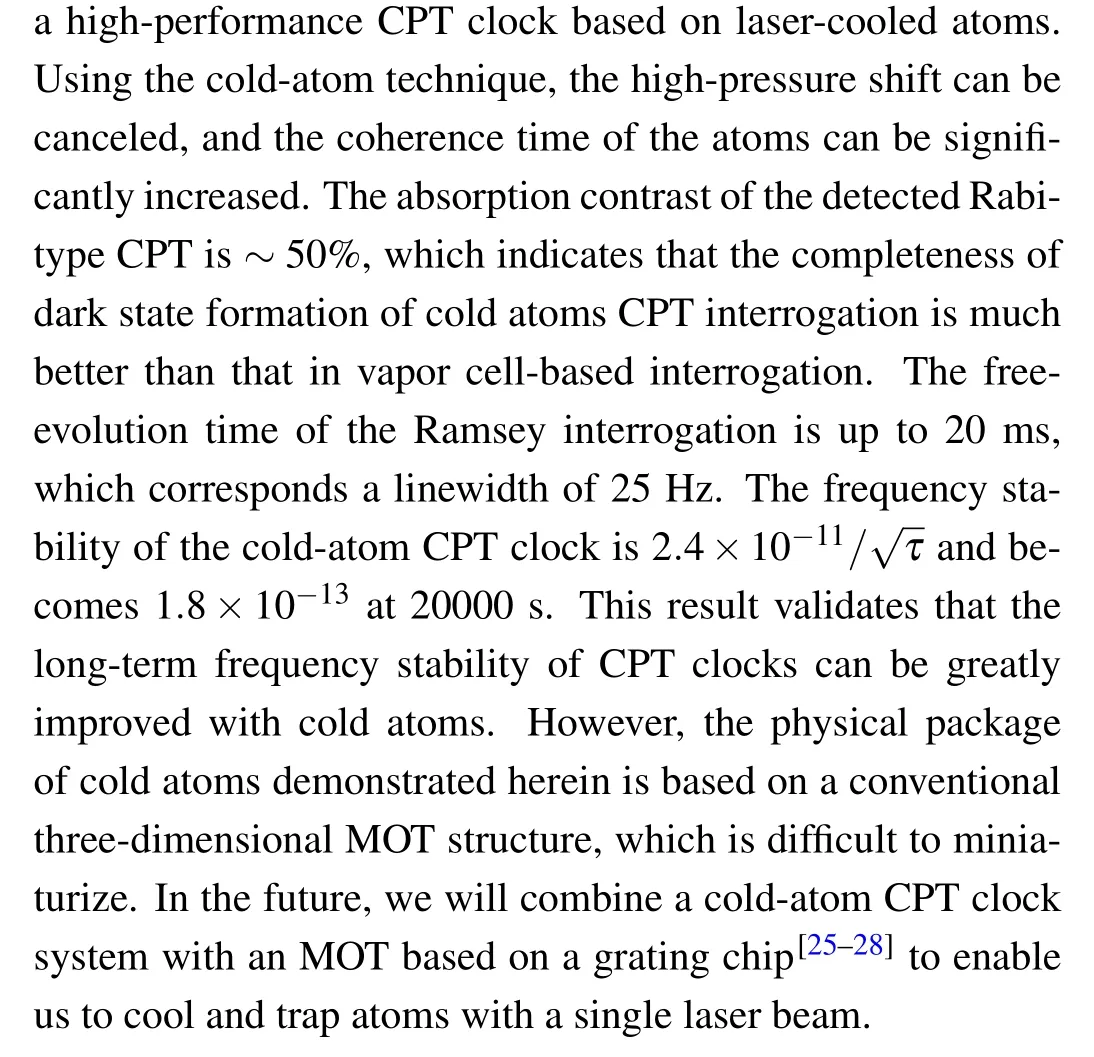
A 7.5 kHz-width CPT signal in a continuous wave regime with theσ+-σ-interrogation scheme is shown in Fig. 6(a).The cold atoms and the optimized pumping scheme significantly improve the atomic population trapped in the dark state.The absorption contrast of the cold-atom CPT resonance signal is defined as the ratio of the CPT peak height to the optical absorption and presents the completeness of the dark state formation. The absorption contrast in the proposed system is more than 50%, whereas the absorption contrast of CPT resonance in a vapor cell is typically less than 5%. Thus, the measured result indicates that the formation of the dark state for cold atoms is much better than the atoms in vapor-cell.Ramsey fringes with free-evolution timeTRof 16 ms are plotted in Fig. 6(b). The linewidth of the central Ramsey fringe is 31.25 Hz, which is consistent with the expected value of 1/2TR.
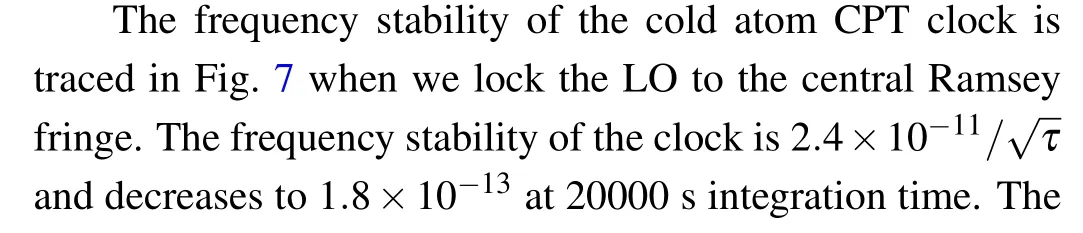
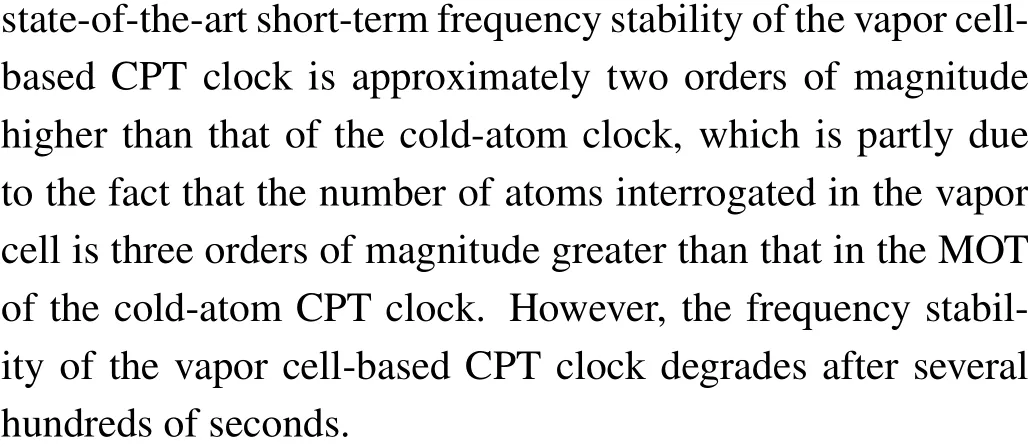
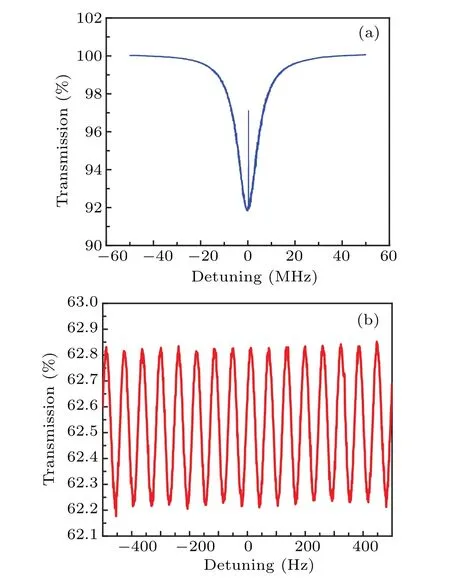
Fig.6. CPT resonance: (a)continuous-wave interrogation,(b)Ramsey interrogation.
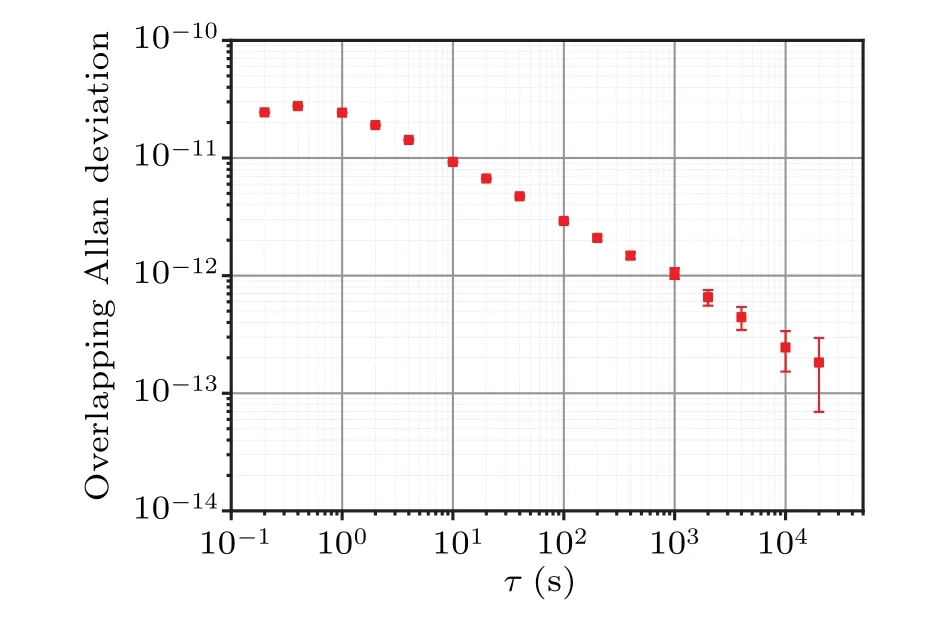
Fig.7. Frequency stability of the cold-atom CPT clock.
4. Conclusion and perspectives
Acknowledgements
We are grateful to Lin Dan and Qiang Hao for their fruitful discussions. This work was supported by the National Natural Science Foundation of China(Grant No.61975194).

- Chinese Physics B的其它文章
- Helium bubble formation and evolution in NiMo-Y2O3 alloy under He ion irradiation
- Dynamics and intermittent stochastic stabilization of a rumor spreading model with guidance mechanism in heterogeneous network
- Spectroscopy and scattering matrices with nitrogen atom:Rydberg states and optical oscillator strengths
- Low-overhead fault-tolerant error correction scheme based on quantum stabilizer codes
- Transmembrane transport of multicomponent liposome-nanoparticles into giant vesicles
- Molecular dynamics simulations of A-DNA in bivalent metal ions salt solution