
Chidamide combined with traditional chemotherapy for primary cutaneous aggressive epidermotropic CD8+cytotoxic T-cell lymphoma:A case report
2022-03-15 07:12:20ZhenDongHeHaiYanYangShengShengZhouManWangQinLiMoFengXiangHuangZhiGangPeng
World Journal of Clinical Cases 2022年4期
INTRODUCTION
Primary cutaneous aggressive epidermotropic CD8+cytotoxic cell T-cell lymphoma is a rare subtype of cutaneous T-cell lymphoma,accounting for less than 1% of all cutaneous T-cell lymphomas.Only dozens of cases have been reported worldwide,and there is no optimal treatment.According to existing reports,the majority of patients with primary cutaneous aggressive epidermotropic CD8+cytotoxic T-cell lymphoma currently receive doxorubicin-based traditional chemotherapy.There are case reports of treatment with CHOP,CHOPE,and Hy-CVAD regimens,but the efficacy is poor.All result in short-term benefits,with an overall survival of 12-32 mo[1].The main reason for the poor long-term efficacy of primary cutaneous aggressive epidermotropic CD8+cytotoxic T-cell lymphoma to traditional chemotherapy is that lymphoma cells are prone to chemoresistance[2].Chidamide has potential antihematological tumor activity and enhances the chemosensitivity of lymphoma cells.It has been recognized for the treatment of relapsed or refractory peripheral T-cell lymphoma.Based on the above theory,we boldly tried the combination of chidamide with traditional chemotherapy (CHOPE) in a patient with primary cutaneous aggressive epidermotropic CD8+cytotoxic T-cell lymphoma with promising results.
CASE PRESENTATION
Chief complaints
A 14-year-old boy was admitted to the Department of Dermatology with a 5-d history of generalized erythema,papules,and blisters and was transferred to the Department of Medical Oncology.
History of present illness
The patient had generalized erythema,papules,and blisters with itching since August 18,2017.Three days after the onset of symptoms,some blisters formed blood blisters with tan crusts on the surface,accompanied by pain,and fever,fear of cold,and chills,with a maximum body temperature of 41 °C.
Physical examination
The patient's body temperature was 37.8 °C,heart rate was 110 bpm,respiratory rate was 20 breaths/min,and blood pressure was 99/67 mmHg.Scattered blood blisters were observed throughout the body,with the most severe blood blisters on the trunk,consistent with the distribution of skin transverse striae (Figure 1).Erosive surfaces of varying sizes were seen in the oral cavity,trunk,extremities,and perineum.Physical examination of the heart,lungs,and abdomen was unremarkable.

Laboratory examinations
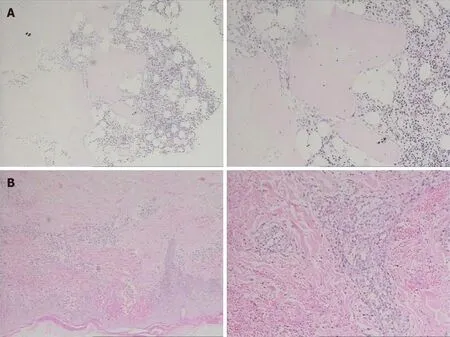
After admission,a blood test was performed and the patient’s white blood cell count was 5.86 × 10/L,hemoglobin concentration was 146.70 g/L,and platelets were 129.80 × 10/L.His biochemical results were as follows:Total protein,61.2 g/L;albumin,29.5 g/L;creatinine,54 μmol/L;lactate dehydrogenase,351 U/L;β-2 microglobulin,3.6 mg/L;interleukin-6,13.34 pg/mL.The results of bone marrow biopsy showed slight microscopic bone marrow hyperplasia,cell volume accounted for 40%,tertiary hematopoietic cells were present,granulocyte/erythrocyte ratio was slightly increased,and cell morphology was normal (Figure 2A).The skin of the left thigh was biopsied,and the pathology results indicated primary cutaneous aggressive epidermotropic CD8+cytotoxic T-cell lymphoma (Figure 2B).The results of immunohistochemistry revealed the following:CD3 (+),CD2 (-/+),CD4 (-/+),CD5 (-/+),CD7 (+),CD8 (++),CD56 (-),TiA-1 (+),GB (+),AlK (-),CD30 (-),CD20 (-),and CD10 (-);EBERs (-);TCR-r gene rearrangement (-).
The patient was diagnosed more than 20 d after the onset of symptoms,and chidamide combined with CHOPE regimen was administered as the patient's first cycle of treatment as follows:Chidamide 30 mg/biw,cyclophosphamide 1100 mg/d1,doxorubicin 70 mg/d1,vincristine 2 mg/d1,dexamethasone 20 mg/d1-5,etoposide 100 mg/d1-5,in a 21 d cycle.The patient completed a total of 6 cycles of treatment and subsequently entered maintenance therapy.
Imaging examinations
He ordered the tailor to make him a mantle and vest of blue velvet embroidered with pearls, and the coachbuilder to make him a golden coach like the coach of the Princess Ludovine

FINAL DIAGNOSIS
Primary cutaneous aggressive epidermotropic CD8+cytotoxic T-cell lymphoma is clinically heterogeneous,and its course progresses rapidly.Treatment options for advanced disease are limited,and significantly effective treatment options deserve active exploration.Numerous studies have shown that histone deacetylase inhibitors (HDAC inhibitors) are used to treat malignant tumors,such as cutaneous T-cell lymphoma and peripheral T-cell lymphoma.Moreover,HDAC inhibitors are now increasingly being used in combination with other types of anticancer drugs for the treatment of various malignancies.Chidamide is an innovative drug independently developed in China,which can exert anti-tumor activity by reversing tumor cell resistance,increasing tumor cell chemosensitivity,potently regulating immunity and potential direct anti-tumor effects[7,8].In December 2014,chidamide was approved by China Food and Drug Administration for the treatment of relapsed or refractory peripheral T-cell lymphoma.Previous studies have shown that chidamide can induce apoptosis and growth arrest of lymphoid or hematologic tumor cells,and can also reverse tumor cytochemical resistance to increase tumor cell chemosensitivity.Wei Guan[9] retrospectively analyzed 17 cases of refractory or relapsed T-lymphocytic lymphoma/leukemia (T-LBL/ALL) and found that chidamide has pleiotropic regulatory immune function and can enhance the sensitivity of tumor cells to chemotherapeutic drugs.Jiang[10] found that chidamide inhibited the proliferation and induced apoptosis of tumor cells and exerted potential anti-leukemia activity.Chidamide can also increase the chemosensitivity of tumor cells by disrupting the Smo/gli-1 pathway and the downstream signaling target p-AKT.Yan[8] found that the combination of chidamide and syndilimab enhanced the efficacy of syndilimab in NK/T cell lymphoma.Based on the above theory,we speculate that a treatment regimen combining chidamide may be a promising therapeutic strategy for refractory T-cell lymphoma.Common adverse events of chidamide include thrombocytopenia,leukopenia,neutropenia,QTc prolongation,fatigue,fever,and gastrointestinal symptoms.Studies have shown that the incidence of adverse events is low and easily controlled,with only a few patients discontinuing treatment due to serious adverse events[7,11].
TREATMENT
9. King s son with beautiful kind eyes: One wonders if the princess deserves such a blessing37 after her behavior, but her royal status traditionally makes her the proper bride for a prince. Besides, she is responsible for breaking the spell however objectionable her methods may be. The description of the eyes also implies the prince is not upset over the mistreatments he received while still a frog.Return to place in story.
OUTCOME AND FOLLOW-UP
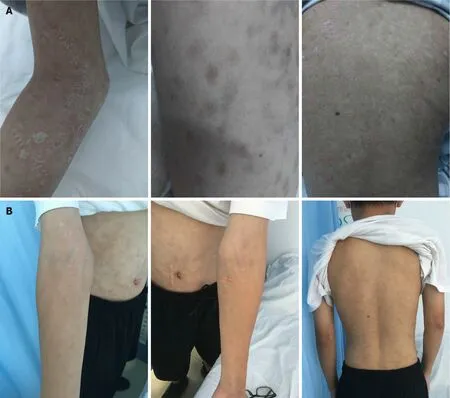
After 4 cycles of treatment,the patient returned to the hospital for follow-up,and his skin rash on the face,neck,trunk,and extremities had disappeared (Figure 4A).The blood tests showed that the white blood cell count was 6.14 × 10/L,hemoglobin concentration was 123 g/L,and platelets were 225 × 10/L.His biochemical results were as follows:Total protein,68.2 g/L;albumin,36 g/L;creatinine,60 μmol/L;lactate dehydrogenase,225 U/L;β-2 microglobulin 1.96 mg/L;interleukin-6,5.3 pg/mL.PET/CT showed that after chemotherapy for cutaneous lymphoma,the original lesions were inactivated and no new lesions were observed (Deauville score:1 point).No clear structural or glucose metabolism abnormalities were noted (Figure 3B).Complete remission was observed.The patient had grade III bone marrow suppression during the 5cycle of chemotherapy,and continued to complete chemotherapy as planned after repeated blood tests were normal after leukocyteelevating therapy.After completing 6 cycles of treatment,he regularly took chidamide 20 mg/biw as maintenance therapy for 1 year.No significant hematological toxicity or gastrointestinal adverse events occurred during maintenance therapy with chidamide.The last follow-up was performed 2 wk ago and the patient's condition was stable without recurrence (Figure 4B).
Primary cutaneous aggressive epidermotropic CD8+cytotoxic T-cell lymphoma was first reported as a rare histopathological subtype of cutaneous T-cell lymphoma in 1999 by Berti[3].It was first classified as a non-specific provisional entity by the World Health Organization/European Organization for Research and Treatment of Cancer in 2005[4].This type of lymphoma is characterized by the presence of localized or diffuse papules,nodules,or tumors,which present as central ulceration or necrosis,or plaques with surface hyperkeratosis[5].Primary cutaneous aggressive epidermotropic CD8+cytotoxic T-cell lymphoma is highly aggressive and can rapidly spread to various organs,such as the lungs,testes,central nervous system,or oral mucosa,with a poor response to traditional chemotherapy[6].Some patients can benefit from doxorubicin-based multiagent chemotherapy for a short time,but most patients relapse a short time after treatment and even develop resistance to traditional chemotherapy and then it transforms into relapsed or refractory lymphoma.Treatment is still a great clinical challenge.
DISCUSSION
Quickly he drew the box from his girdle, took a good pinch of the snuff, and offered one to Mansor, who also took one, and both cried together Mutabor! Instantly their legs shrivelled up and grew thin and red; their smart yellow slippers27 turned to clumsy stork s feet, their arms to wings; their necks began to sprout28 from between their shoulders and grew a yard long; their beards disappeared, and their bodies were covered with feathers
Positron emission tomography/computed tomography (PET/CT) showed mildly increased systemic cutaneous glucose metabolism,which was considered to be cutaneous lymphoma.Mild systemic skin swelling and a diffuse mild increase in glucose metabolism,especially in the local skin of both armpits,right upper quadrant,and posterior coccyx were observed (Figure 3).Multiple small lymph nodes of different sizes with increased glucose metabolism were observed in both armpits and groins.
Based on pathological biopsy,laboratory examinations,imaging examination and clinical manifestations,the patient was finally diagnosed with primary cutaneous aggressive epidermotropic CD8+cytotoxic T-cell lymphoma.
The present patient with primary cutaneous aggressive epidermotropic CD8+cytotoxic T-cell lymphoma achieved complete remission following treatment with chidamide combined with CHOPE regimen.On the one hand,this may have been due to the potential antitumor activity of chidamide,and on the other hand,it may have been because chidamide reverses tumor cell chemoresistance to increases tumor cell chemosensitivity.In this case,the patient experienced short-term hematological toxicity during chemotherapy with chidamide combined with CHOPE regimen,but recovered quickly after leukocyte-elevating therapy.The patient successfully completed 6 cycles of therapy.In addition,no significant adverse events occurred in this patient during maintenance therapy.This regimen was well tolerated and provides a promising therapeutic strategy for the treatment of primary cutaneous aggressive epidermotropic CD8+cytotoxic T-cell lymphoma.
As he could get no other horse, he went into the forest, broke off a branch, stripped the bark off it, so that it became still whiter than his brothers horses, and, mounted on this
CONCLUSION
In conclusion,we found that a combination of chidamide and a traditional chemotherapy regimen is a safe and effective treatment for primary cutaneous aggressive epidermotropic CD8+cytotoxic cell T-cell lymphoma,but its long-term efficacy requires further evaluation.For patients with primary cutaneous aggressive epidermotropic CD8+cytotoxic T-cell lymphoma refractory to traditional therapy (,CHOP),we recommend early combination therapy with chidamide.This study also had limitations:Due to the rarity of primary cutaneous aggressive epidermotropic CD8+cytotoxic T-cell lymphoma,analysis of the results obtained in this report requires caution.Whether the good efficacy in this patient was the result of synergy between traditional chemotherapy and chidamide or a separate effect of chidamide cannot be determined.In the future,we will continue to collect data to assess the efficacy and safety of chidamide in combination with CHOPE in patients with primary cutaneous aggressive epidermotropic CD8+cytotoxic T-cell lymphoma.
We sincerely thank the chief editor and all review experts for reviewing this paper.
 World Journal of Clinical Cases2022年4期
- World Journal of Clinical Cases的其它文章
- Surgical treatment of acute cholecystitis in patients with confirmed COVID-19:Ten case reports and review of literature
- Rituximab as a treatment for human immunodeficiency virusassociated nemaline myopathy:What does the literature have to tell us?
- Eustachian tube involvement in a patient with relapsing polychondritis detected by magnetic resonance imaging:A case report
- Endoscopic clipping for the secondary prophylaxis of bleeding gastric varices in a patient with cirrhosis:A case report
- Inflammatory myofibroblastic tumor after breast prosthesis:A case report and literature review
- Langerhans cell histiocytosis presenting as an isolated brain tumour:A case report