
Improving the spectral purity of single photons by a single-interferometer-coupled microring
2022-03-12 07:48:16YangWang王洋PingyuZhu朱枰諭ShichuanXue薛詩川YingwenLiu劉英文JunjieWu吳俊杰XuejunYang楊學軍andPingXu徐平
Chinese Physics B 2022年3期
關鍵詞:英文
Yang Wang(王洋), Pingyu Zhu(朱枰諭), Shichuan Xue(薛詩川), Yingwen Liu(劉英文),Junjie Wu(吳俊杰), Xuejun Yang(楊學軍), and Ping Xu(徐平)
Institute for Quantum Information&State Key Laboratory of High Performance Computing,College of Computer Science and Technology,National University of Defense Technology,Changsha 410073,China
Keywords: spectral-purity,microring,asymmetric Mach-Zehnder interferometer
1. Introduction
High-quality and deterministic single-photon sources play a critical role in quantum information processing, including quantum cryptography[1,2]and linear-optical quantum computation.[3,4]Single-emitter-based single-photon sources and heralded single-photon sources via spontaneous parametric process are two typical approaches to generate on-demand single photons. The former has been realized on different quantum systems such as quantum dots,[5,6]single atom[7,8]and color centers.[9]A typical implementation of the latter is via spontaneous four-wave mixing (SFWM) in integrated quantum photonic circuits (IQPCs). The heralded singlephoton source based on SFWM in IQPCs holds the advantage of scalability,robustness,energy efficiency and compactness.
Quantum light sources based on SFWM have been implemented on a variety of platforms,such as silicon-on-insulator(SOI),[10]silica-on-silicon,[11]and SiN-on-silica.[12]Of all these platforms, SOI is especially appealing for its CMOScompatibility and holds great potential in fully integrated photonic chips toward high-performance quantum information processing. Due to the high refractive index contrast,[13]large third-order nonlinear coefficient[14]and compact volume,silicon microrings have dramatically increased SFWM efficiency under a relatively low pump power.[15]The bright photonpair source has been implemented using a dual-interferometercoupled silicon microring.[16]Apart from the brightness, the spectral purity of single photons is another essential property to ensure high-visibility quantum interference. The converted photon pairs should be unentangled in frequency to ensure the heralded single photons in the spectrally pure state. Using a narrowband filter to post-select the converted photons is a simple way to obtain high spectral purity, with the sacrifice of single photon counts and the heralding efficiency.Another approach for pursuing high-spectral-purity singlephoton source has been proposed theoretically[17]and demonstrated experimentally.[18]Fully separable biphoton wavefunction is engineered using dual-interferometer-coupled microring, which does not sacrifice the heralding efficiency. The high spectral purity from dual-interferometer-coupled microring benefits from independently tuning quality factors of the pump and converted photons, compared with the one or double straight-waveguide coupled microring whose upper bound on spectral purity is 93%.[20,21]However, a series of dualinterferometer-coupled microrings with different coupling parameters need to be fabricated to confirm the optimal one since the quality factors are fixed after the manufacture of the chip.
In this work, we use a single-interferometer-coupled microring to achieve and characterize high-spectral-purity single-photon source. The microring coupled by an asymmetric Mach-Zehnder interferometer (AMZI) can be configured to get different quality factors for the pump and converted photons. We experimentally engineer the spectral purity of the heralded photons over 93%following the method in Ref.[19].It is a fabrication-friendly scheme to generate high-spectralpurity single photons because of its reconfigurability. This spectral-purity-reconfigurable single-photon source is desired in multiphoton interference research,such as disclosing the relationship of fidelity and distinguishability of photons in Boson sampling.[22]
2. Theory
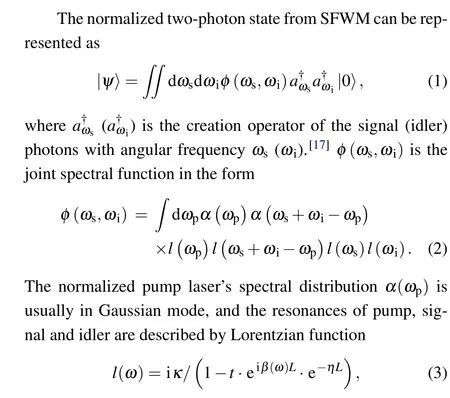
whereκandtare respectively the cross-coupling and selfcoupling coefficients between the bus waveguide and microring,β(ω)is the propagation constant for angular frequencyω,Lis the roundtrip length of the microring,andηis the effective loss coefficient of the microring.
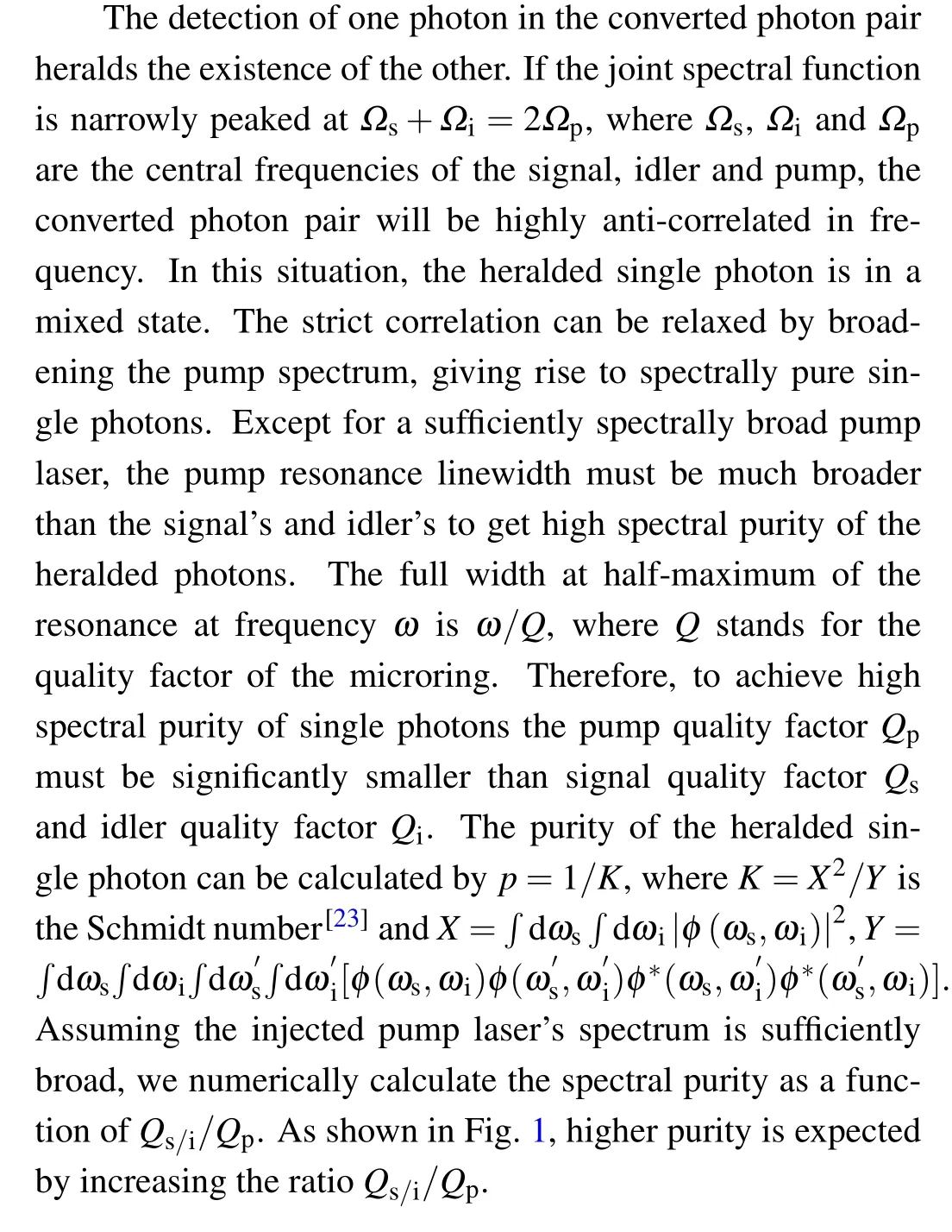
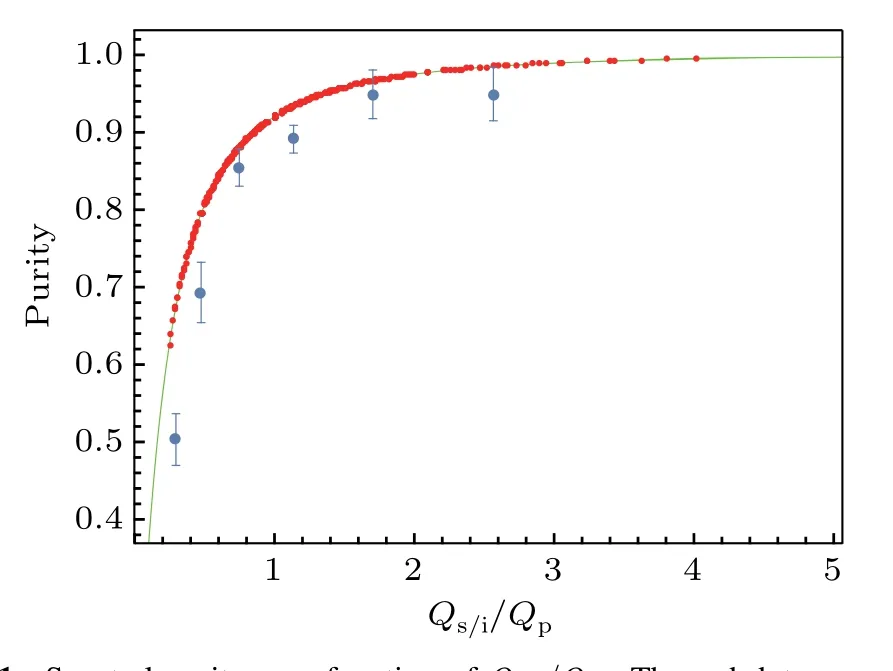
Fig. 1. Spectral purity as a function of Qs/i/Qp. The red dots are samples generated using parameters corresponding to our chip;the green line is spectral purity function of Qs/i/Qp fitted from the simulated samples; and the blue dots with error bars are purities detected experimentally.
The total quality factor contains intrinsic and extrinsic quality factor
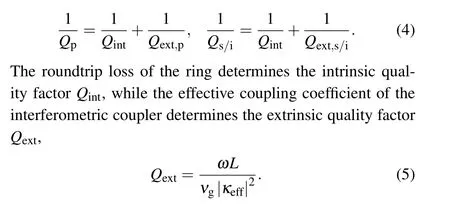
An AMZI-coupled microring structure is used to manipulate the coupling conditions of the pump and signal/idler to optimize the spectral purity of the generated photons, as shown in Fig.2. Assuming the intrinsic quality factors are constant,the quality factors of the pump and signal/idler are determined by the effective coupling coefficient. The path difference of AMZI is half of the ring’s roundtrip,πR, in the original proposal in Ref.[19]. To avoid the heat crosstalk between heaters in AMZI and microring, the path difference of AMZI is set to 3πRin our experiment. The effective coupling coefficient configured by the AMZI satisfies The ratio ofQs/iandQpcan be set in the range of (1/(1+A),1+A),so we can get different purities of single photons.
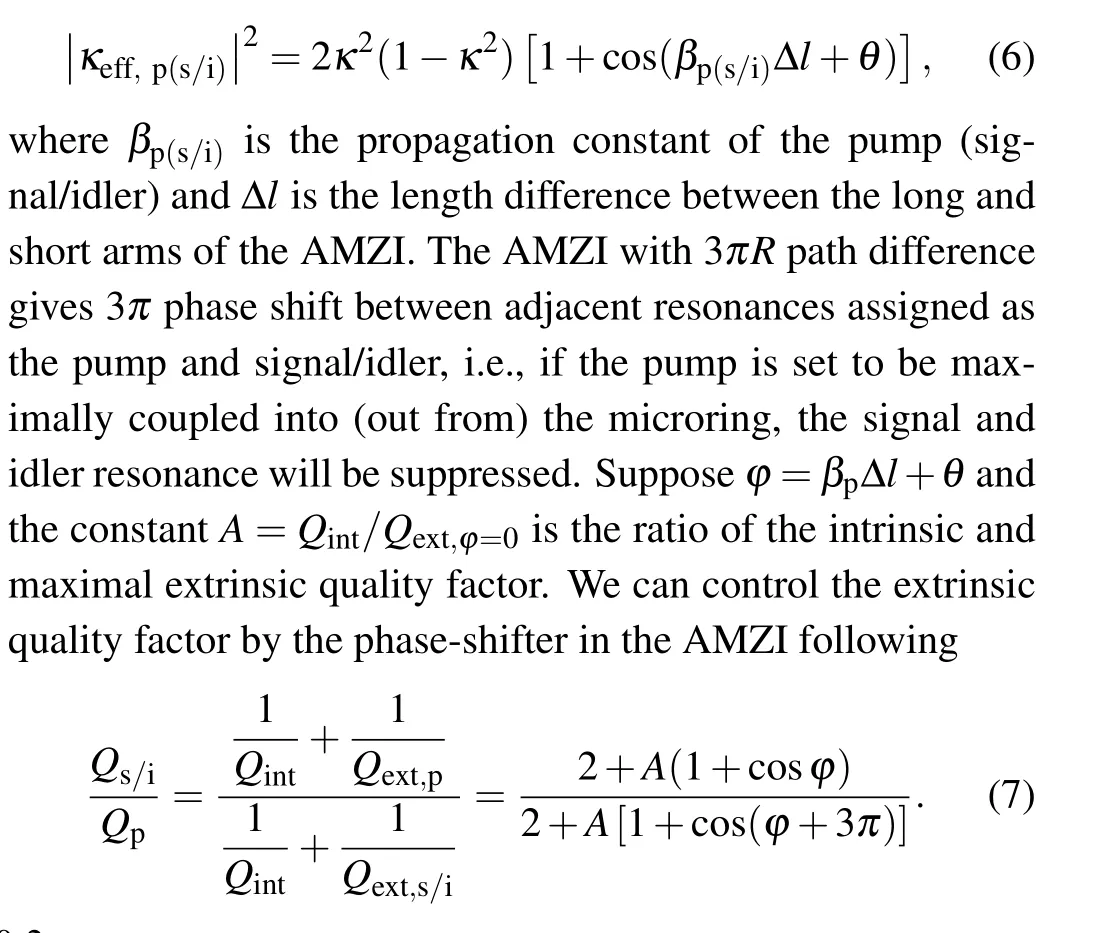
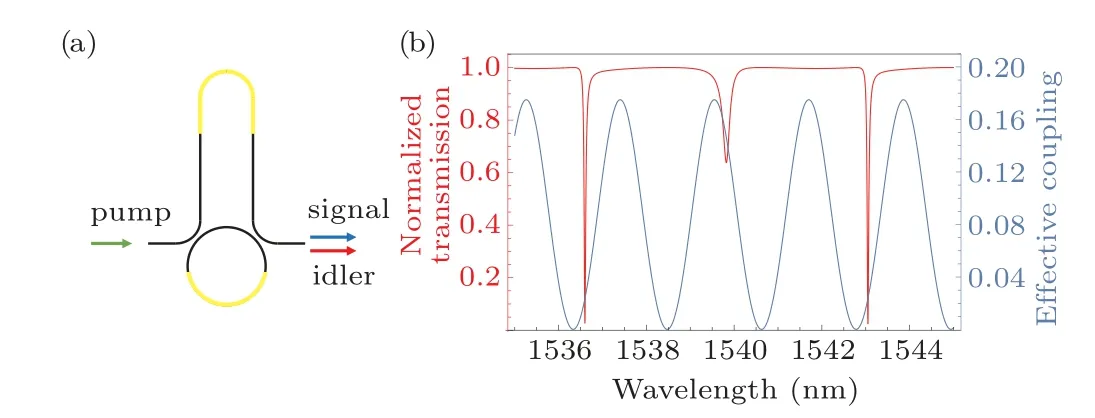
Fig. 2. (a) Schematic of AMZI-coupled microring. (b) The transmission spectra of the AMZI-coupled microring and the corresponding effective coupling.
3. Experiment
Experimentally, we fa bricate an AMZI-coupled micror-ing on an SOI chip. The height of the silicon waveguide in silica is 220 nm,and the width is 450 nm. The roundtrip length of the microring is 2π·28 μm. Free spectral range (FSR) of 3.2 nm is implemented to align the standard dense wavelength division multiplexing(DWDM)channels. The gaps at the two coupling points of the AMZI are both 180 nm. Thermo-optic modulators on the long arm of AMZI and microring are respectively used to tune the interferometer phase and resonant wavelength. The experiment setup is shown in Fig. 3. The pulsed laser with a repetition frequency of 60 MHz is used as the pump laser, which is filtered by a 200 GHz DWDM to suppress sideband noise. A continuous-wave(CW)laser is introduced as the seed signal for joint spectral correlation measurement. The two lasers are combined by a 50:50 fiber beam splitter. The grating couplers couple in and out the pump,seed and converted photons through an off-chip fiber array.
By adjusting the voltage on the phase shifter in AMZI,different effective coupling coefficients are configured. To get the transmission spectra, we scan the tunable CW laser and record the resonator’s transmission power by a power meter.Figure 3 gives the transmission spectra at different voltage configurations. The corresponding quality factors are listed in Table 1. It is hard to maintain exactly equal quality factors of signal and idler,so we take the minimum ofQsandQito calculateQs/i/Qp. The ratiosQs/i/Qpare measured to be 0.29,0.48,0.75,1.14,1.70 and 2.57. According to the fitting curve in Fig.1,the purity of the converted photons is expected to be 67.33%,79.38%,88.08%,93.43%,96.65%and 98.49%,respectively.
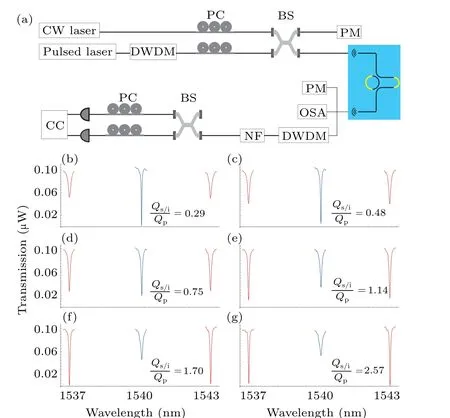
Fig.3. (a)Experimental setup. PC,polarization controller;BS,beam splitter; PM, power meter; OSA, optical spectrum analyzer; CC, coincidence counting module;NF,narrowband filter. (b)-(g)The measured transmission spectrums and the corresponding Qs/i/Qp.

Table 1. Summary of main metrics of the AMZI-coupled microring single-photon sources.
By constructing the signal-idler joint spectral intensity(JSI)profile using the stimulated emission tomography(SET)method,[24]we then study the detailed spectral correlation of signal and idler. Figure 4 gives the theoretical and measured JSI profiles.It depicts that the measured JSI profiles agree well with the theoretical ones. A clear frequency anti-correlation is observed whenQs/i/Qp<1. With the ratioQs/i/Qpincreasing,the spectral correlation of signal and idler decreases. The SET measurement gives a vivid image of spectral correlation,and supplies the corresponding purity of 63.60%, 79.03%,75.28%, 87.98%, 89.70% and 94.77%, respectively. Furthermore, both theoretical and experimentally measured JSI profiles suffer from the deformation compared to those in previous work. This is mainly caused by the drastic change of the effective coupling coefficients around the frequency of resonances. In one FSR of 3.2 nm, the effective coupling coefficient of AMZI with 3πRpath difference goes through 1.5 periods,while the effective coupling coefficient of AMZI withπRpath difference goes through 0.5 periods.The unsymmetry of transmission spectra caused by the drastic change of the effective coupling coefficients can be observed in Fig.2(b)and experimentally demonstrated in Figs.3(b)-3(g).
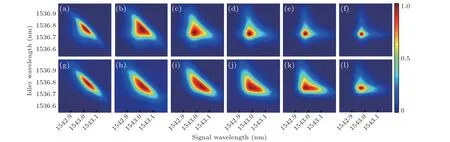
Fig.4. (a)-(f)Theoretical and(g)-(l)experimentally measured signal-idler joint spectral intensity profiles for the ratios Qs/i/Qp being 0.29,0.48,0.75,1.14,1.70 and 2.57.
Time-integrated second-order correlation(g(2))is a rigid purity measurement quantitatively describing the number of temporal modes contained in the converted single photons.To measureg(2)of the signal photons, a 100 GHz DWDM is first used to separate signal photons from idlers and transmitted pump. To further suppress the pump noise and photons from the broadband SFWM in the fiber and straight silicon waveguide, a linewidth-tunable narrowband filter (NF)follows the DWDM channel. In order not to post-select the signal’s spectrum, the NF linewidth is set to 0.2 nm for signal with quality factor of 13660,15560,17740, while the NF linewidth is set to 0.1 nm for signal with quality factor of 20730,25000,29610. The signal is then split by a 50:50 fiber beam splitter and detected by two superconducting nanowire single-photon detectors with dark count rates of 29 Hz and 34 Hz, respectively. Single counts and two-fold coincidence count are recorded to calculateg(2), which are listed in Table 1. Theg(2)of the signal photons increase with the ratioQs/i/Qp, and they are marked in Fig. 1. There are three key factors resulting in the measured single photon purity below the theoretical calculation.First,the waveguide connecting the grating coupler and the input port of the microring is 1188 μm,and the waveguide connecting the output port of the microring and the grating coupler is 372 μm. The SFWM in these waveguides also generates photon pairs but with a different joint spectrum which will affect the purity of the detected single photons. Second,there is still transmitted pump power not filtered out by the DWDM and NF,affecting theg(2)measurement of the signal photons.Third,the imperfection of the nano fabrication causes the deformation of the transmission spectra. When the microring works in undercoupling condition,mode-splitting can be observed,indicating that the resonances in the experiment are not perfectly consistent with the theoretical calculation.With the effect of all these factors,the highest purity of 94.95±3.46%is implemented in our AMZI-coupled silicon microring.
4. Conclusion
We have experimentally demonstrated and characterized a spectral-purity-reconfigurable single-photon source based on an AMZI-coupled silicon microring. The JSI profiles intuitively demonstrate the decrease of correlation between signal and idler as the ratio of signal/idler and pump quality factor increases. The single photong(2)up to 94.95±3.46% is measured. Such high-spectral-purity photons will improve the visibility of quantum interference and facilitate the development of on-chip quantum information processing. Moreover,this concise and reconfigurable AMZI-coupled microring is a fabrication-friendly structure of a high-spectral-purity singlephoton source. We can still get high-spectral-purity single photons by the configuration of AMZI,even if the bias exists in the fabrication of the AMZI-coupled microrings.
Acknowledgments
Project supported by the National Basic Research Program of China (Grant Nos. 2019YFA0308700 and 2017YFA0303700) and the Open Funds from the State Key Laboratory of High Performance Computing of China(HPCL,National University of Defense Technology).
猜你喜歡
國際展望(2017年2期)2017-03-21 18:34:18
鄱陽湖學刊(2016年6期)2017-01-16 13:05:41
中國遠程教育(2016年6期)2016-12-07 10:07:02
財經(2016年19期)2016-08-11 08:17:03
中國遠程教育(2016年5期)2016-06-29 10:13:42
中國遠程教育(2016年2期)2016-03-21 10:31:21
中國遠程教育(2016年1期)2016-02-26 10:37:15
國際展望(2015年5期)2015-09-15 05:41:45
國際展望(2015年4期)2015-07-13 05:30:56
能源(2014年9期)2014-09-15 13:18:12

- Chinese Physics B的其它文章
- Surface modulation of halide perovskite films for efficient and stable solar cells
- Graphene-based heterojunction for enhanced photodetectors
- Lithium ion batteries cathode material: V2O5
- A review on 3d transition metal dilute magnetic REIn3 intermetallic compounds
- Charge transfer modification of inverted planar perovskite solar cells by NiOx/Sr:NiOx bilayer hole transport layer
- A low-cost invasive microwave ablation antenna with a directional heating pattern