
A Study on the Evolution of Country Names from the Perspective of Chinese Character Cultural Circle—A Case Study of Portugal
2021-12-31 08:37:46YangShuaike
Proceedings of Northeast Asia International Symposium on Linguistics,Literature and Teaching 2021年0期
Yang Shuaike
Guangdong University of Foreign Studies,Guangzhou,China
Email:201710064@oamail.gdufs.edu.cn
[Abstract] From the perspective of language contact,this paper examines the documentary evidence of the translation of "portugal" in different periods,and makes a complete and in-depth description of the finalization process of the translation of"portal"in combination with the frequency change of the use of each word in the corpus.It is argued that a large number of Japanese world history and geography books translated by students studying in Japan were widely spread in China and played an important role in the finalization of"Portugal"translation.
[Keywords] Portugal;Translation of national names;Translate;Language contact
At the end of the 16th century,Western Jesuits came to the East,and Matteo Ricci'sComplete Map of Kunyuopened the door to the world for China.For the first time,Chinese intellectuals came into contact with the translation of national names such as "portugal","France" and so on.In these Chinese books and periodicals,the translated words and writing forms of various countries are different,which is an important material for the study of lexical his?tory and geography.Taking "Portugal" as an example,this paper makes a complete and in-depth description of the emergence,use,popularization and finalization of its translation name from the perspective of language contact,and try to analyze the reasons for its finalization.
As the forerunner of the "great geographical discovery",Portugal started the journey of Asia in the 16th centu?ry.The author investigated 32 kinds of typical documents with wide circulation and complete preservation.In terms of time dimension,they include the late Ming and early Qing Dynasties,the middle Qing Dynasty and the late Qing Dynasty.The subjects include geographical books,newspapers and periodicals,atlas and bilingual dictionary.The author covers missionaries and Chinese intellectuals.The details are shown in the table below.
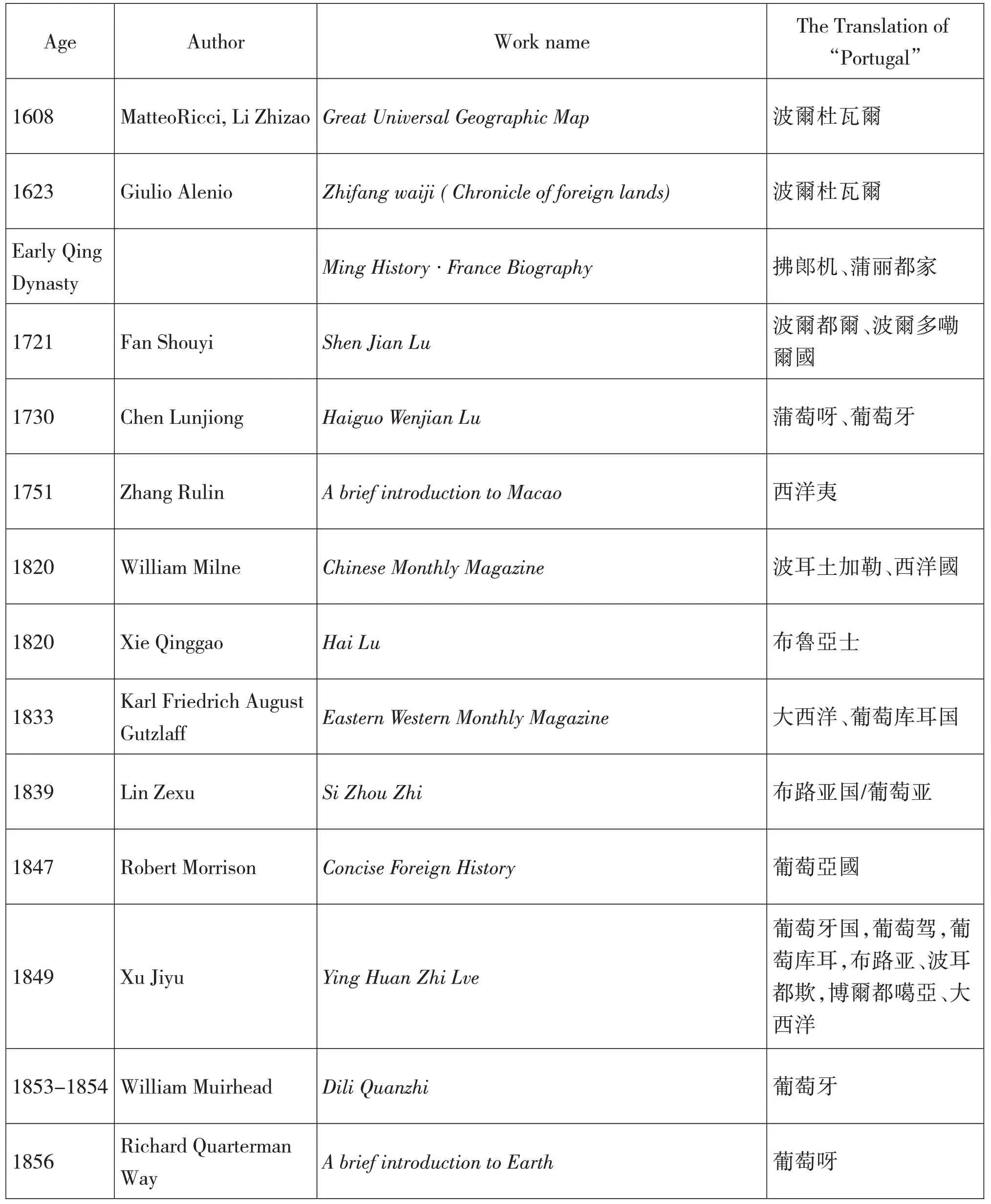
Table 1 :Statistical Table for Translation of the Country Name"Portugal"
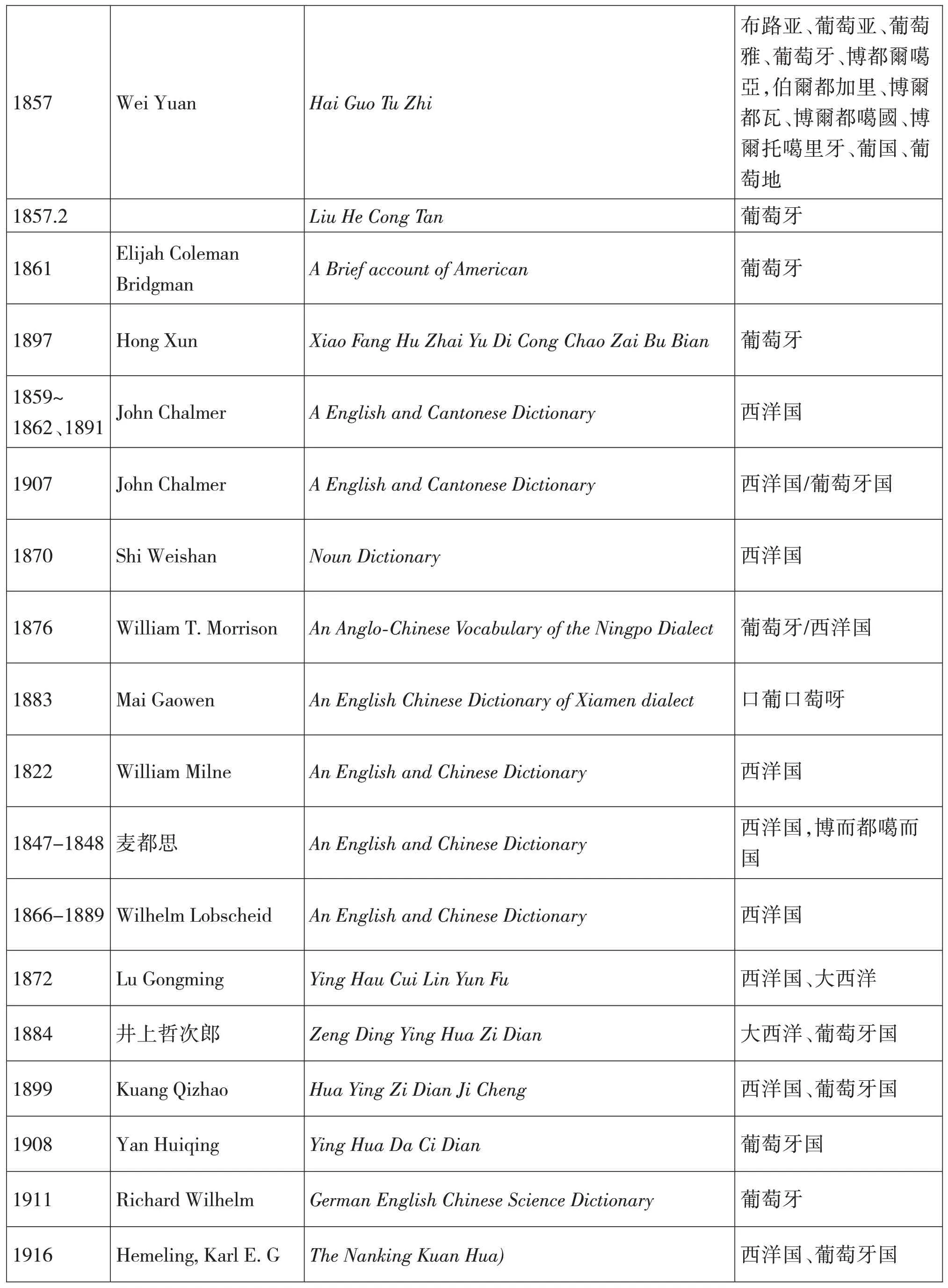
1857 Wei Yuan Hai Guo Tu Zhi 1857.2 1861 Liu He Cong Tan A Brief account of American布路亞、葡萄亞、葡萄雅、葡萄牙、博都爾噶亞,伯爾都加里、博爾都瓦、博爾都噶國、博爾托噶里牙、葡國、葡萄地葡萄牙葡萄牙1897 1859~1862、1891 1907 Elijah Coleman Bridgman Hong Xun Xiao Fang Hu Zhai Yu Di Cong Chao Zai Bu Bian 葡萄牙John Chalmer A English and Cantonese Dictionary 西洋國John Chalmer A English and Cantonese Dictionary 西洋國/葡萄牙國1870 Shi Weishan Noun Dictionary 西洋國1876 William T.Morrison An Anglo-Chinese Vocabulary of the Ningpo Dialect 葡萄牙/西洋國1883 Mai Gaowen An English Chinese Dictionary of Xiamen dialect 口葡口萄呀1822 William Milne An English and Chinese Dictionary 1847-1848麥都思An English and Chinese Dictionary 1866-1889 Wilhelm Lobscheid An English and Chinese Dictionary西洋國西洋國,博而都噶而國西洋國1872 1884 1899 1908 1911 1916 Lu Gongming井上哲次郎Kuang Qizhao Yan Huiqing Richard Wilhelm Hemeling,Karl E.G Ying Hau Cui Lin Yun Fu Zeng Ding Ying Hua Zi Dian Hua Ying Zi Dian Ji Cheng Ying Hua Da Ci Dian German English Chinese Science Dictionary The Nanking Kuan Hua)西洋國、大西洋大西洋、葡萄牙國西洋國、葡萄牙國葡萄牙國葡萄牙西洋國、葡萄牙國
The number of translated words reflects the frequency of exchanges between the country and China at that time.Portugal and China have frequent contacts,there are a total of 28 country names.Taking Peru as an example,South American countries had limited diplomacy with China at that time,and only four words were translated after investi?gation.
Country names are mainly transliterated,and there are few free translations.Free translation needs to find ap?propriate motivation.In the process of free transformation,it is difficult to translate accurately due to the influence of culture and implied meaning.For example,"western countries" also refers to Spain or Portugal.So the number of transliteration of country names is naturally common.
Transliteration is based on the same source words.Using translation,if the source words are different,it will al?so lead to multiple translated names.Although there are many translated names in Portugal,the corresponding word form of the source language is Portugal.
Transliteration adopts different forms of complete translation,abridged translation and additional translation.For the same source word,different transliteration methods will lead to different translated words.For example,"波耳土加勒"is the abridged translation."波"to bo,"耳"to R,"土"to Tu,"加"to ga,"勒"to l."博都爾噶亞","博爾托噶里牙","博爾都噶"and"伯爾都加里"also reflect this law."葡萄牙","布路亞"adopts the form of full translation in order to obtain the similarity of pronunciation.
Thirty-two kinds of documents can be divided into three periods:Late Ming Dynasty,early Qing Dynasty,mid?dle Qing Dynasty and late Qing Dynasty.The translated words in different periods have obvious characteristics of the times.
At the end of the Ming Dynasty and the beginning of the Qing Dynasty,the knowledge of world geography really entered China,and the number of relevant books and periodicals was small.They are still dominated by"波爾杜瓦爾" and variants "波爾都爾" and "波爾多嘞爾".The middle Qing Dynasty can be divided into two stages,with the Opium War as the dividing line.The first stage was before 1807-1840,the Protestant Missionary Morrison and his companions created many translated words and new words.They all use a lot of space to introduce the world geo?graphical pattern,many of which are different from their predecessors.However,during this period,most Western books were printed in Nanyang and banned from circulation in mainland China,so few people actually read these prints and their influence is limited.After the Opium War,these translated words were poured into the Chinese vo?cabulary system.
The second stage was after 1840.The explosive growth of geography related books and periodicals was directly related to the transfer of the Western Learning Center to Shanghai.The missionaries received the help of China's first-class intellectuals,which greatly improved the readability of missionaries'translation.In the late Qing Dynasty,the Educational Association of China,a national educational organization of Protestant missionaries in China,devot?ed itself to the unification of translated words and terms,and formulated a series of plans.Although some achieve?ments were made,did not solve the problem of terminology translation at that time.The word"Portugal"in the geog?raphy books and bilingual dictionaries published by missionaries during this period was translated into "西洋國"and"葡萄牙",but it was still not finalized.
The author makes use ofShenbao(1872-1949) and theNational Modern Periodical Resources Database(1833-1949).An search of the translated words of"portal"is carried out.The trend of word frequency is roughly divided in?to five periods:From 1833 to 1837,"葡萄牙"(2)"葡萄雅"(2)"葡萄庫耳"(1)"葡萄呀"(3)"西洋國"(2),come from theEastern Western Monthly Magazine.There are few publications and low frequency.The reason is that most newspapers and periodicals were printed in Nanyang during this period,which was forbidden to circulate in mainland China,and the Chinese people had limited understanding of the pattern of world geography.
From 1872 to 1902,the content related to "portal" began to increase gradually,but the number was not much.After the Opium War,Chinese people began to pay more attention to the world.Books written by Chinese intellectu?als were published,substituting the national translated names translated by missionaries into the Chinese vocabulary system.Due to the differences between translators and translation methods,the use of translated words in this period was relatively chaotic.The translated words include"葡萄牙","西洋國","大西洋國","葡萄芽","葡萄雅","蒲萄芽","葡萄亞","葡國","葡萄國".
From 1902 to 1911,this period was in the key period of China's social and cultural transformation.During this period,the reports related to"Portugal"began to increase rapidly and reached the peak in 1910.The reason was that the revolution launched by Portuguese republicanists in 1910 overthrew the Portuguese feudal dynasty and estab?lished the Republic.Domestic newspapers and periodicals reported it.During this period,"葡國" and "葡萄牙"were the only translated words corresponding to"Portugal".On the whole,they were used in similar quantities.
The year of 1912 became the turning point of the translation of the words"葡萄牙"and"葡國".Although the translation of "Portugal" has not been finalized,after 1912,the frequency of use of "Portugal" gradually increased,the frequency of use of"Portugal"gradually decreased,the gap between the two gradually increased,and"Portugal"gradually ceased to be used around 1929.
Since 1902,only "葡萄牙" and "葡國" have been retained in the translation of "Portugal","葡萄牙" ap?peared earlier than"葡國",but"葡國"is more in line with the development law of Chinese disyllabic vocabulary.Why didn't its translated names such as "法國","美國" and "德國" be retained? The increase and decrease of word frequency are closely related to the background of the times.Why did it become the turning point of the two translated words from 1912?It's worth thinking about.
Among the Japanese world history and geography books translated by foreign students from 1896 to 1911,the translated word corresponding to"Portugal"is mainly"葡萄牙",and the dissemination of these books in China di?rectly promoted the stereotype of"葡萄牙"in China.The reason for Li's writing is that he should use the least num?ber of strokes and the most convenient strokes.(Li &Niu,2018,p.49) We believe that this inference is question?able.The stereotyped translation of "葡萄牙" has a closer direct relationship with the dissemination of Japanese translated classics.
The translation of"Portugal"has gone through a long process.The books compiled by Chinese intellectuals and Protestant missionaries have not helped "Portugal" to complete the translation,and the symbols of national names are still mixed for a long time.On the contrary,Japan,which has always understood the world through Chinese trans?lation of Western books,quickly completed the construction of modern vocabulary system dominated by humanistic and scientific terms after the Meiji Restoration.A large number of historical and geographical books were published in China through translation,which promoted the finalization of"葡萄牙".
Acknowledgements
This paper is the result of the project"A Study on the Translation of Modern National Names from the Perspective of Language Contact of GDUFS(299-GK20G117)."
 Proceedings of Northeast Asia International Symposium on Linguistics,Literature and Teaching2021年0期
- Proceedings of Northeast Asia International Symposium on Linguistics,Literature and Teaching的其它文章
- Exploring C-E Simultaneous Interpreting Skills from the Perspective of Adaptation Theory
- Make a Better Story of China:Cross-lingual Presentation of the Subtopic"De"(德)of Lun Yü
- Comparative Study of Four English Versions of Ye Yu Ji Bei from Perspective of Eco-Translatology
- A Study on L2 Learners'Computer-mediated Interaction in SLA Writing
- Effect of Grammatical Class:What Role does a Chinese Background Play in Bilinguals?
- Influence of Teachers'L1 Translation Use on Chinese Intermediate EFL Learners'L2 Vocabulary Learning