基于區域劃分的農村有源配電網動態重構方法
2021-12-30 03:02:02劉志虹盛萬興杜松懷
農業工程學報 2021年20期
劉志虹,盛萬興,杜松懷,蘇 娟,夏 越
基于區域劃分的農村有源配電網動態重構方法
劉志虹,盛萬興,杜松懷,蘇 娟※,夏 越
(中國農業大學信息與電氣工程學院,北京 100083)
分布式電源和電動汽車的大規模接入,使得農村配電網的“源-荷”側呈現顯著不確定性。傳統農村配電網的拓撲結構無法應對“源-荷”雙重不確定性所帶來的沖擊和影響,急需研究新的農村有源配電網動態重構方法。該研究考慮“源-荷”時變特性,提出了一種基于區域劃分的農村有源配電網動態重構方法。首先,對配電網絡結構進行區域初始劃分,確定主干線區域和分支線區域;然后,以促進區域間分布式電源的協同應用為目標,基于圖論算法對區域初始劃分結果進行動態優化;其次,對網絡重構方案進行網絡拓撲約束的檢驗與修正;最后,采用快速非支配排序策略確定最優方案。通過IEEE 33節點和PG&E 69節點算例驗證了所提方法的可行性與有效性。算例結果表明,所提方法能夠有效促進分布式電源消納、降低線損和改善電壓分布。尤其是在69節點算例中所提算法的優化效果更顯著,提升了系統日DG平均消納利用率16.09個百分點,日線損降低了55.32%,研究可為農村有源配電網重構提供參考。。
能源;算法;農村有源配電網;區域劃分;網絡動態重構
0 引 言
傳統農村配電網多采用輻射式單向供電的方式,以開環形式運行[1-2]。與城市配電網相比,農村配電網的供電模式較為單一,優化運行的調控能力有限。近年來,大量的光伏、風電等分布式電源(Distributed Generation,DG)接入農村配電網。當前農村配電網的網絡結構、DG并網的位置與容量、線路傳輸容量等系統條件,它們與不斷增加的農村電力需求產生了沖突。此外,電動汽車(Electric Vehicle,EV)等柔性負荷的并網加劇了負荷側的波動。傳統農村配電網的網絡結構無法靈活、高效地應對DG與負荷雙重不確定性給配電網運行帶來的影響,容易產生棄電、網損增加、電壓越限等問題[3-7]。因此,需要一種智能優化控制技術可以靈活、高效地應對DG與負荷的雙重不確定性,來增強農村配電網安全可靠經濟運行能力。
配電網重構(Distribution Network Reconfiguration,DNR)是配電網優化運行控制的重要手段[8]。DNR是通過改變線路中聯絡開關與分段開關的開/合狀態來尋求拓撲結構,使配電網以更可靠、更經濟的方式運行[9]。DNR可分為靜態重構與動態重構兩類[10]。與靜態重構相比,動態重構可以充分考慮DG與負荷的時變特性,根據農村配電網的運行工況對研究周期內的網絡結構進行動態優化,從而更具靈活性與實用性。
目前國內外學者對配電網動態重構的研究已有一些成果。余健明等[11]提出了一種配電網動態分時段重構方法,將研究時段分成多個連續的時間間隔,以網損最小為目標函數,分別進行各時間間隔靜態重構。Shariatkhah等[12]根據負荷波動聚類進行時段劃分,以損耗成本、中斷成本和切換成本為優化目標,通過分時段靜態重構實現動態重構。趙靜翔等[13]提出了一種基于信息熵時段劃分的等效日負荷曲線分段方法,建立了以日損失費用最低為目標的動態重構模型,利用基于十進制編碼的改進雜草混合算法進行求解。李振坤等[14]考慮到負荷的波動特性,提出了一種基于多代理技術的配電網動態重構方法,利用混合粒子群算法進行多時段靜態重構求解。王淳等[15]采用最優模糊C均值聚類技術進行負荷聚類,將配電網動態重構轉換為以聚類中心表示負荷狀態的多個靜態重構問題。Zhu等[16]在實時調度階段考慮了負荷的時變特性,研究了配電網每小時動態重構對DG消納的效用。易海川等[17]考慮了DG在不同時段出力不同的特性,以提高配電網對DG的接納能力為優化目標構建了動態重構模型,并用遺傳算法對其進行求解。文獻[11-17]僅考慮了負荷或者DG的時變特性,這種假設導致了次優的解決方案。文獻[18-19]充分考慮DG與負荷時變特性,構建了多目標配電網重構模型,但是僅適用于靜態重構。傅曉飛等[20]綜合考慮DG與負荷的不確定性,建立了配電網動態重構模型,并利用差分進化入侵雜草優化算法進行求解。唐浩等[21]綜合考慮DG與負荷的時變特性,以網損費用和開關操作費用為目標函數,將配電網進行分時段動態重構。文獻[21]的優化目標不包含DG消納。Zhu等[22]考慮DG與負荷的隨機特性,從DG規劃的角度分析了每小時動態重構對于促進DG消納的作用。付洋洋[23]提出了通過最小數目的開關操作來提高DG消納能力的配電網多時段重構模型。上述文獻大部分是基于時段劃分進行的多時段靜態重構合并來實現動態重構,時段的劃分與合并存在一定的主觀性。此外,常規的動態重構研究通常采用智能優化算法求解構建的數學模型以獲得最優解,解的精度依賴于算法對優化模型的求解計算,存在一定程度的尋優誤差,難以保證解的最優性。
基于上述背景,本文提出了一種基于區域劃分的農村有源配電網動態重構方法。首先,提出了一種區域初始劃分方法,對配電網主干線路、分支線路進行區域初始劃分;然后,提出了一種基于圖論的區域動態優化劃分方法,對初始區域劃分結果進行動態優化,以尋找所有的DNR可行方案;其次,采用快速非支配排序策略以確定最優方案;最后,通過算例驗證所提方法的有效性。
1 農村有源配電網動態重構模型
本節描述了農村有源配電網動態重構問題的目標函數及其相關約束。
1.1 目標函數
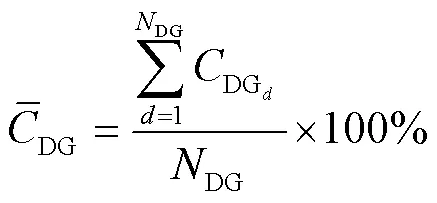
1)DG消納利用率

2)線路損耗
電力系統的線損是反映電力系統經濟性的重要指標,在滿足系統安全穩定運行的條件下,應盡最大可能降低系統的線損。系統總線損定義為[24]
1.2 約束條件
1)功率平衡約束
2)節點電壓約束為
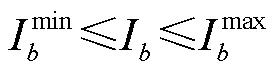
3)支路電流約束為
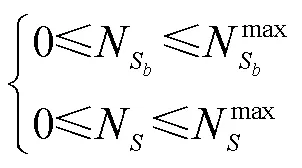
4)DG有功功率輸出約束為
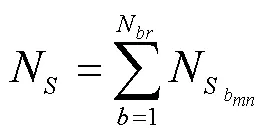
5)開關動作次數約束為
2 基于區域劃分的農村有源配電網動態重構方法
配電網動態重構中描述開關狀態的是離散整數變量,是一種復雜的非線性組合優化問題[25]。在綜合考慮算法效率和全局尋優性能的基礎上,本文提出了一種基于區域劃分的農村有源配電網動態重構方法,并設計了相應的動態重構流程,實現步驟主要包括3部分,如圖1所示。
2.1 農村有源配電網區域初始劃分
本文依照以下2個原則針對存在環路的線路進行區域初始劃分:
1)主干線路的區域初始劃分原則
如果主干線路上包含可控DG,以DG接入節點前的開關為區域劃分界線,從根節點到線路末端依次劃分為一個獨立的區域。即劃分后的區域內最多包含一個DG。如果主干線路上不包含可控DG,則從根節點到主干線路末端劃為一個獨立的區域。
2)分支線路的區域初始劃分原則
如果分支線路上包含可控DG,則分支線路的區域初始劃分原則與主干線路的區域初始劃分原則一致;如果分支線路上不包含可控DG,則從分支界定開關到支路末端劃分為一個獨立的區域。
基于上述區域初始劃分原則,可將整個配電網絡結構劃分為多個初始區域(Initial Region,IR)。
2.2 基于區域動態優化劃分方法尋找DNR可行方案
基于區域動態優化劃分方法獲取DNR可行方案,主要包括以下3個步驟:
1)區域電力供需分析
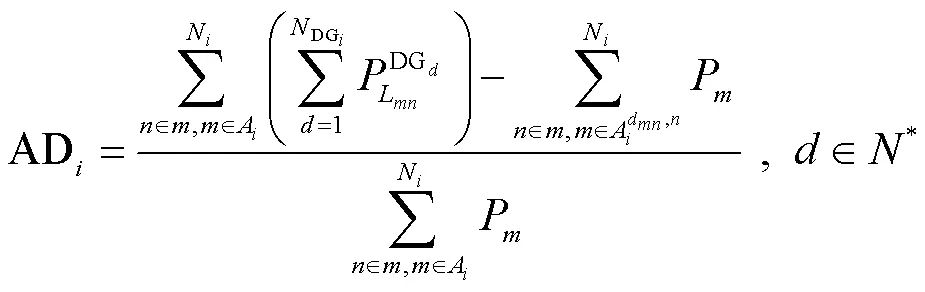
首先,基于區域初始劃分結果和源-荷歷史數據,根據公式(11)、(12)分別計算各區域的源-荷不平衡度與DG充裕度,分析當前各區域的電力供需平衡情況。
區域源-荷不平衡度是指研究區域內總DG與總負荷之間的差值占總負荷的比重。各區域源-荷不平衡度可以表示為
各區域的DG充裕度可以表示為
2)基于圖論算法的區域動態優化劃分
首先,采用圖論算法中的廣度優先遍歷算法[26],確定各IR的鄰接區域(Adjacent Region,AR)。然后,根據區域電力供需分析結果,篩選出具有電力互補特性的AR集合。假設配電網各線路的單位阻抗一致,則線路損耗與線路長度成正相關關系。再次,采用圖論算法中的深度優先遍歷算法[27],從具有電力互補特性的AR集合進一步中篩選出符合配電網潮流正向且距離相近的AR集合。最后,通過開關的優化控制實現若這些AR之間的靈活組合,形成多個新的區域,以最小各AR的源-荷不平衡度,即求解以下數學模型
式中1表示IR集合中相鄰的A和A合并后的區域源-荷不平衡度;2表示A、A之間的線路長度,km。
3)DNR可行方案的檢驗與修正
為了保證配電網中不存在環網結構和孤島,首先基于區域動態優化劃分結果,采用圖論中的深度優先遍歷算法對合并區域之后的配電網絡結構進行連通性和輻射性檢驗。然后,基于檢驗結果對環網進行解環、對孤島進行連接,以滿足配電網拓撲約束,從而可獲得所有的DNR可行方案。
2.3 確定DNR最優方案
1)基于有源配電網動態重構模型的約束條件確定DNR有效方案
為避免DG接入可能引起電壓越限的問題,遍歷所有的可行方案,從中選取滿節點電壓約束條件的DNR方案。在此基礎上,為了降低開關動作對其使用壽命以及電壓穩定的影響,進一步篩選出滿足開關動作次數約束條件的可行方案。
2)基于快速非支配排序策略確定最優方案
采用快速非支配排序遺傳算法 2[28]中的快速非支配排序策略,對DNR有效方案進行非劣排序,可獲得非劣排序層級最高的DNR最優方案。
根據上述的農村有源配電網區域初始劃分原則、基于圖論算法的配電網區域動態劃分方法以及DNR最優方案搜索方法求解配電網動態重構問題,可根據配電網的實際運行工況對任意時間段的網絡拓撲結構進行優化調整。如此反復循環,直至獲得整個研究時段內的DNR最優方案集合。
3 算例分析
3.1 算例1:IEEE 33節點配電系統
3.1.1 測試數據
本文基于IEEE 33節點配電網標準算例[29],加入了分布式光伏、風力發電和EV充電站,來模擬源、荷具有時變特性的農村有源配電網,如圖2所示。在節點6、9、15、22上分別接入了小型風機、風電場、小型光伏電站和光伏電站。各DG的額定容量見表1。在節點12上接入了EV充電站,額定容量為1MW。基于區域初始劃分方法可以將配電網劃分為4個主干線區域(A1~A4)和3個分支線區域(A5~A7),如圖2所示。
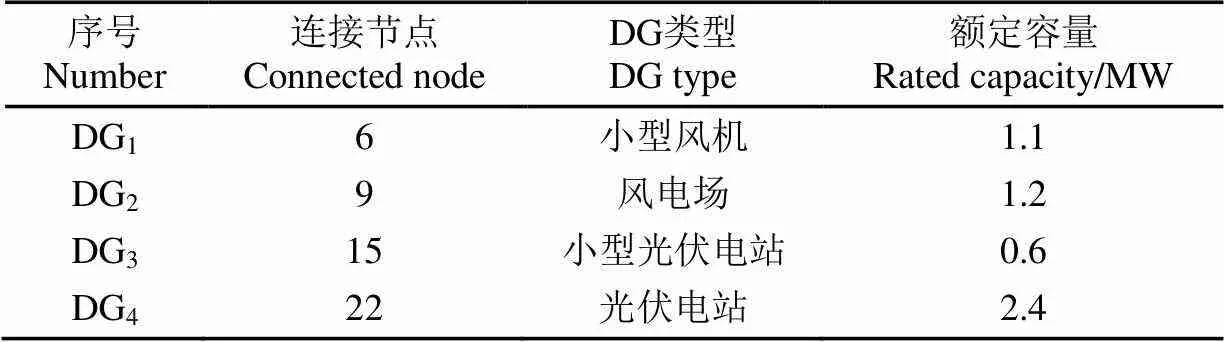
表1 DG配置參數
假設在相同的地區、時間條件下,相同類型的DG出力特性一致,則相同類型的DG有功功率輸出值與其額定容量呈正相關關系。本文將DG有功功率輸出數值與DG額定容量的比值,定義為DG出力率。本文通過DG額定容量乘以DG出力率的變化值來模擬隨時間變化的DG出力值,通過節點原始負荷乘以節點變化率來模擬隨時間變化的負荷值。需要說明的是,采用其他方法來模擬各個節點負荷以及DG的出力時序變化情況,不會影響使用本文所提方法。重構前DG出力率以及負荷變化曲線如圖3所示。
由圖3可以看出,光伏與風力發電以及EV充電負荷皆存在很強的波動性、間歇性與隨機性。源-荷側的不確定性容易導致棄風棄光現象以及電壓越限等問題,增加了配電網優化運行控制的難度。
3.1.2 結果分析
各時段重構得到的最優開關組合見表2,其中每個開關用其對應線路兩端的節點編號表示。本文設定研究時段內每個開關的操作次數和所有開關的總操作次數上限分別為3和16次,可保證配電網動態重構的安全穩定性。由表2可知,隨著負荷需求與DG出力的時序變化,相應時段的配電網重構最優開關組合也在不斷調整。
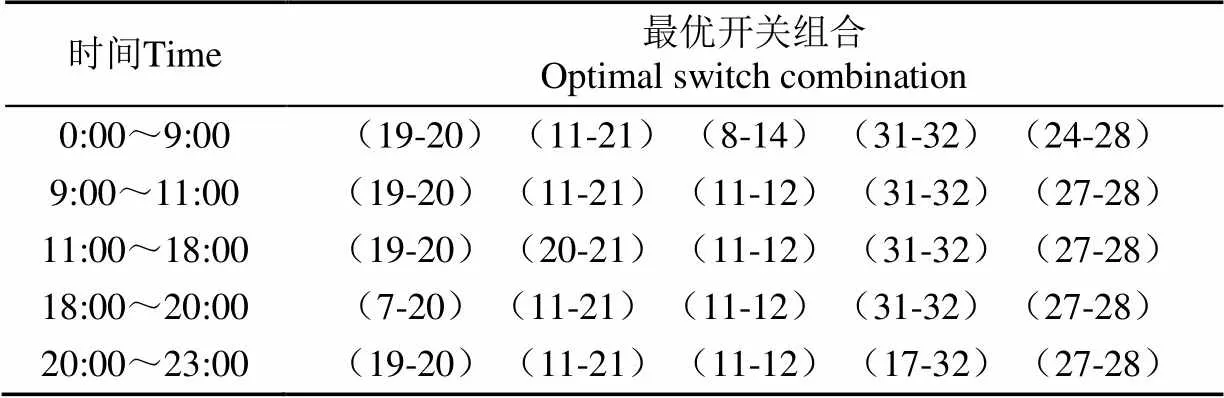
表2 不同時段最優開關組合
本文對24 h內配電網動態重構前后的仿真結果進行對比分析。其中,線路損耗如圖4所示;配電網總DG平均消納利用情況,如圖5所示。
由圖4可以看出,配電網線損在網絡結構經過優化之后有一定程度降低,在11:00至17:00時間段內降損效果明顯,尤其是在14:00線路損耗降低了71.41%,降損效果尤為顯著,說明該方法能有效提高配電網運行的經濟性。
由圖5所知,配電網絡結構經過動態優化之后總DG的平均消納率得到了較大幅度的提升,說明該方法能有效提高配電網的電力供需平衡能力和經濟運行水平。
為了深入分析本文所提網絡結構動態優化方法對各DG消納利用的影響,因此對網絡結構動態優化前后各DG的日平均消納利用率進行了對比,如表3所示。
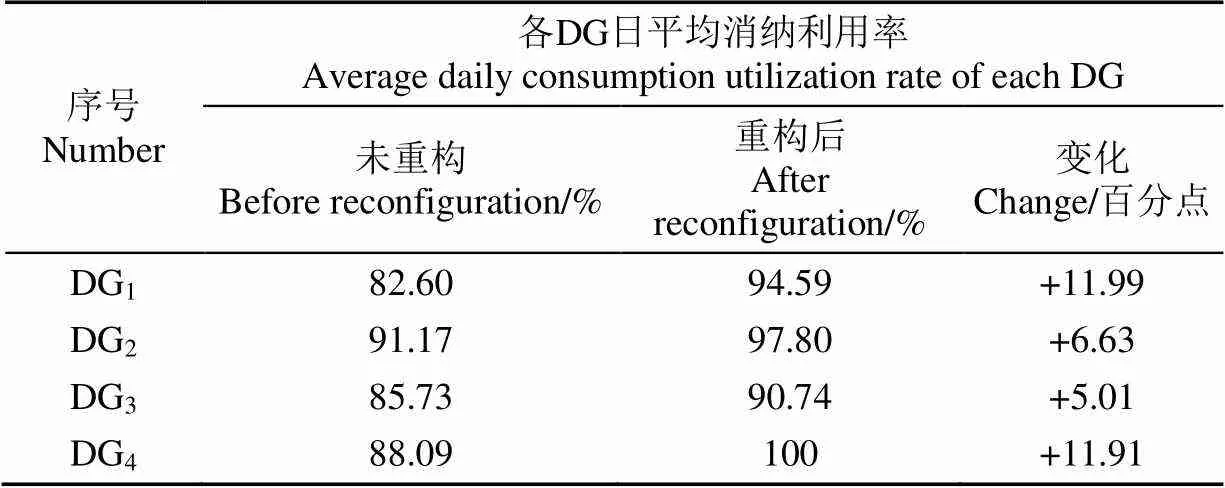
表3 配電網動態重構前后各DG日平均消納利用對比分析
由表3可知,配電網絡結構優化后每個DG的日內平均消納率均有一定程度的提升,其中,DG4實現了完全消納。網絡結構優化后各DG消納利用水平的上升,意味著該方法能降低棄風棄光現象出現的概率,因此該方法能有效提高配電網運行的經濟性以及環保性。
上述是針對24 h時間段內配電網絡結構優化前后仿真結果進行的分析,為了進一步分析本文所提方法在時間斷面上對配電網運行的優化效果,基于圖3顯示的DG總發電在上午11:00左右達到頂峰,本文選取11:00時刻重構前后的配電網運行情況進行細致分析。其中,各DG消納利用的變化情況見表4。經過潮流計算進行電壓校驗,配電網重構前后33個節點電壓分布,如圖6所示。
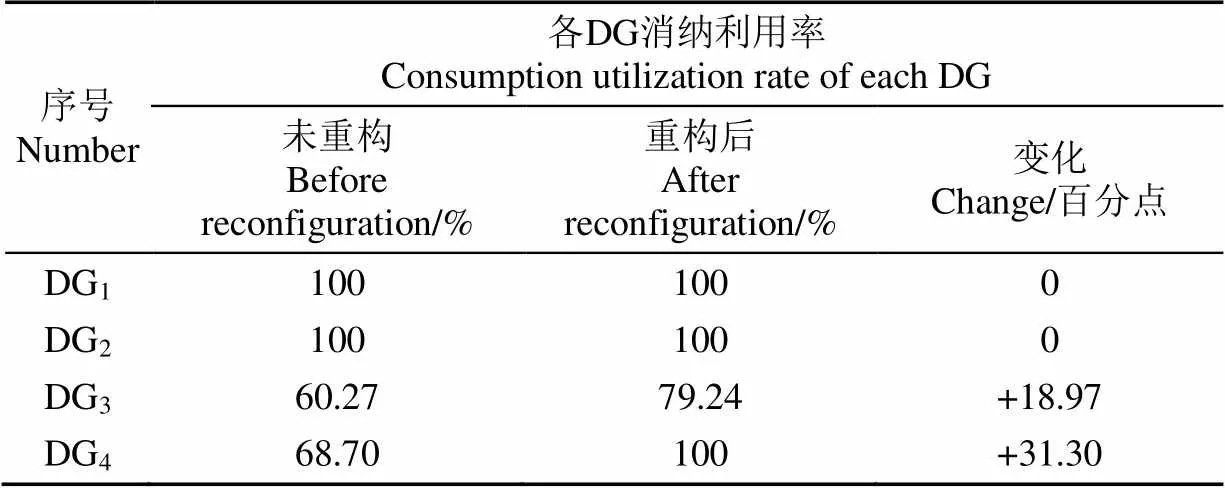
表4 11:00 DNR前后各DG消納利用情況
由表4可知,在11:00根據區域動態優化劃分方法得到的配電網絡結構內部分DG的消納利用率升高了。其中,DG1和DG2的消納利用率在網絡結構優化前后均達到了完全消納,DG1和DG2在初始網絡結構下實現了完全消納,這與DG1和DG2的接入容量以及研究時間段內DG有功出力以及負荷大小相關;連接在22節點的DG4消納利用率提升最顯著,上升了31.30個百分點;DG3消納利用率的提升效果也很明顯,上升了18.97個百分點。
假設配電網線電壓的基準值以根節點為準,則根節點電壓標幺值為1.0。由圖6可知,網絡結構優化后各節點電壓的標幺值都在0.95到1.05之間,符合節點電壓上下限的要求。此外,配電網絡結構優化后的節點電壓有了一定的提升,尤其是DG接入點附近的電壓提升最為顯著。
結合表4與圖6可知,雖然DG1和DG2的消納利用率在網絡結構優化前后均達到了完全消納,但是初始網絡結構下的節點電壓存在越限問題,經過區域優化劃分方法得到的網絡結構下各節點電壓均符合電壓質量要求。
3.2 算例2:PG&E 69節點配電系統
3.2.1 測試數據
為進一步驗證本文所提方法的有效性,本節采用復雜的PG&E 69節點配電系統[30]進行測試,系統的結構如圖7所示。本文分別在節點23、38上接入了額定容量分別為0.8、1MW的光伏電站,在節點53、59上分別接入了額定容量均為0.8MW的風電場。基于區域初始劃分方法可以將配電網絡劃分為2個主干線區域(A1、A2)以及6個分支線區域(A3~A8),如圖7所示。
為保證配電網動態重構的安全穩定性,設定每個開關的操作次數和所有開關的操作次數上限分別為3次和20次。計算所采用的DG出力率的變化情況與圖3中的DG變化曲線一致,負荷率變化曲線如圖8所示。
3.2.2 結果分析
69節點配電系統動態重構結果對比見表5。
由表5可知,與未重構相比,動態重構后的配電網對DG的消納利用率整體上升了16.09個百分點,線損降低了55.32%。
可以看出,該結果與采用IEEE 33節點測試系統所得結論一致,同樣表明了所提方法能夠促進DG消納、提升系統運行的經濟安全運行能力。
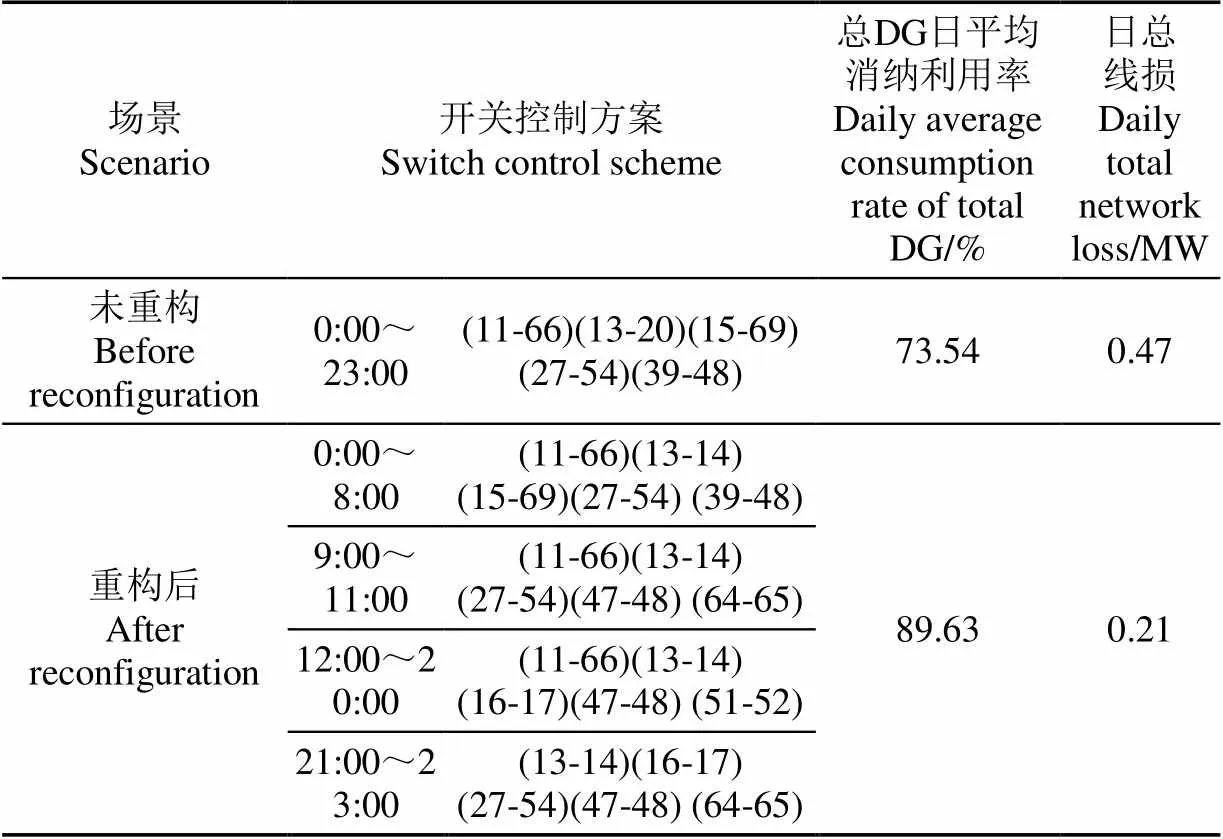
表5 69節點系統動態重構前后結果對比
4 結 論
在大規模DG和EV接入農村配電網的新形式下,本文圍繞農村有源配電網的動態重構問題,提出了一種新的基于區域劃分的農村有源配電網動態重構方法。主要研究工作及結論如下:
1)計及DG與負荷的雙重時變特性,提出了一種農村有源配電網區域初始劃分原則。根據區域初始劃分原則,可以對主干線路和分支線路進行區域初始劃分,形成初始配電網絡劃分圖,為快速求解動態重構問題奠定基礎。
2)提出了一種基于圖論算法的區域動態優化劃分方法,可根據農村有源配電網的實際運行工況對區域初始劃分結果進行動態優化,從而獲得區域間開關控制方案,有助于提高動態重構問題的求解效率。
3)基于IEEE 33節點和PG&E 69節點算例進行了仿真驗證,仿真結果表明:所提方法在33節點算例中損耗降低效果很好,尤其是14:00時的網絡損耗顯著降低了71.41%,此時提高DG消耗的效果也是最明顯的;在69節點算例中提升了系統日DG平均消納率16.09個百分點,日線損降低了55.32%。這說明本文所提方法能夠實現農村有源配電網提升DG消納、降低線損以及改善電壓質量等技術要求。
[1] Oureilidis K O, Bakirtzis E A, Demoulias C S. Frequency-based control of islanded microgrid with renewable energy sources and energy storage[J]. Journal of Modern Power Systems & Clean Energy, 2016, 4(1): 54-62.
[2] 董逸超,王守相,閆秉科. 配電網分布式電源接納能力評估方法與提升技術研究綜述[J]. 電網技術,2019(7):2258-2266.
Dong Yichao, Wang Shouxiang, Yan Bingke. Summary of research on evaluation method and improvement technology of distributed power supply acceptability in distribution network[J]. Power System Technology, 2019(7): 2258-2266. (in Chinese with English abstract)
[3] 孟曉芳,樸在林,王英男,等. 中壓配電網網架優化規劃方法[J]. 農業工程學報,2011,27(11):164-164.
Meng Xiaofang, Piao Zailin, Wang Yingnan. Optimal planning method for medium voltage distribution network[J]. Transactions of the Chinese Society of Agricultural Engineering (Transactions of the CSAE), 2011, 27(11): 164-164. (in Chinese with English abstract)
[4] 蘇向敬,陳思利,米陽,等. 分布式電池儲能在含高比例可再生能源不平衡配電網中的序次優化配置[J]. 電網技術,2019,43(10):3698-3707.
Su Xiangjing, Chen Sili, Mi Yang, et al. Sequential optimization configuration of distributed battery energy storage in unbalanced distribution network with high proportion of renewable energy[J]. Power System Technology, 2019, 43(10): 3698-3707. (in Chinese with English abstract)
[5] 牛煥娜,楊明皓,井天軍,等. 農村主動型配電網優化調度線性模型與算法[J]. 農業工程學報,2013,29(16):190-197.
Niu Huanna, Yang Minghao, Jing Tianjun, et al. Linear optimal operation model and algorithm for active distribution network in rural areas[J]. Transactions of the Chinese Society of Agricultural Engineering (Transactions of the CSAE), 2013, 29(16): 190-197. (in Chinese with English abstract)
[6] 孟曉芳,樸在林,王英男,等. 考慮分布式電源影響的配電網降損分析[J]. 農業工程學報,2013,29(25):128-131.
Meng Xiaofang, PiaoZailin, Wang Yingnan, et al. Analysis of distribution network loss considering influence of distributed generation[J]. Transactions of the Chinese Society of Agricultural Engineering (Transactions of the CSAE), 2013, 29(25): 128-131. (in Chinese with English abstract)
[7] 唐巍,薄博,叢鵬偉,等. 含分布式發電接入的農村電網多目標規劃[J]. 農業工程學報,2013,29(增刊):132-137.
TangWei, Bo Bo, Cong Pengwei, et al. Multi-objective planning of rural power network incorporating distributed generation[J]. Transactions of the Chinese Society of Agricultural Engineering (Transactions of the CSAE), 2013, 29(Supp1. ): 132-137. (in Chinese with English abstract)
[8] 高燕,楊仁剛,李偉. 考慮分布式電源的農村配電網網絡重構[J]. 農業工程學報,2013,29(9):162-169.
Gao Yan, Yang Rengang, Li Wei. Rural distribution network reconfiguration with dispersed generation[J]. Transactions of the Chinese Society of Agricultural Engineering (Transactions of the CSAE), 2013, 29(9): 162-169. (in Chinese with English abstract)
[9] Hamida I B, Salah S B, Msahli F, et al. Optimal network reconfiguration and renewable DG integration considering time sequence variation in load and DGs[J]. Renewable Energy, 2018, 121(6): 66-80.
[10] 翟鶴峰,楊明,趙利剛,等. 提升分布式電源接納能力的配電網三相魯棒動態重構[J]. 電力系統自動化,2019,43(18):35-42.
ZhaiHefeng, Yang Ming, Zhao Ligang, et al. Three-phase robust dynamic reconfiguration of distribution network to improve acceptance ability of distributed generator[J]. Automation of Electric Power Systems, 2019, 43(18): 35-42. (in Chinese with English abstract)
[11] 余健明,王征,許苗. 考慮負荷變化的配電網動態分時段重構[J]. 高電壓技術,2007,33(9):125-128.
YuJianming, Wang Zheng, Xu Miao. Dynamic reconfiguration of distribution network with dividing time and considering load changes[J]. High Voltage Engineering, 2007, 33(9): 125-128. (in Chinese with English abstract)
[12] Shariatkhah M H, Haghifam M R, Salehi J, et al. Duration based reconfiguration of electric distribution networks using dynamic programming and harmony search algorithm[J]. International Journal of Electrical Power & Energy Systems, 2012, 41(1): 1-10.
[13] 趙靜翔,牛煥娜,王鈺竹. 基于信息熵時段劃分的主動配電網動態重構[J]. 電網技術,2017,41(2):402-408.
ZhaoJingxiang, Niu Huanna, Wang Yuzhu. Dynamic reconfiguration of active distribution network based on information entropy of time intervals[J]. Power System Technology, 2017, 41(2): 402-408. (in Chinese with English abstract)
[14] 李振坤,陳星鶯,趙波,等. 配電網動態重構的多代理協調優化方法[J]. 中國電機工程學報,2008,28(34):72-79.
Li Zhenkun, Chen Xingying, Zhao Bo, et al. Dynamic reconfiguration of the distribution network based on multi-agent systems[J]. Proceedings of the CSEE, 2008, 28(34): 72-79. (in Chinese with English abstract)
[15] 王淳,高元海. 采用最優模糊C均值聚類和改進化學反應算法的配電網絡動態重構[J]. 中國電機工程學報,2014,34(10):1682-1691.
Wang Chun, Gao Yuanhai. Dynamic reconfiguration of distribution network based on optimal fuzzy C-means clustering and improved chemical reaction optimization[J]. Proceedings of the CSEE, 2014, 34(10): 1682-1691. (in Chinese with English abstract)
[16] Zhu J, Wu Z, Jiang P, et al. An improved PSO algorithm based on statistics for distribution network reconfiguration to increase the penetration of distributed generations[J]. 2015, DoI: 10.1049.CP.2015.09.02.
[17] 易海川,張彼德,王海穎,等. 提高DG接納能力的配電網動態重構方法[J]. 電網技術,2016,40(5):1431-1436.
Yi Haichuan, Zhang Bide, Wang Haiying, et al. Distribution network dynamic reconfiguration method for improving distribution network’s ability of accepting DG[J]. Power System Technology, 2016, 40(5): 1431-1436. (in Chinese with English abstract)
[18] 叢鵬偉,唐巍,張璐,等. 基于機會約束規劃考慮DG與負荷多狀態的配電網重構[J]. 電網技術,2013,37(9):2573-2579.
Cong Pengwei, Tang Wei, Zhang Lu, et al. Chance-constrained programming based distribution network reconfiguration considering multi-states of distributed generation and load[J]. Power System Technology, 2013, 37(9): 2573-2579. (in Chinese with English abstract)
[19] 趙晶晶,李新,彭怡,等. 基于粒子群優化算法的配電網重構和分布式電源注入功率綜合優化算法[J]. 電網技術,2009,33(17):162-166.
Zhao Jingjing, Li Xin, Peng Yi, et al. A comprehensive optimization algorithm for injection power of distributed generation and distribution network reconfiguration based on particle swarm optimization[J]. Power System Technology, 2009, 33(17): 162-166. (in Chinese with English abstract)
[20] 傅曉飛,紀坤華,廖天明,等. 含間歇性DG的主動配電網動態重構研究[J]. 浙江電力,2018,37(11):73-81.
Fu Xiaofei, Ji Kunhua, Liao Tianming, et al. Study on dynamic reconfiguration of active distribution network considering intermittent DG[J]. Zhejiang Electric Power, 2018, 37(11): 73-81. (in Chinese with English abstract)
[21] 唐浩,周步祥,彭章剛,等. 采用改進細菌覓食算法的含分布式電源配電網動態重構[J]. 電力系統及其自動化學報,2017,29(4):122-128.
Tang Hao, Zhou Buxiang, Peng Zhanggang, et al. Dynamic reconfiguration of distribution network with distributed generations using improved bacterial foraging algorithm[J]. Proceedings of the CSU-EPSA, 2017, 29(4): 122-128. (in Chinese with English abstract)
[22] Zhu J, Gu W, Lou G, et al. Learning automata based methodology for optimal allocation of renewable distributed generation considering network reconfiguration[J]. IEEE Access, 2017, 5: 14275-14288.
[23] 付洋洋. 提高可再生能源消納能力的配電網多時段重構研究[D]. 天津:天津大學,2018.
Fu Yangyang. Research on Multi-period Network Reconfiguration for Increasing the Hosting Capacity of Distribution Networks[D]. Tianjin: Tianjin University, 2018. (in Chinese with English abstract)
[24] Singh J, Tiwari R. Real power loss minimisation of smart grid with electric vehicles using distribution feeder reconfiguration[J]. IET Generation, Transmission & Distribution, 2019, 13(18): 4249-4261.
[25] 陳正鵬,黃純,張亞萍,等. 基于改進雙種群遺傳算法的含分布式電源配電網重構[J]. 電力系統及其自動化學報,2017,29(4):78-83.
Chen Zhengpeng, Huang Chun, Zhang Yaping, et al. Distribution network reconfiguration with different distributed generations based on improved dual population genetic algorithm[J]. Proceedings of the CSU-EPSA, 2017, 29(4): 78-83. (in Chinese with English abstract)
[26] Peng J, Wenli D. Multi-objective modeling and optimization for scheduling of cracking furnace systems[J]. Chinese Journal of Chemical Engineering, 2017, 25(8): 992-999.
[27] 湯旻安,張凱越,許希元. 基于啟發式規則與AHP-CRITIC算法的配電網故障恢復策略[J]. 電力系統保護與控制,2020,48(14):1-9.
Tang Wenan, Zhang Kaiyue, Xu Xiyuan. Service restoration strategy of a distribution network based on heuristic rules and the AHP-CRITIC algorithm[J]. Power System Protection and Control, 2020, 48(14): 1-9. (in Chinese with English abstract)
[28] 徐成司,董樹鋒,孫洲,等. 基于網絡簡化和深度優先遍歷的配電網路徑搜索算法[J]. 電力系統自動化,2017,41(24):170-176.
Xu Chengsi, Dong Shufeng, Sun Zhou, et al. A path searching algorithm for distribution network based on network simplification and depth first traversal[J]. Automation of Electric Power Systems, 2017, 41(24): 170-176. (in Chinese with English abstract)
[29] Nguyen T T, Nguyen T T, Nguyen N A. Optimal network reconfiguration to reduce power loss using an initial searching point for continuous genetic algorithm[J]. Complexity, 2020, 2020(6): 1-21.
[30] Moghaddam M J H, Kalam A, Shi J, et al. A new model for reconfiguration and distributed generation allocation in distribution network considering power quality indices and network losses[J]. IEEE Systems Journal, 2020, 14(3): 1-9.
Dynamic reconfiguration method of rural active distribution network based on regional division
Liu Zhihong, Sheng Wanxing, Du Songhuai, Su Juan※, Xia Yue
(,,100083,)
In recent years, under the guidance of China's green energy development strategy, a large number of photovoltaic, wind power and other DGs have been connected to the rural distribution network. The current rural distribution network structure, DG grid-connected location and capacity, line transmission capacity and other system conditions are in conflict with the ever-increasing rural power demand. DG output and load demand are continuously changing with time. The large-scale access of DGs and EVs has made the “source-load” side of the rural distribution network present significant uncertainty. The traditional topology of rural distribution network cannot cope with the impact of this “source-load” double uncertainty. Therefore, it is urgent to study a new method of dynamic reconfiguration for rural active distribution network. This paper establishes a dynamic reconfiguration model of active distribution network with DG consumption and line loss as objective functions. Taking into account the time-varying characteristics of “source-load”, this paper proposes a new method of dynamic reconfiguration of rural active distribution network based on regional division, and designs the process of this dynamic reconfiguration method. In order to improve the efficiency of solving the problem of dynamic reconfiguration of active distribution network, a regional division method is proposed for the first time. The regional division method includes two parts: The initial division of regions and the optimized division of regions. The dynamic reconfiguration method of active distribution network based on area division mainly includes the following four steps. Firstly, the distribution network structure is divided into several initial regions which include main line regions and branch line regions based on the regional initial division method. Secondly, with the goal of promoting the flexible and efficient combined application of DGs between regions, the result of regional initial division is optimized dynamically based on the breadth-first traversal algorithm in the graph theory algorithm. Thirdly, based on the obtained results of dynamic regional optimization, the depth-first traversal algorithm is used to test and modify the DNR scheme to meet the topology constraints of the distribution network. At this time, all feasible DNR schemes can be obtained. Finally, the fast non-dominated sorting strategy is adopted to select the best network reconfiguration scheme that meets the constraints such as node voltage. To validate the performance of the proposed method, it is tested on the well-known IEEE 33-node and PG&E 69-node distribution system. The simulation result of 33-node distribution system shows that the loss reduction effect of the proposed method is very good. Especially at 14:00, the loss reduction effect of the distribution network was the most obvious, which was reduced by 71.41%. At this time, the effect of increasing the utilization rate of DG consumption is also obvious. On this basis, the proposed method on the consumption of each DG was deeply analyzed in this article. Result shows that the proposed method can achieve complete consumption of DG. The voltage of each node under the network structure obtained by the regional optimization division method meets the voltage quality requirements. In addition, the average daily DG consumption rate of the PG&E 69-node distribution system was increased by 16.09 percent point, and the daily line loss was reduced by 55.32%. The effectiveness of the proposed method is verified by the simulation of these two case studies. The simulation results show that the proposed method can fully switch and adjust the ability to improve the absorption capacity of the distributed power, reduce the line loss, suppress the fluctuation of the distributed power, and keep the node voltage smooth.
energy; algorithm; rural active distribution network; regional division; network dynamic reconfiguration
劉志虹,盛萬興,杜松懷,等. 基于區域劃分的農村有源配電網動態重構方法[J]. 農業工程學報,2021,37(20):248-255.doi:10.11975/j.issn.1002-6819.2021.20.028 http://www.tcsae.org
Liu Zhihong, Sheng Wanxing, Du Songhuai, et al. Dynamic reconfiguration method of rural active distribution network based on regional division[J]. Transactions of the Chinese Society of Agricultural Engineering (Transactions of the CSAE), 2021, 37(20): 248-255. (in Chinese with English abstract) doi:10.11975/j.issn.1002-6819.2021.20.028 http://www.tcsae.org
2021-07-15
2021-10-11
國家自然科學基金項目(52007194);國家電網公司總部科技項目(SGXJWL00YJJS1801742);中國農業大學2115人才工程資助
劉志虹,博士研究生,研究方向為配電網優化運行與控制。Email:zhihongliu@cau.edu.cn
蘇娟,博士,副教授,博士生導師,研究方向為農業電氣化與自動化、電力市場等。Email:sujuan@cau.edu.cn
10.11975/j.issn.1002-6819.2021.20.028
TM761
A
1002-6819(2021)-20-0248-08
猜你喜歡
房地產導刊(2022年5期)2022-06-01 06:20:14
建材發展導向(2021年12期)2021-07-22 08:06:48
建材發展導向(2021年7期)2021-07-16 07:07:52
中學生數理化(高中版.高二數學)(2021年12期)2021-04-26 07:43:48
經濟技術協作信息(2018年32期)2018-11-30 01:43:16
中國科技博覽(2016年2期)2016-04-25 20:32:39
電測與儀表(2016年5期)2016-04-22 01:14:14
小學生導刊(2016年34期)2016-04-11 00:49:44
河南電力(2016年5期)2016-02-06 02:11:24
電測與儀表(2015年5期)2015-04-09 11:30:52