
指向深度學(xué)習(xí)的高中英語(yǔ)閱讀教學(xué)探究
2021-12-08 05:22:41陳麗芳袁丹純
廣東教育·綜合 2021年10期
陳麗芳 袁丹純
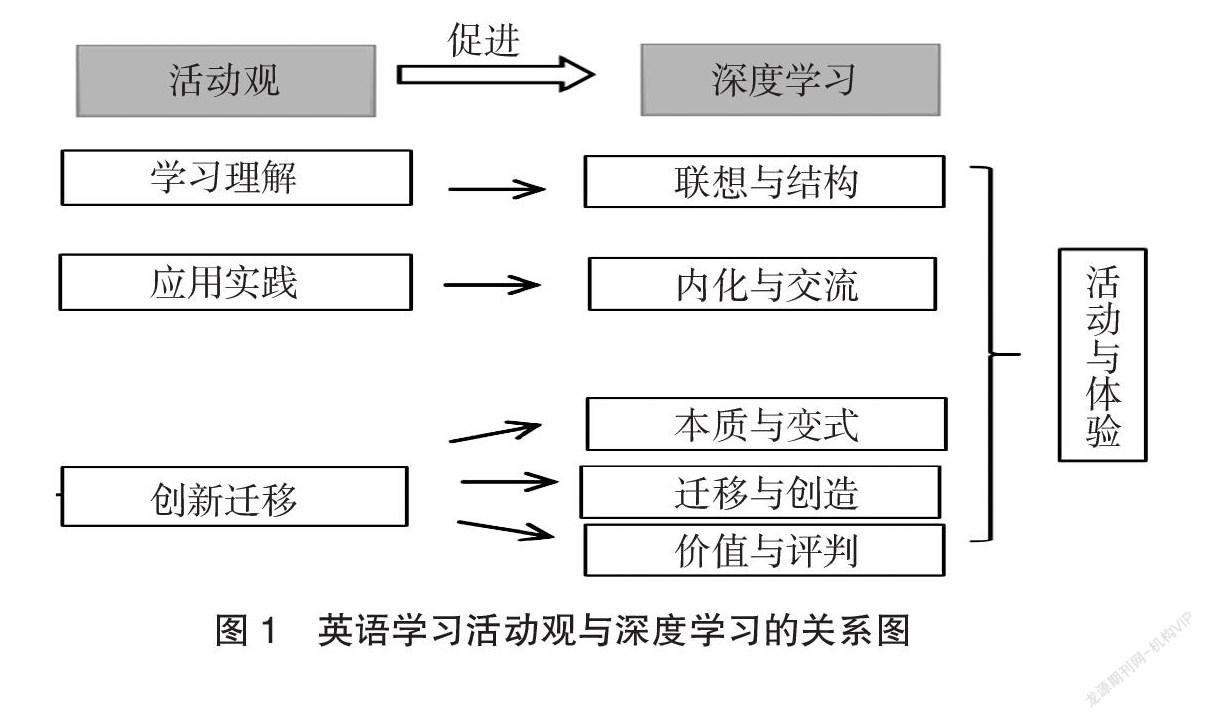
深度學(xué)習(xí)是指學(xué)習(xí)者深度投入學(xué)習(xí)過(guò)程,深度加工知識(shí),并將深度理解的知識(shí)進(jìn)行遷移應(yīng)用,最終實(shí)現(xiàn)深層次的學(xué)習(xí)體驗(yàn)、高層次的思維能力發(fā)展的過(guò)程。郭華(2021)總結(jié)提煉了深度學(xué)習(xí)的五個(gè)特征:活動(dòng)與體驗(yàn)、聯(lián)想與結(jié)構(gòu)、本質(zhì)與變式、遷移與創(chuàng)造和價(jià)值與評(píng)判,并以此來(lái)判斷深度學(xué)習(xí)是否發(fā)生。王薔(2021)在此基礎(chǔ)上補(bǔ)充了“內(nèi)化與交流”這一特征,強(qiáng)調(diào)學(xué)生需要圍繞主題和新的知識(shí)結(jié)構(gòu)開(kāi)展以描述、闡釋、交流等實(shí)踐活動(dòng)為主的內(nèi)化活動(dòng),以實(shí)現(xiàn)深度學(xué)習(xí),達(dá)到促進(jìn)知識(shí)向能力、能力向素養(yǎng)轉(zhuǎn)化的目的。
英語(yǔ)學(xué)習(xí)活動(dòng)觀是指學(xué)生在主題意義引領(lǐng)下,通過(guò)學(xué)習(xí)理解、應(yīng)用實(shí)踐、遷移創(chuàng)新等一系列活動(dòng),在已有的知識(shí)基礎(chǔ)上,通過(guò)不同類(lèi)型語(yǔ)篇的學(xué)習(xí),在創(chuàng)造性地分析和解決各種問(wèn)題的過(guò)程中,發(fā)展自身的多元思維、培養(yǎng)文化意識(shí)和提高學(xué)用能力。活動(dòng)觀的提出為實(shí)現(xiàn)深度學(xué)習(xí)提供了有效實(shí)施路徑。圖1為英語(yǔ)學(xué)習(xí)活動(dòng)觀和深度學(xué)習(xí)的關(guān)系圖。
本文以新人教版高中英語(yǔ)選擇性必修第一冊(cè)第二單元“Looking into the Future”的同主題拓展語(yǔ)篇“First Impressions”閱讀教學(xué)實(shí)踐為例,具體探究在閱讀教學(xué)中如何實(shí)踐英語(yǔ)學(xué)習(xí)活動(dòng)觀,促進(jìn)深度學(xué)習(xí)。
該文是一篇日記型的應(yīng)用文,主要講述Li Qiang時(shí)空旅行前、中、后的所見(jiàn)所聞。其主題語(yǔ)境是人與社會(huì),展現(xiàn)了科技發(fā)展與信息技術(shù)創(chuàng)新,體現(xiàn)科學(xué)精神。語(yǔ)篇圍繞未來(lái)的生活展開(kāi),需要實(shí)現(xiàn)的單元目標(biāo)是“預(yù)測(cè)未來(lái)的世界”,以建構(gòu)正確的未來(lái)觀。經(jīng)過(guò)本堂課的學(xué)習(xí),學(xué)生能夠:(1)獲取文章主要內(nèi)容,借助思維導(dǎo)圖梳理文章脈絡(luò);(2)運(yùn)用所學(xué)詞匯和句型表達(dá)對(duì)未來(lái)的暢想和自己的感受;(3)深度分析文本,讀懂文本深層含義,理解作者態(tài)度和意圖;(4)客觀看待未來(lái)生活,激發(fā)學(xué)生愛(ài)護(hù)環(huán)境,創(chuàng)造美好未來(lái)的意識(shí);(5)聯(lián)系實(shí)際,表達(dá)自己對(duì)未來(lái)的看法以及對(duì)未來(lái)的新認(rèn)知。
一、學(xué)習(xí)理解類(lèi)活動(dòng)
教師創(chuàng)設(shè)情境,提出問(wèn)題:Life today is totally different from the past. Do you want to know how people lived a thousand years ago, especially the people in Zhongshan, Guangdong? 播放視頻,滿足學(xué)生的好奇心,引導(dǎo)學(xué)生思考當(dāng)下生活與過(guò)去的不同。通過(guò)問(wèn)題“What will life be like in 1000 years? ”引出話題:Life in the future.
Activity 1:Fill in the gaps according to the structure of the text.
學(xué)生填寫(xiě)段落結(jié)構(gòu)圖,培養(yǎng)速讀能力,把握文章結(jié)構(gòu)。
Activity 2:Read in details and answer the following questions.
1)Whats time lag?
2)How did he feel at first in Para. 1? And any changes? Find the evidence and underline them.
3)How did he feel during the journey in Para. 2?
4)What is the function of the last sentence in Para. 2?
5)How did he feel when he was surrounded with thin air? Did he feel better later?
6)Read Para. 3 and find out the advantages and disadvantages of hovering carriage. Fill in the blanks with some key words.
7)Whats the function of the first sentence in Para. 4?
8)How did he feel when he was in the house? Find some evidence to support your idea.
借助層層遞進(jìn)的問(wèn)題鏈,激發(fā)學(xué)生的關(guān)聯(lián)性思考,促進(jìn)學(xué)生對(duì)文本的深度理解。
Activity 3:Summarize the whole text.
補(bǔ)充全景結(jié)構(gòu)圖(圖略)。
二、應(yīng)用實(shí)踐類(lèi)活動(dòng)
Activity 4:Retell the story in your own words. The following are the sentences and phrases that may help you.
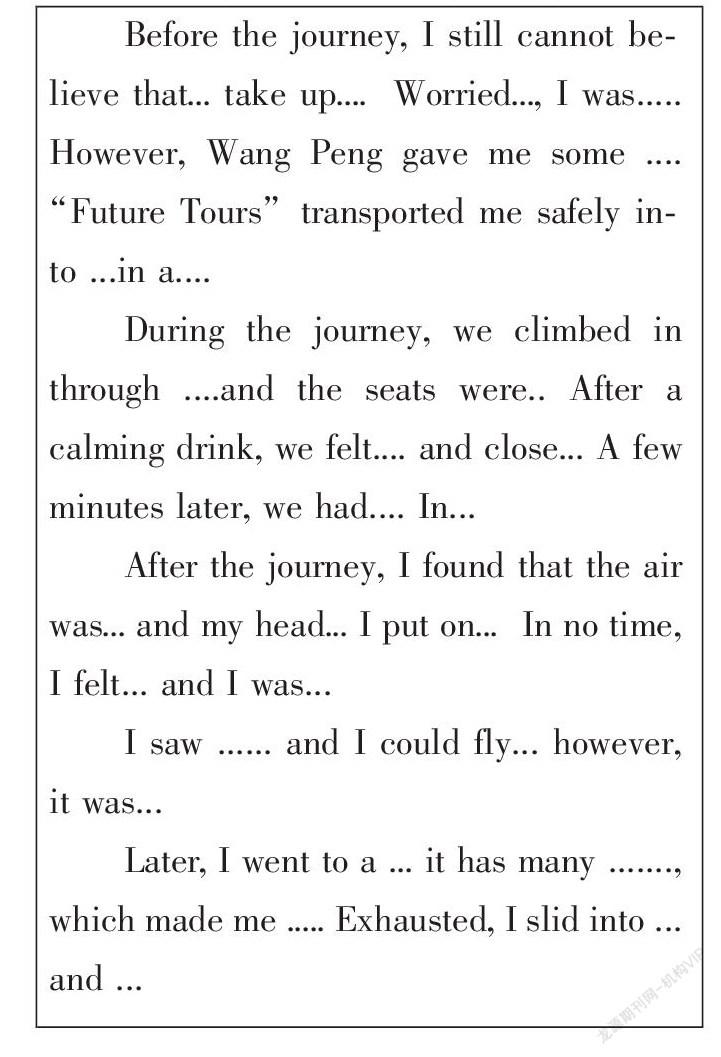
Before the journey, I still cannot believe that... take up....? Worried..., I was..... However, Wang Peng gave me some .... “Future Tours”transported me safely into ...in a....
During the journey, we climbed in through ....and the seats were.. After a calming drink, we felt.... and close... A few minutes later, we had.... In...
After the journey, I found that the air was... and my head... I put on...? In no time, I felt... and I was...
I saw ...... and I could fly... however, it was...
Later, I went to a ... it has many ......., which made me ..... Exhausted, I slid into ...and ...
通過(guò)復(fù)述引導(dǎo)學(xué)生內(nèi)化所學(xué)的語(yǔ)言與結(jié)構(gòu),再創(chuàng)造性地輸出,培養(yǎng)語(yǔ)言表達(dá)能力和邏輯思維能力。
三、創(chuàng)新遷移類(lèi)活動(dòng)
Activity 5:Analyze the writing features.
The structure of each paragraph is? ? ? ? ? ? ? ? ? ? ? .
Write down words that express Li Qiangs feelings.
Activity 6(group work):Imagine and speak.
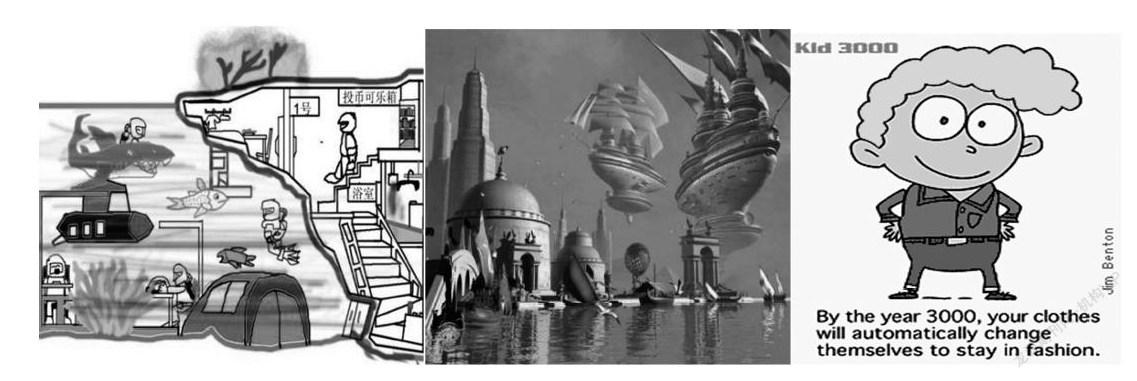
Suppose you were Li Qiang, and you saw the following items(pictures)the next day. Choose one to describe and express your feelings with more than 4 sentences. Work in pairs. Try to use your imagination and pay attention to the general specific structure in your description.
You may begin like this:
“The next day, Wang Peng showed me into ....(the place)”
“The next day, Wang Peng showed me ....(sth.)”
Words and sentences structures for your reference.(略)
通過(guò)小組合作的方式進(jìn)行體驗(yàn)、感悟?qū)W習(xí),引導(dǎo)學(xué)生深度思考并勇于表達(dá),培養(yǎng)他們的想象力、創(chuàng)造力等高階思維。
Activity 7(Homework):Write a letter.
Suppose you were Li Qiang, continue to write an e-mail to your parents about the visit to a school of 3008 the next day and express your feelings by using your imagination with more than 100 words.
在英語(yǔ)學(xué)習(xí)活動(dòng)觀的指導(dǎo)下,筆者首先用思維導(dǎo)圖和問(wèn)題鏈的方式引導(dǎo)學(xué)生縱觀理解全文的篇章結(jié)構(gòu)。接著設(shè)置情境任務(wù),將閱讀、口頭表達(dá)和寫(xiě)作結(jié)合起來(lái),以讀促說(shuō),以讀促寫(xiě)。最后將閱讀中學(xué)到的篇章結(jié)構(gòu)和句型運(yùn)用于新的情境中,提高學(xué)生現(xiàn)學(xué)現(xiàn)用、活學(xué)活用、鞏固知識(shí)和開(kāi)發(fā)知識(shí)的運(yùn)用能力,同時(shí)激發(fā)想象力和創(chuàng)造力,培養(yǎng)高階思維,有效促進(jìn)深度學(xué)習(xí),落實(shí)學(xué)科素養(yǎng)。
注:本文系廣東省教育科學(xué)規(guī)劃課題“普通高中英語(yǔ)教學(xué)共同體的構(gòu)建研究”(課題批準(zhǔn)號(hào):2020YQJK230)階段性成果,及中山市2018年度一般課題“高中英語(yǔ)文學(xué)閱讀思維型教學(xué)的校本研究”(立項(xiàng)編號(hào):B2018150)的階段性成果。
責(zé)任編輯 魏文琦
猜你喜歡
中學(xué)生數(shù)理化·七年級(jí)數(shù)學(xué)人教版(2020年11期)2020-12-14 06:59:52
甘肅教育(2020年8期)2020-06-11 06:10:00
甘肅教育(2020年12期)2020-04-13 06:25:02
福建基礎(chǔ)教育研究(2019年2期)2019-09-10 07:22:44
福建基礎(chǔ)教育研究(2019年2期)2019-05-28 08:39:49
藝術(shù)品鑒證.中國(guó)藝術(shù)金融(2018年8期)2019-01-14 01:14:28
藝術(shù)品鑒證.中國(guó)藝術(shù)金融(2018年10期)2019-01-08 02:44:26
藝術(shù)品鑒證.中國(guó)藝術(shù)金融(2018年12期)2018-08-26 06:03:48
散文百家(2014年11期)2014-08-21 07:16:12
散文百家(2014年11期)2014-08-21 07:16:08
