
Performance Evaluation of a Molten Carbonate Fuel Cell-Graphene Thermionic Converter-Thermally Regenerative Electrochemical Cycles Hybrid System
2021-10-22 08:24:38HUYaowen胡耀文HUANGYuewu黃躍武
HU Yaowen(胡耀文), HUANG Yuewu(黃躍武)
College of Environmental Science and Engineering, Donghua University, Shanghai 201620, China
Abstract: A combined system model is proposed including a molten carbonate fuel cell(MCFC), a graphene thermionic converter(GTIC) and thermally regenerative electrochemical cycles(TRECs). The expressions for power output, energy efficiency of the subsystems and the couple system are formulated by considering several irreversible losses. Energy conservation equations between the subsystems are achieved leaned on the first law of thermodynamics. The optimum operating ranges for the combined system are determined compared with the MCFC system. Results reveal that the peak power output density (POD) and the corresponding energy efficiency are 28.22% and 10.76% higher than that of the single MCFC system, respectively. The effects of five designing parameters on the power density and energy efficiency of the MCFC/GTIC/TRECs model are also investigated and discussed.
Key words: molten carbonate fuel cell (MCFC); graphene thermionic converter (GTIC); thermally regenerative electrochemical cycle (TREC); hybrid system; parameter analysis
Introduction
With the increasing fossil fuel consumption worldwide, it is urgent to explore efficient energy conversion technologies[1]. Fuel cell technology can transform the chemical energy of fuels into electricity without pollution, which may be a good solution to help humankind to fight against global warming[2]. Among various fuel cells, molten carbonate fuel cell (MCFC) has become the popular high-temperature fuel cell in recent years owing to its fuel flexibility, stationary power output, carbon capture and storage applications[3]. Compared with traditional CO2separation technology, MCFC-generators (GTs) can improve the overall efficiency. Duanetal.[4]conducted research on coal-fired power plants combined MCFC to capture CO2. The results illustrate that the efficiency of the power plant is 4.05% higher than that of a traditional power plant. Gas turbines are usually used for MCFC waste heat recovery. Researchers have analyzed the performance of MCFC-GT coupling systems in different methods[5-6]. Besides, the heat emitted from the MCFC can be utilized by combining waste heat recovery applications such as braysson heat engine cycle[7], organic Rankine cycle[8], thermoelectric generator[9], gas turbine[5], micro gas turbine[10], thermophotovoltaic cell[11],etc.However, there are some disadvantages to the existing MCFC-based hybrid systems. The MCFC-gas turbine hybrid system needs plenty of auxiliary devices and can’t be easily miniaturized. Because of the limited energy efficiency at a low temperature, the waste heat cannot be utilized effectively in the MCFC-thermoelectric generator hybrid system. The high efficiency heat recovery application can be coupled to MCFC to form tri- or multi-cycle systems, and the whole performance characterizes of the hybrid system will be improved.
A thermionic converter (TIC) can efficiently convert the heat from the reservoir into electricity by means of thermionic emission with high energy densities[12-13]. In the previous studies, TIC usually required a high-temperature heat reservoir (e.g., 1 650 K) to produce electrical current[14]. Wangetal.[15]proposed a model of vacuum TIC containing irreversible losses and optimized its performance. The heat emitted from the TIC is of high quality, which can be utilized by the heat recovering cycles. Recently, graphene has been applied in the design and manufacture of TIC as an excellent electrode material[16-18]. Graphene thermionic converter (GTIC) is a graphene-emitter based TIC. Liang[16]derived the electrons supply function in GTIC, which was a function of the temperature to the third power. The expression was unlike the traditional Richardson-Dushman (RD) law which was related to the second power of temperature. The ability of the graphene plate to emit electrons was enhanced compared with the traditional metal plate at the same circumstance. It was also reported that a GTIC with a lower work function and higher Fermi energy level can operate in a lower temperature condition[16], which broaden the application of the TIC.
With the recent improvement of high performance materials, the thermal regeneration electrochemical cycle (TREC) system for recovering low-grade waste heat was informed recently[19-22]. The TREC has the advantages of high conversion efficiency, small volume and high charge capacity[19]. Guoetal.[21]proposed a TRECs system model with continuous power generation, and the heat recovery application with TRECs become realistic. Using the maximum efficiency-power product criterion, TRECs with continuous power output were improved dramatically by Wangetal.[23].The waste heat from the GTIC can be recycled to drive the TRECs for additional power production, and the system performance will be enhanced.
In this study, we develop a hybrid model comprised of an MCFC, a GTIC and TRECs for the heat-to-electricity energy conversion process. Taking the several irreversibilities into consideration, the mathematical expression of power output and energy efficiency for the MCFC, GTIC, TRECs and combined system are obtained. The energy balance between the subsystems are gained based on the energy conservation law. The optimum operating regions for the combined system are determined, and the effects of several designing parameters of the triple-cycle model on the performance are investigated separately.
1 System Description
Figure 1 illustrates the MCFC/GTIC/TRECs system made up of an MCFC, a GTIC, TRECs, and a regenerator, where the GTIC operates between the MCFC and the TRECs. The MCFC generates electric powerPMCFCand waste heat at the operating temperatureT. A portion of the waste heatQEis sent to the GTIC for power outputPGTIC. The heat from GTICQCis emitted to TRECs for additional powerPTREC, and the regenerator preheats the gas by harvesting the heat from the exhaust air. The heat leakQLis expelled into the environment at temperatureT0.Q0andQRare the heat escaping from the TRECs and the regenerator, respectively.TEandTCare the temperatures of the emitter and the collector of the GTIC. Several assumptions made in the modelling of the proposed system are as follows[24-26].
(2) Heat transport in the hybrid system obeys Newton’s cooling law.
(3) Chemical reactions are carried out completely in the MCFC.
(4) Heat from the MCFC to the GTIC is fully absorbed by the GTIC.
(5) The emitter and collector of the GTIC have the same surface area.
(6) The heat capacity and charge capacity for TRECs are under stable states.
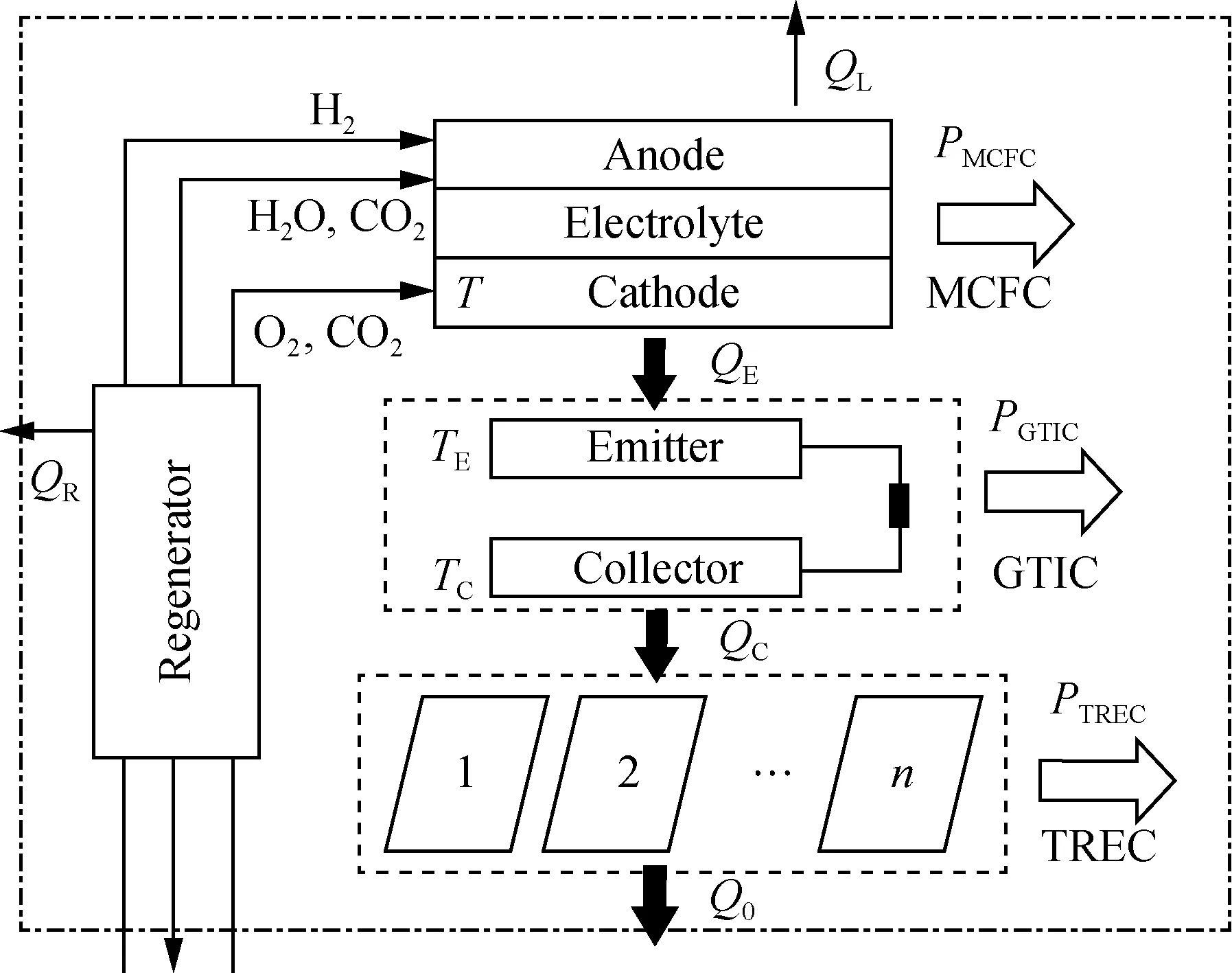
Fig. 1 Schematic view of the MCFC/VTIC/TRECs system
1.1 Molten carbonate fuel cell
MCFCs use alkali metal carbonate as electrolytes. The chemical reaction occurred in the MCFC can be expressed as
A tree covered with tinsel and gaudy1() paper chains graced one corner. In another rested a manger scene produced from cardboard and poster paints by chubby2(), and sometimes grubby, hands. Someone had brought a doll and placed it on the straw in the cardboard box that served as the manger. It didn t matter that you could pull a string and hear the blue-eyed, golden-haired dolly say, My name is Susie. But Jesus was a boy baby! one of the boys proclaimed. Nonetheless, Susie stayed.
where two subscripts “an” and “cat” mean anocle and cathode of the MCFC, respectively. Generally, the total energy transferred per unit time from MCFC is given by
(1)
whereSFindicates the electrode area of MCFC,jrepresents the electric current density,Fis the Faraday’s constant,neis the number of electrons exchanged, andΔhstands for the molar enthalpy change of the chemical reaction. The actual voltage output is less than the theoretical maximum voltageEof MCFC because of the three irreversible losses: anode overpotentialUan, ohm overpotentialUohmand cathode overpotentialUcat. The theoretical maximum voltage and irreversible losses are, respectively, calculated by
E=
(3)
(4)
(5)
(6)
wherepH2,pO2,pH2OandpCO2represent the partial pressures of fuel and air component, respectively;Eact,anandEact,catstand for the activation energy of anode and cathode;RandTdenote the universal gas constant and the working temperature of MCFC, respectively; the anode and cathode are located in the subscript. The actual voltage output is described as
U=E-Uan-Ucat-Uohm.
(7)
The power output and energy efficiency of the MCFC can be calculated by
PMCFC=jSFU,
(8)
(9)
1.2 Power output and efficiency of GTIC
By using the Richardson-Dushman(RD) equation, the current densities emitted from the GTIC emitter surface and collector surface can be, respectively, expressed as[16, 27]
(10)
(11)
whereAE=115.8 A·m-2·K-3andAC=1 200 000 A·m-2·K-3are the RD constant,ψEandψCstand for the work function of the emitter and the collector,kBrepresents the Boltzmann constant, andEFer,Eis the Fermi energy level. The absorbed and released heat of GTIC are written as follows respectively

(12)
(13)
whereSGis the surface area of the GTIC,εsubstitutes for the thermal emissivity between the plates,σstands for the Stefan-Boltzmann constant, and the performance parameters of the GTIC are given by
PGTIC=QE-QC=SG(ψE-ψC)(JE-JC)/e,
(14)
(15)
Due to the fact that the combined system was not found in literatures, the subsystems have been compared with the references, separately. As shown in Fig. 2, the theoretical data derived from the proposed model is closed to the data in the previous study[16], which implies a good agreement. Thus, the model of the GTIC is valid and reliable.
1.3 Power output and efficiency of TREC
TREC contains four thermodynamic processes: isobaric heating and cooling, isothermal charging and discharging processes. Assumed that the gap between the GTIC and the TRECs has no thermal resistance, it is expected that the collector plate temperatureTCof the GTIC and the TREC’s hot side temperatureTHare equal,i.e.,TH=TC. The heat flows absorb from the GTIC and emit to the surroundings are calculated as[28-29]
(16)
(17)
whereαstands for the temperature coefficient,mis the value of TRECs charged packs,RSdenotes the internal resistance of TRECs,cpandcqrepresent, respectively, the specific heat and charge capacity of a TREC. The regenerative efficiency is determined asηR=1-2m/n. Combined Eqs. (16) and (17), the power and energy efficiency of TRECs are found according to
PTREC=Q1-Q0=m(αIΔT-2I2RS),
(18)
and
(19)
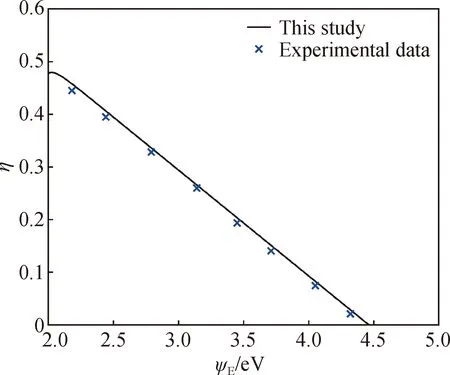
Fig. 2 Validation of GTIC efficiency versus emitter workingfunction compared with reference data
Figure 3 illustrates that the theoretical power output based on the proposed model is well consistent with the experimental data[29]. It shows that the TRECs model can be used effectively to discuss the performance of the hybrid system.
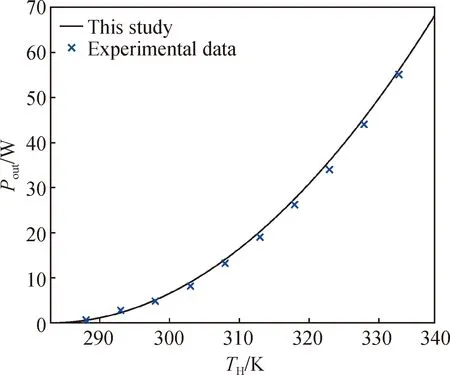
Fig. 3 TREC power output varying with the heatreservoir temperature and the experimentaldata from the reference
1.4 Regenerator
The irreversible loss in the regenerator can be expressed as
QR=KreSre(1-β)(T-T0),
(20)
whereKreandSredenote the coefficient of heat transfer and the regenerator area, respectively, andβstands for the regenerator effectiveness.
1.5 Hybrid system performance
The MCFC inevitably losses its heat to the surroundings. According to the Newton’s cooling law, the heat-leakage from the MCFC is given by
QL=KLSLl(T-T0),
(21)
whereKLstands for the heat transfer coefficient, and the effective heat-leakage area isSL. Considering the first law of thermodynamics and the expressions mentioned above, the energy conservation relations between the subsystems can be obtained as
ΔH=PMCFC+pTREC+QR+QL+q0,
(22)
(23)
(24)
whereQ0is the part of waste heat released from TREC into the environment.cL=KLSL/SFandcre=KreSre(1-β)/SFare integrated parameters relative to the regenerator and the heat-leakage of MCFC, respectively.
The total electrical power and energy efficiency of the combined system can be, respectively, determined by
Ptot=PMCFC+PGTIC+PTREC,
(25)
(26)
2 Performance Analysis

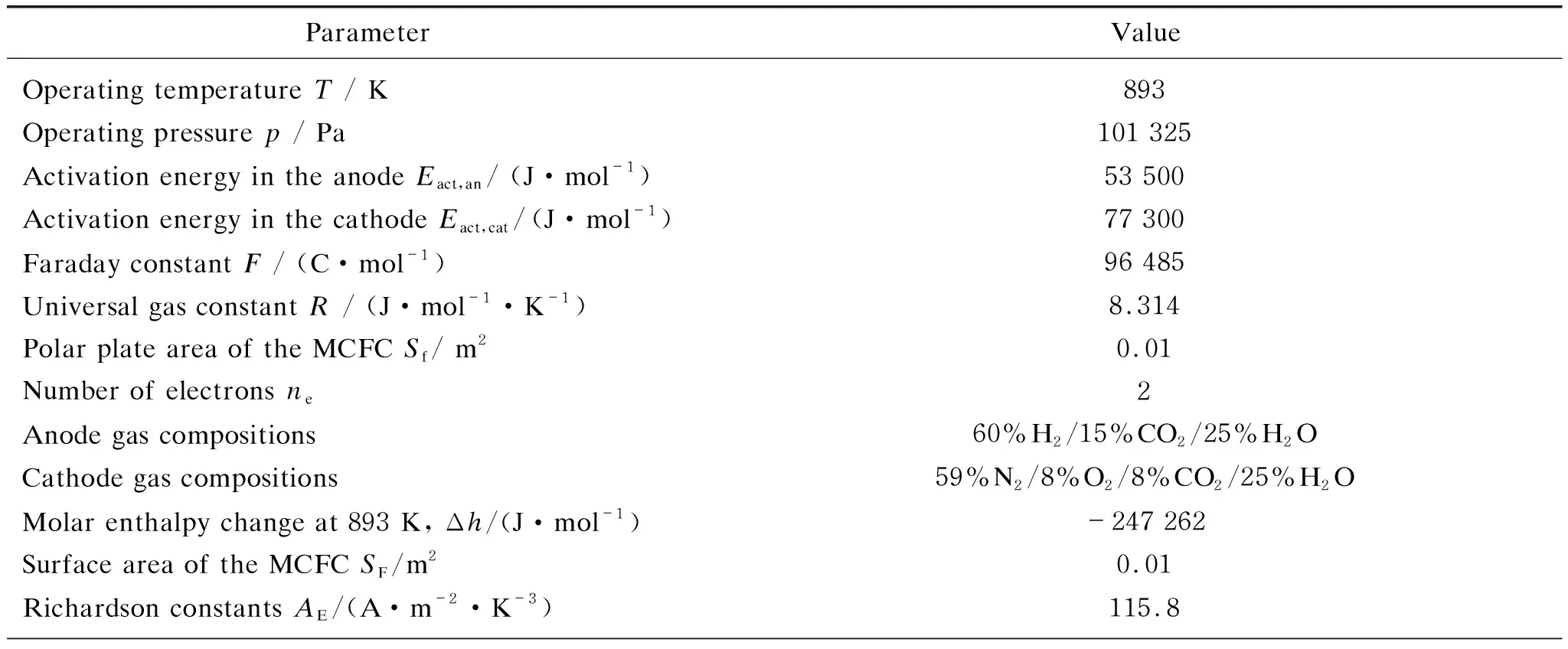
Table 1 Operating parameters used in the modeling combined system
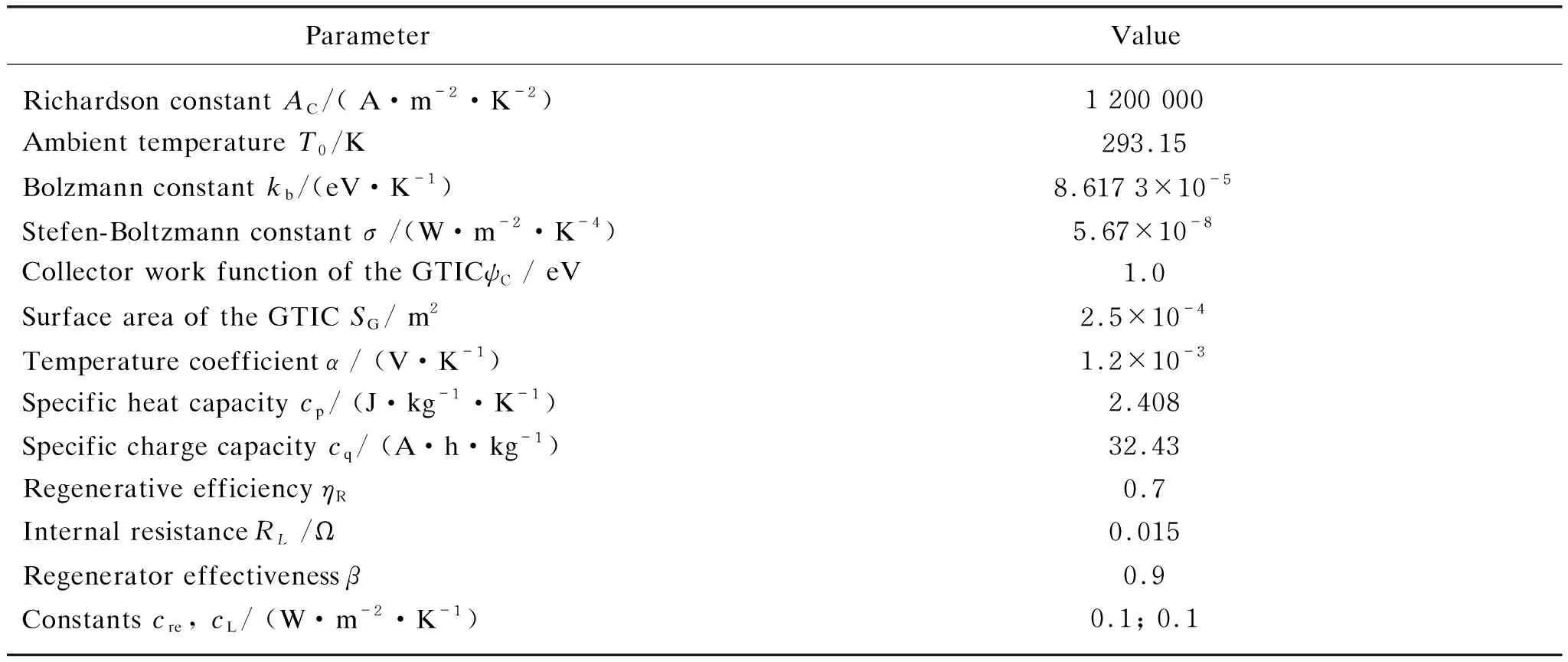
(Table 1 continued)
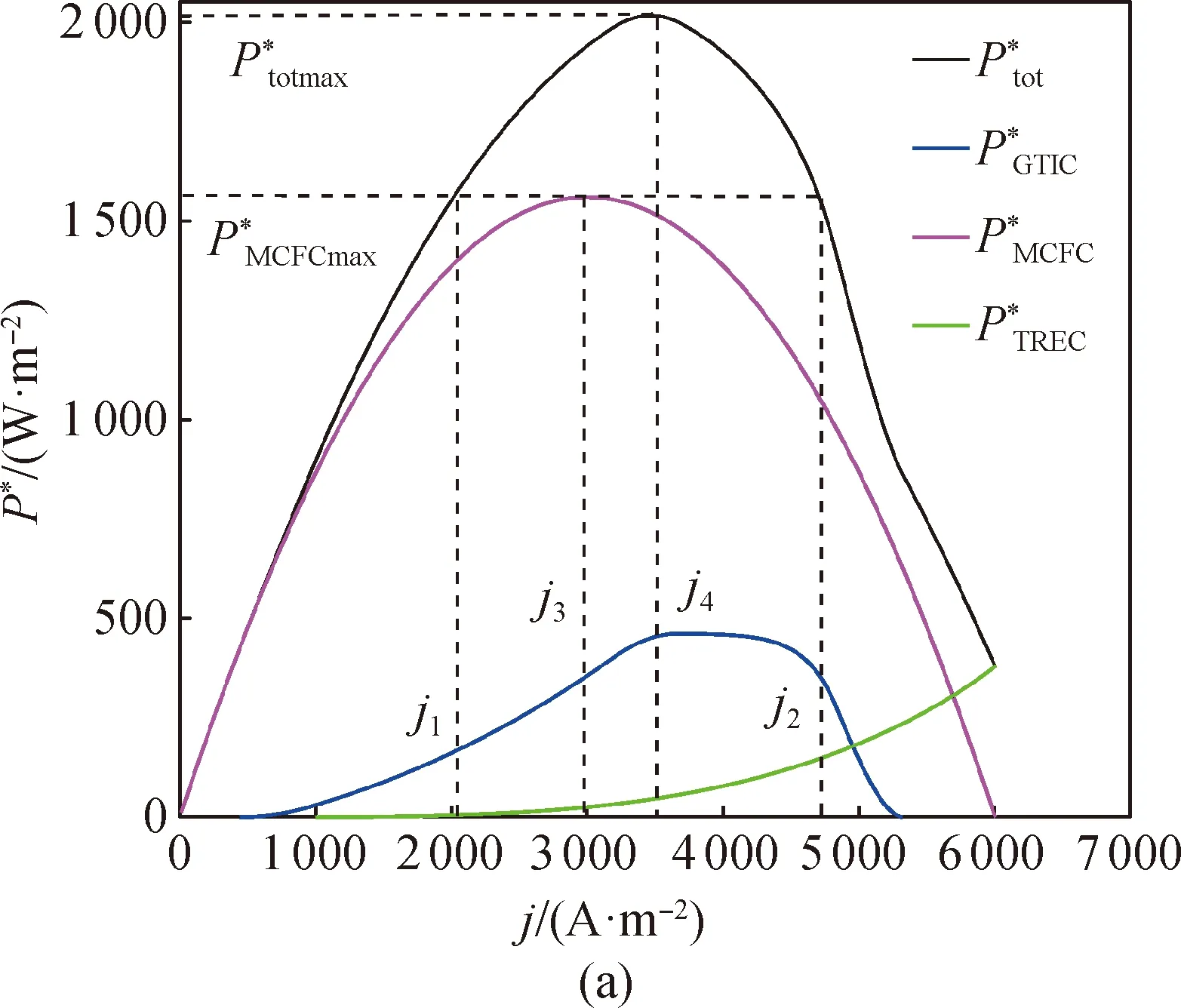
Fig. 4 Variation of performance parameters of MCFC, GTIC, TRECs and overall system with current density:
3 Results and Discussion
The performance of the hybrid system depends on several designing parameters and thermodynamic losses, including the temperature and pressure of the MCFC, collector work function of the GTIC, regenerative efficiency of TREC and effectiveness of regenerator. The impacts of the parameters on the performance of MCFC/GTIC/TRECs system are analyzed, and they remain unchanged unless explicitly mentioned.
3.1 Effects of the MCFC operating temperature

3.2 Effects of the MCFC working pressure
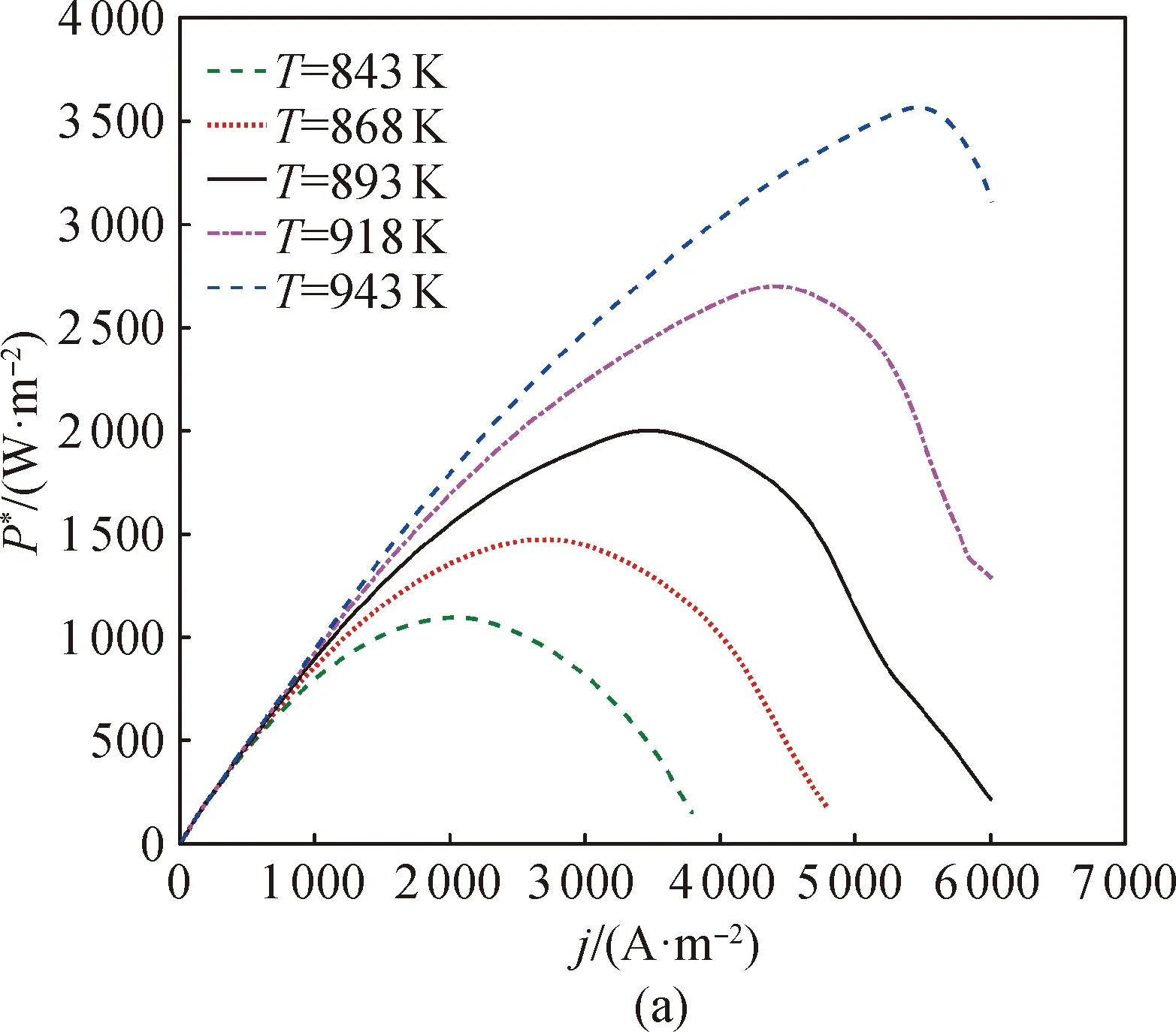
Fig. 5 Performance parameters of combined model varying with j for several given values of operating temperature:(a) POD; (b) energy efficiency
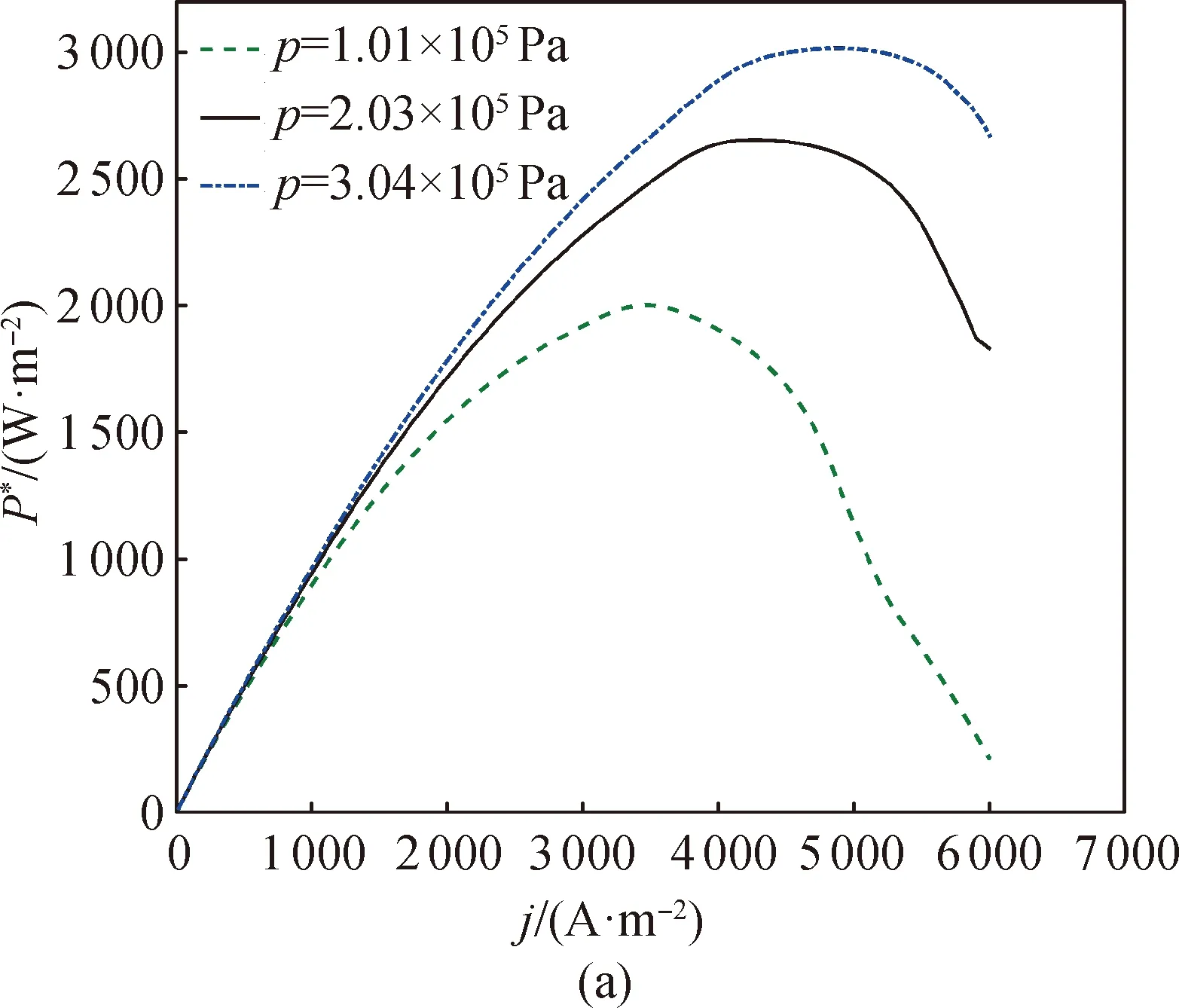
Fig. 6 Influence of MCFC operating pressure on the performance parameters of MCFC/GTIC/TRECs system:(a) POD; (b) energy efficiency
3.3 Effects of collector work function of the GTIC
The collector work function is an important factor for the GTIC, which illustrates the minimum energy for the electron to outflow the collector plate of the GTIC. A lowerψCindicates the electrons in the collector can escape easily. Therefore, the net current density of GTIC decreases. Figure 7 shows that the GTIC performance declines if a lower work function material is used. The TRECs would perform better at the circumstances since more heat is shifted from the GTIC to the TRECs. Because the performance enhancement in TRECs is larger than the performance descent in GTIC, the maximum POD and the corresponding energy efficiency of the combined system are elevated slightly with a decreasingψC.
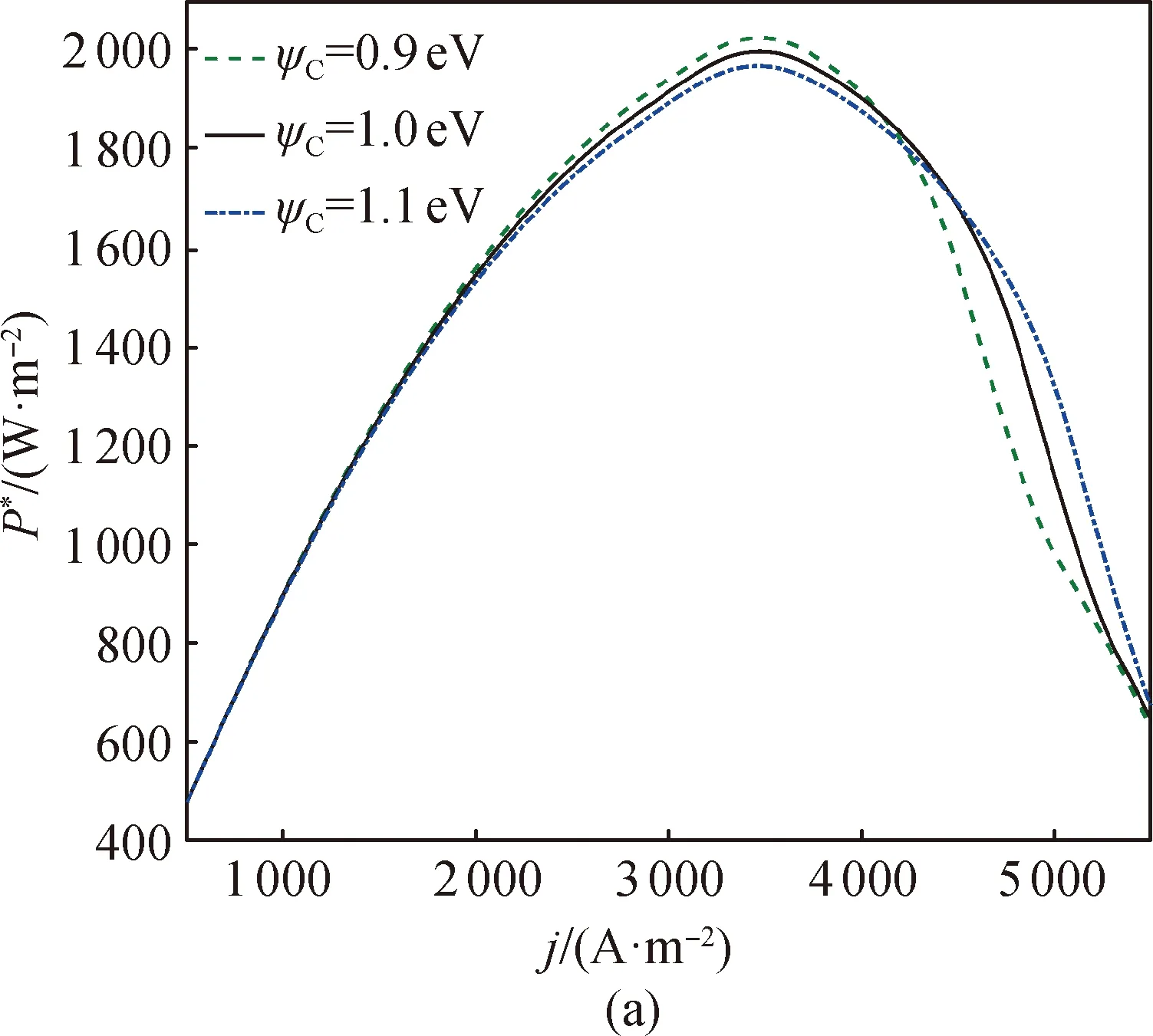
Fig. 7 Influence of the GTIC collector work function ψC on the performance parameters of triple-cycle system:(a) POD; (b) energy efficiency
3.4 Effects of the TREC regenerative efficiency
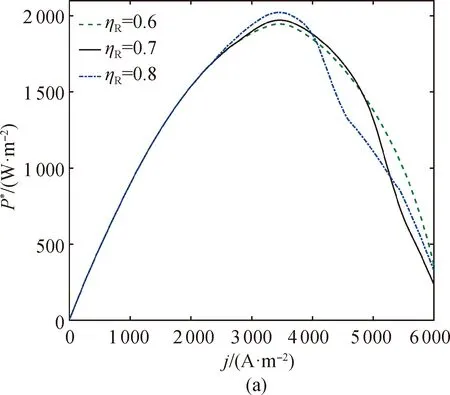
Fig. 8 Influence of the TRECs regenerative efficiency on the performance parameters of triple-cycle system:(a) POD; (b) energy efficiency
3.5 Effects of the effectiveness of regenerator
The regenerator effectiveness can describe the irreversible loss inside the regenerator. Figure 9 depicts that the maximum POD of hybrid system slides as the regenerator effectiveness decreases. It also indicates that the GTIC can work earlier as the regenerator effectiveness increases. The waste heat absorbed by GTIC is rising with decreasing irreversibility loss. Such influence appears to be relatively small compared to other parameters.
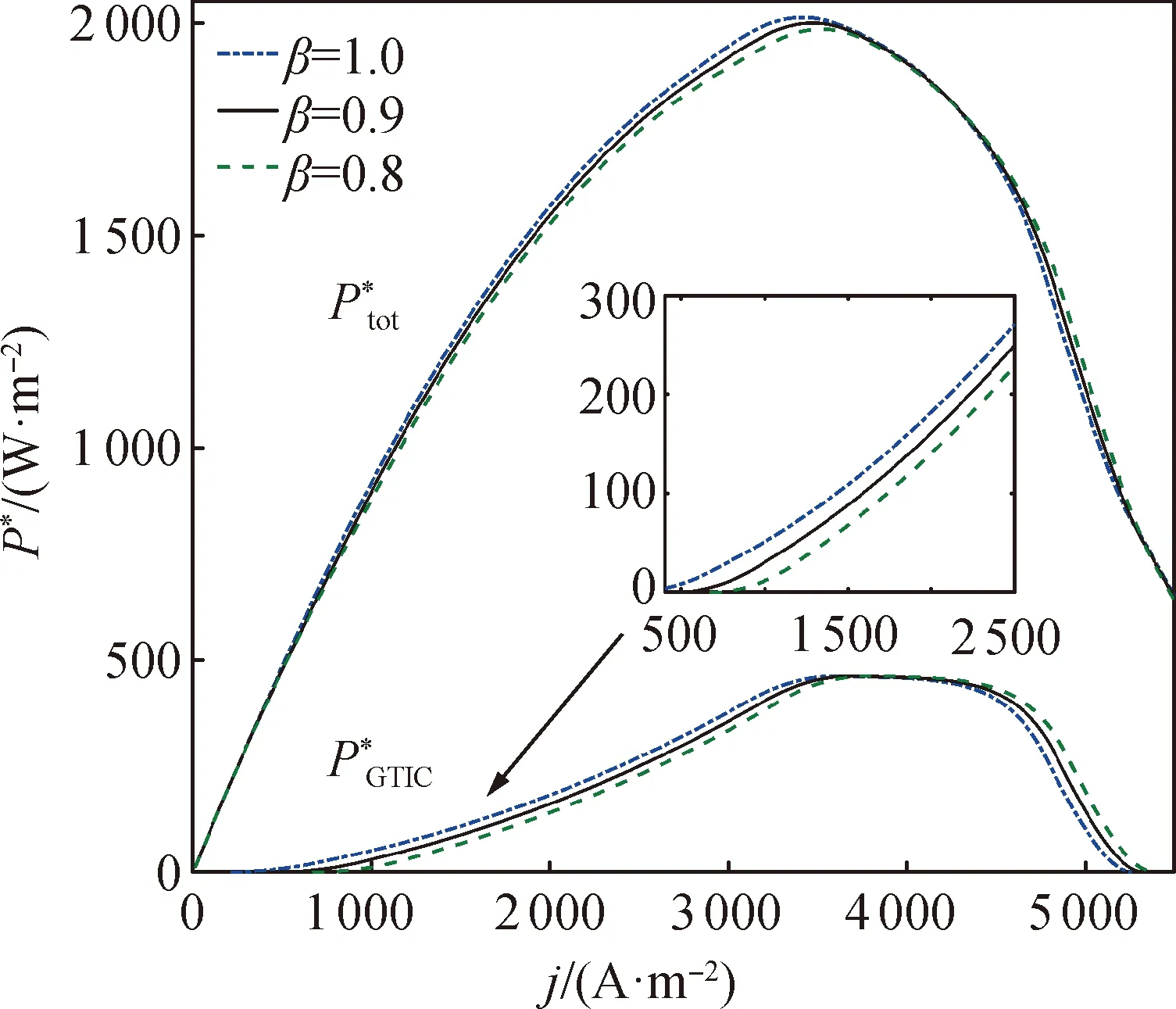
Fig. 9 POD of GTIC and triple-cycle systemfor different regenerator effectiveness
4 Conclusions
In summary, a hybrid system based on MCFC, GTIC and TRECs is proposed to utilize the heat from MCFC for extra power output. The irreversible losses occurred in the subsystems are considered, and the efficiency and the power output of the hybrid system are analytically derived. The optimum operating region of the combined system is also determined. The result illustrates that the maximum POD and the corresponding energy efficiency of the combined system are effectively increased by 28.22% and 10.76% compared with the single MCFC system. The effects of the operating temperature and pressure of the MCFC, collector work function of the GTIC, regenerative efficiency of TREC and effectiveness of regenerator are discussed. The results may offer theoretical guidance for the performance enhancement of an MCFC triple-cycle system.
 Journal of Donghua University(English Edition)2021年4期
- Journal of Donghua University(English Edition)的其它文章
- Influence Mechanism of Clothing Anchor Features on Consumers’ Purchase Intention
- Long Text Classification Algorithm Using a Hybrid Model of Bidirectional Encoder Representation from Transformers-Hierarchical Attention Networks-Dilated Convolutions Network
- Estimating Mechanical Vibration Period Using Smartphones
- Meta-Path-Based Deep Representation Learning for Personalized Point of Interest Recommendation
- Design and Characterization of Electrical Connections for Conductive Yarns
- Influence of Fe2O3 on Release Mechanism of NH3 and Other Nitrogen-Containing Compounds from Pyrolysis of Three Typical Amino Acids in Urban Sludge