
Prosecution records reveal pangolin trading networks in China, 2014-2019
2021-10-18 00:16:46Xiang-QinHuang,ChrisNewman,ChristinaD.Buesching等
Zoological Research 2021年5期
In a precautionary response to the current coronavirus(COVID-19) pandemic, China’s Ministries permanently banned eating and trading in terrestrial wild (non-livestock) animals on 24 February 2020, and extensively updated the list of Fauna under Special State Protection (LFSSP) in 2020 and 2021, in which pangolins (Manidae spp.) were upgraded to the highest protection level. Examining 509 pangolin prosecution records from China Judgements online prior to these changes(01/01/14-31/12/19), we identified that Guangdong, Guangxi and Yunnan Provinces were hotspots for trade in whole pangolins and their scales. Interrupting trade in these three principal southern provinces would substantially fragment the pangolin trade network and reduce supply of imports from other south-east Asian countries. In the context of the revised legislation and strategies intended to prevent wildlife trade, we conclude that targeting interventions at key trade nodes could significantly reduce illegal trade in pangolins, and that this approach could also be effective with other taxa.
Pangolins suffer from being the world’s most heavily trafficked mammalian contraband (Zhou et al., 2014). In China, pangolins are protected by the Wild Animal Conservation Law (WACL 1988, revised in 2004, 2009, 2016 and 2018), in concert with the Criminal Law (Article 151 and 341) (Zhou et al., 2016c). All eight extant pangolin species are named on China’s list of Fauna under Special State Protection(LFSSP 1988, revised in 2003, 2019 and 2021) and/or the Convention on International Trade in Endangered Species of Wild Fauna and Flora (CITES) Appendices. Under Article 341 of China’s Criminal Law, any trader convicted of selling pangolins and/or products derived thereof could face up to 15 years fix-term imprisonment accompanied by fines and/or the confiscation of property; alternatively, under Article 151, a sentence of life imprisonment accompanied by the confiscation of property could be applied for smuggling. Any ongoing illegal pangolin trade in China therefore warrants attention and greater understanding, enabling more effective interventions to disrupt distribution networks and apprehend perpetrators (Zhou et al., 2020).
A very important step was taken to better regulate pangolin trade, and illegal trade in all fauna, on 26 January 2020, when,in an early precautionary response to the COVID-19 crisis, the Chinese government (State Administration for Market Regulation, Ministry of Agriculture and Rural Affairs and National Forestry and Grassland Administration) temporarily banned the sale of all wild animals, and their products, for consumption as food in markets, restaurants and over ecommerce, to last until the conclusion of the epidemic.Subsequently, on 24 February 2020, the Standing Committee of the National People’s Congress implemented a permanent ban on poaching/trading/transporting any terrestrial wild (nonlivestock) animals for food consumption. This redresses previous tacit tolerance for many forms of wildlife trade in China (Xiao et al., 2021; Ye et al., 2020; Yin et al., 2020),often already illegal under WACL and/or the CITES (Zhou et al., 2016c), and thus carries a huge collateral benefit for global biodiversity and animal welfare (Zhou et al., 2016b).Particularly, as of 3 June 2020, China established a national intervention campaign aimed exclusively at pangolin conservation, promoting the protection of all pangolin species at the highest level, and has removed pangolin scale from the Chinese traditional medicinal Pharmacopoeia 2020(Pharmacopoeia Commission of the People's Republic of China, 2020).
Here we examine court Judgement records for patterns of pangolin trade across China immediately prior to these wildlife management responses to the COVID-19 pandemic, also to include shipments arriving across China’s borders. These records distinguished intact (living and dead) pangolins from scale seizures. We evaluate these data in the context of China’s renewed commitment to enforce new and pre-existing laws, to redress damaging aspects of a culture of traditional wildlife exploitation. Finally, we make pragmatic policy recommendations for better regulating the animal trade pervasive in China, integrating with ethics, education and enforcement.
These reforms of China’s judicial system from July 2014 have offered an unprecedented opportunity to collect highquality data on criminal prosecutions at the national level. In accordance with the requirements of China’s Supreme People’s Court, it is now mandatory that judgement records, dating back to 1 January 2014, are published on China Judgements Online website (http://wenshu.court.gov.cn/) within seven days of adjudication. These records cannot be amended, replaced or withdrawn without authority from the courts.
We searched Judgement records for the term “pangolin” (in Chinese). We then screened these court documents according to the following criteria: (i) Full text could be accessed, and the case referred to a crime involving illegal hunting, selling,transporting, purchasing and/or smuggling of pangolins and/or scales across China. (ii) A single case number (record) was assigned in instances where multiple judgement documents existed for the same prosecution, such as any subsequent retrial(s) of a case.
These judgement documents provided retrospective offence information, including items seized, seizure date, seizure location, type of illegal activity, site of origin for seized items and the actual or expected destination areas of goods.
For our pangolin trade network analysis, we listed interceptions involving trade from multiple sources, or trade from multiple destinations arriving at one destination, as multiple shipments. Each entry hereafter refers to a shipment,as a unit of analysis, corresponding to at least one pangolin,or scale consignment being transported between two regions;either importation into China from a foreign country, or between prefectures within China. Data were allocated geographically according to either the foreign country involved, or by using China’s prefecture as the administrative unit (mainland China comprises 334 prefectures in 34 Provinces, and four province-level municipalities).
To determine whether the number of seized individual pangolins and/or weight of the seized scales (log-transformed)were similar between neighboring prefectures, which would suggest trading hotspots, we assessed spatial autocorrelation at 10 equally sized distance classes (52-3 387 km for number of seized individuals and 70-3 359 km for the weight of seized scales, using Moran’sI(Moran, 1950) in Spatial Analysis in Macroecology 4.0 (Rangel et al., 2010); where 52 km and 70 km were the shortest distances between the centers of prefectures involved in pangolin seizures and 3 387 km and 3 359 km the maximum distances for whole pangolins and for scales, respectively. We tested whether seizure hotspots were skewed by the contribution of certain prefectures, using a cross tabulation with aχ2test and applying the Yates’s correction for continuity (due to the relatively small number of seizure locations).
The pangolin trade network was mapped using Circos(mkweb.bcgsc.ca/tableviewer) software, more widely used in genetics (Krzywinski et al., 2009), but also applied to wildlife trade (Cheng et al., 2017; Patel et al., 2015). Networks consisted of nodes joined by directed connections. The nodes represented the regions of origin and destination of shipments,as given in judgement documents. Each connection was characterized by the direction and volume of the shipment(s).A pair of nodes could have a bi-directional connection if trade was reciprocal, as occurred between some prefectures. Any connection that began and ended at the same node was not included in the analyses, because it did not constitute a shipment.
We characterized pangolin trade according to the following metrics: network size, defined as the total number of regions,or nodes, in the network; average number of shipments that were sent from and received by a particular node over the 6-year study period; and average number of sending and receiving connections per node over the 6-year study period(Hanneman & Riddle, 2005). Key intermediary, or “gate keeper” nodes were identified based on flow betweenness centrality, as a metric of the extent trade flows must pass through a particular node (Freeman et al., 1991). Flow betweenness was calculated using the “sna” package in R (R Core Team, 2016). Finally, we identified sets of key nodes using Borgatti criteria, as defined in the “key-player” problem(Borgatti, 2006; Cheng et al., 2017; Patel et al., 2015). These were nodes that had more connection with other nodes in the network, derived from a reciprocal distance weighted reach index. To examine the probability of a region being identified as a key region, we applied a Poisson parametric bootstrapping procedure assuming independence among network connections. Additionally, we established which set of nodes would maximize the fragmentation index representing the proportion of nodes isolated after the removal of key node sets. Key regions, along with their associated fragmentation and reach indices, were calculated using the Key-player program version 1.45 (Borgatti, 2006).
Following this procedure, we collated 509 court documents,published between 1 January 2014 and 31 December 2019,which pertained to 448 cases of pangolin crime across China;181 involved seizures totaling 7 718 whole pangolins, and 213 involved 17 280 kg of scales; these 448 seizures occurred between 25 December 2011 and 29 October 2019. The majority of prosecution records (362 of the 448 cases) did not report clearly or exactly which pangolin species had been traded illegally. There are two cases forManis culionensis(Philippine pangolin), 6 cases forManis gigantea(Giant pangolin), 54 cases forManis javanica(Malayan pangolin), 7 cases forManis tricuspis(Three-cusped pangolin), 1 case forManis crassicaudata(Indian pangolin), 1 case forManis tetradactyla(Black-bellied pangolin) and 25 cases forManis pentadactyla(Chinese pangolin), with some cases involving multiple species. The majority of whole animal seizures originated from prefectures in Guangdong (Jiangmen: 4 715 individuals in 1 case; Zhuhai: 960 individuals in 1 case), and Guangxi (Fangchenggang: 385 individuals over 27 cases),while the majority of scale seizures originated from Shanghai(3 329 kg over 7 cases) along with prefectures in Guangdong(Yunfu: 6 848 kg in 1 case; Foshan: 1 783 kg over 2 cases)(Figure 1A).
Countrywide, seizures of individuals and scales followed similar geographical patterns, but occurred in only 67 and 37 of China’s 338 prefectures and province-level municipalities,respectively (Figure 1A). Autocorrelation was detected for pangolin individuals in the first distance class (52-291 km) of the spatial correlogram (positive autocorrelation: Moran'sI=0.326,P<0.05), while autocorrelation was detected for the scales in the first distance class (70-294 km: positive autocorrelation: Moran'sI=0.465,P<0.05). 92.9% of individuals and 80.1% of scales were seized from 32 and 24 prefectures, respectively; all located in Guangdong, Guangxi and Yunnan: a significant bias toward China’s southern provinces (χ2with Yates’s correction,P<0.05,df=1, for both individuals and scales).
Next, we identified key trade network nodes, based on the 194 cases that pertained to 236 shipments in this network; 83 international and 153 inter-prefectural prosecutions for which transaction origin and destination were known (Figure 1B;Supplementary Tables S1, S2). Note, a further 254 cases either did not specify pangolin origin and/or destination, or did not involve international/inter-prefectural trading, and were thus excluded from further analyses. Pangolins from fourteen countries were smuggled into China. Most importation came from Myanmar (31 shipments to 5 prefectures) and Vietnam(14/7) contributing 58% of all international shipments links to China (Supplementary Table S3). 71.8% of imported pangolins and scales were received by just seven prefectures,primarily in Yunnan (Baoshan: 14 links with Myanmar;Dehong: 10 with Myanmar; and Xishuangbanna: 5 with Myanmar and 3 with Laos); followed by Guangzhou in Guangdong Province (7 with Nigeria, Ethiopia, Vietnam and Qatar), Shanghai (6 with Nigeria, Ethiopia, Equatorial Guinea and Guinea), Fangchenggang in Guangxi Province (6 with Vietnam) and Beijing (5 with Italy, Ethiopia, Equatorial Guinea and Guinea). Myanmar (31 shipments), Dehong (28) and Fangchenggang (20) were the nodes that exported the most shipments. The most connected nodes were Fangchenggang(shipping to 11 prefectures), Vietnam (7) and Guangzhou (7)(Supplementary Table S3).
We identified the most connected key nodes within the network, i.e. those that would disseminate trade to the most other nodes. The entire network could be perfused via just 37 nodes; however, 61.3% perfusion occurred via just the 6 most connected nodes (Supplementary Tables S4, S5). Based on maximum connectivity, we identified various sets of one to six nodes that connected to over 39% of other nodes in the network (Supplementary Table S5). We further established that 92.8% network fragmentation could be achieved by removing just six key nodes (Supplementary Tables S6, S7),preventing partners from trading (Figure 1C). Among these 6 key intervention nodes, Guangzhou, Beijing, Fangchenggang and Shenzhen were also those most connected nodes.
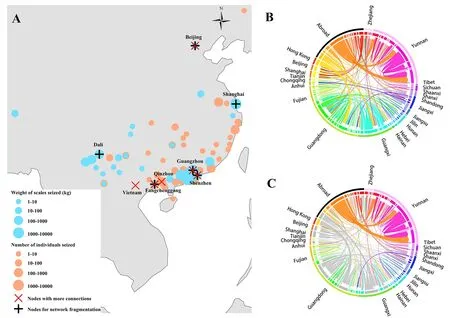
Figure 1 Pangolin seizures and illegal trade flows
We further identified key trade network nodes for trade in whole animals (32 international and 91 inter-prefectural shipments) and scales (55 international and 63 interprefectural shipments), respectively. Reflecting overall patterns in the importance of trade nodes, among the 6 key intervention nodes for whole animals, Guangzhou, Beijing and Fangchenggang were the most connected nodes(Supplementary Tables S4-S7). Among the 6 key intervention nodes for scales, Vietnam and Shenzhen were the most connected nodes (Supplementary Tables S4-S7).
This investigation provides a better understand trading patterns in pangolins from the standpoint of wildlife conservation, both to avoid the imminent extinction of this globally most trafficked family and to alleviate the terrible animal cruelty involved in their capture, transport and captivity(Zhou et al., 2016b). Although China’s pangolin trading network has been presented at different spatial scales based on data available from public media (Cheng et al., 2017; Xu et al., 2016) or the United Nations Environment Programme-World Conservation Monitoring Centre (UNEP-WCMC)’s CITES Trade Database (Heinrich et al. 2016), the benefits of the judgement documents we analyzed here are that these provided a robust, reliable and systematic recent source of data, independent of whether arrests attracted formal news or social media.
Our study exposed that, insofar as Judgement reports provide an accurate and systematic reflection of illegal trading,pangolin trading remains an issue of concern predominantly through regions in southern China. Importantly, by applying the key-player game algorithm to our network analysis, we found that through targeting just eight nodes in total, spread between two sets of six main trading nodes (6 perfusion and 6 isolation nodes, of which 4 nodes are shared) perfusion could be reduced by more than 60%, and over 90% of the trading network could be isolated. This approach would result in substantial disruption of all pangolin trade in China. Vital, too,is that investigators and prosecutors seek to identify which pangolin species is involved (with its recognized binomial) to better map trade pattern details (Zhou et al., 2016c). This could enable interventions to stem imports into China’s southern provinces close to Myanmar, Laos and Vietnam.Ultimately, disrupting delivery to Chinese consumers would likely decimate supply networks and hunting pressures in these other south-east Asian countries, with intrinsic benefits for pangolin populations in the wild.
More intensive policing of wet markets is, however, only part of the solution (Phelps et al., 2014). Due to the international complexities involved in pangolin trafficking, which require advanced managerial and organizational skills and high levels of internet and/or computer literacy, trade is generally perpetrated by offenders with a higher level of education(68.5% with at least a junior middle school education)compared to other wildlife offenders (Shao et al., 2021). These criminals will quickly learn adaptive counter-strategies to attempt conceal crimes and evade detection. Indeed,corporate or organized crime cartels are often involved. For example, between 2013-2014, an unlicensed company in Guangxi Province was prosecuted for smuggling 4 195 pangolins from Vietnam. Nine men and one woman were charged; nine other suspects escaped. A more holistic approach aimed at reducing and/or eliminating the customer base purchasing pangolins and pangolin-derived products would therefore have broader benefits. Moreover,conservation efforts for pangolin should have proper dissemination of scientific wildlife conservation concept (Zhou et al., 2016a).
Lessons learned from this tragic global COVID-19 pandemic offer the opportunity to reduce the likelihood of future illegal wildlife trade-related zoonotic outbreaks (Macdonald et al.,2021; Montgomery & Macdonald, 2020; Zhou et al., 2020).Indicatively too, enhanced legislation and policing aimed at eliminating illegal wildlife trade in China shows signs of success, with nationally only 26 prosecutions for pangolinrelated crimes documented by judgements published between 1 January and 31 July 2021, with no evidence that this reduction is due to lessened diligence by the authorities. Our approach here could equally be applied to target interventions based on the spatial patterns of illegal trade in various other wildlife taxa in China. These pangolin seizure hotspots(Guangdong, Guangxi and Yunnan Provinces) are, however,not generalizable to all persecuted taxa; for example, sales of invasive turtles (Chelydridae spp. andTrachemys scripta elegans) tend to be focused in the middle and lower Yangtze River basin (Liu et al., 2021), whereas sales of protected turtles (49 species) occur predominantly in the Pearl River Delta national conurbation (Ye et al., 2020). This underlines that to better enable targeted action aimed at maximally disrupting networks, and to better enable supply chain tracing to contain outbreaks of zoonotic epidemics (Can et al., 2019;Cyranoski, 2020; Dezs? & Barabási, 2002), it is important to identify the species-specific key locations where vulnerable wild animal taxa are traded and sold.
SUPPLEMENTARY DATA
Supplementary data to this article can be found online.
COMPETING INTERESTS
The authors declare that they have no competing interests.
AUTHORS’ CONTRIBUTIONS
X.Q.H. collected the data with the assistance from M.L.S.;X.Q.H., Y.C.Y., and S.L. performed analysis; C.N., C.D.B.,D.W.M. and Z.M.Z. contributed to the concept and writing of the manuscript; Z.M.Z. supervised and managed the project.All authors read and approved the final version of the manuscript.
ACKNOWLEDGMENTS
We thank Y. Luo and Q.M. Wei from China West Normal University for expert support with data collection.
- Zoological Research的其它文章
- Phylogenomic relationships and molecular convergences to subterranean life in rodent family Spalacidae
- Chromosome-scale genome assembly of brownspotted flathead Platycephalus sp.1 provides insights into demersal adaptation in flathead fish
- Deletion of phosphatidylserine flippase β-subunit Tmem30a in satellite cells leads to delayed skeletal muscle regeneration
- Role of juvenile hormone receptor Methoprene-tolerant 1 in silkworm larval brain development and domestication
- Captopril alleviates lung inflammation in SARS-CoV-2-infected hypertensive mice
- Global view on virus infection in non-human primates and implications for public health and wildlifeconservation