
Molecular phylogeny and morphological comparisons of the genus Hebius Thompson, 1913 (Reptilia:Squamata: Colubridae) uncover a new taxon from Yunnan Province, China, and support revalidation of Hebius septemlineatus (Schmidt, 1925)
2021-10-18 00:16:38Shao-BingHou,Zhi-YongYuan,Ping-FanWei等
Zoological Research 2021年5期
We describe a new species of the genusHebiusand provide evidence for the validity ofH. septemlineatuscomb. nov..Morphological and molecular analyses ofHebiusspecimens collected in Yunnan Province, China, revealed three distinct lineages, namely the newly describedHebius weixiensissp.nov., as well asH. octolineatus(Boulenger, 1904), andH.septemlineatuscomb. nov. (Schmidt 1925), which is removed from synonymy withH. octolineatus. Based on mitochondrial genealogy,Hebius weixiensissp. nov. is sister toH.septemlineatuscomb. nov., whileH. octolineatusis sister toH. bitaeniatus. The new species andH. septemlineatuscomb.nov. showed considerable genetic divergence from their recognized congeners (uncorrectedP-distance ≥3.9%).Furthermore, the new species andH. septemlineatuscomb.nov. can be diagnosed from closely related congeners by a combination of pholidosis characters.
The genusAmphiesmaDuméril, Bibron & Duméril, 1854 was long recognized as a monophyletic group with many species widely distributed across southern, eastern, and south-eastern Asia (Wallach et al., 2014). However, taxonomy within the clade has been in flux. Based on molecular analyses, Guo et al. (2014) split the genusAmphiesma(sensu lato) into three genera: i.e.,Amphiesma(sensu stricto),HerpetoreasGünther, 1860, andHebiusThompson, 1913.Recently, Kizirian et al. (2018) synonymized the monotypic generaParahelicopsBourret, 1934, which containedParahelicops annamensisBourret, 1934, andPararhabdophisBourret, 1934, which containedPararhabdophis chapaensisBourret, 1934, with the genusHebius. In addition, the generic assignments of some species have changed based on their systematic positions revealed in various studies; for example,multilocus phylogenetic analyses of mitochondrial and nuclear genes indicated thatHebius pealii(Sclater, 1891) andHebius xenura(Wall, 1907) were actually nested within the genusHerpetoreas, and thus both species were moved toHerpetoreas(Das et al., 2020; Lalronunga et al., 2020).
Over the last several years, we collected a series ofHebiusspecimens during herpetological surveys in Yunnan, China,(Figure 1Ai). After euthanasia, liver tissue samples were taken and preserved in 85% ethanol, and specimens were fixed in 10% buffered formalin solution, then transferred to 70%ethanol after two days. All specimens and samples were deposited in the Kunming Institute of Zoology (KIZ), Chinese Academy of Sciences (CAS) (see Supplementary Text and Table S1).
Measurement and scale counting methods are presented in Supplementary Materials and Methods. To reconstruct the phylogeny ofHebius, we extracted total genomic DNA and amplified and sequenced a 978 bp fragment of the mitochondrial cytochromeb(cytb) gene. Trees were reconstructed using partitioned maximum-likelihood (ML) and Bayesian inference (BI) analyses (see Supplementary Materials and Methods for details).
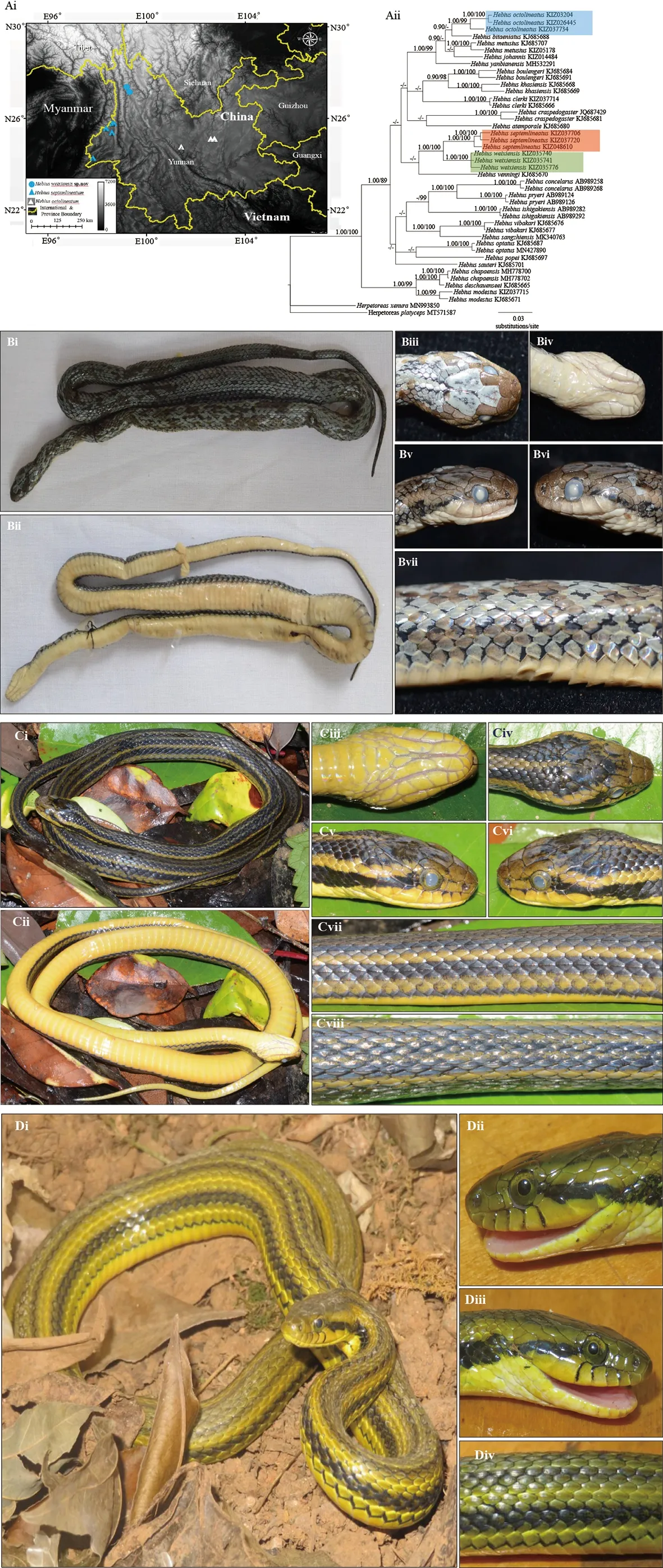
Figure 1 Phylogenetic relationships of genus Hebius, and distribution and photo of Hebius weixiensis sp. nov., H. septemlineatus comb.nov. and H. octolineatus
Both ML and BI analyses yielded nearly identical topologies,except for several nodes with low support (Figure 1Aii). The genusHebiuswas recovered as a monophyletic group with strong support, and all newly collected specimens were nested within the genus (Bayesian posterior probability 1.00/ML bootstrap support 100, given in this order below). The newly collected specimens were recovered in three clades.The three specimens from Weixi County formed a monophyletic clade, which was sister to another monophyletic clade that included the three specimens from Longchuan County and Tengchong City (1.00/100). The three specimens from Kunming City and Chuxiong formed a monophyletic clade withH. octolineatus(1.00/99).
For the newly collected specimens, the three mtDNA clades were consistent with three distinct morphological groups. The uncorrected genetic distances among the three clades varied from 3.9% to 14.2% (Supplementary Table S2).
Taxonomic accounts
Hebius weixiensis sp. nov. Hou, Yuan, Wei, Guo & Che (Figure 1Bi-Bvii)
Holotype:KIZ 035739, adult male, collected by S.B. Hou and P.F. Wei on 19 June 2019 from Shang Village (N27.130267°,E99.326753°; 2 426 m a.s.l.), Weixi County, Yunnan Province,China.
Paratypes:Three adult males (KIZ 035741, KIZ 035742, and KIZ 035776) and one adult female (KIZ 035740) collected by S.B. Hou and P.F. Wei on 19 June 2019 from same locality as holotype; three adult males (KIZ 028321, KIZ 028323, and KIZ 028324) and three adult females (KIZ 028318, KIZ 028325,and KIZ 028326) collected by K. Wang and J.L. Ren on 6 July 2016 from Gongnong Village, Pantiange Town, Weixi County,Yunnan Province, China; one adult male (KIZ 044335)collected by K. Wang from Shigu Township, Lijiang City; single adult male (CIB II0447) from Weixi, Yunnan (collector and collecting information unknown; CIB: Chengdu Institute of Biology).
Diagnosis:Hebius weixiensissp. nov. can be distinguished from its recognized congeners by a combination of the following characters: (1) nasal divided, each half in contact with each other; (2) loreal pentagonal, entering orbit or not; (3)supralabials eight; (4) preocular one or two; (5) postoculars three; (6) infralabials eight to ten; (7) dorsal scales 19-19-17 rows; (8) dorsal scale reduction from 19 to 17 rows at position of 96thto 101stventrals; (9) ventrals 171-182; (10) subcaudals 74-88, paired; (11) anal divided; (12) no dorsal stripes or some dorsal stripes on posterior body; (13) no ventrolateral stripe; and (14) ventral body pale yellow.
Description of holotype:Body moderately stout, total length 567 mm (SVL 425 mm, TaL 142 mm); tail slender, 25.0% total length; head length moderate (HL 16.7 mm, 3.9% of SVL),oval in shape, distinct from neck; eyes large, pupil suborbicular; rostral semicircular, invisible from above; nasal divided, lateral nostril piercing medially; internasals paired,trapezoidal in shape, narrower end facing; prefrontals paired,larger than internasals; frontal hexagonal, spear like, longer than width, tip facing posteriorly and inlayed by both parietals;parietal paired, large, contacting five small nuchal scales;loreal pentagonal, slender, entering orbit; preocular single;supraocular single; postoculars three; temporals 2+1+3;supralabials eight, fourth and fifth entering orbit, seventh largest; mental triangle, inlayed completely by first pair of infralabials; infralabials nine; two pairs of chin shields; dorsal lanceolate, imbricated, 19-19-17 rows, distinctively keeled except outer most two rows; dorsal scale rows reduced from 19 to 17 between 99thand 101stventrals; ventrals 175;subcaudals paired, 87 excluding tip; cloacal plate divided.
Coloration:In life, dorsal surface of head olive brown, with randomly scattered dark gray to black speckles. Dorsum curry colored, with some glossy yellow stripes, especially on anterior of body. Venter pale yellow, with grayish black markings at outer margins of ventral scales on posterior of body, grayish black blotches continuing to tip of tail. In preservative, dorsal surface of head curry colored, with gray dots; ventral surface of head white; dorsal surface of anterior body brown-black, posterior body black; venter pale-yellow.
Variation:Measurements, body proportions, and scale counts are listed in Table 1.
Comparisons:Hebius weixiensissp. nov. can be easily distinguished from all recognized congeners by a series of contrasting morphological characters, including body pattern,morphometry, and scalation. Among the six morphological characteristics selected (DSR, VS, SC, TaL/ToL, dorsal stripes, ventrolateral stripe), there are at least two morphological differences between the new species and its
congeners.Hebius weixiensissp. nov. differs from 12 species in DSRM (19 vs. 17 or 15), 35 species in VS (171-182 vs. less than 170 or more than 183), 26 species in SC (74-88 vs. less than 66 or more than 89), 19 species in TaL/ToL(23.5%-25.6% vs. more than 26.2%), 22 species in dorsal stripe (none vs. at least one), and 27 species in ventrolateral stripe (absent vs. present). A detailed comparison is provided in Supplementary Table S3.
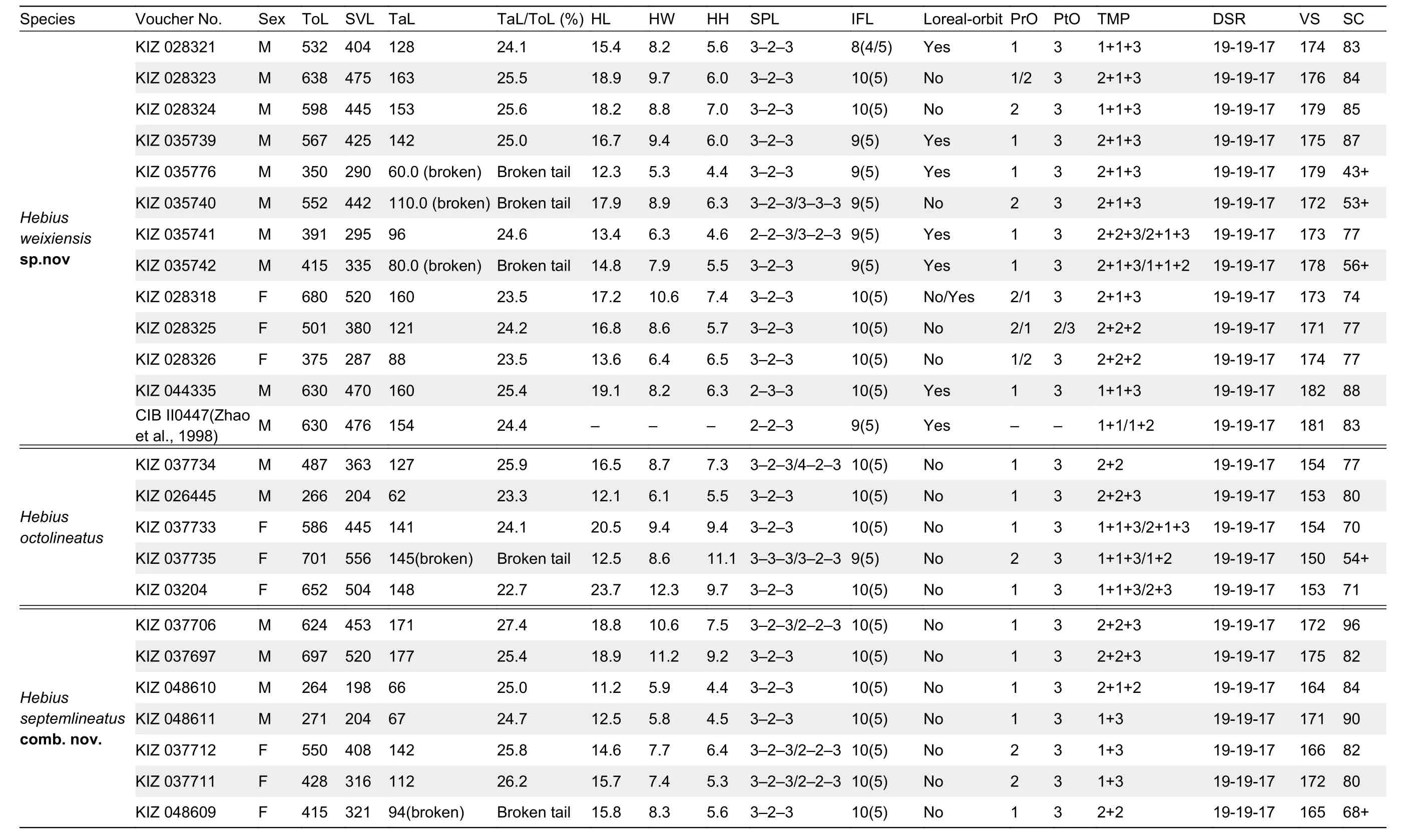
Table 1 Morphometric and pholidosis characters of holotypes of Hebius weixiensis sp. nov., H. octolineatus, and H. septemlineatus comb. nov.
Etymology:The specific name “weixiensis” is derived from the type locality of the new species in Weixi County, Yunnan Province, China. We propose “Weixi Keelback Snake” as its English common name and “維西腹鏈蛇” (Wei Xi Fu Lian She)as its Chinese common name.
Distribution:The new species is known only from Weixi County and Shigu Township in Lijiang, Yunnan Province,China.
Hebius septemlineatus comb. nov. (Schmidt, 1925)(Figure 1Ci-Cviii)Natrix septemlineataSchmidt, 1925.
Type locality:Tengyueh (now Tengchong City), Yunnan Province, China.
Holotype: AMNH 21 051, collected by R. C. Andrews and E.Heller in May 1917.
Chinese Name:We suggest “Tengchong Keelback Snake” as its English name and “騰沖腹鏈蛇” (Teng Chong Fu Lian She)as its Chinese name.
Materials:Hebius septemlineatuscomb. nov.,n=7(Supplementary Text).
Revised diagnosis:Hebius septemlineatuscomb. nov. can be distinguished from its recognized congeners by a combination of the following characters: (1) TaL/ToL 23.5%-25.6%; (2) internasals narrowed anteriorly; (3) nasal divided, each half in contact with each other; (4) nostrils lateral; (5) loreal almost quadrilateral, higher than width,separated from orbit; (6) supralabials usually eight; (7)preocular one or two; (8) postoculars usually three; (9) mental triangles; (10) infralabials nine or ten, first pair in contact with each other, first-fifth infralabials in contact with anterior chin shields; (11) dorsal scales 19-19-17 rows; (12) dorsal scale rows reduced from 19 to 17 at position of third and fourth dorsal scale rows and from 97thto 101stventrals; (13) ventrals 164-175; (14) subcaudals 80-96, paired; (15) anal divided;(16) four dorsal stripes on each side, not including ventrolateral stripe; and (17) ventral pale yellow.
Variation:Measurements, body proportions, and scale counts are listed in Table 1.
Distribution:This species is known only from western Yunnan, China, including Tengchong and Longchuan.
Systematics:This species has only been mentioned by Schmidt (1925). It was subsequently synonymized withNatrix octolineatum(nowHebius octolineatus) by Pope (1935:112).Here, it is validated to a full species.
Hebius octolineatus (Boulenger, 1904)(Figure 1Di-Div)
Materials:Hebius octolineatus,n=5 (details in Supplementary Text).
Diagnosis:Hebius octolineatuscan be distinguished from its recognized congeners by a combination of the following characters: (1) TaL/ToL 20.7%-25.9%; (2) internasals narrowed anteriorly; (3) nasal divided, each half in contact with each other; (4) nostrils lateral; (5) loreal almost quadrilateral,higher than wide, not entering orbit; (6) supralabials usually eight; (7) preocular one or two; (8) postoculars three; (9)infralabials nine or ten, first pair in contact with each other,first-fifth infralabials in contact with anterior chin shields; (10)mental triangles; (11) dorsal scales rows 19-19-17; (12) dorsal scale rows reduced from 19 to 17 at position of third and fourth dorsal scale rows and from 81stto 86thventrals; (13)ventrals 150-154; (14) subcaudals 70-80, paired; (15) anal divided; (16) four dorsal stripes on each side, not including ventrolateral stripe, two yellow and two grayish-black; (17)black zigzag lateral line, formed by outer edges of ventral shields; and (18) venter pale yellow.
Description and variation:Detail measurements, body proportions, and scale counts are listed in Table 1.
Distribution:The species is found in Yunnan, China,including Kunming and Chuxiong.
Systematics:Boulenger (1904) described three new species ofTropidonotusfrom Yunnan Fu (now Kunming City), Yunnan Province, China, each based on a single specimen:T.octolineatus,T. quadrilineatus, andT. pleurotaenia.Subsequently,T. quadrilineatusandT. pleurotaeniawere synonymized withNatrix octolineatum(nowHebius octolineatus) by Pope (1935). The clarifications ofH.septemlineatuscomb. nov. andH. octolineatusare consistent with the original descriptions (Supplementary Table S4).
Hebius octolineatushas been extensively confused withH.septemlineatuscomb. nov. in the literature. Previous descriptions ofH. octolineatuswere based on specimens collected in western Yunnan and Sichuan, rather than the type locality (Yang and Rao, 2008; Zhao et al., 1998; Zhao, 2006).Despite the confusion,H. octolineatuscan be rather easily separated fromH. septemlineatuscomb. nov. by (1) number of ventrals (164-175 vs. 150-154), (2) number of subcaudals(80-96 vs. 70-80), (3) more posterior occurrence of reduction in dorsal scale rows from 19 to 17 (97thto 101stventrals vs.81stto 86thventrals), (4) fourth and fifth supralabials yellow(vs. fourth and fifth supralabials yellow with back edge black);(5) vertebral behind head yellow and immediately after dark,continued to base of tail (vs. dorsum pale grayish brown).
The genusHebiusis a species diverse group. The description ofHebius weixiensissp. nov. and revalidation ofHebius septemlineatuscomb. nov.bring the total species number of the genus to 48, including 23 species in China (with 18 in Yunnan alone). The species diversity ofHebiusmay be underestimated, and further study based on extensive samples is highly desirable.
NOMENCLATURAL ACTS REGISTRATION
The electronic version of this article in portable document format represents a published work according to the International Commission on Zoological Nomenclature (ICZN),and hence the new names contained in the electronic version are effectively published under that Code from the electronic edition alone (see Articles 8.5-8.6 of the Code). This published work and the nomenclatural acts it contains have been registered in ZooBank, the online registration system for the ICZN. The ZooBank LSIDs (Life Science Identifiers) can be resolved and the associated information can be viewed through any standard web browser by appending the LSID to the prefixhttp://zoobank.org/.
Publication LSID:
urn:lsid:zoobank.org:pub:54079D4F-5BDE-4F4B-8883-3D76234 11763
Hebius weixiensisLSID:
urn:lsid:zoobank.org:act:254502C2-C95B-4C44-8A5B-671414 083D01
SCIENTIFIC FIELD SURVEY PERMISSION INFORMATION
The collection of all animals used in this study obeyed the Wildlife Protection Act of China. Collection permits were issued by the Kunming Institute of Zoology, Chinese Academy of Sciences (BBCJ-2014-001). All relevant protocols of the IACUC (IACUC R13-11) and Animal Care and Ethics Committee at the Kunming Institute of Zoology were followed for the proper treatment of animals in the field.
SUPPLEMENTARY DATA
Supplementary data to this article can be found online.
COMPETING INTERESTS
The authors declare that they have no competing interests.
AUTHORS' CONTRIBUTIONS
J.C. and P.G. conceived and designed this study. Z.Y.Y.,P.F.W., J.M.C., and G.G.Z. conducted the field surveys.G.H.L. and W.J.S. sorted out samples. S.B.H. and Z.Y.Y.performed the experiments, measured the specimens, and analyzed the data. S.B.H. wrote the manuscript. S.B.H., P.G.,Y.H.W., and J.C. discussed and revised the manuscript. All authors read and approved the final version of the manuscript.
ACKNOWLEDGMENTS
We thank Kai Wang, Rong-Lu Wang, Mian Hou, and Jin-Long Ren for their help in the field. We thank Zhong-Bin Yu for help during lab work.
- Zoological Research的其它文章
- Phylogenomic relationships and molecular convergences to subterranean life in rodent family Spalacidae
- Prosecution records reveal pangolin trading networks in China, 2014-2019
- Chromosome-scale genome assembly of brownspotted flathead Platycephalus sp.1 provides insights into demersal adaptation in flathead fish
- Deletion of phosphatidylserine flippase β-subunit Tmem30a in satellite cells leads to delayed skeletal muscle regeneration
- Role of juvenile hormone receptor Methoprene-tolerant 1 in silkworm larval brain development and domestication
- Captopril alleviates lung inflammation in SARS-CoV-2-infected hypertensive mice