Why Are Teenagers So Vulnerable to Mental Illness?為何青少年易患精神疾病
2021-09-24 10:28:54約翰·埃爾德/文李婧萍/譯
英語世界 2021年9期
約翰·埃爾德/文 李婧萍/譯
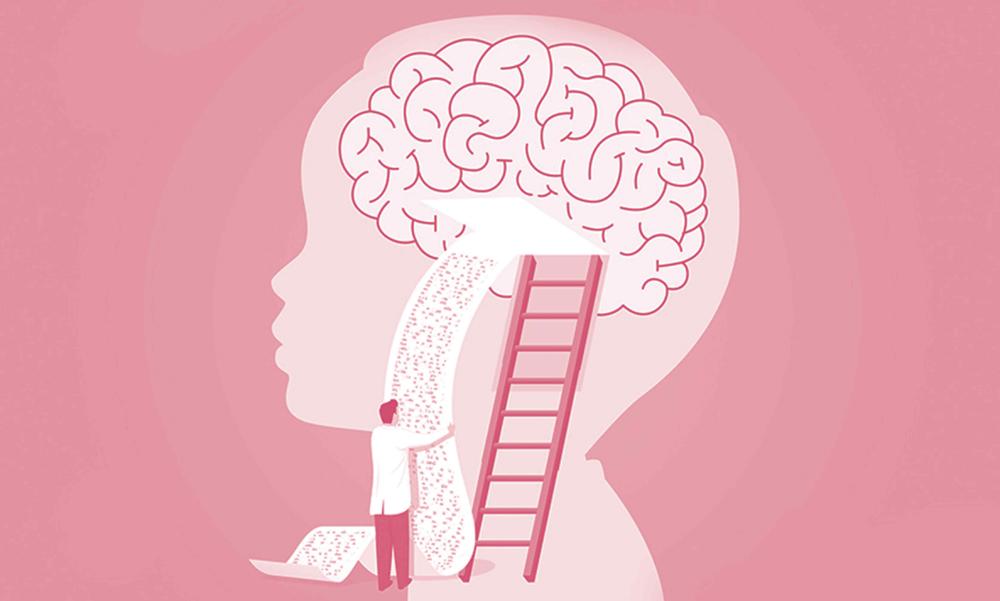
Cambridge scientists have found that the adolescent brain undergoes a “disruptive” form of remodelling—during which new networks come online—allowing teenagers to develop more complex adult social skills.
But this disruptive phase, which sees a somewhat radical shift in the strengthening and weakening of certain neural connections, may explain why young people have an increased risk of mental illness.
This discovery was part of a big-picture finding that the functional connectivity of the human brain—how different regions of the brain communicate with each other—changes in two main ways during adolescence.
According to a statement from Cambridge, the study collected functional magnetic resonance imaging (fMRI) data on brain activity from 298 healthy young people, aged 14 to 25 years, each scanned on one to three occasions about six to 12 months apart.
As the participants were bid to lie still and as quietly as possible, the researchers analysed the pattern of connections between different brain regions while the brain was in a resting state.
Please dont move, dont talk
Measuring functional connectivity in the brain presented particular challenges, said Dr Franti?ek Vá?a, who led the study.
“Studying brain functional connectivity with fMRI is tricky as even the slightest head movement can corrupt the data—this is especially problematic when studying adolescent development as younger people find it harder to keep still during the scan,” said Dr Vasa, in a prepared statement.
“Here, we used three different approaches for removing signatures of head movement from the data, and obtained consistent results, which made us confident that our conclusions are not related to head movement, but to developmental changes in the adolescent brain.”
What the scientists found
The scans revealed that “the brain regions that are important for vision, movement, and other basic faculties were strongly connected at the age of 14 and became even more strongly connected by the age of 25”.
The scientists called this a “conservative” pattern of change, as areas of the brain that were rich in connections at the start of adolescence become even richer during the transition to adulthood.
In other words, the changes were of a consolidating character—and perhaps not so surprising.
However, the scans showed “the brain regions that are important for more advanced social skills, such as being able to imagine how someone else is thinking or feeling (so-called theory of mind), underwent a more ‘disruptive pattern of change”.
In these regions—mainly in whats known as the association cortex—connections were redistributed over the course of adolescence: Connections that were initially weak became stronger, and connections that were initially strong became weaker.
By comparing the fMRI results to other data on the brain, the researchers found the network of regions that showed the disruptive pattern of change during adolescence had high levels of metabolic activity typically associated with active remodelling of connections between nerve cells.
The mystery of adolescent mental illness
Professor Ed Bullmore, joint senior author of the paper and head of the Department of Psychiatry at Cambridge, said: “We know that depression, anxiety and other mental health disorders often occur for the first time in adolescence—but we dont know why”.
“These results show us that active remodelling of brain networks is ongoing during the teenage years and deeper understanding of brain development could lead to deeper understanding of the causes of mental illness in young people.”
The new study appears to build on a 2016 Cambridge experiment that used magnetic resonance imaging (MRI) to study the brain structure of almost 300 individuals aged 14 to 24 years old.
By comparing the brain structure of teenagers of different ages, they found that during adolescence, the outer regions of the brain, the cortex, shrink in size, becoming thinner.
However as this happens, levels of myelin—the sheath that insulates nerve fibres, allowing them to communicate efficiently—increase within the cortex.
According to a statement from the university, myelin was thought mainly to reside in the so-called “white matter”, the brain tissue that connects areas of the brain and allows for information to be communicated between brain regions.
However, the researchers show that it can also be found within the cortex, the “grey matter” of the brain, and that levels increase during teenage years.
In particular, the myelin increase occurs in the association cortical areas—the areas of the brain shown to undergo disruptive changes in the more recent study.
These are regions of the brain that act as hubs, the major connection points between different regions of the brain network.
The researchers compared their MRI results with Allen Brain Atlas, which maps regions of the brain by gene expression—the genes that are switched on in particular regions.
They found that “those brain regions that exhibited the greatest MRI changes during the teenage years were those in which genes linked to schizophrenia risk were most strongly expressed”.
劍橋大學的科學家們發現,青少年的大腦會經歷一種“破壞性”重塑——在此期間,新的神經網絡出現——使青少年發展出更復雜的成人社交技能。
但這個破壞性階段或許能夠解釋為什么年輕人患上精神疾病的風險會加大。在這一階段,某些神經連接增強和減弱時的變化有些劇烈。
這項發現是一個宏觀研究結果的一部分,該研究發現:人類大腦的功能連接(大腦不同區域之間的相互交流)在青春期主要以兩種方式發生變化。
劍橋大學的報告稱,這項研究共收集了298名受試者大腦活動的功能磁共振成像數據,他們身體健康,年齡處于14到25歲之間,各掃描1到3次,每次間隔6到12個月。
受試者按要求盡量安靜平躺且保持不動,研究人員在其大腦處于休息狀態時分析不同腦區的連接模式。
請勿動勿言
測量大腦的功能連接頗具挑戰性,領導這項研究的弗朗齊歇克·瓦沙博士如是說。
瓦沙博士在一份預先準備好的聲明中提到:“用功能磁共振成像技術研究大腦的功能連接并不太好把握,因為即使是最輕微的頭部運動也會破壞數據——而這在研究青春期發育時尤其棘手,畢竟年齡越小越難在掃描過程中保持不動。
“研究中,我們分別用了三種不同的方法從數據中剔除頭部運動產生的影響,三種方法得到的結果一致,因此我們確信最終的結論與頭部運動無關,而與青少年大腦的發育變化有關。”
科學家們的發現
掃描結果顯示,“14歲時,大腦中關乎視覺、運動和其他基本能力的重要區域彼此緊密關聯,到25歲這種關聯變得更加緊密”。
科學家們稱此為“保守的”變化模式,因為早在青春期初期就有緊密連接的大腦區域,只不過在向成年過渡的過程中變得連接更加緊密。
換言之,這些變化具有的是增強鞏固的性質,或許并沒有那么新奇。
然而,掃描結果顯示,“大腦中那些牽涉高級社交技能——比如能夠想象他人想法或感受(所謂的心理推測能力)——的重要區域,經歷了相對更具‘破壞性 的變化。”
在這些區域(主要是所謂的聯絡皮質)中,各種連接在整個青少年時期被重新分配:最初較弱的連接變強,而最初較強的連接變弱。
通過比較功能磁共振成像結果與其他大腦數據,研究人員發現,青春期呈現破壞性變化模式的大腦區域網絡代謝活動旺盛,這通常與神經細胞之間連接發生活躍的重構息息相關。
探秘青春期精神疾病
該論文資深的共同作者、劍橋大學精神病學系主任埃德·布爾莫教授說:“我們知道,抑郁、焦慮和其他精神健康障礙首次出現常常是在青春期,但我們不了解原因。
“這些結果告訴我們,青少年時期大腦網絡重構活躍,隨著對大腦發育的深入了解,我們有可能進一步了解年輕人罹患精神疾病的種種誘因。”
這項新研究似是基于2016年劍橋大學的一項實驗進行的,該實驗使用磁共振成像研究了近300名14歲至24歲受試者的大腦結構。
他們通過對比不同年齡青少年的大腦結構發現:在青春期,大腦外部區域(即皮層)會縮小且變薄。
但與此同時,皮層內的髓鞘數量增加。髓鞘可隔離神經纖維,使其有效交流。
根據劍橋大學的報告,髓鞘被認為主要存在于所謂的“白質”中——“白質”是連接大腦各區域的組織,能讓大腦各區域進行信息交流。
不過研究人員也證明,髓鞘可能還存在于大腦皮層(即大腦的“灰質”)中,而且其數量在青少年時期會有所增加。
尤其是,髓鞘的增加發生在聯絡皮質區域——近期這項研究顯示,恰是這些區域發生了破壞性變化。
大腦的這些區域起到樞紐作用,是大腦網絡不同區域之間的主要連接點。
研究人員將受試者的核磁共振成像結果與艾倫腦圖譜進行了比較,艾倫腦圖譜是通過基因表達(在特定區域被激活的基因)繪制出的大腦區域圖。
他們發現,“青少年時期核磁共振變化最大的那些腦區,是與罹患精神分裂癥相關的基因表達最強烈的那些區域”。
(譯者單位:北京外國語大學)
猜你喜歡
體育科技文獻通報(2022年3期)2022-05-23 13:46:54
瘋狂英語·新讀寫(2021年7期)2021-10-13 06:35:44
遼金歷史與考古(2021年0期)2021-07-29 01:06:54
科技傳播(2019年22期)2020-01-14 03:06:54
民用飛機設計與研究(2019年4期)2019-05-21 07:21:24
中國科技博覽(2016年2期)2016-04-25 20:32:39
小學生導刊(2016年34期)2016-04-11 00:49:44
電測與儀表(2015年5期)2015-04-09 11:30:52
中國火炬(2014年4期)2014-07-24 14:22:19
中國火炬(2013年1期)2013-07-24 14:20:18