
MULTIPLE SOLUTIONS OF SOME ELLIPTIC SYSTEMS WITH LINEAR COUPLINGS?
2021-09-06 07:54:30陳宇彤蘇加寶
(陳宇彤) (蘇加寶)
School of Mathematical Sciences,Capital Normal University,Beijing 100048,China E-mail:chenyutong@cnu.edu.cn;sujb@cnu.edu.cn
Mingzheng SUN (孫明正)
College of Sciences,North China University of Technology,Beijing 100144,China E-mail:suncut@163.com
Rushun TIAN (田如順)?
School of Mathematical Sciences,Capital Normal University,Beijing 100048,China E-mail:rushun.tian@cnu.edu.cn
Abstract In this paper,we study the existence of nontrivial solutions to the elliptic systemwhere ??RNis bounded with a smooth boundary.By the Morse theory and the Gromoll-Meyer pair,we obtain multiple nontrivial vector solutions to this system.
Key words Morse theory;multiplicity;elliptic system;linear couplings
1 Introduction

In this paper,we consider the system

λ
∈R is a parameter.As a concrete example,F
(x,u,v
)=u
,F
(x,u,v
)=v
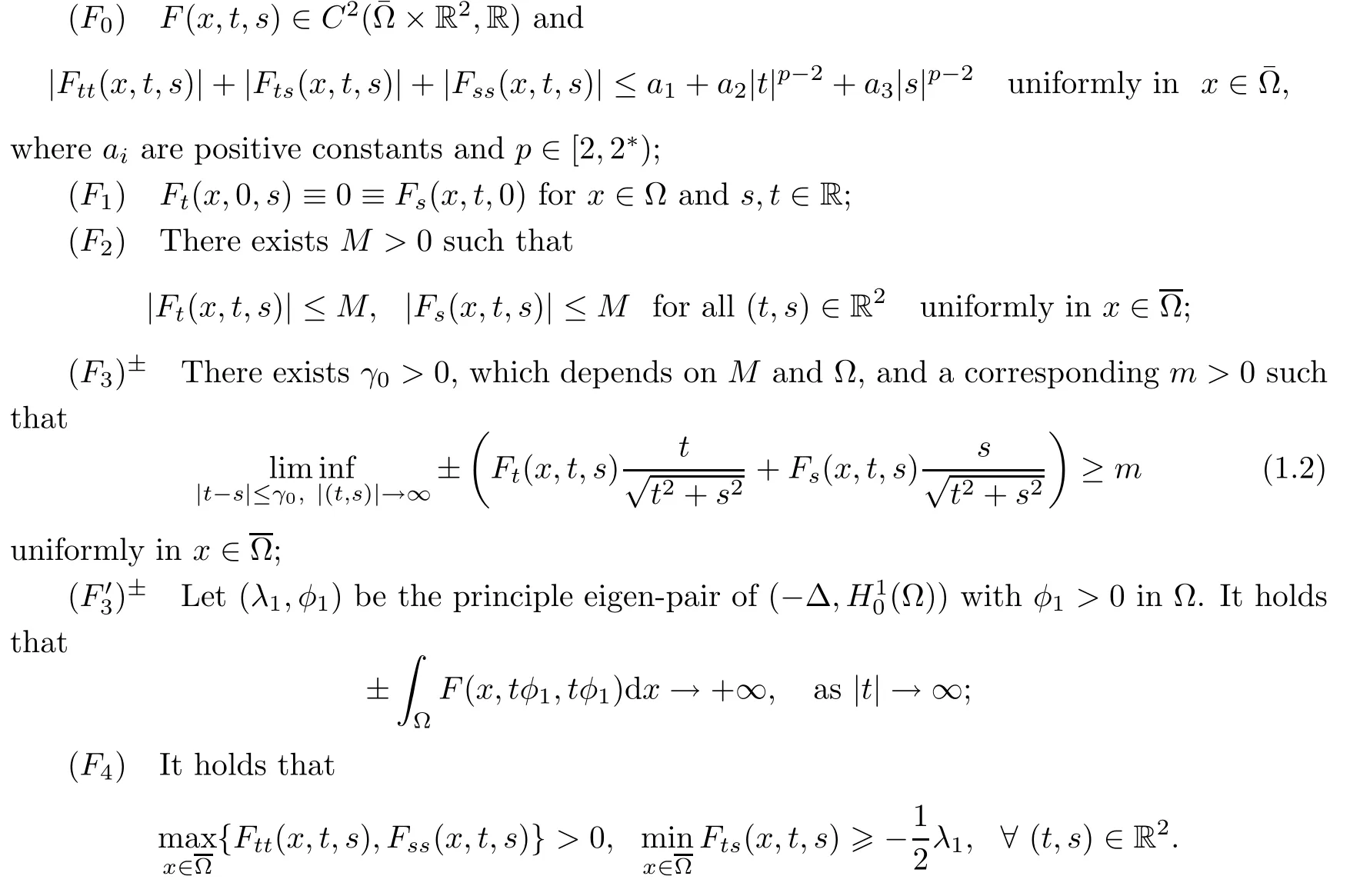
was considered in[1],and more general power type nonlinearities were studied in[2].Here we are interested in the case in which the asymptotic linear nonlinearities satisfy the Landesman-Lazer type resonance conditions.More precisely,we make the following assumptions onF
:
u,v
)/=(0,
0).If a nontrivial solution has one component identical to zero,then this solution is called semi-trivial,and ifu
/=0 andv
/=0,then(u,v
)is called a vector solution.Remark 1.1
(1)If(F
)holds,then(1.1)does not have semi-trivial solutions,that is,any nontrivial solution of(1.1)must be a vector solution.(2)The constantγ
that appears in(F
)has a lower bound that depends onM
and ?.Above this lower bound,γ
is free to take any value.Fixing such aγ
,(F
)then requires somem>
0 such that(1.2)holds.We shall see in Section 3 how such a lower bound is determined.Notice that we just need(F
)to be valid with one pair of(γ
,m
).The main results of this paper are the following theorems:
Theorem 1.2
Assume thatF
satis fies(F
),
(F
)and(F
).Then there existsδ>
0 such that,for anyλ
∈(λ
?δ,λ
),system(1.1)has at least three solutions.If(F
)also holds,then at least two of these solutions are vector solutions.Theorem 1.3
Assume thatF
satis fies(F
),
(F
),(F
)and(F
).Then there existsδ>
0 such that,for anyλ
∈(λ
,λ
+δ
),system(1.1)has at least three solutions.If(F
)also holds,then at least two of these solutions are vector solutions.The main theoretical tools we adopt in this paper are the Conley index,the Gromoll-Meyer pair and the Morse relation;we refer to[6,7]for more on these topics.To the best of our knowledge,[4]was the first paper that applied the Morse theory to the coupled systems.In[22,24]a bifurcation theorem related to Morse indices was applied to the coupled systems with power type nonlinearities.In this paper,we apply the Morse theory to find multiple nontrivial solutions.The above theorems extend the corresponding results in[10]by including features that hold for the system under consideration.
This paper is organized as follows:notations and the properties of an associated linearized system are given in Section 2.In Section 3,we prove the main theorems and give some comments.
2 Preliminaries
F
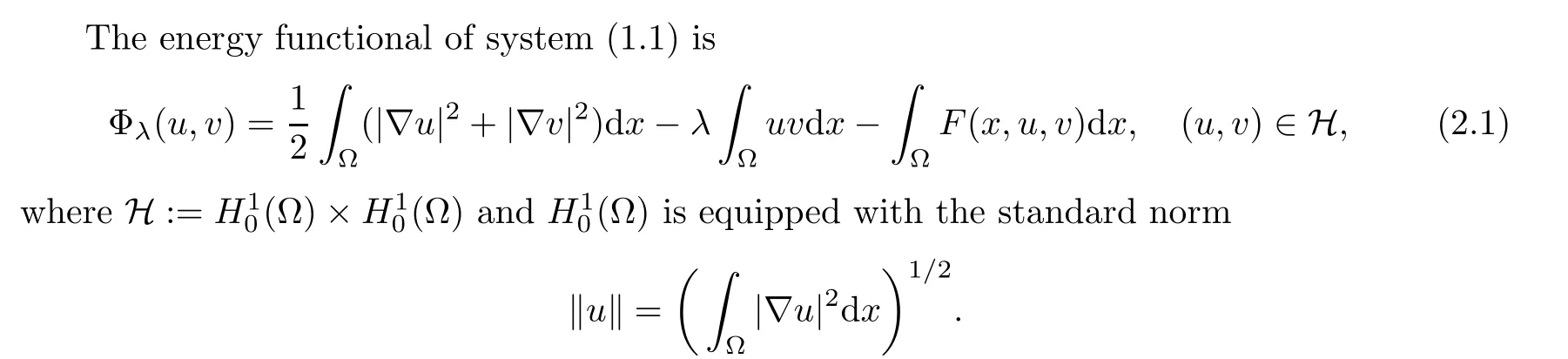
),Φis well-de fined and is ofC
in H.We can rewrite Φin the abstract form as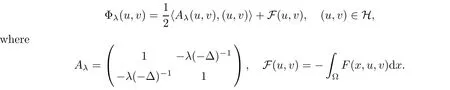
Remark 2.1
System(1.1)can be written asL
(u,v
)=μ
(u,v
)+(1?μ
)(F
,F
),where

The linearized part of system(1.1)near in finity reads as
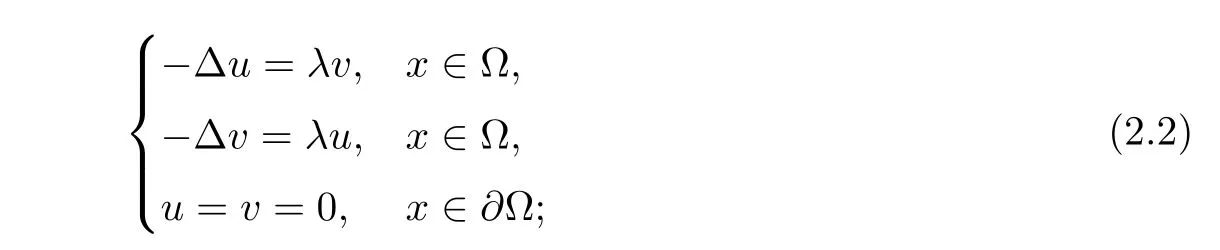
this is related to the eigenvalue problem of the biharmonic operator with Navier boundary conditions.For more references on this,we refer to the monograph[14].If the coefficients of linear coupling terms are independently chosen,that is,(2.2)becomes an asymmetric system

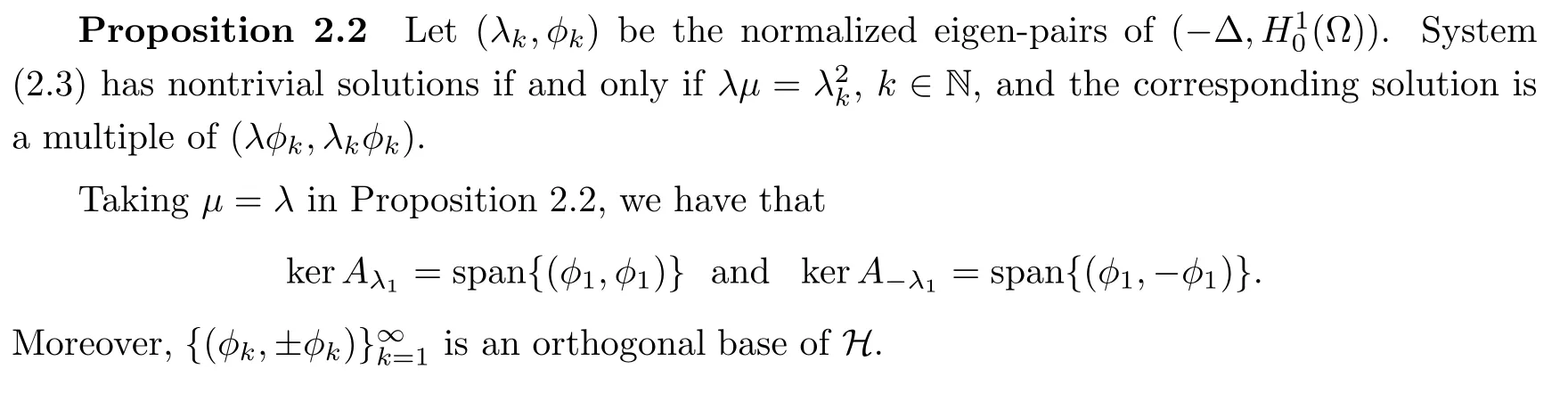
then[23,Lemma 2.1]provides a description as follows:
3 Proofs of Theorems 1.2 and 1.3
T,T
)and(t,t
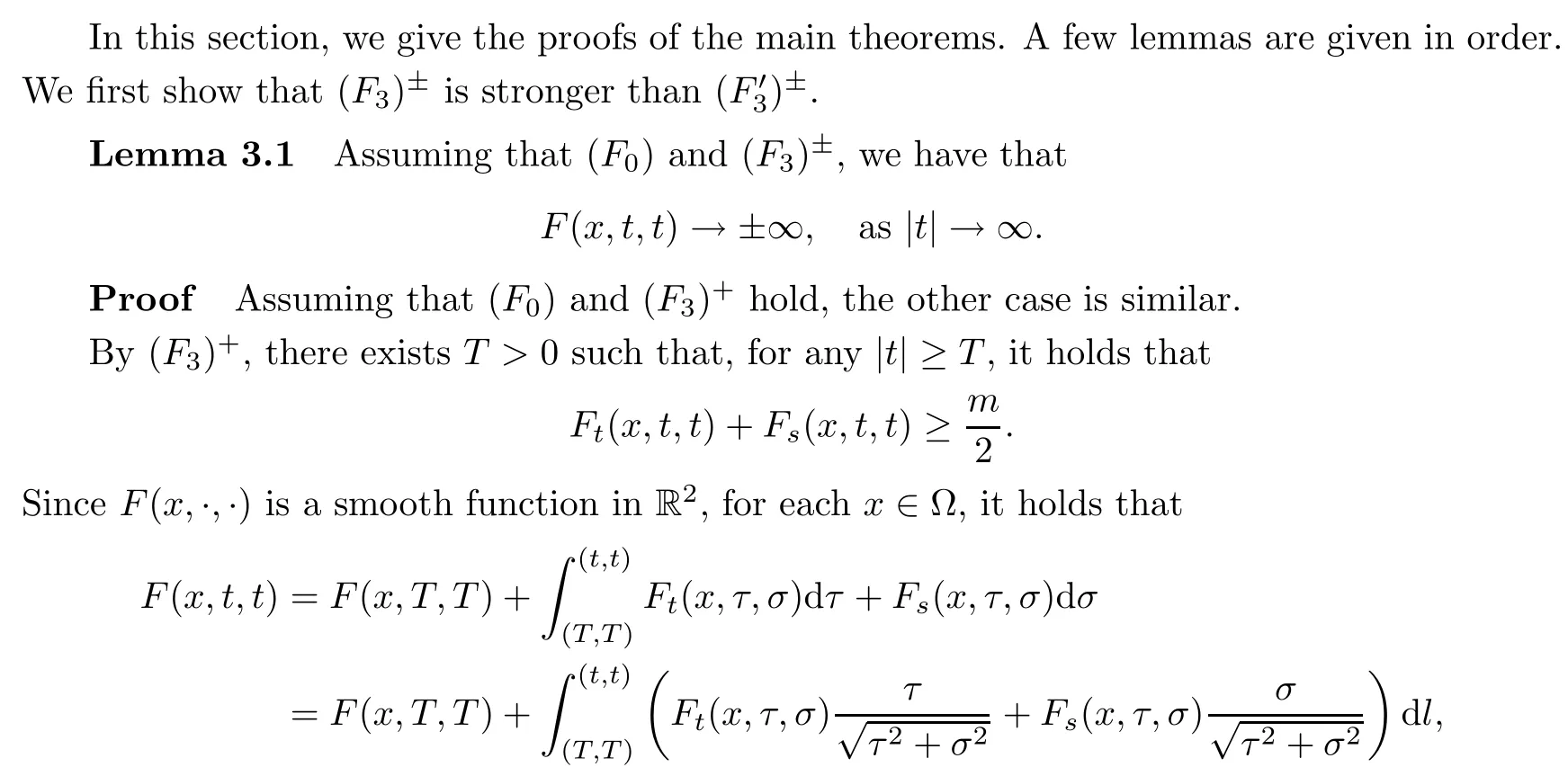
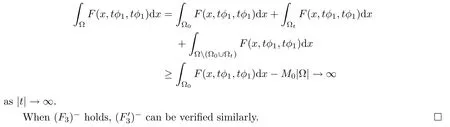
)is the selected path.Then,fort>T
,
F
(x,t,t
)→+∞ast
→+∞.With similar arguments,F
(x,t,t
)→+∞ast
→?∞too.The next lemma is a generalization of the scalar equation(see[19]).

Then a direct c alculation shows that
To apply the Morse theory,we need a few lemmas.
Proof
Letting{(u
,v
)}be a sequence in H satisfying
C>
0 such that
u
,v
)}has a decomposition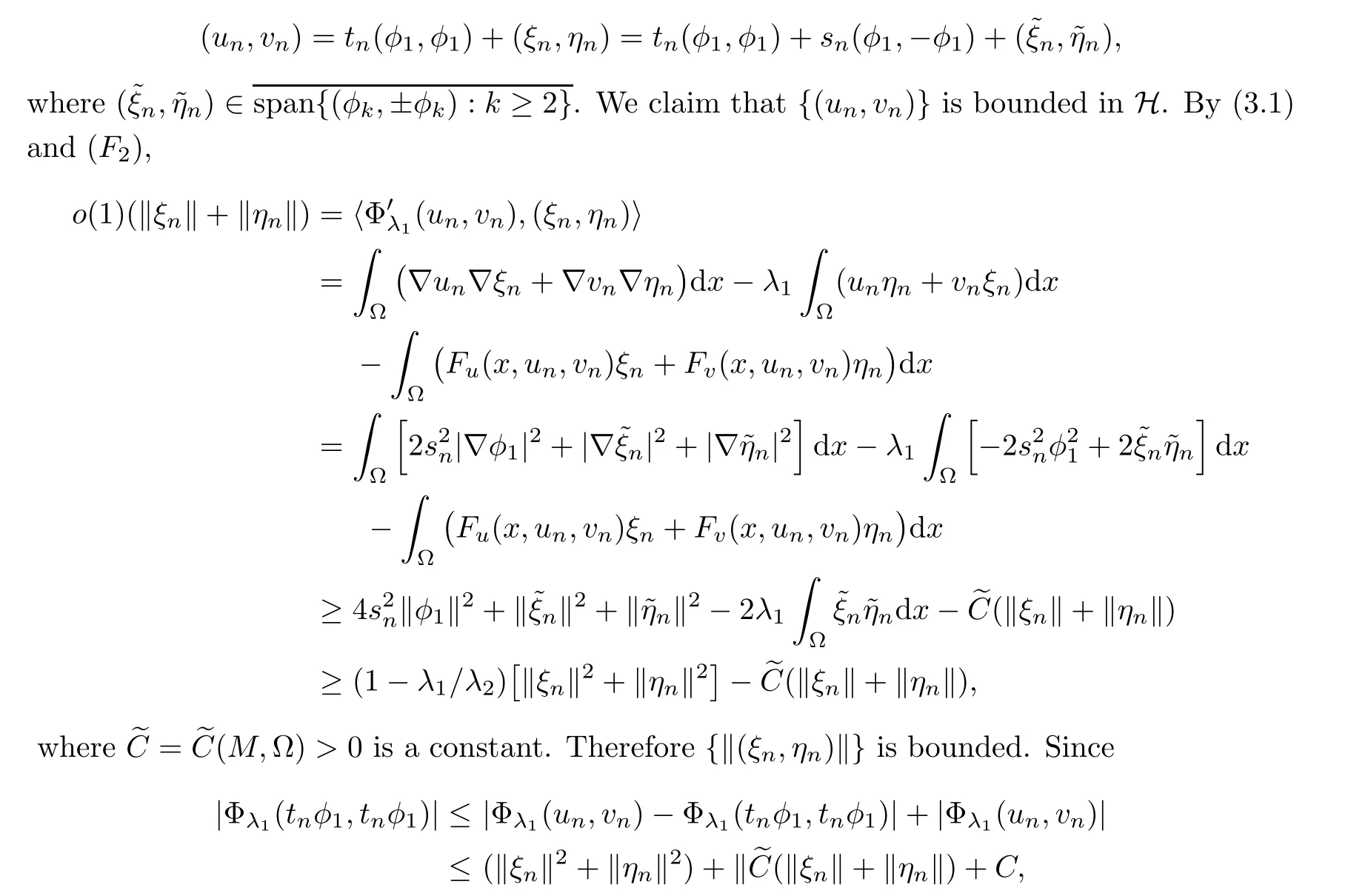
t
φ
,t
φ
)}is bounded.Therefore
t
}is also bounded.Thus{(u
,v
)}is bounded in H.Therefore,a weakly convergent subsequence exists,so a strongly convergent subsequence can be extracted by using the compact embedding and the equations.
Lemma 3.4
Assume thatF
satis fies(F
),(F
)and(F
).ThenK
is bounded.Proof
We prove that the case for(F
)holds.Assume,for the sake of contradiction,that there is a sequence{(u
,v
)}?K
such that
u
,v
)=t
(φ
,φ
)+(ξ
(t
),η
(t
))be the orthogonal decomposition of(u
,v
)in H.Then,by the arguments in the proof of Lemma 3.3,one deduces that{(ξ
(t
),η
(t
))}is bounded in H.Since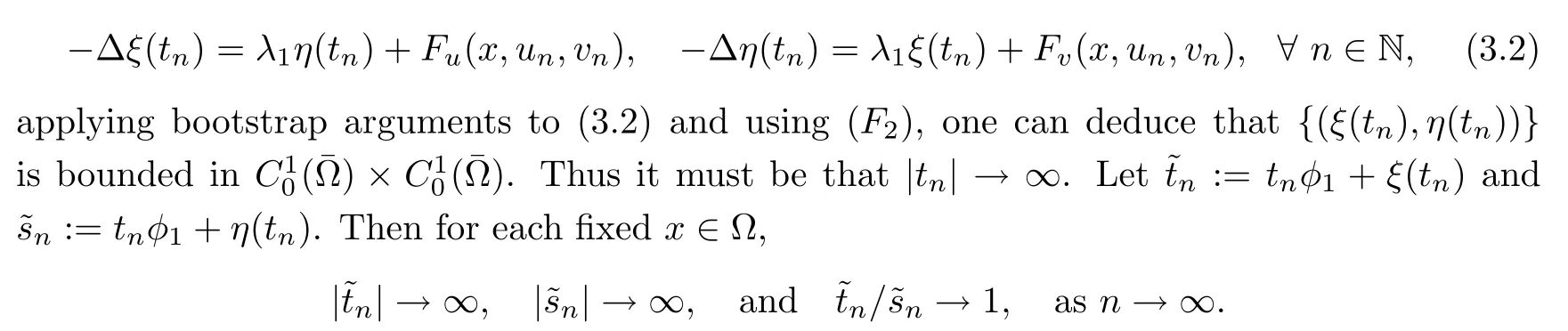
φ
and integrating over ?,we obtain
A
and(kerA
)both are invariant subspaces ofA
,the orthogonality implies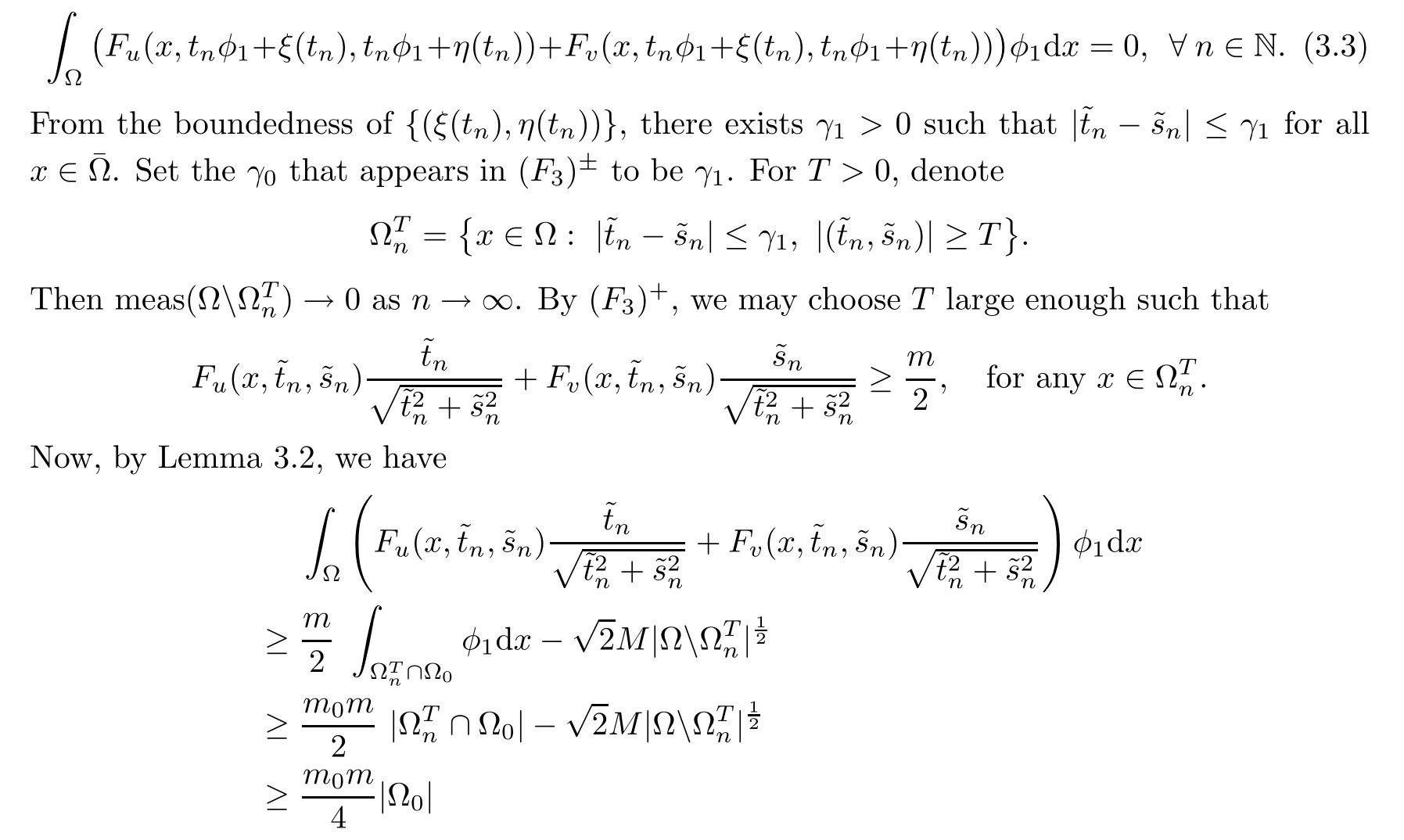
n
large enough.By(3.3),it holds that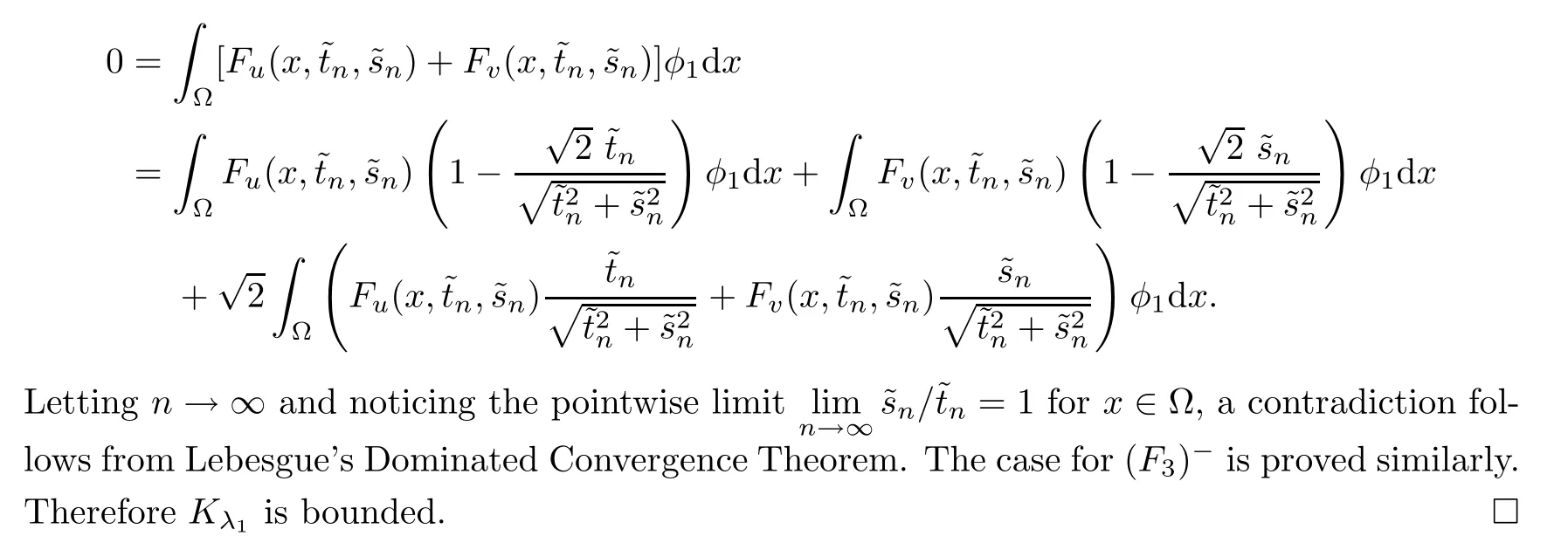
Now we are ready to present the proofs of Theorems 1.2 and 1.3,which are based on the framework laid out in[10].It is worth mentioning that the system,as compared to the scalar cases,requires different techniques for obtaining multiple solutions.
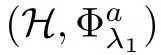
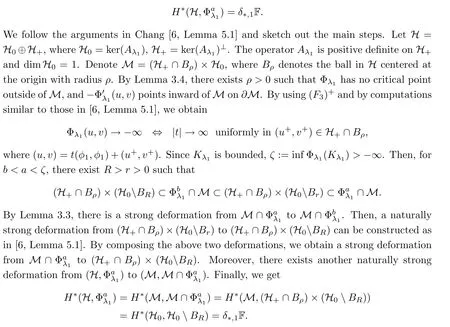
O
be a big closed ball containingK
,and letα,β
be regular values of Φsuch that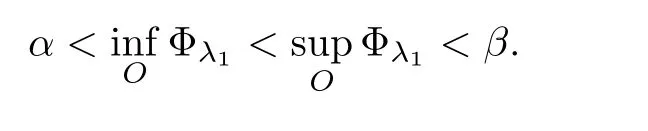
O,α,β
)is an isolating triple f orK
.De fine
K
,there exists a bounded Conley index pair(N,N
)forK
.By the topological invariance of the Conley index and the fact that a Gromoll-Meyer pair is also a Conley index pair,we have
δ>
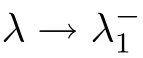
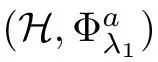
0 small enough andλ
∈(λ
?δ,λ
),Φsatis fies the(PS)condition and(W,W
)is also a Gromoll-Meyer pair ofK
∩W
(see[7,9]).It follows from(3.4)that Φhas a critical point(u
,v
)∈W
with the critical groupC
(Φ,
(u
,v
))/=0.This means that(u
,v
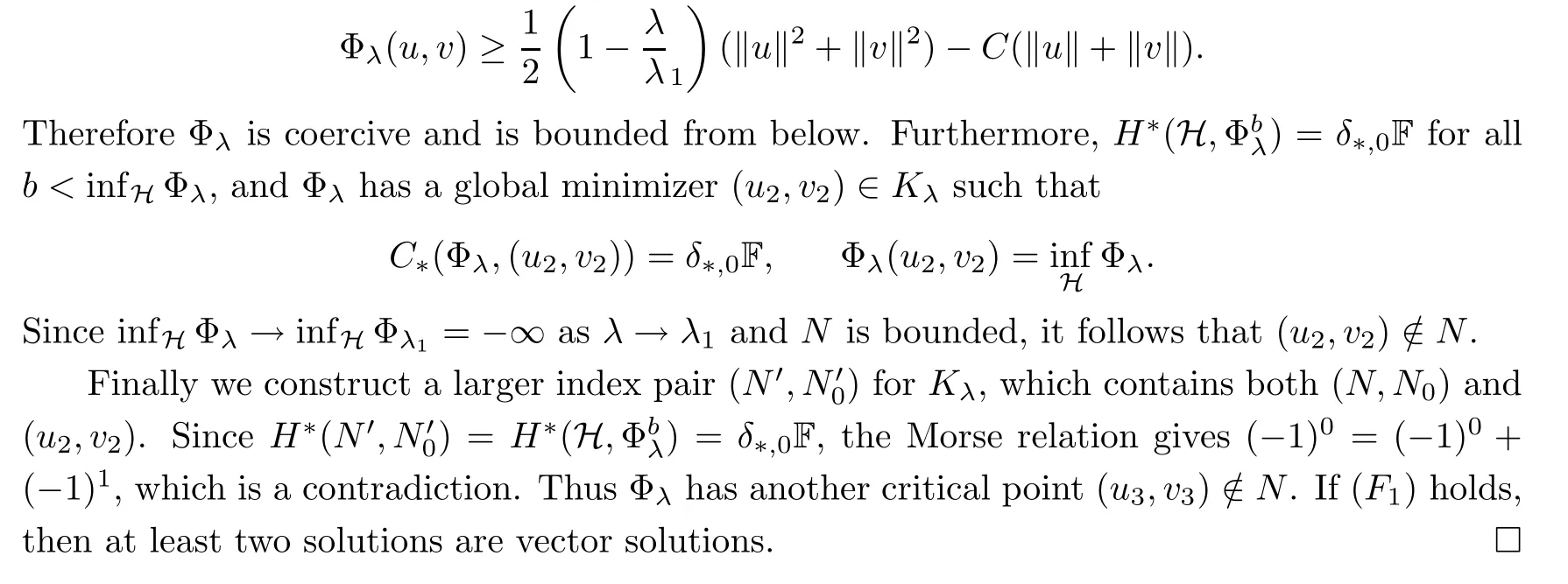
)is a mountain pass point of Φ([6]).Notice that for each fixedλ
∈(λ
?δ,λ
),

O
be a big closed ball containingK
,and letα,β
be regular values of Φsuch that
O,α,β
)is an isolating triple forK
and
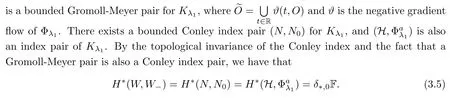
δ>
0 small enough andλ
∈(λ
,λ
+δ
),(W,W
)is also a Gromoll-Meyer pair ofK
∩W
(see[7,9]).It follows from(3.5)that Φhas a critical point(u
,v
)∈W
with the critical groupC
(Φ,
(u
,v
))/=0.Thus(u
,v
)is a local minimizer of ΦandC
(Φ,
(u
,v
))=δ
F.For each fixedλ
∈(λ
,λ
),Φis anti-coercive on Hand coercive on H,and we have that Φsatis fies(PS)and thatK
is bounded.Fora<
inf Φ(K
),
u
,v
)such that
u
,v
)∈/N
forδ>
0 small,otherwise a third critical point of Φcould be obtained by comparing(3.5)and(3.6).The linearized system of(1.1)at(u
,v
)reads as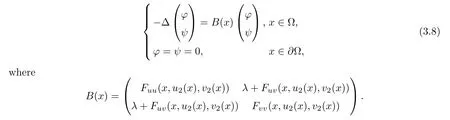
F
),forδ>
0 small andλ
∈(λ
,λ
+δ
),the matrixB
(x
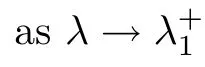
)is cooperative and fully coupled,it follows from(3.7)and[8,Theorem 2.1]that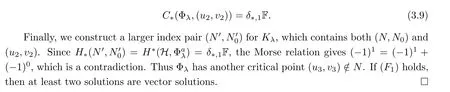
Acknowledgements
The authors would like to thank the referee for giving valuable suggestions and a kind reminder of reference[4]. Acta Mathematica Scientia(English Series)2021年4期
- Acta Mathematica Scientia(English Series)的其它文章
- REGULARITY OF WEAK SOLUTIONS TO A CLASS OF NONLINEAR PROBLEM?
- EXISTENCE TO FRACTIONAL CRITICAL EQUATION WITH HARDY-LITTLEWOOD-SOBOLEV NONLINEARITIES?
- A DIFFUSIVE SVEIR EPIDEMIC MODEL WITH TIME DELAY AND GENERAL INCIDENCE?
- ON A COUPLED INTEGRO-DIFFERENTIAL SYSTEM INVOLVING MIXED FRACTIONAL DERIVATIVES AND INTEGRALS OF DIFFERENT ORDERS?
- CLASSIFICATION OF SOLUTIONS TO HIGHER FRACTIONAL ORDER SYSTEMS?
- ENERGY CONSERVATION FOR SOLUTIONS OF INCOMPRESSIBLE VISCOELASTIC FLUIDS?