
ERESULTS FOR AN ELASTIC FRICTIONAL CONTACT PROBLEM WITH NONMONOTONE SUBDIFFERENTIAL BOUNDARY CONDITIONS?
2021-09-06 07:54:32劉永建
(劉永建)
Guangxi Colleges and Universities Key Laboratory of Complex System Optimization and Big Data Processing,Yulin Normal University,Yulin 537000,China E-mail:liuyongjianmaths@126.com
Stanislaw MIóRSKI
College of Applied Mathematics,Chengdu University of Information Technology,Chengdu 610225,China Jagiellonian University in Krakow,Chair of Optimization and Control,ul.Lojasiewicza 6,30348 Krakow,Poland E-mail:stanislaw.migorski@uj.edu.pl
Van Thien NGUYEN
Departement of Mathematics,FPT University,Education Zone,Hoa Lac High Tech Park,Km29 Thang Long Highway,Thach That Ward,Hanoi,Vietnam.E-mail:Thiennv15@fe.edu.vn
Shengda ZENG (曾生達)?
Guangxi Colleges and Universities Key Laboratory of Complex System Optimization and Big Data Processing,Yulin Normal University,Yulin 537000,China Jagiellonian University in Krakow,Chair of Optimization and Control,ul.Lojasiewicza 6,30348 Krakow,Poland E-mail:zengshengda@163.com
Abstract The goal of this paper is to study a mathematical model of a nonlinear static frictional contact problem in elasticity with the mixed boundary conditions described by a combination of the Signorini unilateral frictionless contact condition,and nonmonotone multivalued contact,and friction laws of subdifferential form.First,under suitable assumptions,we deliver the weak formulation of the contact model,which is an elliptic system with Lagrange multipliers,and which consists of a hemivariational inequality and a variational inequality.Then,we prove the solvability of the contact problem.Finally,employing the notion of H-convergence of nonlinear elasticity tensors,we provide a result on the convergence of solutions under perturbations which appear in the elasticity operator,body forces,and surface tractions.
Key words Mixed variational-hemivariational inequality;H-convergence;homogenization;Clarke subgradient;Lagrange multiplier;elasticity operator
1 Introduction
The aim of this paper is to investigate a mathematical model described by a system consisting of a hemivariational inequality and a variational inequality in re flexive Banach spaces.Such systems appear as weak formulations of various static contact problems in the theory of elasticity and are motivated by a menagerie of friction and contact boundary conditions.We will analyze a new nonlinear frictional contact problem which is described by a nonlinear elastic constitutive law and mixed boundary conditions.The latter combine the Signorini unilateral frictionless contact condition,nonmonotone multivalued contact and friction laws with locally Lipschitz super potentials.
Note that the theory of hemivariational inequalities started in the 1980s with the contributions of P.D.Panagiotopoulos[32–34],and since then it has considerably enriched the development of variational inequalities in many directions.The main idea behind hemivariational inequalities was to remove the hypotheses on the differentiability and convexity of energy functionals and to derive the variational formulations of various mechanical problems with the help of the generalized subgradient of Clarke.Hemivariational inequalities cover boundary value problems for PDEs with nonconvex,nonmonotone and possibly multivalued laws,in particular,problems where the Clarke subgradient is a pseudomonotone operator;see[30].The literature on hemivariational inequalities has been signi ficantly enlarged in the last forty years,mainly because of their multiple applications to a wide fields;see monographs[26,27,30,36]for analysis of various classes of such inequalities,and,see,for example,[3–5,13–16,18–20,28,29,38–40].
The novelties of this paper are several.First,we formulate the frictional contact problem as a mixed variational-hemivariational inequality.This formulation of the contact model under consideration is new and is studied here for the first time.Another formulation,in the form of a single variational-hemivariational inequality,can be found in[7,21–24,27,30,36].Second,we apply a recent abstract result from[2]and prove the existence of solutions to a mixed variational-hemivariational inequality.Third,we demonstrate a result on the convergence of solutions to the contact problem under perturbations which appear in the elasticity operator,body forces,and surface tractions.We will apply the notion ofH
-convergence of nonlinear elasticity tensors,as outline in,[1,6,8,11].Using this notion allows one to deal with the homogenization process modeling the periodic structures.The applications ofH
-convergence to mixed variational-hemivariational inequalities has not been studied.Mixed variational-hemivariational inequalities have been considered very recently in[2,25].The application of homogenization to pure boundary hemivariational inequalities in linear elasticity can be found in[17].Finally,we note that the recent results on the mathematical theory of contact mechanics are available in recent monographs[12,27,35]and the references therein.
The structure of the paper is as follows:in Section 2,a complicated frictional elastic contact problem is introduced and studied for which we prove the theorem of the existence of solutions for the contact problem under consideration;Section 3 deals with the convergence of solutions to the model under theH
-convergence of nonlinear elasticity tensors,perturbations in the body forces,and surface tractions.2 A Nonlinear Frictional Elastic Contact Model
This section is devoted to studying a complicated static frictional contact problem in elasticity.We first recall a recent theoretical result concerning the existence and uniqueness of a mixed variational-hemivariational inequality.Then,we deliver the classical mathematical formulation for the elastic contact problem under consideration.In addition,under suitable assumptions,we obtain the weak formulation of the contact problem,which is formulated by a mixed variational-hemivariational inequality.Finally,an existence and uniqueness theorem for the contact problem is established.
Throughout this paper we use the notion of a generalized directional derivative and the Clarke generalized subgradient recalled below;see,for example,[10,27].LetJ
:X
→R be a locally Lipschitz function on a Banach spaceX
.The generalized directional derivative ofJ
atx
∈X
in the directionv
∈X
is de fined by
J
atx
is a subset of the dual spaceX
,given by
V
,E
andX
be re flexive Banach spaces,and Λ be a nonempty subset ofE
.We denote by〈·,
·〉the duality pairing betweenV
and its dualV
.Given an operatorA
:V
→V
,a functionJ
:X
→R,a bilinear functionb
:V
×E
→R,an operatorγ
:V
→X
and an elementf
∈V
,we consider the following mixed variational-hemivariational inequality:Problem 2.1
Find(u,λ
)∈V
×Λ such that the following two inequalities hold:
The following theorem is a direct consequence of[2,Theorem 15]:
Theorem 2.1
Let Λ be a nonempty,closed and convex subset ofE
with 0∈Λ.Assume that the following conditions are ful filled:?J
:X
→2isbounded,that is,?J
maps the bounded subsets ofX
into bounded subsets of(i)J
:X
→R is a locally Lipschitz function such that its generalized subdifferential operatorX
?;
γ
:V
→X
is a linear and continuous operator.Then,for eachf
∈V
,Problem 2.1 has at least one solution(u,λ
)∈V
×Λ,which is unique in its first component.Next,we move our attention to studying a static frictional elastic contact problem.We provide a description of this problem,give its weak formulation,and prove an existence result.We suppose that a nonlinear elastic body occupies,in the reference con figuration,a bounded domain ? in R,d
=2,3 with Lipschitz boundary Γ=?
?,which is considered to be partitioned into four mutually disjoint measurable parts Γ,Γ,Γand Γwith meas(Γ)>
0.In this paper,the indicesi
,j
,k
,l
run from 1 tod
,unless stated otherwise,and the summation convention over repeated indices is used.In what follows,we shall adopt the standard notation:ν and Sdenote the unit outward normal on the boundary?
?,and the space of symmetric tensors of second order on R,respectively.The inner products and norms in Rand Sare given by
u
),σ=(σ
),and


accordingly.Similarly,the normal and tangential components of stress field σ on the boundary are de fined by

respectively.
We now formulate the classical mathematical model of the static contact problem.
Problem 2.2
Find a displacement field u:?→Rand a stress field σ:?→Ssuch that

We describe shortly the physical meaning of the equations and conditions in Problem 2.2.Equation(2.4)represents a nonlinear elastic constitutive law in which A stands for a nonlinear elasticity operator.Moreover,equality(2.5)is the equation of equilibrium,where the symbol“Div”denotes the divergence operator,that is,

j
is assumed to be locally Lipschitz with respect to its last variable,which is not convex in general.Furthermore,the condition in(2.10)is a friction law governed by the generalized gradient of a locally Lipschitz potentialj
.Such a frictional condition has been investigated many times,for instance,in[17,27,36]and the references therein.To explore the unique solvability of Problem 2.2,we now impose the following assumptions:
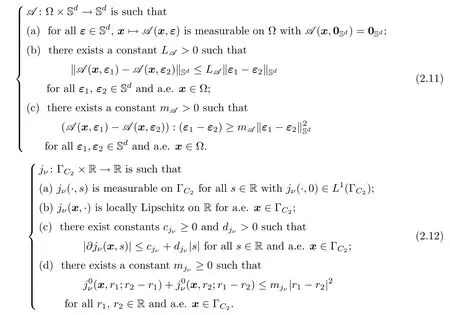
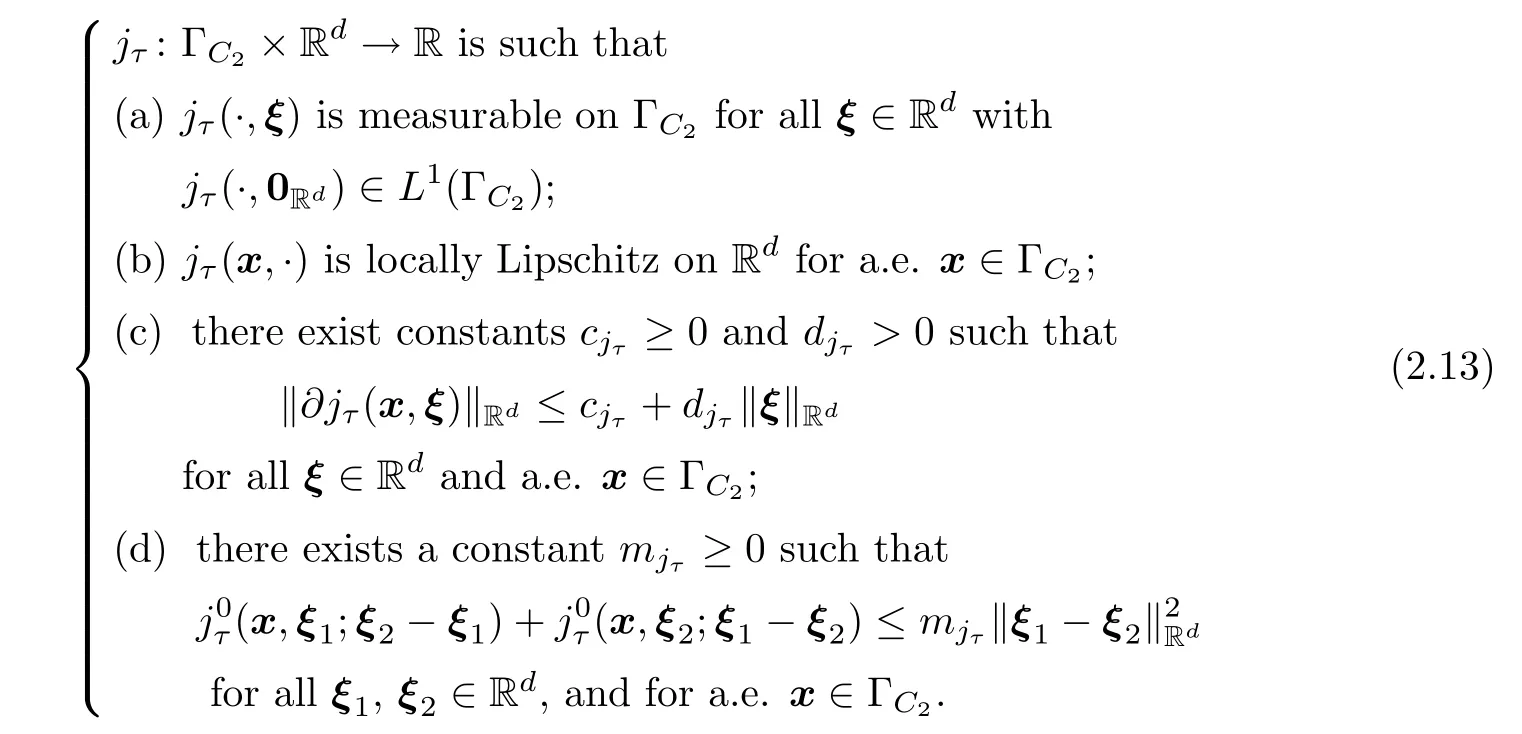
Finally,we suppose that the densities of volume forces and surface tractions have the following regularity:

To establish the variational formulation of Problem 2.2,we consider the function spaces

Obviously,H is a Hilbert space with the inner product and corresponding norm given by



is a Hilbert space as well.
Throughout the paper,we denote by γ:V
→L
(Γ;R)the trace operator for vector-valued functions.Furthermore,we introduce a mapβ
:V
→L
(Γ)de fined by
Y
=H
2(Γ)?L
(Γ)the image ofV
under the functionβ
,that is,
Y
,endowed the norm
E
be the dual space ofY
,and de fine a subsetS
ofV
by
E
de fined as
,
·〉represents the duality pairing betweenE
andY
.Subsequently,we assume that(u,
σ)are smooth enough on ? such that(2.4)–(2.10)are satis fied.For any v∈V
fixed,multiplying the equation of equilibrium(2.5)by v?u and applying the Green formula(see,for example,[27,Theorem 2.25]),it turns out that
The boundary conditions(2.6)and(2.7)imply

V
is de fined by
which is obtained by applying the Riesz representation theorem.Next,taking into account(2.9),(2.10),the equality

and the de finition of the Clarke subgradient

we obtain

λ
∈E
de fined by
b
:V
×E
→R given by
From the above equalities and the frictionless boundary condition(2.8),it follows that
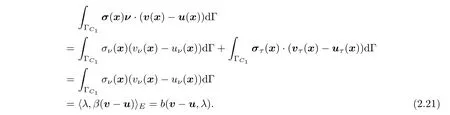
λ
∈Λ,u∈S
,and
From(2.4),(2.17),(2.18),(2.21)and(2.22),we derive the following variational formulation of Problem 2.2:
Problem 2.3
Find a displacement field u∈V
and a multiplierλ
∈Λ such that
V
toL
(Γ;R)):
Theorem 2.2
Assume that(2.11)–(2.14)hold.If,in addition,the smallness condition is satis fied,then Problem 2.3 has at least one solution(u,λ
)∈V
×Λ,which is unique in its first component.Proof
We shall invoke Theorem 2.1 to conclude the desired assertion.To this end,we will verify that all conditions of Theorem 2.1 are valid.We now de fine an operatorA
:V
→V
and a functionJ
:X
→R by
X
=L
(Γ;R).It follows from hypotheses(2.12),(2.13)and[27,Theorem 3.47]thatJ
is a locally Lipschitz function such that
X
.Also,from hypotheses(2.12)(c),(2.13)(c)and[27,Theorem 3.47(vi)],we find constantsα
≥0 andβ
>
0 such that
?J
:X
→2is bounded.Moreover,assumptions(2.12)(e)and(2.13)(e),and the inequality(2.28),reveal that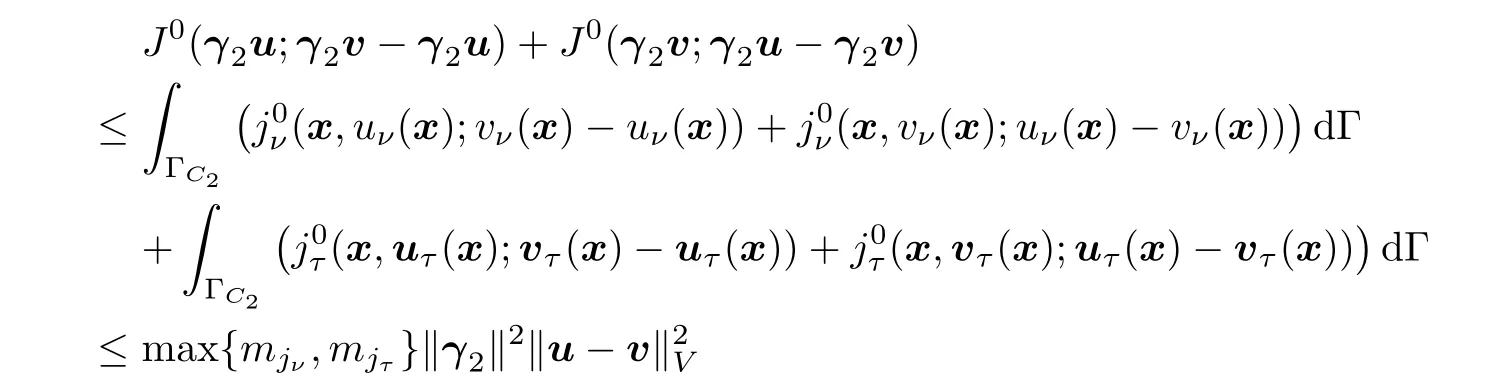
V
.This leads to the inequality

On the other hand,the hypothesis(2.11)(b)guarantees that

V
.This means thatA
is a Lipschitz continuous operator.Since A(x,
0)=0for a.e.x∈?,this results in us getting that‖A
u‖≤L
‖u‖for all u∈V
.Furthermore,hypothesis(2.11)(c)implies that
V
.Combining(2.29)and(2.30),one has
?J
(γu),ξ∈?J
(γv),and u,v∈V
.

This identity leads to

ρ
∈E
be arbitrary,we have
,λ
)∈V
×Λ,which is unique in its first component:
,λ
)∈V
×Λ is also a solution to Problem 2.3.Finally,we will show that the first component u of the solution to Problem 2.3 is unique.Let(u,λ
),(u,λ
)∈V
×Λ be two solutions to Problem 2.3.Then,we have
ρ
=λ
andρ
=λ
into(2.32)fori
=1 and 2,respectively,we add the resulting inequalities to obtain
i
=1 and 2,respectively,and combining the resulting inequalities with(2.33),we derive
hence u=u.This completes the proof.
3 Convergence Analysis
In this section,we are interested in the study of the behavior of a sequence of solutions to the nonlinear elastic contact problem,Problem 2.2,under the perturbations in the nonlinear elasticity operator A,volume forces f,and surface tractions f.


S
,k
∈N,and a function g∈H
(?;R),consider the Dirichlet problem with homogeneous boundary condition

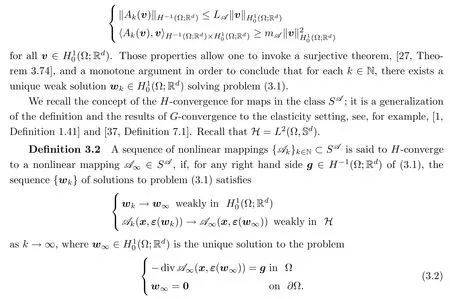
H
-convergence of elasticity operators is a critical mathematical tool for studying the homogenization of periodic problems.For example,if A∈S
is such that A(·,
ε)is periodic andε>
0,then,putting
H
-converges to Aasε
→0,where Ais independent of the spatial variable.The following theorem reveals that each sequence inS
is relatively compact in the sense ofH
-convergence:
Furthermore,we recall a fundamental convergence result,which will play an important role in the main result of this section;its proof can be found in[1,Lemma 1.43]and[10,Lemma 11].
Lemma 3.4
(Compensated compactness)Let{z}be a sequence converging to zweakly inH
(?;R),and let{h}be a sequence converging to hweakly in H such that
Then,the sequence{h:ε(z)}converges to h:ε(z)in the sense of distributions on ?,namely,Z

G
andH
-convergences,we refer to[8,9,41].Letk
∈N∪{∞}be a parameter and let{A}be a sequence inS
.We consider the following perturbed problem:find a displacement field u∈V
and a multiplierλ
∈Λ such that
V
,problem(3.3),(3.4)can be equivalently formulated as
Theorem 3.5
Let{(f,
f)}and{A}be two sequences inH
×L
(Γ;R)andS
,respectively.Assume that hypotheses(2.11)-(2.14)and(2.25)are ful filled.If,in addition,the following convergences are satis fied:
,λ
)∈V
×Λ of solutions to problem(3.5),(3.6)fork
∈N,associated with(f,
f),has a subsequence converging weakly inV
×Λ ask
→∞to the solution(u,λ
)∈V
×Λ to the following problem:
Proof
For eachk
∈N∪{∞},Theorems 2.1 and 2.2 show that problem(3.5)-(3.6)has at least one solution(u,λ
)∈V
×Λ for eachk
∈N,which is unique in its first component.Let f∈V
be such that
V
,for allk
∈N.The proof will be carried out in three steps.Step 1
The sequences{u}and{λ
}are both uniformly bounded inV
and Λ,respectively.Recall that 0∈Λ,so we takeρ
=0in(3.6)to get
Inserting v=?uinto(3.5),this yields that

Taking into account the last two inequalities,one has

Moreover,inequalities(2.12)(d)and(2.13)(d)imply that

for a.e.x∈Γ.On the other hand,(2.12)(c)and(2.13)(c)entail that

for a.e.x∈Γ(C).Combining(3.11)and(3.12),we have


λ
}in Λ.For any w∈V
{0},taking v=?w in(3.5),one has
From the boundness of{u},we obtain

V
{0},whereM
>
0 is such that
k
∈N.Passing to the supremum in(3.14)with w∈V
{0},this yields that
λ
}is uniformly bounded in Λ.The re flexivity of the spacesV
,E
and H implies that there exist subsequences,still denoted in the same way,and elements u∈V
,λ
∈Λ and η∈H such that
k
→∞.Step 2
We will identify the limit η in(3.17)and show that η(x)=A(x,
ε(u))for a.e.x∈?.




The latter,combined with the facts that,

as well as the compensated compactness result of Lemma 3.4,shows that


t
δ+(1?t
)ε(u)witht>
0 into the above inequality to obtain
t
→0,we obtain
This means that

Therefore,from(3.17),we verify the desired conclusion.
Step 3
We will prove that the pair(u,λ
)is a solution to problem de fined in(3.8)and(3.9).Note that the operators γ:V
→L
(Γ;R)andβ
:V
→L
(Γ)are both compact,thus,by convergence(3.15),it follows that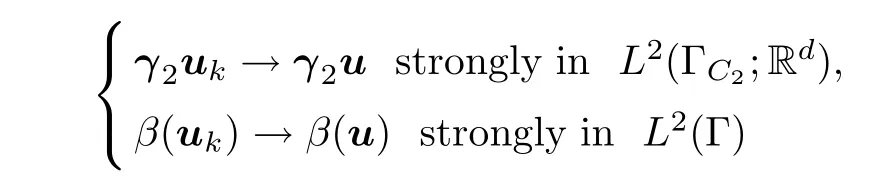
k
→∞.This implies that
On the other hand,it follows from the converse Lebesgue-dominated convergence theorem(see,for example,[27,Theorem 2.39])that by passing to a subsequence if necessary,we have
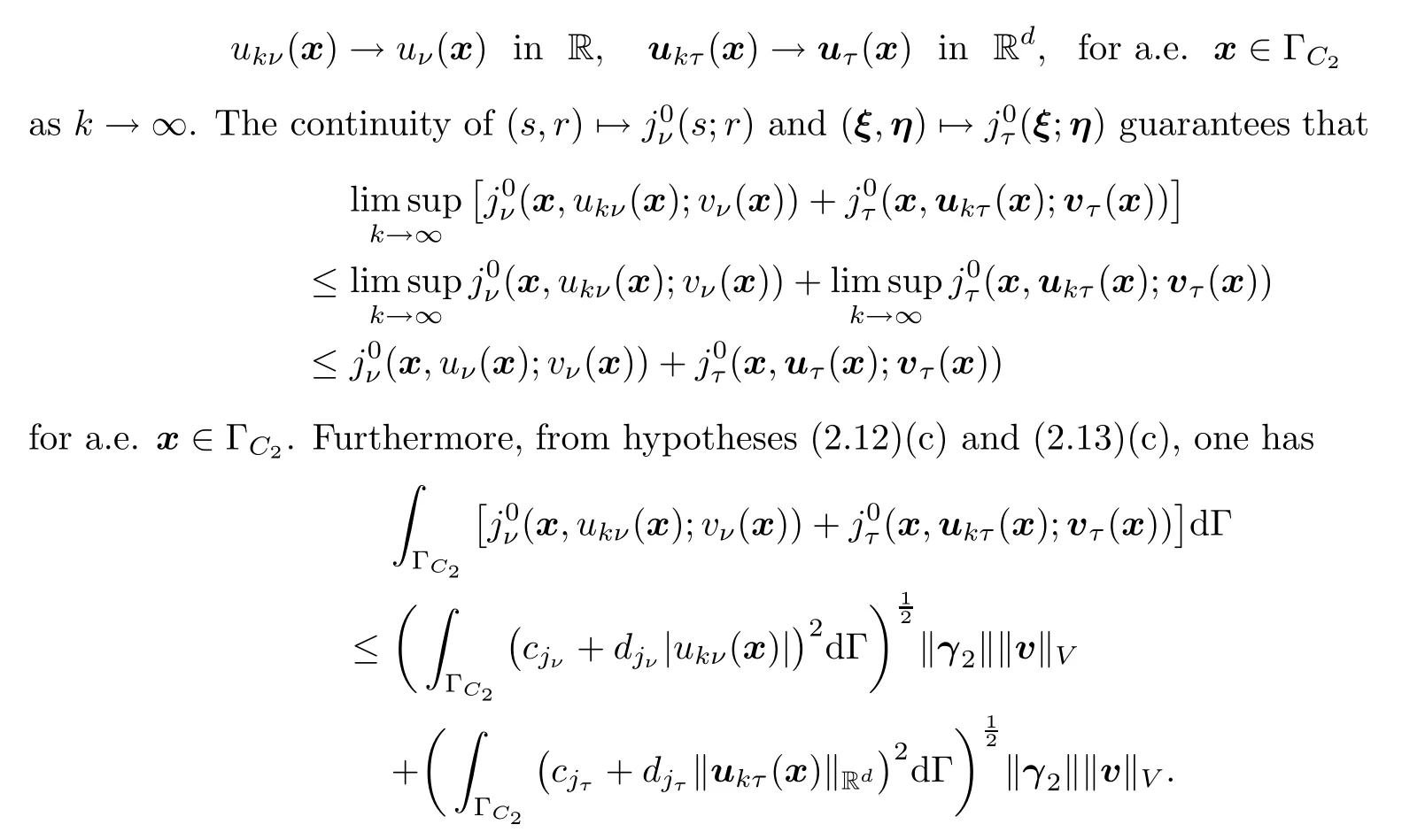
V
,by the Fatou lemma(see,for example,[27,Theorem 1.64])we get that
From(3.17),(3.22)and(3.23),it follows that

V
.Combining(3.21)and(3.24),we conclude that(u,λ
)∈V
×Λ is a solution to problem(3.8),(3.9).Remark 3.6
From Theorem 2.2,we can see that the first component of a solution for(3.8)and(3.9)is unique.This implies that each subsequence of{u}converges weakly to the same limit u.Consequently,we conclude from[35,Theorem 1.20]that the whole sequence{u}converges weakly inV
to u.Acknowledgements
This article is honor of the 75th anniversary of Yulin Normal University. Acta Mathematica Scientia(English Series)2021年4期
- Acta Mathematica Scientia(English Series)的其它文章
- REGULARITY OF WEAK SOLUTIONS TO A CLASS OF NONLINEAR PROBLEM?
- EXISTENCE TO FRACTIONAL CRITICAL EQUATION WITH HARDY-LITTLEWOOD-SOBOLEV NONLINEARITIES?
- A DIFFUSIVE SVEIR EPIDEMIC MODEL WITH TIME DELAY AND GENERAL INCIDENCE?
- ON A COUPLED INTEGRO-DIFFERENTIAL SYSTEM INVOLVING MIXED FRACTIONAL DERIVATIVES AND INTEGRALS OF DIFFERENT ORDERS?
- CLASSIFICATION OF SOLUTIONS TO HIGHER FRACTIONAL ORDER SYSTEMS?
- ENERGY CONSERVATION FOR SOLUTIONS OF INCOMPRESSIBLE VISCOELASTIC FLUIDS?