
Four-year-old anti-N-methyl-D-aspartate receptor encephalitis patient with ovarian teratoma: A case report
2021-08-05 01:11:44CongYingXueHuiDongHuiXiaYangYuWuJiangLingYin
World Journal of Clinical Cases 2021年19期
Cong-Ying Xue, Hui Dong, Hui-Xia Yang, Yu-Wu Jiang, Ling Yin
Cong-Ying Xue, Hui-Xia Yang, Ling Yin, Department of Obstetrics and Gynecology, Peking University First Hospital, Beijing 100034, China
Hui Dong, Yu-Wu Jiang, Department of Pediatrics, Peking University First Hospital, Beijing 100034, China
Abstract BACKGROUND A population-based comparative study in United States shows that the prevalence and incidence of autoimmune encephalitis are comparable to those of infectious encephalitis and its detection is increasing over time. Some patients are complicated with ovarian teratoma. The younger the patient is, the less likely a tumor will be present.CASE SUMMARY This case report describes the successful treatment of anti-N-methyl-D-aspartatereceptor (NMDAR) encephalitis by early laparoscopic ovarian cystectomy and immunotherapy in a 4-year-old female child. And to the best of our knowledge,this detailed case report describes the youngest patient to date with anti-NMDAR encephalitis who underwent laparoscopic ovarian cystectomy.CONCLUSION Although the younger the patient is, the less likely a tumor will be detected, we still emphasize that all patients with suspected or confirmed anti-NMDAR encephalitis should be screened for ovarian tumors if possible. Prompt initiation of immunotherapy and tumor removal are crucial for good outcomes.
Key Words: Anti-N-methyl-D-aspartate receptor encephalitis; Childhood; Laparoscopic surgery; Ovarian teratoma; Case report
INTRODUCTION
A population-based comparative study in the United States shows that the prevalence and incidence of autoimmune encephalitis are comparable those of infectious encephalitis and its detection is increasing over time. The prevalence of anti-N-methyl-Daspartate-receptor (NMDAR) encephalitis was 0.6/100000[1]. This disorder is observed in patients of all ages but most often in young adults and children with or without teratomas[2,3]. Approximately 80% of patients with anti-NMDAR encephalitis are women[4]. In an observational cohort study, patients with ovarian teratoma accounted for 44.2% of all female anti-NMDAR encephalitis patients (207 of 468)[5]. However, in a single-center prospective study in China, patients with ovarian teratoma accounted for 26.9% of all female patients (29 of 108)[6]. Previous reports have demonstrated that the prevalence of tumors in this disease is associated with age, sex, and race[2,3].Patients typically present with acute behavioral changes, psychosis, and catatonia that evolve to seizures, memory deficits, dyskinesias, speech problems, and autonomic and breathing dysregulation[2]. The optimal management of anti-NMDAR encephalitis includes immunotherapy and removal of the tumor[7,8]. Despite the severity of the disease, patients often improve after intensive care support, immunotherapy, and prolonged hospitalizations that require multidisciplinary care[5]. We report a case of ovarian mature cystic teratoma in a 4-year-old female child with anti-NMDAR encephalitis who received laparoscopic ovarian cystectomy and immunotherapy. To the best of our knowledge, this detailed case report describes the youngest patient to date with anti-NMDAR encephalitis who underwent laparoscopic ovarian cystectomy.
CASE PRESENTATION
Chief complaints
A 4-year-old girl was admitted to the pediatric intensive care unit (PICU) of Peking University First Hospital as an emergency (day 1) with intermittent fever, convulsions,and abnormal mental behavior over 15 d of evolution.
History of present illness
Fever (In China, fever is diagnosed when a body temperature is ≥ 37.3 °C) occurred 15 d ago with the highest body temperature of 37.5 °C and without obvious inducement.The symptoms were accompanied by headache. The girl developed convulsions 10 d after the initial symptom onset, lasting a few seconds to 3 min with spontaneous remission occurring 2-3 times a day. Her parents sent her to a local hospital for treatment first. Routine blood tests were normal, and the serum immunoglobulin M antibodies against coxsackie virus and adenovirus were positive. Electroencephalogram (EEG) indicated a small number of low-medium amplitude spikes in the left parietal and central regions and midline during the sleep period. Brain magnetic resonance imaging (MRI) was performed without obvious pathological findings. The patient was diagnosed with viral encephalitis and treated with antiviral drugs at the local hospital. During admission, the condition of the patient worsened on day 13 of symptom onset with intermittent psychiatric symptoms and behavioral changes,including agitation, pressured speech, and dyskinesias of the arms and legs. Thereafter, her parents took her to the outpatient department of pediatrics at our hospital,and she was admitted to the PICU as an emergency.
History of past illness
The patient had a free previous medical history.
Personal and family history
There was no special personal or family history.
Physical examination
After admission, physical and neurological examinations were unremarkable except for a slightly higher temperature at 37.5 °C.
Laboratory examinations
Routine laboratory tests were unremarkable.Tumor markers and autoimmune profiles were within normal limits. Blood and urine cultures revealed no findings of bacteria or other microorganisms. The detection of thyroid function was also normal.
Imaging examinations
Brain MRI was performed without obvious pathological findings. Brain MRI was reexamined on day 9 and demonstrated small flaps of T2 fluid-attenuated inversion recovery hyperintensity in the right frontal lobe. On day 12, abdominal-pelvic ultrasound revealed a 3.4 cm × 3.1 cm × 2.8 cm cystic tumor in the left adnexal region,suggesting ovarian teratoma.
MULTIDISCIPLINARY EXPERT CONSULTATION
Considering that previous neurological symptoms had improved significantly,surgical excision was decided by gynecologists and pediatricians. A laparoscopic exploration was performed carefully under general anesthesia (day 18), and the left ovarian tumor was removed completely with minimal bleeding.
FINAL DIAGNOSIS
Anti-NMDAR encephalitis secondary to teratoma.
TREATMENT
Considering that previous neurological symptoms had improved significantly, surgical excision was decided by gynecologists and pediatricians. A laparoscopic exploration was performed carefully under general anesthesia (day 18), and the left ovarian tumor was removed completely with minimal bleeding (Figure 1). The operative time was 62 min.
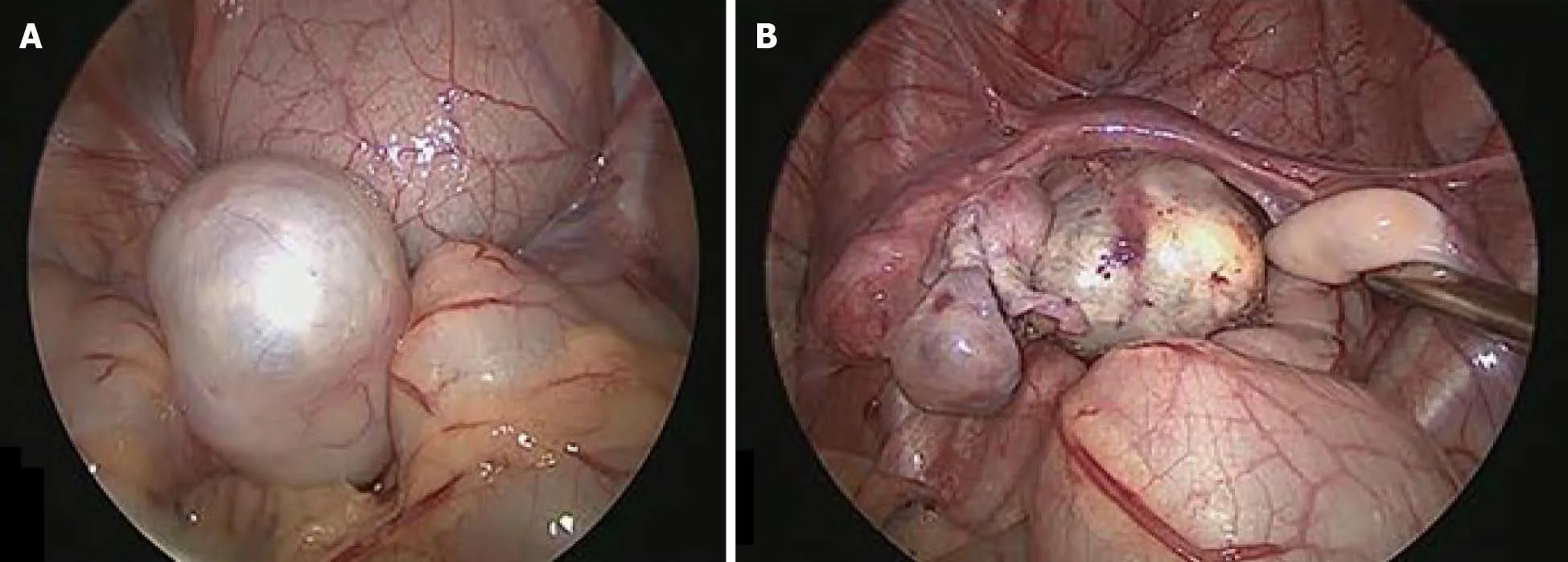
Figure 1 Laparoscopy. A: Initial laparoscopic image; B: Laparoscopic image after the tumor was removed completely.
The operation and anesthesia went very well. The patient could breathe spontaneously without snoring or apnoea after extubation. Her vital signs were stable, and in the immediate postoperative period, the girl was transferred to the PICU and went to the pediatric neurology ward that night based on a stable condition. Postoperative pathological results confirmed that the tumor was a mature cystic teratoma and that the teratoma contained a component of mature neuroglial tissue. Immunotherapy,including intravenous administration of methylprednisolone and oral prednisone acetate, was initiated on day 23. During hospitalization, the body temperature of the patient increased intermittently until day 25, reaching a maximum of 38.5 °C on day 10. After this date, the patient’s temperature was normal.
OUTCOME AND FOLLOW-UP
After treatment, the patient’s previous symptoms gradually disappeared. She was discharged on the 20thpostoperative day with prednisone acetate and levetiracetam.The total duration of hospitalization was 37 d. The pediatrician followed up with the patient, and her symptoms have completely improved without relapse or sequelae to date. EEG with normal results was performed 15 wk after discharge. The antiepileptic drug and glucocorticoid had been stopped with a total course of 6 mo. Colonystimulating factor (CSF) and serum anti-NMDAR antibodies were tested again 6 mo after discharge, and the results were all negative. EEG was also performed again at the same time, and the result was normal. The girl is vigorous to date with no signs of encephalitis and no recurrence of the ovarian tumor.
DISCUSSION
In 2007, Dalmauet al[9] formally proposed the concept of anti-NMDAR encephalitis[9], which has since been observed in patients of all ages but most often in young adults and children with or without teratomas[7]. The age distribution of anti-NMDAR encephalitis reported in the literature is very wide, ranging from 8 mo to 85 years[5]. The younger the patient is, the less likely a tumor will be present[5]. In a study conducted by Floranceet al[3], the frequency of ovarian teratoma in patients with anti-NMDAR encephalitis was 56% in women aged ﹥ 18 years, 31% in girls ﹤ 18 years, and 9% in girls aged ﹤ 14 years. To the best of our knowledge, this detailed case report describes the youngest patient to date with anti-NMDAR encephalitis who underwent laparoscopic ovarian cystectomy. Since the disease was first proposed in 2007, clinicians’ understanding of anti-NMDAR encephalitis has gradually increased.However, given that the disease is relatively rare and the clinical manifestations are complex, it is difficult to make accurate and timely diagnoses. It is important to note that although brain MRI may be within normal limits in 67% of patients, 90% of these patients commonly exhibit EEG abnormalities. The final diagnosis is made with the detection of anti-NMDAR antibodies in the blood or CSF[7]. However, early treatment is associated with better outcomes. At present, the production of anti-NMDA receptor antibodies has been unanimously recognized as the ectopic expression of NMDA receptors in ovarian tumor tissues, which stimulates the production of antibodies in the body and causes disease when acting on NMDA receptors in the nervous system under appropriate conditions. However, the mechanism of antibody production in patients with nonovarian tumors remains unclear. Brain NMDA receptors determine the existence of higher mental functions, playing a fundamental role in the mechanisms of consciousness, memory, learning, emotions, and even in some motor functions. In the process of anti-NMDAR encephalitis, antibodies are generated in response to the neural elements within the teratoma. The newly formed autoantibodies react with the NMDA receptor 1 subunit of the ligand-gated cation channel NMDA receptor, which is primarily expressed in the hippocampus and forebrain and is implicated in memory and learning[7,10]. This reaction results in specific and recognizable syndromes that develop in five stages of illness and recovery as first reported by Sansinget al[11], including prodromal, psychotic, unresponsive,hyperkinetic, and gradual recovery phases. However, there are no strict boundaries for each stage.In this case report,we present a typical case of anti-NMDAR encephalitis with rapid improvement after laparoscopic ovarian cystectomy and immunotherapy without sequelae. The initial prodromal phase was a nonspecific viral-like symptom disease with fever and headache, which later progressed into two stages of neuropsychiatric abnormalities. With IVIg and symptomatic treatment, her condition was controlled. After the tumor was surgically removed, glucocorticoid treatment was performed, and her condition improved significantly. An observational cohort study revealed two independent predictors of good outcome: Lower severity of symptoms,which is assessed as no need for admission to an intensive care unit, and prompt initiation of immunotherapy and tumor removal[5]. On the second day after the girl was admitted to our hospital, IVIg was implemented by a pediatrician. The diagnosis of anti-NMDAR encephalitis was confirmed 1 wk after hospitalization, and surgery was performed 18 d after admission. Glucocorticoids were applied 23 d after admission. The total duration of hospitalization was 37 d with 8 d of PICU admission.The patient has a good prognosis given our timely diagnosis and treatment with laparoscopic tumor resection and immunotherapy.
CONCLUSION
The younger the patient is, the less likely a tumor will be detected[5]. This case report intends to emphasize that all patients with suspected or confirmed anti-NMDAR encephalitis should be screened for ovarian tumors if possible. Prompt initiation of immunotherapy and tumor removal are crucial for good outcomes.
 World Journal of Clinical Cases2021年19期
- World Journal of Clinical Cases的其它文章
- Liver injury in COVID-19: Known and unknown
- Brugada syndrome associated with out-of-hospital cardiac arrest: A case report
- Small bowel obstruction caused by secondary jejunal tumor from renal cell carcinoma: A case report
- Ectopic opening of the common bile duct into the duodenal bulb with recurrent choledocholithiasis: A case report
- Glutamic acid decarboxylase 65-positive autoimmune encephalitis presenting with gelastic seizure, responsive to steroid: A case report
- Neuromuscular electrical stimulation for a dysphagic stroke patient with cardiac pacemaker using magnet mode change: A case report