
Phoretic self-assembly of active colloidal molecules*
2021-05-24 02:28:02LijieLei雷李杰ShuoWang王碩XinyuanZhang張昕源WenjieLai賴文杰JinyuWu吳晉宇andYongxiangGao高永祥
Chinese Physics B 2021年5期
Lijie Lei(雷李杰), Shuo Wang(王碩), Xinyuan Zhang(張昕源), Wenjie Lai(賴文杰),Jinyu Wu(吳晉宇), and Yongxiang Gao(高永祥),?
1Institute for Advanced Study,Shenzhen University,Shenzhen 518060,China
2Institute of Microscale Optoelectronics,Shenzhen University,Shenzhen 518060,China
Keywords: Brownian dynamics,diffusiophoresis,active colloidal molecule,self-assembly
1. Introduction
Colloidal molecules refer to the assembly of colloidal clusters with well-defined coordination number and spatial arrangement.[1]They are often regarded as mesoscopic counterparts of molecules as colloidal particles are several orders of magnitude bigger than atoms.[2]Of particular interest are active colloidal molecules, which contain at least one species that can self-propel or swim.[3]By extracting energy from the environment and convert it into self-propelled motion, active colloidal molecules are able to perform various dynamic functions, such as translation, rotation, and in-situ assembly–disassembly with high accuracy.[4–7]Studying the self-assembly process of active molecules is not only beneficial for the design and fabrication of miniaturized machines and devices,[8,9]it also promises insights into understanding how active matter organizes into complex and robust dynamic structures,[10]including collections of motile microorganisms,[11]animal flocks,[12,13]and chemical or mechanical imitations.[14,15]
Diffusiophoresis is known as the migration of colloidal particles in response to an externally imposed solute concentration gradient.[16,17]It is a generic strategy for the design of self-propelled active colloids[18]and nonequilibrium interactions for self-assembly of colloidal molecules.[19]For active colloids,the solute gradients are commonly generated by their catalytic surfaces. Through designing the surface with unbalanced catalytic activity,the chemical reaction will produce an asymmetric concentration field,which interacts with the particle, resulting in self-propelled motion or self-phoresis.[20–23]Asymmetric catalytic activity on colloids’ surface has been widely used to produce self-propelled Janus colloids in hydrogen peroxide[24]and other chemicals.[25–27]
Diffusiophoretic motion fundamentally relies on two distinct physicochemical properties of the colloids. The first one is the surface activity, which refers to the colloid’s ability to generate or consume solute molecules through chemical reactions at their surface.[20]The second one is surface mobility,also termed as phoretic mobility,[16]which leads to an effective slip motion of the colloid in response to gradients in surface concentration. The collective propulsion and rotation of the colloidal molecules are intimately linked to their exact geometry.
In this work,we simulate the self-assembly of active colloidal molecules in binary systems in which colloidal particles interact and respond via diffusiophoresis. Our aim is to investigate the influence of surface parameters and size asymmetry on the structure and dynamics of active colloidal molecules.Note that phoretic interactions between particles are not restricted to be reciprocal and are inherently nonequilibrium,which therefore may lead to self-assembled structures and dynamic functions that are unseen in colloidal self-assembly driven by thermodynamics.
2. Model and methodology
There are two independent parameters to characterize the properties of spherical catalytic colloids,[19]which are surface activity(α)and surface mobility(μ).Both the surface activity and surface mobility can be positive or negative(or even zero).Experimentally, these two parameters can be manipulated by modifying the surface chemistry of colloidal particles.
Specifically, the concentration field C(r) around a catalytic particle in 3D can be obtained by solving the diffusion equation

with a boundary condition

where D is the diffusion coefficient of the chemicals,R is the radius of the colloidal particle,and α is the surface activity of the particle. The resulted concentration field decays as 1/r,

Now,consider two colloidal particles with radius(R1,R2),surface activity (α1,α2), and surface mobility (μ1,μ2), respectively that are in each other’s concentration field. Here we ignore the hydrodynamic interaction between the particles and assume that the concentration field will not be disturbed by the presence of other particles. Within the far-field approximation, the drift velocity of particle 2 in the concentration field produced by particle 1 can be described as

in which r12=r2?r1,and r1and r2are the vectors describing the positions of particles 1 and 2, respectively. Similarly, the drift velocity of particle 1 in the concentration field produced by particle 2 can be obtained as

We should note that V1/=?V2in general because α1μ2/=α2μ1even when the two particles are of equal size, R1=R2. This implies a broken action-reaction symmetry for interspecies interactions. The fact that the action-reaction symmetry is broken indicates that the whole pair moves with a velocity

2.1. Binary system composed of colloidal particles of equal size
As pointed out by Soto and Golestanian,[19]the effective interaction between phoretic colloids is similar to the unscreened electrostatic interaction between charged colloids in a fluid. The sign of the interaction, being repulsive or attractive, depends only on the signs of the surface parameters(α,μ),which are summarized in Table 1. The first term and the second term in the table refer to the interaction applied to particle 1 induced by particle 2 and the interaction applied to particle 2 induced by particle 1, respectively. It becomes obvious that when the product of α1μ2is less than zero, particle 2 will be attracted by particle 1. On the contrary, when the product of α1μ2is greater than zero,the particle 2 will be repelled by particle 1. α2μ1describes the interaction of particle 1 induced by particle 2 in the same way. Table 1 highlights the richness in the pair interactions of binary systems based on the current diffusiophoresis model,which can be tuned by adjusting the surface parameters to realize a wealth of selfassembled structures and dynamic functions. If the interaction is attractive for two particles,it is possible to form a most basic colloidal molecule,i.e.,a dimer. The whole pair will move with a velocity proportional to α1μ2?α2μ1,while the two colloids attract each other with a relative velocity proportional to α1μ2+α2μ1.[19]
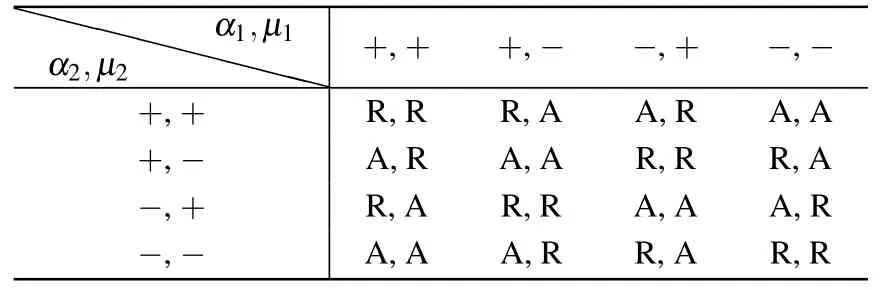
Table 1. Interaction pattern between active colloids(R:repulsive,A:attractive).
2.2. Binary system composed of colloidal particles of different size
A mixture of colloidal particles with the same surface parameters but different size will break the geometry symmetry,which will lead to the formation of moving colloidal molecule or even flocking. Consider a dimer composed of two particles with the same surface activity α1=α2=α*and surface mobility μ1=μ2=μ*but different radii R0and R. The whole pair velocity is proportional to the sum of each particle analogous to Eq.(6),so we can have
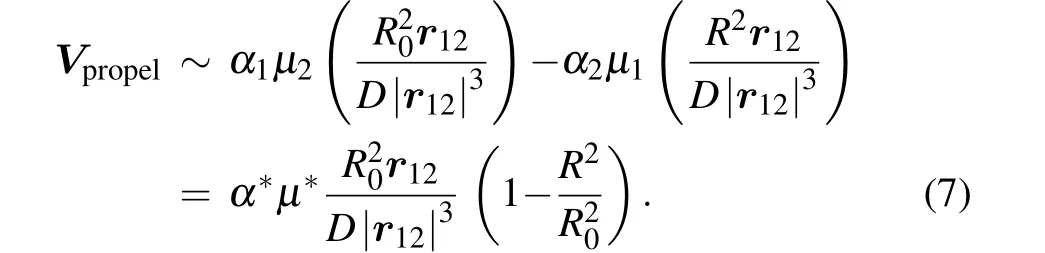
As can be seen,when R=R0,the two particles have the same radius,the velocity of the pair will be zero,due to the actionreaction symmetry. When R/=R0, the symmetry is broken,resulting in self-propelled motion of the dimer.
2.3. Equation of motion
The equation of motion governing the behaviors of colloidal particles based on the current model have been described previously,[19]which is the following stochastic equation:
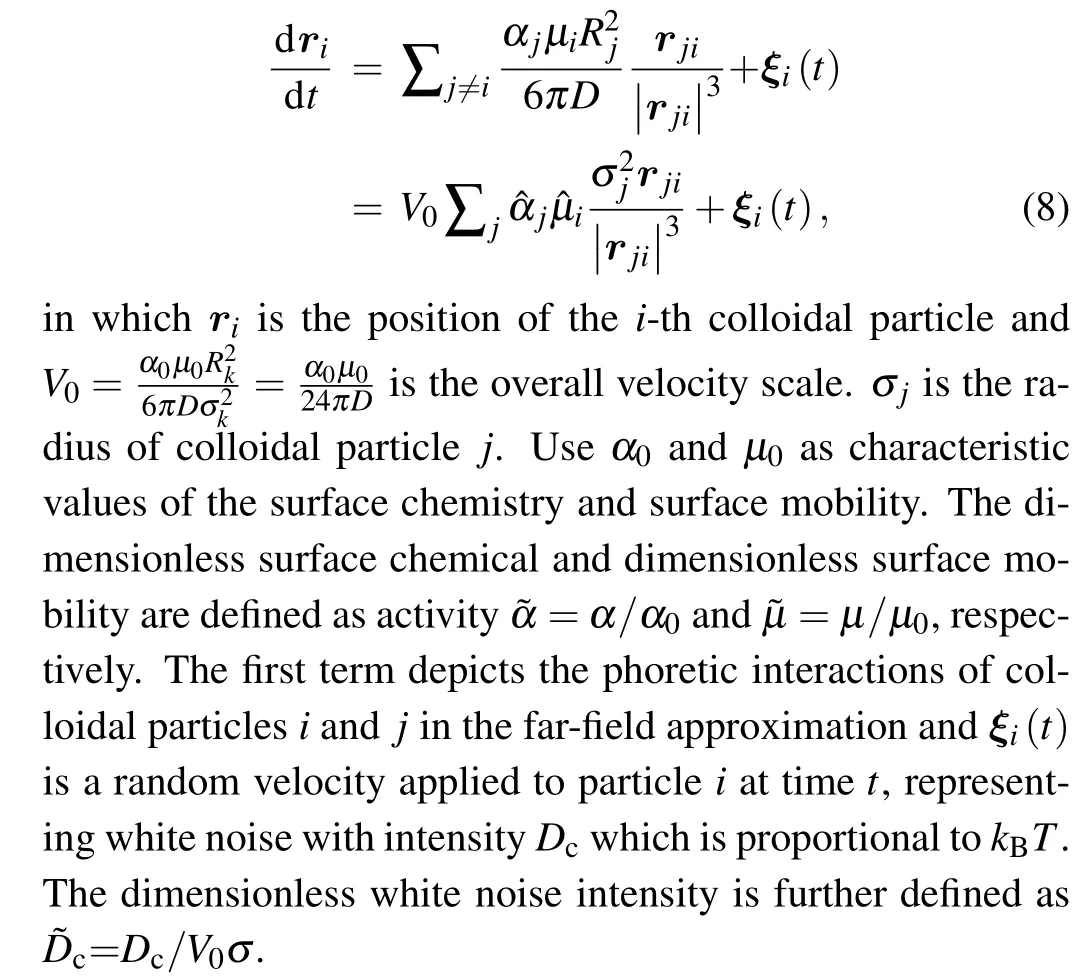
In general,colloidal particles in experiments cannot overlap. In our simulation, to impose the exclude volume effect,two particles are reflected by the same overlapping distance if they start to overlap. The procedure is repeated until there are no remaining overlaps. Periodic boundary conditions are used,and the interactions are treated using the minimal image convention.[28,29]As most of the experiments are confined to 2D, we confine the colloidal particles to a quasi-3D domain by limiting the center of the particle to move within half of the particle’s radius without considering real plates to avoid additional complexity. When the particles reach this imaginary boundary, they are bounced forward to the domain. This allows us to apply the formulas derived for three-dimensional systems to this quasi-3D condition.
3. Results and discussion
In the current system, the area fraction φ is defined as φ=Nπσ2/4L2,where N is the total number of colloidal particles used in the simulation,and L is the length of our squared domain. The overall velocity scale used in the current systems is V0=100.0 and the white noise magnitude Dc=1.0. The system is advanced in a time step of δt =0.001σ/V0. The diffusiophoresis interaction is truncated at r =20R, beyond which the concentration gradient has decayed low enough to be overlooked.
3.1. Binary systems with colloidal particles of equal size
We first simulate the behaviors of binary system composed of equal-size colloidal particles (species A and B)with different surface activity (αA,αB) and surface mobility (μA,μB), respectively. The simulation is performed with N =20 and L=20 with mono-dispersed colloidal particle’s radius R=0.5, resulting in an area fraction φ =0.98%. Initially the colloidal particles were randomly distributed in the box. The simulation runs up to 1 million steps to allow the colloids to form colloidal molecules and achieve active behaviors. Because of the nonequilibrium property of the current system, it is possible to manipulate the surface parameters to obtain stable colloidal molecules with different configurations and dynamic functions.
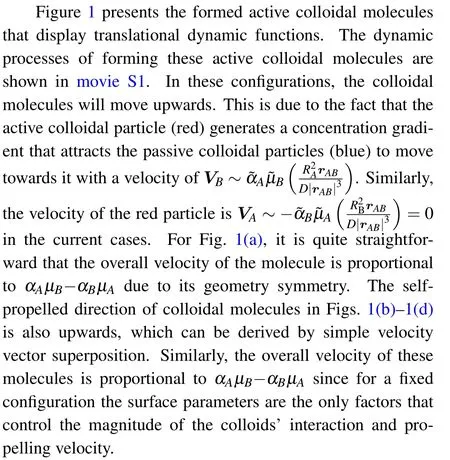
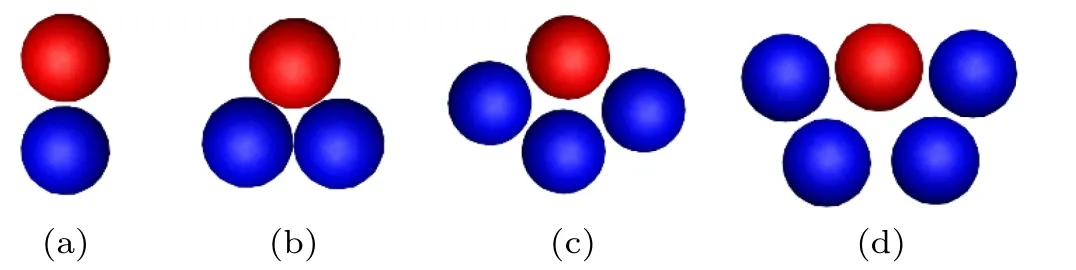
Fig.1. Configurations of active colloidal molecules ABn with translational dynamic functions. n varies from 1 to 4 in (a)–(d). Colloid A is red and colloid B is blue,with ?αA=1.0, ?μA=0.0, ?αB=0.0, ?μB=?1.0.
In Fig. 2, we present configurations of several colloidal molecules that display dynamic functions of rotation, see movies S2, S3, and S4. Since ?αi?μi>0 and ?αi?μj|i/=j<0, colloidal particles with the same surface parameters repel each other while the different species of particles attract each other.At the same time, the red particles attract blue particles with a stronger phoretic interaction than the attraction of blue colloids to red colloids since ?αA?μB>?αB?μA. These arrangements break the action-reaction symmetry and lead to the rotation of the colloidal molecules.
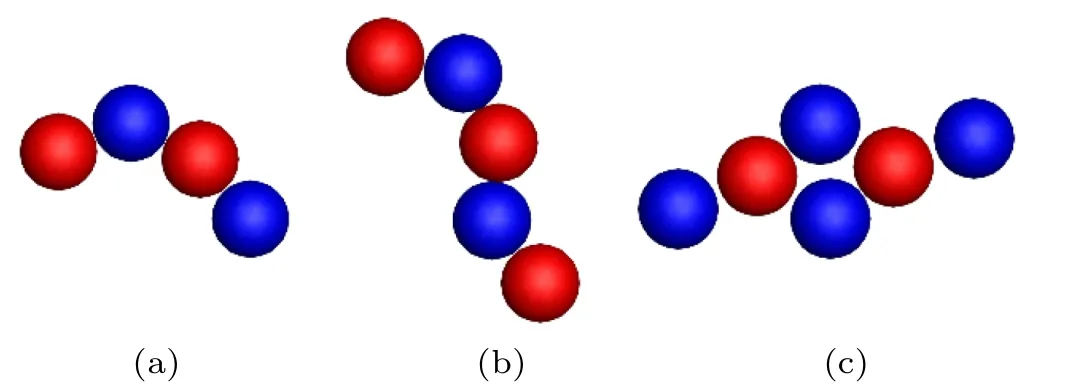
Fig. 2. Configurations of active colloidal molecules with rotational dynamic functions. All the colloidal molecules rotate in clock-wise direction. (a) ?αA=1.0, ?μA=3.0, ?αB=?1.0, ?μB=?1.0;(b)and(c) ?αA=2.0,?μA=1.0, ?αB=?1.0, ?μB=?1.0.
In Fig.3,we present configurations of self-assembled active colloidal molecules that remain rest due to their symmetric structures(the dynamic process of forming these colloidal molecules are shown in movies S5 and S6). Even though Fig. 3(a) has the same configuration with Fig. 1(a), however,the pair velocity parameter ?αA?μB??αB?μA=0.0 in Fig. 3(a),which results in a rest configuration. Moreover, the interaction between the same species of particles are repulsive in Figs. 3(a), 3(b), 3(f)since ?αi?μi=1 >0 while the interaction between particles 1 and 2 is attractive since ?αA?μB= ?αB?μA=?1.0. Note that the magnitude of the attraction is equal to the repulsion in this case. The ABAB chain is formed because among the same species of particles they have a repulsive interaction, leading to the fact that they cannot approach a particle from the same species. On the other hand, there is an attractive interaction between colloidal particles from different species, resulting a configuration A–B–A–B. The interaction modes of colloids in Figs.3(c)–3(e)are similar. However,the magnitudes of attraction and repulsion between the colloids are different. Specifically, the attraction applied on the blue colloids is larger than the repulsion between blue colloids|?αA?μB|>|?αB?μB|, which allows the blue colloids attached to the red colloids, overcoming the repulsion among blue colloids to some extent.
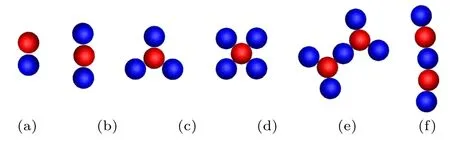
Fig. 3. Configurations of stationary active colloidal molecules of (a) AB,(b)AB2,(c)AB3,(d)AB4;(e)A2B5,and(f)A2B3. For(a),(b),(f) ?αA=1.0,?μA =1.0, ?αB =?1.0, ?μB =?1.0; for (c), (d), (e) ?αA =2.0, ?μA =1.0,?αB=?1.0, ?μB=?1.0.
3.2. Binary systems with colloidal particles of different size
Then we simulate colloidal particles that have the same surface activity and surface mobility with different radii. The previous results have shown that the colloidal particles with the same radius, but different surface parameters may form different colloidal molecules and some of them may move together, which is due to the break of action-reaction symmetry. First the configurations of active colloidal particles with different radii are investigated with a radius ratio R/R0=0.5.Figure 5 shows the configurations of colloidal particle formed by colloids with different radius but the same surface parameters,see in movie S7. As analyzed in Eq.(7),different radii of the colloids break the symmetry of geometry, resulting in the translational active colloidal molecules shown in Fig. 4.Since the interactions between all these colloids are attractive only, these colloidal molecules will keep growing when they approach each other. In addition, Fig. 5 presents some other basic configurations of active colloidal molecules formed by colloids with different radii and surface parameters, including one dimer(AB),two types of trimers(AB2and A2B),one type of A3B molecule,one type of AB3and one type of A2B4molecules, see movies S8, S9, and S11. Some of the configurations, i.e., (a), (b), and (d), are the same with the colloidal molecules in Fig. 4, but the moving directions are different. In Fig. 4, all the colloidal molecules move with the red colloid leading while in Figs. 5(a) and 5(b) these colloidal molecules move with the blue colloid leading. Compared with the monodispersed cases, there are more spaces for the small colloids to assemble around the big colloids,allowing more compact configurations. Since the colloidal molecules are moving, these molecules will keep growing by attracting nearby colloids,gradually either forming a symmetry molecule or flocking.
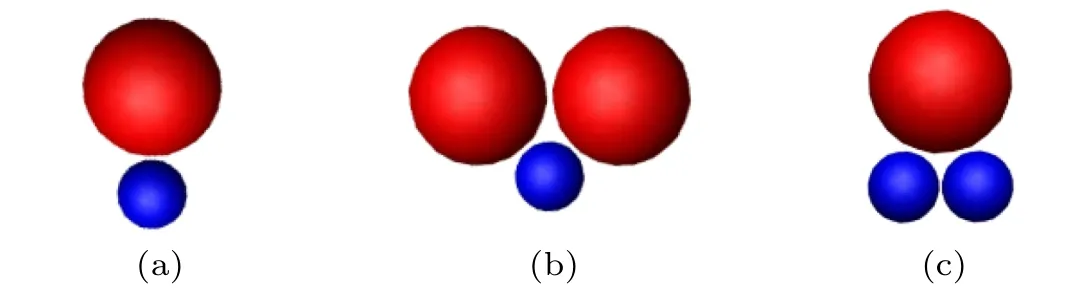
Fig. 4. Colloidal molecules formed by colloids with the same surface parameters but different radius(?αA=1.0, ?μA=?1.0, ?αB=1.0, ?μB=?1.0).

Fig.5. Basic configurations of active colloidal molecules with different surface parameters(colloid A is the big red particles and colloid B is the blue particles). For the AB,A2B,and A3B molecules in(a),(b),and(c) ?αA=0.0,?μA =?1.0, ?αB =1.0, ?μB =0.0; for the AB2 molecule in (d) ?αA =1.0,?μA =0.0, ?αB =0.0, ?μB =?1.0; for the AB3 molecule in (e) ?αA =1.0,?μA=0.0, ?αB=?1.0, ?μB=?1.0,and for the A2B3 molecule in(f) ?αA=1.0,?μA=0.0, ?αB=?1.0, ?μB=?1.0.
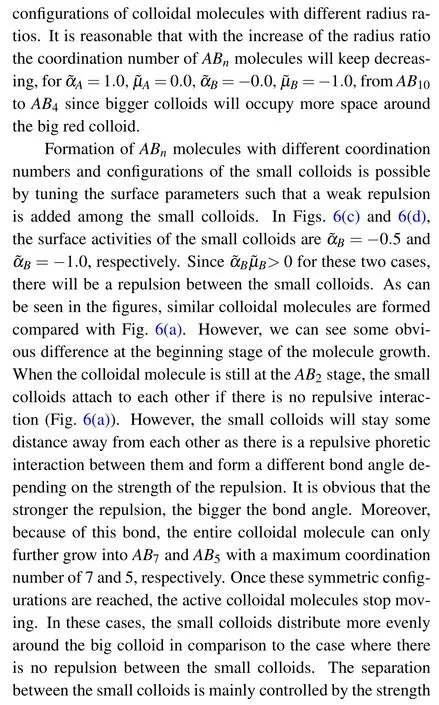
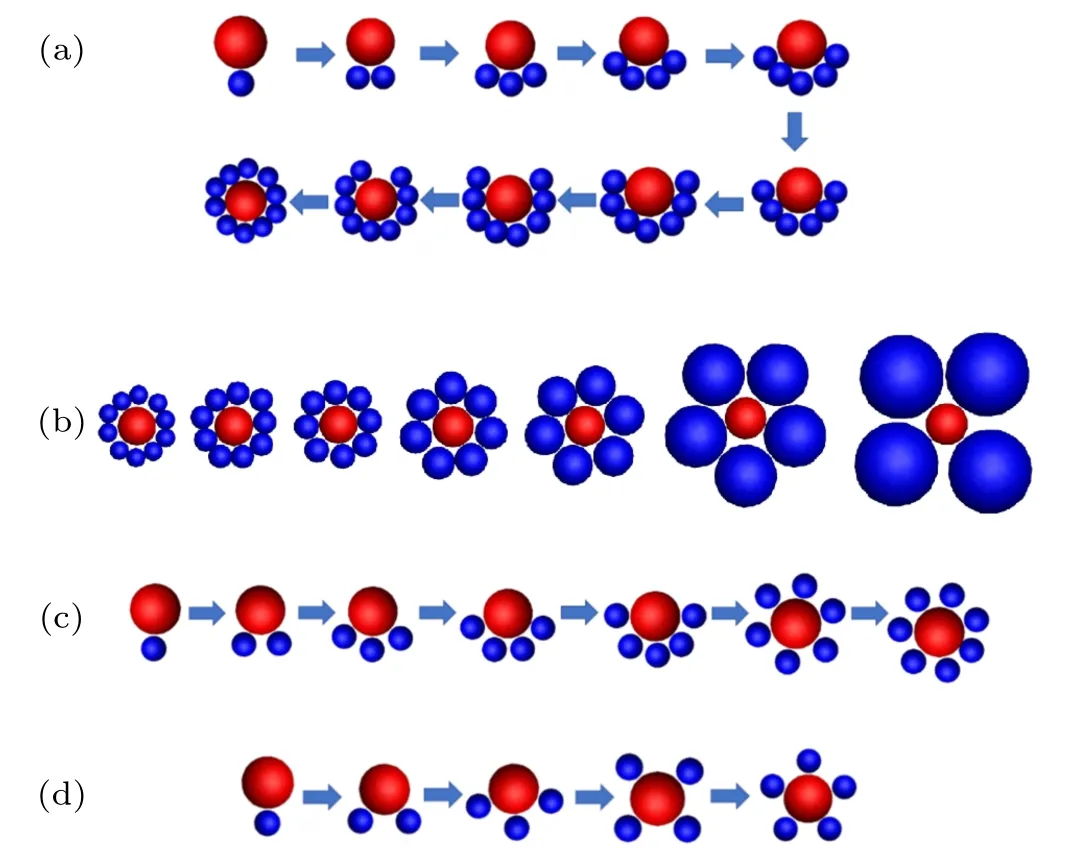
Fig.6. Self-assembly of active colloidal molecules with coordination numbers and bond angles controlled by the surface activity of the small colloid. For(a)the radius ratio is 0.5 and the surface parameters are =1.0, =0.0, =0.0, =?1.0; for(b)the radius ratios are 0.5,0.6,0.65,0.85,1.0,1.5,2.0 from left to right and the surface parameters are ?αA=1.0,=0.0, ?αB=0.0, =?1.0;for(c)the radius ratio is 0.5 and the surface parameters are =1.0, ?μA=0.0, ?αB=?0.5, =?1.0;for(d)the radius ratio is 0.5 and the surface parameters are ?αA =1.0, ?μA =0.0, =?1.0,?μB=?1.0.
4. Conclusion and perspectives
Using Brownian dynamics simulations of model active colloidal particles, we have elucidated a variety of dynamical structures induced by diffusiopheresis interaction of active colloids. To capture the basic features of the self-assembled colloidal molecules, only the far-field approximation of the diffusiophoresis interaction is considered, which decays as 1/r. From our simulation, colloidal molecules of three different dynamic functions are realized, including translation,rotation, and rest. Moreover, we show that colloidal particles with the same surface parameters can form dynamical structures with dynamic functions via breaking their size symmetry.The product of surface activity and surface mobility(αμ)is a key factor which affects the propelling velocity of the active colloidal molecules.
For colloidal particles with equal radius, active colloidal molecules can be formed with different surface parameters,including translational,rotational,and stationary molecules. For some configurations,i.e.,AB molecule,they can either be stationary or translational depending on their specific surface parameters,which provides a possible way to control the mobility of colloidal molecules by altering their surface parameters.
Colloidal particles with different radii can break the symmetry of geometry, forming some self-propelled molecules and resting colloidal molecules. Typically, ABnare formed with monodispersed colloids. Altering the surface parameters of the small colloids can easily change the bond angle. Specifically,in the current study,increasing the repulsion among the small colloids will increase the bond angle.
The current model captures the basic self-assembly and active behavior of active colloidal molecules in a small domain and a small number of particles quite well. More simulations,with even more colloidal particles and perhaps more species of surface parameters,may be required to explore whether the current diffusionpheresis model can be extended to study and predict more complex situation of colloidal particles. In this area, computationally efficient models and schemes such as the one we adopted in the current paper may provide a pragmatic tool and some qualitative results for real active colloids systems.
Acknowledgment
We would like to thank Professor Scott A.Edwards from Shenzhen University for stimulating discussion.

- Chinese Physics B的其它文章
- Process modeling gas atomization of close-coupled ring-hole nozzle for 316L stainless steel powder production*
- A 532 nm molecular iodine optical frequency standard based on modulation transfer spectroscopy*
- High-throughput identification of one-dimensional atomic wires and first principles calculations of their electronic states*
- Effect of tellurium(Te4+)irradiation on microstructure and associated irradiation-induced hardening*
- Effect of helium concentration on irradiation damage of Fe-ion irradiated SIMP steel at 300 °C and 450 °C*
- Optical spectroscopy study of damage evolution in 6H-SiC by H+2 implantation*