
78份四川小麥育成品種(系)條銹病抗性鑒定與抗條銹病基因分子檢測
2021-04-27 01:04:48王昱琦陳國躍蒲宗君周永紅康厚揚
作物學報 2021年7期
習 玲 王昱琦 朱 微 王 益 陳國躍 蒲宗君周永紅 康厚揚,*
78份四川小麥育成品種(系)條銹病抗性鑒定與抗條銹病基因分子檢測
習 玲1,2王昱琦1,2朱 微1,2王 益1,2陳國躍1,2蒲宗君3周永紅1,2康厚揚1,2,*
1四川農業大學小麥研究所, 四川成都 611130;2西南作物基因資源發掘與利用國家重點實驗室, 四川成都 611130;3四川省農業科學院作物研究所, 四川成都 610066
四川省是小麥條銹菌新小種產生的重要地區之一, 了解2016年以來四川小麥育成品種(系)對當前流行的條銹菌生理小種和致病類型的抗性水平以及明確其抗條銹病基因的分布狀況, 可為四川育種防控小麥抗條銹病和品種布局提供理論依據。本研究選擇2個小種CYR32和CYR34對78份四川小麥育成品種(系)進行苗期鑒定, 利用當前小麥條銹菌優勢小種CYR32、CYR33、CYR34, 以及貴22-14、貴農致病類群等混合菌進行成株期人工接種鑒定, 并利用19個抗條銹病QTL和基因、、、、、、、、、、、、、、、、、和的分子標記對供試材料進行抗條銹病基因檢測。結果表明, 在78份供試材料的苗期鑒定中, 對CYR32表現出抗性的有60份, 占76.92%; 對CYR34表現出抗性的有40份, 占51.28%; 同時對CYR32和CYR34表現抗性的有36份, 占46.15%。78份小麥品種(系)在成株期均表現抗條銹病, 其中綿麥835、蜀麥1743、蜀麥1829和蜀麥1868表現為免疫。苗期和成株期抗病性鑒定結果表明, 成株期抗性材料有42份, 占53.85%; 全生育期抗性材料有36份, 占46.15%。分子檢測結果表明, 可能攜帶、、、、、、、、、、、、、和的材料分別有5、5、45、2、30、5、30、39、3、2、22、8、23、6和24份。同時攜帶2~6個抗條銹病基因的聚合材料分別有24、22、11、14和3份, 占94.87%。所有供試品種(系)均未檢測到、、和, 僅西科麥18未檢測到上述19個抗條銹病基因, 可能攜帶其他已知或新的條銹病抗性基因。本研究鑒定了78份四川小麥育成品種(系)對條銹病抗性水平整體較好, 明確了其攜帶的抗條銹病基因, 為利用其培育持久抗性小麥品種提供了科學依據。
小麥條銹病; 小麥品種(系); 抗性評價; 分子檢測
小麥條銹病是由條形柄銹菌小麥專化型(f. sp., Pst)引起的真菌病害,嚴重影響小麥的產量[1]。條銹菌主要隨風遠距離傳播, 引起大規模的流行發生, 從而造成巨大的產量和經濟損失。由于病原菌的快速進化和新毒力小種的出現, 常常導致小麥生產上廣泛應用的品種喪失抗條銹性[2]。迄止, 中國小麥主產區已發生過多次條銹病大流行, 1950年、1964年、1990年、2002年和2017年的條銹病流行分別導致小麥產量損失60億、32億、18億、13億和15億千克, 嚴重影響小麥生產安全[3]。
研究發現, 導致小麥品種喪失抗條銹性的新毒性小種主要來源于甘肅南部和四川西北部等地區[4-5]。四川省是中國重要的小麥主產區, 也是條銹菌冬繁區, 四川盆地海拔300~700 m, 屬于亞熱帶季風性濕潤氣候, 冬季氣候溫和, 平均氣溫6~8℃, 為條銹菌的繁殖提供了適宜環境, 病原菌侵染秋苗并越冬繁殖, 翌春, 病原菌隨著高空氣流傳播至中、東部的黃淮海麥區以及長江中下游麥區, 導致條銹病大規模發生[6-8]。2009年首次在四川省發現以條中34 (CYR34)為代表的貴農22致病類群(對致病,=), 幾年內擴展至全國小麥主產區。CYR34對小麥生產上應用較廣的重要抗條銹病基因、(=)、產生毒性, 成為當前的主流小種, 導致抗條銹病的川麥42、綿麥37、內麥8號等主推品種喪失抗性[9-10], 而川麥42是由四川省農業科學院利用國際玉米小麥改良中心(CIMMYT)引進的一批硬粒小麥—節節麥人工合成種與四川生產上推廣的川麥30雜交、回交培育而成的, 在CYR34出現之前具有高產、抗病等優良性狀[11-12]。
到目前為止, 四川省與CIMMYT進行種質資源交換已有30多年歷史, CIMMYT種質已成為四川小麥育種的重要親本資源[13]。在四川麥區, 通過與CIMMYT選育得到了突破性品種繁6及衍生系綿陽11, 以及后來具有CIMMYT小麥種質血緣的川麥18、川麥30、川麥32、川麥36、川麥39和人工合成種后代川麥42、川麥43, 這些品種在條銹病新抗源, 高產強筋上都具有較大突破[14]。CIMMYT小麥種質的引入極大地促進了四川小麥品種改良, 特別在其抗病性和廣適性等方面[15]。四川省的小麥條銹病新毒性小種變異快, 利用分子標記輔助選擇(marker-assisted selection, MAS)將CIMMYT的外源優異抗性基因導入本地品種中, 以培育持久抗性新品種[13]。
實踐證明, 不斷培育和利用抗病品種是防治條銹病最具生態效益和經濟安全的方法。目前已正式命名的抗條銹病基因有83 (~)個, 但是許多小種特異性抗病基因已被毒性小種所克服, 若長期大面積單一使用某一抗性基因(如、/、), 導致病原菌與抗源協同進化使條銹菌產生變異, 則會出現條銹病大面積流行[16], 因此需要不斷挖掘小麥抗條銹病基因或QTL (quantitative trait locus), 加強四川小麥與CIMMYT的種質交流。Ye等[17]在244份四川小麥地方品種和小麥育成品種中鑒定出52份在6種環境中表現穩定抗條銹病的材料, 并定位到兩個新的抗性QTL (和)。周露[18]、王健維[19]、劉濤[20]分別在四川小麥地方品種古宋大龍須、儀隴坨麥和合江移栽麥鑒定出顯性抗條銹病基因, 分別命名為、和。王相權等[21]利用CYR32、CYR33和CYR34的混合菌從1949—2016年四川省審(認)定的170份冬小麥品種(系), 篩選出川農30、蜀麥126、川麥55等43份品種(系)抗條銹病, 這些材料可在小麥生產上繼續使用或作為親本資源。曹世勤等[22]利用CYR32、CYR33、CYR34及G22-14、中4-1和混合菌對331份四川小麥品種(系)在甘肅隴南的抗條銹病鑒定, 表明成株期表現抗性的有72份,僅11份材料對條銹菌具有全生育期抗性(all stage resistance, ASR)。以上研究結果僅對四川小麥品種(系)的條銹病抗性進行了鑒定和評價, 但是未涉及抗條銹病基因的系統研究。因此, 本研究對2016年以來四川省78份小麥育成品種(系)進行苗期和成株期抗條銹病鑒定, 抗條銹病基因的分子檢測, 明確這些小麥品種(系)的條銹病抗性水平和抗條銹病基因的利用, 為抗病品種的合理布局防控小麥條銹病提供理論依據。
1 材料與方法
1.1 供試材料
78份四川小麥育成品種(系), 由四川省農業科學院作物所蒲宗君博士、綿陽市農業科學院任勇博士、西南科技大學楊隨莊博士、四川農業大學譚飛泉博士、代壽芬博士提供。銘賢169用作苗期條銹病感病對照和誘發條銹病小麥品種, SY95-71和臺長29用作成株期誘發條銹病小麥材料, 15個已知抗條銹病基因載體材料:()、/6*Avocet S、/6*Avocet S、/6*Avocet S、/6*Avocet S、/6*Avocet S、蜀麥1675 ()、川麥55 ()、Opata 85 ()、RSL65 ()、PI 566596 ()、川農19 ()、PI 610750 ()、PI 480016 ()和C591 (), 感病材料Avocet S作為陰性對照。對照材料均由四川農業大學小麥研究所提供。苗期鑒定在甘肅省農業科學院溫室進行, 采用當前流行小種CYR32 (Avirulence/Virulence:、、、、、、、/、、、、、、、、、、、、、、、、、、、、、、、、、、、)[23-25]和CYR34 (Avirulence/Virulence:、、、/、、、、、、、、、、、、、、、、、、、、、、、、、、、、、、、)[24-26]。成株期抗條銹病鑒定在四川溫江基地, 通過人工接種CYR32、CYR33、CYR34及貴22-14、水源類型、貴農致病類群的等量混合菌, 供試菌種均由甘肅省農業科學院植物保護研究所賈秋珍研究員提供。
1.2 試驗方法
1.2.1 苗期抗病性鑒定 在甘肅省農業科學院植物保護研究所溫室對78份供試材料進行苗期抗性鑒定。感病對照為銘賢169, 所有材料分別選取10~15粒種子播種, 待長到一葉一心期時用于接種。小種 CYR32和CYR34各25 mg新鮮夏孢子加在1 mL的吐溫水溶液中制備條銹菌懸浮液, 用噴霧裝置將孢子懸浮液分小種均勻噴灑在植株葉片上, 靜置30 min晾干, 將接種植株置于濕度>95%的10℃保濕間黑暗保濕24 h, 后置于光照培養箱內培養, 接種后18~20 d, 待銘賢169充分感病時, 調查反應型(infection type, IT), 反應型按照0~9級[27]調查標準進行記錄, 高抗(ITs 0~3)、中抗(ITs 4~6)、高感(ITs 7~9)[28]。
1.2.2 成株期人工誘發抗病性鑒定 78份四川小麥育成品種(系)于2018—2019年在四川農業大學溫江基地進行成株期抗條銹病鑒定。采用隨機區組設計, 行長1.5 m、行距0.3 m, 每個材料單粒播種, 每行定植15株, 垂直于供試品種種植行一端種植1行感病對照SY95-71作為條銹病誘發行。在小麥分蘗期時用等量的混合菌與滑石粉1︰50 (m/v)的比例混合均勻, 采用涂抹法[29]進行人工接種, 待SY95-71嚴重度達80%以上時, 對供試材料進行成株期抗病性調查, 每行隨機選取單株6株, 調查其病害嚴重度(disease severity, DS)和普遍率, 每隔7 d調查一次, 共3次, 最后一次調查反應型, 計算其平均病害嚴重度(mean disease severity, MDS)各平均普遍率。反應型鑒定標準與苗期的一致, 嚴重度采用8個等級(0、5%、10%、20%、40%、60%、80%和100%)[27]。
1.2.3 抗條銹病基因的分子檢測 取小麥葉片組織, 采用Hill-Ambroz等[30]改良的CTAB提取方法提取供試材料基因組DNA, 使用分光光度計(NanoDropone, 賽默飛世爾科技(中國)有限公司, 美國)測定DNA濃度, 并用1×TE溶液將DNA稀釋至100 ng μL–1, 于–20℃冰箱中儲存備用。選用與、、、、、、、、、、、、、、、、、和[31]緊密連鎖的Simple Sequence Repeats (SSR)、Cleavage Amplification Polymorphism Sequence (CAPS)、Sequence Tagged Sites (STS)和Kompetitive Allele-specific PCR (KASP)等標記或功能標記, 對供試材料基因組DNA進行PCR擴增,擴增程序使用降落式PCR (Touchdown PCR), 擴增產物在1.5%~2.0% (m/v)的瓊脂糖凝膠電泳(視PCR擴增產物大小而定)、毛細管電泳、熒光定量PCR中擴增檢測。分子標記的所有引物序列均由上海生工生物工程有限公司合成(表1)。

表1 抗條銹病基因的分子標記及引物序列

(續表1)
aDM: dominant marker; AFLP: amplified fragment length polymorphism; STS: sequence tagged sites; InDel: insertion/deletion; CAPS: cleavage amplification polymorphism sequence; SSR: simple sequence repeats; KASP: kompetitive allele-specific PCR.
2 結果與分析
2.1 苗期抗條銹性
條銹菌小種CYR32和CYR34對78份四川小麥育成品種(系)的苗期抗病性鑒定結果表明, 綿麥161、西科麥12、川農30等60份品種(系)對CYR32表現出苗期抗性(ITs 0-6), 占76.92%。綿麥827、蜀麥1783、川麥608等40份品種(系)對CYR34表現出苗期抗性, 占51.28% (表2)。綿麥902、蜀麥1743、川麥611等36份品種(系)對2個小種均表現苗期抗病性, 占46.15%, 其中蜀麥1613、蜀麥1829、蜀麥1868、川麥605和川麥1747對CYR32和CYR34都表現為高抗(ITs 0-3) (表2)。對比2個小種抗病情況發現, 對CYR32表現感病的有18份, 對CYR34表現感病的有38份。其中凡37123、西科麥12和川麥613等24份種質對CYR32表現抗病, 但對CYR34感病; 而西科麥475、川農32、蜀麥1843和川麥1694對CYR32感病, 但對CYR34抗病, 說明在新小種CYR34出現后對一部分抗源已產生毒性, 以后應加強銹病監測。綜合而言, 四川小麥育成品種(系)在苗期對當前2個流行的條銹菌生理小種具有較好的抗病性, 抗性水平整體偏高。
2.2 成株期抗條銹性
根據2019年溫江(2019WJ)的田間條銹病鑒定結果, 78份四川小麥育成品種(系)在成株期對當前供試的條銹菌均表現抗病, 其中高抗條銹病(ITs 0-3, MDS<20%)的有76份, 占97.44%, 綿麥835、蜀麥1743、蜀麥1829和蜀麥1868在成株期對供試條銹菌表現為免疫水平(IT 0、MDS=0), 僅蜀麥1820和川麥1546表現為中抗條銹病(IT 4)(表2)。
2.3 抗條銹病評價
根據78份四川小麥育成品種(系)的苗期和成株期抗病性鑒定結果, 利用成株期抗性(adult plant resistance, APR)和全生育期抗性(all stage resistance, ASR)確定供試材料的抗病性類型。所有供試材料中有36份表現為全生育期抗性, 占46.15%; 42份表現為成株期抗性, 占53,85%; 苗期和成株期均高抗(ITs 0-3)條銹病的有蜀麥1613、蜀麥1829、蜀麥1868、川麥605和川麥1747 (表2)。結果表明78份四川小麥品種(系)對條銹病具有較好的抗病性, 可以繼續投入小麥生產使用中, 也可作為小麥育種的親本資源。

表2 78份四川小麥育成品種(系)抗條銹病評價及分子檢測結果

(續表2)
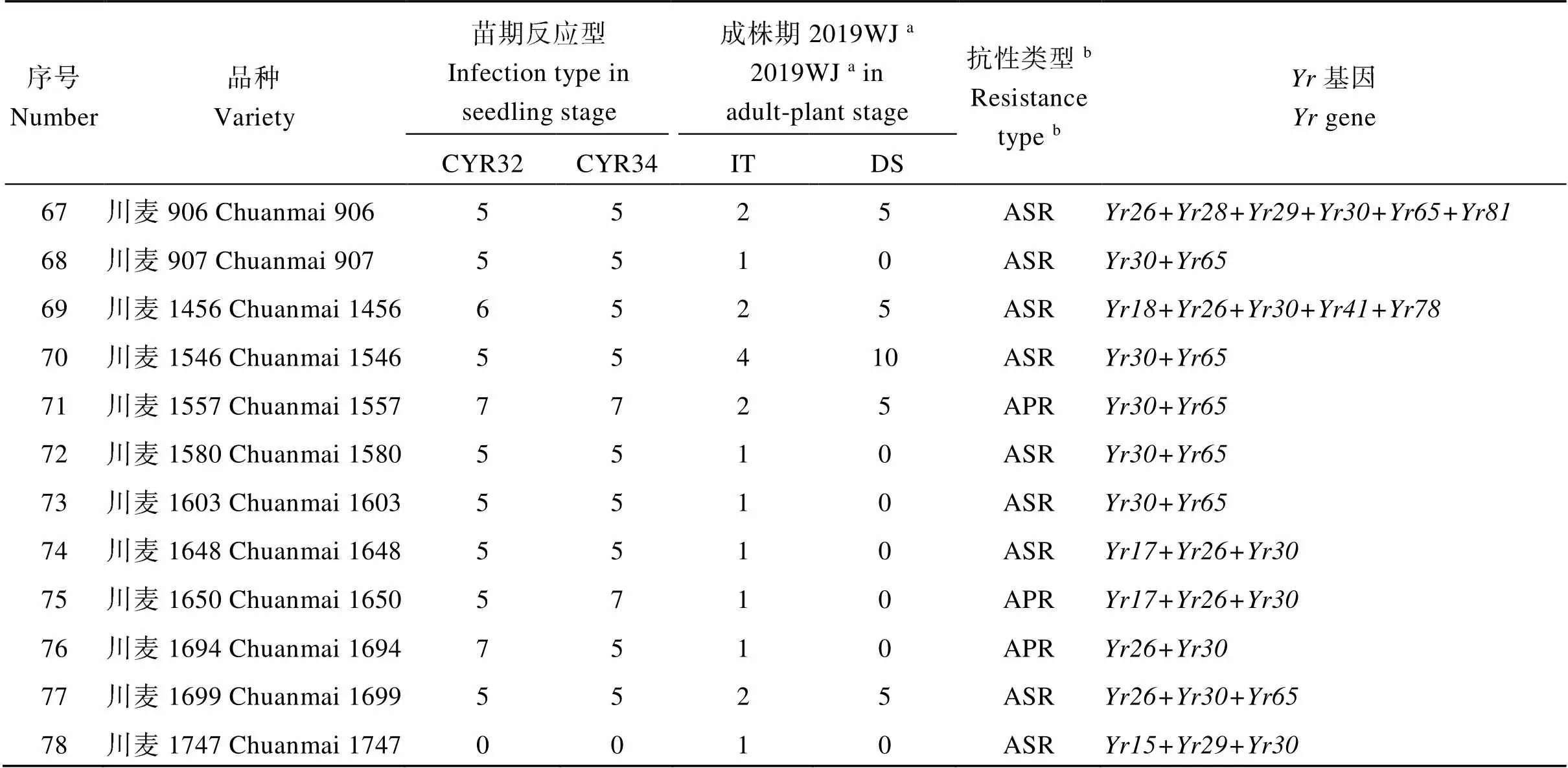
(續表2)
a2019WJ, 成株期抗條銹病鑒定于2019年在溫江基地(2019WJ)進行; DS: 病害嚴重度;bAPR: 成株期抗性; ASR: 全生育期抗性; “—”: 未知基因或未確定基因。
a2019WJ indicates identification of wheat materials resistance to wheat stripe rust in Wenjiang in 2019; DS: disease severity; APR: adult plant resistance; ASR: all stages resistance; “—”: unknown or undeterminedgene.
2.4 抗條銹病基因分析
根據19個抗條銹病基因、、、、、、、、、、、、、、、、、和的分子鑒定結果(表2), 綿麥319、綿麥906和蜀麥1843等5份材料可能攜帶; 西科麥557、蜀麥1829、綿麥835等5份材料可能攜帶(圖1), 占6.41%; 凡37123、31966和西科麥475等45份材料可能攜帶; 與共分離的基因特異性標記、STS標記以及KASP標記的檢測表明, 僅川麥801和川麥1456 可能攜帶, 占2.56%; 與緊密連鎖的STS標記和檢測出綿麥1419、川麥607、川麥1699等30份材料可能攜帶該基因; 綿麥905、蜀麥1675、川麥93等5份材料可能攜帶, 占6.41%; 利用CAPS標記檢測結果, 發現西科麥497、蜀麥1743、川麥83等30份材料可能攜帶, 占38.46%; 西科麥12、蜀麥1821、川麥1650等39份材料可能攜帶(圖2), 占50%; 綿麥906、川農27和川農32等3份材料可能含有, 占3.85%; 利用的緊密連鎖標記和均擴增出目標條帶的有蜀麥1868和川麥1456, 占2.56%; 可能攜帶的包括綿麥827、川麥605、川麥901等22份材料, 占28.21%; 川農39、西科麥518、蜀麥1885等8份材料可能攜帶, 占10.26%; 與連鎖的KASP標記檢測出綿麥1501、西科麥546和川麥607等23份材料可能攜帶該基因; 根據KASP標記檢測結果顯示, 綿麥903、川農30、川麥87等6份材料可能攜帶(圖3), 占7.69%; 與連鎖的KASP標記檢測出凡37123、31966、西科麥11等24份材料可能含有該基因, 占30.77%。所有供試材料均未檢測到、、和。僅西科麥18未檢測到以上19個基因, 推測其可能攜帶未檢測到的其他已知或新的抗條銹基因。
2.5 Yr基因聚合的分子檢測
由表2可知, 四川小麥育成品種(系)中含多個基因的材料共74份, 占供試材料的94.87%, 同時攜帶2~6個基因的材料分別為24、22、11、14和3份。攜帶2個基因的西科麥12 ()、川農41 ()和川麥606 ()等11份材料表現成株期抗性; 攜帶3個基因的22份材料中, 西科麥518 ()、蜀麥1821 ()和蜀麥1843 ()等12份材料表現出成株期抗性; 攜帶4個基因的材料中僅綿麥319 ()和川麥98 ()表現全生育期抗性, 其余均為成株期抗性材料; 攜帶5個基因的綿麥827 ()、蜀麥1868 ()和川麥1456 ()等8份材料表現全生育期抗性。攜帶6個基因的川麥93 ()和川麥801 ()為成株期抗性材料, 川麥906 ()表現全生育期抗性。這些攜帶多個基因的種質在田間對條銹病均表現出高抗或免疫水平。
M: Molecular weight marker (1 kb); 1:; 2: Avocet S; 3: 綿麥835; 4: 西科麥557; 5: 蜀麥1829; 6: 蜀麥1868; 7: 川麥1747; 8: 凡37123; 9: 31966; 10: 綿麥161; 11: 綿麥827; 12: 綿麥906; 13: 西科麥12; 14: 川農27; 15: 川農41; 16: 蜀麥1613; 17: 蜀麥1821; 18: 蜀麥1871; 19: 川麥607; 20: 川麥611; 21: 川麥802; 22: 川麥803。
M: molecular weight marker (1 kb); 1:; 2: Avocet S; 3: Mianmai 835; 4: Xikemai 557; 5: Shumai 1829; 6: Shumai 1868; 7: Chuanmai 1747; 8: Fan 37123; 9: 31966; 10: Mianmai 161; 11: Mianmai 827; 12: Mianmai 906; 13: Xikemai 12; 14: Chuannong 27; 15: Chuannong 41; 16: Shumai 1613; 17: Shumai 1821; 18: Shumai 1871; 19: Chuanmai 607; 20: Chuanmai 611; 21: Chuanmai 802; 22: Chuanmai 803.
M: Molecular olecular weight marker (35~5000 bp); 1: Opata85(); 2: Avocet S; 3: 綿麥827; 4: 綿麥1419; 5: 西科麥12; 6: 西科麥475; 7: 川農39; 8: 蜀麥1671; 9: 蜀麥1675; 10: 蜀麥1871; 11: 川麥86; 12: 川麥87; 13: 川麥802; 14: 川麥905; 15: 川麥906。
M: molecular weight marker (35–5000 bp); 1: Opata 85 (); 2: Avocet S; 3: Mianmai 827; 4: Mianmai 1419; 5: Xikemai 12; 6: Xikemai 475; 7: Chuannong 39; 8: Shumai 1671; 9: Shumai 1675; 10: Shumai 1871; 11: Chuanmai 86; 12: Chuanmai 87; 13: Chuanmai 802; 14: Chuanmai 905; 15: Chuanmai 906.
黃色: 攜帶的綿麥903、綿麥906、綿麥5658、川農30、川農32和川麥87。藍色: 未攜帶的綿麥319、綿麥835、西科麥12、西科麥518、蜀麥1675和川麥605。綠色:多基因品種(系)綿麥1501、蜀麥1871和川麥906。黑色: 空白對照H2O。
Yellow: wheat cultivars carrying, Mianmai 903, Mianmai 906, Mianmai 5658, Chuannong 30, Chuannong 32, and Chuanmai 87. Blue: wheat cultivars without carrying, Mianmai 319, Mianmai 835, Xikemai 12, Xikemai 518, Shumai 1675, and Chuanmai 605. Green:multigenic wheat cultivars (lines), Mianmai 1501, Shumai 1871, and Chuanmai 906. Black: H2Oasblank control.
3 討論
3.1 四川盆地小麥品種(系)條銹病抗性研究
四川盆地在我國西南麥區占有重要地位, 從1930年以來, 四川小麥育種已有80多年歷史, 選育和推廣具有優良農藝性狀以及抗病抗蟲的高產優質小麥品種是小麥育種的目標, 小麥育成品種的育種措施主要是雜交育種、誘變育種和雜交誘變相結合, 其中雜交育種是目前四川省品種選育的主要方式[54]。四川小麥通過與CIMMYT的冬春雜交穿梭育種培育出一大批高產, 優質和具有抗性的小麥中間材料或新品種, 使優異的抗性基因得到合理利用, 被廣泛應用于小麥生產上[13]。還有一部分小麥種質由國內外育種專家利用小麥與外緣屬種黑麥(L.)、簇毛麥(L.)、粗山羊草()等創制的易位系進行育種, 如利用小麥-黑麥1RS?1BL易位系[55]作為親本來源培育出的川農27、川農30和川農32等材料; 由小麥-簇毛麥6VS?6AL易位系選育而成的92R系列[56], 培育出蜀麥482、川麥91和川麥92等小麥品種; 以及利用CIMMYT的Syn-CD769和Syn-CD786等[57]人工合成小麥培育出綿麥367、川麥601和川麥602等優異的種質資源, 目前作為四川小麥育種中的重要抗性資源[54]。小麥條銹病是一種氣傳性真菌病害, 由于抗病基因布局單一, 當前小麥生產上大面積推廣和種植的抗病品種攜帶相同抗病基因, 而長期以來病原菌與寄主之間協同進化, 極易導致抗病基因失效, 為小麥育種帶來嚴峻挑戰[58]。例如, 自20世紀60年代, 攜帶的小麥引進中國并廣泛應用于小麥育種計劃中, 到20世紀80年代末, 80%以上的小麥品種都攜帶, 然而在1985年出現的新小種CYR29導致攜帶的小麥品種喪失抗性, 造成1990年小麥產量損失265萬噸[2,59-60]。因此培育具有持久抗性的小麥品種對可持續控制小麥條銹病至關重要[61]。
四川省育種家加強了對條銹病的防控意識。2000年后, 在小麥品種審定中實行“條銹病抗性一票否決制”, 使小麥條銹病得到有效控制[21]。朱光等[62]利用CYR31、CYR32、CYR33的混合菌對427份湖北省小麥品系進行條銹病的抗性鑒定, 抗條銹病的有173份, 參試品系對條銹病抗性介于中抗和中感之間, 綜合抗性水平不高。劉敏捷等[63]利用CYR32、CYR33的混合菌對369份山西省小麥區試品種以及育種材料進行條銹病抗性分析, 發現對小麥條銹病表現抗病的僅44份, 占11.9%, 抗性水平整體偏低, 建議在該地區加強新抗源的篩選和鑒定, 不斷提高抗病育種水平。張培禹等[64], 王相權等[21], 曹世勤等[22]對部分四川省小麥品種(系)進行條銹病抗性鑒定, 抗性種質分別占供試材料的47.76%、21.75%和25.29%, 抗性水平整體偏低。本研究鑒定78份近幾年選育的四川小麥品種(系)對當前流行的條銹菌均有較強的抗性, 與往年相比, 抗性品種所占比例明顯提高, 可繼續在小麥生產中使用。
3.2 四川小麥品種(系)抗條銹病基因布局
中國歷史上發生過多次小麥條銹病大流行, 導致小麥嚴重減產, 其根本原因是使用單一或少數抗源, 小麥品種較快喪失抗性。分子標記輔助選擇(MAS)可快速準確對抗病基因標記位點進行檢測, 再與田間抗病性鑒定相結合, 可大大縮短育種年限, 有效提高育種效率[54]。Huang等[65]在2000—2016年黃淮海麥區審定的66份小麥品種中篩選到10份對CYR32、CYR33、CYR34都具有抗性的種質, 在24個品種中檢測到、、和, 其中頻率最高, 占28.8%, 所有種質都未檢測到、和。本研究分子檢測結果顯示, 攜帶、、、、、、、、、、、、、和的材料各有5、5、45、2、30、5、30、39、3、2、22、8、23、6和24份。其中、和主要存在于川麥系列。源自四倍體野生二粒小麥(), 定位于1BS上, 本研究中5份種質檢測出, 目前對中國的主流小種具有較好的抗性, 今后可在小麥育種中加強利用[32]。來自偏凸山羊草(Tsusch)的基因片段目前仍具有抗性[66], 本研究鑒定得到45份攜帶該基因的材料, 占比較高。作為慢銹性基因, 可延緩病情發展的速度,//基因簇對葉銹病、條銹病和白粉病等多種真菌病害具有部分或持久抗性[39], 本研究中僅有川麥801和川麥1456檢測出。董娜等[67]在348份小麥育成品種(系)中僅檢測出7份攜帶的種質, 表明在中國育成品種(系)中分布頻率較低, 在今后抗性育種中也應加強對此類慢銹性基因的利用。來源于中國圓錐小麥(L.)80-1, 被定位到染色體1BS上[68], 本研究篩選得到30份可能攜帶該基因的材料, 但對CYR34已失去抗性, 今后應謹慎使用, 避免單個基因應用到育種中, 應聚合不同抗病類型的基因培育持久抗性的新品種。源自普通小麥Pavon 76, 位于染色體1BL上[43], 本研究30份種質可能攜帶該基因。來源于普通小麥Opata 85, 位于染色體3BS上[44], 本研究檢測出39份可能攜帶該基因的種質。源自普通小麥PI 519805[51], 本研究檢測出23份可能含該基因的材料。被鑒定來自小麥地方品種Aus27430的染色體6AS上[53], 本研究得到24份可能攜帶該抗性基因的材料。僅西科麥18未檢測到本研究中的19個抗條銹病基因, 推測可能含有其他已知或未知的抗條銹病基因。本研究結果可為育種家培育抗病新品種提供理論基礎。
研究表明, 提高有效抗性基因的利用率, 要因地制宜, 合理布局不同抗性類型基因, 從而實現小麥生產品種抗病基因多樣化, 以培育出具有多基因聚合的持久抗性新品種[69]。周軍等[69-70]對來自貴州、四川、山東等省的242份小麥品種(系)進行抗條銹病評價以及抗條銹病基因、、、、的分子檢測, 發現具有成株期抗性的有貴協2號、貴農25號等116份材料, 同時含有2、3、4個抗條銹病基因的分別有39、7和1份, 如+和, 供試材料中攜帶基因的頻率最高(24.38%)。蔚睿等[72]對2017-2019年黃淮麥區區試的150份小麥品種(系)進行條銹病抗性鑒定以及、、、、、、和的分子標記檢測, 鑒定到47份具有成株期抗性, 31份具有慢銹性, 其中69.3%的品種(系)攜帶, 16份材料同時攜帶2個抗性基因(、等), 2份攜帶3個抗條銹病基因(), 該研究發現供試材料的抗性主要是由多個基因提供。Liu等[73]對2個已知抗條銹病基因的小麥品種進行雜交, 培育具有顯著改善條銹病抗性的小麥品系, 研究發現、和對目前的條銹菌生理小種仍具有較好的抗性, 在+,+和+等基因組合中存在加性效應或上位效應, 同時抗性基因的數量與小麥的農藝性狀顯著性較小。本研究篩選出含多基因的材料共74份, 同時攜帶2~6個抗性基因的材料分別有24、22、11、14和3份, 田間表型均高抗條銹病。主要以基因聚合形式存在, 其中綿麥1501含5個抗性基因, 川麥93和川麥906同時攜帶6個抗性基因,雖對CYR34失去抗性, 但在多基因聚合的材料中不影響小麥品種的條銹病抗性。當前四川省選育的小麥品種(系)整體抗性水平較高, 可為小麥育種提供抗性親本資源。若抗病品種的抗性年限能從目前的3~5年延長至8年, 也許就能使抗銹育種跟上品種的更新換代, 就需要利用分子標記輔助選擇培育多基因聚合的品種, 提高抗性基因豐富度, 以有效提高品種的持久抗病性[69]。
4 結論
2016年以來四川小麥育成品種(系)對當前小麥條銹病流行小種具有較高抗性, 本研究中78份供試材料, 76份高抗條銹病, 2份中抗條銹病, 分子標記檢測出74份為多基因聚合種質, 其抗性可能由多個基因共同作用, 同時材料中也可能存在新的抗條銹病基因, 如西科麥18, 可進一步加強對抗源和抗性基因的挖掘, 結合分子標記輔助選擇應用于小麥育種中。
[1] Wellings C R. Global status of stripe rust: a review of historical and current threats., 2011, 179: 129–141.
[2] Wan A M, Chen X M, He Z H. Wheat stripe rust in China., 2007, 58: 605–619.
[3] 馬占鴻. 中國小麥條銹病研究與防控. 植物保護學報, 2018, 45(1): 1–6. Ma Z H. Researches and control of wheat stripe rust in China., 2018, 45(1): 1–6 (in Chinese with English abstract)
[4] 鄺文靜, 張貴勝, 章振羽, 姬紅麗, 沈麗, 倪建英, 王宗華, 彭云良. 小麥條銹病菌突變體的毒性研究. 西南農業學報, 2013, 26: 2323–2331. Kuang W J, Zhang G S, Zhang Z Y, Ji H L, Shen L, Ni J Y, Wang Z H, Peng Y L. Studies on virulence ofmutants off. sp., 2013, 26: 2323–2331 (in Chinese with English abstract).
[5] 賈秋珍, 黃瑾, 曹世勤, 張勃, 王曉明, 金社林. 感染我國重要小麥抗源材料貴農22的條銹菌新菌系的發現及致病性初步分析. 甘肅農業科技, 2012, (1): 3–5. Jia Q Z, Huang J, Cao S Q, Zhang B, Wang X M, Jin S L. Discovery of new stripe rust strain infected to China’s major wheat resistant material Guinong 22 and its preliminary pathogenicity analysis., 2012, (1): 3–5 (in Chinese with English abstract).
[6] 姚革, 蔣濱, 田承權, 夏先全, 蔣凡, 廖華明, 沈麗. 四川省小麥條銹病持續流行原因及防治對策. 西南農業學報, 2004, 17: 253–256. Yao G, Jiang B, Tian C Q, Xia X Q, Jiang F, Liao H M, Shen L. Epidemic and control strategies of wheat stripe rust in Sichuan, China.2004, 17: 253–256 (in Chinese with English abstract).
[7] 任勇, 李生榮, 周強, 杜小英, 何員江, 魏育明, 鄭有良. 134份四川小麥品種(系)的條銹病抗性評價. 麥類作物學報, 2014, 34: 847–853. Ren Y, Li S R, Zhou Q, Du X Y, He Y J, Wei Y M, Zheng Y L.Evaluation of resistance to stripe rust of 134 wheat cultivars and lines from Sichuan province., 2014, 34: 847–853 (in Chinese with English abstract).
[8] 李北. 四川盆地條銹菌冬繁區小麥品種(系)抗條銹性評價及基因分析. 西北農林科技大學, 陜西楊凌, 2017. pp 2–7. Li B. Stripe Rust Resistance and Genes in Wheat Cultivars and Lines from Inoculum Overwintering Region in Sichuan Basin. Northwest A&F University, Yangling, Shanxi, China, 2017. pp 2–7 (in Chinese with English abstract).
[9] 向運佳, 章振羽, 沈麗, 鄺文靜, 姬紅麗, 倪建英, 陳萬權, 彭云良. 2005-2010年四川省小麥條銹病菌毒性變化動態. 西南農業學報, 2013, 26: 1858–1863. Xiang Y J, Zhang Z Y, Shen L, Kuang W J, Ji H L, Ni J Y, Chen W Q, Peng Y L. Virulence dynamics off. sp.in Sichuan province from 2005 to 2010., 2013, 26: 1858–1863 (in Chinese with English abstract).
[10] 徐志, 王勝, 姬紅麗, 倪建英, 尹勇, 沈麗, 彭云良. 四川小麥條銹病菌貴農22致病類群流行對小麥品種抗性的影響. 西南農業學報, 2016, 29: 2845–2853. Xu Z, Wang S, Ji H L, Ni J Y, Yin Y, Shen L, Peng Y L. Resistance breakdown of wheat varieties in Sichuan caused by epidemic of Gu-22 virulence group off. sp.., 2016, 29: 2845–2853 (in Chinese with English abstract).
[11] 張顒, 楊武云, 胡曉蓉, 余毅, 鄒裕春, 李青茂. 源于硬粒小麥-節節麥人工合成種的高產抗病小麥新品種川麥42主要農藝性狀分析. 西南農業學報, 2004, 17: 141–145. Zhang Y, Yang W Y, Hu X R, Yu Y, Zou Y C, Li Q M. Analysis of agronomic characters of new wheat variety Chuanmai 42 derived from synthetics (×)., 2004, 17: 141–145 (in Chinese with English abstract).
[12] 張颙, 楊武云, 鄒裕春. 源于CIMMYT人工合成種的小麥新品種川麥42的選育與研究. 西南農業學報, 2007, 20: 199–202. Zhang Y, Yang W Y, Zou Y C. Characterisation of the new wheat cultivar Chuanmai 42 derived from CIMMYT hexaploid wheat., 2007, 20: 199–202 (in Chinese with English abstract).
[13] 鄒裕春, 張颙, 楊武云, 楊恩年, 黃鋼. 四川-CIMMYT小麥穿梭育種回顧與展望. 西南農業學報, 2003, 16: 102–106. Zou Y C, Zhang Y, Yang W Y, Yang E N, Huang G. Reviews and prospects of Sichuan-CIMMYT wheat shuttle breeding program., 2003, 16: 102–106 (in Chinese with English abstract).
[14] 鄒裕春, 楊武云, 朱華忠, 楊恩年, 蒲宗君, 伍鈴, 張颙, 湯永祿, 黃鋼, 李躍建, 何中虎, Singh R, Rajaram S. CIMMYT種質及育種技術在四川小麥品種改良中的利用. 西南農業學報, 2007, 20: 183–190. Zou Y C, Yang W Y, Zhu H Z, Yang E N, Pu Z J, Wu L, Zhang Y, Tang Y L, Huang G, Li Y J, He Z H, Singh R, Rajaram S. Utilization of CIMMYT germplasm and breeding technologies in wheat improvement in Sichuan, China., 2007, 20: 183–190 (in Chinese with English abstract)
[15] 韓燁, 何中虎, 夏先春, 李星, 李在峰, 劉大群. CIMMYT小麥材料的苗期和成株抗葉銹病鑒定. 作物學報, 2011, 37: 1125–1133. Han Y, He Z H, Xia X C, Li X, Li Z F, Liu D Q. Seedling and slow rusting resistances to leaf rust in CIMMYT wheat lines., 2011, 37: 1125–1133 (in Chinese with English abstract).
[16] Li J B, Dundas I, Dong C M, Li G R, Trethowan R, Yang Z J, Hoxha S, Zhang P. Identification and characterization of a new stripe rust resistance geneon rye chromosome 6R in wheat., 2020, 133: 1095–1107.
[17] Ye X L, Li J, Cheng Y K, Yao F J, Long L, Yu C, Wang Y Q, Wu Y, Li J, Wang J R, Jiang Q T, Li W, Ma J, Wei Y M, Zheng Y L, Chen G Y. Genome-wide association study of resistance to stripe rust (f. sp.) in Sichuan wheat., 2019, 19: 147, doi: 10.1186/s12870-019-1764-4.
[18] 周露. 四川小麥地方品種古宋大龍須抗條銹病基因的遺傳分析及染色體定位. 四川農業大學碩士學位論文, 四川成都, 2016. pp 21–27. Zhou L. Genetic Analysis and Chromosomal Location of Yellow Rust Resistance Gene in ‘Gusongdalongxu’ of Sichuan Wheat Landrace. MS Thesis of Sichuan Agricultural University, Chengdu, Sichuan, China, 2016. pp 21–27 (in Chinese with English abstract).
[19] 王健維. 四川小麥地方品種儀隴坨麥抗條銹病基因的遺傳分析及其分子標記. 四川農業大學碩士學位論文, 四川成都, 2015. pp 27–34. Wang J W. Genetics analysis and Molecular Tagging of Stripe Rust Resistance Gene in Sichuan Landrace Wheat Yilongtuomai.MS Thesis of Sichuan Agricultural University, Chengdu, Sichuan, China, 2015. pp 27–34 (in Chinese with English abstract).
[20] 劉濤. 四川小麥地方品種合江移栽麥抗條銹病基因的遺傳分析及染色體定位.四川農業大學學位論文, 四川成都, 2015. pp 23–32. Liu T. Genetic Analysis and Chromosomal Location of Yellow Rust Resistance Gene in Hejiangyizai of Sichuan Wheat Landraces.MS Thesis of Sichuan Agricultural University, Chengdu, Sichuan, China, 2015. pp 23–32 (in Chinese with English abstract).
[21] 王相權, 蔣云, 鄭建敏, 黃輝躍, 汪仁全, 王春鳳, 楊杰智, 王仕林, 榮飛雪, 王用軍, 周海燕, 關淑仙, 陳新媛. 170 份四川省冬小麥品種(系)條銹病抗性鑒定. 湖北農業科學, 2019, 58(14): 65–69. Wang X Q, Jiang Y, Zheng J M, Huang H Y, Wang R Q, Wang C F, Yang J Z, Wang S L, Rong F X, Wang Y J, Zhou H Y, Guan S X, Chen X Y. Identification of strip-rust resistance of 170 winter wheat varieties (lines) in Sichuan province., 2019, 58(14): 65–69 (in Chinese with English abstract).
[22] 曹世勤, 孫振宇, 徐志, 王萬軍, 賈秋珍, 楊隨莊, 彭云良, 黃瑾, 張勃. 331份四川小麥品種(系)在甘肅隴南抗條銹性表現及利用價值. 植物保護, 2019, 45(1): 155–158. Cao S Q, Sun Z Y, Xu Z, Wang W J, Jia Q Z, Yang S Z, Peng Y L, Huang J, Zhang B. Evaluation resistance of 331 Sichuan wheat cultivars (lines) to stripe rust and their utilization prospect in southern Gansu province., 2019, 45(1): 155–158 (in Chinese with English abstract).
[23] Quan W, Hou G L, Chen J, Du Z Y, Lin F, Guo Y, Liu S, Zhang Z J. Mapping of QTL lengthening the latent period ofin winter wheat at the tillering growth stage., 2013, 136: 715–727.
[24] Liu T G, Peng Y L, Chen W Q, Zhang Z Y. First detection of virulence inf. sp.in China to resistance genes(=) present in wheat cultivar Chuanmai 42., 2010, 94: 1163, doi:10.1094/PDIS-94-9-1163C.
[25] Wu J H, Wang Q L, Chen X M, Wang M J, Mu J M, Lv X N, Huang L L, Han D J, Kang Z S. Stripe rust resistance in wheat breeding lines developed for Central Shaanxi, an overwintering region forf. sp.in China., 2016, 38: 317–324.
[26] 劉博, 劉太國, 章振羽, 賈秋珍, 王保通, 高利, 彭云良, 金社林, 陳萬權. 中國小麥條銹菌條中 34 號的發現及其致病特性. 植物病理學報, 2017, 47: 681–687. Liu B, Liu T G, Zhang Z Y, Jia Q Z, Wang B T, Gao L, Peng Y L, Jin S L, Chen W Q. Discovery and pathogenicity of CYR34, a new race off. sp.in China., 2017, 47: 681–687 (in Chinese with English abstract).
[27] Line R F, Qayoum A. Virulence, aggressiveness, evolution and distribution of races of(the cause of stripe of wheat) in North America 1968-87., 1992, 1788: 1–44.
[28] Qayoum A, Line R F. High-temperature, adult plant resistance to stripe rust of wheat., 1985, 75: 1121–1125.
[29] 陳國躍, 姚琦馥, 劉亞西, 鄧梅, 吳文雄, 何員江, 余馬. 四川地方小麥品種條銹病抗性研究. 四川農業大學學報, 2013, 31: 1–8. Chen G Y, Yao Q F, Liu Y X, Deng M, Wu W X, Yu M. Studies on yellow rust resistance of Sichuan wheat landraces., 2013, 31: 1–8 (in Chinese with English abstract).
[30] Hill-Ambroz K L, Brown-Guedira G L, Fellers J P. Modified rapid DNA extraction protocol for high throughput microsatellite analysis in wheat., 2002, 42: 2088–2091.
[31] Wu J H, Huang S, Zeng Q D, Liu S J, Wang Q L, Mu J M, Yu S Z, Han D J, Kang Z S. Comparative genome-wide mapping versus extreme pool-genotyping and development of diagnostic SNP markers linked to QTL for adult plant resistance to stripe rust in common wheat., 2018, 131: 1777–1792.
[32] Marchal C, Zhang J P, Zhang P, Fenwick P, Steuemagel B, Adamski N M, Boyd L, Mcintosh R, Wulff B B H, Berry S, Lagudah E, Uauy C. BED-domain-containing immune receptors confer diverse resistance spectra to yellow rust., 2018, 4: 662–668.
[33] 邵映田, 牛永春, 朱立煌, 翟文學, 徐世昌, 吳立人. 小麥抗條銹病基因的AFLP標記. 科學通報, 2001, 46: 669–672. Shao Y T, Niu Y C, Zhu L H, Zhai W X, Xu S C, Wu L R. AFLP marker of stripe rust resistance genein wheat., 2001, 46: 669–672 (in Chinese with English abstract).
[34] Liu W, Frick M, Huel R, Nykiforuk C L, Wang X M, Gaudet D A, Eudes F, Conner R L, Kuzyk A, Chen Q, Kang Z S, Laroche A. The stripe rust resistance geneencodes an evolutionary-conserved and unique CC-NBS-LRR sequence in wheat., 2014, 7: 1740–1755.
[35] Klymiuk V, Yaniv E, Huang L, Raats D, Fatiukha A, Chen S S, Feng L H, Frenkel Z, Krugman T, Lidzbarsky G, Chang W, J??skel?inen M J, Schudoma C, Paulin L, Laine P, Bariana H, Sela H, Saleem K, S?rensen C K, Hovm?ller M S, Distelfeld A, Chalhoub B, Dubcovsky J, Korol A B, Schulman A H, Fahima T. Cloning of the wheatresistance gene sheds light on the plant tandem kinase-pseudokinase family., 2018, 9: 178–202.
[36] He Y, Feng L H, Jiang Y, Zhang L Q, Yan J, Zhao G, Wang J R, Chen G Y, Wu B H, Liu D C, Huang L, Fahima T. Distribution and nucleotide diversity ofin wild emmer populations and Chinese wheat germplasm., 2020, 9: 212, doi: 10.3390/pathogens9030212.
[37] Huang L, Feng L H, He Y, Tang Z Z, He J S, Sela H, Krugman T, Fahima T, Liu D C, Wu B H. Variation in stripe rust resistance and morphological traits in wild emmer wheat populations., 2019, 9: 44.
[38] 賈舉慶, 雷孟平, 劉成, 李光蓉, 楊足君. 小麥抗條銹基因的新SCAR標記的建立與應用. 麥類作物學報, 2010, 30: 11–16. Jia J Q, Lie M P, Liu C, Li G R, Yang Z J. Exploitation and application of a new SCAR marker linked to strip rust resistance genein wheat., 2010, 30: 11–16 (in Chinese with English abstract).
[39] Lagudah E S, Krattinger S G, Herrera-Foessel S, Singh R P, Huerta-Espino J, Spielmeyer W, Brown-Guedira G, Selter L L, Keller B. Gene-specific markers for the wheat genewhich confers resistance to multiple fungal pathogens., 2009, 119: 889–898.
[40] Fang T L, Lei L, Li G Q, Powers C, Hunger R M, Carver B F, Yan L L. Development and deployment of KASP markers for multiple alleles ofin wheat., 2020, 133: 2183–2195.
[41] Wang C M, Zhang Y P, Han D J, Kang Z S, Li G P, Cao A Z, Chen P D. SSR and STS markers for wheat stripe rust resistance gene., 2008, 159: 359–366.
[42] Zhang C Z, Huang L, Zhang H F, Hao Q Q, Lyu B, Wang M N, Epstein L, Liu M, Kou C L, Qi J, Chen F J, Li M K, Gao G, Ni F, Zhang L Q, Hao M, Wang J R, Chen X M, Luo M C, Zheng Y L, Wu J J, Liu D C, Fu D L. An ancestral NB-LRR with duplicated 3'UTRs confers stripe rust resistance in wheat and barley., 2019, 10: 4023.
[43] Ren Y, Singh R P, Basnet B R, Lan C X, Huerta-Espino J, Lagudah E S, Ponce-Molina L J, Lan C X. Identification and mapping of adult plant resistance loci to leaf rust and stripe rust in common wheat cultivar Kundan., 2017, 101: 456–463.
[44] Hayden M J, Kuchel H, Chalmers K J. Sequence tagged microsatellites for thelocus provide new diagnostic markers to select for the presence of stem rust resistance genein bread wheat (L.)., 2004, 109: 1641–1647.
[45] Huang L, Sela H, Feng L H, Chen Q J, Krugman T, Yan J, Dubcovsky J, Fahima T. Distribution and haplotype diversity of WKS resistance genes in wild emmer wheat natural populations., 2016, 129: 921–934.
[46] Lin F, Chen X M. Genetics and molecular mapping of genes for race-specific all-stage resistance and non-race-specific high-temperature adult-plant resistance to stripe rust in spring wheat cultivar Alpowa., 2007, 114: 1277–1287.
[47] Luo P G, Hu X Y, Ren Z L, Zhang H Y, Shu K, Yang Z J. Allelic analysis of stripe rust resistance genes on wheat chromosome 2BS., 2008, 51: 922–927.
[48] Lowe I, Jankuloski L, Chao S, Chen X M, See D, Dubcovsky J. Mapping and validation of QTL which confer partial resistance to broadly virulent post-2000 North American races of stripe rust in hexaploid wheat., 2011, 123: 143–157.
[49] Cheng P, Xu S, Wang M N, See D R, Chen X M. Molecular mapping of genesandfor stripe rust resistance in hexaploid derivatives of durum wheat accessions PI 331260 and PI 480016., 2014, 127: 2267–2277.
[50] Xu H X, Zhang J, Zhang P, Qie Y M, Niu Y C, Li H J, Ma P T, Xu Y F, An D G. Development and validation of molecular markers closely linked to the wheat stripe rust resistance genefor marker-assisted selection., 2014, 198: 317–323.
[51] Dong Z Z, Hegarty J M, Zhang J L, Zhang W J, Chao S, Chen X M, Yonghong Zhou Y H, Dubcovsky J. Validation and characterization of a QTL for adult plant resistance to stripe rust on wheat chromosome arm 6BS ()., 2017, 130: 2127–2137.
[52] Nsabiyera V, Bariana H S, Qureshi N, Wong D, Hayden M J, Bansal U K. Characterisation and mapping of adult plant stripe rust resistance in wheat accession Aus27284., 2018, 131: 1459–1467.
[53] Gessese M, Bariana H, Wong D, Hayden M, Bansal U. Molecular mapping of stripe rust resistance genein a common wheat landrace Aus27430., 2019, 103: 1166–1171.
[54] 鄭建敏, 羅江陶, 萬洪深, 李式昭, 楊漫宇, 李俊, 楊恩年, 蔣云, 劉于斌, 王相權, 蒲宗君. 四川省小麥育成品種系譜分析及發展進程. 遺傳, 2019, 41: 599–610. Zheng J M, Luo J T, Wan H S, Li S Z, Yang M Y, Li J, Yang E N, Jiang Y, Liu Y B, Wang X Q, Pu Z J. Pedigree and development of wheat varieties in Sichuan province.(Beijing), 2019, 41: 599–610 (in Chinese with English abstract).
[55] Rabinovich S V. Importance of wheat-rye translocations for breeding modern cultivars ofL., 1998, 100: 323–340.
[56] Chen P, Qi L, Zhou B, Zhang S, Liu D. Development and molecular cytogenetic analysis of wheat-6VS/6AL translocation lines specifying resistance to powdery mildew., 1995, 91: 1125–1128.
[57] Yang W, Liu D, Li J, Zhang L, Wei H, Hu X, Zheng Y, He ZH, Zou Y. Synthetic hexaploid wheat and its utilization for wheat genetic improvement in China., 2009, 36: 539–546.
[58] Chen X M. Epidemiology and control of stripe rust (f. sp.) on wheat., 2005, 27, 314–337.
[59] Wan A M, Zhao Z H, Chen X M, He Z H, Jin S L, Jia Q Z, Yao G, Yang J X, Wang B T, Li G B, Bi Y Q, Yuan Z Y. Wheat stripe rust epidemic and virulence off. sp.in China in 2002., 2004, 88: 896–904.
[60] Chen W Q, Wu L R, Liu T G, Xu S C, Jin S L, Peng Y L, Wang B T. Race dynamics diversity and virulence evolution inf. sp.the causal agent of wheat stripe rust in China from 2003 to 2007., 2009, 93: 1093–1101.
[61] 劉太國, 章振羽, 劉博, 高利, 彭云良, 陳萬權. 小麥抗條銹病基因毒性小種的發現及其對我國小麥主栽品種苗期致病性分析. 植物病理學報, 2015, 45: 41–47. Liu T G, Zhang Z Y, Liu B, Gao L, Peng Y L, Chen W Q. Detection of virulence toand pathogenicity to Chinese commercial winter wheat cultivars at seedling stage., 2015, 45: 41–47 (in Chinese with English abstract).
[62] 朱光, 彭敏, 劉健, 鄒賢斌, 汪華, 楊立軍, 高春保, 劉易科. 湖北省小麥品種(系)對赤霉病、條銹病、白粉病和紋枯病的抗性評價. 植物保護, 2020, 46(3): 204–209. Zhu G, Peng M, Liu J, Zou X B, Wang H, Yang L J, Gao C B, Liu Y K. Evaluation on resistance of wheat varieties (lines) tohead blight, stripe rust, powdery mildew and sharp eyespot in Hubei province., 2020, 46(3): 204–209 (in Chinese with English abstract).
[63] 劉敏捷, 原宗英, 武英鵬. 2015–2018年度山西省小麥區域試驗品種及育種材料抗病性評價. 山西農業科學, 2020, 48: 489–491. Liu M J, Yuan Z Y, Wu Y P. Resistance evaluation of wheat regional trail varieties and breeding materials in Shanxi province in 2015–2018., 2020, 48: 489–491 (in Chinese with English abstract).
[64] 張培禹, 曾慶東, 王琪琳, 康振生, 韓德俊. 四川盆地小麥品種(系)抗條銹性鑒定與評價. 麥類作物學報, 2012, 32: 779–783. Zhang P Y, Zeng Q D, Wang Q L, Kang Z S, Han D J. Identification and evaluation of resistance to stripe rust in current wheat cultivars (lines) from Sichuan basin., 2012, 32: 779–783 (in Chinese with English abstract).
[65] Huang L, Xiao X Z, Liu B, Gao L, Gong G S, Chen W Q, Zhang M, Liu T G. Identification of stripe rust resistance genes in common wheat cultivars from the Huang-Huai-Hai region of China., 2020, 104: 1763–1770.
[66] Wang Y, Zhang H Z, Xie J Z, Guo B M, Chen Y X, Zhang H Y, Lu P, Wu Q H, Li M M, Zhang D Y, Guo G H, Yang J, Zhang P P, Zhang Y, Wang X C, Zhao H, Cao T J, Liu Z Y. Mapping stripe rust resistance genes by BSR-Seq:andon chromosome 2AS in Chinese wheat lines Mengmai 58 and Huaiyang 1 are., 2018, 6: 91–98.
[67] 董娜, 胡海燕, 胡鐵柱, 李淦, 李小軍, 陳向東, 張亞娟, 茹振鋼. 348份小麥種質中抗條銹病基因、和的分子標記檢測與分布. 西北農業學報, 2019, 28: 1960–1968. Dong N, Hu H Y, Hu T Z, Li G, Li X J, Chen X D, Zhang Y J, Ru Z G. Molecular detection and distribution of stripe rust resistance genes,andamong 348 wheat germplasms., 2019, 28: 1960–1968 (in Chinese with English abstract).
[68] Ma J X, Zhou R H, Dong Y S, Wang L F, Wang X M, Jia J Z. Molecular mapping and detection of the yellow rust resistance genein wheat transferred fromL. using microsatellite markers., 2001, 120: 219–226.
[69] 吳立人, 牛永春. 我國小麥條銹病持續控制的策略. 中國農業科學, 2000, 33(5): 1–7. Wu L R, Niu Y C. Strategies of sustainable control of wheat stripe rust in China., 2000, 33(5): 1–7 (in Chinese with English abstract).
[70] 陳萬權, 康振生, 馬占鴻, 徐世昌, 金社林, 姜玉英. 中國小麥條銹病綜合治理理論與實踐. 中國農業科學, 2013, 46: 4254–4262. Chen W Q, Kang Z S, Ma Z H, Xu S C, Jin S L, Jiang Y Y. Integrated management of wheat stripe rust caused byf. sp.in China., 2013, 46: 4254–4262 (in Chinese with English abstract).
[71] 周軍, 李魁印, 張立, 彭琴, 徐如宏, 任明見. 242份小麥品種(系)成株期抗條銹病鑒定及分子標記檢測. 河南農業科學, 2020, 49(6): 84–97. Zhou J, Li K Y, Zhang L, Peng Q, Xu R H, Ren M J. Identification of adult-plant resistance to stripe rust and molecular marker detection ofgene in 242 wheat varieties (lines)., 2020, 49(6): 84–97 (in Chinese with English abstract).
[72] 蔚睿, 金彥剛, 吳舒舒, 吳建輝, 王琪琳, 曾慶東, 劉勝杰, 夏中華, 王曉靜, 康振生, 韓德俊. 黃淮麥區小麥新品種(系)抗條銹水平與抗病基因分析. 麥類作物學報, 2020, 40: 278–284. Wei R, Jin Y G, Wu S S, Wu J H, Wang Q L, Zeng Q D, Liu S J, Xia Z H, Wang X J, Kang Z S, Han D J. Stripe rust resistance of new varieties(lines) from Huang-Huai valley wheat region in China., 2020, 40: 278–284 (in Chinese with English abstract).
[73] Liu R, Lu J, Zhou M, Zheng S G, Liu Z H, Zhang C H, Du M, Wang M X, Li Y F, Wu Y, Zhang L. Developing stripe rust resistant wheat (L.) lines with gene pyramiding strategy and marker-assisted selection., 2020, 67: 381–391.
Identification of resistance to wheat and molecular detection of resistance genes to wheat stripe rust of 78 wheat cultivars (lines) in Sichuan province
XI Ling1,2, WANG Yu-Qi1,2, ZHU Wei1,2, WANG Yi1,2, CHEN Guo-Yue1,2, PU Zong-Jun3, ZHOU Yong-Hong1,2, and KANG Hou-Yang1,2,*
1Triticeae Research Institute, Sichuan Agricultural University, Chengdu 611130, Sichuan, China;2State Key Laboratory of Crop Gene Exploitation and Utilization in Southwest China, Chengdu 611130, Sichuan, China;3Crop Research Institute, Sichuan Academy of Agricultural Sciences, Chengdu 610066, Sichuan, China
Sichuan province is one of the main origins of new races of the wheat stripe rust pathogen. To understand the resistance level of wheat cultivars (lines) bred in Sichuan since 2016 to the current predominant races of the pathogen and pathotypes and to clarify the distribution of resistance genes can provide a theoretical basis for the management of wheat stripe rust by breeding resistance wheat cultivars and wheat variety deployment in Sichuan. In this study, 78 Sichuan wheat cultivars (lines) were identified at seedling stage by two races CYR32 and CYR34. At adult plant stage in wheat, the mixture of the current predominant races of CYR32, CYR33, CYR34, G22-14, and G22 pathogenic groups virulent to wheat cultivar Guinong 22 were artificially inoculated to assess the resistance of the tested wheat. Nineteen resistance genes and QTLs, including,,,,,,,,,,,,,,,,,, and, were detected the presence of the resistance genes in all tested materials. The results showed that 60 (76.92%) of the 78 tested materials were resistant to CYR32, 40 (51.28%) resistant to CYR34, and 36 (46.15%) resistant to both races at seedling stage. Seventy-eight wheat materials were resistant to wheat stripe rust at adult stage, 4 out of which, including Mianmai 835, Shumai 1743, Shumai 1829, and Shumai 1868, were immune to the disease. Disease resistance identification showed that 42 (53.85%) exhibited adult plant resistance and 36 (46.15%) were all stage resistant to wheat stripe rust. Molecular detection indicated that 5, 5, 45, 2, 30, 5, 30, 39, 3, 2, 22, 8, 23, 6, and 24 carried the resistance gene,,,,,,,,,,,,,, and, respectively. Two to six resistance genes were detected in 24, 22, 11, 14, and 3 of the tested wheat materials, accounting for 94.87%.,,, andwere not detected in all wheat cultivars (lines), and only Xikemai 18, not detected any of the 19 resistance genes mentioned above, presumably, may carried other known or new resistance genes to wheat stripe rust. In summary, that resistance level of 78 wheat cultivars (lines) to wheat stripe rust was identified, and the resistance genes of these cultivars were identified. These results provide scientific basis for breeding durable resistant wheat cultivar.
stripe rust of wheat; wheat cultivars (lines); resistance evaluation; molecular detection
10.3724/SP.J.1006.2021.01061
本研究由“十三五”國家重點研發計劃項目(2017YFD0100900)和四川省應用基礎重點項目(2020YJ0348)資助。
This study was supported by the National Key Research and Development Program of China (2017YFD0100900) and the Science and Technology Bureau of Sichuan Province (2020YJ0348).
康厚揚, E-mail: houyang.kang@sicau.edu.cn, Tel: 028-86250350
E-mail: 1043975458@qq.com, Tel: 028-86250350
2020-08-02;
2020-11-13;
2020-12-22.
URL: https://kns.cnki.net/kcms/detail/11.1809.S.20201222.1440.002.html
