
借
2021-04-22 07:48:36
漢語(yǔ)世界(The World of Chinese) 2021年2期
Heres a character to borrow in hard times—but dont forget to give it back
有借有還,再借不難
In 208, when general and strategist Zhou Yu (周瑜) of the Three Kingdoms period challenged his rival Zhuge Liang (諸葛亮) to prepare 100,000 arrows within 10 days for their upcoming fight on the Yangtze River against the army of warlord Cao Cao (曹操), Zhuge knew that Zhou was setting him up for defeat. Nevertheless, he pledged to accept any punishment if he failed to complete the task in three days.
Instead of asking for craftsmen and materials, Zhuge prepared 20 boats covered with a black curtain, each loaded with 30 men and over 1,000 bundles of straw. In the early hours of the third day, under the cover of darkness and screened by heavy fog, Zhuge sent the boats floating toward Caos camp on the opposite bank. When they drew near their target, Zhuges 600 men began hollering loudly and beating drums, mimicking the sound of an attack. Alarmed, Cao ordered around 10,000 men to shoot arrows at the non-existent horde—all landing harmlessly on the bales of straw.
According to The Romance of Three Kingdoms (《三國(guó)演義》), a classic novel of the Ming (1368 – 1644) that dramatized events from this period in history, Zhuges troops sailed back before daybreak with over 100,000 arrows. The tale gave rise to the idiom 草船借箭 (c2ochu1n ji- ji3n, “borrowing arrows with thatched boats”), which refers to achieving ones goals by harnessing another persons strengths. It is commonly cited as evidence of Zhuges genius, though historians believe the clever ruse was in fact planned and carried out by Zhou Yus boss, the warlord Sun Quan (孫權(quán)), in another battle against Cao Cao in 213.
First appearing in the 2,000-year-old Analytical Dictionary of Chinese Characters (《說(shuō)文解字》), the character 借 (ji-, borrow) consists of a “person (人 r9n)” radical on the left side, and a “past
(昔 x~)” radical on the right side. It refers to making temporary use of other peoples property, as in 借錢(qián) (ji-qi1n, to borrow money) and 借書(shū) (ji-sh$, to borrow books).
The latter phrase naturally found favor with Chinas scholarly elites. Yan Tuizhi (顏之推), a scholar and educator from the sixth century, instructed in The Family Instructions of Master Yan (《顏氏家訓(xùn)》), “We must cherish all books borrowed from others (借人典籍,皆須愛(ài)護(hù) Ji- r9n di2nj!, ji8 x$ 3ih&).” The Qing dynasty (1616 – 1911) literatus Yuan Mei (袁枚) noted a paradox about reading, “Only borrowed books will be earnestly read (書(shū)非借不能讀也 Sh$ f8i ji- b&n9ng d% y0)”—namely, people will probably not read their own books because they believe they can read them anytime, but they will devour borrowed books because they need to return them eventually.
Confusingly, 借 means not only to borrow, but to lend. A librarian might say, “這本書(shū)是孤本,不外借 (Zh- b0n sh$ sh# g$b0n, b% w3i ji-, This is our only copy of the book, so it cannot be lent out).” When it refers to lending, 借 is often followed by the verb 給 (g0i, to give) to indicate who the recipient is—for instance, 她把手機(jī)借給同學(xué)了 (T` b2 sh6uj~ ji-g0i t5ngxu9 le, She lent her mobile phone to a classmate).
Paired with its synonym 貸 (d3i, loan), 借貸 (ji-d3i) refers to the borrowing and lending of money, as in 這個(gè)工廠靠借貸維持生產(chǎn) (Zh-ge g4ngch2ng k3o ji-d3i w9ich! sh8ngch2n, This factory depends on loans to operate). The receipt of a loan, or an IOU, is a 借條 (ji-ti1o) or 借據(jù) (ji-j&).
As the folk saying goes, “One loan returned in time makes it easier to borrow a second time (有借有還,再借不難 Y6u ji- y6u hu1n, z3i ji- b& n1n).” It is important for a person to build a good reputation by returning borrowed goods or repaying (還 hu1n) their creditors in a timely manner. However, not all borrowed items can be returned, as the verbs 借宿 (ji-s&, putting someone up for the night) and 借讀 (ji-d%, studying at a school away from ones home area) indicate.
In the examples above, the character 借 has been extended to mean making use of something in a broader sense. 借鑒 (ji-ji3n) is to draw lessons on others experience, and 借古諷今 (ji-g^-f0ngj~n) is to borrow a historical parable to criticize a current practice, often to disguise the barb and protect the critic from retribution.
In many idioms, 借 is used metaphorically. 借刀殺人 (ji-d`o-sh`r9n, “to murder with a borrowed knife”) is to take advantage of another person to get rid of an adversary, and 借花獻(xiàn)佛 (ji-hu`-xi3nf5, “to present Buddha with borrowed flowers”) is to make a present out of objects or opportunities provided by others. You might hear at a banquet, 今天是老孟請(qǐng)客,我借花獻(xiàn)佛,敬你一杯 (J~nti`n sh# L2o M-ng q@ngk-, w6 ji-hu`-xi3nf5, j#ng n@ y# b8i, Though Meng is the one treating us to dinner, Id like to take the opportunity to toast you).
借 can also indicate the use of pretexts, as in 借口 (ji-k6u, excuse) and 借故 (ji-g&, making an excuse). In international politics, the Chinese government is often heard protesting against countries interference in others internal affairs in the name of human rights (借人權(quán)問(wèn)題干涉別國(guó)內(nèi)政 ji- r9nqu1n w-nt! g`nsh- bi9gu5 n-izh-ng).
In addition the character is used for etiquette. For instance, 借光 (ji-gu`ng, literally “borrowing the light”), is a polite phrase one can use before asking others the time or for directions, or to request favors, as in “借光,去火車(chē)站怎么走 (Ji-gu`ng, q& hu6ch8zh3n z0nme z6u, Excuse me, could you tell me the way to the railway station)?” It also refers to benefiting from association with somebody else, as in “借這個(gè)高考狀元的光,我們?nèi)J艿搅耸虚L(zhǎng)的表?yè)P(yáng) (Ji- zh-ge g`ok2o zhu3ngyu1n de gu`ng, w6men qu1nxi3o sh7ud3o le sh#zh2ng de bi2oy1ng, Thanks to a classmate who scored highly on the national college entrance exams, our entire school was praised by the mayor).”
It is said that 借光 originated with the nocturnal reading habits of Kuang Heng (匡衡), a man born to a poor family who grew up to be a prime minister in the Western Han dynasty (206 BCE – 25 CE). As a child, Kuang had been keen to learn, but had to work in the daytime and had no lamp oil for reading at night. One evening, he noticed a slim beam of light shining from his neighbors house through a small hole in the wall, so he chiseled a bigger hole to use the light for reading. Known as 鑿壁借光 (z1ob#-ji-gu`ng, “borrowing light by chiseling a hole in the wall”), the story has been used to encourage children to study hard (hopefully without damaging their neighbors property or invading their privacy).
– Huang Weijia (黃偉嘉) and Tan Yunfei (譚云飛)
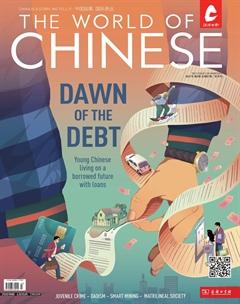 漢語(yǔ)世界(The World of Chinese)2021年2期
- 漢語(yǔ)世界(The World of Chinese)的其它文章
- Like a Boss
- seeking truths
- All About ING
- CANVASSING THE NEIGHBORHOOD
- Sausage Fest
- Mosuo on the move