
Mosuo on the move
2021-04-22 18:23:32徐盈盈
漢語世界(The World of Chinese) 2021年2期
關鍵詞:文化
徐盈盈

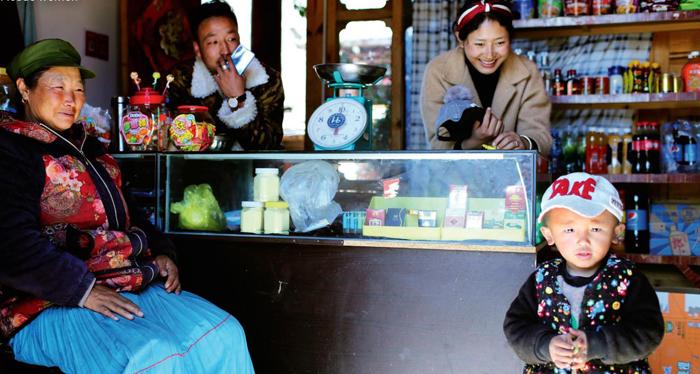

On Lugu Lake, Chinas last matrilineal culture is in chaotic transition
走進瀘沽湖畔女兒國,揭開摩梭文化的神秘面紗
Gemu Mountain, the highest peak beside Lugu Lake, bears striking resemblance to the profile of a slumbering woman: forehead, nose, chin, elegantly curved neck, and sloped breasts clearly defined. According to lore, Gemu was a goddess who trysted with several male gods down on earth, but missed the deadline to go back up to heaven. She instead turned into a mountain, watching over the lake and its people as a constant guardian (all her male lovers turned into smaller mountains surrounding her).
I wonder if Gemu is watching as our Tibetan driver, Mr. Yang, takes me and my traveling companions along the lake shore from Yunnan to Sichuan province. Yang shares the story of how he fell in love with a Mosuo woman, and left with her to work in the southeastern city of Guangzhou, before returning to Lugu Lake to have their child. While Mosuo typically inherit surnames from their mother, “we fought over whose surname our child would take—and almost divorced because of it—but I won,” Yang says triumphantly.
The Mosuo people, who number under 100,000 and have their own language, have lived for over two thousand years at the edge of Lugu Lake. For decades, the perceived exoticism of their matrilineal culture has been a draw for tourists, anthropologists, and journalists, many of whom portray it as a feminist utopia—a “Kingdom of Women” or “Nation of Daughters”—on the far-flung frontier of southwestern China.
Accessible only by horse until 1982, Lugu Lake straddles the border of Yunnan and Sichuan. The freshwater lake is the highest in Sichuan, nearly 2,700 meters above sea level, with waters so pure they shimmer green and blue at different depths. Today, freshly-paved roads connect it to the bustling tourist town of Lijiang, Yunnan, shortening a seven-day horseback ride to a smooth five-hour drive.
As with most ethnic groups in modern China, the last few decades reconfigured Mosuo life. The world has come knocking on Lugu Lakes door, with most of its young people exposed to new thinking by several years of work or study in nearby towns and cities. I flew into the shiny Ninglang Lugu Lake Airport—completed in 2015 and known as Yunnans highest altitude airport—and boarded a bus that wound around the hills for an hour up to the lakes shores.
Sitting next to me was Jiachu, a Mosuo ticket-seller with a ponytail and a baseball cap, who chattered excitedly with the Yi bus driver in Mandarin. Holding onto the railing as the bus swerved to and fro, Jiachu told me she hoped to move out of her maternal home once she saved enough money. “The last generation couldnt afford to build new houses,” she said. “But our generation can. My mother picked her most capable daughter to continue as head of her household, and the rest of us can go out and start our own nuclear families.”
More and more young people like Jiachu are opting out of the traditional Mosuo family structure. Traditionally, Mosuo belong to their mothers household their entire life, with three generations living in a courtyard complex with their grandmother at the helm. When a woman comes of age, she moves into her own “flower room” separate from the grandmothers complex, where she can take male visitors.
At the beginning of a courtship, men can only visit women at night and must leave in the morning; it is considered impolite if he is seen by the family. Today, skits performed for tourists in local villages dramatize this rendezvous: Men determinedly climb in through a womans window, or leave their hats hanging on the doors to ward off other suitors.
Affection is at the center of a Mosuo relationship, where both sides retain their financial independence. When the couple turn serious, men will formally offer gifts to the womans family, after which the couple become axia, or partners. At this point, no longer having to hide, the men are welcome to visit their axias family and sit by the hearth for meals and tea, though most still live and work in their maternal homes. This courtship, called sese, is often translated as “walking marriage,” though some argue it is not a marriage at all.
All children are raised in the mothers family, though the birth father will give a feast at the childs first full month to publicly acknowledge they are blood relations. A child calls each of their mothers sisters “mother,” while the word for “maternal uncle” carries more emotional weight than the word for “father.” Men help raise the children born to their sisters, and typically have little to do with parenting their own child.
To end a relationship, a woman needs only refuse to open her door, or a man needs only to say he will no longer be stopping by. Both are free to seek new partners without social stigma. In traditional Mosuo society, there are virtually no widows, orphans, homeless, divorce lawyers, or matchmakers, and some Mosuo tell me there is less domestic violence compared to other places.
In the 1960s and 70s, a Chinese anthropologist named Zhan Yongxu conducted a survey of the marital status of 1,740 women and 785 men living along the lake, finding 73 percent practiced axia relationships. Zhan reflected that the axia system was able to persist because the influence of the outside world was still relatively weak at the time—mountain communities across the world rely on isolation for their unique cultures to flourish—and the notion of individual private ownership had not yet formed.
Fast forward half a century, and many young Mosuo are now leaving their matrilineal homes and moving in with their lovers, citing various reasons: Couples are having less children and investing more in each childs education. Birth fathers now hope to have a more active role in their childrens lives. Surrounded from a young age with classmates of Yi, Tibetan, Naxi, and Han descent, many Mosuo are also marrying across ethnic lines. Some couples simply want to live romantic lives with each other, like those they see on TV.
As morning dawned over the lake, gulls flit through the mist that rises from the lakes placid waters. My travel companions and I decide to circle the lake (around 60 kilometers) by foot and by bike to truly get to know it. Half the lake belongs to Sichuan province, and the other half to Yunnan.
We pulled over for a rest on a rocky outcrop dominated by a stone stupa which formed the center of a dense entanglement of hundreds of trembling Tibetan prayer flags—a sign explained this was the source of Lugu Lake. A sacred place for the Mosuo, who practice Tibetan Buddhism alongside indigenous spiritualism, the lake is supposed to grant a blessing to all those who sip its water.
Mosuo were thought to have come to Lugu Lake over 2,000 years ago as yak herders, following the rivers south from modern-day Gansu to avoid the expanding Qin army that would establish the first Chinese empire (221 – 206 BCE). In early historical records such as the Book of Later Han, written in the 5th century, the Mosuo were known as “Yak Barbarians” who lived beside Lugu Lake and lived off its plentiful natural resources.
When Kublai Khans army entered Yunnan in the 13th century, annexing Yunnan to the Mongol empire, many of his soldiers settled on the eastern side of the lake. As the Mongol men married Mosuo women, some families in the community gradually became patrilineal. In modern times, some of these eastern Mosuo have successfully petitioned the government to register them as Mongol ethnicity, while other Mosuo are registered under the Naxi ethnicity.
From then until the 1960s, Lugu Lake was loosely administered in the chieftain system, in which a local chief ruled as a representative of the imperial court. It is said that the Mosuo family structure helped them evade a Qing dynasty (1616 – 1911) marriage tax, as there were no weddings to record.
The story of the last Mosuo chieftains secondary wife, Xiao Shuming, is preserved on an island in the lake now named Princess Island. Accessible by hired boat, the rocky isle is topped by a mansion (now a museum) where she once lived: reciting poems, playing the piano, and planting peonies until her death in 2008. A matchmaker arranged for Xiao, a well-educated and literate Han woman, to marry the chieftain. It was a political marriage: She was meant to help her husband with his paperwork in Chinese.
Xiaos story seems to contradict the popular idea of the Mosuo as practitioners of “free love”: She was formally married to an older man she had never met, as a secondary wife no less. The more nuanced truth is that Mosuo marriage practices have always evolved, both naturally and forcefully, in fits and starts, with the pressures of migration and political movements. While centuries of imperial rule failed to fundamentally change the social practices of common people, the last few decades have done far more in changing Mosuo culture from the inside-out.
After visiting the island, we return to shore for lunch, trekking up a dirt path to a traditional courtyard home belonging to a 24-year-old man named Kuzuo. His grandmother is still sitting by the hearth of her zumuwu (“grandmothers room”), drinking suyoucha, a salty milk tea. By 11 in the morning, she is on her second cup of the day. Kuzuo speaks to her in a hushed, respectful tone.
This room, built entirely out of wood as per Mosuo tradition, is the epicenter of Mosuo family life. It is where the family holds meetings and where important guests are welcomed. Its also where grandmother, the matriarch of the family, sleeps. Surrounding her is a Tibetan Buddhist altar, with two pillars signifying the two genders, and the newest addition to the room: a full-body electric massage chair. On the wall, between hanging scrolls of Tibetan thangka painting, is a yellowed portrait of Mao Zedong.
Under Mao, the Mosuo chieftain lost his mansions in the land reform. He and his wives were locked up for ten years during the Cultural Revolution, putting a decisive end to chieftain rule. Red Guards visiting Lugu Lake were also appalled at the “feudal” practice of sese. In the 1960s and 70s, many couples of walking marriages were pressured to register their marriages with the government, which ran a campaign titled “One Husband, One Wife.”
Even today, the widespread fascination of Lugu Lake is tied with a fetishization of sese as promiscuity. A sign on a closed shop reads, cheekily, “The owner is out on a walking marriage.” Tour guides report having trouble with overeager men trying to pick up Mosuo women, assuming their sexual availability. Media have reported that certain hotels and tours offer a “walking marriage experience” in which a professional sex worker would come to your door dressed in traditional Mosuo clothing. “It makes you so mad,” spits Kuzuo, “the lies that tour guides spread about us.”
Another popular misconception is often spread by Western visitors: While Mosuo culture is matrilineal, it is not matriarchal. Mosuo families traditionally worked as a collective with no sense of personal property, so there was nothing for women to inherit over men. Both genders have equal say at the fireplace where important decisions are made. Labor is divided by gender, women controlling finances and doing housework, men organizing community events and doing heavy manual labor.
However, this dynamic is also breaking down as incomes and lifestyles diverge. A man in his 30s, named Zhaxi, gives us a lift to town while bringing his familys walnuts to market. As we climb into his car, he recalls his childhood in which families helped each other with planting and harvests: “You help your neighbor, and they help you, thats how it had always been.” For every event in the village, whether a wedding or a funeral, each family must send one member to help out with cooking, set-up, and clean-up. As community spirit declined in recent years, some local towns have begun imposing fines on families who fail to participate.
Zhaxi tells us that he left Lugu Lake at age 11—first to build roads in the county, then to work in a shipbuilding factory in Jiangsu province—finally coming home aged 23. “Back then, men went out a lot, and women didnt go out as much. Now women like to go out, and men dont go so much—they feel like their labor isnt worth much.” Women take up jobs in the service industry, which pay higher than the construction and factory jobs most often filled by men. While I met handfuls of young Mosuo men during my trip, it was much rarer to see a young Mosuo woman still living in the village.
In the town of Lugu Lake, we take a seat at Erches Restaurant. Located along the main cobblestoned thoroughfare, it has a wallpaper in the pattern of international flags and a menu advertising pizza, lemonade, and lattes. Shelves in the back of the store are filled with books about Mosuo history. In addition to his penchant for international culture, 25-year-old Erche is the founder of the Mosuo Cultural Studies Society, a volunteer group of a few dozen Mosuo who regularly host scholarly lectures, Mosuo music and dance nights, and basketball games in the community. He spends his spare time collecting oral history accounts from elderly Mosuo about their spiritual traditions.
“A few years ago, I thought I would stay in my maternal household forever and keep the practice alive,” Erche says, taking a brisk sip of his coffee. “But now I feel that different people do different amounts of work, so Id rather move out.” Rather than handing his income over to his family to be spent by consensus, Erche preferred to control his own restaurants earnings—including the large sum he spent to register the Mosuo Cultural Studies Society as a social organization.
Finished with circling the lake, I sit by the water and watch a lonely string of Tibetan prayer flags shuddering violently in the wind. Todays Lugu Lake is a place where bubble tea is drunk alongside suyoucha, and IKEA furniture adorns the ancient architecture of the zumuwu. But perhaps it doesnt matter—Mosuo songs may be sung during the day for tourists in cultural performances, but they are also sung again at night, belted out by locals at full blast on KTV.
I look up at Gemu Mountain, silhouetted purple in the dusk, and back toward the village, where the roving lights of a disco strafe the sky. A gaggle of young men (one in a Simpsons sweater) amble past, chattering loudly in Mosuo. I wonder if theyre planning to climb through any windows tonight.
猜你喜歡
中國德育(2022年12期)2022-08-22 06:16:18
湖北教育·綜合資訊(2022年4期)2022-05-06 22:54:06
金橋(2022年2期)2022-03-02 05:42:50
金橋(2022年1期)2022-02-12 01:37:04
英語文摘(2019年1期)2019-03-21 07:44:16
小天使·一年級語數英綜合(2018年9期)2018-10-16 06:30:16
西部大開發(2017年8期)2017-06-26 03:16:12
西部大開發(2017年8期)2017-06-26 03:15:50
人民中國(日文版)(2015年10期)2015-04-16 03:53:52
人民中國(日文版)(2015年9期)2015-03-20 15:08:05
 漢語世界(The World of Chinese)2021年2期
- 漢語世界(The World of Chinese)的其它文章
- Like a Boss
- seeking truths
- All About ING
- CANVASSING THE NEIGHBORHOOD
- Sausage Fest
- Minor Offense