
A NEW WAY OF DAO
2021-04-13 02:41:08BYMADSVESTERAGERNIELSEN
漢語世界 2021年2期
關鍵詞:時代
BY MADS VESTERAGER NIELSEN
In a temple in the clouds, the ancient religion of Daoism tries adapting to the 21st century
“我”在陜西擂鼓臺當道士:古老的道教與嶄新的時代

High in the clouds on Leigutai Mountain—known as “Shaanxi’s Little Wudang Mountain” after the holy Daoist site in northern Hubei province—Priest Xuan Zhao pours green tea and discusses the newest young additions to the temple ranks.“It is difficult to compete with smart phones,” he says.
Xuan is the head and caretaker of the temple, known simply asdaoshi(道士), or “Dao practitioner.” Having overseen the affairs of the temple for a decade, Xuan has managed to attract three young men between the ages of 17 and 27 since 2017 to become his followers and live at the temple.It’s a small victory from the lonely existence he led with just himself and two assistants when he first took charge in 2010.
The lives and opportunities of young Chinese have changed dramatically since Xuan first decided to follow Dao in the 1980s.Sixty years ago, Leigutai boasted four full-fledged priests, and Xuan dreams of reaching this level again.Sometimes it seemed like an uphill battle, with an increasingly digitized young generation preferring city life and the worship of pop stars.“Young people today are not immediately interested in the depths of the Dao,” Xuan says.“But without them there won’t be anybody to take over when I am gone, so I have to try.”
Originating some time during the Warring States period (475 - 221 BCE), Daoism is the only major Chinese religion that is entirely homegrown.Many Chinese consider the sage Laozi to be the founder of Daoism and the author of its most sacred text, theDao De Jing.The religion enjoyed its ups and downs through the ages—soaring to unprecedented heights during the Song dynasty (960 - 1279), when the Huizong Emperor added Daoist priests to his court to teach him the secrets of alchemy—while retaining a status on par with Buddhism and Confucianism throughout most of Chinese history.
Daoism was standardized by the PRC after 1949 as a “religion”—a concept only arriving with Westerners in the late 1800s—and grouped together with folk religions all over China, some of them wildly inconsistent with original Daoist philosophy.Because of this, the estimate of the number of Dao followers differs widely.According to government figures, there are over 40,000 practicing priests and nuns scattered across more than 9,000 temples in China.It is estimated that more than 10 million people consider themselves Daoists, and more than 100 million participate in some form of Daoist or folk religious activities.
According to legend, the temple at Leigutai (擂鼓臺, “Drum-Beating Platform”) got its name when Zhang Fei (張飛), a famous hero from the Three Kingdoms period (220 - 280),used the mountain as a signaling post from which he could beat torrents of drum commands to his army below.Later, Huang Chao (黃巢), the leaderof one of the last rebellions that brought the Tang dynasty (618 - 907)to its knees, fled to the mountain when his forces were pushed out of the Tang capital of Chang’an (now Xi’an in Shaanxi province).These folk heroes and many others are now part of the pantheon of statues on the mountain.By the Qing dynasty(1616 - 1911), the temple had become famous for creating pills and mystic medicine.In 1953, the head monk,Yang Wenpeng, was even invited to join the Health Workers’ Association in neighboring Hanyin county due to the alleged healing effects of these Daoist panaceas.But by 1957 the tide of politics had turned against these“superstitious practices,” and Yang was expelled from the association.
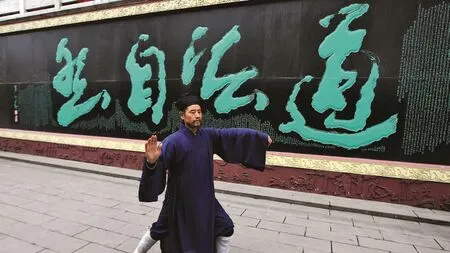
Martial arts are an aspect of Daoism that has seeped into popular culture

Incense dries in the main temple compound
Despite this, the popularity of the mountain and its midsummer temple fair continued to grow, reaching its peak in 1960 when the mountain attracted around 6,000 pilgrims.This came to an end with the onset of the Cultural Revolution, when one priest named Chen Shuxi was paraded through the streets of the neighboring town as a counterrevolutionary.Yang worked in the kitchens of a communal farm until the 1970s, when he was allowed to return to the priesthood.
The temple had lain abandoned for decades when Xuan arrived in 2010,but now the mountain can see up to 1,000 visitors a day.These include hikers, young local families in search of some traditional culture, and a small number of devout Daoists.
Xuan had to work together with the government to achieve this.Approached in the early 2010s by tourism officials of Ankang prefecture,who wanted to integrate the temple into a wider “Leigutai Forest Scenic Area,” Daoist followers were required to open the temple doors and“disseminate Chinese culture.” Temple activities were opened to the public,with followers expected to instruct visitors about Daoism and the broader palette of Chinese history and culture,encourage them to observe temple rituals, and teach them how to light incense properly.
Xuan seized the opportunity to carry out a complete restoration of the temple between 2014 and 2017, funded by the county government and private donors.The original structures—a main temple with a square courtyard and a 300-meter stairway leading to the mountain top—were left dilapidated during the Cultural Revolution, so they were torn down and replaced with replicas in cement, marble, and granite,with glazed roof tiles.The courtyard was enlarged to include individual rooms for all followers, as well as dining rooms, public bathrooms, and five guestrooms.
The temple earns a cut of the ticket sales for the scenic area, and makes up the rest of its costs through incense sales and private donations.Every day,the followers and staff make their way from their living quarters up to the mountain top, where they greet visitors and answer their questions.One volunteer sells incense sticks in bundles of five for 10 RMB and instructs the worshipers to “bow in front of the temple and throw three incense sticks in the furnace, then place two sticks in front of the spirits below the stairs.”

At 2,000 meters above sea level, the temple at Leigutai is shrouded in clouds all year round
Most tourists are not familiar with the ritual.Instead, they are content to just walk to the top of the mountain for the best view and light all five sticks.“This is Chinese culture, so I wanted to bring my children here to witness it for themselves,” a visitor with the surname Li begins to explain before our conversation is cut short by the volunteer.“The remaining incense sticks should be put with the spirits below the stairs!” she shouts.The family hurries down from the platform.
At the peak, an older Daoist follower,who used to live as a hermit in the mountains, is telling fortunes by throwing two half-moon shaped objects calledjiaobei(茭杯), or “moon blocks,”on the ground.A woman kneels on a cushion before him, wreathed with smoke from a small incense burner,while her family looks on.“It is a divine answer,” the follower says, reading the patterns on the ground.“Your mother will have good health.”
Challenges to the ancient ways come from both the market and the state.Many original Daoist practices, such as the making of Daoist medicine,have been banned as “superstitious activities.” Practices like throwing moon-blocks occupy a gray area,and at some other Daoist temples, a crowd-pleaser is to tell fortunes using the ancient philosophical textBook of Changes—another gray practice classified as “folk spiritualism” rather than religion.
Priest Xuan refuses to stoop to that level.“We can teach you the wisdom of theBook of Changes, but it takes a long time.Those who just take your money and throw out an answer are frauds!” he grumbles.In recent years, examples of the “overcommercialization” of religion have permeated Chinese media, from temples that have amassed grotesque wealth to swindlers posing as priests to collect alms.
Dinner is served at 6 p.m.every evening at the temple.“These are 100 percent original Daoist recipes: green,homegrown, organic, and sustainable,made from the produce of the gardens around our temple,” Xuan intones.Visitors are allowed to join, but due to space limitations it is not advertised.
If visitors linger longer than usual,the priest encourages them to come back.If they are interested in Daoism,they are welcome to stay in one of the guestrooms.Preferably, they should also leave a positive review on travel apps.
If there are bad reviews, and the writer has left their phone number, the temple follows up to invite them back and give them a better experience.This Daoist customer service is carried out mainly by the young followers on the mountain, who know that, like any other participant in China’s digital world, they need to manage their reputation carefully.
MILLENNIALS ON THE MOUNTAIN
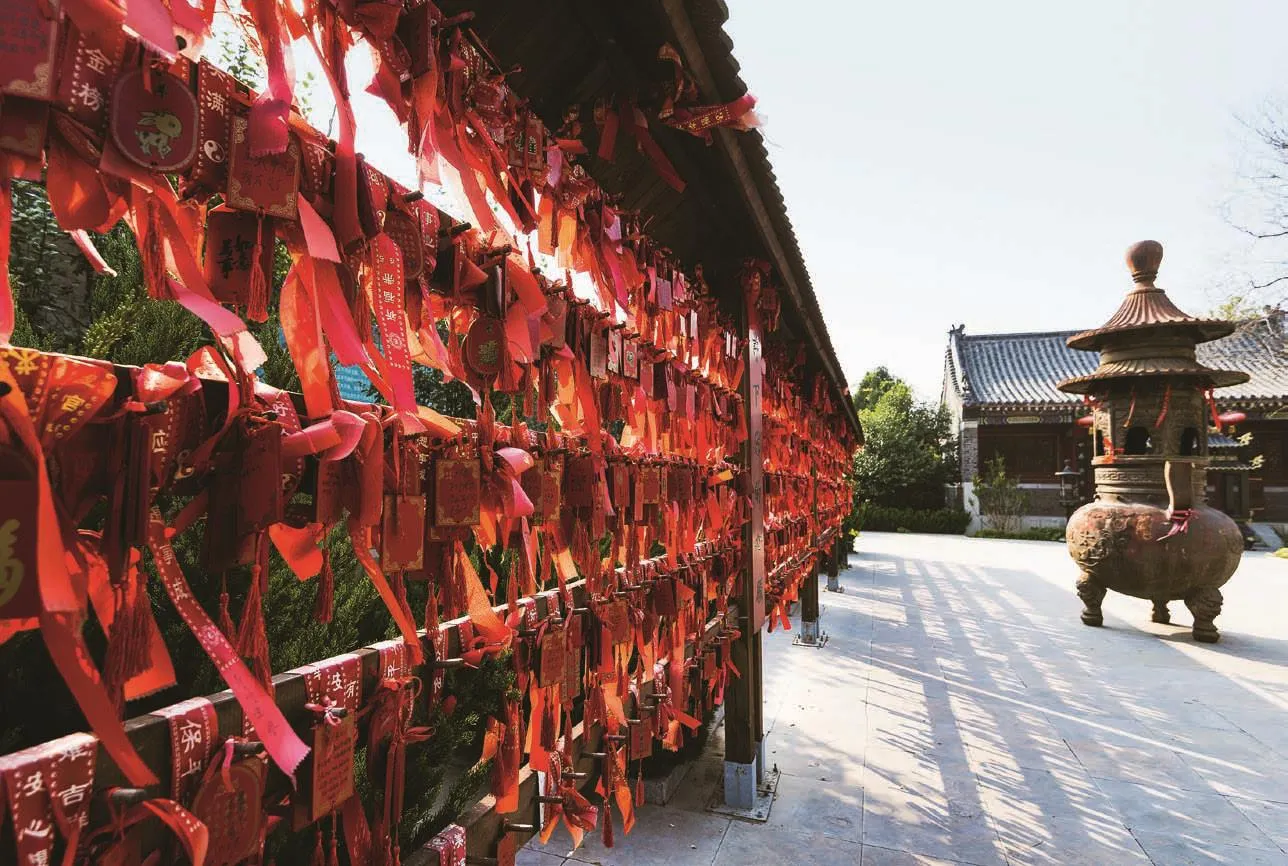
Visitors leave ribbons with auspicious messages at Daoist temples for good luck
Priest Xuan may have outdone his predecessors in terms of visitor numbers, but drumming up followers has been a much greater challenge.There were now ten people living on the mountain: three young initiates,three older followers including himself,and four retired women who work in the kitchen and sell incense to visitors.But their average age is still above 50 years.
Xuan’s young followers get up at 6 a.m.every day and perform a number of duties as part of their training:sweeping the grounds, and carrying out the morning ritual of bowing and lighting incense in the main prayer hall.During the day, they study the Daoist texts and rituals, and it usually takes a couple of years to become a fully initiated Daoist follower, after which they may remain at Leigutai or follow their Daoist path to another temple.
The three young men have very different backgrounds.At 17, Wang Ling is the youngest.He dropped out of high school, and tried to join the military, “but they did not want me,” he says.Now he is in charge of beating drums and bells and lighting incense to the gods every morning.“I feel like I am doing something useful.”
This thought is echoed by Zhang Rong, 25, who used to work in a motorbike repair shop.“I feel like I can help people up here.We are the ones who keep the worship of the spirits of the mountain and teach the history to the people who visit.”Zhang is not yet initiated, thus not able to wear robes, so he sports a blazer, or a white T-shirt when he acts as the all-purpose handyman around the temple.
“We are really into swords and martial arts,” Zhang says, displaying the black Chinese sword that he trains with.The young men buy their weapons on e-commerce site Taobao and dance through the courtyard every day with blades flying in circles—but never actually fighting.“Menghui has even appeared in a movie,” the other two laugh as Xu Menghui, the third initiate, bows his head with a smile.
For the younger generation, another appeal that sets Daoism apart from other religions is—for the lack of a better word—its coolness.Dotted around many Daoist temples are explicit statues and murals displaying the gory punishments that await immoral souls in the various Daoist hells.Fortune telling, hermitage,out-of-body techniques, swords, and martial arts are also knitted into the fabric of thousands of years of Daoist heritage.For fantasy nerds or metal heads—what’s not to like?
Priest Xuan is aware of this appealand allows his young followers to indulge in it, but his main focus is on having them study the scriptures.Still,the portrayal of Daoists as mystical and wise figures in pop culture is welcomed, because it provides a basis from which Daoists can engage with visitors.Some of his followers have appeared in movies, and the temple has been featured on TV and in the local newspapers.This in turn helped increase visitor numbers.
TRUE BELIEVERS
But Daoism is far more than coolness to these young followers.Its religion and spiritualism offer tangible meaning and purpose to their lives.
Xu Menghui, 27, is both the most experienced and the most educated of the young Daoists.He has been living at the temple for two years, but first heard the Dao’s call in high school.He visited the temple one summer in university, and felt there was something wrong in his life when he returned to school.“That place was not right for me, and I left my studies to live here,” he says.
Proficient in several traditional Chinese instruments, including the four-stringedpipa, two-stringederhu,and thexiaoflute, Xu practices his instruments in the clouds every day as a way to practice rituals.He also uses meditation to reflect on life.Xu’s mother died when he was a child, and one day he saw her in a dream surrounded by humans and demons who began tearing the flesh from her body.“She said nothing,but her face begged me for help, and I did nothing,” he says.“This dream haunted me.I was horrified that I did not do anything.”
Xu first contacted a Buddhist monk about his dream, who told him his mother was caught between two worlds, and he could help her attain peace through prayer.“That was when I became religious.I have always thought a lot about life and why I am here on earth, and I became more and more attracted to Daoism.”
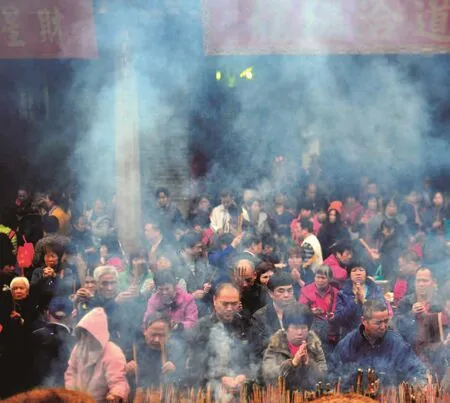
Worshipers light incense and pray at a Daoist temple in Guangzhou for the Lantern Festival
Like Buddhism, Daoism has permeated into popular culture in China.In a way, Daoism’s appeal comes from its status as a homegrown religion—unlike Buddhism, which was imported from India—and incorporates Chinese folk culture.Daoist retreats are also romantically associated with historical literati and philosophers who have tried to gain wisdom through hermitage.
This is great advertising for Daoism,but the PR is a balancing act.The previous excesses of some temples remain in the minds of modern Daoists.One temple in Henan province was closed in 2017 when “it was found to have sought profits in the name of religion,” according to the State Administration of Cultural Heritage.
One way that Leigutai tries to alleviate this is by working with the local government.Xu has become the temple’s representative in the county’s political congress, answering questions about religious affairs.
“We want to help our society,” Priest Xuan says.“And we need to look at what the government is trying to do in order to do so, right?” The young Daoists are more down-to-earth.“As long as our temple can be a place for the mind to stop and think in our world, then more people will come,”says Xu.
Wang Lin, the youngest follower,is watching the sea of clouds below the temple when I ask him what he wants to do in the future.“I find meaning in life every day and I strive to do better,” he says.“I no longer have dreams of fame or becoming rich.I am here to learn to live, to live according to the Dao.” Cutting our conversation short, he rushes up the stairs and vanishes in the mist.
It was once again time to worship the spirits at Leigutai.
猜你喜歡
小哥白尼(軍事科學)(2022年7期)2022-09-20 03:51:30
嶺南音樂(2022年4期)2022-09-15 14:03:12
陽光(2020年6期)2020-06-01 07:48:36
陽光(2020年5期)2020-05-06 13:29:18
人大建設(2019年11期)2019-05-21 02:54:48
電影(2018年9期)2018-10-10 07:18:38
金橋(2018年4期)2018-09-26 02:24:44
足球周刊(2016年14期)2016-11-02 10:56:23
足球周刊(2016年15期)2016-11-02 10:55:36
足球周刊(2016年10期)2016-10-08 10:54:55
