
廣東報春苣苔屬一新種
2020-12-14 03:59:42黃翠瑩孟開開郭劍強陳昉廖文波凡強
廣西植物 2020年10期
黃翠瑩 孟開開 郭劍強 陳昉 廖文波 凡強
摘 要:? ?該文報道了在廣東丹霞山發(fā)現(xiàn)的報春苣苔屬一新種——黃進報春苣苔(Primulina huangjiniana),并對其進行了描述。該新種與同屬物種短序報春苣苔(P. depressa)最為相似,但兩者在形態(tài)特征上能夠很好地區(qū)別:黃進報春苣苔具有更短的、長2.5~6 mm的苞片(vs. 短序報春苣苔具有長15~30 mm的苞片,順序下同);花萼裂片等長(vs. 不等長),花絲基部附近膝狀突起,中部以上具腺毛(vs. 于中部膝狀突起且無毛);柱頭倒三角形,深2裂成2線形裂片(vs. 片狀,稍2淺裂,裂片為三角形),側(cè)膜胎座(vs. 中軸胎座)。加上該新種在內(nèi),丹霞山目前共記錄有6種報春苣苔屬植物,其中丹霞小花苣苔(P. danxiaensis)和該新種均為丹霞地貌特有植物。黃進報春苣苔目前在丹霞山的兩個地方有發(fā)現(xiàn),成年植株不超過200株,根據(jù)IUCN紅色名錄標準,屬于極危種。
關(guān)鍵詞:? 丹霞, 長蒴苣苔亞科, 廣東植物區(qū)系, 形態(tài)學比較, 短序報春苣苔
1 Introduction
The redefined Primulina Hance, based on the re-circumscription of recent molecular phylogenetic studies, is the largest genus in the subfamily Didymocarpoideae of Gesneriaceae with about 204+ species (including subspecies and varieties) in China (Wen et al., 2019, 2020), including nearly all previous species of Chirita sect. Gibbosaccus Clarke, all species of Chiritopsis W. T. Wang, and two species of Wentsaiboea D. Fang & D. H. Qin (Wang et al., 1998; Fang & Qin, 2004; MOller et al., 2011; Wang et al., 2011; Weber et al., 2011; Xu et al., 2012; Wang et al., 2017). Its species diversity is still growing rapidly due to numerous new species being constantly discovered and described? since the past decade (Yang et al., 2018). Interestingly, more than 170 Primulina species are endemic to limestone karsts of South to Southwest China and North Vietnam (Wang et al., 2017; Xu et al., 2017; Hong et al., 2018; Wen et al., 2019).
Mount Danxia in Guangdong Province is one of the famous examples of Danxia landform characterized by red-colored sandstones and conglomerates of largely Cretaceous age. In the past three decades, five endemic plant species were found there, namely, Danxiaorchis sinchiana J. W. Zhai, F. W. Xing & Z. J. Liu (Zhai et al., 2013), Diospyros danxiaensis (R. H. Miao & W. Q. Liu) Y. H. Tong & N. H. Xia. (Zhao et al., 2018; Tong & Xia, 2019), Firmiana danxiaensis H. H. Hsue & H. S. Kiu (Xu et al., 1987), Primulina danxiaensis (W. B. Liao, S. S. Lin & R. J. Shen) W. B. Liao & K. F. Chung (Shen et al., 2010; Xu et al., 2012), and Viola hybanthoides W. B. Liao & Q. Fan (Fan et al., 2015). The endemism in this unique Danxia landform also arouse peoples interests in the biodiversity patterns.
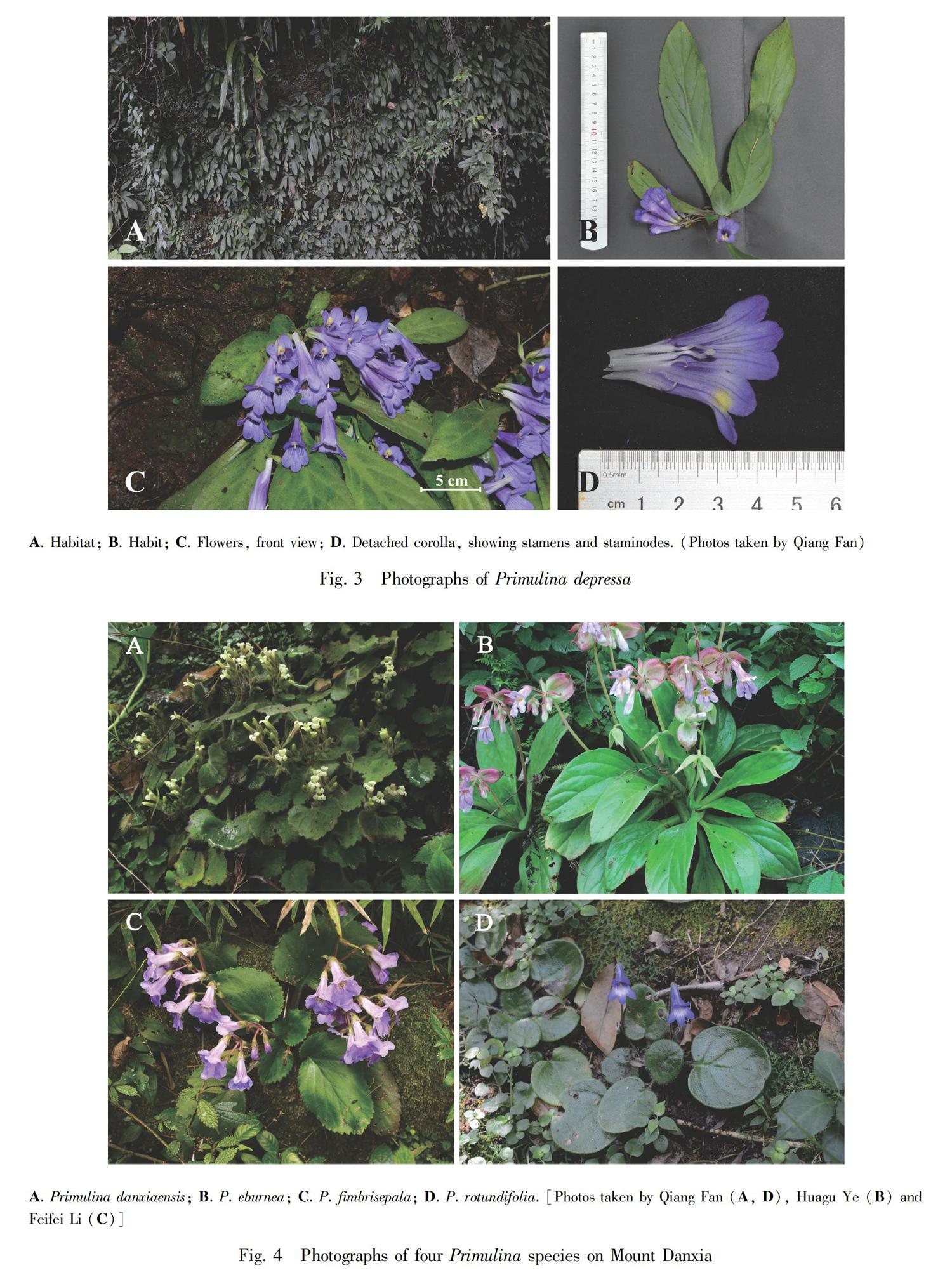
Since 2004, we have conducted continuous biological surveys on Mount Danxia in order to elucidate the biodiversity patterns of Danxia landforms (Peng et al., 2011). During the expeditions, a distinct Primulina species was collected by the third author (JQG) in 2016. Including this putative new taxon, a total of six Primulina species occur in Mount Danxia. The rest are P. danxiaensis,P. depressa (Hook. f.) Mich. MOller & A. Weber, P. rotundifolia (Hemsl.) Mich. MOller & A. Weber, P. fimbrisepala (Hand.-Mazz.) Y. Z. Wang, and P. eburnea (Hance) Y. Z. Wang(Wang et al., 1998; Wei et al., 2010; MOller et al., 2011; Weber et al., 2011; Wang et al., 2011). At the first glance, the putative new taxon looks similar to P. depressa, which is a relatively common species on Mount Danxia. However,? after two years field observations and the comprehensive literature studies, we confirm that it is a new species and obviously distinguished from P. depressa. Therefore, it is described and illustrated here.
2 Materials and Methods
Morphological observations of the new species and its close relatives were carried based on living plants in the field as well as dry specimens. High resolution image of the holotype specimen of Primulina depressa (deposited in K, barcoding number K000858361) was consulted on JSTOR Global Plants (https://plants.jstor. org/, accessed 10 July 2019). All morphological characters were measured using a micrometer and a stereomicroscope (Leica S8APO, Leica Microsystems Inc., Germany) and descriptions were made following the terminology presented by Wang et al.(1998) and Li & Wang (2005). The voucher specimens are deposited in IBSC, IBK and SYS.
3 Taxonomic Treatment
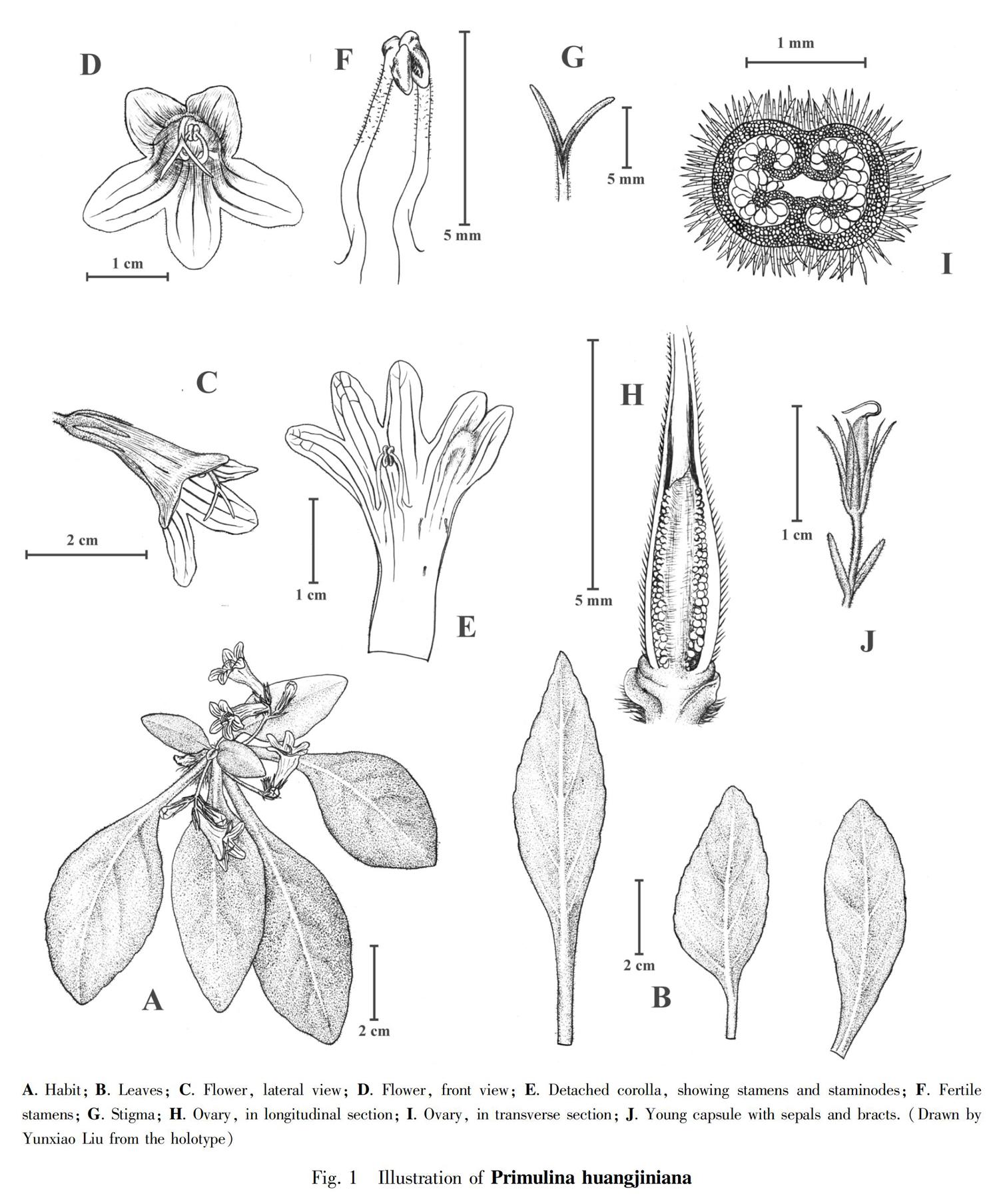
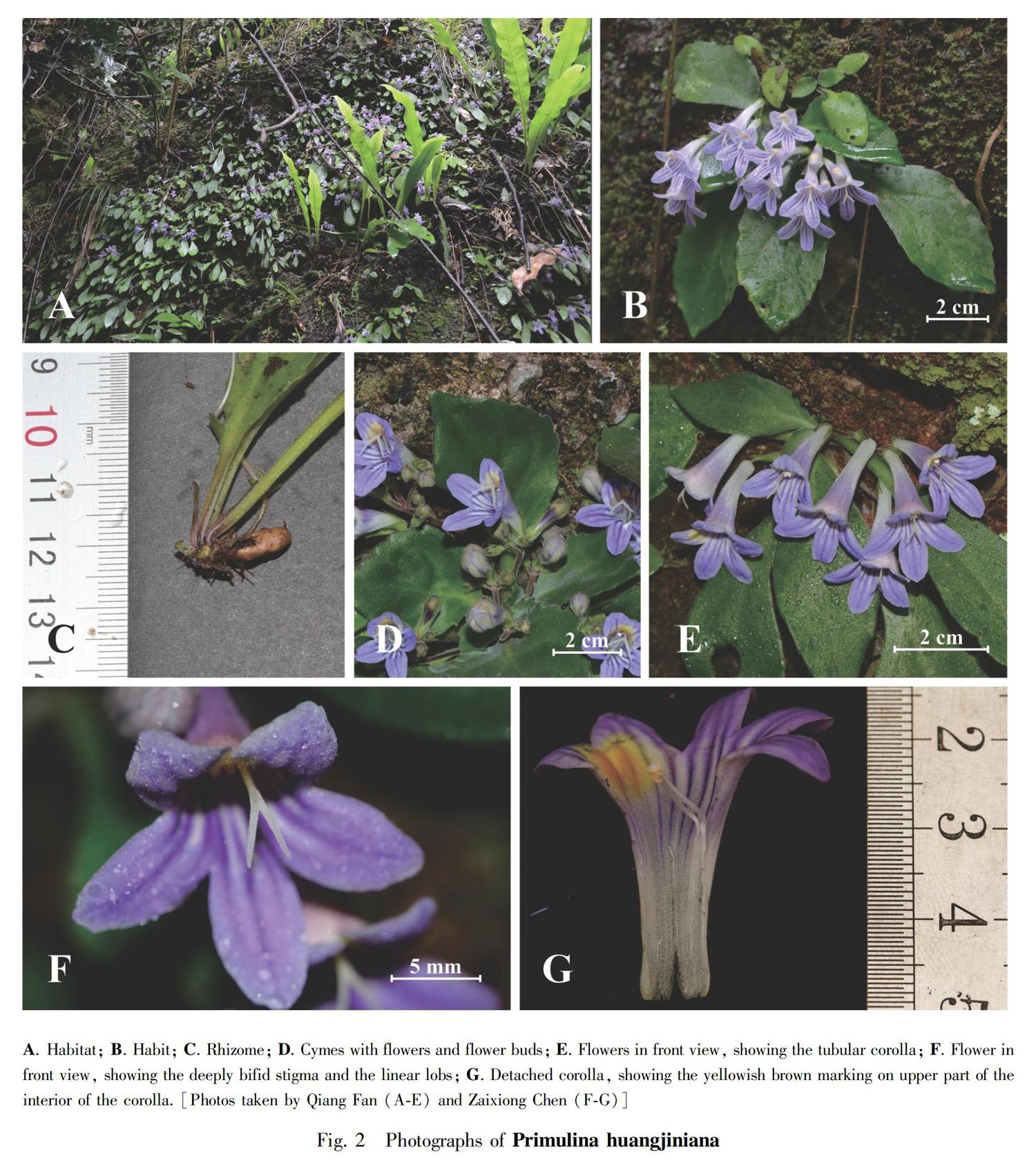
Primulina huangjiniana? W. B. Liao, Q. Fan & C. Y. Huang, sp. nov.? Fig. 1, 2
Similar to Primulina depressa, but differs from it by its shorter bracts 2.5-6 mm long (vs. 15-30 mm long), calyx lobes subequal (vs. unequal), filaments glandular-puberulent above the midpoint and geniculate near the base (vs. glabrous and geniculate near the middle), deeply 2-lobed obdeltoid stigma with two linear lobes (vs. slightly 2-lobed lamelliform stigma with two acute-triangular lobes), and parietal placenta (vs. axile placenta).
Type.? CHINA. Guangdong Province, Renhua County, Mount Danxia, on the moist rocks in forest edge,30 m a. s. l., 20 April 2018, Q. Fan and Y. S. Huang 16997 (holotype: SYS!; isotypes: IBK!, IBSC!, SYS!).
Description. Perennial herbs. Rhizome subterete, 0.5-2 cm long, 2-5 mm in diameter, internodes inconspicuous. Leaves 4-10, crowded at the apex of rhizome; petiole flattened, (0.5-) 1-4 (-7) cm long, 2-5 mm wide, pubescent; leaf blade eshy when fresh, thin chartaceous when dried, ovate to oblong-elliptic, (2-) 3-7.5 (-10) × (1-) 1.5-4 (-5.5) cm, both surfaces densely pubescent, apex acute to obtuse, base cuneate, margin repand or inconspicuously serrate; lateral veins 3-4 on each side, inconspicuous. Cymes 2-7 or more, 1-2-branched, 1-5-flowered; peduncle 0.5-1.5 cm long, ca. 1 mm in diameter, densely pubescent; bracts 2, opposite, green, linear-lanceolate, 2.5-6 × ca. 1 mm, margin entire, apex acute, densely pubescent on both surfaces; pedicel 2-5 mm long, ca. 1 mm in diameter, densely pubescent. Calyx 5-parted to base; lobes lanceolate, 6-12 × 1-1.5 mm, margin entire, both surfaces densely pubescent. Corolla 3.5-4.0 cm long, pale blue-purple or white, with bluish purple stripes inside, upper part of the interior of the corolla with a yellowish brown marking, outside sparsely puberulent, inside glabrous; corolla tube tubular to infundibuliform, 2.4-3.1 cm long, 7-10 mm in diameter at the mouth, 3-4 mm in diameter at the base; limb distinctly 2-lipped, adaxial lip 2-lobed, lobes ovate, 8-10 × 5-7 mm, abaxial lip deeply 3-lobed, lobes oval to oblong, 10-12 × 5-7 mm. Stamens 2, adnate to 1.5-2 cm above the corolla tube base; filaments linear, 8-13 mm long, geniculate near the base, with glandular trichomes above the midpoint; anthers fused by the entire adaxial surfaces, 1.5-3.5 mm long, glabrous. Staminodes 3, the lateral ones 2-5.5 mm long, apex capitate, adnate to 1.3-2 cm above the corolla tube base, the middle one 0.5-1 mm long, sometimes absent, adnate to 1-1.2 cm above the corolla tube base, glabrous; Disc annular, ca. 1 mm in height. Pistil 2.6-3.2 cm long, ovary conical, 3-4.5 mm long, 1-2 mm in diameter, densely pubescent; style 2.6-3.2 cm long, ca. 0.8 mm in diameter, pubescent; stigma obdeltoid, deeply 2-lobed, 4-8 mm long, lobes linear. Capsule ovoid to cylindrical, 4-9 mm long, 2-3 mm in diameter, densely pubescent.
Distribution and habitat.? Primulina huangjiniana is currently known only from two localities on Mount Danxia, Renhua County, North Guangdong, China. The species grows on moist rocks in forest edge or on sunny rocks of the cliff. The associated herb species mainly include Microsorum fortunei (T. Moore) Ching, Onychium japonicum (Thunb.) Kze., Selaginella davidii Franch., S. delicatula (Desv.) Alston and Youngia heterophylla (Hemsl.) Babcock & Stebbins.
Preliminary conservation status.? Only two populations were found with no more than 200 mature individuals in a total area of about 0.5 km2. The localities of two populations are over 10 km apart. Thus, the species could be considered as Critically Endangered (CR, B2a) according to IUCN Red List Criteria (IUCN, 2017).
Phenology.? Flowers from March to May and fruits from April to June (observation by QF and JQG in the field from March 2017 to November 2018).
Key to differentiate the new species and other species from? Mount Danxia of Guangdong, China
1. Corolla yellowish, smaller, 12-15 mm long Primulina danxiaensis
1. Corolla non-yellow, bigger,≥25 mm long 2
2. Leaf blade margin serratus to dentate 3
2. Leaf blade margin entire 5
3.? Peduncle 6-28 cm long or longer, corolla inside purple-stained P. fimbrisepala
3.? Peduncle ≤5 cm long or shorter, corolla inside no purple-stained 4
4.? Bracts 15-30 × 1.5-3 mm, corolla 4.5-5 cm long P. depressa
4.? Bracts 2.5-6 × ca. 1 mm, corolla 3.5-4 cm long P. huangjiniana
5.? Leaf blade orbicular-ovate to orbicular-reniform, bracts narrowly triangular, 4-6 × 0.8-1 mm P. rotundifolia
5.? Leaf blade ovate to elliptic or obovate, bracts ovate to orbicular-ovate, 10-45 × 8-28 mm? P. eburnea
Guangdong Province (Hooker, 1892), but without detailed location. In fact, it is a very common species on the moist rocks of Mount Danxia, but interestingly, it never grows together with P. huangjiniana. It had been mistaken to be P. depressa before anatomical studies were done to find its parietal placenta differed from P. depressas axile placenta.
The two species share some similar characters, e.g. peduncles usually shorter than the petioles that makes the flowers appear nestled among the leaves, a piece of yellowish brown marking on the upper part of the interior of the corolla, and a relatively smaller capsules (less than ca. 1 cm long in length) compared to other Primulina species having large corolla which usually have longer linear capsules with the length 1-5 cm (except the previous Chiritopsis and Wentsaiboea species). However, Primulina huangjiniana can be readily distinguished from P. depressa by its slender rhizome (2-5 mm vs. 6-12 mm in diameter), shorter leaf blade (3-7.5 cm long vs. 8-20 cm long) and bracts (2.5-6 mm long vs. 15-30 mm long), calyx lobes subequal (vs. unequal), filaments with glandular-puberulent above the middle and geniculate near the base (vs. filaments glabrous and geniculate near the middle), deeply 2-lobed obdeltoid stigma with two linear lobes (vs. slightly 2-lobed lamelliform stigma with two acute-triangular lobes), and parietal placenta (vs. axile placenta) (Table 1). In addition, the two species have different flowering time. After two years field observation on Mount Danxia, we found that P. huangjiniana blossomed from March to May, while P. depressa blossomed from April to June.
Differences between the new species, its morphologically related species and other species from the Mount Danxia are shown in the following identification key (Fig. 3, Fig.4):
Additional specimen examined (paratypes). CHINA. Guangdong Province, Renhua County, Mount Danxia, on sunny rocks, 466 m a. s. l., 20 April 2018 (fl.), Q. Fan and Y. S. Huang 16995 (SYS); the same locality, 125 m a.s.l., 2 June 2018 (fr.), Q. Fan 17003 (SYS).
Acknowledgments? We are deeply grateful to Mrs Yunxiao Liu? for her excellent illustration on the manuscript.
References:
FA N Q, CHEN SF, WANG LY, et al., 2015. A new species and new section of Viola (Violaceae) from Guangdong, China [J]. Phytotaxa, 197(1): 15-26.
FANG D, QIN DH, 2004. A new genus of the Gesneriaceae from Guangxi, China [J]. Acta Phytotax Sin, 42(6):533-536.? [方鼎,覃德海,2004. 廣西苦苣苔科一新屬——文采苣苔屬 [J]. 植物分類學報,42(6):533-536]
HONG X, LI ZL, LIU JZ, et al., 2018. Two new species of Primulina (Gesneriaceae) from limestone karsts of China [J]. Peer J, 6: e4946.
HOOKER JD, 1892. Chirita depressa [J]. Curtiss Bot Mag, 118: t.7213.
IUCN, 2017. Guidelines for Using the IUCN Red List Categories and Criteria. version 13. [EB/OL]. Standards and Petitions Subcommittee of the IUCN Species Survival Commission.http://cmsdocs.s3.amazonaws.com/RedListGuidelines.pdf
LI ZY, WANG YZ, 2005. Plants of Generiaceae in China [M]. Zhengzhou: Henan Science and Technology Publishing House: 1-721.? [李振宇,王印政,2005. 中國苦苣苔科植物 [M]. 鄭州:河南科學技術(shù)出版社:1-721.]
MOLLER M, FORREST A, WEI YG, et al., 2011. A molecular phylogenetic assessment of the advanced Asiatic and Malesian didymocarpoid Gesneriaceae with focus on non-monophyletic and monotypic genera [J]. Plant Syst Evol, 292: 223-248.
MOLLER M, WEI YG, WEN F, et al., 2016. You win some you lose some: updated generic delineations and classification of Gesneriaceae-implications for the family in China [J]. Guihaia, 36(1): 44-60. [MOLLER M, 韋毅剛, 溫放, 等, 2016. 得與失: 苦苣苔科新的屬級界定與分類系統(tǒng)——中國該科植物之變遷 [J]. 廣西植物, 36(1): 44-60.]
PENG SL, LIAO WB, LI Z, et al., 2011. Integrated biological surveys on Mount Danxia, Guangdong [M]. Beijing: Science Press: 1-235.? [彭少麟,廖文波,李貞,等,2005. 廣東丹霞山動植物資源綜合科學考察 [M]. 北京:科學出版社:1-235.]
SHEN RJ, LIN SS, YU Y, et al., 2010. Chiritopsis danxiaensis sp. nov. (Gesneriaceae) from Mount Danxiashan, South China [J]. Nord J Bot, 28: 728-732.
TONG YH, XIA NH, 2019. Diospyros danxiaensis (R. H. Miao & W. Q. Liu) Y. H. Tong & N. H. Xia (Ebenaceae), a new combination and a new synonym for a persimmon from Guangdong [J]. J Trop Subtrop Bot, 27(3): 346-348. [童毅華, 夏念和, 2019. 丹霞杮, 廣東杮屬(杮科)——新組合及其一新異名 [J]. 熱帶亞熱帶植物學報, 27(3): 346-348.]
WANG J, AI B, KONG HH, et al., 2017. Speciation history of a species complex of Primulina eburnean (Gesneriaceae) from limestone karsts of southern China, a biodiversity hot spot [J]. Evol Appl, 10: 919-934.
WANG WT, 1981. Quinque genera nova Gesneriacearum E Sina [J]. Bull Bot Res, 1(3): 21-28.
WANG YZ, MAO RB, LIU Y, et al., 2011. Phylogenetic reconstruction of Chirita and allies (Gesneriaceae) with taxonomic treatments [J]. J Syst Evol, 49: 50-64.
WANG WT, PAN KY, LI ZY, et al., 1998. Gesneriaceae [M]//WU ZY, RAVEN PH. Flora of China (Vol.18). Beijing: Science Press; St. Louis: Missouri Botanical Garden Press: 244-401.
WEI YG, WEN F, MOLLER M, et al., 2010. Gesneriaceae of South China [M]. Nanning: Guangxi Science & Technology Publishing House.? [韋毅剛, 溫放, MOLLER M, 等, 2010. 華南苦苣苔科植物 [M]. 南寧:廣西科學技術(shù)出版社.]
WEBER A, MIDDLETON DJ, FORREST A, et al., 2011. Molecular systematics and remodeling of Chirita and associated genera (Gesneriaceae)? [J]. Taxon, 60: 767-790.
WEN F, LI S, XIN ZB, et al., 2019. The updated plant list of Gesneriaceae in China under the new Chinese naming rules [J]. Guangxi Sci, 26(1): 37-63.? [溫放,黎舒,辛子兵,等,2019. 新中文命名規(guī)則下的最新中國苦苣苔科植物名錄 [J]. 廣西科學,26(1): 37-63.]
WEN F, WEI YG, FU LF, et al., 2020. The Checklist of Gesneriaceae in China? [EB/OL]. The Gesneriad Consevation Center of China, http://gccc.gxib.cn/cn/about-68.aspx.? [溫放,韋毅剛,符龍飛,等,2020. 中國苦苣苔科植物名錄? [EB/OL]. 中國苦苣苔科植物保育中心,http://gccc.gxib.cn/cn/about-68.aspx.]
XU WB, ZHANG Q, WEN F, et al., 2012. Nine new combinations and one new name of Primulina (Gesneriaceae) from South China [J]. Phytotaxa, 64: 1-8.
XU WB, GUO J, PAN B, et al., 2017. Diversity and distribution of Gesneriaceae in China [J]. Guihaia, 37(10): 1219-1226.? [許為斌,郭婧,盤波,等,2017. 中國苦苣苔科植物的多樣性與地理分布 [J]. 廣西植物,37(10): 1219-1226.]
XU XH, QIU HX, XU SJ, 1987. New species and variety of Sterculiaceae from China [J]. J S Chin Agric Univ, 8(3): 1-5.? [徐祥浩,丘華興,徐頌軍,1987. 中國梧桐科植物的新種和新變種 [J]. 華南農(nóng)業(yè)大學學報,8(3): 1-5.]
YANG LH, CHEN JL, WEN F, et al., 2018. Primulina malipoensis (Gesneriaceae), a new species from Sino-Vietnamese border area [J]. PhytoKeys, 94: 107-116.
ZHAI JW, ZHANG GQ, CHEN LJ, et al., 2013. A new orchid genus, Danxiaorchis, and phylogenetic analysis of the tribe Calypsoeae [J]. PLoS ONE, 8: e60371.
ZHAO WY, FAN Q, CHEN F, et al., 2018. Diospyros penghuae, a new species of Ebenaceae from Danxiashan Mountain in Guangdong, China [J]. Acta Sci Nat Univ Sunyatseni, 57(5): 98-103. [趙萬義, 凡強, 陳昉, 等, 2018. 廣東丹霞山杮樹科一新種——彭華杮 [J]. 中山大學學報(自然科學版), 57(5): 98-103.]
( 責任編輯 周翠鳴 )
