
云南東南部苦苣苔科植物一新種
2020-12-14 03:59:42張貴良蔡磊王逸之張貴生
廣西植物 2020年10期
張貴良 蔡磊 王逸之 張貴生
摘 要:? ?中越邊境的石灰巖地區不僅具有較豐富的植物多樣性,而且特有現象十分突出。該文描述了中越邊境石灰巖地區位于云南東南部河口境內的苦苣苔科一個植物新種——南溪蛛毛苣苔(Paraboea nanxiensis Lei Cai & Gui L. Zhang)。該新種在葉片的形狀和毛被、花的顏色、花序短于葉片以及雌蕊無毛等性狀上與產自廣西那坡的垂花蛛毛苣苔(P. nutans D. Fang & D. H. Qin)最為相似。兩者的主要區別在于:該新種的花萼裂片先端最寬且光滑無毛,花冠淺寬鐘形、花冠筒不明顯、花冠管內面基部白色,花絲無毛以及蒴果稍微扭曲;該新種生于云南海拔530~610 m的河口及馬關一帶,而垂花蛛毛苣苔產于廣西那坡的海拔900~1 150 m段的石灰山。此外還討論了該新種與蛛毛苣苔屬其他幾種基生葉類型的近緣種[如三萼蛛毛苣苔(P. trisepala W. H. Chen & Y. M. Shui)、蔓耗蛛毛苣苔(P. manhaoensis Y. M. Shui & W. H. Chen)及河口蛛毛苣苔(P. hekouensis Y. M. Shui & W. H. Chen)]的區別,并提供了相關物種的彩色圖片及區分說明,主模式標本存放于中國科學院昆明植物研究所標本館(KUN)中。近年來,由于中越邊境的石灰巖地區不斷有新分類群或新記錄物種的發現,所以很有必要加強對該區域的植物多樣性考察。
關鍵詞:? 蛛毛苣苔屬, 新類群, 石灰巖地區, 分類學, 云南植物區系
1 Introduction
The genus Paraboea (C. B. Clarke) Ridl. has become one of the larger genera in the Old World Gesneriaceae after the revision (Xu et al., 2008), combination (Puglisi et al., 2011), transfer (Puglisi et al., 2016), and descriptions of many new species (Triboun & Middleton, 2012, 2015; Guo et al., 2016; Wen & Wei, 2016; Xu et al., 2017a; Middleton, 2018; Averyanov et al., 2020). Up to now it includes more than 130 species mainly distributed in the eastern Himalayas and Indo-China Peninsula and the adjacent areas (Puglisi et al., 2015; He et al., 2018). China harbours a high diversity of Paraboea with many endemic species (Middleton, 2018), and hitherto, 33 species are recorded in South and Southwest China, such as Guangdong, Guangxi, Guizhou and Yunnan? (Wang et al., 1990, 1998; Li & Wang, 2005; Chen et al., 2012; Xu et al., 2017b; Lu et al., 2019; Wen et al., 2019).
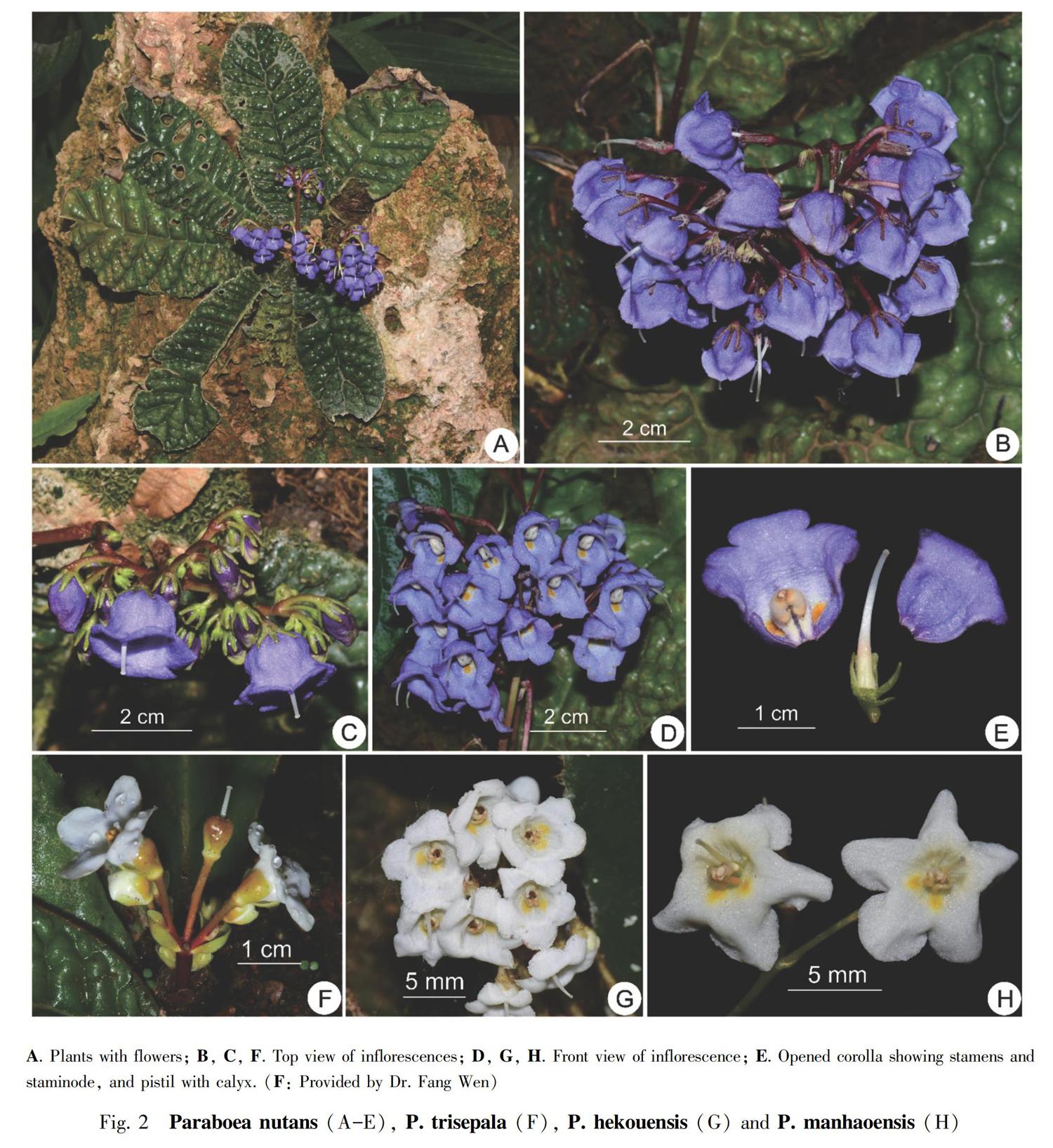
In the floristic surveys in the limestone areas of southeastern Yunnan, China in 2016, we discovered a plant belonging to the Subfamily Didymocarpoideae, Family Gesneriaceae. We confirmed it belonged to the genus Paraboea when we observed its flower and fruit characteristics (such as: two fertile stamens, twisted capsule and cobwebby-woolly hair on the leaf blade) in the following years. After a careful examination of the specimens and the related literature of Paraboea from the adjacent regions, we concluded that this plant represents a new species to science (Wang et al., 1990, 1998; Li & Wang, 2005; Chen et al., 2012; Xu et al., 2017a; Middleton, 2018; He et al., 2018). Here, the new species, P. nanxiensis Lei Cai & Gui L. Zhang, is described, and its morphological characters are compared with the closely related species P. nutans D. Fang & D. H. Qin (Fig. 2: A-E).
2 Taxonomy treatment
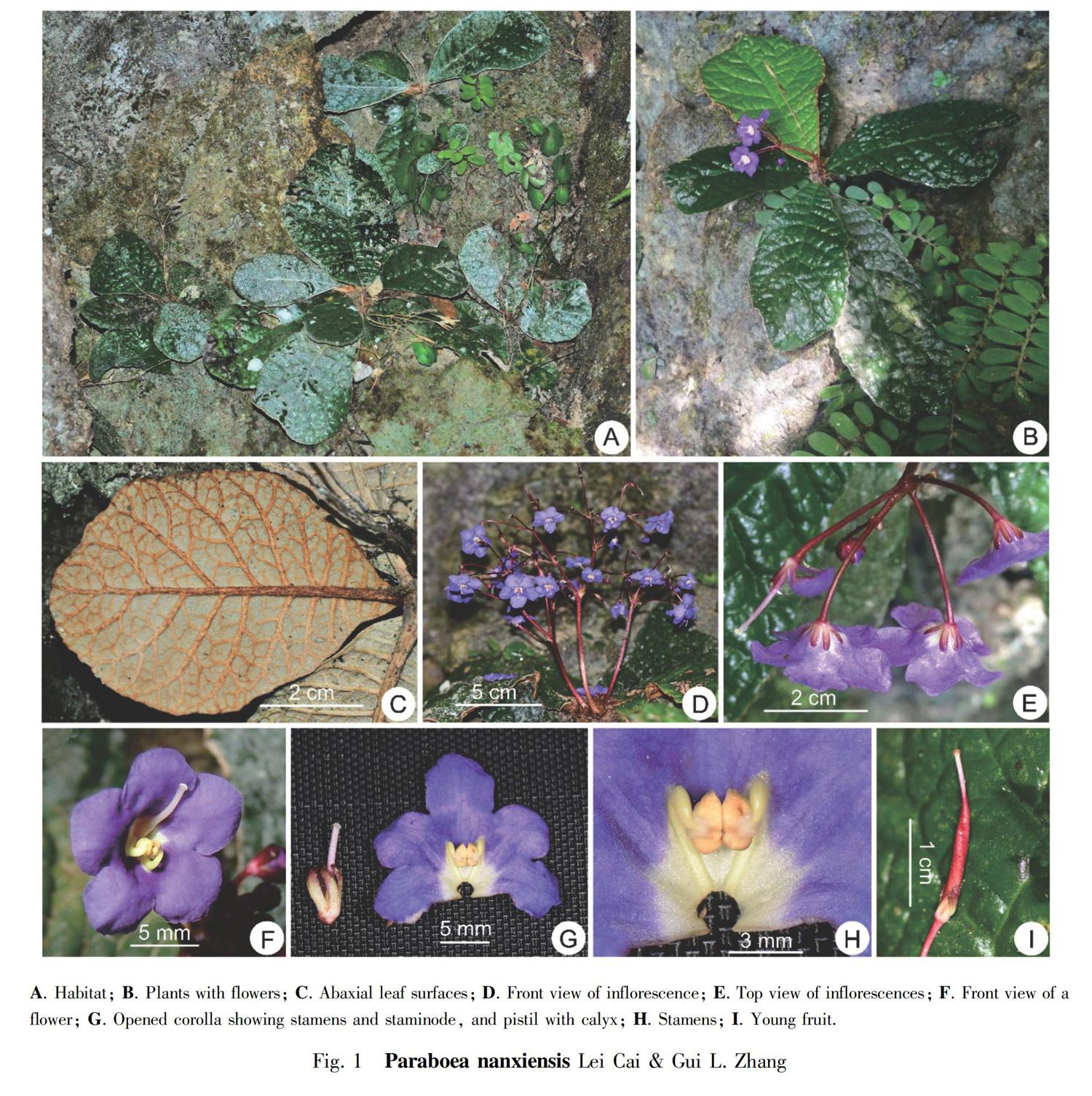
Paraboea nanxiensis? Lei Cai & Gui L. Zhang, sp. nov. (Fig. 1)
Type: CHINA . Yunnan Province: Hekou County, Nanxi Township, Baishahe, Laolongtian, 22°41′56″ N, 103°57′19″ E, alt. 536 m, on the rocks under the tropical rainforest in karst region, in flowering, 14 July 2017, G.L. Zhang et al. CL2017085 (holotype KUN!, isotypes KUN! IBK!).
Diagnosis:? The new species is morphologically similar to Paraboea nutans in the obovate leaf blade with cobwebby-woolly and brownish woolly hair on both sides, absent or short petiole and purplish blue flowers, but it can be easily distinguished from P. nutans by its calyx lobes oblong to oblanceolate, glabrous, corolla broadly shallow campanulate, tube inside white below the middle, filament glabrous and capsule slightly twisted.
Description:? Perennial herbs, stemless. Leaves
basal; petiole (absent or) 2-5 mm long, rust-brown woolly; leaf blade obovate, 6.5-22.5 × 2.5-10.5 cm, leathery, adaxially dark green, cobwebby-woolly, later glabrescent, abaxially brown cobwebby-woolly to pannose, rust-brown woolly along margin and veins, lateral veins 7-12 on each side of midrib, base attenuate to broadly cuneate, margin undulate, apex rounded. Cymes 1-4, axillary, 1-2-branched, inflorescence 5-15-flowered; peduncle 4-8 cm long, brown cobwebby-woolly, later glabrescent; bracts linear lanceolate, ca. 5 × 2 mm, outside brown cobwebby-woolly; pedicel 1.4-2.4 cm long, glabrous. Calyx 5-parted to base, lobes equal, oblong to oblanceolate, 4-6 × 2-2.2 mm, glabrous, margin entire. Corolla purplish blue, broadly shallow campanulate, outside glabrous; tube short, 5-7 mm long, white below the middle inside, ca. 2 mm in diameter at base, 8-12 mm in diameter at throat; limb slightly 2-lipped; adaxial lip 2-lobed, lobes semicircular to broadly ovate, 5-7 × 6-9 mm, abaxial lip 3-lobed, lobes semicircular to broadly ovate, 6-8 × 7-10 mm. Stamens 2, included; filaments yellowish white, ca. 2 mm long, glabrous, curved in the middle, adnate to 3-4 mm above corolla tube base; anther 2, confluent at apex; staminodes 3, ca. 0.4 mm long, adnate to ca. 1 mm above corolla tube base. Disc inconspicuous. Pistil glabrous; ovary conical, 3-6 mm long, ca. 1 mm in diameter; style linear 5-8 mm long, ca. 0.5 mm in diameter; stigma 1, capitate. Capsule linear, slight twisted, 1.2-1.8 cm long, ca. 1.5 mm in diameter, with persistent style.
Phenology: Flowering from July to August; fruiting from September to December.
Distribution & Ecology: Paraboea nanxiensis is found from Hekou County and Maguan County with two separate populations in southeastern Yunnan Province, near the border between China and Vietnam. It grows on the surface of the moist rocks under the tropical rainforest in limestone area with other lithophytic plants (e.g. Adiantum L., Begonia L., and Elatostema J. R. Forster & G. Forster).
Etymology:? The specific epithet “nanxiensis” is derived from the name of the type locality, Nanxi Township, Hekou County, Yunnan Province, China. The Chinese name is “nán xī zhū máo Jù Tái” (南溪蛛毛苣苔).
Conservation status:? Approximately only 50 individuals were found in two separate locations during filed investigation. Base on the result of field surveys and available data, Paraboea nanxiensis is provisionally assessed as Critically Endangered (CR) B2a according to IUCN Red List categories and criteria (IUCN, 2019), and we will continue to pay attention on the dynamics of this plant species with extremely small populations.
Additional specimens examined:? China, Yunan Province, Maguan County, Gulinqing Community, Juziyuan, Zhankengdaokou, 103°54′09.91″ E, 22°43′41.92″ N, alt. 610 m, on the surface of moist rocks, 20 November 2017, L. Cai et al. CL2017092 (KUN!).
Notes:? Paraboea nanxiensis morphologically resembles P. nutans in the obovate leaf blade with cobwebby-woolly and brownish woolly hair, absent or short petiole and purplish blue, however, P. nanxiensis can be clearly distinguished from P. nutans by several vegetative characters, e.g. the calyx lobes oblong to oblanceolate, glabrous (vs. oblong or lanceolate-oblong, outside sparsely brownish woolly); corolla broadly shallow campanulate (vs. helmet shaped); limb slightly 2-lipped (vs. limb obviously 2-lipped); tube inside white below the middle (vs. two yellow patches underside of tube near base); filament glabrous (vs. glandular puberulent), and capsule slightly twisted (vs. not twisted). Additionally, the new species grows in the altitude of 530-610 m in southeastern Yunnan, while its congener grows at an altitude of 900-1 150 m in Guangxi. It also resembles P. trisepala W. H. Chen & Y. M. Shui from Guangxi in the shape and indumentum characteristic of leaf blade, but obviously different in the three calyx lobes and straight capsule of the latter (Chen et al., 2008) (Fig. 2: F). There are also two basal leaves Paraboea species (P. hekouensis Y. M. Shui & W. H. Chen and P. manhaoensis Y. M. Shui & W. H. Chen) in the same geographic region, but they are very different from the new species. P. hekouensis has white flowers and golden-brown simple long trichomes on the lower leaf surface, petioles, peduncles and pedicels, while P. manhaoensis has tiny white flowers and golden subsessile glands on lower leaf surface on the veins, petioles, peduncles and filaments (Chen et al., 2012) (Fig. 2: G, H). At the same time, the type locality is in the Sino-Vietnamese limestone region which is one of the biodiversity hotspots in the world, many species of Gesneriaceae (including the genus Paraboea) were discovered in this area in recent years (Chen et al., 2012, 2014; Cai et al., 2017, 2019; Xu et al., 2017a; Middleton, 2018; Chen et al., 2019; Lu et al., 2019; Averyanov et al., 2020), therefore, we will continue to pay more attention to the Gesneriaceae species diversity in this area and adjacent region.
Acknowledgements
We thank Mr. Guoyun Li of Maguan Gulinqing Provincial Nature Reserve, Mr. Pin Zhang, Mr. Yunmeng Li and Ms. Jiajun Yang of Kunming Institute of Botany, Chinese Academy of Sciences during the field work, and we are particularly grateful to Dr. Weibin Xu and Dr. Fang Wen of Guangxi Institute of Botany, Guangxi Zhuang Autonomous Region and Chinese Academy of Sciences for their assistance on species identification.
References:
AV ERYANOV LV, XU WB, NGUYEN KS, et al., 2020. Paraboea villosa (Gesneriaceae), a new species from Northern Vietnam? [J]. Taiwania, 65(1): 33-36.
CAI L, LIU DT, ZHANG P, et al., 2019. Two new species of Henckelia (Gesneriaceae) from Southeastern Yunnan, China? [J]. PhytoKeys, 130: 151-160.
CAI L, ZHANG GL, ZHANG GS, et al., 2017. Loxostigma hekouensis (Gesneriaceae), a new species from Yunnan Province, China? [J]. Ann Bot Fenn, 54: 429-433.
CHEN L, CHEN WH, GUO SW, et al., 2019. Petrocodon tenuitubus (Gesneriaceae), a new species from Southeast Yunnan, China? [J]. Guihaia, 39(5): 574-580.? [陳力, 陳文紅, 郭世偉, 等, 2019. 云南東南部石山苣苔屬一新種——細管石山苣苔 [J]. 廣西植物, 39(5): 574-580.]
CHEN WH, MOLLER M, SHUI YM, et al., 2008. A new species of Paraboea (Gesneriaceae) from a karst cave in Guangxi, China, and observations on variations in flower and inflorescence architecture? [J]. Bot J Linn Soc, 158: 681-688.
CHEN WH, MOLLER M, SHUI YM, et al., 2014. Three new species of Petrocodon (Gesneriaceae),? endemic to the limestone areas of Southwest China, and preliminary insights into the diversification patterns of the genus? [J]. Syst Bot, 39(1): 316-330.
CHEN WH, MOLLER M, ZHANG MD, et al., 2012. Paraboea hekouensis and P. manhaoensis, two new species of Gesneriaceae from China? [J]. Ann Bot Fenn, 49: 179-187.
GUO J, LU ZC, LIU J, et al., 2016. Paraboea crassifila, a new species of Paraboea (Gesneriaceae) from Danxia landform in Guangxi, China? [J]. Taiwania, 61(1): 8-12.
HE DM, FENG YF, PAN FZ, et al., 2018. Paraboea wenshanensis, a new species of Gesneriaceae from Yunnan, China? [J]. PhytoKeys, 95: 83-91.
IUCN, 2019. Guidelines for Using the IUCN Red List Categories and Criteria. Version 14. Prepared? [EB/OL]. The Standards and Petitions Subcommittee of the IUCN Species Survival Commission. http://cmsdocs.s3.amazonaws.com/RedListGuidelines.pdf
LI ZY, WANG YZ, 2005.Plants of Gesneriaceae in China [M]. Zhengzhou: Henan Science and Technology Publishing House: 1-721.? [李振宇, 王印政, 2005. 中國苦苣苔科植物 [M]. 鄭州: 河南科學技術出版社: 1-721.]
LU ZC, LIU ED, HAN MQ, et al., 2019. Discovery of Paraboea minutiflora (Gesneriaceae) from southeastern Yunnan, China with supplementary description? [J]. Guihaia. DOI: 10.11931/guihaia.gxzw201909027.? [陸昭岑, 劉恩德, 韓孟奇, 等, 2019. 微花蛛毛苣苔在中國云南的發現及其補充描述 [J]. 廣西植物.? DOI: 10.11931/guihaia.gxzw201909027.]
MIDDLETON DJ, 2018. Two new species of Paraboea (Gesneriaceae) from Vietnam? [J]. Edinb J Bot, 75(3): 421-425.
PUGLISI C, MIDDLETON DJ, TRIBOUN P, et al., 2011. New insights into the relationships between Paraboea, Trisepalum, and Phylloboea (Gesneriaceae) and their taxonomic consequences? [J]. Taxon, 60(6): 1693-1702.
PUGLISI C, SUDDEE S, TRIBOUN P, et al., 2015. A new species of Paraboea (Gesneriaceae) from Thailand? [J]. Gard Bull Singapore, 67(1): 101-106.
PUGLISI C, YAO TL, MILNE M, et al., 2016. Generic recircumscription in the Loxocarpinae (Gesneriaceae), as inferred by phylogenetic and morphological data? [J]. Taxon, 65(2): 277-292.
TRIBOUN P, MIDDLETON DJ, 2012. Twenty new species of Paraboea (Gesneriaceae) from Thailand? [J]. Gard Bull Singapore, 64: 333-370.
TRIBOUN P, MIDDLETON DJ, 2015. Three new species of Paraboea (Gesneriaceae) from Thailand? [J]. Thai For Bull (Bot), 43: 18-23.
WANG WT, PAN KY, LI ZY, 1990. Gesneriaceae? [M]// WANG WT. Flora Reipublicae Popularis Sinicae. Beijing: Science Press, 69: 460-471.? [王文采, 潘開玉, 李振宇, 1990. 苦苣苔科 [M]// 王文采. 中國植物志. 北京: 科學出版社, 69: 460-471.]
WANG WT, PAN KY, LI ZY, 1998. Gesneriaceae? [M]//WU ZY, RAVEN PH. Flora of China. Beijing: Science Press; St. Louis: Missouri Botanical Garden Press, 18: 362-367.
WEN F, LI S, XIN ZB, et al., 2019. The updated plant list of Gesneriaceae in China under the new Chinese naming rules? [J]. Guangxi Sci, 26(1): 37-63.? [溫放, 黎舒, 辛子兵, 等, 2019. 新中文命名規則下的最新中國苦苣苔科植物名錄 [J]. 廣西科學, 26(1): 37-63.]
WEN F, WEI YG, 2016. Paraboea yunfuensis: A new calcicolous species of Gesneriaceae from Yunfu, Guangdong Province, China? [J]. Telopea, 19: 125-129.
XU WB, GUO J, PAN B, et al., 2017a. Three new species of Paraboea (Gesneriaceae) from limestone karsts of China based on morphological and molecular evidence? [J]. Bot Stud, 58(1): 1-14.
XU WB, GUO J, PAN B, et al., 2017b. Diversity and distribution?of Gesneriaceae in China? [J]. Guihaia, 37(10): 1219-1226.? [許為斌, 郭婧, 盤波, 等, 2017. 中國苦苣苔科植物的多樣性與地理分布 [J]. 廣西植物, 37(10): 1219-1226.]
XU ZR, BURTT BL, SKOG LE, et al., 2008. A revision of Paraboea (Gesneriaceae)? [J]. Edinb J Bot, 65: 161-347.
( 責任編輯 李 莉 )
