The Research on Classroom Questioning in Senior High School Under Constructive Theory
2020-10-14 09:10:31楊江青
青年生活 2020年31期
楊江青
Abstract: This paper mainly uses constructive theory to analyze classroom questioning in senior high school. The results shows that referential questions are of great importance. But referential questions and display questions are supposed to complement each other.
Key words: senior high school; English teaching; classroom questioning
1. Introduction
Constructive theory emphasizes subjective understanding and meaningful construction, concerns initiative, sociality, and context, and opposes to impart ready knowledge simply.
2. The Demands of Constructivism on Teachers
The medium roles of teachers Teachers help students to make rational use of various resources, guide students to absorb the required knowledge, stimulate students' interest. The medium roles of teachers are to help students solve problems and reach goals by language in classroom.
Teacher's classroom discourse? As Nunan said: in the process of foreign language and second language acquisition, teacher's discourse is crucial to both the organization of classroom teaching and students' language acquisition. An important type of teacher discourse is questioning. Teachers can not only engage students in communication by asking questions, but also urge students to adjust their language to make it more understandable.
3. Research Design
Research participants: students from four classes of Changle No.1 middle school: Unit 1 Friendship. Research methods: classroom observation
4. Results and Discussion
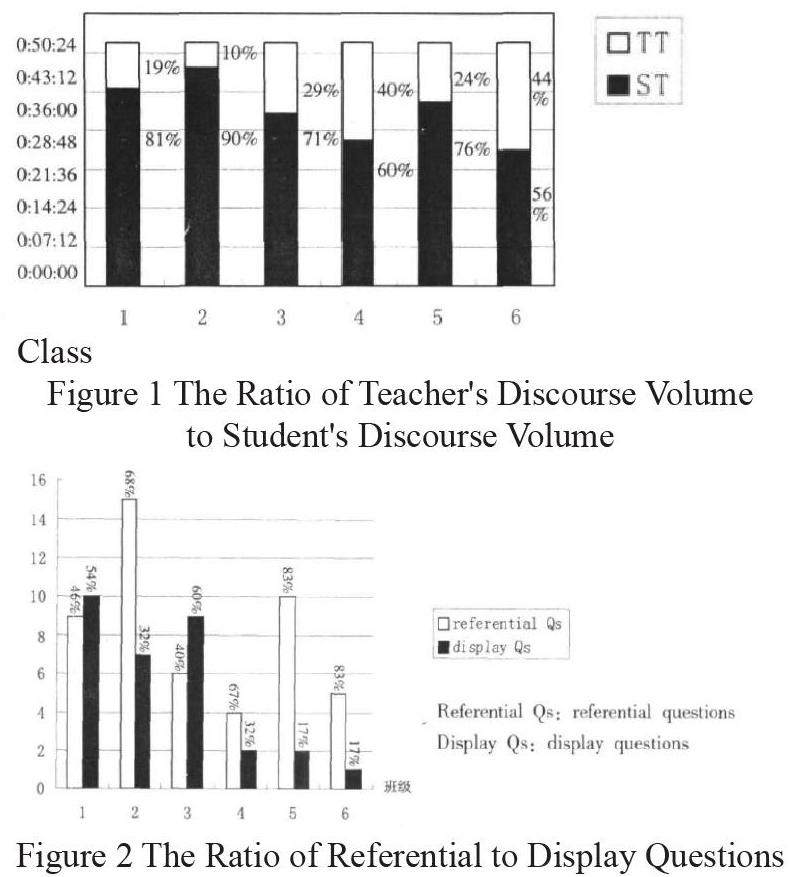
Teachers are randomly invited to attend the class. According to the recording, the time occupied by teacher's discourse and student's discourse in six classes and the proportion occupied in one class are counted respectively.
From Figure 1, it indicates that the discourse volume of middle school students in six classes is above 60%. Among them, the amount of students' discourse in four classes is more than 30 minutes, which shows the students' learning subjectivity.
Figure2 indicates that although there are great differences in the number of teachers' questions, there is basically a common feature: except for class 1 and class 3, the other 4 class reference questions are nearly the display questions, accounting for 60%-83% of the total number of questions. The number of referential questions in class 1 and 3 is also between 40% and 50%.
By linking the two charts and comparing the results with the suggestions made by many scholars, teachers should use more referential questions in order to create more communication in class. However, in the specific class, the referential questions may be less than the display questions, while the proportion of discourse output of students in class can still be large, such as 81% in class 1 and 71% in class 3.
Referential questions, display questions and student knowledge construction. In class 1, Teachers ask students to make presentations in each class, and students make their own PPT to visualize them. In this class, a student gives a detailed description of PUKA, a popular cartoon character among students. After that, the teacher asks the students to discuss it.
From the transcript, teacher first put forward two referential questions: Why do you like it? Why does PUKA products popular among students? Each student can answer these two questions according to his understanding and experience. The following three students take an active part in the class from different aspects. After asking questions, teachers can get feedback quickly from students. They use display questions to encourage students to answer questions. Does anyone want to answer this question? I do want to know your opinion, anyone volunteers? Teachers encourage students to answer questions and make appropriate evaluation of students' questions.
5. Conclusion
During the process of helping students knowledge construction, teachers' language plays a mediating role. Teacher's question is of great importance. In the high schools English teaching, which takes the students as the main body, referential question is essential. In the specific teaching process, teachers should combine the classroom practice, use constructivism as the guidance, skillfully combine the two kinds of questions in order to cultivate students' creative thinking, reasonably create a learning environment for constructing knowledge, and give full play to students' intellectual potential and creative ability.
References:
[1]Harmer,Jeremy.1998.How to Teach English[M].London:Addison Wesley,2014.
[2]榮靜嫻.微格教學(xué)與微格研究[M].上海:華東師范大學(xué)出版社,2000.
猜你喜歡
國(guó)家教育行政學(xué)院學(xué)報(bào)(2022年9期)2022-10-10 10:02:28
體育科技文獻(xiàn)通報(bào)(2022年3期)2022-05-23 13:46:54
遼金歷史與考古(2021年0期)2021-07-29 01:06:54
少先隊(duì)活動(dòng)(2021年5期)2021-07-22 09:00:02
家庭影院技術(shù)(2020年11期)2020-12-28 01:22:42
甘肅教育(2020年14期)2020-09-11 07:57:50
科技傳播(2019年22期)2020-01-14 03:06:54
民用飛機(jī)設(shè)計(jì)與研究(2019年4期)2019-05-21 07:21:24
東方教育(2017年19期)2017-12-05 15:14:48
唐山文學(xué)(2016年2期)2017-01-15 14:03:59