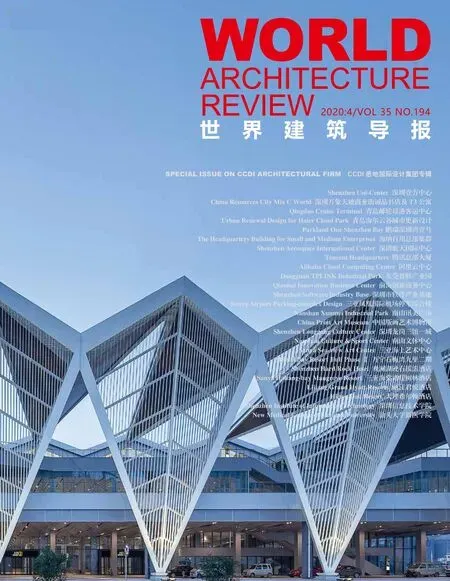
南山訊美廣場
2020-09-07 06:46:10
世界建筑導報 2020年4期
業主:深圳市訊美科技有限公司
地點:深圳市南山高新區中區科苑大道
用地面積:11 607.44平方米
建筑面積:234 588.29平方米
結構形式: 框架-核心筒結構
建筑設計: CCDI 悉地國際+ASGG (美國)
結構設計/機電設計: CCDI 悉地國際
設計/竣工: 2012/2016年
Client: ShenZhen XunMei Technology Co.,Ltd
Location: Keyuan Avenue, High-Tech Zone, Nanshan District, Shenzhen, China
Site Area: 11,607.44 m2
Floor Area: 234,588.29 m2
Structural Form: Frame - Core Tube Structure
Architectural Design: CCDI + ASGG (USA)
Structural Design/M&E Design: CCDI
Design/Completion: 2012/2016
在深圳市南山區既有的異形而開放的城市肌理中,布局三座高層辦公建筑、廠房、研發、以及一系列復合化的商業設施,是一項富有趣味的設計挑戰。本案的場地環境并非優越,周邊新舊并存的都市面貌暗示著這座速生城市在過去30年中的演變痕跡,建筑師的設計起點在于尋找一個別致的設計手段,來回應這片地價飆升的熱土所應具備的21 世紀的形態特征和空間組織方式。因此首先考慮的是結合品字型用地特征,將廠房及研發樓按品字形布局,布置在用地端頭,空出中央的城市步行空間。同時,沿中央步行軸兩側布置食堂,商業配套等設施,并將部分研發室獨立布置,與塔樓脫離,減少干擾,有利于精密儀器的使用。
為了保證交通動線上的功能性和舒適性,CCDI 對于“人車分流”的設計考慮,在于將南側科智路向地塊內由原有的7米擴寬至10米,優化市政道路條件的同時,提供給自身一個更舒適的入口空間與道路環境。車行流線沿基地邊緣布置,各個界面均設置地下車庫出入口,車輛沿園區道路可停靠至每棟建筑下方后進入地下車庫,貨車車流通過東北角入口進入園區停靠后直接進入地下車庫,從而實現了基地內部的無縫貫通。而人行流線則由城市道路,順應建筑布局延伸至內部公共庭院,場地局部利用建筑底層架空,設置健康運動的活躍氣氛,豐富園區的工余生活。在地面層,建筑師充分考慮了采光井,為地下一層車庫提供自然的采光通風環境。在步行區域兩側,與廠區出入口處,設置空層層及雨篷,并形成連續、舒適、起伏的步行空間,一系列遮陽體系的設計迎合了深圳這座城市南方熱帶多雨氣候。
園區的建筑形態現代簡約,暗示出深圳高效進取的都市精神,以及作為科技建筑所蘊含的純凈、理性的風格特征。高層建筑轉角位置的幕墻呈現出富有趣味的變化,凹凸起伏的設計手法是對未來都市界面的一種時尚回應,人們漫步此處仿佛不是一個簡單的辦公園區,而是精致的步行街。建筑師用其細膩而獨特的表皮語匯,為這組建筑增添了戲劇化的都市表情,通過吸引周邊社群的來訪體驗來增添辦公建筑的街角活力,將建筑的生命周期深刻融入在“產城一體”的都市戰略之中。
In the existing distinctive and open urban fabric of Nanshan District, Shenzhen, it’s an interesting challenge to design three high-rise office buildings with factory and R&D facilities and a series of complex commercial facilities. The project is not prestigiously sited, as it is surrounded by both old and new buildings that have witnessed the evolution of the fast-growing city over the past 30 years. With the goal of identifying a special design means to respond to the land’s skyrocketing prices as well as its morphological characteristics and spatial arrangement methods unique for the 21st century, the architects came up with the idea of laying out the factory and R&D facilities in the shape of squares, with the ends featuring spaces for walking. In the meanwhile, the central walking axis is lined with dining and commercial facilities, while part of the R&D spaces are built to be independent from the tower to reduce disturbances and facilitate the use of precision instruments.
In order to ensure the functionality and comfort of the traffic lines, CCDI’s design highlights a division of flows of people and vehicles by extending the seven-meter section of Kezhi Road on the southern side by three meters into the plot. While optimizing the conditions of the municipal road, this enables a more comfortable entrance and a more pleasant road environment. The vehicle flow lines are arranged along the edges of the base, with all interfaces equipped with entrances to and exits from underground parking lots. Along the road, a passenger vehicle can enter the bottom of a building into the underground parking lot, while cargo vehicles can drive from the entrance at the northeast corner into the park and then pull up directly at the underground parking lot, thus ensuring a seamless connection inside the base. As for the flows of people, urban roads are extended into the internal public courtyard. Part of the site is elevated at the bottom to create vibrant spaces for exercise to enrich people’s life after work. On the ground, the architects designed a sufficient number of light shafts to provide the underground park lot with natural lighting and ventilation. On both sides of the walking area as well as at the entrance and exit of the factory facility, empty layers and awnings are created to form a continuous, comfortable and undulating walking space for pedestrians. A series of shading systems are in place to respond to the tropical and rainy climate in the southern city of Shenzhen.
The architectural form of the park is modern and simplistic, which echoes with the Shenzhen sprit of efficiency and entrepreneurship as well as the pure and rational style of high-tech buildings. The curtain walls at the corners of the high-rise buildings feature an interesting alternation of concavities and convexities as a stylish imagination about future urban interfaces. Walking inside, people will feel as if they were on an exquisite pedestrian street rather than an office park. Using a meticulous yet unique language to present the surface, the architects add dramatic expressions to this cluster of buildings and attract visitors from neighboring communities, thus enhancing the vigor of the office buildings and profoundly fusing the life cycle of the construction into the city’s strategy of “integration of industrial, urban and ecological functions”.


猜你喜歡
資源信息與工程(2021年5期)2022-01-15 05:37:52
北方建筑(2021年6期)2021-12-31 03:03:54
文苑(2020年10期)2020-11-07 03:15:36
現代裝飾(2020年6期)2020-06-22 08:43:12
現代裝飾(2020年3期)2020-04-13 12:53:14
藝術啟蒙(2018年7期)2018-08-23 09:14:18
建材與裝飾(2018年5期)2018-02-13 23:12:02
海峽姐妹(2017年7期)2017-07-31 19:08:17
Coco薇(2017年5期)2017-06-05 08:53:16
少兒科學周刊·兒童版(2015年6期)2015-11-24 03:49:38