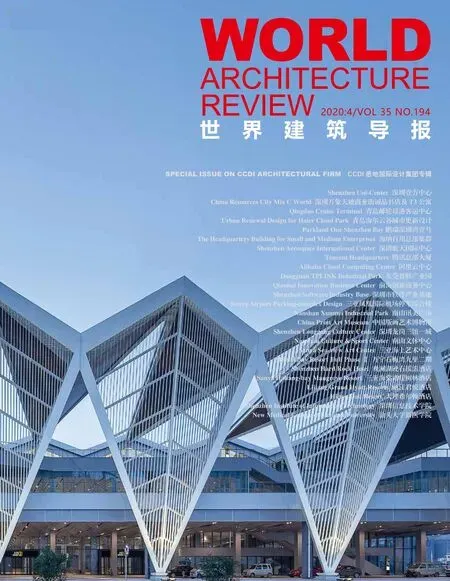
CCDI 集團(tuán)旗下的四個(gè)工作室訪談
2020-09-07 08:11:02采訪對(duì)象境工作室胡錚禹慶HuZhengYuQing東西影工作室王照明朱雄毅WangZhaomingZhuXiongyi21工作室王浪WangLangREAL工作室伍濤閆福輝WuTaoYanFuhui
世界建筑導(dǎo)報(bào) 2020年4期
關(guān)鍵詞:建筑設(shè)計(jì)
采訪對(duì)象:境工作室(胡錚、禹慶 Hu Zheng, Yu Qing),東西影工作室(王照明、朱雄毅 Wang Zhaoming, Zhu Xiongyi),21 工作室(王浪 Wang Lang),REAL 工作室(伍濤、閆福輝 Wu Tao, Yan Fuhui)
采訪策劃:艾俠、施婍婷 Ai Xia, Shi Qiting
引言
對(duì)建筑設(shè)計(jì)創(chuàng)作的一線單元采用“工作室”(Studio)的組織方式,在CCDI 已經(jīng)有十多年的歷史。由主持建筑師領(lǐng)銜設(shè)立工作室,代表了集團(tuán)對(duì)高端設(shè)計(jì)資源的重視和培育,也促成了建筑師個(gè)人成功與組織品牌高度同構(gòu)的發(fā)展模式。曾幾何時(shí),CCDI有大大小小近20 個(gè)工作室在運(yùn)作,其中有些比較成功,有些歷經(jīng)波折起伏,有些難以維持的工作室不得不面臨關(guān)閉。對(duì)于整個(gè)集團(tuán)的“企業(yè)生態(tài)”而言,這些都是正常的生態(tài)現(xiàn)象。
放眼世界,在大型國(guó)際化建筑機(jī)構(gòu)里以工作室形式成長(zhǎng)起來(lái)的著名建筑師,例如NBBJ 旗下的Peter Pran、SOM 旗下的Adrian Smith、法國(guó)AS 旗下的Jean Nouvel,Aedas 旗下的Andrew Bromberg 等等。這批人的共同特點(diǎn)是:大器晚成,技術(shù)精良,依托大公司的營(yíng)銷和管理平臺(tái),達(dá)到可觀的作品數(shù)量和規(guī)模。即使后來(lái)他們脫離母公司單獨(dú)開業(yè),其名望還是建立在之前公司的背書之上。
在CCDI 復(fù)雜而多變的管理歷程之中,讓“工作室”回歸一種簡(jiǎn)單而純粹、最適合設(shè)計(jì)思考的工作環(huán)境,一直是我們的理想。廣義地看,所有進(jìn)行建筑創(chuàng)作的有限單元,都可以看作是一個(gè)工作室;狹義地看,本次訪談的“工作室”,是指在大規(guī)模的設(shè)計(jì)機(jī)構(gòu)CCDI 旗下開設(shè)的具有一定精英效應(yīng)的四個(gè)小型設(shè)計(jì)團(tuán)隊(duì)。對(duì)于學(xué)習(xí)建筑、立志投身設(shè)計(jì)又身處大型設(shè)計(jì)機(jī)構(gòu)的建筑師,開設(shè)工作室是實(shí)現(xiàn)長(zhǎng)遠(yuǎn)建筑理想的上好途徑。
而一個(gè)工作室若想在市場(chǎng)上長(zhǎng)期繁榮,唯一的辦法是提升技術(shù)高度和工作室品牌。理論上說(shuō),工作室的存在,可以凸顯設(shè)計(jì)創(chuàng)作的領(lǐng)先價(jià)值。對(duì)CCDI 而言,培育一個(gè)優(yōu)秀的工作室,和培養(yǎng)一條成功的產(chǎn)品線一樣,需要精心灌溉,不可操之過急。
由建筑師胡錚、禹慶主持的“境工作室”、由建筑師朱雄毅、王照明主持的“東西影工作室”、由建筑師王浪主持的“21 工作室”,由建筑師伍濤主持的“REAL 工作室”,是CCDI 集團(tuán)非常典型的獲得成功的工作室的范例。本期世界建筑導(dǎo)報(bào)收錄的個(gè)CCDI 集團(tuán)的設(shè)計(jì)作品,有高達(dá)60%的比例來(lái)自于這四個(gè)工作室的設(shè)計(jì)創(chuàng)作。在設(shè)計(jì)理論和類型學(xué)的選擇上,這四家工作室皆成功發(fā)揮出某種屬于自身的“核心能力”,共同為CCDI 在業(yè)界形成了意義深遠(yuǎn)的競(jìng)爭(zhēng)優(yōu)勢(shì)。

朱雄毅

王照明
東西影工作室
問題1: 為什么工作室取名“東西影”,它有何寓意?
朱雄毅:東西影”取自八大山人“畫者東西影”的繪畫哲學(xué)——源于“東西”,又實(shí)現(xiàn)對(duì)它的超越,得“意”忘“形”,有影可追,無(wú)跡可尋。“東西”即“物”,對(duì)“物”的討論是工作室一貫的興趣所在,與“物”的偶然相遇,孕育著新的驚喜與發(fā)現(xiàn)。這里的“物”涵蓋具體的結(jié)構(gòu),材料、場(chǎng)地、空間等建筑學(xué)的基本問題。通過對(duì)這些問題、“東西”的不斷追問,重新認(rèn)知挖掘它們未被發(fā)現(xiàn)的價(jià)值,是我們的興趣所在。

留仙洞總部競(jìng)賽(模型)(合作:INGAMEONLY)

寶安工人文化宮(模型)
王照明:在中國(guó)過去的幾千年時(shí)間里,建造服務(wù)于各種用途,服務(wù)于等級(jí)和制度,服務(wù)于材料和邏輯, 有標(biāo)準(zhǔn)的制式和完整的工匠體系,可以說(shuō)建造的目的一直是非常清晰的。在中國(guó)這幾十年反而模糊了,錯(cuò)過了一個(gè)與世界同調(diào)的階段,然后進(jìn)入了一個(gè)沒有定數(shù)的階段。一面是海量新鮮事物的涌入,一面是各種資本構(gòu)建的標(biāo)準(zhǔn)和消費(fèi)主義的循循善誘,一切都在快速迭代,一切都被沖擊的東倒西歪。建筑師在這樣的背景噪聲下,需要花更多的精力去應(yīng)對(duì)干擾,去思考這些因素的背后邏輯。如果只是從一個(gè)具體而常規(guī)的需求出發(fā),快速發(fā)展的技術(shù)和逐漸被西方體系馴化的行業(yè),卻能從每一個(gè)具體問題上給出完整的解決方案。但當(dāng)這個(gè)需求不那么常規(guī)時(shí),成熟的體系反而無(wú)法應(yīng)對(duì)了,因?yàn)樘厥獠僮魇堑托实摹R簿褪钦f(shuō)當(dāng)下中國(guó)普遍性建造需求是標(biāo)準(zhǔn)化的,它本身已經(jīng)不構(gòu)成問題了,但這套體系也是一劑麻藥,讓精神遲緩,意志消沉,這反而是一個(gè)更嚴(yán)峻的問題。
問題3:為什么建造?為建筑學(xué)而建造?建造如何適應(yīng)?
王照明:建筑是人類通過材料和技術(shù)能完成的最大體量的構(gòu)筑物類型,它同時(shí)服務(wù)于人的意識(shí)需求和肢體需求,特別的建筑能喚醒人的某種意識(shí),對(duì)物質(zhì)體存在感的意識(shí),激發(fā)個(gè)體主動(dòng)的思考與環(huán)境之間的關(guān)系。建筑學(xué)像是一個(gè)特別的解碼放大器,可以讓建筑師嘗試用不同的讀取機(jī)制,從世界中提取特殊性和關(guān)聯(lián)性,最終找到匹配自己的具有動(dòng)態(tài)適應(yīng)性“代碼”。運(yùn)用這個(gè)特殊的“代碼”,建筑師可以為變化的未知以及能被感受的需求建造。
問題4:東西影的實(shí)踐主要在深圳這樣一座典型的速生城市,你們?cè)诮ㄖ腥绾沃v述城市?
朱雄毅:城市公共空間扮演著至關(guān)重要的角色,它是一個(gè)中立的場(chǎng)所,讓陌生人相遇并產(chǎn)生包容。從某種程度上說(shuō),公共空間不是設(shè)計(jì)出來(lái)的,而是使用出來(lái)。缺乏在場(chǎng)感的公共空間不具備討論的真實(shí)性。比如在深圳軟件產(chǎn)業(yè)基地項(xiàng)目中,我們?cè)O(shè)計(jì)了一個(gè)貫穿東西,距地10米兩層的空中連接體,串聯(lián)各標(biāo)準(zhǔn)辦公塔樓。地面層在連接體的陰影之下遮擋陽(yáng)光、暴雨,設(shè)置多樣豐富的商業(yè)配套,營(yíng)造南方連續(xù)有頂遮陽(yáng)的街道生活。在高密度的城市核心,完全開放的架空公共空間體系,沒有明確定義功能屬性,沒有準(zhǔn)入條件,市民可以自在輕松,沒有壓力呆在這里的臺(tái)階、平臺(tái),或停留或經(jīng)過,甚至買賣商品交易。建成之后,早上上班時(shí)間,筆者曾見一些移動(dòng)的小販駕著電動(dòng)車到此賣早餐,買早餐的白領(lǐng)排了長(zhǎng)長(zhǎng)的隊(duì)伍,呈現(xiàn)出城市本應(yīng)擁有的“煙火氣”,這當(dāng)然有點(diǎn)出乎設(shè)計(jì)的意料,但卻又在意料之中:彈性的城市公共空間,允許了自下而上的市民活動(dòng),這些活動(dòng)極大豐富了場(chǎng)所的內(nèi)涵,給人以真實(shí)的感動(dòng)。

桂園中學(xué)(模型)

海納百川總部大廈(模型)
問題5:深圳是一個(gè)庫(kù)哈斯眼里典型的“普通城市”,依賴全國(guó),乃至全球資源流動(dòng)塑造的城市,文化底蘊(yùn)缺乏,像這樣的城市中可能具有地域的特質(zhì)么?這里的人的生活方式有無(wú)獨(dú)特性?
王照明:深圳是個(gè)非常有地域特征的城市,炎熱、多風(fēng)、多雨,但氣候相對(duì)穩(wěn)定,沒有北方城市冬夏兩種生活狀態(tài)的切換,這其實(shí)極大的簡(jiǎn)化了城市面臨的問題,也讓空間設(shè)計(jì)、日常使用、行為交互具有了快速驗(yàn)證的可能,在使用習(xí)慣上也更容易達(dá)成全社會(huì)的共識(shí)。另一方面城市跨區(qū)的日常遷移,讓很多區(qū)域呈現(xiàn)出了白天沒人和晚上沒人的單一化屬性。快節(jié)奏的工作生活方式和人群層級(jí)的快速換代,使得居民對(duì)環(huán)境的關(guān)注度不夠,也缺少長(zhǎng)期經(jīng)營(yíng)生活環(huán)境的意愿,沒有那種城市群體層面生成的記憶和習(xí)慣,這讓建筑實(shí)踐對(duì)于這類問題的探究很難沉淀下去。當(dāng)然這也是最有意思的地方,它讓我們這代人有機(jī)會(huì)參與一座城市建立集體記憶和行為的過程,跟隨這個(gè)過程,也許能找到這個(gè)時(shí)代需要我們探求的真正使命。
問題6:雖然東西影工作室的作品大都保持著城市性和整體感,但是也時(shí)常出現(xiàn)分散與不確定性的特質(zhì),你們是如何處理其中的關(guān)聯(lián)?
朱雄毅:設(shè)計(jì)脫離不了現(xiàn)實(shí)的環(huán)境,我們會(huì)做類型與問題梳理,通過對(duì)環(huán)境的分析,理性厘清設(shè)計(jì)的邊界。但建造的行為發(fā)生,便一定會(huì)對(duì)原來(lái)的環(huán)境(自然或城市)發(fā)生改變,新的秩序,關(guān)系將會(huì)產(chǎn)生,構(gòu)筑一種“新的地理”。新的設(shè)計(jì)不會(huì)是舊有環(huán)境的簡(jiǎn)單復(fù)制,而是一種創(chuàng)造性的闡釋,我們希望制造一種熟悉的陌生感——偶然的際遇,在際遇中這些事物釋放出信號(hào),激發(fā)著彼此更恒定的的生存關(guān)系,找到各自存在的意義,突出強(qiáng)化自身的特征。
問題7: 2021年威尼斯雙年展以“我們?nèi)绾喂餐睢睘轭}邀請(qǐng)參展建筑師們構(gòu)想一個(gè)可以共同生活的場(chǎng)所。作為參展建筑師之一,請(qǐng)問您如何理解這個(gè)主題?
朱雄毅:2020 是非常特殊的一年,新的世界局勢(shì)下,雙年展提出“我們?nèi)绾喂餐睢彼坪跤兄撤N先見之明。共同生活的前提是跨越文化我們共同經(jīng)驗(yàn)的是否能形成共識(shí)。對(duì)這個(gè)問題的答案我是悲觀的。我們挑選了中國(guó)版畫博物館從一個(gè)方面做了重新的梳理,可以說(shuō)其實(shí)是一個(gè)獨(dú)立的文本了,取名:“鏡中園”。博爾赫斯對(duì)鏡子的描述非常令我著迷,在他看來(lái)“人類的形象和鏡子中的形象同樣不真實(shí)又同樣真實(shí)。鏡子與交媾是一回事。它們都創(chuàng)造形象,而不創(chuàng)造現(xiàn)實(shí)。……世界上每一樣事物都是一面秘密的鏡子,是宇宙的映象……把所有事物都關(guān)聯(lián)在一起”。在版畫博物館主體架空層吊頂,我們?cè)O(shè)置了鏡面的不銹鋼,鏡面反射景象把歷史的客家碉樓,自然的山水,反射進(jìn)我們?cè)O(shè)計(jì)的“垂直”院子中,形成一個(gè)“鏡中的園林”通過坡道往返,真實(shí)的鏡中園與真實(shí)園林之間不斷切換“假作真時(shí)真亦假,真作假時(shí)假亦真”的場(chǎng)景。
問題8:工作室未來(lái)的前進(jìn)方向和興趣是什么?
朱雄毅:黑格爾認(rèn)為:“精神的一切屬性都只因自由才得以成立,一切僅僅是爭(zhēng)取自由的手段,一切都在尋求自由和產(chǎn)生自由,自由是精神唯一真實(shí)的東西。” 人的生存最本質(zhì)是獲得自由,我們認(rèn)為建筑在使用、場(chǎng)地的介入方面只是個(gè)定義一個(gè)框架,這個(gè)框架的適應(yīng)性很重要,技術(shù)和社會(huì)都在不斷變化,建筑也應(yīng)該允許人們進(jìn)行調(diào)整,更新,互動(dòng),人在里面外面自由的生活,不會(huì)給人壓迫感。
人在空間使用中的 “自由”狀態(tài),自由的呼吸,它基于個(gè)體的創(chuàng)造,又具有普世價(jià)值,它富有情感,又有理性的基礎(chǔ)。,它模糊輕與重,內(nèi)與外,堅(jiān)固與柔軟,崇高與世俗。我們不希望有固定的風(fēng)格,不帶有任何預(yù)設(shè),而是根據(jù)周邊環(huán)境,使用的需求,文化因素,時(shí)代特征等因素,對(duì)技術(shù)和美學(xué)提出新的問題與拓展,賦予建筑獨(dú)特的形式。
Dong-Xi-Ying Studio
Q1: Why is the studio named “Dong-Xi-Ying (literally “reflections of things” in English)?
ZHU Xiongyi: We were inspired by the painting philosophy “painting is the reflection of real thing”of Pa-ta Shan-jen (pseudonym of Zhu Da) to name the Studio“Dong-Xi-Ying”. Pa-ta Shan-jen believed that what we paint is our perception and understanding of the original object rather than what it appears to be. Likewise, we are always interested in the discussion of objects. We take delight in unexpected encounters with different objects, as they promise new surprises and discoveries.By “objects”, I mean specific structures, materials, sites and spaces, all of which are fundamental issues of architecture. Through continuous exploration of these issues and objects, we can discover value that has never been unveiled before, and discuss the most essential and original form of architecture. We can also address specific cases by jumping out of the box to materialize constructions that are logical.
Q2: In the development process of China in the past few decades, what new changes have arisen in real-life practices? What new problems do they pose?
WANG Zhaoming: When the intention of architecture is clarified, the issues surrounding it will be clear. Over thousands of years, architecture served various purposes in China. It served hierarchy, institutionalism, materials, and logic, with standard formats and a complete artisanship system. It’s safe to say that the intention of architecture was always clear. However, in recent years, it’s been blurred in China. It missed the timing when it could synchronize itself with the rest of the world, and thus entered a stage of uncertainties. On the one hand, it’s bombarded with new things from other places. On the other hand, it’s struggling with the standards of capital construction and the temptation of consumerism. All is changing fast. All is in chaos. In such a disturbing context, architects need to spend more time and energy copying with distractions to find out the real logic behind all the noises. If it’s only about addressing a specific yet conventional need, the industry, possessing fast developing technologies and gradually tamed by the western system, is able to provide a complete solution. However, when the need is not that conventional, the mature system can be overwhelmed, as any special operation can be regarded as inefficient. In other words, standardization is now the norm for architecture in China.While it does not cause any issue, it is like an anesthetic that can numb the spirit and kill energy, which can be a rather serious problem.
Q3: For what do you build? For architecture? How do you adapt construction?
WANG Zhaoming: Construction is about building the largest structures accomplishable by human beings through the use of materials and technologies.It serves both ideological and physical needs of mankind. A special building can awaken a specific consciousness about existence and inspire people to think about their relation with the environment. Architecture is like a special decoder enabling architects to try different mechanisms to extract specificity and relevance from the world and find the dynamically adaptable code that matches with their need.By using this special code, architects can build for changing uncertainties and perceivable needs.

中國(guó)版畫博物館
Q4: Dong-Xi-Ying mainly practices architecture in Shenzhen, a typical fast-growing city. How do you tell stories about the city through architecture?
ZHU Xiongyi: The city is a place where people choose a common way of life. As a collection of people unfamiliar with one another, the urban public space plays a vital role. It is a neutral and all-inclusive place that allows strangers to meet. It can attract people of different backgrounds and ideas into a new group. It’s an embodiment of openness and freedom. In a sense, public spaces come into shape because of use rather than design.
Q5: Shenzhen is a typical “ordinary city” in the eyes of Rem Koolhaas. It is a city that relies on the flows of resources throughout the country and even the world. It lacks cultural heritages. Is it possible for such a city to have regional characteristics?Do people here live a unique way of life?
WANG Zhaoming: Shenzhen is a city with distinctive characteristics. It is hot,windy and rains quite a lot. However, it is blessed with a relatively stable climate,unlike cities in the northern part of China that have to deal with the shift between summer and winter. In fact, this helps to greatly reduce the challenges facing urban constructions, and makes it possible to quickly verify spatial design, daily use and behavior interaction. While it makes it easier for the society to agree on specific uses, it also leads to a lack of differentiation. On the other hand, due to daily flows of people from one district to another, there are some districts empty during the daytime and some other emptied of people during the nighttime. As a result of the rapid pace of work and life as well as the fast changes in the population, residents pay little attention to the environment around them and lack the willingness to improve their living environment for the long term. The absence of memories and habits as a group in the city poses tremendous challenges for architectural practices to explore such issues in depth. In consequence, constructions will have to constantly change their form of use to adapt to human behaviors.
Q6: While most of the designs of Dong-Xi-Ying Studio highlight a sense of urbanity and wholeness, there are also times when your works feature disparity and uncertainty. How do you deal with such connection?
ZHU Xiongyi: Design cannot be separated from the real environment. We identify design types and issues, and clarify the boundaries of design through a careful analysis of the environment. However, the occurrence of construction is sure to cause some change to the original natural or urban environment. There will be a new order as well as new relationships, thus shaping a new geography. A new design is never a simple replication of the old environment; rather, it’s a creative interpretation. We strive to create a sense of unfamiliarity with something that seems familiar. It’s like an unexpected encounter, during which the construction can communicate itself to inspire a more lasting relationship and a more profound meaning of existence and highlight its own characteristics.
Q7: TheBiennale Architettura 2021in Venice, with the theme of “How Will We Live Together?”, invites architects to envisage a place for people to live together. As one of the architects to attend the show, how do you understand the theme?
ZHU Xiongyi: 2020 is a very special year. Given the new world landscape, the biennale, themed “How Will We Live Together”, does seem to have some sort of foresight. The premise of living together is whether we can form a consensus based on our shared experiences across cultures. My answer to this question is pessimistic. We selected China Print Art Museum, and highlighted one aspect of it in our submission, which in a way became an independent work. We named it“The Garden in the Mirror”. The most important space in the museum is the Time Axis, composed of a Hakka street, diaolou (fortified multi-storey towers), and halfmoon shaped ponds. As for the ceiling of the elevated layer of the building, we used a mirror-like stainless steel structure, which can reflect the historical Hakka watchtower as well as natural scenes into the vertical courtyard we design, thus forming a garden in the mirror. A walk down the slope enables a surreal experience of the shift between the mirrored garden and the real one.
Q8: Where will the Studio’s priorities and passions lie in the future?
ZHU Xiongyi: Hegel believes, “All spiritual attributes can be valid only because of freedom. Everything is just a means of fighting for freedom. Everything is seeking and generating freedom. Freedom is the only real thing about the spirit.” The essence of human existence is to gain freedom. We believe that architecture should only be about defining a framework for use and site intervention. It’s important for the framework to be adaptable. Technologies are changing, so is our society.Therefore, constructions should allow people to make adjustments, renewals and interactions, and enable them to live freely both on-site and off-site without causing a sense of suppression.
People should have the freedom to use spaces the way they want. Architecture is a result of individual creativity. However, it should also have a universal value, based on sensibility and rationality. It blurs the boundaries between the intangible and the tangible, the inside and the outside, the tough and the soft, as well as the noble and the vulgar. We don’t want to have any fixed style or presumption. Instead, we are willing to pose new questions and make new explorations in terms of techniques and aesthetics based on the surrounding environment, user needs, cultural factors as well as the characteristics of the time to endow construction with unique forms.

胡睜

禹慶
境工作室
問題1:與激起社會(huì)漣漪的先鋒作品不同,境的作品總能讓人靜下心來(lái)沉浸其中,這種追求冷靜、理性的設(shè)計(jì)態(tài)度是您將工作室命名為【境】的原因嗎?
胡錚:我們最好的作品都是內(nèi)心的理想世界,而實(shí)現(xiàn)這一情感寄托的媒介是建筑空間架構(gòu)的搭建。清晰的建構(gòu)特征和嚴(yán)謹(jǐn)?shù)膸缀沃刃蚩梢越沂粳F(xiàn)代社會(huì)中人的真實(shí)需求,也可以創(chuàng)造一個(gè)樸素、持久深長(zhǎng)的境界。

青島港總部大廈國(guó)際競(jìng)賽方案 模型研究


武漢南湖藝術(shù)中心(效果圖)
禹慶:境試圖通過一系列圍繞“造境”的建筑實(shí)踐,展示我們對(duì)建造技藝的堅(jiān)守、對(duì)存在體驗(yàn)的關(guān)注,探索當(dāng)代建筑和城市設(shè)計(jì)的可能性。之所以取名“境”,這包含了我們對(duì)建筑的看法,我們認(rèn)為好的建筑一定是由物質(zhì)營(yíng)造而成并能直達(dá)人心的場(chǎng)所,那是一種主客體完整合一的體驗(yàn)。現(xiàn)代社會(huì)總是快速的更替與演變,很多關(guān)系似乎總是在不斷瓦解與重組,作為建筑師我們會(huì)去理解和接受這種現(xiàn)代性的事實(shí),但在設(shè)計(jì)上我們總是希望與這股不穩(wěn)定的潮流保持適當(dāng)?shù)木嚯x,以相對(duì)冷靜與理性的角度去探尋到建筑與人之間更加穩(wěn)定的、更加意味深長(zhǎng)的關(guān)系。
問題2:這種看似排除外界干擾的純凈空間是如何與紛繁復(fù)雜的“當(dāng)下”產(chǎn)生聯(lián)系的?
胡錚:冷靜、理性的建筑性格并不等于疏離社會(huì)。境致力于利用建筑解決城市中那些具體存在的問題。以三亞鳳凰國(guó)際機(jī)場(chǎng)停車樓綜合體為例,項(xiàng)目所在地原先是一片露天停車場(chǎng)。經(jīng)過幾次勘察,我發(fā)現(xiàn)市民在路邊下車,拖著行李,在烈日下穿過停車場(chǎng)到達(dá)航站樓出發(fā)大廳。小汽車和出租車涌入停車場(chǎng),爭(zhēng)搶車道,景象混亂。緊鄰?fù)\噲?chǎng)的航站樓候機(jī)大廳,也因?yàn)橐?guī)模限制無(wú)法為日益增多的旅客提供充足的休息空間和配套設(shè)施。面對(duì)種種離散且雜亂的日常現(xiàn)象,我希望建筑可以規(guī)劃出一條可以將他們整合起來(lái)的秩序。
禹慶:我不認(rèn)為我們是在排除,可能有些時(shí)候會(huì)根據(jù)環(huán)境制造一些抽離感,它會(huì)與紛繁復(fù)雜的當(dāng)下產(chǎn)生對(duì)比,但它并不是排他的,而是為了給復(fù)雜環(huán)境植入新的秩序、或是節(jié)奏變化、或是某種趣味,或是透氣的場(chǎng)所,我們視為是對(duì)當(dāng)下的一種調(diào)劑。
問題3:長(zhǎng)達(dá)337米的三亞機(jī)場(chǎng)綜合樓,平行串聯(lián)了三個(gè)不同功能的建筑體量,展現(xiàn)了一個(gè)線性交通組織的水平巨構(gòu)。可以為我們講解它的設(shè)計(jì)思路嗎?
胡錚:十年前的冬天,我在柏林旅行,一棟綿延數(shù)百米的巨型建筑給我留下了深刻的印象。他讓我聯(lián)想到戰(zhàn)后的馬賽、紅色時(shí)期的維也納、建國(guó)后的北京……令我深受震動(dòng)的不是建筑的尺度,而是尺度背后折射出的意識(shí)形態(tài)。“大”建筑帶有英雄主義的情結(jié),它集中而強(qiáng)烈的展現(xiàn)出人存在的意志。想到這棟建筑處于原社會(huì)主義統(tǒng)轄的東柏林地界,這一事實(shí)背后的原因就不言而喻了。或許是我上大學(xué)以來(lái)所受到的理想主義教育,又或許是那次柏林街頭的偶遇,對(duì)于“大”建筑,我似乎有一種偏愛。三亞鳳凰國(guó)際機(jī)場(chǎng)停車樓綜合體地處高鐵站與機(jī)場(chǎng)候機(jī)樓之間基地東西綿長(zhǎng),南北狹促。綜合考慮機(jī)場(chǎng)片區(qū)的城市條件及限高要求,這個(gè)看似激進(jìn)的水平“巨構(gòu)”,其實(shí)也是理性思考后的必然選擇。
問題4:復(fù)雜多樣的功能最終被精確整合到嚴(yán)格的秩序之中,由此產(chǎn)生的視覺特征蘊(yùn)含著怎樣的準(zhǔn)則和規(guī)律?
禹慶:對(duì)幾何的探究本身就是人們認(rèn)知和歸納自然世界的基本方法,我們確實(shí)傾向于通過幾何的關(guān)系來(lái)建構(gòu)秩序,這其中當(dāng)然有功能的秩序,更重要的是希望建立更好的生活的秩序,希望在壓縮得越來(lái)越高效與緊湊的社會(huì)生活中,通過空間操作保留更多的具有儀式感或者趣味性的時(shí)刻。在我們的設(shè)計(jì)作品中,往往有一種極少的傾向,但境不會(huì)把精力過度的集中在對(duì)形式、特征規(guī)律的總結(jié)上。事實(shí)上,形式上的極少只是表象,更重要的是尋找建構(gòu)起點(diǎn)。在創(chuàng)作階段,我會(huì)在圖紙上做減法,直到結(jié)構(gòu)、功能以最簡(jiǎn)潔的幾何形態(tài)融入空間塑造,圖紙階段的工作才算完成。圖紙就像是建造之前的預(yù)演,預(yù)演后的圖面不斷清晰、一步步接近心中所想,建筑形態(tài)也更具體、更精確。如果圖紙上的每一條線、每一個(gè)色塊都能在建筑升化過程中發(fā)揮作用,那就是我們最好的作品。一張合乎建造邏輯的圖紙,已足夠表達(dá)隱藏在秩序與比例之下的建筑特性。以萬(wàn)寧石梅灣九里二期項(xiàng)目的大屋頂結(jié)構(gòu)造型為例,無(wú)論是混凝土結(jié)構(gòu)還是鋼結(jié)構(gòu),也無(wú)論是雙坡、十字坡還是傘蓋,最后均因符合結(jié)構(gòu)邏輯的形式表達(dá)顯得和而不同。
問題5:寧?kù)o、圣默的精神空間往往會(huì)給人帶來(lái)壓迫感。若步行于一個(gè)將幾何秩序運(yùn)用極致的沉浸空間中,能否激發(fā)出人們體驗(yàn)建筑的欲望?
胡錚:沉靜和興奮是可以出現(xiàn)在同一空間里的。從超高層建筑到科技產(chǎn)業(yè)園,不論面對(duì)何種空間尺度的設(shè)計(jì)實(shí)踐,我們都設(shè)法平衡秩序與活力之間的關(guān)系。中國(guó)中鐵西南總部是一個(gè)小街區(qū)尺度下我把幾何秩序運(yùn)用到極致的案例。通過正交體系下切分、拉伸、錯(cuò)位,裙房和高層體量有機(jī)組合,底部自然得植入商業(yè)功能,激發(fā)街道生活。向外懸挑的建筑形態(tài)覆蓋部分城市廣場(chǎng),為不同天氣條件下的城市活動(dòng)創(chuàng)造了有利的條件,保證了小街區(qū)尺度下步行空間的連續(xù)性。
禹慶:前面已經(jīng)說(shuō)過我們營(yíng)造的空間對(duì)于紛繁的當(dāng)下來(lái)說(shuō)很多可能是偏安靜的,有儀式感的,但也有很多是有趣味性的,可探索的,這都會(huì)視乎于建筑所在環(huán)境或者使用上的需求,我們不認(rèn)為秩序化會(huì)與體驗(yàn)之間產(chǎn)生矛盾,就好像最為簡(jiǎn)單最為秩序化的圍棋棋盤上會(huì)產(chǎn)生最有趣味的游戲,我們始終會(huì)在那些簡(jiǎn)單明晰的空間秩序下編織入最豐富多彩的生活,去解決最復(fù)雜多樣的問題。
問題6:聊一聊美國(guó)哥倫比亞大學(xué)的留學(xué)經(jīng)歷對(duì)當(dāng)前工作的影響?
胡錚:我在哥倫比亞大學(xué)學(xué)的是城市設(shè)計(jì),這段求學(xué)經(jīng)歷讓我有機(jī)會(huì)深入研究和走訪東西方不同類型的城市。我發(fā)現(xiàn)城市與建筑的相互聯(lián)系盡管有可能是千絲萬(wàn)縷和具體而微的,但在建筑復(fù)雜的多樣性背后,有某些共同的規(guī)律起作用。這些規(guī)律可能是可見的,比如氣候、地形、城市肌理等,也可能是不可見的,比如意識(shí)形態(tài)、文化風(fēng)俗和生活方式等。與其關(guān)注單體建筑的個(gè)性,我更加關(guān)注城市力量對(duì)建筑塑形的普遍性。在回國(guó)后的實(shí)踐中,我體會(huì)到單棟建筑的設(shè)計(jì)除了需要有細(xì)膩敏感的城市對(duì)話關(guān)系和嚴(yán)謹(jǐn)精確的內(nèi)部結(jié)構(gòu)之外,對(duì)于城市中隱含秩序的深刻揭示和表達(dá),才能夠使建筑具備超越地域和時(shí)間限制的持久力量。
JING Studio
Q1: Different from avant-garde works that cause stirs in society, designs presented by JING Studio always calm and absorb hearts. Is the pursuit of sober and rational design the reason why you named the studio “JING”?
HU Zheng: The best possible works are always about portraying the ideal world cherished in our heart. Construction of architectural space is a good way to realize what we have been dreaming about. With clearly defined features and a rigorous geometric order, construction can not only reveal the real passions and needs of modern people but also create a plain, lasting and profound atmosphere.

簡(jiǎn)上體育中心(效果圖)

深圳寶安公共文化藝術(shù)中心(模型)

深圳寶安公共文化藝術(shù)中心(模型)
YU Qing: JING wants to demonstrate our unwavering commitment to architectural skills and techniques and attention to existential experience, and explore the possibilities of contemporary architecture and urban design through a series of architectural practices themed “ZAO JING (meaning “creating the ideal state” in English”).
Q2: How do such pure spaces seemingly excluding external disturbances correlate with the present that is filled with hustles and bustles?
YU Qing: I don’t think we are excluding them. Sometimes, we may create a sense of isolation depending on particular environmental conditions to form a contrast with the existing hustles and bustles. However, instead of exclusion, we do so to weave a new order, or a rhythmic change, or some sort of fun, or a relaxing place into a complex environment. We think it’s like adding spice to the world we are in.
Q3: The 337-meter-long Complex Building of Sanya Phoenix International Airport has three buildings with different functions connected in parallel, presenting an enormous horizontal structure of linear transportation organization. Can you explain its design idea for us?
HU Zheng: I went on a trip to Berlin in the winter ten years ago. There, a magnificent building extending for hundreds of meters impressed me deeply,reminding me of the post-war Marseille, Rotes Wienand Beijing after the founding of the People’s Republic of China - to name just a few. It’s the ideology behind the enormity that struck me deeply, rather than the mere size of the construction. Grand buildings are reflections of heroism, and a strong and concentrated embodiment of the human will to exist. The reason behind such massiveness is self-evident, given its location at the former socialist East Berlin territory. It seems that I have long had a preference for buildings that are huge, maybe because of the idealism education I received during my university years or the unexpected encounter I had with that building in Berlin. The Parking-Complex of Sanya Phoenix International Airport is located between the high-speed railway station and the airport terminals. Given the fact that the site stretches long from east to west but is quite narrow from south to north, a horizontal megastructure became a seemingly radical but actually rational choice, based on the conditions of the urban areas surrounding the airport as well as the height limitation requirements.
Q4: Functions that are complex and diverse are eventually accurately integrated into a strict order. What rules and patterns can the resulting visual characteristics convey?
YU Qing: Geometry in essence is a basic method for human beings to recognize and generalize the patterns of the natural world. We do tend to build through geometry the order we desire for functionality, and more importantly for a better life. In an increasingly efficient and compact social life, we want to retain as many moments of rituality and fun as possible through our design of spaces. In our design works, there’s a minimalistic tendency. However, JING never put too much focus on generalization of forms, features and patterns. Instead, through the expression of minimalism, what we really want is to seek the starting point for construction.During the design period, I always try to delete things that are unnecessary until the structure and functionality are expressed in the most concise geometric form for the creation of spaces. Drawings are like a pre-construction rehearsal, which can help clarify the thought and ensure that the eventual form of architecture is the most concrete and accurate. If all the lines and color blocks can play their roles during the process of refinement, our best possible work can be created. A drawing that is consistent with the construction logic is sufficient to express the construction characteristics behind order and proportion. Take the gigantic roof structure of Shimei Bay Palace Phase IIin Wanning for example. Despite the mixture of concrete and steel structures and the use of double-slope, cross-ridge and umbrella-like roofs, they look harmonious when put together because of compliance with the construction logic.
Q5: Tranquil and sacred places can be suppressive. Can an immersive space that utilizes the geometric order to the extreme really kindle people’s desire to explore the construction?
HU Zheng: It is possible for calmness and excitement to exist in the same space.From super high-rise buildings to high-tech industrial parks, we always do our best to balance order and vitality no matter what size of space we design. The southwest headquarters of China Railway Group Limited is a case where I use the geometric order to the extreme within the size of a small block. Through orthogonal cutting,stretching and staggering as well as an organic combination of podiums and highrises and the incorporation of commercial functions at the bottom, the street life is spiced. The construction is cantilevered outward to cover part of the city square,thus ensuring a favorable environment for city activities under different weather conditions as well as a continuous walking space within the scale of a small block.
YU Qing: As I said before, while many of the spaces we create are quiet and ceremonial in the context of the hustling and bustling modern world, they are also full of fun for exploration, depending on the environment they are in or the need for specific use. We don’t agree that there’s a conflict between order and experience.Just as the simplest and most orderly Go board enables the most interesting game,so is our attempt to weave the most colorful and exciting life into spaces of a neat and clearly defined order to address the most complicated problems.
Q6: Now, could you please talk about the impact of your education at Columbia University in the United States on your current career?
HU Zheng: I studied urban design at Columbia University. The experience gave me the opportunity to study and visit different types of cities in the east and the west.I found that while the interconnection between the city and its buildings may be subtle, there are some common patterns in play behind the complexity and diversity of constructions. Some patterns are visible, such as climate, terrain, and urban texture. Some others may be invisible, such as ideology, culture and customs, and lifestyle. Rather than focusing on the individuality of a single construction, I pay more attention to the universality of urban power in shaping buildings. In practicing architecture after returning to China, I have come to the realization that in addition to the delicate and sensitive dialogue with the city and a rigorous and precise internal structure, the design of any single building must be able to profoundly reveal and express the hidden order of the city to ensure that the building has the lasting power to transcend the constraints of time and distance.

三亞鳳凰國(guó)際機(jī)場(chǎng)停車綜合樓
21 工作室
問題1:21 工作室是遵循什么原則展開創(chuàng)作的?您的設(shè)計(jì)團(tuán)隊(duì)近期工作聚焦在那些建筑類型?
王浪:21 工作室并不是CCDI 的第21 個(gè)工作室(笑)。很多人可能不會(huì)想到,“21”其實(shí)取自六本木21_21 美術(shù)館。如果說(shuō)“20/20 vison”代表完美的視力,“21”則代表超越常人的眼界和境界以及擁有遇見未來(lái)的洞察力。我們當(dāng)下正好處于21 世紀(jì),“21”這個(gè)數(shù)字,也是寄望我們可以打破框架的束縛,比當(dāng)前的設(shè)計(jì)領(lǐng)先一步,著眼于未來(lái)的理想。從業(yè)績(jī)來(lái)看,我們的團(tuán)隊(duì)在科技產(chǎn)業(yè)類型的建筑方面有突出的優(yōu)勢(shì),尤其是在城市更新背景下、對(duì)城市格局產(chǎn)生重大影響的高密度辦公產(chǎn)業(yè)園、商業(yè)辦公綜合體,以及由此衍生的文化設(shè)施,這些是我們一直堅(jiān)持的研究和實(shí)踐領(lǐng)域。簡(jiǎn)單地說(shuō),21 工作室關(guān)注于建筑與城市、環(huán)境及人的關(guān)系, 通過建筑與人的互動(dòng)來(lái)演繹當(dāng)代城市場(chǎng)景。
問題2:在面對(duì)超大尺度的城市更新項(xiàng)目時(shí),對(duì)于城市的歷史元素與當(dāng)下的開發(fā)價(jià)值如何有效地平衡?
王浪:我認(rèn)為這兩者是不矛盾的,城市其實(shí)是某種現(xiàn)實(shí)生活的投影。以青島海爾云谷項(xiàng)目為例,設(shè)計(jì)前,園區(qū)是以一種封閉的、高效的、機(jī)械化的形態(tài)存在。設(shè)計(jì)改造后,園區(qū)向產(chǎn)城一體化轉(zhuǎn)變,通過首層架空、形體錯(cuò)動(dòng)、形成立體花園式環(huán)境和體驗(yàn)式的研發(fā)辦公開放園區(qū)。保留園區(qū)歷史主軸線以延續(xù)園區(qū)歷史記憶,使得歷史遺存與現(xiàn)代建筑進(jìn)行良好的互動(dòng)。
問題3: 我們觀察到辦公建筑是近年來(lái)發(fā)展迅速的一個(gè)類型,也是21 工作室非常擅長(zhǎng)的設(shè)計(jì)類型。在具體工作中,您和建筑師團(tuán)隊(duì)如何提前預(yù)判這個(gè)類型可能出現(xiàn)的變化和趨勢(shì)?
王浪:從未來(lái)趨勢(shì)看,超級(jí)企業(yè)的超級(jí)園區(qū)會(huì)在中國(guó)成為一個(gè)非常重要的開發(fā)類型,它們本身在功能上是高度混合的,其動(dòng)態(tài)的多樣性可以理解為:由多個(gè)業(yè)態(tài)并存共生組成的“橫向多樣性”,以及由城市歷史和文脈疊合構(gòu)成的“縱向多樣性”, 青島海爾云谷就是典型的實(shí)例。同時(shí),結(jié)合都市郊區(qū)的城市化,特色小鎮(zhèn)的政策引導(dǎo),辦公、商業(yè)、體育、人居緊密結(jié)合的小鎮(zhèn)園區(qū)也是一個(gè)趨勢(shì),例如我們正在著手設(shè)計(jì)的海門足球小鎮(zhèn)。此外,回歸都市核心區(qū),與城市CBD 更新緊密結(jié)合的辦公業(yè)態(tài)開發(fā),往往伴隨著對(duì)標(biāo)志性建筑的訴求,也對(duì)結(jié)構(gòu)、空間、幕墻、室內(nèi)的一體化提出了更高的設(shè)計(jì)要求。21 工作室在這方面的典型作品是即將竣工的深圳紅土大廈。
問題4: 作為中國(guó)本土接受本科和研究生教育的建筑師,面對(duì)業(yè)主不斷提出的“國(guó)際化”要求,如何應(yīng)對(duì)?
王浪:設(shè)計(jì)的國(guó)際化是工作方法、思維領(lǐng)域的國(guó)際化,不是個(gè)體生理和學(xué)業(yè)特征的國(guó)際化。21 設(shè)計(jì)工作室是一個(gè)全過程設(shè)計(jì)的團(tuán)隊(duì),我們不僅有較強(qiáng)的方案推導(dǎo)能力,也有較強(qiáng)的深化能力。我們?cè)cSOM、KPF、Foster + Partners、HENN 等公司合作,從合作過程中獲益良多,將國(guó)際化的視野運(yùn)用在本土化實(shí)踐中。國(guó)際化并不意味著只是對(duì)外,本土也很重要。我們也是一個(gè)真正的國(guó)際化團(tuán)隊(duì),有外籍建筑師、海歸建筑師、有國(guó)際視野的國(guó)內(nèi)建筑師,多樣化的設(shè)計(jì)師團(tuán)隊(duì)架構(gòu)使得團(tuán)隊(duì)更有活力。

王浪
問題5: 作為在大型集團(tuán)中能夠直接盈利的工作室,如何平衡悉地國(guó)際對(duì)設(shè)計(jì)項(xiàng)目的商業(yè)回報(bào)和工作室對(duì)建筑學(xué)本體要素的追求?
王浪:作為一個(gè)成熟的建筑工作室,一定是專業(yè)與商業(yè)相平衡的,不可能因?yàn)閷?duì)某一方的偏執(zhí)而放棄另一方。我們通過成熟的積累、高效的模式來(lái)滿足客戶的要求。同時(shí),在每個(gè)項(xiàng)目中尋找突破點(diǎn),發(fā)掘特別之處。我們希望每個(gè)項(xiàng)目比上一個(gè)項(xiàng)目進(jìn)步一點(diǎn),這是我們現(xiàn)實(shí)而直接的實(shí)踐態(tài)度。長(zhǎng)遠(yuǎn)來(lái)看,這是一件了不起的事情。所謂的商業(yè)回報(bào)和建筑學(xué)本質(zhì)追求并不完全矛盾,像SOM 所說(shuō)的“Good Design is Good Business”。我希望設(shè)計(jì)團(tuán)隊(duì)有好的口碑和較多的客戶,我們有選擇項(xiàng)目的空間,希望設(shè)計(jì)師能平衡工作和生活。高強(qiáng)度的輸出并不是唯一解,所有的事應(yīng)該是張弛有度的。建筑是一場(chǎng)馬拉松,人生也是如此,專業(yè)與商業(yè)更是如此。
問題6:在具體的技術(shù)方法和形態(tài)語(yǔ)言方面,21 工作室有哪些新的研究和偏好?
王浪:技術(shù)方法上比較廣泛的,沒有特定的偏好。對(duì)于每一種擅長(zhǎng)的類型,針對(duì)不同項(xiàng)目與不同業(yè)主的需求,我們?cè)趯I(yè)的積累基礎(chǔ)上做一些變異,讓其更適應(yīng)與城市、環(huán)境、人這三者的關(guān)系。設(shè)計(jì)過程中,我們采用草圖、模型、Grasshopper 等方式優(yōu)化設(shè)計(jì),這些都只是設(shè)計(jì)工具和手段。相比較起來(lái),我們更關(guān)注設(shè)計(jì)思想和解決問題的方法。
形態(tài)語(yǔ)言上多變的,沒有具體的形式框架來(lái)限制自己,根據(jù)建筑與城市、環(huán)境及人的關(guān)系去選擇合適的方式去做,不會(huì)因?yàn)橹鞒纸ㄖ焸€(gè)人的喜好束縛大家的方向。我認(rèn)為工作室應(yīng)該是開放性的,吸納大家的創(chuàng)造力,團(tuán)隊(duì)與個(gè)人共同成長(zhǎng),做出有特色的作品。作為一個(gè)商業(yè)建筑師團(tuán)隊(duì),我們更關(guān)注整個(gè)設(shè)計(jì)的落地性和完成質(zhì)量,提高把握項(xiàng)目的完成度,使設(shè)計(jì)貼近城市、環(huán)境和人。
一個(gè)好的建筑設(shè)計(jì)不僅僅是照片好看,而是應(yīng)該被較好的使用,發(fā)揮其城市性功能和公共性價(jià)值。

海爾云谷研究模型

青島某文化設(shè)施設(shè)計(jì)模型
21 Studio
Q1: What principles does 21 Studio follow in practicing architecture? What types of architecture has your design team been focusing on recently?
WANG Lang: 21 Studio is not the 21st studio of CCDI (laughs). It might surprise many people if they are told that “21” is actually an inspiration from 21_21 DESIGN SIGHT. While 20/20 vision stands for a perfect vision, “21” indicates an extraordinary vision and a profound insight into the future. We are in the 21st century. “21” is a number representing our hope to jump out of the box, lead current designs and focus on future ideals. In terms of performance, our team has outstanding strengths in designing high-tech industrial constructions, especially high-density office parks,commercial and office complexes as well as derivative cultural facilities that can have a significant influence on the urban landscape in the context of urban renewal.These are what we have been studying and practicing over the years. Simply put, 21 Studio focuses on the relationships between architecture and the city, and between the environment and people. We want to interpret modern urban scenes through the interaction between architecture and people.
Q2: In the face of super-large urban renewal projects, how can you effectively maintain the balance between the historical elements of the city and its current development value?
WANG Lang: I think the two are not conflicting. The city is actually a reflection of real life. Take Qingdao Haier Cloud Valley for example. Before design, the park existed as a closed, efficient and mechanized site. After design and transformation,the park has changed into an industry-city integration. Through the elevation of the first floor and the staggering of structures, an experience-oriented R&D office park with a vertical garden-like environment open to the outside is formed. The historical elements of the park are retained as a link to memories about its past, thus enabling a good interaction between historical heritages and the modern construction.
Q3: We notice that office architecture has been developing rapidly in recent years,which is also a type of architecture that 21 Studio excels at. In specific work processes, how do you and your team of architects anticipate possible changes and trends of this type?
WANG Lang: In the future, super-parks of mega-corporations will become a very important type of development in China. They are highly sophisticated mixtures of functions. Their dynamic diversity can be understood as a combination of horizontal diversity based on the co-existence and symbiosis of multiple forms and vertical diversity formed as a result of the interaction with the history and culture of the city.Qingdao Haier Cloud Valley is a typical example. Besides, driven by the urbanization of suburban areas as well as policies and guidelines about characteristic towns,parks in the form of a town where functions such as office, business, sports and residence are closely interwoven are also an evident trend. A good example is Haimen Football Town we are designing now. What’s more, there’s also a trend to shift attention back to CBDs. Office architecture development, which is closely related to CBD renewal, is also coupled with the need for the creation of iconic landmarks. As a result, there are higher design requirements in terms of structure,space, curtain wall and indoor integration. One of our representative works in this regard is Shenzhen WONG TUNG Tower, which is about to be completed soon.
Q4: As an architect who received undergraduate and graduate education in China,how do you deal with the “internationalization” requirements constantly put forward by clients?
WANG Lang: The internationalization of design is about the internationalization of working methods and thoughts, rather than the internationalization of individual physiological and academic characteristics. 21 Studio is a full-process design team.We have strong abilities to develop and refine solutions. We have worked with companies such as SOM, KPF, Foster + Partners and HENN, and have benefited a lot from such cooperation. We apply the international perspective to our localization practice. Internationalization does not mean that all our focus should be on other countries and regions; it’s also important to pay attention to local trends and needs.We are in fact an international team. We have international architects, and Chinese architects that have overseas education experience or possess an international outlook. Such a diversified team structure ensures vigor and vitality.
Q5: As a studio that is part of a large group but can directly make profits, how do you balance CCDI’s requirements on project returns and the Studio’s pursuit of the quintessence of architecture?
WANG Lang: As a mature architectural studio, we must be able to maintain a balance between professional and commercial value. Instead of abandoning one for the other, we try our best to accumulate expertise and experience and develop efficient models to meet client requirements. Besides, we seek breakthroughs in each project. We explore and identify areas that can make a project special. We hope that each project can be better than the previous one. We take a realistic and direct approach to the practice. In the long run, it’s really something incredible. The so-called commercial returns are not in conflict with the pursuit of the essence of architecture. Just as SOM said, “Good design is good business.” Ideally, a team of architects should have a good reputation and a solid customer base so as to have the freedom to choose projects. We also want our architects to balance their work and life. We don’t think one should only focus on output efficiency. All work and no play makes a studio a dull one. Architecture is like a marathon, so is life. It is also true of the relationship between profession and business.
Q6: In terms of specific technical methods and morphological language, what new researches and preferences does 21 Studio have?
WANG Lang: We have been experimenting with a wide range of technical methods without any particular preference. For each architectural type we excel at, we make variations based on our expertise to meet different project and client needs and ensure better compatibility with the city, environment and people. During the design process, we adopt methods such as drafting, modeling and Grasshopper to optimize our design. For us, these are just design tools and means. In comparison, we pay more attention to design ideas and problem-solving methods.
The morphological language is changeable, and there is no need to use any specific form or framework to limit ourselves. We tend to pick suitable approaches based on the relationships between architecture and the city as well as between the environment and people, rather than restrict ideas merely because of the personal preferences of the chief architect. To me, a good studio should be open to possibilities of creation. To achieve distinctive designs, it’s important to ensure that individual architect can grow together with the team. As a team of commercial architects, we are more focused on the implementation and completion quality of our design. We will continue to improve our control over the execution of each project to ensure alignment of our design with the city, environment and people.
A good architectural design should not just look good in photos. Instead, they should be put into good use to realize their functionality and public value.

某大型都市科技園區(qū)研究模型

深圳紅土創(chuàng)新大廈研究模型

新一代科研中心
REAL 工作室
問題1:REAL 工作室是何時(shí)成立的,有著怎樣的團(tuán)隊(duì)構(gòu)成和工作模式?
伍濤:REAL 工作室是2015年成立的,由于我們的團(tuán)隊(duì)一直以來(lái)主要以商業(yè)類型的項(xiàng)目為主,這個(gè)名字主要意向在于“創(chuàng)造真實(shí)的都市商業(yè)場(chǎng)景”。工作室的規(guī)模不大,與大部分的方案團(tuán)隊(duì)類似,采用項(xiàng)目組的工作架構(gòu)開展工作,因?yàn)槲覀冎饕脑O(shè)計(jì)領(lǐng)域是商業(yè)類型的項(xiàng)目,設(shè)計(jì)過程中有些范疇具有一定的商業(yè)特點(diǎn),所以我都需要參與內(nèi)部討論或者與業(yè)主的溝通把控。我們比較關(guān)注設(shè)計(jì)的商業(yè)產(chǎn)品邏輯,怎樣一步步分析,把握核心點(diǎn),從不同角度如何平衡需求,這一塊需要有大量的實(shí)踐積累。
問題2:REAL 工作室專注于大型城市綜合體和商業(yè)建筑的設(shè)計(jì),積累了哪些經(jīng)驗(yàn)和業(yè)績(jī)?
閻福輝:工作室早期參與的項(xiàng)目是贛州的萬(wàn)象城的設(shè)計(jì)工作,當(dāng)時(shí)國(guó)內(nèi)團(tuán)隊(duì)獨(dú)立設(shè)計(jì)這類項(xiàng)目的經(jīng)驗(yàn)還比較少,所以有不少需要學(xué)習(xí)的地方,當(dāng)時(shí)面對(duì)街區(qū)與集中商業(yè)的動(dòng)線邏輯,已經(jīng)感覺到這塊需要重點(diǎn)分析思考了。后面到了參與深圳壹方中心的設(shè)計(jì)工作時(shí),就感覺到當(dāng)下國(guó)內(nèi)商業(yè)建筑有了明顯的改變了,這又與早期對(duì)設(shè)計(jì)的思考大體能夠?qū)?yīng)上,所以就提出了關(guān)于“復(fù)合動(dòng)線”的想法,今天這一觀點(diǎn)也還在工作中不斷積累完善。后面有機(jī)會(huì)參與深圳大沖萬(wàn)象天地、白石洲改造的整體商業(yè)規(guī)劃研究,對(duì)我們的專業(yè)度提升產(chǎn)生了更多價(jià)值。
問題3:早在2013年的《城市建筑》雜志的論文中,您就提出過商業(yè)綜合體的“復(fù)合動(dòng)線”原則,可否進(jìn)一步解釋一下這個(gè)設(shè)計(jì)方法?
伍濤:“復(fù)合動(dòng)線”的想法建議首先要理解為一種商業(yè)規(guī)劃的邏輯,其次才表現(xiàn)為一種設(shè)計(jì)方法。我們知道大型商業(yè)建筑有其特定的設(shè)計(jì)要素和判斷依據(jù),當(dāng)下大量的項(xiàng)目實(shí)踐正不斷重復(fù)或者優(yōu)化這些相對(duì)專業(yè)性的支撐點(diǎn),過去面對(duì)商業(yè)設(shè)計(jì)的問題,比較多的是從其本身的價(jià)值依據(jù)找出路,運(yùn)營(yíng)—業(yè)態(tài)—?jiǎng)泳€—尺度—主題,這個(gè)邏輯的鏈條已經(jīng)非常完善而整體,我們也是會(huì)依據(jù)這些而工作,體現(xiàn)設(shè)計(jì)的專業(yè)性。但是我們要看到很多人,不論業(yè)主或是設(shè)計(jì)者越來(lái)越不滿足于此,比較典型的反映就是商業(yè)的室內(nèi)與室外、地上與地下以及空中的關(guān)系變得復(fù)雜了,而城市的發(fā)展也需要這些地方變得越來(lái)越不可分離與界定。所以,單就商業(yè)綜合體的設(shè)計(jì)而言,如何處理以上的關(guān)系可能就需要一套思考的邏輯。我們希望多少找到一點(diǎn)規(guī)律一點(diǎn)共性的地方,比如室內(nèi)動(dòng)線與室外動(dòng)線的銜接需要什么特征的判斷依據(jù)或者節(jié)點(diǎn),這些對(duì)城市和對(duì)項(xiàng)目更多的意味著什么,有什么包容與拓展性。在面對(duì)項(xiàng)目的時(shí)候,我們相對(duì)也就會(huì)更宏觀的看待項(xiàng)目的商業(yè)價(jià)值,更重要的是會(huì)讓判斷的邏輯鏈變得更豐富、更有外延特點(diǎn)。基于“復(fù)合動(dòng)線”的理念加入新的設(shè)計(jì)決策點(diǎn),我們希望讓業(yè)主理解,項(xiàng)目的設(shè)計(jì)要點(diǎn)可能比他們想的還要更復(fù)雜一些。
問題4: 對(duì)于超大尺度的商業(yè)地塊開發(fā),類似于華潤(rùn)萬(wàn)象天地、壹方中心,我們?nèi)绾芜M(jìn)一步理解更高的開發(fā)密度與更緊密的公共交通之間的關(guān)系?這方面REAL 工作室有哪些新的觀察和研究?
閻福輝:未來(lái),隨著項(xiàng)目開發(fā)密度不斷加高,立體化的公共交通體系將銜接“復(fù)合動(dòng)線”組織業(yè)種布局以及主題空間。怎樣創(chuàng)造性的利用碼頭港口、軌道交通、公交系統(tǒng)、駐車空間等交通設(shè)施將是我們工作的另一個(gè)思考點(diǎn)。舊金山“大中央車站”提供了一個(gè)很好的范本。在最繁忙的舊金山市中心,大中央車站連接五個(gè)街區(qū),其將該地區(qū)轉(zhuǎn)變?yōu)榛旌嫌猛旧鐓^(qū),立體化的公共交通系統(tǒng)不僅銜接了商業(yè)空間而且整合了城市街區(qū),同時(shí)在屋頂提供了一處高線城市公園。未來(lái)高密度城市開發(fā)交通問題更多需要我們以更大的視域以及城市思維去著手設(shè)計(jì)工作,同時(shí)創(chuàng)造性的為城市提供充滿活力的公共空間。

伍濤

閻福輝
問題5:作為立足本土的設(shè)計(jì)工作室,REAL 與諸多世界一線的國(guó)際設(shè)計(jì)機(jī)構(gòu)競(jìng)賽或者合作過,這個(gè)過程中有哪些觀念上的沖突,以及如何巧妙地應(yīng)對(duì)和調(diào)和?
伍濤:我們與境外設(shè)計(jì)單位有多次的合作,工作類型有很多種情況,有些是他們主導(dǎo)設(shè)計(jì)工作,有些是雙方共同把控設(shè)計(jì),也有一些我們只是做些配合的工作。在這些年的感受就是他們的國(guó)際視野與經(jīng)驗(yàn)是值得我們學(xué)習(xí)的。在本土化的一些理念上,境外團(tuán)隊(duì)不一定能理解得很好,他們的思考常常變得不那么能“落地”,很多情況下對(duì)業(yè)主來(lái)說(shuō)需要一定的判斷力,我們的角色就比較重要了,我覺得首先是在設(shè)計(jì)決策上我們會(huì)保持一定的獨(dú)立性,對(duì)各方的意見不會(huì)簡(jiǎn)單接受。我們有自己的特點(diǎn),所以從客觀角度的分析成果也有較大的說(shuō)服力,看起來(lái)是一個(gè)讓幾方都能接受的選擇題,但其實(shí)結(jié)論已經(jīng)很清晰了。業(yè)主通常也希望有這樣的介入方式,對(duì)項(xiàng)目的設(shè)計(jì)成果有更好的把控。
問題6:在后疫情時(shí)代,對(duì)于人群高密度集聚的商業(yè)空間,未來(lái)會(huì)有哪些值得注意的、對(duì)建筑設(shè)計(jì)產(chǎn)生關(guān)鍵影響的問題?可否為我們預(yù)知一二?
伍濤:在疫情期間,人們通過線上工作、學(xué)習(xí)、消費(fèi),這一切看上去可以正常運(yùn)轉(zhuǎn)。但是隨著疫情消退,人們表現(xiàn)出一種對(duì)回歸線下實(shí)體交流空間的強(qiáng)烈渴望。
我們相信未來(lái)的商業(yè)空間會(huì)更加強(qiáng)調(diào)從社群共識(shí)需求的角度展開設(shè)計(jì)。商業(yè)空間作為人與商品交互的空間會(huì)更加強(qiáng)調(diào)在地性,社群共識(shí),商業(yè)空間將成為社群的共有“第三空間”。可以做個(gè)類比,我們知道南山科技園片區(qū)的人群特征與福田中心區(qū)的人群特征明顯不同,我們應(yīng)強(qiáng)化這種差異性打造屬于本地社群消費(fèi)習(xí)慣的商業(yè)空間。一方面人們可以在家門口就完成自己喜好的消費(fèi)活動(dòng),減少不必要的交通、移動(dòng)。另一方面,也在強(qiáng)化每個(gè)社區(qū)的在地性與歸屬感。這次疫情的發(fā)源地是人群高度密集集市。那么未來(lái)商業(yè)空間的形態(tài)是否會(huì)趨向于規(guī)模更小的社區(qū)中心式的模式,亦或是摒棄傳統(tǒng)封閉盒子狀的集中商業(yè)更多呈現(xiàn)出開敞式的街區(qū)商業(yè),我們拭目以待。

深圳壹方中心

柳州華潤(rùn)中心的采光中庭
REAL Studio
Q1: When was REAL Studio established? And what team structure and work approach do you adopt?
WU Tao: REAL Studio was established in 2015. As our focus has long been on commercial projects, we named it “REAL” to indicate our intention to “create real commercial scenes in cities”. Our studio is not big. Similar to most studios, we adopt the work structure of a project team. Most of our projects are commercial ones, so during the design process, some commercial factors need to be taken into consideration. Therefore, I need to exercise control by participating in internal discussions or communications with clients. We are focused on the logic behind the commercial products we design. How to conduct systematic analyses to properly identify priorities and balance needs requires the accumulation of extensive practices.Q2: Through design of large urban complexes and commercial buildings, what has REAL Studio learned that can be applied in future practices? What accomplishments have you made?
YAN Fuhui: One of our earliest projects was the design of The MixC in Ganzhou.At that time, Chinese architects didn’t have much experience in independently designing such projects, so there were a lot of things for us to learn and improve.During that period, we realized the importance of dynamic lines for blocks and concentrated commercial facilities. Later, we had the opportunity to participate in the design of Shenzhen UNI-Center, and we noticed pronounced changes in commercial facilities, which were consistent with our early thoughts about design.Thus, we proposed the idea of “composite dynamic lines”, a concept we are still developing and refining. In recent years, we have been in charge of commercial planning forThe MixC in Dachong, Shenzhen and renovation of Bai Shi Zhou, which have also helped to improve our professionalism and expertise.
Q3: In a paper published in Urbanism and Architecturein 2013, you proposed the principle of “composite dynamic lines” for commercial complexes. Could you please further explain the design method?
WU Tao: The idea of “composite dynamic lines”is more of a logic for commercial planning than a design approach. We hope to identify patterns and commonalities,such as what rationale or joint should be used for linking indoor dynamic lines with outdoor ones, what they mean for the city and the project, and possibilities of inclusion and expansion. In this way, we will be able to have the big picture in mind when looking at the commercial value of a project. More importantly, the concept can help to enrich and expand the logic for decision-making. By adding new points for decision-making based on the “composite dynamic lines”, we hope to help our clients understand that a project design is far more complicated than they imagine.Q4: As for the development of super-large commercial land plots, such asThe MixC andUNI-Center, could you explain how should we approach the relationship between higher development density and denser public transport? Does REAL Studio have any new observations and researches in this regard?
YAN Fuhui: In the future, as the development density of projects continues to increase, well-designed public transportation systems will help to connect “composite dynamic lines” to better organize different types of business and themed spaces.How to creatively utilize transport facilities such as ports, terminals, rail transit, bus systems and parking spaces will be another area requiring our further analysis and exploration. Grand Central Terminal in San Francisco is a good example worth learning. Located in the city’s busiest downtown area, Grand Central Terminal connects five blocks and turns the area into a multi-purpose community. In addition to linking commercial spaces, the well-planned public transportation system integrates urban blocks and even creates an urban park on its roof. In the future,as a result of high-density urban development, we need to approach our design with a broader view and a comprehensive urban mindset to address issues related to transportation. In this way, we can provide vigorous public spaces for cities in a creative manner.

蘇寧蕪湖城市之光

深圳萬(wàn)象天地
Q5: As a local studio, REAL has competed or collaborated with many world-leading international architectural firms. What conceptual conflicts did you experience during these processes? And how did you cope with them?
WU Tao: We have worked with overseas architectural firms many times. In some cases, the design was in their charge alone, or in the charge of both of us. In some other cases, we were just responsible for assisting them. Through my experience with them over the years, I must say that their international perspective and experience are what we should learn from. It seems that overseas teams generally lack a good understanding of localization. Some of their ideas are not that feasible in China. In such cases, our role is important, as we can help the project owner decide what’s good and what’s not. First of all, I believe it’s important to maintain our independence when it comes to making design decisions. We never blindly follow other people’s opinions. We have our own ground and we can objectively analyze results to provide an option with a clear and convincing conclusion acceptable to all parties. Project owners often prefer such a form of intervention to better control the design results.
Q6: In the post-pandemic era, what issues should we pay attention to that might have a vital effect on future architectural design of commercial spaces characterized by mass gatherings? What trends do you expect? Could you please explain them a little bit?
WU Tao: We believe that future design of commercial spaces will focus more on community consensus. Commercial spaces are spaces for interaction between people and commodities. In the future, they will become shared “third-spaces”for communities as a result of increasing emphasis on locality and community consensus. For example, Nanshan High-Tech Park is significantly different from Futian CBD in terms of demographic characteristics. We should highlight such differences to create commercial spaces compatible with consumption habits of local communities. On the one hand, people can complete consumption activities they like near their home, thus reducing unnecessary transportation and movement. On the other hand, such efforts can help to reinforce a sense of locality and belonging. The epicenter of COVID-19 was a densely populated market. So, it’s likely that future commercial spaces might be smaller ones that are just like community centers,or there might be a shift from the traditional box-like concentration of commercial facilities to business blocks. Let’s wait and see how commercial spaces will change.
猜你喜歡
北方建筑(2021年6期)2021-12-31 03:03:54
文苑(2020年10期)2020-11-07 03:15:36
現(xiàn)代裝飾(2020年7期)2020-07-27 01:27:42
現(xiàn)代裝飾(2020年6期)2020-06-22 08:43:12
現(xiàn)代裝飾(2020年4期)2020-05-20 08:55:08
流行色(2020年1期)2020-04-28 11:16:38
藝術(shù)啟蒙(2018年7期)2018-08-23 09:14:18
海峽姐妹(2017年7期)2017-07-31 19:08:17
Coco薇(2017年5期)2017-06-05 08:53:16
福建農(nóng)業(yè)科技(2016年10期)2016-03-07 09:46:49