帶口音源語文本對口譯員的影響
2020-07-06 09:29:11許婕
青年生活 2020年21期
許婕

摘要:口譯已經成為許多國際會議場合必不可少的服務。由于發言者在英文演講過程中常帶有口音,這對口譯員的工作造成了諸多困難。該論文共展示并分析了包括共同作者網絡、共同機構網絡和關鍵詞共現等三種使用CiteSpace形成的知識圖譜,以及總體發文趨勢圖,以吉爾的認知負荷模型為理論指導,旨在調查帶口音源語演講對口譯員的表現產生的影響,并著重分析其對口譯員聽辨過程產生的影響,最后為師生提出實踐性的建議以提高口譯質量。
關鍵詞:帶口音源語文本;口譯;CiteSpace;共現分析;吉爾的口譯模型
中圖分類號:H315.9
Key words: accented source text; interpreting; CiteSpace; co-occurrence analysis; influence; strategies
引 言
As the development of globalization, the 21st century has become an age of flourishing international exchanges that require interpreters to facilitate communication between parties who speak different languages, while many speakers who speak English have a strong accent such as Indian accent, French accent, Spain accent, Japanese accent and even Scotland accent. According to Daniel Gile's Effort Models (2009), interpreters confronted with source language speech with strong accents are forced to allocate more efforts on listening and analysis, which is the first step in the process of interpreting, resulting in production delay and a loss of information. Moreover, unfamiliar English accents can lead to stress, affecting the intonation and ability to make immediate response of interpreters. Therefore, to guarantee the quality of interpretation production, figuring out the specific impacts of accents and promoting practical strategies are of great significance.
This essay aims at analyzing the effects of accented source language speech on interpreters' performance particularly Listening and Analysis Effort based on bibliometric analysis and thus proposing practical suggestions for further improvement for both students and teachers. Hereinafter the bilbiometrics is a branch of scientometrics, used for developing and measuring information as well as transferring knowledge in traditional printed articles and electronic information environment (i.e. database). And bibliometric analysis is frequently used in scientific researches to draw knowledge maps (i.e. visualization, co-author network and bibliometric coupling) for further quantitative and qualitative analysis of online database. In interpreting studies, bibliometric analysis is applied for explore the research frontier and present situation such as institutional cooperation.
1Literature
1.1The Effort Models of Interpreting
Printer (1969) has pointed out that there is some association between the deterioration of the interpreter's performance and some kind of overload of short-term memory. Some cognitive psychologists (Broadbent 1958; Moray 1967; Kahneman 1973; Norman 1976) have found out that several mental operations need attention (alternative name is 'processing capacity') and time. And the interpreter's performance deteriorates if the requirements of attention is more than his/her available processing capacity. Three Efforts the mental operations involved in interpreting including the Listening and Analysis Effort, the Production Effort and the Memory Effort. The three terms are defined by Gile (2009) as following:
1.3Conceptual Terms
Modularity Q is one measure of the structure of networks or graphs, which was designed to measure the strength of division of a network into modules (also called clusters). Networks with high modularity Q are reasonably divided into loosely coupled clusters (Chen, 2014).
Silhouette Score is a heuristic tool to see whether the parameters chosen by researchers are reasonably and estimate the level of uncertainty when interpreting a clusters culture, being bounded by 1. A silhouette score of 1 means that a cluster is distinct from other clusters.
Betweenness Centrality measures the extent to which a node connects to other nodes in a network. A high betweenness centrality value suggests that the node plays an essential role in the communication between other nodes.
2Methodology
2.1Data Source
As a key national information construction project under the lead of Tsinghua University, and supported by PRC Ministry of Education, China National Knowledge Infrastructure (CNKI) has become the gold standard for research discovery and analysis in China, linking publications and researchers to databases spanning various disciplines by citing and controlling indexes. This essay used the core set of the CNKI database as the data source and the search strategy of "Topic = Interpreting + Accent" to collect a total of 164 articles between January 1, 2005 and December 31, 2019. Article data were then stored in the form of "Refworks Exportation" using the "TXT Plain Text" format for subsequent analysis. The amount of data collected in this study? meets the requirements for CiteSpace analysis (Chen, 2017).
2.2Research Procedures
This study adopted a bibliometric method to perform an general trend analysis on the collected documents. In addition, a co-author network, co-institute network was conducted, and keyword co-occurrence was analyzed. According to Chen (2014), the basic function of the CiteSpace is network analysis and visualization, enabling researchers to explore the intellectual landscape of a knowledge domain and discern what problems they have been trying to solving and what methods and tools they have developed to reach their goals.
3Research Results and Discussion
3.1Co-Author Analysis
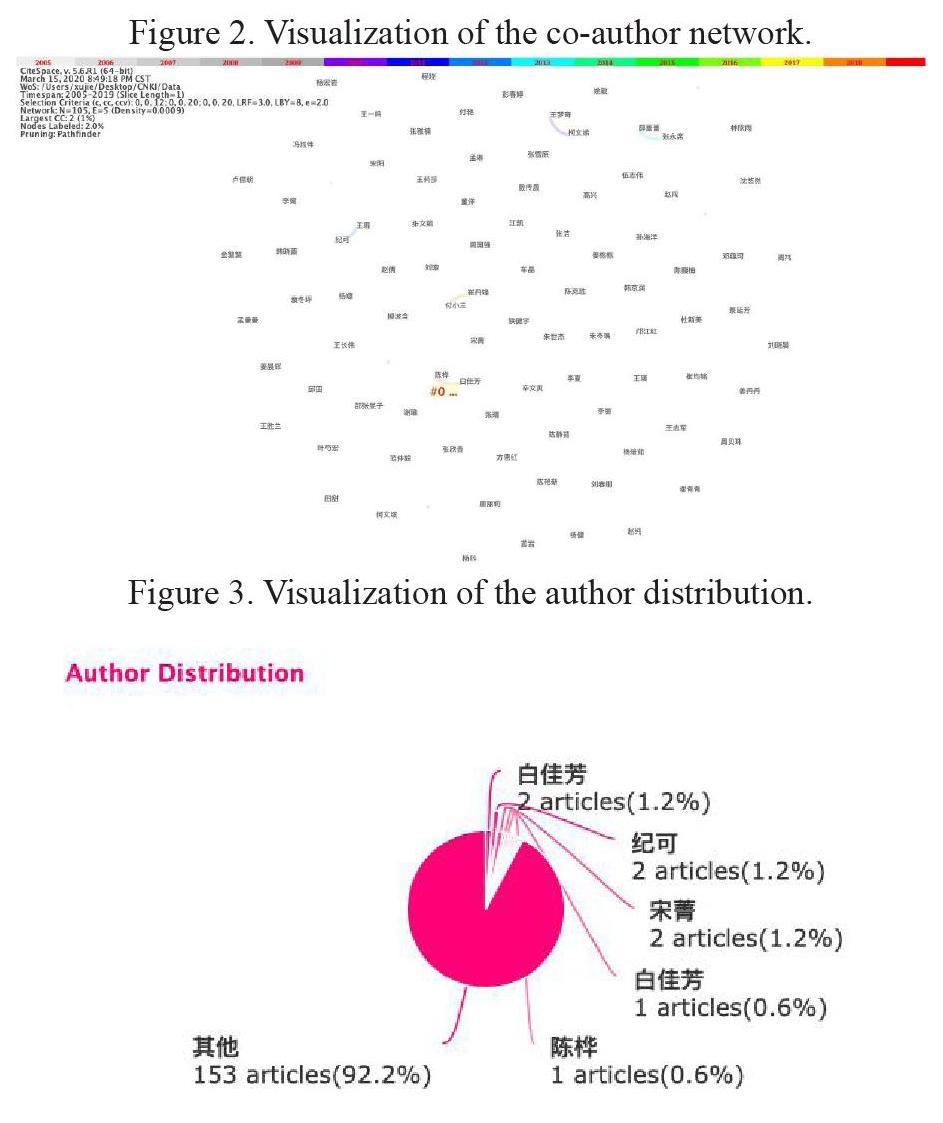
The co-author network is used to analyze the joint research in a certain research field. As shown in Figure 2, the CiteSpace analysis results show a total of 105 nodes, indicating 105 highly prolific authors, and 5 bilateral cooperative lines, indicating that the collaboration rate between the authors is very low. No relatively stable and large academic teams have been formed. Referring to Figure 3, we can notice that only three authors including BAI (2018), JI (2012) and SONG (2010) published more than one article. It can be concluded that the number of average article published per author is quite small.
3.2Co-Institute Analysis
The network of co-institute in Figure 4 indicates that there are 23 research institutes and two collaboration links. Since most of the nodes are isolated points, it can be inferred that nearly all the research is conducted by a single author. Only two pairs of institutes including the School of Interpreting and Translation Studies of Guangdong University of Foreign Studies, the College of Applied Foreign Languages of Shenzhen Polytechnic have cooperative relationship, the College of Foreign Studies in Guangxi University, and the School of Foreign Studies at Nanjing University. And the detailed information about the publications of seven top active institutes are shown in Figure 5, indicating that the top three universities are Heilongjiang University (19 articles), Hebei Normal University (12 articles) and Beijing Foreign Studies University (11 articles). Apparently, the universities which published most essays have no cooperative relationship with other institutes.
The source text mainly describes the macro-environment of climate change has quietly affected the operation of museums. As significant public facilities of educational publicity, museums need to take the initiative to assume the sense of corporate social responsibility. The administrators must carry on the green transformation to buildings and installations. And it is environmental entrepreneurship that guides this change. From an overall perspective, the author have identified four major areas of renovation, including suitable workspace, green technology and material selection, energy consumption and management and communicating environmentalism. By listing the experience of some museums, the author illustrates the respective advantages of these four kinds of areas and introduces the concrete practical methods.
3.3Keyword Co-Occurrence Analysis
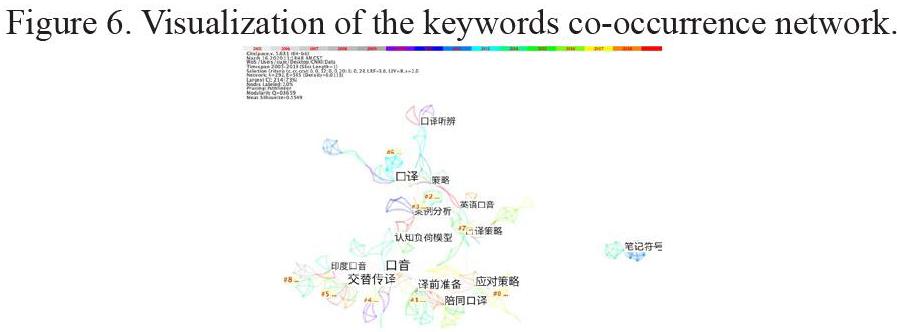
Due to the close relation between the keywords and the cores of articles, the analysis of similar keywords can facilitate the identification of the cores of research on interpreting and accent. The terms are being grouped hereinafter, for instance, preparations, liaison interpreting and coping strategies can be divided into one category, and case study and Gile's models are another group. Figure 6 is a keyword co-occurrence network of 292 nodes generated from the core database, where nodes represent the keywords. Modularity Q reached 0.8659 > 0.3, and the structure is reasonable (Newman, 2004), suggesting that the network has dense connection between nodes within modules. Silhouette score arrived at 0.5549 > 0.4, and the result is reasonable (Rousseeuw & Kaufman, 1990), indicating that the node is placed in the correct cluster. As is demonstrated in Figure 6, the keywords which are most concerned by interpreting researchers include accent, Giles Effort Models, consecutive interpreting, resolutions and preparations.
According to Gile (2009), interpreters have more processing capacity and time for discourse production in consecutive interpreting than that in simultaneous interpreting. The interpreter's performance, in result, has greater chances to be improved. Furthermore, most companies that are about to have conference have insufficient time and fund to prepare professional facilities such as an interpretation booth or audience receivers for simultaneous interpreting. So consecutive interpreting becomes a more common choice especially in business field and draws attention from researchers.
4Conclusions and Suggestions
4.1Conclusions
In conclusion, this essay identifies general trend of annual publication, authors, institutions, and keywords that had significant influence on accent and interpreting study. It can be concluded based on the general trend analysis that studies on interpreting and accented source language speech are rare and has prospective future. Besides, mostly studies in this field are accomplished by individual researchers in China because the number of lines between nodes in the co-author network is very small. In addition, lines connected nodes in the co-institute network are also few, indicating that cooperation between institutions needs to be encouraged to save unnecessary efforts and resources and thus generate more comprehensive views. On the basis of high-frequency keywords, it can be deduced that strategies to deal with accent in interpreting is of top priority for scholars. And aspects like accent, consecutive interpreting, Giles Effort Models, preparations and resolutions are the hotspots and research trend in the recent years.
4.2B. Suggestions
Most importantly, interpreters should follow the instruction of the basic comprehension 'equation' put forward by Gile (2009), which is C (Comprehension) = KL (Knowledge of Linguistics) + ELK (Extralinguistic Knowledge) + A (Deliberate Analysis), to ensure comprehension. Linguistic knowledge is composed of various elements such as lexis, phonics, grammar and the Sender's mother tongue which can result in syntax, incorrect word usage and unnatural pronunciation that make the comprehension task harder. Gile (2009) argues that a good mastery of the Sender's mother tongue offers the interpreter more elements in support of analyzing errors in pronunciation, words and grammar (for instance in Japanese accent, /l//n//m/ are omitted or mispronounced, while /r/ is deviated into /l/. In Arabic accent, /p/ is deviated into /b/). Extralinguistic knowledge contains encyclopedic knowledge stored in the interpreters' long-term memory as well as information about the occasion, background of main participants of the communication and the speaker's preference of quoting in favor of the anticipation and speech comprehension in terms of linguistic disambiguation.
Meanwhile, Vandergrift (2004) stated that interpreting students should integrate top-down process by using context and prior knowledge to build a conceptual framework for comprehension and bottom-up process by combining larger units of meaning from phoneme-level up to disclosure-level to enhance their comprehension ability.
References
[1] Gile. D. (2009). Basic Concepts and Models for Interpreter and Translator Training. Philadelphia: John Benjamins Publishing Company.
[2] Vandergrift. L. (2004). Listening to Learn or Learn to Listen. Annual Review of Applied Linguistics, 24, 3-25.
[3] 鮑剛. (2005). 口譯理論概述. 北京: 中國對外翻譯出版社.
[4] 陳悅, 陳超美, 劉澤淵, 等. (2015). CiteSpace 知識圖譜的方法論功能. 科學學研究, 33(2), 242-253.
[5] 李輝. (2019). 淺析口譯中的聽辨能力. 才智, 33, 241.
[6] 雷中華. (2018). 吉爾談口譯與教學. 學術訪談, 06, 61-65.
[7] 田甜. (2013). 吉爾模式下口音對口譯員口譯表現的影響及應對策略. 碩士學位論文. 上海: 上海外國語大學
[8] 謝瑜. (2019). 口譯課堂中語音聽辨能力的培養. 海外英語, 17, 61-62.