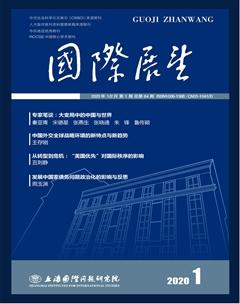
英文摘要
2020-02-07 05:33:24
國際展望 2020年1期
關鍵詞:英文
Abstracts
China in A Transformed World—Panel Discussion on Chinas Strategic Options
QIN Yaqing, et al.
Abstract: In a world that is going through unprecedented changes Chinas strategic options in a range of policy domains, such as great power politics, economic competition, trade and investment, and cyberspace, also have to be updated. Seventy years of interaction with the rest of the world have produced a coherent set of ideas and visions that is guiding the conduct of Chinas foreign relations. Chinas vision of a stable international order depends on a new type of international relations. As an emerging power moving closer to the worlds center stage, China is willing to shoulder commensurate international responsibilities to advance the general welfare of the developing world with the aim of building a community with a shared future. As China begins to look inward at itself and outward at the world in a new perspective, it needs to take full account of domestic development and the international context when making strategic planning. Such planning must be in line with, among other thins, power political logic, Chinas status as a world power, and universal values embedded in the vision of humanity as a community with a shared future. In order to maintain sustainable economic growth, Chinas needs to not only play close attention to domestics economics but also the international economic landscape. Emerging domains of strategic importance like cyberspace should be prioritized in Chinas strategic planning. In a increasingly complex world, Chinas domestic and foreign policy options will exert a far-reaching impact on the evolution of the international order. China will remain a growing, emerging power for the near future and its sustainable development will increasingly depend on its capacity for innovation and creativity.
Keywords: world transformation, foreign policy ideology, grand strategy, international economic landscape, cyberspace
A Changing Strategic Environment for Chinas Diplomacy: New Features and Trends
WANG Cungang
Abstract: China is moving center stage in a world that is going through unprecedented changes. Against this backdrop, the global strategic landscape for Chinas diplomacy is also displaying new features and trends. In economic terms, in the wake of the 2008 financial crisis, anti-globalization sentiments and calls for de-globalization are growing, creating barriers to further regional integration and exacerbating both the governance and development deficits. In political terms, political instability in western democracies and governance decay in the developing world give rise to the resurgence of populism and tribalism. A new power equilibrium is yet to be achieved as the contest for global leadership among great powers and strategic competitions in new frontiers like space and cyberspace intensify by the day. Defense expenditures across the world are increasing dramatically, presenting challenges for the global arms control regime. International peace and stability is under growing strain as domestic violence and transnational terrorism continue unabated. The pattern of cultural exchanges and civilizational dialogues has become more complicated as some countries resort to protectionism, others promote greater openness, and still other remain undecided. In a more competitive and yet more interconnected world, China needs to prepare for more changes and challenges of historic proportions while remaining patient and confident about the viability of its development model and contributing more to the general welfare of the international community.
Keywords: Chinese diplomacy, global strategic landscape, great power competition, de-globalization, new equilibrium
From Transition to Crisis: The Impact of “American First” on the International Order
CHOU Zejing
Abstract: The Trump administrations “America First” policy is exerting a far-reaching impact on the evolution of the international order. Victory in great power competition has returned as Americas top strategic priority. U.S. withdrawal and pullback from a number of international agreements and organizations has undercut the integrity of international institutions. Disregard for liberal democratic norms and values is undermining liberalisms reigning position. The liberal international order is in deep crisis. In the past, people argued over the best way for America to lead the world. Now they are doubtful about Americas leadership role. Where once Washington was bent on maintaining its leadership position while accommodating emerging powers demands for greater representation and voice, today it is focusing on increasing its own national strength to appease the disaffected and alienated white blue collars who see themselves as victims of growing inequalities stemming from deepening globalization and foolhardy pursuit of American supremacy. Chinas response to the shock waves of America First must begin with a full account and better understanding of the characteristics and crises of an evolving international order.
Keywords: America First, liberal international order, power competition, institutional disarray
The Rise of Grassroots Movements in the United States: Reality or Myth?
WEI Zhuoyi and LI Qingsi
Abstract: Americans have always been proud of their longstanding liberal democratic tradition which is believed to be the source of economic vitality and social justice. However, in recent years, grassroots movements like the Patriot movement, Tea Party movement, and Occupy Wall Street, have swept across the United States, reflecting ordinary Americans dissatisfaction and with the government and the elite. Riding on the conservative waves of anti-globalism, nationalism, populism, and protectionism, Donald Trump scored an upset victory in the 2016 presidential election, the culmination of grassroots groups political and social influence. The past three years have only seen the antagonism between grassroots groups and political elites deepen. After reviewing the grassroots movements in the United States since 2008 by analyzing their driving forces and impacts, this article concludes that the fundamental demands and objectives of the grassroots movements are too idealistic, and that the fierce struggles can only result in temporary policy compromises but are difficult to produce fundamental changes in the American economic and political systems. Hailing from the elite class, President Trump will distance and detach himself from the right-wing grassroots, making what is happening a myth.
Keywords: Trump administration, grassroots movements, political elites, anti-globalization, wealth gap
Politicization of Debt in Developing Countries: Influence and Reflection
ZHOU Yuyuan
Abstract: Public debts in developing countries have been rising since 2008. Apart from the debt crisis itself, a new phenomenon deserving attention is the increasing politicization of debt-related issues. At the domestic level, the debt issue is becoming a tool in political competition. At the international level, debt management is a perfect excuse for certain outsiders to intervene, influence, and reshape national policies of developing countries. Meanwhile, development financing is becoming a new arena for major power competition. Indeed, the politicization of debt has negative impacts for both lenders and borrowers, but it has also increased the knowledge of debt issue, which has prompted the governments to improve their debt management capacity. More importantly, it has lent a urgency to rethinking the existing international debt governance system. A comprehensive understanding of the politicization of debt will help China in its development financing in the developing world.
Keywords: developing countries, debt, politicization
Sri Lankas External Debt: Controversy and Causes
LI Yanfang
Abstract: Since 2017, India and some Western countries have been whipping up anti-Chinese sentiment by accusing China of creating mounting debts in Sri Lanka and other developing countries which are recipients of Chinas BRI investments and loans. These groundless accusations are part of an international smear campaign that seeks to thwart Chinas ascendance and BRI progress. Economic indicators prove that Sri Lankas growing debt burdens since 2011—the result of expanding productivity, trade imbalances, government deficits, and ill debt management—are manageable, although fluctuations in the global financial markets have undercut the nations solvency. Chinese loans and investments in Sri Lanka contribute little, if at all, to its mounting debt burdens. Politicization of the debt issue reflects the intensifying geostrategic competition in the Indo-Pacific region. Charges that China is laying a debt trap in some countries, however groundless, have created negative effects on BRI cooperation. To counter these false accusations, China needs to conduct debt risk assessments and build a model of geoeconomic cooperation that is more open, inclusive, and diverse.
Keywords: Sri Lanka, debt trap, debtbook diplomacy, Belt and Road Initiative
Politicization of Malaysias Debt Issue: the Root Cause of “Debt Trap Theory”
ZHANG Yingjin
Abstract: Malaysias debt issue has attracted growing international as well as domestic attention and given rise to heated debates. This article examines the state of Malaysias debt issue, especially its scale and structure. Malaysias national debt has been growing since 2007 but the debt risk is generally under control and there is little likelihood of a systemic risk. However, the politicization of the debt issue has given rise to a “debt trap conspiracy theory,” accusing China of creating a debt crisis to gain diplomatic leverages. A politically-charged financial issue which is increasingly exaggerated in a smear campaign against China will only undercut China-Malaysia relations in particular and BRI cooperation in general. Financial issues can only be solved through financial approaches. Politicization will only whip up negative mutual feelings. The only viable option is for Beijing and Kuala Lumpur to tackle the issue at its root in a rational manner.
Keywords: Malaysia, debt, politicization, debt trap theory, Belt and Road initiative
猜你喜歡
國際展望(2017年2期)2017-03-21 18:34:18
鄱陽湖學刊(2016年6期)2017-01-16 13:05:41
中國遠程教育(2016年6期)2016-12-07 10:07:02
財經(2016年19期)2016-08-11 08:17:03
中國遠程教育(2016年5期)2016-06-29 10:13:42
中國遠程教育(2016年2期)2016-03-21 10:31:21
中國遠程教育(2016年1期)2016-02-26 10:37:15
國際展望(2015年5期)2015-09-15 05:41:45
國際展望(2015年4期)2015-07-13 05:30:56
能源(2014年9期)2014-09-15 13:18:12