Unit 3 Could you please tell me where the restrooms are?
2019-12-10 09:20:55
時(shí)代英語(yǔ)·初中 2019年6期
第一課時(shí) Section A (1a—2d)
用所給詞的適當(dāng)形式填空
1. She was very ______ (amuse) by your words.
2. It ______ (normal) takes 20 minutes to get there.
3. Whenever I see Jake, he seems to be ______ (rush).
4. Id like two ______ (pair) of blue jeans.
5. My apartment is on the ______ (three) floor of that red building.
漢譯英
1. 他就沿街而住,挨著郵局。
He just the streetthe post office.
2. 打擾一下,請(qǐng)問(wèn)最近的游樂(lè)園在哪里?
, could youtell me where theis?
3. 我想知道貴書店今天什么時(shí)候關(guān)門。
I your today.
4. 順著這條街走,一直走過(guò)銀行。
this streetyouthe bank.
補(bǔ)全對(duì)話(有一項(xiàng)多余)
A: What a fine day today!? ? ? ? 1
B: That sounds like a good idea.? ? ? ? 2
A: Lets go to the Green Hill.
B: Shall we take the bus there?
A:? ? ? ? 3? ? ? ? Its not very far.
B: Thatll be OK. Ill ride my new bike my father bought me for my birthday last month.
A:? ? ? ? 4
B: Lets ask Mary and Jack to go with us. They planned to go last Sunday but it rained.
A: Good! Im sure they will be happy to.
B: Have you got any idea what we are doing there?
A:? ? ? ? 5
B: That will be fine.
A. Where to go?
B. We can go there by bike.
C. How about going on a trip?
D. Why not ask someone else to join us?
E. Who else would you like to go with?
F. We can just lie on the grass having a good rest.
1.? ? ? ? ? ? ? ? 2.? ? ? ? ? ? ? ? 3.? ? ? ? ? ? ? ? 4.? ? ? ? ? ? ? ? 5.
完形填空
Who designed the first helicopter (直升機(jī))? Who? the most famous pictures in the world? Who knew more about the human body than most ? There is an answer? all these questions—Leonardo da Vinci.
Leonardo may have been the greatest genius (天才) the? has ever known. He lived in Italy around the year 1500, but many of his inventions seem modern to us today. For example, one of his notebooks has drawings of a helicopter. Of course, he couldnt? a helicopter with the things he had. But scientists say his idea would have .
But Leonardo wasnt just an inventor. He was one of the greatest artists of his day. By the time he was twenty years old, he was called a master (大師) painter, and as he got older he became? more famous. Sometimes he drew a hand in ten different ways? he was ready to paint.
Many of Leonardos wonderful paintings are still? us today. You may know one of his most famous works—the? woman known as the Mona Lisa.
1. A. took B. made C. painted D. invented
2. A. artists B. doctors C. painters D. teachers
3. A. to B. of C. for D. from
4. A. earth B. school C. world D. company
5. A. draw B. paint C. work D. build
6. A. flown B. worked C. gone D. stopped
7. A. little B. just C. even D. only
8. A. before B. after C. because D. when
9. A. in B. with C. within D. beside
10. A. interesting B. crying C. smiling D. surprising
第二課時(shí) Section A (3a—4c)
選詞填空
從方框中選出恰當(dāng)?shù)脑~或短語(yǔ),并用其適當(dāng)形式填空。
amusement? ? ?around here? ? ?between... and...
ride? ? ?start with
1. These stories are meant to ______ readers.
2. I only knew two people in London to ______ , but I soon made a lot of friends.
3. One of the ______ was thrown off his horse.
4. When I was in primary school, I just sit ______ Jack ______ Mary.
5. Could you please tell me if there is a restroom ______?
句子翻譯
1. 我想知道他明天來(lái)不來(lái)。(wonder)
2. 昨晚他直到做完作業(yè)才去睡覺(jué)。(until)
3. 我們先去動(dòng)物園如何?(how about)
4. 你如果害怕了就大聲叫出來(lái)吧。(shout out loud)
閱讀理解
Learn to relax. Overwork is the main reason why so many students feel tired and stressed. Cut down some of the jobs you need to do each day so that you can only focus on the most important things. Leave time for activities that are relaxing and fun. This might mean reading a good book, listening to music, going for a walk or taking a bath.
Get a good nights sleep. Getting enough sleep will help you keep your body and mind in the best form. If you stay up late and need to get up early for school the next day, you may not be able to focus on the things you need to do.
Exercise regularly and eat well. Dont rush through your meals. Eat less junk food. Eat healthy food instead.
Get to know pleasant people. Some people are optimistic, while others not. Choose optimistic people as your friends and spend more time with them and youll be as happy as them.
Stay calm (平靜) when you face any problem. Find out the best choice from those that are in your mind. Knowing that you are able to solve problems is a good way to build up your self-confidence.
Have a happy attitude (態(tài)度). Your attitude decides the way you see things. Is your “cup” half full or half empty? Learn to think more positively (積極地) about the difficulties you face.
1. What does Paragraph 1 mainly tell us?
A. How to get relaxed.
B. How to work happily.
C. How to spend your free time.
D. How to find time to do good things.
2. What does the underlined word “optimistic” in Paragraph 4 mean in Chinese?
A. 主動(dòng)的 B. 認(rèn)真的
C. 樂(lè)觀的 D. 輕松的
3. If you have a half cup of water, the writer tells you to regard your “cup” as ___ .
A. full B. half full
C. empty D. half empty
4. What does the text mainly tell us?
A. Dont work or study too hard.
B. What kind of relaxing activities can we do?
C. How to feel relaxed and happy under the stress of study and work.
D. It is important to get enough sleep, exercise regularly and eat healthily.
第三課時(shí) Section B (1a—1e)
用所給詞的適當(dāng)形式填空
1. Jim suggested ______ (put) the vase on that table.
2. He told me not (go) there because it was too far.
3. For ______ (convenient), the two groups have been treated as one in this report.
4. It is not enough to ask questions ______ (correct).
5. I was ______ (fascinate) to hear about his travel in Britain.
漢譯英
1. 請(qǐng)問(wèn)樂(lè)隊(duì)今天傍晚在哪表演呢?
you pleasemethis evening?
2. 要是附近有咖啡店,我們可以停下來(lái)吃點(diǎn)東西。
theres a cafe, we could ?some snacks.
3. 他們?cè)趩?wèn)有關(guān)紐約之旅的情況。
They are the New York.
4. 瑪麗昨天建議我去看牙醫(yī)。
Mary I
yesterday.
完形填空
There once was a boy who loved eating sweets. He? asked for sweets from his father. His father was a? man and they lived in a very old house. He could not always? sweets for his son. But the little boy did not? this, and asked for sweets all the time.
The boys father thought? about how to stop the child asking for so many sweets. There was a very holy (神圣的) man living nearby at that time. The boys father had a(n) . He decided to take the boy to the great man who might be? to persuade (說(shuō)服) the child to stop asking for sweets all the time. The boy and his father went along to the? man. The father said to him, “Oh, great saint (圣人), could you ask my son to stop asking for sweets which I cannot afford?” The great man was in , because he liked sweets himself. How could he ask the boy to give up asking for sweets? The holy man told the father to? his son back after one month.
During that month, the holy man gave up eating sweets, and when the boy and his father? after a month, the holy man said to the boy, “My dear child, will you stop asking for sweets which your father cannot afford to give you?” From then on, the boy? asking for sweets.
The boys? asked the saint, “Why didnt you ask my son to give up asking for sweets? we came to you a month ago?” The holy man replied, “How could I ask a boy to give up sweets when I loved sweets myself? In the last month I gave up eating sweets.”
A persons? is much more powerful than just his words.
1. A. always B. never C. hardly D. seldom
2. A. rich B. honest C. kind D. poor
3. A. make B. accept C. afford D. find
4. A. ignore B. change C. remember D. understand
5. A. happily B. crazily C. lazily D. hard
6. A. excuse B. surprise C. idea D. proverb
7. A. afraid B. lucky C. able D. sorry
8. A. young B. strong C. great D. ugly
9. A. difficulty B. peace C. danger D. tears
10. A. call B. turn C. get D. bring
11. A. returned B. asked C. left D. disappeared
12. A. forgot B. finished C. continued D. stopped
13. A. sister B. brother C. father D. mother
14. A. when B. because C. until D. though
15. A. success B. history C. future D. action
選詞填空
閱讀短文,從方框中選擇適當(dāng)?shù)脑~并用其正確形式填空(每詞限用一次)。
angry celebrate from fine however he
invite please soup taste visitor with
One day a visitor came to Nasreddins house. “I am your cousin? Konya,” he said, “and I have brought you a duck to? the visit.” Nasreddin was . He asked his wife to cook the duck, and served the visitor a? dinner. The next day another visitor arrived. “I am the friend of the man who brought you the duck,” he said. Nasreddin invited him in and gave? a good meal. The next day another visitor arrived and said he was the friend of the friend of the man who had brought the duck.
Again Nasreddin invited him in for a meal. , he was getting a bit angry.? seemed to be using his house as a restaurant. Then another visitor came, and said he was the friend of the friend of the friend of the man who had brought the duck. He was? in. Nasreddins wife brought some? to the table and the visitor tasted it. “What kind of soup is this? It? just like warm water.” “Ah!” said Nasreddin. “That is the soup of the soup of the soup of the duck.”
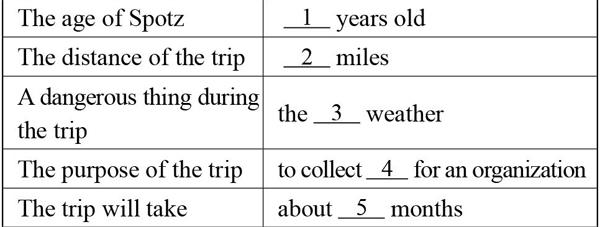
A dangerous thing during the trip the? ? 3? ? weather
The purpose of the trip to collect? ? 4? ? for an organization
The trip will take about? ? 5? ? months
1.? ? ? ? ? ? ? ? ? ? ? ? ? ? 2.? ? ? ? ? ? ? ? ? ? ? ? ? ? 3.
4.? ? ? ? ? ? ? ? ? ? ? ? ? ? 5.
第五課時(shí) Section B (3a—Self Check)
用所給詞的適當(dāng)形式填空
1. I really thank you for ______ (help) me out.
2. Im looking forward to ______ (meet) you in Beijing.
3. The bookstore is on the ______ (three) floor.
4. She was ______ (introduce) to me as a well-known writer.
5. Excuse me, is there a _____ (direct) train to Manchester?
按要求完成句子
1. “Did you see her last week?” he asked.(改為間接引語(yǔ))
2. The film began 5 minutes ago.(用現(xiàn)在完成時(shí)改為同義句)
3. I dont know which one I can buy.(用不定式結(jié)構(gòu)改為簡(jiǎn)單句)
4. I have never met him before.(用for the first time改為同義句)
閱讀表達(dá)
There are many famous museums throughout the world where people can enjoy art. Washington DC has the National Gallery of Art; Paris has the Louvre; London, the British Museum. Florida International University (FIU) in Miami also shows art for people to see. And it does so without a building, or even a wall for its drawings and paintings.
FIU has opened what it says is the first computer art museum in the United States. You dont have to visit the university to see the art. You just need a computer.
All of the art is stored in the school computer. It is computer art, produced electronically by artists on their own computers. In only a few minutes, your computer can receive and copy all the pictures and drawings through the Internet.
Robert Shostak is director of the new computer museum. He says he started the museum because computer artists had no place to show their works.
A computer artist could only record his pictures electronically and send the records to others to see on their computers. He could also put his pictures on paper. But to print good pictures on paper, the computer artist needed an expensive laser (激光) printer.
Robert Shostak says the electronic museum is mostly for art or computer students at schools and universities. Many of the pictures in the museum are made by students. Mr Shostak said the FIU museum will make computer art more fun for computer artists because more people can see it. He says artists enjoy their works much more if they have an audience. And the great number of home computers in America could mean a huge audience for the electronic museum.
1. Where can people enjoy art?
2. What do people need to see the art in FIU museum?
3. What is stored in the computer museum in FIU?
4. When was the museum started?
5. Whom is the electronic museum mostly for?
書面表達(dá)
假如你是一名九年級(jí)的學(xué)生,請(qǐng)根據(jù)內(nèi)容要點(diǎn),以“Our After-class Activities”為題,用英語(yǔ)寫一篇短文,介紹你們學(xué)校課外活動(dòng)的情況。內(nèi)容要點(diǎn):
1﹒活動(dòng)時(shí)間;
2﹒活動(dòng)的項(xiàng)目;
3﹒你最喜愛(ài)的活動(dòng);
4﹒你對(duì)此的體會(huì)。
注意:
1﹒詞數(shù)90左右;
2﹒短文須包括所有內(nèi)容要點(diǎn),可以適當(dāng)發(fā)揮;
3﹒語(yǔ)句通順,語(yǔ)法正確。
Our After-class Activities
猜你喜歡
中學(xué)生數(shù)理化·七年級(jí)數(shù)學(xué)人教版(2023年3期)2023-03-21 00:44:54
科學(xué)大眾(2022年11期)2022-06-21 09:20:52
保健醫(yī)苑(2022年5期)2022-06-10 07:47:26
少先隊(duì)活動(dòng)(2022年5期)2022-06-06 03:45:04
家庭科學(xué)·新健康(2022年3期)2022-05-10 00:32:13
中老年保健(2021年2期)2021-08-22 07:31:10
學(xué)校教育研究(2020年13期)2020-07-07 09:31:30
海峽姐妹(2018年3期)2018-05-09 08:20:40
臺(tái)聲(2016年2期)2016-09-16 01:06:53
冶金經(jīng)濟(jì)與管理(2015年1期)2015-02-28 21:08:52