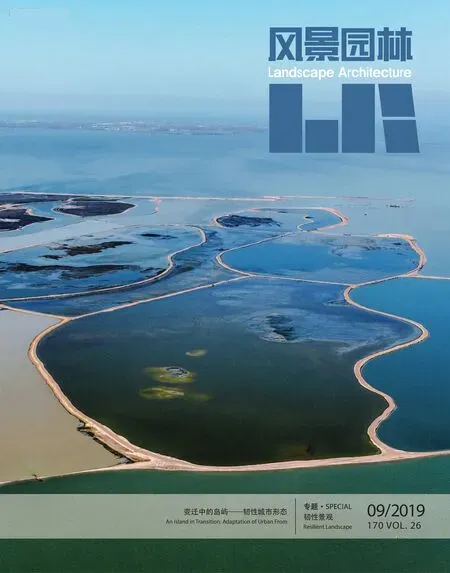
三角洲適應性轉型
——基于景觀的區域設計方法
2019-12-02 14:21:10斯特芬奈豪斯熊亮丹尼艾勒坎納特拉
風景園林 2019年9期
(荷)斯特芬·奈豪斯 熊亮 (意)丹尼艾勒·坎納特拉
處于城市化進程中的三角洲地區是世界上最富希望且動態十足的區域之一。其在世界生態系統和全球經濟中的地位舉足輕重[1]293,[2],為水系統主導的多種敏感性環境中的種群聚集提供了條件。同時,由于集約型城市土地利用和經濟活動在敏感性水環境中難以維持,這些三角洲極其脆弱,面臨多重威脅[3-4]。如果缺乏有效的管治就嘗試維持這些活動,將造成生態系統的破壞和社會—文化價值的損失,也將削弱三角洲抵御自然災害和氣候變化的能力。其結果將影響三角洲地區的環境、經濟以及生活在這些水系統中居民的健康和繁榮[5]2-3。
城市化三角洲可視為一系列復雜社會—生態系統的集合。這些系統包含的各子系統具有獨立的動態特征和速率變化(圖1)。空間戰略可以保障這類區域的可持續發展,增強其韌性、協助各系統修復漏洞,并增強這些系統應對自然和人工威脅的能力。這些空間戰略應能協調各系統間的關系,減少破壞性的系統間矛盾,例如城市發展引起的洪澇風險增加。生態敏感型的城市開發具有保障經濟社會增長的潛力,而空間戰略應關注這方面的潛力,并為增強自然系統和水安全提供契機[5]3-4。同時,其也應包含廣泛的社會和經濟參與者,以支撐當地的社會、經濟和文化。有說服力的溝通方式能使這類空間戰略得到廣泛的理解和支持,并產生影響[6-7]。
除了改善三角洲地區的生存條件之外,空間戰略還能通過應對氣候變化來降低氣候相關的風險等級。為創造更有韌性的三角洲區域,城市規劃和管理需要有一定的適應能力。空間戰略應該識別出生態動力設計的可能。在這些設計中,自然與城市的發展有機會得到整合,確保水安全的適應性設計導則也能得以實現。此外,對空間規劃、設計和災害管理中的各種轉型性過程的整合也十分必要。由此可以改善土地利用、機構間協調和機制間關系,促成有效、可持續和全納的城市發展[5]6。

1 廣州市琶洲典型的漁村與新城開發反映了長短期發展之間的矛盾Confrontations between incremental long-term and fast short-term developments indicated by fisherman villages and new urban development in Pazhou, Guangzhou

2 大部分城市化區域位于洪澇易泛的低地(+10 m地區,深藍部分),增加了洪澇風險Most of the urbanization takes place in the flood prone lowland (+10 m zone, indicated in dark blue), which increases the flood risk in PRD
自21世紀以來,在城市化三角洲地區規劃設計領域出現了一系列旨在發展適應性系統的研究。包括荷蘭的萊茵—馬斯—斯海爾德河三角洲[8-9],美國的密西西比河三角洲[10-11]以及越南的湄公河三角洲[12-13]。研究表明,與傳統規劃戰略相比,在國土治理中采用城市景觀動態的視角能獲得更大的潛在收益[1]293-312,[14-15]。本文闡明了在城市化三角洲中,通過基于景觀的區域設計實現適應性城市轉型的方法。對珠江三角洲進行案例分析的同時,也著重闡述這一城市景觀規劃設計一體化方法。該方法強調城市景觀的規劃和設計須根據適應性城市轉型的要求,對自然和城市動態的適應性節奏和性質進行調節[5]6。
適應性城市轉型采用了基于景觀的區域設計方法,將其作為整合性、多尺度的規劃設計途徑。如此可以結合多部門活動,促進城市和鄉村多種轉型性過程的發展,以取得更協調的可持續性成果。基于景觀的區域設計是塑造區域形態的重要戰略,其以景觀為基礎產生可持續的城市化三角洲,也通過空間規劃和設計為長期可持續的城市景觀發展提供途徑。一言以蔽之,區域設計是一種跨學科的嘗試,不但保障可持續和連續性發展,也指導和塑造由社會—經濟和環境過程引起的改變,同時通過有形的關系為區域建立當地特色[16]43-46。
1 珠江三角洲
在過去40年間,珠江三角洲(簡稱珠三角)是世界上發展最快速的三角洲地區。2014年,其超越東京灣地區,成為世界上面積最大、人口最多的城市區域[17]。20世紀80年代起,珠三角一直處于中國城市化和社會經濟轉型改革的前沿陣地[18]。然而,由于氣候變化和環境惡化,珠三角的遠期經濟發展需要應對巨大挑戰,包括紅樹林生態系統消失[19]、農田流失[20]、空氣和水污染[21]、水資源短缺[22]、社會治安問題[23]等。
一方面,由于洪澇易泛區的城市化(圖2),使珠三角暴露在持續增長的洪水風險之中。海平面的持續上升、夏季臺風等極端性熱帶風暴的加劇對區域內的基礎設施持續施壓。另一方面,珠三角的生態系統日趨破碎和脆弱[24],表現為生態系統服務[25]和環境承載力[26]的降低。宏觀尺度的干預使千篇一律的單一性空間在微觀尺度上取代了多樣的歷史性環境和文化遺產[27]。雖然有關部門積極推進一體化規劃設計方法,但仍未進行大范圍的有效施行[28]。例如“海綿城市”的建設難點之一就是整合不同部門之間的多種規劃[29]。
為了珠三角的可持續發展,急需在其城市發展中采用新的規劃設計方法。針對經濟發展和環境修復之間的矛盾,以及氣候變化帶來的相關風險,區域設計提供了一種解決之道,即發展基于景觀的概念和實踐。珠三角的高速發展使其成為一個尤有價值的案例,在此案例中可以探索和驗證這些更具適應性的整體規劃方法的潛力,而基于景觀的區域設計就是這類整體規劃方法中的一種。

3 基于景觀的區域設計的4個重要階段Four important phases in landscape-based regional design

4 將城市景觀理解為分層的復雜系統Understanding the urban landscape as a layered and complex system

5 公元前4000年至2015年珠江三角洲景觀的形成Landscape formation of the PRD from 4000 BC to AD 2015
2 基于景觀的區域設計
基于景觀的區域設計將城市景觀視為全納性的動態復雜系統。在此視角下,空間發展通過生態區域的規劃導則和設計導則的實施得以實現。這一方法建立在查爾斯·埃里奧特(Charles Eliot)[30]、沃倫·曼寧(Waren Maning)[31]、彼得·維爾哈亨(Pieter Verhagen)[32]、帕特里克·阿伯克羅姆比(Patrick Abercrombie)[33]、弗里茨·舒馬赫(Fritz Schumacher)[34]、伊恩·麥克哈格(Ian McHarg)[35]、菲利普·劉易斯(Philip Lewis)[36]等人的觀點和實踐之上。
區域設計采用風景園林、景觀生態學、地理學和建筑學的原則進行空間導向的研究、設計和規劃。同時也利用系統思維和復雜理論推進更綜合的區域規劃設計,以涵蓋構成城市景觀的各種復雜關系網絡[37]13-34。基于這些目的,區域設計為城市轉型、生態多樣性保護、水資源管理、休閑游憩、社區建設、文化認同和經濟發展提供了一種模式[38]。
基于景觀的區域設計包含2個部分:戰略和干預。前者辨識并引領對區域可持續增長最有利的場所、功能、尺度和相互關系,后者在微觀尺度創造積極條件[37]22。區域設計根據自然和城市景觀生理和功能塑造區域的物理形態,并致力為未來發展創造條件。這種方法能在區域到地方之間的不同尺度運作,也能由普遍到特殊,既保持整體連續性又兼顧局部偶然性。它在各類國土之間提供了多種方式以平衡服務與質量間的關系[39]。
區域設計是著眼于保護和開發各種資源的開放戰略。通過景觀規劃和設計的方式,為空間發展指導開發過程并創造前景條件[37]25。區域設計也設置了穩健且適應能力強的系統,這些系統既有韌性也能根據變化進行調整。區域設計的組織結構是以水系統和交通系統為代表的“強健”且聯通的結構,這些組織結構能夠支持區域發展,融入當地實際,經受各種挑戰,也足以靈活地邁向未來[40]。
由于這種基于景觀的區域設計承認城市肌理的集體性,并允許各類“作者”參與創作,使其成為一種社會全納性的設計方法[41],為利益相關方和其他參與者指明了方向,使各方得以同心協力。由此,基于景觀的區域設計成為一項跨學科的任務,工程專業和生態專業通過空間設計思維在此整合,本地居民的想法和知識也得到重視。因此,區域設計可以根據各要素的時空尺度特征,對自然環境、個體及信息、治理及其相互關系進行跨越時空尺度的組織[16]43-46。
基于景觀的區域設計的核心是研究與設計的緊密互動。研究的分析能力與設計的探索能力密切相關。在設計前期,設計通常會借助一些研究形式來獲得針對空間問題的基本方向和手段,而在這種方法中,設計過程本身作為視覺化空間問題的推動者,探索多種可能性,生成多樣的解決方案。因此,結合設計的研究被視為有力的研究戰略,通過創新型整體化方式來解決復雜的空間問題。這種目標明確的求索過程是區域設計的中心,思考和創作在此攜手并進。研究和設計的各種機制中融入了想象、創造和創新,結合設計的研究將這些機制一一實現。其也可作為通過行動、觀察和求索而獲得洞見的理解方式。因此,圖析和繪圖成為視覺思考和溝通的重要工具[42]。

6 珠三角生態—農業系統圖The eco-agricultural system of the PRD
3 區域設計過程的關鍵階段
基于景觀的區域設計過程包含至少4個迭代階段:收集信息、獲得理解、規劃發展和行動展望(圖3)[43]。
3.1 收集信息和獲得理解
在設計過程開始之前,需要在對場地挑戰和潛力的充分理解之上確立區域戰略的目標。這不僅意味著收集、創造數據及信息,也意味著在多尺度上對區域進行分析和評價,后者還包括識別利益相關方。該階段的問題包括:1)一個地區如何在微觀和宏觀尺度上運作;2)在不同尺度上有哪些決定區域的空間—視覺、歷史、社會及生態結構和過程;3)城市和自然各系統如何運轉。
上述問題的答案揭示了對設計要素的描述、選擇和評價,并涵蓋了綜合性城市景觀規劃設計中的各個方面。在此過程中,通過設計者獨自對信息進行解讀、合成和應用,數據被轉化為知識。在該過程中,設計者通過對數據和信息的探索、分析和合成,增進了對區域(各方面)在空間關系、結構和格局的理解程度。理解(洞見)是基于評價的認知,使知識提升效益,增加價值[44]。借助理解,設計者可識別國土的主要挑戰和機遇,并勾勒出多種未來走向。設計過程不應該局限于聽取專家咨詢,也應通過交互工作坊、訪談、觀察和問卷等形式,采納政府官員和當地居民等其他利益相關方的意見。
3.2 規劃發展和行動展望
在分析和評價階段結束后,區域設計的主要挑戰和機遇已經確定,繼而是發展和探索眾多整體性、多尺度的設計戰略和導則,尤其需要關注這些戰略和導則的潛力。需要解答的問題如下:1)如何應對該地區的挑戰;2)如何通過多個尺度上的眾多項目來開發區域的潛能;3)在區域尺度上有哪些需要注明和整體協調的空間關鍵結構和過程;4)在區域尺度上有哪些戰略點,可安排哪些對其有利的條件;5)這些戰略點和有利條件如何與區域內進行中的項目相聯系;6)哪些重要的利益相關方能夠保障社會經濟和生態的扎根;7)是否具有借鑒意義的國際先例;8)如何使長期戰略和短期設計干預互相關聯、彼此扶持。

7 珠三角基礎設施系統圖A map summarizing the infrastructural system of the PRD
解答此類問題所采取的重要方式包括:先例研究、愿景建設、結合設計的研究等。設計性思維對探索設計戰略和導則在空間上應用的可能性大有裨益。這部分的關鍵包括創新、創造和想象。設計戰略和導則通過視覺化方式探索,其可行性由設計師、專家和利益相關方評價。計算機模型、現場試驗、模擬等都是這個過程的組成部分,尤其是涉及產生觀點、視覺化和測試的時候。該步驟涉及的問題包括:1)有哪些有用的空間規劃設計戰略和導則;2)這些戰略和導則如何在區域應用,可能的結果如何;3)在空間、社會和生態視角上,有哪些優化方案;4)是否能在設計中包含某些歷史層面;5)如何使規劃適應并增強區域的認知度;6)設計能否在長時間內進行變更并具備靈活度;7)如何構成土地利用格局、植被、水、城市類型和其他要素,使其能夠促進生態系統服務及文化表達。
區域設計不僅僅通過規劃和設計技巧來優化、整合和組織物理結構,也體現了相關部門政策發展下的長期戰略。通常需要在政府治理上做出新的配置來為區域設計創造條件,例如開發一系列微觀項目。因此在規劃早期,納入相關決策者、政府部門和其他利益相關方就顯得十分重要。
4 理解珠三角:一個復雜系統
珠三角的城市景觀可以理解為一個復雜系統,其包含著多個子系統,各子系統具有獨立的動態特征和速率變化[14]160-191。作為一個系統,城市景觀是在網絡和場所的交織中形成的物質空間,其中的網絡和場所所屬的組織層次繁多,具有顯著的時空維度[45-47]。長時段(longue durée)的概念在此十分必要,因為其將城市景觀視為一種持續變化的長期性結構。第一級動態與自然環境相連,其特征是幾乎難以覺察的慢速過程,包括轉型、重復和自然演替等;第二級動態與長期社會、經濟和文化歷史相連;第三級動態則是短期的人類和政治事件[48]。簡而言之,在生態、社會文化和政治因素影響下,自然與人類在結構、格局和過程等層面進行持續不斷的相互作用,進而產生了不斷發展的城市景觀。
4.1 圖析景觀系統
圖析(mapping)是制圖探索,可用于研究自然與人類互動所產生的空間關系,識別重要條件、關鍵驅動力和各顯著性動態帶來的影響。這種對景觀系統進行的圖析與麥克哈格[49]倡導的可持續性地圖有所分別。圖析著重于理解眾多空間關系及動態的變化,這些關于空間條件的知識并不一定能推導出適建地區,但是能夠協助形成適應性規劃戰略和設計導則。根據動態的變化對城市景觀進行逐層分解是理解城市景觀系統的有效方法[50]10-22(圖4)。低速動態變化的層面是基質(如地形、水文、土壤)和氣候(如降水類型、溫度、風)。這些環境條件對土地利用最具影響力,因此稱為第一級條件。位于中速動態變化層面中的第二級條件包括交通、水利、能源等基礎設施網絡,這些條件對土地利用影響顯著。相對于一級條件,二級條件的增長和變化更快,為農業土地利用和城市定居鋪平了道路,產生了高速動態變化轉型的層面[50]19。
4.2 圖析珠三角的自然和城市系統
為了理解珠三角的自然和城市系統,本文筆者制作了一組地圖以掌握國土各動態層面、自然和城市系統及其相互作用。總結了描繪珠三角特征的主要物理結構和格局,包括生態-農業系統、城市系統、基礎設施網絡和城市肌理及其相互關系。

8 1950—2015年城市發展Urban development from 1950 to 2015

9 珠三角城市肌理結構圖A map summarizing the structure of the urban tissue in the PRD
自然系統取決于氣候、地貌、水和巖型。這些自然要素驅動土壤形成,確定水文,生態系統、農業土地利用、歷史聚落和城市的分布。珠三角可根據地貌特征分為2個部分:西部是經歷數千年來淤積和沉積過程形成的河控型三角洲,東部河口則為潮控型三角洲(圖5)[51]156,珠三角80%以上的土地是平原,有160余個島丘,另有187個島嶼分布在近海[51]155。其三角洲低地的特點是2個次級三角洲和一個潮控河口。西江、北江和東江主導著珠三角,其流域面積453 690 km2,干流總長2 200 km。西江是最重要的水沙來源(占80%徑流量和90%輸沙量)。西江和北江次級三角洲的洪水期在4—9月。7—9月間,河口區域受到臺風等熱帶風暴所帶來的風暴潮威脅。
珠三角濕潤平坦,這樣的自然氣候和地理條件是濕地生態、城市發展和農業生產的重要基礎。此地的農業活動可以追溯到4 000多年以前。在這個由頻繁的洪水和持續的泥沙沉積所形成的不斷變化的濕地環境中,人與自然形成了可持續發展的關系[52-53]。濕潤和平坦的地形特征使當地居民經過長年累月形成了一套復雜的多尺度水敏性途徑——種植業與水產養殖相結合。該途徑長久以來作為當地經濟生產的基礎。其中最值得一提的是產生于14世紀的次級三角洲中的基塘系統:四周堤圍種果樹,中間水塘養魚[54]。17世紀早期,這種模式發生改變,桑樹和四大家魚的組合振興了當地的絲綢和漁業經濟。從此,這種種植業與水產養殖業結合的模式延續到了20世紀20年代[55]。如今,大部分種植業與水產養殖業結合地區發生了轉化,或成為單一的漁業養殖,或成為工業片區和城市。
珠三角的自然植被由重要的海灣帶和河岸帶主導,在這些區域中包括了多種紅樹林、濕地和濕潤森林類型。在山區以多種干旱森林類型為主,一些地區的原生植被遭到砍伐,并在近期得到再植。坡腳地區擁有能夠提供淡水和灌溉的淡水集水區(圖6)。
該區域在各歷史時期非常依賴水上交通。從20世紀50年代起,土地所有權從私有變為國有或集體所有,這使得珠三角在區域尺度發展基礎設施成為可能。大尺度堤圍的改造[51]156、(高速)鐵路網絡的鋪開和公路里程的持續增長成為城市快速擴張的重要條件。在廣州—深圳(香港)和廣州—珠海(澳門)的廊道上均有優良的公路鐵路基礎設施。重要的交通樞紐包括香港和南沙的海港,以及香港和廣州的空港(圖7)。
包括廣州、佛山和澳門等在內的歷史名城可以追溯到2 000多年之前。以廣州為例,考古發現的規模可觀的王宮御苑,展示了南越國在公元前約203年左右豐富的文化[56]。值得一提的是,廣東省的嶺南園林和傳統建筑適應了特殊的氣候條件,在選址、朝向、布局和實際建造方面都主動營造微氣候。由于戰略和交通原因,這些歷史城市的核心地區都與河流和海洋相連。
自20世紀50年代起,歷史城市開始受到基礎設施建設的影響。從20世紀80年代起,中國在珠三角建立特別經濟區以吸引外資,珠三角也開始成為世界上城市化最快速的三角洲區域(圖8)[50]。該區域在關稅、金融和稅收上獲得了一定程度的自主權。制造業公司開設工廠,創造了富有活力的經濟區域。在城市化過程中,大面積的圩田地區由農業用地轉為城市用地。根據廣東省2016統計年鑒,珠三角擁有6 000萬人口,并將在2030年增長到8 000萬。
城市發展的空間模式因地而異。北部的城市化呈現出圍繞歷史城鎮中心的同心圓模式。東部的城市化以線性模式沿著海岸線發展并受山脊限制。西部由圩田城市化產生了分散模式。目前城市化集中于廣州—深圳的城市廊道,南沙作為連接口岸具有重要的地位(圖9)。
綜合圖(圖10)展示了在環境條件(如基質和氣候)和基礎設施網絡(交通、水管理和能源)相互作用下的城市景觀。這些條件為農業用地和城市定居點的發展鋪平了道路,而后者則帶來了最高級別的變化和轉型動態層面。然而,快節奏的城市化與氣候變化在城市中產生了嚴重問題。除了海平面上升之外,臺風引起的空前風暴潮和增長的河流徑流量導致了城市區域頻繁的洪澇。渠化的河流失去蓄洪空間,水安全受到威脅。相當一部分農業用地轉型成工業用地及城市區域,失去了調蓄雨水的能力。原生紅樹林的消失使得海岸線更易遭受洪水威脅。除了洪澇之外,珠三角還遭受著一系列威脅:流失的生態和文化—歷史價值、地層下陷、咸潮入侵、用于食物生產的農業用地流失,以及眾多社會—經濟問題等。
5 邁向珠三角可持續發展的未來
基于景觀的區域戰略,以適應性城市轉型作為基礎來正視珠三角的主要挑戰和潛力。在這種戰略中,針對從多系統分析中提煉出的多種自然和城市動態,必須調節其適應性的節奏和性質。規劃發展和行動展望將聚焦在尺度的角度以連接經濟和生態發展的潛力,使規劃得以順利開展。目標是為舊工業(居住區)和受到建成區擴張限制之下的區域農業景觀提供可持續的轉型,使其能夠容納經濟和人口的增長。這些地區具有特別的空間條件,適于長期的經濟發展。與此同時,這些地區通常位于三角洲河口的新圍墾之地,該地河網密集,魚塘密布,濕地和農業為高敏感的生態系統,易受洪澇威脅。在這一階段識別出區域藍綠基礎設施和城市級水網的發展可能性,以提升區域的適應能力、生態系統服務功能和水安全。

10 珠三角城市景觀The urban landscape of the PRD
5.1 愿景研究
筆者進行了愿景研究來調查珠三角可能的未來發展。通過結合現實和想象,識別關鍵位置、驅動力和未來事件的預期影響,這些既是機遇,也是挑戰(圖11)[1]293-312。愿景作為有用的工具,可以解決未來發展趨勢的不確定性,并理解各種發展趨勢及其之間的聯系、新的挑戰和政策以及政策成效,也能建立并促進各利益相關方參與戰略性對話[57],[58]11-13。目前為止各種愿景都是在學術環境下制定的,政府機構和水務局也包含在內。愿景的完善需借助制定假設集合的方式。這個包含多條假設條件的集合根據已發現的各種主要相互作用關系而制定,且必須自洽和自相干。在這些假設之上,可以依據現有愿景系統地進行選擇性描述,并識別決定空間發展走向的最顯著外部變量[58]11-13。

11 探索珠三角空間發展的未來愿景Exploring future scenarios for the spatial development of the PRD

12 使用電腦制圖桌共同思考珠三角的未來Thinking together about the future of the PRD using a digital map table
5.2 發展區域的戰略視野
珠三角戰略視野的雛形由主導未來發展的因素決定,這些因素通過2種評價相結合:1)隨時間推移的城市景觀增長評價,2)區域現有空間發展項目評價。這個戰略視野需要根據以下基本設想進一步深化:珠三角將成為中國的硅谷,擁有交通便捷的城市品質,健全的藍綠框架,鄉土的文化—歷史資產,以及水敏型社會—生態全納的城市性。根據東翼(廣州—香港一線)現有規劃,珠三角將繼續發展成為連接通達的“紅—綠項鏈”,山海之間將形成強有力的城市口岸和港口以及健全的綠色廊道。西翼則將受益于濕潤平原的特征,發展成結合水敏性生態農業—水產業和蓄洪區域的藍色軸線,并以交通導向發展形成的強健的城市口岸為補充。
5.3 轉型視角
區域戰略視野主要用于確定空間規劃設計中的優先權。通過返測(back casting)識別空間轉型視角,以協助完成由戰略規劃設定和引導的目標。空間轉型視角提供了一套適應性設計戰略,這套戰略是根據珠三角2個次級三角洲和1個河口的國土上的挑戰和潛力定制而成。每一個轉型的視野具有以下視野之一:水敏和社會—生態全納、多時空尺度下的靈活和多功能。在2個次級三角洲上,轉型視野與河流和雨水適應性途徑相聯接。其包含以下設計導則:韌性河流設計;農業—水產養殖業一體化;可持續城市轉型;新城區、歷史村落整合;工業轉型和生態旅游等。在河口上,轉型視野主要與海水適應性途徑相連接。其包含以下設計導則:多功能防洪;港口和碼頭發展;圍墾(沉積與侵蝕);水岸發展和轉型以及紅樹林和其他海岸生態系統的保護及開發。
各項轉型視角均須深化。設計導則需要通過對相關成功國際案例的研究而形成。此外,它們的潛在需求須通過研究結合設計的過程來探索。這些設計導則的可能性可以通過空間和視覺的方式以戰略性地區作為實驗場進行測試。讀者可在孫傳致等[59]一文中了解農業—水產養殖業一體化這一設計導則在珠三角多尺度水敏性設計中的深化。
5.4 行動展望
為了將獲取的知識和想法轉化成行動,需要為新型治理創造條件。因此區域設計將猜想也包含在內,以促成各利益相關方之間的互動,完成合作、共同設計和微調設計的過程。如上所述,2種評價對區域設計過程至關重要,包括針對現有城市規劃戰略和項目的建成后評價,以及針對潛在適應性戰略愿景的預評價。區域設計過程必須通過這2種評價,理解城市景觀各動態并促進其轉型[5]3-4。交流是將本地利益相關方和決策者納入的核心,因此發展和利用創新型視覺化方法和工具十分關鍵。針對利益相關方的訪談和工作坊貫穿于整個過程之中,以探討達成共識的可能性。在工作坊中,利益相關方圍繞在電腦制圖桌周圍理解各系統的相互關系(圖12)。除了電腦制圖桌外,其他視覺化手段還包括增強現實技術和虛擬現實技術[60]。參與者可以看到其行為在其他系統上可能產生的影響。這些創新型的視覺化手段大大加速了所有利益相關方關于各種提議的討論,并將進一步發展區域視野和相關戰略。轉型視野將引領三角洲的發展,使其通向更可持續的前景。
6 結語
綜上所述,珠三角的城市景觀是多種過程和系統的產物,這些過程和系統擁有不同的變化動態且相互影響。相互連接系統及其外在形態是當今區域發展的基礎之一。因此,通過空間設計將系統聯系起來的能力變得愈發重要。
在珠三角的適應性轉型中,我們提倡將基于景觀的區域設計作為一種全納性的規劃設計方法。本文不僅描述了其結果,也闡釋了這一方法。在挑戰接踵而至的時代,此類方法的提出使不同的理解方式、社會—生態全納性設計過程以及不同學科和利益相關方的合作模式成為可能。基于景觀的區域設計促進了設計學科間的合作,如建筑、城市規劃和風景園林等,也通過塑造建成環境來檢視空間設計的效果。此外,這種全納性的設計方法得以建立多對關系,如生態與文化、過程與形態、長期發展與短期發展、區域戰略與本地干預等。因此,基于景觀的區域設計是指導國土轉型強有力的媒介,是其兼顧本地認同的產生和區域關系的保障,同時將生態、社會過程與城市形態聯系起來。
在這種思路下,基于景觀的區域設計提供了新的運作能力,使空間設計成為一種整體性的創意行為,也將區域城市景觀作為重要的探索領域。在此之中的探索由文脈而驅動,以方案為焦點,并且跨越學科。
致謝:
感謝格利高里·布拉肯博士所作的英文編輯。
圖片來源:
圖1由謝光源攝;圖2基于SRTM(30 m)和Hydropolis由斯特芬·奈豪斯繪;圖3來源于參考文獻[37];圖4由斯特芬·奈豪斯繪;圖5、8來源于參考文獻[50];圖6、7、9、10由斯特芬·奈豪斯、丹尼艾勒·坎納特拉、熊亮繪,數據來源于SRTM(30 m)、Hydropolis、谷歌地圖、百度地圖、開放街道圖(OSM,2018.4),其中土地利用數據源于世界生態土地單位地圖(250 m,WorldELU,2015)、Globeland30(2010)、港口數據源于世界港口指數數據庫(WPI,2018.4),老城區數據源于參考文獻[50];圖11、12由斯特芬·奈豪斯攝。
Urbanizing deltas are among the most promising and dynamic regions of the world.They play a significant role in both the world’s ecosystems and the global economy[1]293,[2]. They accommodate large concentrations of population in particularly sensitive environments that are dominated by water systems. As a result, these deltas face extreme vulnerability and multiple threats[3-4]. This is because the intensification of urban land use and economic activity within a sensitive water environment is a difficult situation to manage. In the absence of effective governance,the outcomes of this management are often a combination of ecosystem damage and the loss of socio-cultural values. This weakens the capacity of deltas to resist natural hazards, and the risks associated with climate change. These effects have consequences for the environment, the economy of the deltas, and the health and prosperity of citizens that live around these water systems[5]2-3.
Urbanizing deltas can be understood as a set of complex social-ecological systems and subsystems, each with their own dynamics and speed of change (Fig. 1). To ensure a more sustainable future, spatial strategies are needed in order to strengthen resilience, assist systems to cope with their vulnerabilities, and strengthen their capacity to face natural and human-made threats. These strategies will need to address the interrelation of systems by helping to avoid damaging contradictions,such as when urban development increases the risk of flooding. Strategies like these can draw attention to the potential of ecologically sensitive urban development that ensures economic and social growth, while also providing opportunities for the strengthening of natural systems and water safety[5]3-4. Concurrently, a spatial strategy such as this must involve a wide range of social and economic actors, while also supporting the social, economic,and cultural conditions of the local inhabitants.These strategies should be communicated in ways that are persuasive so that they may gain wide understanding, support, and influence[6-7].
At the same time, it is not only necessary for these strategies to improve the living conditions within urban deltas, but to also adapt to climate change in order to decrease the risk level of these areas. The urban planning and management necessary to create more resilient deltas require a certain degree of adaptive capacity. Their strategies must also identify eco-dynamic design options that not only provides opportunities for the integration of nature alongside urban development processes, but also implements adaptive design principles that ensure water safety.In addition to this, there is a need to integrate transformative processes in governance that combine spatial planning, design, and disaster management.Doing so will allow for the optimization of landuse, institutions, and mechanisms for an efficient,sustainable, and inclusive urbanization[5]6.
From the 2000s onwards, there have been serious attempts to develop an adaptive systems approach towards the planning and designing of urbanizing deltas. Examples of these attempts include the Rhine-Meuse-Scheldt (RMS) Delta in the Netherlands[8-9], the Mississippi River Delta in the United States[10-11]and the Mekong Delta in Vietnam[12-13]. This paper and the related research suggests that there is a much greater potential benefit in using urban landscape dynamics in territorial governance, as opposed to more traditional planning strategies[1]293-312,[14-15].The paper also elaborates on a landscape-based regional design approach for an adaptive urban transformation of the urbanizing deltas. It not only uses the Pearl River Delta as an example of this, but also focuses on the description of the approach itself. Therefore, this paper outlines an integrative approach towards the planning and designing of urban landscapes, where natural and urban dynamics must set both the pace and nature of adaptation required for adaptive urban transformation (AUT)[5]6.
AUT employs landscape-based regional design methods as an integrative and multiscale design and planning approach. Doing so can steer urban and rural transformative processes through a combination of sector activities aimed towards more coordinated sustainable outcomes.Landscape-based regional design is considered to be an important strategy that shapes the physical form of regions by using landscape as the basic condition to generate sustainable urbanized deltas.It also provides ways for long-term sustainable urban landscape development through both spatial planning and design. In summary, regional design is a transdisciplinary effort that not only safeguards sustainable and coherent development, but also guides and shapes changes that are brought about by socio-economic and environmental processes,while establishing local identity through tangible relationships to a region[16]43-46.
1 Pearl River Delta
The Pearl River Delta (PRD) in China has been the fastest developing delta in the world for the past four decades. In 2014, it even surpassed Tokyo to be the world’s largest urban area in regards to both size and population[17]. The PRD has led to groundbreaking changes in Chinese urbanization and socio-economic transformation changes since the 1980s[18]. In spite of this, the PRD faces immense challenges regarding its long term economic development because of the threats posed by climate change and environmental degradation. These challenges include issues such as mangrove disappearance[19], agriculture land loss[20], air and water pollution[21], water shortage[22],and a decrease in social security[23].
On the one hand, the region is exposed to increasing flood risks due to urbanization in flood prone areas (Fig. 2) due to rising sea levels and extreme typhoons and storms in summer, which put stress on infrastructure systems of the region.On the other hand, the ecosystem is becoming increasingly fragmented and vulnerable[24], which is characterized by a decline in both ecological services[25]and environmental carrying capacity[26].At the local level, large scale interventions have replaced the diverse historical environment and cultural heritage of the PRD, with more uniform space that lacks any sort of distinctiveness[27]. There is, however, an increasing awareness by authorities and authorities of the value in more integrated planning and design approaches, but they have not been so widely introduced yet[28]. For example, the implementation of the so-called national “Sponge City” policy — a concept that focuses on integrated urban water management — has met with delays in the elaboration of both multiple and separate sectoral plans[29].
In order to guide the PRD towards a more sustainable future, there is an urgent need for new ways of planning and design in the practice of its urban development. The emerging concept and practice of landscape-based regional design offers a way to tackle the conflicts and threats between economic development, environmental recovery,and risks associated with climate change. The high speed in which the PRD has developed makes it a particularly valuable case where the potential of more adaptive integrated planning approaches,such as landscape-based regional design, can be experimented and explored.
2 Landscape-based Regional Design
Landscape-based regional design aims to afford spatial development by applying bioregional planning and design principles that regard the urban landscape as an inclusive, dynamic and complex system. Landscape-based regional design builds on ideas developed and applied by Charles Eliot[30], Waren Maning[31], Pieter Verhagen[32],Patrick Abercrombie[33], Fritz Schumacher[34], Ian McHarg[35]and Philip Lewis[36].
Regional design uses principles from landscape architecture, landscape ecology,geography, and architecture for spatial oriented research, design and planning. It also utilizes ideas from both system thinking and complexity theory to promote a more comprehensive type of regional planning and design that addresses the complex relationship webs that make up the urban landscape[37]13-34. For these purposes, regional design offers a mode for urban transformation,preservation of biodiversity, management of water resources, leisure, community building, cultural identity and economic development[38].
Landscape-based regional design identifies and guides the most advantageous places,functions, scales and inter-relationships for a region’s sustainable growth — strategy — and sets the scene for local initiatives — intervention[37]22.Regional design forms the physical shape of regions based on knowledge of the natural and urban landscape physiology and functioning, and focuses on generating circumstances for future development. This type of approach also operates on different scales, ranging from regional to local,and from general to particular, while preserving overall continuity and promoting local contingency.It also offers ways of balancing out the services and qualities between parts of a territory[39].
The regional design is like an open-ended strategy that is aimed at protecting and developing resources. This is achieved by guiding developments and establishing future conditions for spatial development by means of landscape planning and design[37]25. It also sets up robust and adaptive systems that are resilient and open to change. The organizational structures — “strong” and coherent structures such as water and transport systems —provide the backbone for regional development as well as adapt to local circumstances and withstand challenges, but also sufficiently flexible to develop into future situations[40].
Regional design based on landscape is a social-inclusive approach as it acknowledges the collective nature of the urban tissue and enables various “writers” to participate[41]. The regional design generates a directed field where various stakeholders and other participants can contribute to its development. In this regard, landscape-based regional design is a transdisciplinary undertaking where engineering and ecology specializations merge with spatial design thinking, but also involve local residents’ thoughts and knowledge. Regional design can therefore be regarded as an integrative platform that organizes physical environment,individuals and information, governance, and their interaction at distinct scales through space and time[16]43-46.
At the heart of landscape-based regional design exists a strong interaction between research and design. This implies that the analytical capacity of research is closely connected to the explorative power of design. Next to typical forms of research that serve as input for the design, the design process itself is employed as a vehicle to not only frame spatial problems visually,but to explore multiple possibilities and generate various solutions. Therefore, research through design can be regarded as a powerful research strategy in which complex spatial problems are approached in a creative and integrated manner.The targeted search process plays a central role in which thinking and producing go hand in hand.Research through design implements mechanisms of research and design that are combined with imagination, creativity, and innovation. It is also used as a way to understand where action,observation, and searching can be used in order to achieve new insights. Therefore, mapping and drawing are important tools for visual thinking and communication[42].
3 Key Phases in the Regional Design Process
Landscape-based regional design consists of at least four iterative phases: collecting information,gaining understanding, plan development, and action perspective (Fig. 3).
3.1 Collecting Information and Gaining Understanding
Before the start of the design process, the objectives of the regional strategy need to be identified and based on a proper understanding of the site, including its challenges and potentials. Not only does this means the collection and creation of data and information, but it also means the analysis and evaluation of the region at multiple scales,which includes the identification of all relevant stakeholders. The questions one should ask at the beginning of this process includes: 1) How does an area operate on a local scale level, and how does it function in a larger regional context; 2) What are the spatio-visual, historical, social, and ecological structures and processes that determine the region at different scales; 3) How does both the urban and natural systems work.
Answering questions such as the ones mentioned above implies the description, selection,and valuation of the elements, while also including aspects that matter in comprehensive urban landscape planning and design. It is a process where data becomes knowledge in relation to an individual interpreting, synthesising, and applying information.The process is about exploring, analysing, and synthesising data and information in order to increase the level of understanding on (aspects of) the region in terms of spatial relations, structures, and patterns.Understanding (or “insight” ) is the application of knowledge, increasing effectiveness, and adding value by judgement[44]. It enables the application of knowledge to identify the main challenges and opportunities of the territory, while also outlining alternative futures. The design process should also not only just get the consultation of experts, but it should also include the input of other stakeholders,such as governmental officials and people living in the region. This can be done via interactive workshops,interviews, observations, questionnaires, etc.
3.2 Plan Development and Action Perspective
As soon as the analysis and evaluation phase is finalized, and the main challenges and opportunities are determined, various integral and multiscale design strategies and principles need to be developed and explored, especially in regards to their potential.The questions that need to be answered involve the following: 1) What can be done to address the challenges of the area; 2) How can the potential of the region, by means of projects at multiple scales,be exploited; 3) What are spatial key structures and processes that need to be addressed and coordinated integrally at the regional scale; 4) What are strategic locations, and what are the favourable conditions that can be arranged at the regional scale; 5) How does that relate to the on-going projects in the region; 6) Who are the important stakeholders that should be involved to ensure social-economic and ecological embedment; 7) Are there any informative(international) precedents; 8) How can long-term strategies and short-term design interventions interrelate and strengthen each other.
In order to address these type of questions,precedent study, scenario building, and research through design are important means that can be used to answer them. Design thinking is also useful to explore the spatial possibilities of the application, in regards to various the design strategies and principles. The keywords this part of the process are innovation, creativity, and imagination. Design strategies and principles are also explored in a visual way, while also being evaluated on their feasibility by designers,specialists, and stakeholders. Computer models,field experiments, modelling etc. can also be parts of this process, especially in regards to generating ideas, visualization, and testing. The questions that need to be addressed in this phase include: 1) What are any useful spatial planning design strategies and principles; 2) How can they be applied at multiple scales in the region, and what will be the probable outcome; 3) What is the optimal solution from a spatial, social, and ecological point of view; 4) Is it possible to include any historical aspects in the design; 5) How can the plan adapt to the identity of the region, and strengthen it as well; 6) Does the design allow for change and flexibility over time;7) How can the composition of land use-patterns,vegetation, water, urban typologies, and other elements facilitate ecosystem services, as well as cultural expression.
The regional design is not only a platform that prioritizes, integrates, and organizes physical structures that make use of planning and design skills. It is also an implementation of a longterm strategy that requires policy development by responsible authorities. However, new governance arrangements often need to be developed in order to set conditions, such as the development of local projects, for example. Therefore, it is important to involve relevant policymakers, governmental authorities, and other stakeholders who already need to participate in early stages of the planning process.
4 Understanding the PRD as a Complex System
The PRD’s urban landscape can be understood as a complex system consisting of subsystems.Each of them has its own dynamics and velocity of change[14]160-191. The urban landscape as a system is a material space that is structured as a constellation of networks and places with various organizational levels that address distinct spatial and temporal dimensions[45-47]. Here, the concept of longue durée is essential as it is about understanding the urban landscape as a long-term structure that is constantly changing. The first level of dynamics is connected to the natural environment and is characterized by a slow process of almost imperceptible transformation, repetition, and natural succession.The second level of dynamics is linked to longterm social, economic, and cultural history. The third level of dynamics is that of short-term human and political occurrences[48]. In short, the urban landscape is an ongoing development that is the result of action and interaction between natural and human structures, patterns, and processes that depend on ecological, socio-cultural, economic, and political factors.
4.1 Mapping Landscape Systems
The spatial relationships between environmental circumstances and human reactions and interventions can be studied through cartographic explorations —mapping — to identify important conditions, critical driving forces and the effects of distinct dynamics.Mapping landscape systems as such is different from the suitability maps as proposed by McHarg[49]. This because the mapping is focused on understanding spatial relationships and the dynamic of change,and not necessarily indicating areas where e.g. urban developments can take place. Rather, it reveals the spatial conditions that can inform adaptive planning strategies and design principles. Decomposing the urban landscape in layers according to the dynamic of change is a proven method for gaining understanding the urban landscape system (Fig. 4)[50]10-22. Layers with a low dynamic of change are substratum(e.g. topography, hydrology, soil) and climate (e.g.precipitation patterns, temperature, wind). These environmental conditions are regarded as the most influential conditions for land use and are known as first tier conditions. Infrastructural networks for transportation, water management and energy supply are grouped in another layer and indicated as second tier conditions. These are also significant conditional variables for land use, but their growth and change is quicker than environment the first tier conditions.These conditions together pave the way for the development of agricultural land use and urban settlements, resulting in the layer with the highest change and transformation dynamics[50]19.
4.2 Mapping the Natural and Urban System of the PRD
In order to understand the natural and urban system of the PRD, several maps have been made to get a grip on the dynamic of the territory, the natural and urban system and their interactions. The three maps that were made summarizes the main physical structures and patterns that characterize the PRD which are the eco-agricultural system,the urban system, the infrastructure networks and urban tissue, and their relationships.
The natural system is based on climate,landforms, water and rock type. These physical factors drive the formation of soils, determine hydrology and the distribution of eco-systems,agricultural land-use and historical settlements and cities. The PRD can be divided into two parts which have different types of geomorphology. The western part of the delta is a river-dominated plain that has been formed by natural processes such as siltation and deposition, for over a millennium. The estuary in the east is tide-dominated (Fig. 5)[51]156.Almost 90% of the land in the PRD is a flat terrain comprised of 160 hills and 187 islands that is spread around the coast[51]155. The deltaic lowland is characterized by two sub-deltas and an estuary with tidal influence. The rivers that dominate the PRD are the Xijiang River, the Beijiang River and the Dongjiang River. Together, they cover a drainage area of 453,690 km2and have a total length of 2,200 km. The most important river in terms of water discharge and sediment load is the Xijiang River (80% of the water discharge, 90% of the sediment load). Seasonal flooding is a common characteristic in the Xijiang River and Beijiang River sub-deltas mainly during the period from April to September. The estuary also suffers from extreme tides induced by typhoons or storm surges that mainly occur in typhoon season which ranges from July to September.
In the PRD, the wet and flat characteristics are important conditions for wetland ecology, urban development and agriculture. It is notable that more than 4,000 years of extensive agricultural activities have taken place here. This has proven to be a sustainable human-environment relationship in the ever-changing wetland environment that has resulted from frequent flooding and the continual seaward extension[51-52]. Over the years, due to the wet and flat conditions of the terrain, the inhabitants have developed a sophisticated multiscale water-sensitive approach known as agri-aquaculture in the warm hot plains. This was for a long time the basis for local economic production. One of the most notable approaches is the dike-pond system found in the sub-deltas that was developed from the 14th century onwards with fruit trees planted on dikes with fish ponds in the centre[54]. This changed in the early 17th century where a combination of mulberry and four major fish species were utilized and had created a local silk and fisheries economy. Since then, this type of agri-aquaculture pattern continued to grow and prosper until it hit a peak around the 1920s[55].Nowadays, most of these areas have transformed into fish ponds for only fish production, industrial plots and urban tissue.
The natural vegetation in the PRD are defined by important bays and riparian zones which consists of mangrove forests, wetlands and wet forests. Individual mountains and ridges are home to dry forests. However, many of these have become deforested and in recent events, the process of replanting the trees has started. On the foot of the slopes, fresh water basins have been created for fresh water supply and irrigation (Fig. 6).
In historical times, the region heavily relied on transportation over water. From the 1950’s,the change of land ownership from private to state-owned has enabled large scale infrastructure development in the PRD. Large-scale dike reconstructions[51]156, the development of a vast network of (high-speed) train connections and an increase in road infrastructure has been important conditions for the rapid urban extension in the region. Well-developed road and train infrastructure can be found in the corridors from Guangzhou-Shenzhen/Hong-Kong and Guangzhou-Zhuhai/Macau. Important transportation hubs are the ports of Hong Kong and Nansha and the international airports of Hong Kong and Guangzhou (Fig. 7).
Historical cities such as Guangzhou, Foshan and Macau have a long history that dates back to more than 2,000 years. In Guangzhou for instance,archaeologists discovered the visible remains of a sizeable royal garden and palace showcasing the rich culture of the Nanyue kingdom that dates back to about 203 BC[56]. A notable detail is that the historic Lingnan gardens in the Guangdong province and its traditional architecture have adapted to specific climatological circumstances in terms of allocation, orientation, layout and materialisation that have positively influenced the micro-climate. The historical cities cores are all related to the river and sea for strategic reasons and transportation.
From the 1950’s onwards, the historical cities have been influenced by infrastructural investments.Since the 1980s, China created the PRD Special Economic Zone to attract foreign investment and the delta turned into the fastest urbanizing delta in the world (Fig. 8)[50]. It gave the area a certain degree of autonomy in terms of customs, finance and taxes. Manufacturing companies opened factories and had created a vibrant economic region. During the process of urbanization, large areas inside the polders transformed from farmland into urbanized areas. Presently, there are now 60 million inhabitants according to the Guangdong Statistical Yearbook 2016, and the PRD expects to reach a population of 80 million by 2030.
The urban development followed different spatial patterns. In the North, urbanization occurred in a more concentric pattern around the historic town cores. In the East, urbanization occurred in more linear developments that followed the coast line but has been limited by mountain ridges. Finally, in the West, dispersed patterns have been observed as a result of the polder fields that were used to urbanize. In terms of urbanization,the main focus is now on the urban corridor in Guangzhou-Shenzhen, with an important role for Nansha as connection hub (Fig. 9).
The synthesis map (Fig. 10) shows the urban landscape as the result of the interaction between environmental conditions (e.g. substratum and climate) and the infrastructural networks for transportation, water management and energy.These conditions have paved the way for the development of agricultural land uses and urban settlements which has resulted in the layer with the highest dynamics of change and transformation.However, the fast pace of urbanization and climate change has caused severe problems in the region.Next to sea-level rise, unpreceded storm surges caused by typhoons and increased water discharges by the rivers have resulted in frequent floods in urban areas. Water safety is under threat by the canalization of rivers which also lacks in flood storage. Sizeable stretches of agricultural land have been transformed into industrial sites and urban areas, and thereby lose their absorption/storage capacity for keeping rain water and ability to mitigate abundance and shortage of water. Natural mangrove forests have disappeared while making the coast line more vulnerable to flooding. Besides floods, the PRD also suffers from the loss of ecological and cultural-historical values, subsidence,salt water intrusion, agriculture land loss for food production and socio-economic problems.
5 Towards a Sustainable Future for the PRD
Adaptive urban transformations are the basis for a landscape-based regional strategy to address the main challenges and potentials of the PRD. In this strategy, natural and urban dynamics as derived from the systems analysis must set the pace and nature of adaptation. Plan development and the action perspective on how to make the plan work will focus on the potential of connecting economic and ecological development at multiple scales. The goal is to facilitate sustainable transformations of old industrial/housing areas and the regional agricultural landscape associated with the constraints on the expansion of the built-up area to accommodate economic and population growth. These areas possess specific spatial conditions for long term economic development. At the same time, they are usually located on the newly reclaimed land at the estuaries of the delta, with dense waterways, vast areas of fishing ponds, wetlands and agriculture with highly sensitive ecosystems and are very vulnerable to flooding. In this phase the possibilities for the development of regional green-blue infrastructures and city-level water networks are identified for increasing adaptive capacities, ecosystem services and water safety.
5.1 Scenario Studies
To investigate the PRD’s likely future development, scenario studies are employed.In scenario studies realism and imagination are combined to identify critical key locations, driving forces and prospective impacts of occurrences in the future — both opportunities and threats(Fig. 11)[1]293-312. Using scenarios is an useful instrument to address uncertainty and to generate understanding about trends and their relationships,new challenges and policies, and their effects. It also structures strategic discussions and encourages involvement of various stakeholders[57],[58]11-13. For now the scenarios are conducted in an academic setting, but with involvement of governmental authorities and water boards. Building scenarios involves formulating an internally consistent and coherent set of hypotheses on the primary relationships that are explored. On the basis of these assumptions, a systematic but selective description of the current scenario can be made,as well as identifying the most significant external variables that determine the course of spatial development[56]11-13.
5.2 Developing a Regional Strategic Vision
Together with the assessment of urban landscape growth over time and the evaluation of present spatial development projects in the region,several significant factors of future development are identified which led to an initial strategic vision for the PRD. The vision needs further elaboration on the basic idea that the PRD will develop into China’s Silicon Valley with strong developed and well connected urban qualities, robust greenblue frameworks, have cultural-historical assets connected to the region and water sensitive socioecological inclusive urbanism. According to the initial idea the East-wing (Guangzhou-Hong Kong corridor), the PRD will further develop into a well-connected red-green necklace, with strong urban hubs and marinas, alternated with robust green corridors that connect the mountains to the sea. The West-wing will take benefits from the wet plains developing into a blue axis with water sensitive ecological agri-aquaculture and flood storage, complemented with strong urban hubs that benefit from transit oriented development (TOD).
5.3 Transformation Perspectives
The primary use of the regional strategic vision is to determine priorities in spatial planning and design.Back casting is used to identify spatial transformation perspectives that help to accomplish the objectives as set by the strategic plan and guide actions according to. The spatial transformation perspectives provide a set of adaptive design strategies that are specific to the challenges and potentials of the territories in the subdeltas and the estuary of the PRD. The perspective of each transformation has a spatial dimension and is: water sensitive and socio-ecologically inclusive,flexible and multifunctional and addresses multiple temporal and spatial scales. In the sub-deltas, the transformation perspectives are connected to the river and rain water adaptive approaches and which includes design principles for resilient river design, integrated agri-aquaculture, sustainable urban transformations,new urban districts, integration of (historic) villages,industrial transformation and eco-tourism. In the estuary, the transformation perspectives are mainly connected to sea water adaptive approaches which includes design principles for multifunctional flood protection, harbour and marina development, land reclamation (sedimentation, erosion), development and transformation waterfronts and protection and development of mangroves and other coastal ecosystems.
Each of these transformation perspectives need to be elaborated into more detail. Design principles need to be identified by studying relevant and successful (international) cases. In addition,their potential needs to be explored through a research through design process. Strategic areas can serve as experimentation sites, to test the possibilities of their application in a spatial and visual way. In Sun Chuanzhi’s paper readers can find further elaboration on agri-aquaculture for multiscale water-sensitive design in the PRD[59].
5.4 Action Outlook
In order to put the gained knowledge and ideas into action, it is important to address the question of whether it is possible to create conditions for new governance arrangements. Therefore the regional design involves speculation in order to investigate if and how different stakeholders would be able to find ways of collaborating, agreeing on a design and fine-tuning it. As discussed, the regional design process must facilitate an understanding of urban landscape dynamics and the transformations through an ex-post evaluation of existing urban planning strategies and projects, and an ex-ante evaluation of scenarios of potential adaptation strategies[5]3-4. Communication is a central issue and it is crucial to develop and utilise innovative visualisation methods and tools that permit the involvement of local stakeholders and decision makers. Throughout the process, interviews and workshops with stakeholders are organized to investigate possible agreements between them.During the workshops, stakeholders are brought together around digital map-tables (Fig. 12),where the relationships between different systems can be shown. Augmented Reality and Virtual Reality are also other mediums that are employed[60]. Participants are able to see the possible consequences of their initiatives on other systems.These innovative visualisation methods speed up the discussion on different proposals with all the stakeholders and will form the basis for the further development of the regional vision and related strategy. The transformation perspectives that will guide the development of the delta towards a more sustainable future.
6 Conclusion
As discussed, the PRD’s urban landscape is the result of various processes and systems that have different dynamics of change and influence each other. The ability to interrelate systems through spatial design has become increasingly important,as the interconnection of different systems and their formal expression is a fundamental aspect of contemporary regional development.
Landscape-based regional design is put forward as an inclusive planning and design approach for adaptive transformation of the PRD.The paper outlined an approach rather than the outcomes. In times of complex challenges the development of approaches like offer alternative ways of understanding, socio-ecological inclusive design processes and modes for collaboration amongst disciplines and stakeholders. Landscapebased regional design stimulates design disciplines like architecture, urban planning and landscape architecture to cooperate. It also reviews the agency of spatial design by giving shape to the built environment. In addition, as an inclusive design approach it establishes relationships between ecology and cultural aspects, process and form,long-term and short-term developments, and regional strategies and local interventions. As such landscape-based regional design is a powerful vehicle for guiding territorial transformations in a process of creating local identity and safeguarding regional relationships, and at the same time linking ecological and social processes and urban forms.
In this line of thinking, landscape-based regional design provides a new operational power for spatial design — as an integrative, creative activity— and recognizes the regional urban landscape as a significant field of inquiry that is context-driven,solution-focused, and transdisciplinary.
Acknowledgements:
We would like to thank Dr. Gregory Bracken for English editing.
Sources of Figures:
Fig. 1 ? Xie Guangyuan; Fig. 2 ? Steffen Nijhuis based on SRTM (30m), Hydropolis; Fig. 3 ? reference [37]; Fig.4, 11, 12 ? Steffen Nijhuis; Fig. 5,8 ? reference [50]; Fig.6,7,9,10 ? Steffen Nijhuis, Daniele Cannatella & Xiong Liang, the statistics from SRTM (30m), Hydropolis, google map, baidu map, OpenStreetMap (OSM, 2018.4), land use data from Word ecology land unit (250m, WorldELU, 2015),Globeland30 (2010), port data from the World Port Index Database (WPI, 2018.4), old town data from reference [50].
猜你喜歡
現代裝飾(2021年6期)2021-12-31 05:27:54
小學科學(學生版)(2020年12期)2021-01-08 09:28:10
少年漫畫(藝術創想)(2020年12期)2020-06-09 05:50:08
藝術啟蒙(2018年7期)2018-08-23 09:14:18
海峽姐妹(2017年7期)2017-07-31 19:08:17
Coco薇(2017年5期)2017-06-05 08:53:16
中國科技博覽(2016年2期)2016-04-25 20:32:39
小學生導刊(2016年34期)2016-04-11 00:49:44
電測與儀表(2015年5期)2015-04-09 11:30:52
中國攝影家(2014年6期)2014-04-29 14:54:47