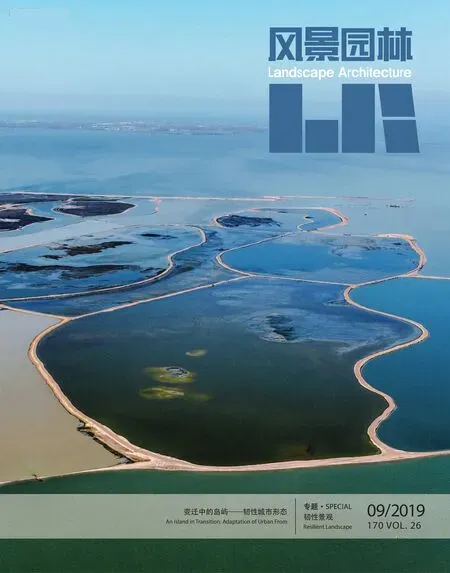
以柔克剛的彈性
2019-12-02 08:22:28王向榮
風(fēng)景園林 2019年9期

伴隨著世界人口的飛速增長,人類開發(fā)利用地球的區(qū)域不斷擴大,對環(huán)境的干預(yù)也不斷加強。世界上越來越多的人生活在城市,在全球性的快速城市化進程中,大量城市建設(shè)用地的拓展都是通過如圍海造地、砍伐森林、挖掘山體、填埋濕地、渠化河道、侵占農(nóng)地等壓縮自然區(qū)域的方式來實現(xiàn)的。在許多地區(qū),人類對環(huán)境干預(yù)的強度遠遠超過了自然本身的更新能力,這對全球的生態(tài)系統(tǒng)造成了無法估量的負面影響,全世界都面臨著越來越嚴重和復(fù)雜的環(huán)境問題。
工業(yè)革命以來,人們更相信和依賴技術(shù)來抗拒自然災(zāi)害。當(dāng)代城市建造了大量現(xiàn)代化的基礎(chǔ)設(shè)施,如堤壩、水閘、排水管網(wǎng)等,來抵御城市所面臨的暴雨、洪水和風(fēng)暴潮等災(zāi)害。然而這些看似完備的基礎(chǔ)設(shè)施,在自然災(zāi)害面前似乎并沒有預(yù)想中強大的抵御能力,一場暴雨或一次臺風(fēng)都可能給城市帶來巨大的災(zāi)難和損失。
隨著氣候變化、海平面上升及人類對環(huán)境干預(yù)的不斷增強,自然災(zāi)害的發(fā)生愈發(fā)頻繁,強度也愈加嚴重。而人類建造的抵御災(zāi)害的基礎(chǔ)設(shè)施都是剛性的和靜態(tài)的,很難應(yīng)對不斷變化且難以預(yù)見的新的環(huán)境問題。同時,城市也是不斷發(fā)展的,按照一個固定標(biāo)準建造的基礎(chǔ)設(shè)施無法保證一個動態(tài)變化的城市的安全。再加上地質(zhì)條件變化、設(shè)施老化等原因,許多基礎(chǔ)設(shè)施都會存在著功能退化和安全隱患的問題。另外,基于抵御自然過程而建造的基礎(chǔ)設(shè)施大多是與自然割裂和分離的,這些設(shè)施對當(dāng)?shù)氐淖匀弧⑽幕途坝^會帶來許多不利的影響,往往使城市失去了有機的結(jié)構(gòu)、宜人的尺度和詩情畫意的風(fēng)景。因此,要有效地避免自然災(zāi)害造成的巨大破壞,城市必然要另辟蹊徑,尋求新的解決方案,于是彈性城市的概念便應(yīng)運而生了。
彈性是指一個系統(tǒng)在受到外部干擾下具有不會崩潰的能力。依彈性思維,城市的安全建立在其應(yīng)對外界干擾的能力上。一旦受到災(zāi)害的威脅,城市能夠消化并吸收外界干擾、抵御災(zāi)害的發(fā)生。如果沖擊和干擾產(chǎn)生了不利的結(jié)果,城市能夠較快地恢復(fù)到平衡的狀況。
彈性城市強調(diào)的不僅僅是抵御外部災(zāi)害的能力,還特指通過消化和吸收從而化解外部沖擊的能力。可以說,彈性的觀念來自于人們對自然更深刻的理解。如果將人工建造與自然對立,建造剛性的基礎(chǔ)設(shè)施就是人類應(yīng)對自然災(zāi)害的直接選擇,目的是控制自然,將干擾排除在外;如果認為人類是自然的一部分,人工建造可以與自然和諧共生,那么人、城市與自然環(huán)境就可以形成相互關(guān)聯(lián)、相互融合的關(guān)系,自然的沖擊也就可以被吸收和消化。彈性是一種以柔克剛的思維,一座具有彈性的城市,在平時呈現(xiàn)出人工建造與自然之間的融合與平衡,面對災(zāi)難的沖擊時能保持動態(tài)穩(wěn)定的狀況。
要實現(xiàn)彈性城市的目標(biāo),完整的具有彈性的城市生態(tài)基礎(chǔ)設(shè)施必不可少,它由自然環(huán)境和人工建設(shè)的水岸、濕地、綠地等共同組成,構(gòu)成了城市內(nèi)外完整的生態(tài)網(wǎng)絡(luò)。生態(tài)基礎(chǔ)設(shè)施將自然引入城市,也將城市轉(zhuǎn)化為生態(tài)系統(tǒng)的一部分,從而使得城市具有應(yīng)對環(huán)境變化的適應(yīng)能力和調(diào)節(jié)能力。
如何實現(xiàn)城市生態(tài)基礎(chǔ)設(shè)施的完整性和彈性呢?首先必須為城市內(nèi)外的自然留下充分的空間。古時的湖泊疏浚、退圩還湖,今天的留白增綠、退耕還林等措施都是為了增加儲蓄洪水的緩沖空間,從而使得區(qū)域或城市具有抵御洪水的更大的彈性。然后,還應(yīng)該連接這些自然空間,構(gòu)筑起一個從區(qū)域到城市再到街區(qū)的全尺度的生態(tài)網(wǎng)絡(luò)系統(tǒng)。同時,這個系統(tǒng)必須要順應(yīng)當(dāng)?shù)氐臈l件,具備自然的過程,擁有本地化多樣的自然類型,從而具有環(huán)境適應(yīng)性和應(yīng)對外界干擾的能力。這一系統(tǒng)還要具有綜合的功能,包括生態(tài)保護與修復(fù)、氣候調(diào)節(jié)、雨洪管理、生物多樣性和棲息地維護,以及審美、公益、教育、游憩等。
剛性的城市防護基礎(chǔ)設(shè)施依然不可或缺,但是彈性的思想啟發(fā)我們可以將相當(dāng)多這樣的基礎(chǔ)設(shè)施結(jié)合到城市生態(tài)基礎(chǔ)設(shè)施的建設(shè)之中,既有效地幫助城市這個日益龐大、復(fù)雜而脆弱的系統(tǒng)平安地度過每一次沖擊并迅速恢復(fù),又能平衡城市中自然與人工的關(guān)系,使得人工建造的城市充滿自然的氣息和詩情畫意。
主編:王向榮教授
2019年9月5日
PREFACE
Resilience: Echoing Hardness with Softness
As the world population is escalating, human beings are continuously expanding the area for development with the limited land on earth, meanwhile enhancing their intervention to the environment. More and more people are living in the cities amid the rapid worldwide urbanization process. A growing number of urban construction lands are realized at the expense of natural areas, like reclaiming land from the sea, disafforestation, excavating mountains, filling wetlands, embanking rivers, occupying farmlands,etc. In many areas, people’s intervention to the environment has far surpassed the renewability of the nature itself, resulting in an uncountable negative influence on the global ecosystem, and the world is facing increasingly severe and complex environmental problems.
Since the industrial revolution, people have trusted and relied on technology resisting natural disasters to a greater extent. A vast of modern infrastructures have been built in contemporary cities, such as dams, sluices, drainage networks, in order to resist rainstorms, floods, and storm surges that the city might be faced with. However, these infrastructures, seeming to be perfect, fall short of their premeditated strong resistance when facing the natural disaster, and storm or typhoon may still cause huge disaster and loss to the city.
As the climate continues to change, the sea level to rise, and human beings to intervene the environment, the occurrence of natural disaster is witnessed to be more and more frequent and serious. Yet the infrastructure built by the human being to resist the disaster is rigid and static which is hard to cope with the changeable and unpredictable new environmental issues. At the same time, the city evolves, while the infrastructures are constructed following a fixed standard, which might fail to guarantee the safety of a dynamically changing city. And many infrastructures face the functional degeneration and hidden danger, due to the change of geological condition and facility aging. In addition, most infrastructures constructed to resist the natural process are spilt and separate from the nature system, bringing many adverse effects to local natural environment, culture, and landscape, mostly forcing the city to lose the organic structure, pleasant scale, and picturesque scenery. Thus, the city needs to find another way and new solutions to availably avoid the huge damage caused by the natural disaster,and then the concept of resilient city emerges.
Resilience means that a system is equipped with the power not to collapse when interfered by external factors. In the view of resilience, the safety of the city is built on the its power to cope with the external interference. Once it is threatened by the disaster,it is able to digest and absorb the external interference and to resist the disaster. If some negative impact is inevitable, it is capable of recovering to its balanced status in short period of time.
What the resilient city stresses is not only the ability to resist the external disaster, but the ability to dissolve the external impact by digestion and absorption. We can say that the concept of resilience originates from people’s more profound understanding to the nature. If the artificial building is forced against the nature, to build the rigid infrastructure is the direct choice for human beings to resist the natural disaster, for the purpose of controlling the nature and excluding any interference. If human beings are taken as a part of the nature, the artificial building is symbiosis with the nature, then a correlative and integrated relationship can be formed among the human, city, and natural environment, and the natural impact could be digested and absorbed. The resilience is an idea of echoing the hardness with the softness; a resilient city will reflect the integration and balance between artificial buildings and the nature at ordinary times and keep a dynamic and stable condition when being impacted by the disaster.
In order to realize the goal of resilient city, the complete resilient urban ecological infrastructure is indispensable, which consists of natural environment, artificial water bank, wetland, greenbelt, etc.,constituting an entire eco-network inside and outside the city. While the ecological infrastructure introduces the nature into the city, the city itself transfers into a part of the eco-system, allowing the city to adopt and adjust to the change of the environment.
How to realize the integrity and resilience of the urban ecological infrastructure? First of all, enough space has to be left for the nature inside and outside the city. Projects like lake dredging and “returning polders to lakes” in ancient times; “l(fā)eaving blanks and adding green spaces” and “returning farmlands to forests” today, they are all for the purpose of increasing the buffer space for retaining the stormwater, enabling the region or city to be capable of resisting the flood. Then, these natural spaces should also be connected to establish an all-round eco-network system, from regions, cities, to blocks. Meanwhile, the system must adapt to the local condition, be free of its initiative natural process, possess the local diversity, then it would be equipped with the environmental adaptability and able to response to outside interference. Comprehensive functions should also be possessed,including ecological protection and restoration, climate regulation,flood management, biodiversity and habitat maintenance, as well as public benefit, education, and recreation.
The rigid urban infrastructure is still an integral part, yet the idea of resilience inspires that we can combine some similar infrastructures with the construction of urban ecological infrastructure, effectively helping the city, as a growing, complex,and vulnerable system, peacefully overcome every punch of impact and recover rapidly, as well as balancing the relationship between nature and human beings, filling the artificial city with nature and picturesque sceneries.
Translator: WANG Xiyue
Chief Editor: Prof. Dr-Ing. WANG Xiangrong
September 5th, 2019
猜你喜歡
大科技·百科新說(2021年6期)2021-09-12 02:37:27
中老年保健(2021年12期)2021-08-24 03:30:40
保健醫(yī)苑(2021年7期)2021-08-13 08:48:02
中國傳媒大學(xué)學(xué)報(自然科學(xué)版)(2021年1期)2021-06-09 08:43:00
好孩子畫報(2020年5期)2020-06-27 14:08:05
學(xué)生天地(2020年36期)2020-06-09 03:12:30
小學(xué)科學(xué)(學(xué)生版)(2020年5期)2020-05-25 07:11:32
中國生殖健康(2020年6期)2020-02-01 06:28:50
意林·全彩Color(2019年6期)2019-07-24 08:13:50
中國生殖健康(2019年11期)2019-01-07 01:28:02