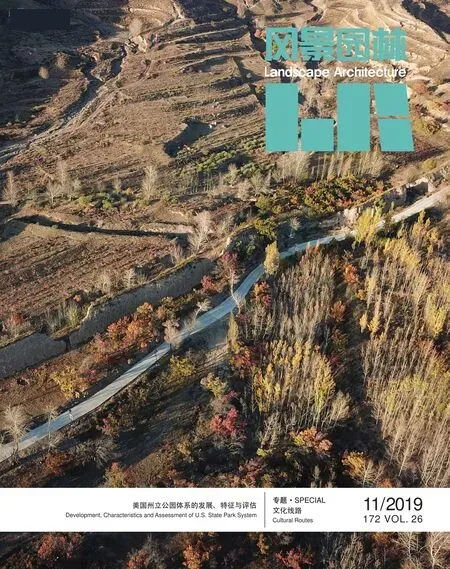
文化線路:文化交流的空間廊道
2019-12-01 06:55:00徐桐
風(fēng)景園林 2019年11期
關(guān)鍵詞:文化
文化線路,作為文化遺產(chǎn)領(lǐng)域的概念,始于1987年的“歐盟遺產(chǎn)計劃”。國際政治風(fēng)云變幻的20世紀(jì)80—90年代,發(fā)生了一系列重要事件,包括擁有共同文化基因的歐洲一體化進(jìn)程加快、蘇聯(lián)解體帶來全球化新契機(jī)、亞非拉地區(qū)發(fā)展訴求高漲等,這些共同構(gòu)成了國際政治、經(jīng)濟(jì)、文化領(lǐng)域思潮變革的時代背景。
反映在國際文化遺產(chǎn)保護(hù)方面,傳統(tǒng)的歷史性、建筑性保護(hù)視野被不斷反思和突破。1994年,針對世界遺產(chǎn)名單的不平衡性問題,在巴黎聯(lián)合國教科文組織總部召開的“世界遺產(chǎn)代表名單‘全球戰(zhàn)略’和專題研究專家會議”上明確指出,“必須將文化遺產(chǎn)保護(hù)從一個紀(jì)念碑式和靜態(tài)的視角,轉(zhuǎn)向?qū)θ祟愇幕敭a(chǎn)(wealth of human cultures)更全面和多樣化的認(rèn)知視野上來”。這表明文化遺產(chǎn)保護(hù)的目標(biāo)開始拓展,進(jìn)入全球文化多樣性的表達(dá)、交流、合作發(fā)展的新階段。同年,在馬德里召開的名為“將線路作為文化遺產(chǎn)的一部分”的專家會議上正式提出“文化線路”概念,其核心在于強(qiáng)調(diào)文化線路“見證國家間或地區(qū)間的交流與對話”。至此,以“人類遷徙和文明對話”為核心內(nèi)涵的文化線路概念迅速走出歐盟,成為國際文化遺產(chǎn)領(lǐng)域共同關(guān)注的焦點(diǎn)。
以2008年國際古跡遺址理事會(ICOMOS)通過的《文化線路憲章》為標(biāo)志,國際文化遺產(chǎn)保護(hù)領(lǐng)域基本厘清了文化線路作為文化遺產(chǎn)特定類型的主題研究框架:文化線路需要依托實(shí)際存在(或歷史上實(shí)際存在過)的有較長歷史跨度和空間跨度的交通線路;文化線路產(chǎn)生和發(fā)展需要有宗教、商業(yè)、政治或者其他特定目的作為動力;從結(jié)果上,文化線路促進(jìn)了“不同民族、國家、區(qū)域或大陸之間,在相當(dāng)長的時期內(nèi)的貿(mào)易、思想、知識和價值觀念上的多維度、持續(xù)和相互的交流”。也即,文化線路以文化區(qū)、文明區(qū)之間多元交流需求為動力,伴隨人員、物資、信息的傳輸,最終架構(gòu)其文化交流的空間廊道。
當(dāng)今,文化線路已經(jīng)突破單純的遺產(chǎn)保護(hù)范疇。國際上漸有通過挖掘與紀(jì)念古代區(qū)域間文化聯(lián)系與交流的史實(shí)、復(fù)興當(dāng)代社會文明認(rèn)同、促進(jìn)經(jīng)濟(jì)交流合作的趨勢。這本身符合世界遺產(chǎn)保護(hù)的基本宗旨,也得到了國際社會的廣泛認(rèn)同。以絲綢之路和海上絲綢之路為代表,歷史上的文化線路項(xiàng)目已經(jīng)通過“一帶一路”當(dāng)代國際合作廊道概念,提升至國家戰(zhàn)略高度。2014年6月,在卡塔爾多哈召開的第38屆遺產(chǎn)大會上,中國、哈薩克斯坦、吉爾吉斯斯坦三國聯(lián)合申報的“絲綢之路:長安—天山廊道路網(wǎng)”,南美6國共同申報的“夸帕克南:安第斯道路系統(tǒng)”兩項(xiàng)跨境文化線路項(xiàng)目成功登錄成為世界文化遺產(chǎn)。2個申遺項(xiàng)目均經(jīng)歷了聯(lián)合申報國十余年的遺產(chǎn)調(diào)查、主題研究、保護(hù)管理合作;借申遺推動的合作已經(jīng)為沿線國家搭建起社會、政治、經(jīng)濟(jì)和文化交流合作的新廊道。
文化線路在學(xué)術(shù)與實(shí)踐上的快速發(fā)展提醒我們,應(yīng)當(dāng)繼續(xù)檢視和拓展其學(xué)術(shù)研究的視野。回到文化線路承載的文化交流上,針對文化的結(jié)構(gòu)及其特性,根據(jù)“文化適應(yīng)性和傳播性”理論,人類早期文明多為人類適應(yīng)特定自然地理環(huán)境、后期社會環(huán)境而形成的內(nèi)生型文明或文化。具有一定空間距離的不同區(qū)域內(nèi)生型文化要素在積累到特定階段,將形成復(fù)雜性高級文化層,并出現(xiàn)溢出效應(yīng)和磁石效應(yīng),也即出現(xiàn)向周邊傳播和吸收外來文化要素的過程。這一效應(yīng)成為文化、文明區(qū)之間構(gòu)建文化交流空間廊道的內(nèi)在核心驅(qū)動力,是為歷史必然。朝圣之路、香料之路、絲綢之路、茶馬古道、萬里茶道、奴隸之路、可可貿(mào)易之路等線路雖有不同的突出主題,但這些僅是文化線路承載文化傳播功能的外在表象,而文化交流的內(nèi)涵則通過空間廊道沿線區(qū)域文化構(gòu)成的“技術(shù)系統(tǒng)、制度系統(tǒng)、精神系統(tǒng)”3 個子系統(tǒng)得以全面體現(xiàn)。因此,在文化線路主題研究的視野下,文化三大子系統(tǒng)作為宏觀歷時性文化交流成果,見證了文化線路連接文化區(qū)的多元共性文化特征應(yīng),當(dāng)作為核心研究對象。
具體到建筑、城鄉(xiāng)規(guī)劃和風(fēng)景園林學(xué)科,文化線路空間廊道覆蓋范圍內(nèi)的建筑形制,城鎮(zhèn)、鄉(xiāng)村及周邊環(huán)境構(gòu)成的景觀形態(tài)通常能作為研究對象,挖掘體現(xiàn)文化交流傳播影響下的共性文化特征。此研究視野不僅可以指導(dǎo)文化遺產(chǎn)保護(hù)分析,同時可供文化線路串聯(lián)區(qū)域的共性歷史資源發(fā)掘、景觀特征分析、展示利用規(guī)劃借鑒。本期文化線路專題中,既有將“南粵古驛道”“米倉道(巴中段)”等文化線路本體的保護(hù)與規(guī)劃展示利用作為研究對象的文章,也有將依托文化線路形成的“江門華僑華人文化線路資源”“古代城湖分布”“海上絲路東海航線之瀨戶內(nèi)海區(qū)域景觀”等文化交流成果的共性特征作為研究對象的文章。作為圍繞文化線路開展多學(xué)科交叉研究的最新成果,可供專攻此領(lǐng)域的學(xué)者討論共鑒,期待能夠引起更多學(xué)術(shù)爭鳴。
徐桐
2019年10月8日
PREFACE
Cultural Routes: Space Corridor for Cultural Exchange
Cultural route, as a concept in the field of cultural heritage,began with the Declaration of Santiago de Compostela by Council of Europe in 1987. In the 1980s and 1990s, when international politics greatly changed, a series of important events occurred,including the acceleration of the process of European integration with common cultural genes, the new opportunity of globalization brought by the disintegration of the Soviet Union, and the high demand for development in Asia, Africa and Latin America constitutes the era background of ideological change in the field of international politics, economy and culture.
Reflected in the protection of international cultural heritage, the traditional historical and architectural protection vision has been constantly reflected and broken through. In 1994, in response to the imbalance of the world heritage list, it was clearly pointed out, at Expert Meeting on the “Global strategy” and thematic studies for a representative World Heritaqe List (UNESCO Headquarters, 20-22 June 1994), that “moving from a ‘monumental’ and static view to a more comprehensive and diversified perception of the wealth of human cultures.” This shows that the goal of cultural heritage protection has begun to expand, and it has entered a new stage of development in the expression, exchange and cooperation of global cultural diversity. In the same year, the concept of “Cultural Route”was formally put forward at the expert meeting entitled “Taking the Route as a Part of Cultural Heritage” held in Madrid. The core of the concept is to emphasize that cultural routes “witnesses the exchanges and dialogues between countries or regions”. So far, the concept of cultural routes with the core connotation of “Human Migration and Civilization Dialogue” has rapidly stepped out of the European Union and become a heritage type of common concern in the field of international cultural heritage.
Taking theThe ICOMOS Charter on Cultural Routesadopted in 2008 as a mark, the field of international cultural heritage protection clarifies the research framework of cultural routes as a specific type of cultural heritage basically: Cultural routes need to rely on actual existing (or historically existed) transportation routes with long historical and spatial span. The generation and development of cultural routes need to be motivated by religious,commercial, political or other specific purposes. As a result,cultural routes should promote “the material, cultural or spiritual exchanges generated by the movement of mankind over long and continuous periods of time ,…, a cultural inter-fertilization among countries or regions”. That is to say, the cultural routes are driven by the diversified communication needs between cultural areas and civilized areas, with the transmission of personnel, materials and information, to construct its space corridor for cultural exchange finally.
Nowadays, cultural routes have broken through the simple category of heritage protection. In the world, there is a trend of reviving the identification of contemporary social civilization and promoting economic exchange and cooperation by excavating and commemorating the historical facts of ancient regional cultural contacts and exchanges. This is in line with the basic purpose of world heritage protection and has been widely recognized internationally. Represented by the Silk Road and the Maritime Silk Road, the cultural routes project in history has been promoted to the national strategic level through the concept of “The Belt and Road”, the contemporary international cooperation corridor. In June 2014, at the 38th Heritage Conference held in Doha, Qatar,the two cross-border cultural routes of “Silk Road: Chang an— Tianshan Corridor Road Network” jointly applied by China,Kazakhstan and Kyrgyzstan as well as the “Kwapaksnam: the Andean Road System” jointly applied by the six countries of South America were successfully registered as world cultural heritages.The two applying inherit projects have experienced more than ten years of heritage investigation, theme research, and protection management cooperation in the joint applicant countries. The cooperation promoted by world heritage application has built a new corridor for social, political, economic and cultural exchanges and cooperation for the countries along the route.
The rapid development of cultural routes in academic and practical reminds us that we should continue to examine and expand the vision of its academic research. Back to the cultural exchange carried by cultural routes, according to the structure and characteristics of culture, as well as the theory of “cultural adaptability and communication”, most of the early human civilization is the endogenous civilization or culture formed by human adapting to the specific natural geographical environment and the later social environment. When the endogenous cultural elements of different regions with certain space distance accumulate to a specific degree, they will form a complex high-level cultural layer, and there will be spillover effect and magnet effect occurring, that is, the process of spreading around or absorbing foreign cultural elements to the surrounding areas. This effect has become the internal core driving force for constructing the cultural exchange space corridor between cultural and civilized areas, which is inevitable for history.Although the Pilgrimage Route, the Spice Trade Route, the Silk Road,the Tea Road, the Tea Horse Road, the Slave Route, the Cocoa Trade Route and other routes have different prominent themes, these are only the external appearances of cultural routes in carrying cultural communication functions. The connotation of cultural exchange is fully reflected in the three subsystems of “technical system,institutional system and spiritual system” composed of regional culture along the space corridor. Therefore, in the perspective of the thematic research on cultural route, among the three subsystems of culture, it should be regarded as the core research object which can be acted as the result of macro diachronic cultural exchange and witness the multiple common cultural characteristics of cultural routes connecting cultural areas.
Specifically in our disciplines of architecture, urban and rural planning and landscape architecture, the architectural form covered in the cultural routes space corridor as well as the morphology of landscape composed by urban, rural and surrounding environment can be taken as the research object to explore the common cultural characteristics under the influence of cultural exchange and communication. This research field can not only guide the analysis of cultural heritage protection, but also provide reference for the exploration of common historical resources, the analysis of landscape characteristics, the display and utilization planning of cultural routes and its connected series of regions. In this monograph of cultural routes, there are articles that take the protection and planning of the cultural route itself as research objects, like the “Southern China Historical Trail”, and “Micang Ancient Road (Bazhong Section)”, and there are also articles that take the common characteristics of cultural exchange results as research objects, like “Jiangmen Overseas Chinese Cultural Routes Resources”, “The Distribution of Ancient Cities and Lakes”, and “Seto Inland Sea Regional Landscape of Haisi East China Sea Route” and other cultural exchanges which rely on the cultural routes as research objects. As the latest achievement of interdisciplinary research around cultural routes, it can be discussed and learned mutually by scholars in this field with this issue, and we also expect that it can cause more academic contending.
XU Tong
October 8th, 2019
猜你喜歡
中國德育(2022年12期)2022-08-22 06:16:18
湖北教育·綜合資訊(2022年4期)2022-05-06 22:54:06
金橋(2022年2期)2022-03-02 05:42:50
金橋(2022年1期)2022-02-12 01:37:04
英語文摘(2019年1期)2019-03-21 07:44:16
小天使·一年級語數(shù)英綜合(2018年9期)2018-10-16 06:30:16
西部大開發(fā)(2017年8期)2017-06-26 03:16:12
西部大開發(fā)(2017年8期)2017-06-26 03:15:50
人民中國(日文版)(2015年10期)2015-04-16 03:53:52
人民中國(日文版)(2015年9期)2015-03-20 15:08:05