
Benefit community promotes evolution of cooperation in prisoners’dilemma game?
2019-11-06 00:46:54JianweiWang王建偉JialuHe何佳陸FengyuanYu于逢源WeiChen陳偉RongWang王蓉andKeYu于可
Chinese Physics B 2019年10期
Jianwei Wang(王建偉), Jialu He(何佳陸), Fengyuan Yu(于逢源),Wei Chen(陳偉),Rong Wang(王蓉), and Ke Yu(于可)
School of Business Administration,Northeastern University,Shenyang 110819,China
Keywords:coevolution,cooperation,prisoners’dilemma game,benefit community
1.Introduction
According to Darwinian theory of evolution,[1]each rational individual is selfish enough to make profits for themselves no matter who others are and what they are doing.However,cooperation plays a totally important role in almost all kinds of fields,such as biology,sociology,economics,and so on.[2–7]Understanding the spontaneous emergence and maintenance of altruism and cooperation among selfish individuals is an extremely interesting and significant challenge,which has attracted a lot of attention of researchers in recent decades.In order to solve this puzzle,evolutionary game theory,[8–10]a classical and powerful theoretical framework,which is extensively used,has provided an effective tool to investigate the evolution of cooperation. In basic game theory models,the prisoners’dilemma game(PDG)[11–13]is the most common and frequently used,attracting a lot of attention both in theoretical and experimental fields.In PDG,two equivalent players play a game in which they have to choose either cooperate(C)or defect(D)at the same time.Each of the simultaneous cooperators receives a reward R,and mutual defection results in a punishment P,the cooperator whose partner defects gets S(the sucker’s payoff),while the defector gains T(the temptation to defect).Accordingly,a PDG exists only if two conditions are satisfied:T>R>P>S and 2R>T+S,which makes the defectors too formidable to be defeated by cooperators even though the mutual cooperation yields larger payoffs for both players.
As a metaphor for the problems surrounding the evolution of cooperative behavior,the prisoners’dilemma has gained a great deal of attention and many researchers have been burying themselves in solving it. Nowak and May,[14]initially explored the consequences of spatial structure and found that cooperation increases when placing all the players on a two-dimensional lattice. Since then,various types of spatial topology have been introduced into subsequential studies,[15]in which,players,who are arranged on a structured topology,including random regular graphs,[16–19]BA scale-free network,[20–24]small world network,[25–30]and interdependent network,[31–34]can interact only with their direct neighbors. In addition,five rules for the evolution of cooperation which are kin selection,direct reciprocity,indirect reciprocity,network reciprocity,and group selection,were reviewed by Nowak[35]in 2006,interpreting the emergence and maintenance of cooperation in social dilemma.Furthermore,a large amount of mechanisms facilitating cooperative behaviors have been proposed in recent years’studies,such as reputation,[36–39]social norms,[40–45]rewards,[46–50]and punishments,[51–54]teaching ability,[55]environment,[56–58]aspiration,[59,60]memory,[61,62]interference of noise,[63]selfinteraction,[64]external forcing,[65]decoy effect,[66]to name but a few.
In real world,there are many groups in which members help each other,regardless of you and me.For example,if a man marries a woman,and they become a family,everything of them,including incomes,consumption,friends,and so on,will be owned and shared in common.Besides,recalling everyone’s student days,teachers always divide the whole class into several learning groups to improve the average grades of the whole class.Every student with high scores is appointed to help those who are not good at learning in the same group.In addition,motivated by Nowak and May,who found that cooperators form compact clusters to prevent being invaded by defectors,we come up with an idea about benefit community among cooperators in order to reduce the defectors’aggression,to some extent,in which one cooperator links with its cooperative neighbors until there are no cooperators among cooperative ones’neighbors,and all of their payoffs are equally divided when a game ends.Different from other works on dynamic networks,on which players have the choice to drop connections and re-establish connections with players,our model is the one on a static network,where cooperators compact their common benefit communities,and all of the benefit communities evolve with the evolution of players’strategy.The results of computer simulations show the promotion of cooperation on the square lattice and the WS small world network,what is more important,we obtain a better result on the WS small world network.
The rest of this paper is arranged as follows.In Section 2,we illustrate our evolutionary game model in detail.And the results of numerical simulation are proposed and described in Section 3.Finally,we make the conclusions in Section 4.
2.The model
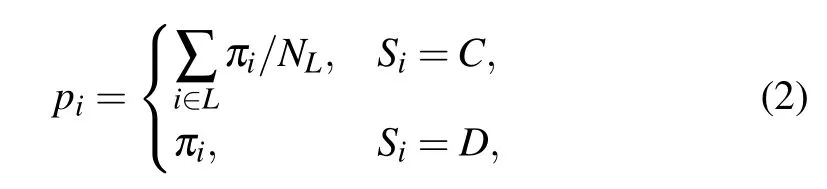
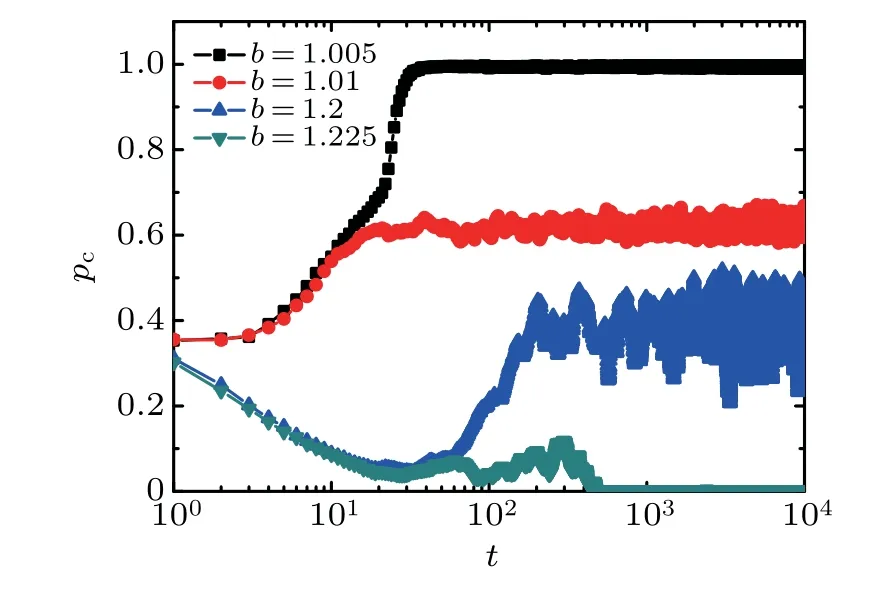
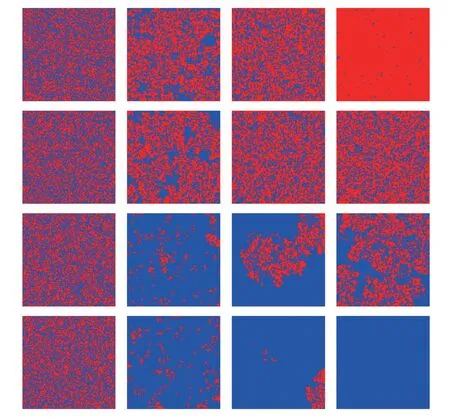
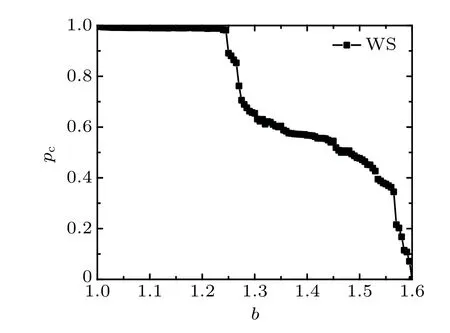
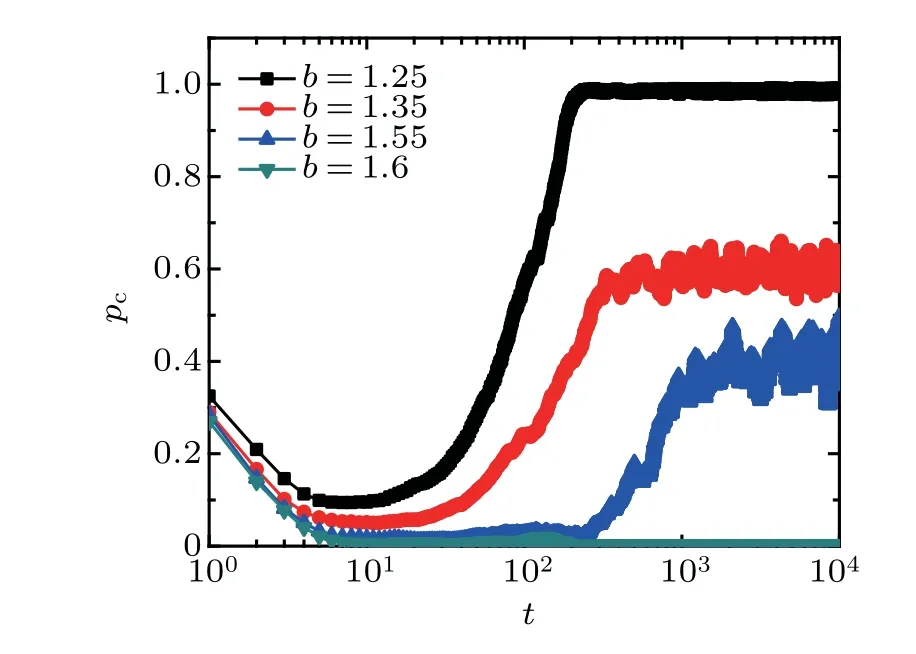
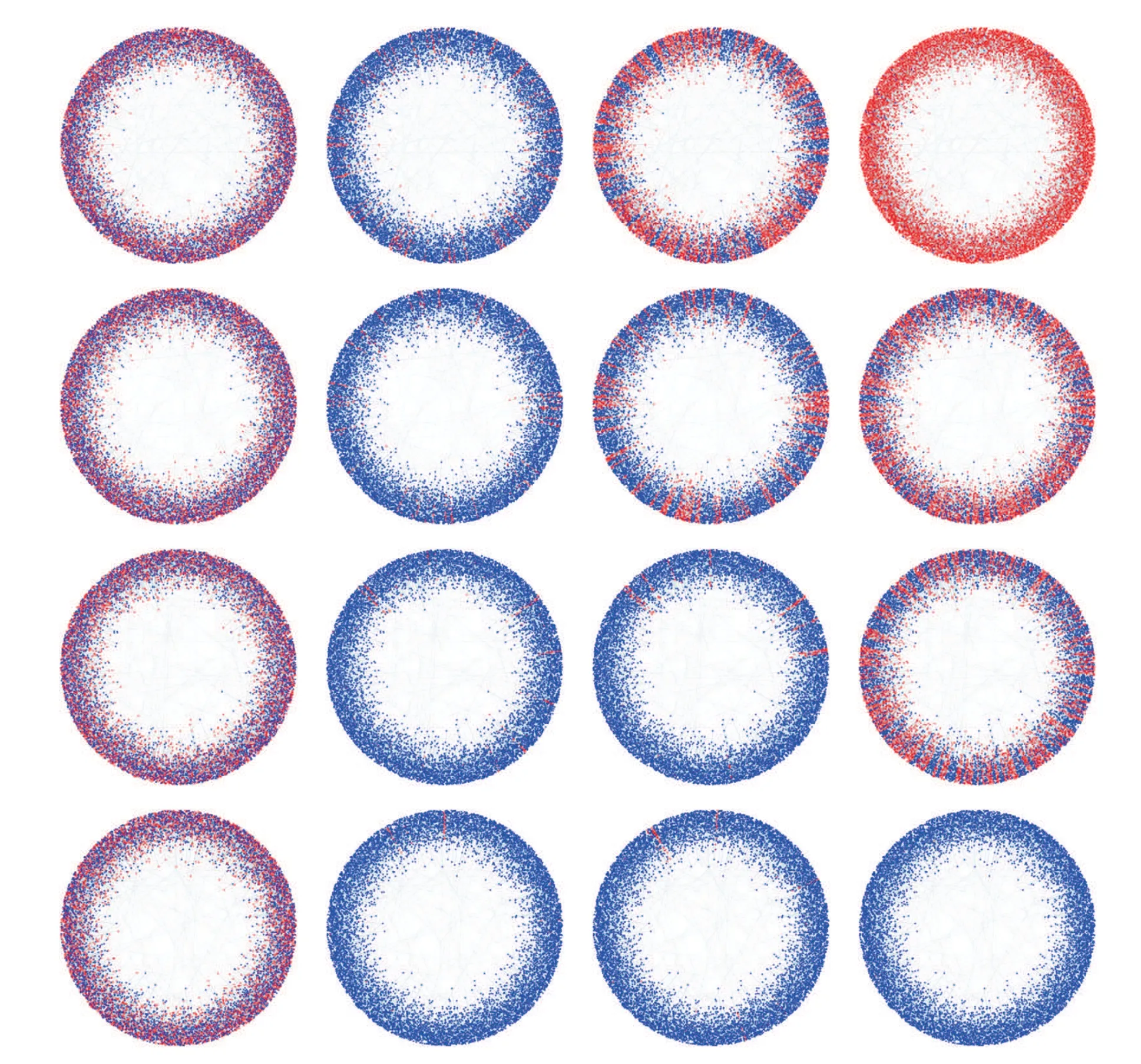
In this paper,we consider an evolutionary prisoners’dilemma game with a new mechanism of benefit community.Initially,a population with fixed size N is located on two kinds of network,in which each node represents one player and each link denotes the pairwise relationships between players,including a regular square lattice of size L×L with four nearest neighbors under a periodic boundary condition,and a WS small world network with ρ=0.01 and k=4,of which ρ and k represent the rewiring probability and the degree,respectively.Here,each node is arranged by a cooperator or a defector with equal probability initially.We denote players’strategy by the two-dimensional vector S,which is(1,0)Tif a player is a cooperator and is(0,1)Tif a player is a defector.Following a common parametrization in most of the literature,we choose the weak PDG in which the parameters are defined as R=1,T=b,S=P=0,where b(1 At each time step,choosing to cooperate or defect,player i plays the game with its nearest four neighbors simultaneously and gains its payoff where Nirepresents the set of neighbors of player i. After each game,a random cooperator links with its cooperative neighbors until there are no cooperators among its neighbors,and all of them compose a benefit community in which all of their payoffs are divided equally when a round of game ends,while a defector’s payoff is not divided.It is worth noting that each cooperator can be in only one benefit community.Therefore,one player i obtains its final payoff, where L and NLrepresents the set of the same league and the number of cooperators in community. The game is implemented by Monte Carlo(MC)simulations. First,a randomly selected player i receives its payoff according to Eq.(2).Next,one of its four neighbors j is selected randomly,whose payoff is pj.At last,player i adopt j’s strategy with a probability proportional to the difference between their payoff, where K(K>0)measures the uncertainties(noise)characterizing irrational choices.K →0 represents complete rationality,while K →∞denotes entire randomness.Here,we set K=0.1 in this paper. Besides,we introduce the process of mutation with the probability of mutationμ=0.001 in each time step. The results of simulations showed below are obtained on a square lattice sized 100×100.In order to avoid errors,we also apply it on a WS small world network of size N=10000,k=4,ρ=0.01.Then,we observe the variation trend of the fraction of cooperators pc.To assure suitable accuracy,the equilibrium pcis gained by averaging over 10 independent runs,in which we calculate the average result of the last 1000 time steps of total 10000 time steps. We begin with the results for the evolutionary PDG on square lattice network.The fraction of cooperators pcin dependence on the temptation to defect b is demonstrated in Fig.1.It is obvious that the value of pcdecreases with rising value of b and the critical value of b is almost 1.009 for total cooperation.After that,the fraction of cooperators pcdrops sharply to 0.6 and when 1.015 Fig.1.Average fraction of cooperation pc as a function of the temptation to defect b on the square lattice. In order to further explore and discuss the evolution of cooperation in spatial PDG,it is necessary to clarify its potential microscopic dynamics.In Fig.2,the time courses of the fraction of cooperators pcon the square lattice are recorded.The temptation to defect b is set to be equal to 1.005,1.01,1.2,and 1.225.For b=1.005 and 1.01,the first thing that catches our attention is that defectors in the early stages of the evolutionary process perform better than cooperators.And after that,the advantages of the benefit community of cooperators are revealed,and the fraction of cooperators pcof the black curve increases rapidly to almost 1 with the increase of time steps,while the value of pcof the red curve increases slowly and after it reaches 0.6,keeps stable.However,with the rising temptation to defect b,the fraction of cooperation gradually decreases.Especially when b is particularly large,defectors expend so fast that the effect of benefit community is not very obvious and cooperators die out soon.When b=1.2,the value of the fraction of cooperation pcdrops fast at the early stage,then it begins to increase due to the particular distribution mechanism,but what attracts us more is the big fluctuation at the last stage.On account of the mutation probability,0.001,once one cooperator whose neighbors are all cooperators mutates into a defector,the next time step,the cooperators will have a great potential to be a defector for its high-payoff defective neighbors and it leads to a low fraction of cooperators,but then the advantages of the extraordinary mechanism pull it back to a high pc.So,it fluctuates up and down among 0.4 at last.As shown in Fig.2,the green curve,whose b is 1.225,a big temptation to defect,defectors expend so strongly that cooperators are overwhelmed quickly.In the green curve,after t=100,it begins to rise up while soon it drops to zero and all of these prove that our mechanism does not work in the face of an enormous temptation to defect. Fig.2. Time courses of the fraction of cooperators pc on the square lattice.The presented results are obtained for the temptation to defect b=1.005,1.01,1.2,1.225. To vividly depict the time courses of the evolutionary PDG and explain why our new mechanism can effectively deal with the social dilemmas,we plot the characteristic snapshots of distribution of cooperators(red)and defectors(blue)on the square lattice for various temptation to defect b,including 1.005,1.01,1.2,and 1.225,when t=0,10,100,10000.From a rough scan of these snapshots,the influences of b on the evolutionary processes are extremely big.At the early stage,the most of nodes are occupied by defectors due to the relatively big benefit b.After that,many clusters and benefit communities are formed by cooperators,trying to defend the invasion of defectors. As described in Fig.3,when b=1.005 and 1.01,cooperators increase rapidly,forming clusters and benefit communities to protect themselves from being invaded by defectors,especially when b=1.005,the stable fraction of cooperators pcis totally close to 1. Nevertheless,as for b=1.225,cooperators decrease quickly due to the persistently invading defectors and drop to the situation in which there are nearly all defectors without cooperators. Then,we gain the results of simulations on the WS small world network with node size N=10000,rewiring probability ρ=0.01,degree of nodes K=4.As depicted in Fig.4,when 1 ≤b ≤1.25,the stabilized fraction of cooperation pcis almost 1 and with the increasing temptation to defect b,the value of pcdeclines continually.When 1.25 ≤b ≤1.3,the value of pcdescends rapidly to 0.6 and then drop slow to 0.5 when b ranges from 1.3 to 1.45.After that,when 1.45 ≤b ≤1.6,the trend of decline in the fraction of cooperation accelerates gradually according to the big temptation to defect,which makes defectors perform better. And at last,the value of pcdrops quickly to zero when b=1.6,that is to say,the advantages of benefit community cannot be observed and cannot help maintain cooperation as for the big temptation to defect b.All of these show us the big effects of temptation to defect on the fraction of cooperators in the whole evolutionary PDG process.Contrast to that on the square lattice,the effect on the WS small world performs better. Fig.3.Characteristic snapshots of distribution of cooperators(red)and defectors(blue)on the square lattice for the temptation to defect b equal to 1.005,1.01,1.2,1.225(top to bottom)when t=0,10,100,10000(left to right). Fig.4.Average fraction of cooperation pc as a function of the temptation to defect b on the WS small world network. In order to further illustrate the fraction of cooperation pcover time,the curves of time courses are presented in Fig.5.The stationary fraction of cooperation pcrises to nearly 1 when b=1.25,and it decreases with the rising temptation to defect b,so it drops to 0 when b=1.6.From the four curves in Fig.5,it is intuitively observed that at the early stage,pcdecreases regardless of the value of b,the bigger the value of temptation to defect is,the more rapidly the pcdeclined due to each one’s entirely rationality.And after the first stage,the mechanism of benefit communities for cooperators plays a significant role in promoting cooperation when the temptation to defect is not very big.The essence of the identified mechanism for promoting cooperation is attributed to the equally divided payoffs in the benefit communities,which has the possibility to be bigger than the temptation to defect b,and inspire the enthusiasm of the players to cooperate.Therefore,we can found the stationary fraction of cooperation pcis almost 0.98,0.6,0.4,and 0,respectively,when b=1.25,1.35,1.55,and 1.6.However,when b is big enough,on the other word,the temptation to defect is so big that the enthusiasm of the cooperators cannot be observed,so the fraction of cooperation drops to zero fast and it cannot rise up no longer. Fig.5.Time courses of the fraction of cooperators pc on the WS small world network.The presented results are obtained for the temptation to defect b=1.25,1.35,1.55,1.6. To further explain the evolutionary process vividly,we depict the typical snapshots of distribution of cooperators(red)and defectors(blue)on the WS small world network for various temptation to defect b,including 1.25,1.35,1.55,and 1.6 when t=0,10,100,10000 in Fig.6.Apparently,in the nascent stage,defectors benefit more than cooperators due to relatively big temptation.But from step 10 to step 100,the situation is reversed,in which situation cooperators try to contact clusters hardly and divide their payoffs equally among other members in the same benefit community,and the difficulties of compacting benefit communities increase with the rising temptation to defect.As presented in Fig.6,when b=1.25,from step 100 to step 10000,cooperators expand quickly until they occupy the whole network.As for b=1.35,in the stationary situation,cooperators and defectors occupy half of the whole network.While different from the scattered situation in the initial stage,cooperators compact many clusters or benefit communities and exist stably.And when b=1.55,cooperators perform slightly better than defectors,the fraction of cooperation is almost around 0.4.Nevertheless,when b=1.6,the advantage of benefit community can’t be found,with the situation of defectors swallowing up rapidly all the cooperators. Fig.6.Characteristic snapshots of distribution of cooperators(red)and defectors(blue)on the WS small world network for the temptation to defect b equal to 1.25,1.35,1.55,1.6(top to bottom)when t=0,10,100,10000(left to right). In behavioral science,most of cooperators form groups,helping each other and once someone defects,he or she is eliminated from the group.Inspired by this phenomenon,we have investigated the evolutionary process of the prisoners’dilemma game on the square lattice and the WS small world network with a special mechanism,of which cooperators linking together contact a benefit community and divide all their payoffs equally.In addition,we find this mechanism can effectively promote the evolution of cooperation by observing and analyzing the results of MC(Monte Carlo)simulation. Especially,contrasting to that on the square lattice,it is more effective for this extraordinary mechanism to facilitate cooperation on the WS small world network,while the fraction of cooperators decreases with rising temptation to defect b. In summary,such a coevolution mechanism brings a beneficial environment for cooperators to avoid the invasion of defectors.We hope that this work can interest and inspire more studies to deal with the social dilemma.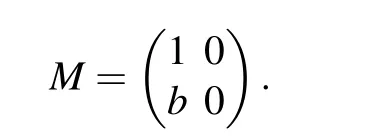


3.Results and analyses

4.Conclusion
