在設計中生存
2019-10-17 08:49:24何塞普瑪利亞加西亞豐特斯JosepMariaGarciaFuentes
世界建筑 2019年9期
何塞普-瑪利亞·加西亞-豐特斯/Josep-Maria Garcia-Fuentes
朱琳 譯/Translated by ZHU Lin
記憶與再生:胡安·納瓦羅·巴爾德維格作品中身體與記憶
欄目主持:阿爾伯托·博洛尼亞,米凱利·博尼諾,皮埃爾-阿蘭·克羅塞特
胡安·納瓦羅·巴爾德維格(1939 年生于西班牙桑坦德)的作品和形象并不為中國大眾所熟知,因此,我們希望在《世界建筑》雜志“記憶與再生”欄目中的發表能夠幫助人們更好地了解他。如何能用幾句話刻畫出他的獨特和在當代建筑的國際視野中的重要性呢?
首先,50 多年來,納瓦羅·巴爾德維格將他作為建筑師的工作與其作為畫家和雕塑家的工作聯系起來,并且在全部3 個領域都有著出色的成就,包括各類獎項、出版,以及在西班牙乃至全歐洲、還有美國最重要的博物館和文化中心舉行個人人類學展覽。
其次,其密集而又豐富的建筑和藝術作品中展現出了非凡的一致性和連續性,并聚焦于一些激進的想法和觀念:對重力、光線、身體、時間和裝飾品的實驗。這種當下十分罕見的一致性并不限制研究領域。相反,多虧了廣泛的閱讀——從藝術史到人類學,從精神分析到生物學,(甚至)從中國詩歌到美學——所滋養的求知欲,也多虧了遙遠的建筑師和藝術家之間——比如約翰·索恩和理查德·諾伊特拉,亨利·馬蒂斯和馬塞爾·杜尚——彼此呼應的格外廣泛而開放的視覺文化,納瓦羅·巴爾德維格得以繼續深化和豐富他的工作,并達到了如今最成熟的程度,正如后文發表的巴塞羅那龐培法布拉大學項目(1996-2016)中所彰顯的那樣。
在這一典型的方案中,3 座新建筑喚起了之前存在的建筑體塊,并維持了它們的體量和高度,但同時在材料、色彩和創新的內部空間上又有了根本的區別,為城市地區的再生做出了決定性的貢獻。因此,“記憶”的概念作為納瓦羅·巴爾德維格作品的核心,與“變形”的概念是分不開的,這可以從以前的經典作品中得到證明,例如穆爾西亞舊磨坊的重建(1984-1987)、馬德里大圣弗朗西斯科大教堂地區的規劃(1982-1994),特別是羅馬的赫茲圖書館(1995-2012):一個非同尋常的階梯狀空間圍繞著由玻璃圍成的采光井,能夠喚起該區域豐富的歷史分層——曾經的羅馬別墅花園和后來的16 世紀祖卡利宮花園。
納瓦羅·巴爾德維格的作品不僅體現了場所和建筑的記憶和變形,也體現了主題和圖案的記憶和變形,例如,他能夠將一些書法符號變形并植入龐培法布拉大學對彩色遮陽的絕妙而靈活的運用:繪畫和涂鴉的手部動作的記憶被鐫刻在遮陽這一建筑元素的物質性中。然而,一切都是以微妙的、幾乎超然的方式發生的:藝術家-建筑師的身體及其創作的時間在作品中的存在仍然是謹慎的、幾乎抽象的,因此我們必須用我們的身體去體會空間體驗全部的豐富性和多樣性。簡而言之,納瓦羅·巴爾德維格提出將整個建筑定義為“一種身體的藝術”,因為我們的身體“像一個敏感的接收器和中介,在物理世界中自由地移動和互動”,正因如此,建筑的目的“是引導對自然環境的創造性關注,來有意地呈現出預先存在的東西——它先于任何特定的工作目標而存在”[1]。 (皮埃爾-阿蘭·克羅塞特)
Memory and Regeneration: Body and Memory in the Work of Juan Navarro Baldeweg
Column Editors: Alberto Bologna, Michele Bonino, Pierre-Alain Croset
The work and the figure of Juan Navarro Baldeweg (Santander, Spain, 1939) are little known to the Chinese public, and we hope therefore that this publication on the pages of the "Memory and Regeneration" column of World Architecture would contribute to a better knowledge of him.How to characterise in just a few lines what makes him unique and so important in the international panorama of contemporary architecture?
Firstly, for over 50 years, Navarro Baldeweg has associated his work as an architect with that of a painter and a sculptor, with very high levels of excellence in all three fields, recognised by prizes,publications and personal anthological exhibitions in the most important museums and cultural centres in Spain, Europe and the United States.
Secondly, there is an extraordinary coherence and continuity of this intense and rich production,both architecturally and artistically, which focuses on a few radical ideas and notions: experimentation on the gravity, on light, on the body, on time, on the ornament. This coherence, so rare today, does not limit the field of research. On the contrary, thanks to an intellectual curiosity nourished by readings ranging from art history to anthropology, frompsychoanalysis to biology, from (even) Chinese poetry to esthetics, and thanks to a particularly wide and open visual culture that echoes architects and artists very distant from each other - such as John Soane and Richard Neutra, Henri Matisse and Marcel Duchamp - Navarro Baldeweg continues to deepen and enrich his work that reaches today its greatest degree of maturity, evident in the project for the Universitat Pompeu Fabra in Barcelona(1996-2016), published on these pages.
In this exemplary intervention, the three new buildings evoke the pre-existing volumes maintaining their mass and height, but at the same time radically differentiate themselves in the materials, colours and innovative internal spatiality,contributing decisively to the regeneration of the urban area. The notion of memory, central to the work of Navarro Baldeweg, cannot therefore be separated from that of metamorphosis, as evidenced by previous exemplary interventions such as, for example, the restructuring of the Old Mills in Murcia (1984-1987), the arrangement of the area of San Francisco el Grande in Madrid (1982-1994),and especially the Hertzian Library in Rome (1995-2012), an extraordinary terraced space that wraps around a well of light with a glass perimetre, able to evoke the rich historical stratification of the area, once the garden of a Roman villa and later the garden of the sixteenth-century Palazzo Zuccari.
Memory and metamorphosis not only of places and buildings, but also of themes and motifs,characterise the work of Navarro Baldeweg, able for example to transfigure some calligraphic signs in the wonderful plastic invention of the coloured sunbreakers of the Universitat Pompeu Fabra: the memory of the gesture of the hand that draws and scribbles is engraved in the materiality of this architectural element. However, everything takes place in a subtle, almost detached way: the presence in the work of the artist-architect's body and of its creation's time remains discreet, almost abstract, and so we with our body have to live the spatial experience in all its richness and variety. In a nutshell, Navarro Baldeweg proposes to define the whole architecture "an art of the body", because our body acts "like a sensitive receiver and agent, freely moving and interacting with in the physical world",and for this reason the purpose of architecture"is to direct the creative regard on the natural environment to deliberately render present the preexisting, that which is prior to any specific work objectives" [1]. (Pierre-Alain Croset)
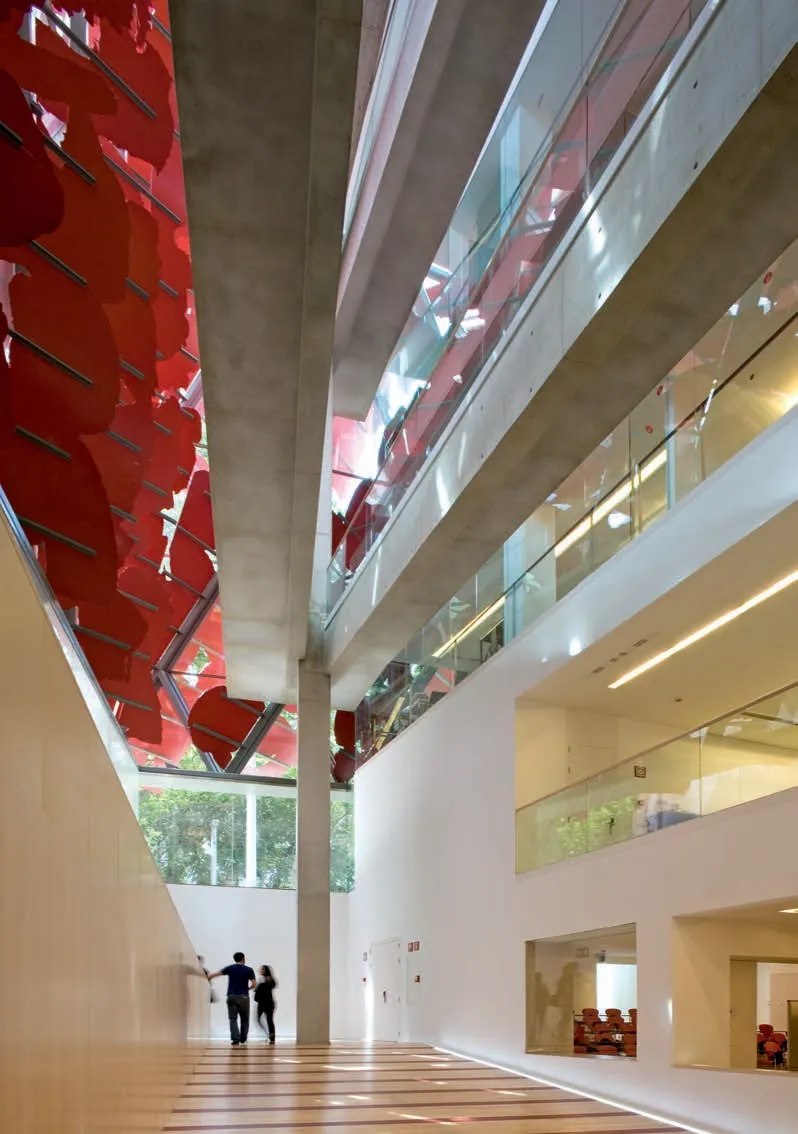
1 胡安·納瓦羅·巴爾德維格設計的紅色庭院的內部大廳/The interior hall in the red courtyard by Juan Navarro Baldeweg(圖片來源/Sources: Lourdes Jansana)
納瓦羅·巴爾德維格特意設計了3 座不同的建筑——它們看起來很簡潔,且都與場地邊界對齊。嚴整的立面由白色、銀色和灰色構成。然而,3 座建筑的材料稍有不同:玻璃,鋁材和混凝土;每座建筑暗含的建構和結構對策也稍有不同:其中一個是純玻璃立面,一個是由帶切口的鋁板包裹,還有一個好似在立面上露出了內部的混凝土網格。盡管它們分別展現了不同的構成元素,它們成功地創造出一種富有多樣性的整體感。
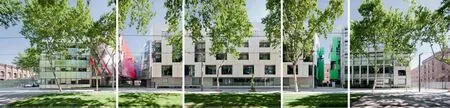
2 新建筑面向休塔德利亞公園/Fa?ade elevation of the new buildings towards the Ciutadella Park
3 座建筑之間的空間形成了兩個庭院,將正對休塔德利亞公園的地塊南側與新建筑和原有軍營之間的步行街連接起來。一個薄薄的體塊在高層將其中兩座建筑連在一起。它沿著步行街,盡管相對建筑立面稍稍縮進,但它在這一側確定了屬于這兩座建筑的連續體量,并且所有的入口都布置在此側。這個體量為整體引入了一種微妙的不對稱感。它包括了交通空間,兩側分別連接了兩座建筑的大堂,從而擴展了它們各自的公共空間,同時建立起與步行街對面的主校區的某種關系。一座露天連橋將新建筑與由軍營改造而來的主校區上的教學空間連接起來。
3 座建筑的大廳和交通空間垂直展開,沿著新的建筑體塊的剖面,布置在兩個庭院周圍,它們可以為小型階梯教室和每座建筑地下層的其他小教室等公共空間提供光照,通風和朝向公園的視野。如果說院系空間和辦公室的樸素風格是關乎城市肌理和場所記憶的一種背景,相對地,豐富的空間形式探索被濃縮在了這些庭院中,包括連接從地下層到頂層所有樓層的垂直空間,還有透明玻璃構成的傾斜曲面立面。
此外,兩個庭院的構成元素所呈現特別的多彩面貌,并顯示出極大的自由,與3 個體塊整體的樸素亦不加粉飾的材料性之間形成一種張力。每個庭院中巧妙的色彩元素,不僅為陽光直射最多的立面部分充當遮陽,同時也激活了新建筑的大廳和公共空間,并在這些垂直空間中創造出令人興奮的體驗。這些色彩元素是經過激光切割的大型鋁板。在其中一個庭院,這些鋁板被切割成建筑師的畫筆筆跡的形狀,并涂成紅色。另外一個庭院的鋁板有著近似菱形的切口,涂成綠色。這些美妙的色彩本身是互補色,因此同時相對于新建筑主要立面上不加粉飾的混凝土和玻璃的材料特性,增添了一種充滿活力的對應。
納瓦羅·巴爾德維格在這些建筑中的材料和設計的構圖使人想起胡安·米羅的著名畫作——畫家在粗糙的畫布上隨意地布置一系列手畫的線條,繩結和明亮的彩色織物元素。于是,整個構圖就是一套簡單元素,被極其省力的方法結合起來,以創造出富有啟發性和表現力的作品。同樣地,這也是建筑師在這個項目中所實現的,并呼應著場所記憶和場地的獨特性。比如,其中一個庭院的紅色鋁板是固定在立面的結構上的,一半在建筑內部,一半在外部。這模糊了室內外的邊界,并且當陽光照在巨大的鋁板上,會形成像森林中的樹葉所形成的影子那樣獨特的陰影。忽然之間,建筑的使用者會透過一個窗口注意到街對面與之互補的綠色公園,而這一窗口正是基于這一目的而精心設置的。
建筑師對于米羅式構圖的借鑒清晰地體現在了位于馬略卡的一個會議廳競賽的提案中,上文提到的很多想法都在這個項目中得到了進一步的發展。這種洞察力顯露出了建筑師對于將“互補的幾何形”應用于設計的探索,還有對類似于“掛毯中的圖案”“網中的結”“共鳴的盒子”(其中“建筑只是樂器,音樂才是最重要的”)等建筑形式的反思。這些想法從巴爾德維格早期在麻省理工大學與捷爾吉·科普斯合作時起,就奠定了他的作品——正如現有與納瓦羅·巴爾德維格相關的出版物所廣泛認同的那樣。
然而,除了這些想法之外,龐培法布拉大學的項目還展現出巴爾德維格為了克服現代藝術,科學和建筑之間特有的分裂而進行的踏實探索。確實,如果說大多數現代建筑師在專注于探索由新的材料和建造技術——機器——的應用所形成的所有挑戰,現代藝術家則更傾向于重新思考人類的根本是什么,藝術的心理學影響如何,以及技術可以怎樣傳遞我們最直接的感知。當巴爾德維格試圖在他的建筑中調和這些明顯的相悖的探索,這種張力就在其作品中得到了升華。這也提示我們銘記理查德·諾伊特拉的觀點。與這位美國建筑師一樣,巴爾德維格在巴塞羅那的這一項目使我們想起了技術與建筑在調和我們與自然和建成環境的關系中所起到的作用。作為人類,我們和我們的城市,只有通過設計才能夠繼續生存并保持鮮活的記憶,因為建筑使衰退的城市文脈重獲新生,并不斷賦予它新的含義。□

3 在這三座建筑物中,納瓦羅·巴爾德維格針對每個建筑物的不同立面解決方案和材料的細部/Details of the different fa?ades solutions and materialities in each of the three buildings by Navarro Baldeweg(2.3圖片來源/Sources: Eugeni Bach)
The Universitat Pompeu Fabra was founded in 1990 with the aim of establishing a brand-new world-leading academic and research institution in the city of Barcelona. The goals and legal aspects for the creation of the new institution were inspired by those of the Universidad Carlos III, which was founded one year earlier in Madrid. The project for the new Barcelonan public university had an intense ambition to build a robust relationship with Catalan society. It was agreed that the academic and research focus of the new university would focus on the areas connecting human beings with the urban polis:social sciences and humanities, biomedical sciences,and technology of communications.
Enric Argullol, a jurist and C hair in Administrative Law, led the first steps of the project following a commission by the Catalan Government,and eventually became the first rector of the institution. The task to regenerate the academic and research life of the country with values of excellence and internationalisation set the ambitious agenda of the new institution, and the challenge to solve its urban and architectural location was turned into an opportunity to focus the ambition of building a strong social commitment with the city of Barcelona.
Instead of building a new campus, the new university was "inserted in the middle of the old city of Barcelona, where, like in many other old European urban centres, degradation was not a risk, but unfortunately a reality", as explained by Argullol. The original master plan of the university was thus conceptualised as means to foster a wider urban regeneration. It contemplated the use of a few closed-off buildings scattered in the old city,including abandoned palaces and ruined hotels elements, and manage to create a consistent set enlivened by diversity.
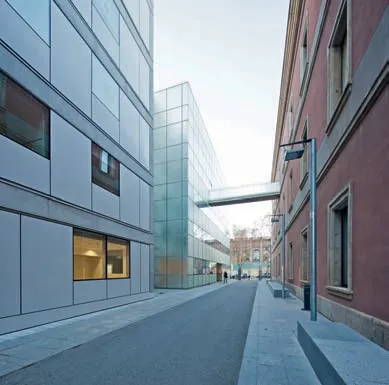
4 新建筑與前圣若梅軍營的主校園空間(位于右側)之間的步行街/The pedestrian street between the new buildings and the main campus space in the former barrack of Sant Jaume (on the right)(圖片來源/Sources: Eugeni Bach)
The spaces between the three buildings define two courtyards connecting the south-facing side of the site, that in front of the Ciutadella Park, to the pedestrian street that runs between the new constructions and the former barrack. One thin volume connects together two of the three buildings in the upper floors. It is placed along the pedestrian street, though slightly indented in regards to the buildings' fa?ades. However, it defines a continuous mass for the two buildings on this side, where all entrances to each building are positioned. This volume introduces a subtle asymmetry into the whole set. It contains circulation spaces and sews together the halls of the two buildings on each side,as it expands the public areas of each building, and also establishes a relation to the campus buildings placed across the pedestrian street. An open-air bridge links the new departments with the teaching spaces in the main campus area -the former barrack.
The halls and circulations areas of the three buildings are developed vertically, across the section of the new volumes, and organised around the two courtyards, as they supply light, ventilation and views towards the park to the common and public areas, including a small lecture theatre and other small teaching rooms placed in the basement of each building. In contrast to the austerity of the departmental spaces and offices, which act as a sort of background connecting with the urban fabric and the memories of the site, rich spatial exploration is concentrated in these courtyards, with vertical spaces running past all floors from the basement to the top, and slanted and curved fa?ades of transparent glass.
Moreover, constructive elements in these two courtyards have a special colourful presence that manifests with an intense freedom, in tension with the austere and raw materiality of the whole building mass of the new three volumes. These brilliant colourful elements in each courtyard act as solar protections for the fa?ades most exposed to sunlight, as they also animate halls and public areas of the new buildings, and create an exciting experience in these vertical spaces. They are big lasercut aluminium plates. In one courtyard these sheets are cut to the shape of the architect's ink-brush scrawls and painted red. In the other courtyard the plates are perforated with cuts in rhomboidal shapes, and the aluminium is painted green. These brilliant colours, therefore, are complementary,located next to Las Ramblas, in the historic quarter of the city, but also other unusual constructions like a former water tank which was transformed into the central library of the university. The reuse of this last building, located in front of the Ciutadella Park, was envisaged in connection to two adjacent blocks of military barracks, which were transformed into the university's main campus area. Actually, the whole area of the park itself was also a military place before it became a park during the World Fair held in the city in 1888, when the space was gained as a new public area for the city.
The project for the Universitat Pompeu Fabra by architect Juan Navarro Baldeweg sits within these successful interventions. It consists of a set of three connected buildings that are the outcome of a restricted competition for the whole site organised in 1996. Since then, the construction of the project has spanned over two decades, until the completion of the last building in 2016. The site is a large rectangular plot with one of its long sides facing the former barracks, earlier transformed into the main campus area. The other long flank, facing south, is open towards the green park of the Ciutadella.
The competition brief defined the details of the programme in the new buildings - department offices and spaces linked to the main campus area in the former barrack of Jaume I - and the massing of the area. Architects were required to demolish the three existing housing blocks on the site (which were raised in 1888 to serve for the barracks in front)due to their poor original construction and design.It was stipulated that all proposals must organise their built mass in three volumes while keeping the same height above ground as the existing buildings,so the new development could somehow keep part of the site's memory. At a more practical level: this tripartite division would allow the organisation of the construction work in clear stages, to be executed when funding becomes available.
Navarro Baldeweg deliberately designed three different buildings for the site that appear simple and align with the plot edges. They have discreet fa?ades in white, silver and grey colours.Their materiality, however, differs slightly for each building: glass, aluminium and concrete; as does the underlying tectonic and structural solution for each volume: one is defined as a clean glass fa?ade, another is wrapped in an aluminium sheet perforated with openings, and the last one seems to reveal its inner concrete grid in the elevation. All of them, though, manifest their respective constructive and they add a vibrant counterpoint to the palette materiality of untreated concrete and glass in the main surfaces of the new volumes.
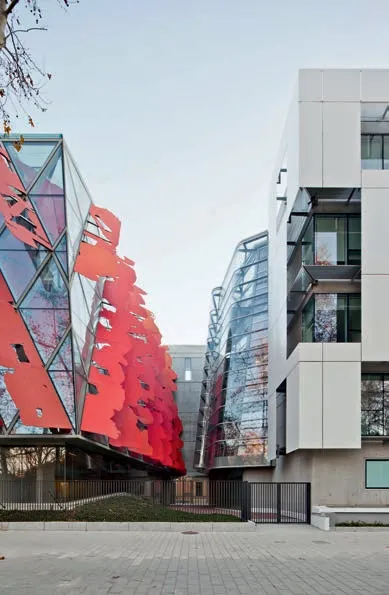
5 紅色庭院與圍繞其的垂直交通空間和大廳/The red courtyard and the vertical circulation spaces and halls around it
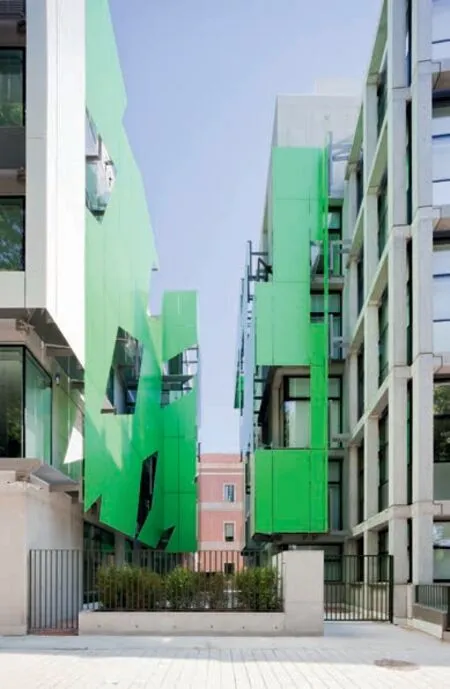
6 大學的院系大樓與帕斯夸爾·馬拉加利基金會(位于右側)之間的綠色庭院/The green courtyard between the university's department buildings and the Fundació Pasqual Maragall (on the right)

7 中央大樓的紅色庭院面向交通空間/The circulation spaces facing the red courtyard in the central building
The material and design composition by Navarro Baldeweg in these buildings evokes the famous paintings by Joan Miró, in which the painter casually articulates a series of hand-brushed lines,rope knots and bright coloured fabric elements upon a crude canvas. The whole composition is thus a set of simple elements joined together with an extreme economy of means to create an evocative and strong expressive piece. Similarly, this is what the architect achieves in his project in relation to the memories of the place and the site's uniqueness. The red aluminium plates in one of the courtyards, for example, are fixed upon the structure of the fa?ade,with half of their surface inside the building and half of it outside. This blurs the boundary between interior and exterior, and when sunlight hits the big plates, it casts a distinctive shadow that resembles that cast in a forest by the leaves of trees. Suddenly the user of the building becomes aware of the complementary green park across the street, which the view can reach through a window carefully placed with this aim.
The reference to Miró's compositions is explicit in the architect's report for the competition on a conference hall in Mallorca, a project in which many of these ideas are developed further. This insight reveals the architect's constant exploration of design through "complementary geometries",as well as his reflection on architecture like "the image in the tapestry" "the knot in a web", or a"box of resonance" in which "architecture is the instrument, but what matters is the music." Ideas that underpin the architect's work since his early stages at the MIT together with Gy?rgy Kepes, as is widely acknowledged in the existing bibliography on Navarro Baldeweg.
Beyond these ideas, however, the project for the Universitat Pompeu Fabra reveals Baldeweg's steady search to overcome the entrenched split between art, science and architecture of modernity. Indeed,if most modern architects concentrated in exploring the boundaries of the challenges posed by the use of new materials and constructive techniques -the machine- modern artists were rather inclined to rethink what is the organic essence of humankind,the psychological impacts of art, and how technique might mediate our most immediate perception.This tension is sublimated in Baldweg's work, as he tries to reconcile all these apparently divergent explorations into his architecture. This also prompts us to remember the ideas of Richard Neutra. Like the American architect, the project by Navarro Baldeweg in Barcelona reminds us of the role that technology and architecture play in mediating our relation with nature and the built environment. It is only through design that we, as human beings, and our cities, will survive and will keep memories alive as architecture regenerates degraded urban fabrics and continuously mediates their interpretation.□
注釋/Note
1)Restricted competition,即指對參賽者身份有所限制的競賽。

8 紅色庭院的地面花園朝向休塔德利亞公園/The ground garden in the red courtyard looking towards the Ciutadella park(圖片來源/Sources: Eugeni Bach)
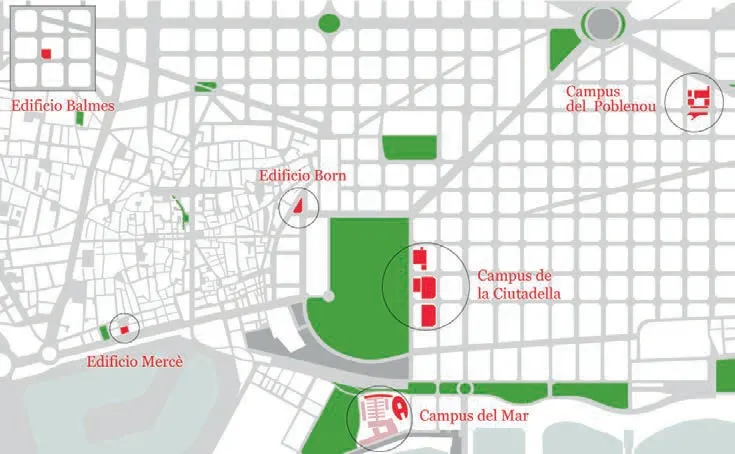
9 大學的建筑物在舊城中的分布,貧困區域得到了重建/University's buildings in the old city and deprived areas to be regenerated(圖片來源/Sources: Universitat Pompeu Fabra)

10 南立面/South elevation(圖片來源/Sources: Juan Navarro Baldeweg)
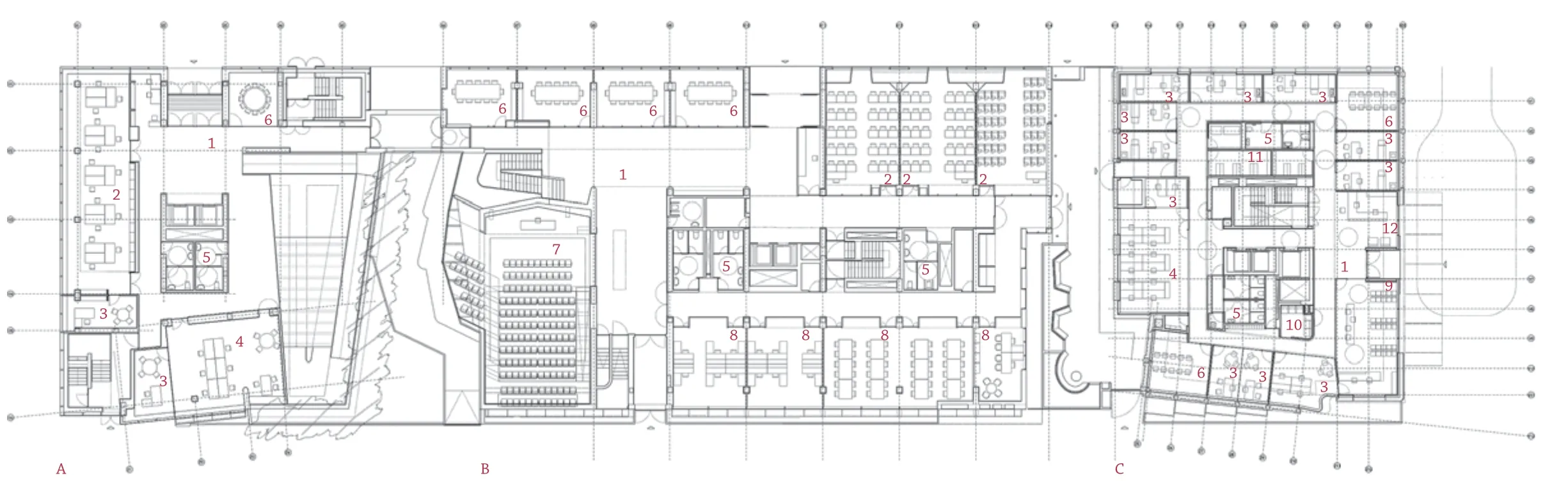
11 首層平面/Ground floor plan(圖片來源/Sources: Juan Navarro Baldeweg)A-龐培法布拉大學,梅爾塞·羅杜萊拉樓,惠靈頓38號/Universitat Pompeu Fabra, Mercè Rodoreda Building, Wellington 38 B-龐培法布拉大學,社會科學與人文館,惠靈頓32-36號/Universitat Pompeu Fabra, Social Sciences and Humanities, Wellington 32-36 C-帕斯夸爾·馬拉加利基金會,惠靈頓28-30號/Pasqual Margall Foundation, Wellington 32-36
猜你喜歡
北方建筑(2021年6期)2021-12-31 03:03:54
文苑(2020年10期)2020-11-07 03:15:36
學苑創造·A版(2020年10期)2020-11-06 05:21:26
現代裝飾(2020年6期)2020-06-22 08:43:12
現代裝飾(2020年4期)2020-05-20 08:55:08
作文周刊·小學一年級版(2016年27期)2017-06-03 23:21:17
絲綢之路(2016年9期)2016-05-14 14:36:33
新湘評論·下半月(2016年4期)2016-05-05 22:12:41
新湘評論·下半月(2016年4期)2016-05-05 22:12:41
海外文摘(2016年4期)2016-04-15 22:28:55