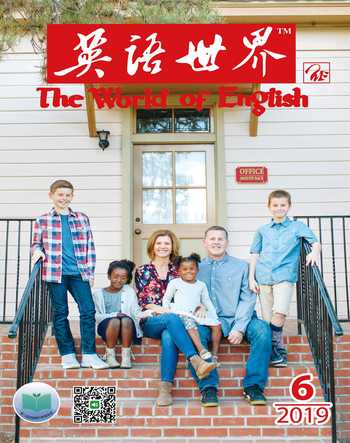
The Beauty of Adoption收養(yǎng)之美
2019-09-10 07:22:44瑪喬麗·赫希郝保偉
英語世界 2019年6期
瑪喬麗·赫希 郝保偉
If you were to form an opinion about adoption based on media coverage, you’d probably conclude that it was a mess. Babies snatched from ambivalent1 birth mothers. Crying toddlers2 ripped from their families by birth parents who changed their minds. Teenagers searching for their “real” parents and discarding their adoptive families like out-of-style clothes.
Those are the media images. They have little to do with the reality experienced by most adoptive families. Nevertheless, the media’s focus on “problems” posed by adoption encourages a very distorted view of a vital and wonderful institution. If you were part of an adoptive family, this is some of what you might hear:
“Do you have any REAL (or natural, or biological) children?” The answer is yes. Children who come into their families through adoption are real, natural, AND biological3. Language makes a difference. What should we call little people who become part of a family because of adoption? Simple. We should call them that family’s children.
“Who are their ‘real’ parents?” Say, what?4 We are the people who were sleep-deprived during their infancy. We are the people who paid for their braces5. We are the people who cry with them when things don’t go well. We are the people who live through their teenage years. If that isn’t “real” parenthood, what would you call it?
“You are so kind to have adopted a child.” You give us too much credit. Adoption is not charity. People adopt children because they want to have children, and adoption is one of the ways that children come into a family. We are not the United Way6. An act of charity, no matter how commendable7, normally takes place occasionally and at a distance. Parenting a child is up-close and personal. Our commitment to our children, like any other parents’, is total. It does not depend on sympathy, pity, or a desire to feel good.
“I couldn’t love an adopted child as much as one of my own.” Many people seem to believe that a genetic tie is necessary for a happy family. If that were so, presumably you would love your husband or wife much less than you love your brother or sister. After all, you have a direct genetic link to your siblings; you don’t, I hope, to your spouse.
This belief seems to underlie much of the media treatment of particular families. In reports of child abuse, for example, reporters seem to find it necessary to indicate if the perpetrator8 or the victim was adopted. Do they feel they’re helping to explain the tragedy? Is it that people with direct genetic ties would not ever hurt one another? Carefully-done studies show that adopted children, especially those adopted very young, are just as well-adapted, healthy, and smart as are non-adopted children. But some children become available for adoption because they were abused or neglected by their birth families, and even years of loving care may not cure the anger that was thus sown.
“I want a child who looks like me.” Chances are, you’ll be wrong at least half the time. “Looking like” is a matter of perception and expectation at least as much as physical reality. I couldn’t count the number of times I’ve been told that my tall, blond, blue-eyed oldest daughter looks like me. I’m small, brown-eyed, and brunette9. But we are mother and daughter; people expect us to resemble one another, and so they find the ways in which we do.
At some point, we will build up enough experience with birth parents who would rather not be “found” and with adopted children who discover that their birth parents have as many warts10 as their adoptive parents, that the situation will come into better balance.
“Adoption is expensive.” Is it ever. That’s a shame, though I understand why it’s so. Just as families do not grow their own babies for free—hospitals and doctors do send bills for their services, no matter what—licensed social workers and various other safeguards11, to make sure that these precious little lives are protected, cost money.
It’s not easy to convince some people of the beauty of adoption. There are some who go so far as to object to all adoptions, on the ground that12 adoption “breaks up families.” To all of them, let me say:
Adoption is not a problem. Adoption is a solution. There are people all over this country who would like to be parents, and who would be fine parents, but who are not able to grow babies. There are children all over this world who no longer have parents, or whose parents are unable to care for them. When these two get together, it is not a trauma13. It is not a minefield14. There’s a word for it. It’s called a family.
如果你對收養(yǎng)的看法來自于媒體報道,那你很可能認為這是件麻煩事:嬰兒被從內(nèi)心掙扎的生母身邊搶走;哭鬧的幼兒被決意反悔的親生父母從收養(yǎng)家庭帶走;十幾歲的孩子找尋“真正的”父母,將收養(yǎng)家庭像過時的衣物一樣拋棄。
上述是媒體刻畫的形象,與大多數(shù)收養(yǎng)家庭的實際經(jīng)歷幾乎毫不相關。然而,媒體對收養(yǎng)所帶來“問題”的關注使得人們對收養(yǎng)這一重要又美好的機制產(chǎn)生嚴重的誤解。如果你是收養(yǎng)方,你可能聽到過這些:
“你有真正的(親生的或有血緣的)孩子嗎?”答案是肯定的。通過收養(yǎng)進入家庭的孩子是真實的、自然的和有生命的。措辭很重要。通過收養(yǎng)而成為家庭一分子的小孩子,我們應該如何稱呼他們?很簡單,他們就是這家的孩子。
“誰是他們‘真正的’父母?”這是什么話?在他們的嬰兒期睡眠不足的是我們;為他們的牙套買單的是我們;遭遇不順時,與他們一起落淚的是我們;陪他們度過青少年時期的是我們。如果這都不算“真正的”為人父母,這又是什么呢?
“您能收養(yǎng)孩子真是太善良了。”過獎了。領養(yǎng)不是搞慈善。人們收養(yǎng)孩子是因為他們想要孩子,收養(yǎng)是孩子進入家庭的方式之一。我們不是聯(lián)合勸募協(xié)會。無論多么值得稱贊,慈善行為通常是偶爾為之且與己無關的。養(yǎng)育孩子則是跟自己密切相關的私人事務。與其他父母一樣,我們對孩子的付出是全身心的。收養(yǎng)靠的不是同情、憐憫或想自我滿足的欲望。
“我不能像愛自己的孩子那樣去愛收養(yǎng)的孩子。”很多人似乎認為,要想家庭幸福,血緣關系不可或缺。如果真是這樣,比起自己的丈夫或妻子,你大概會更愛自己的兄弟或姐妹吧。畢竟,你與兄弟姐妹是直系血親,跟配偶卻不是。
這種觀念似乎成了大眾傳媒描述特定家庭的基調(diào)。例如,在有關虐待兒童的報道中,記者們似乎認為有必要說明施害者或受害者是否屬于被收養(yǎng)人群。他們真的覺得自己在幫助人們解讀這類悲劇嗎?難道血親之間就不會互相傷害嗎?若干詳細的研究表明,領養(yǎng)的孩子,特別是年齡很小時就被領養(yǎng)的,與非領養(yǎng)的孩子一樣,適應性強,健康且聰明。但是有些孩子被收養(yǎng)是因為遭受親生父母的虐待或忽視,深埋在童年記憶中的憤怒即便此后多年的關愛可能也無法平息。
“我想要個看起來像我的孩子。”你可能至少錯了一半。 “看起來像”既是物質(zhì)現(xiàn)實問題,也是一種感知和期望。我的大女兒高個子、金發(fā)碧眼,經(jīng)常有人說她很像我。我呢,小個子,棕色眼睛,深褐色頭發(fā)。但我們是母女,人們覺得我們應該彼此相像,由此找出我們的一些相似之處。
有些親生父母不想被找到,收養(yǎng)的孩子也會發(fā)現(xiàn)親生父母和養(yǎng)父母一樣有諸多缺點,我們將與這樣的父母和孩子加強接觸,未來某個時候會積累到足夠的經(jīng)驗,使情況更平衡。
“領養(yǎng)很昂貴。”情況一直如此。雖然我理解其原因,但這確實令人遺憾。正如家庭不可能不花分毫地養(yǎng)育孩子——醫(yī)院和醫(yī)生會為他們的服務送上賬單——為確保這些寶貴的小生命受到保護,注冊社工和其他各種安全防護都得花錢。
讓有些人明白收養(yǎng)的美好之處并非易事。一些人甚至反對任何收養(yǎng),理由是收養(yǎng)“令家庭解體”。對于這些人,我想說:
領養(yǎng)不是問題。領養(yǎng)是問題的解決之法。這個國家到處都是想做父母的人,他們會是很好的父母,但卻無法生育。這個世界上到處都有失去父母或父母無力照顧的孩子。當這兩者相聚時,那既不是創(chuàng)傷,也不是雷區(qū)。有一個詞用來稱呼它——家。
(譯者為“《英語世界》杯”翻譯大賽獲獎選手)