I二次治療Graves甲亢對患者血清相關指標及甲減發生率的影響
2019-09-09 03:07:03陳正萍易吉秀凌冰趙莉蒲銀燕
中國醫藥導報
2019年18期
陳正萍 易吉秀 凌冰 趙莉 蒲銀燕

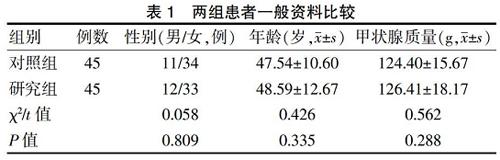

[摘要] 目的 探討131I二次治療Graves甲亢對患者血清相關指標及甲減發生率的影響。 方法 選擇2015年4月~2017年5月重慶市黔江中心醫院收治的Graves甲狀腺功能亢進癥患者90例,根據隨機數字表法分為對照組(45例)和研究組(45例)。對照組患者采用甲巰咪唑治療,研究組患者采用131I治療,兩組患者連續治療12個月。檢測并比較兩組治療前后血清促甲狀腺激素(TSH)、游離三碘甲狀腺原氨酸(FT3)、游離甲狀腺素(FT4)、甲狀腺刺激抗體(TSAb)、甲狀腺刺激阻斷性抗體(TSBAb)及促甲狀腺激素受體抗體(TRAb)水平。比較兩組治療后的甲狀腺功能減退發生率。 結果 兩組患者治療前血清TSH、FT3、FT4、TSAb、TSBAb及TRAb水平之間的差異無統計學意義(P > 0.05);與治療前比較,兩組患者治療后血清TSH水平明顯升高(P < 0.05),血清FT3、FT4、TSAb、TSBAb及TRAb水平均明顯降低(P < 0.05),而研究組患者治療后血清TSH高于對照組(P < 0.05),血清FT3、FT4、TSAb、TSBAb及TRAb水平低于對照組(P < 0.05)。研究組治療后的甲狀腺功能減退發生率與對照組比較,差異無統計學意義(P > 0.05)。 結論 131I二次治療Graves甲亢能夠明顯改善血清TSH、FT3、FT4、TSAb、TSBAb及TRAb水平,其甲狀腺功能減退發生率與甲巰咪唑治療相比無明顯差異。
[關鍵詞] Graves甲亢;131I;甲巰咪唑;甲減發生率
[中圖分類號] R581.1 ? ? ? ? ?[文獻標識碼] A ? ? ? ? ?[文章編號] 1673-7210(2019)06(c)-0061-04
Effect of 131I second treatment on serum related indexes and hypothyroidism rates in the treatment of Graves disease
CHEN Zhengping1 ? YI Jixiu2 ?LING Bing2 ? ZHAO Li2 ? PU Yinyan2
1.Department of Pharmacy, Chongqing Qianjiang Central Hospital, Chongqing ? 409000, China; 2.Department of Endocrine, Chongqing Qianjiang Central Hospital, Chongqing 409000, China
[Abstract] Objective To investigate the effect of 131I second treatment on serum related indexes and hypothyroidism rates in the treatment of Graves disease. Methods From April 2015 to May 2017, 90 patients with Graves disease treated in Chongqing Qianjiang Central Hospital were selected, according to the random number table method, they were divided into control group (n=45) and study group (n=45). The patients in the control group were treated with Methamazole, while the patients in the research group were treated with 131I. The patients of two groups were treated for 12 months. The serum thyroid stimulating hormone (TSH), free triiodothyronine (FT3), free thyroxine (FT4), thyroid stimulating an body (TSAb), thyroid stimulation-blocking antibody (TSBAb) and thyrotrophin receptor antibody (TRAb) of the two groups before and after treatment was compared. The hypothyroidism rates of the two groups after treatment was compared. Results There was no significant difference of the serum levels of TSH, FT3, FT4, TSAb, TSBAb and TRAb in the two groups before treatment (P > 0.05). After treatment, the serum TSH of the two groups was significantly higher than before treatment, the serum levels of FT3, FT4, TSAb, TSBAb and TRAb of the two groups were significantly lower than before treatment (P < 0.05); and the levels of serum TSH was higher than the control group after treatment, the levels of serum FT3, FT4, TSAb, TSBAb and TRAb in the study group were lower than the control group after treatment (P < 0.05). There was no significant difference in the incidence of hypothyroidism between the two groups after treatment (P > 0.05). Conclusion 131I in the second treatment of Graves disease can improve the serum levels of TSH, FT3, FT4, TSAb, TSBAb and TRAb, and the hypothyroidism rate between the 131I and Methamazole has no difference.
[Key words] Graves disease; 131I; Methamazole; Hypothyroidism rate
Graves甲亢,又稱毒性彌漫性甲狀腺腫,是由于體內甲狀腺細胞上的促甲狀腺激素(TSH)受體被TSH受體抗體(TRAb)而引起的甲狀腺功能亢進癥(簡稱“甲亢”),是導致機體消化、神經、內分泌、循環等多個系統代謝紊亂或損傷的一種慢性自身免疫性疾病[1]。Graves甲亢易復發,臨床對于復發的Graves甲亢患者多采用口服抗甲狀腺藥物治療和131I治療的措施[2]。口服抗甲狀腺藥物主要應用甲巰咪唑,避免了131I輻射暴露的風險,然而其療程較長,且復發率較高,藥物不良反應較多[3]。13……
登錄APP查看全文
猜你喜歡
中華詩詞(2022年6期)2022-12-31 06:41:24
中老年保健(2021年3期)2021-08-22 06:50:04
昆明醫科大學學報(2021年1期)2021-02-07 01:06:36
現代臨床醫學(2021年1期)2021-01-26 00:56:02
中華養生保健(2020年4期)2020-11-16 01:31:40
中西醫結合肝病雜志(2020年2期)2020-10-27 02:18:50
中國科技論壇(2017年7期)2017-07-25 08:49:53
媽媽寶寶(2017年2期)2017-02-21 01:21:24
國際漢語學報(2016年1期)2017-01-20 08:21:20
中國中醫藥現代遠程教育(2014年22期)2014-03-01 04:32:55