
喹硫平聯合顱磁刺激治療老年癡呆精神行為癥狀的臨床效果
2019-09-07 07:55:51王金東周田田陳曉芹王百靈崔維珍
中國醫藥導報
2019年17期
關鍵詞:效果
王金東 周田田 陳曉芹 王百靈 崔維珍
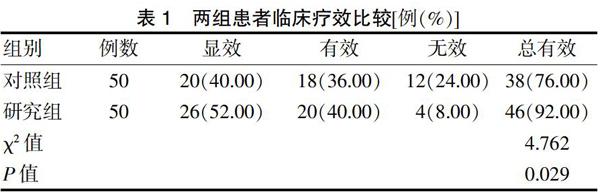

[摘要] 目的 探討喹硫平聯合顱磁刺激治療老年癡呆精神行為癥狀的臨床效果。 方法 選取2012年10月~2018年6月青島市精神衛生中心接收的老年性癡呆伴有不同程度精神行為癥狀患者100例,采用隨機數字表法分為對照組(50例)和研究組(50例),對照組與研究組均給予常規治療,其中對照組給予喹硫平治療,研究組在對照組的基礎上采用重復經顱磁刺激治療,連續治療12周。評價并比較兩組的臨床療效,比較兩組患者治療前后的認知功能(MoCA)、生活能力(ADL)、智力狀態(SIL)及精神行為癥狀(NPI),比較兩組患者治療期間的不良反應發生情況。 結果 研究組的臨床總有效率為92.00%,明顯高于對照組的76.00%,差異有統計學意義(P < 0.05);治療后兩組MoCA、SIL評分均高于治療前,且研究組高于對照組,差異有統計學意義(P < 0.05);治療后兩組ADL、NPI評分均低于治療前,且研究組低于對照組,差異有統計學意義(P < 0.05);兩組不良反應發生率比較差異無統計學意義(P > 0.05)。 結論 喹硫平聯合顱磁刺激治療老年癡呆精神行為癥狀臨床效果確切,可明顯改善患者的精神行為癥狀、認知功能、智力狀態及生活能力,安全性較高,為臨床治療提供參考。
[關鍵詞] 喹硫平;顱磁刺激;老年癡呆;精神行為癥狀;效果
[中圖分類號] R749.16? ? ? ? ? [文獻標識碼] A? ? ? ? ? [文章編號] 1673-7210(2019)06(b)-0046-04
Clinical effect of Quetiapine combined with cranial magnetic stimulation on psychobehavioral symptoms of senile dementia
WANG Jindong1? ?ZHOU Tiantian1? ?CHEN Xiaoqin2? ?WANG Bailing1? ?CUI Weizhen1
1.Department of Geriatrics, Qingdao Mental Health Center, Shandong Province, Qingdao? ?266034, China; 2.Department of Material Dependence, Qingdao Mental Health Center, Shandong Province, Qingdao? ?266034, China
[Abstract] Objective To study the clinical effect of Quetiapine combined with transcranial magnetic stimulation in the treatment of mental and behavioral symptoms of senile dementia. Methods From October 2012 to June 2018, 100 patients of senile dementia with different degrees of mental and behavioral symptoms who were treated in Qingdao Mental Health Center were selected. They were divided into control group (50 cases) and study group (50 cases) by random number table method. Patients in both groups were given conventional treatment, the control group was treated with Quetiapine, and the study group was treated with repetitive transcranial magnetic stimulation on the basis of control group, both two groups were treated for 12 weeks. The clinical efficacy of the two groups was evaluated and compared. The cognitive function (MoCA), life ability (ADL), intelligence state (SIL) and mental and behavioral symptoms (NPI) of the two groups before and after treatment was compared. The adverse reactions of the two groups during treatment were compared. Results The total clinical effective rate was 92.00% in the study group, which was significantly higher than 76.00% in the control group, the difference was statistically significant (P < 0.05). After treatment, the scores of MoCA and SIL in the two groups were higher than those before treatment, and the study group was higher than that in the control group, the differences were statistically significant (P < 0.05). After treatment, the scores of ADL and NPI in the two groups were lower than those before treatment, and the study group was lower than that in the control group, the differences were statistically significant (P < 0.05). There was no statistically difference in the incidence of adverse reactions between the two groups (P > 0.05). Conclusion Quetiapine combined with transcranial magnetic stimulation is effective in the treatment of mental and behavioral symptoms of senile dementia. It can significantly improve the mental and behavioral symptoms, cognitive function, intelligence state and living ability of the patients. It has a high security, and it can provide a reference for clinical treatment.
[Key words] Quetiapine; Transcranial magnetic stimulation; Senile dementia; Mental and behavioral symptoms; Effect
老年癡呆是一種神經系統退行性疾病,有起病隱匿和進行性發展的特點[1]。臨床上常有記憶、語言、執行功能障礙及精神行為異常等表現,嚴重影響患者日常生活[2]。隨著我國人口老齡化的加深,其發生率逐年遞增,目前患病人數已超過800萬,其病情也會隨著患者年齡的增長而加重,給社會和患者家庭帶來沉重的負擔[3]。目前臨床上常采用經典抗精神藥或膽堿酯酶抑制劑等治療,但患者易出現心律不齊、錐體外系癥狀等不良反應,安全性不佳。……
登錄APP查看全文
猜你喜歡
中老年保健(2021年12期)2021-11-30 02:58:01
好日子(2021年8期)2021-11-04 09:02:46
小學生學習指導(爆笑校園)(2020年6期)2020-07-03 10:01:10
攝影之友(影像視覺)(2019年2期)2019-03-05 08:27:14
攝影之友(影像視覺)(2018年12期)2019-01-28 09:01:02
攝影之友(影像視覺)(2018年12期)2019-01-28 09:01:02
中華詩詞(2018年11期)2018-03-26 06:41:34
小學生學習指導(低年級)(2017年11期)2017-10-23 01:32:36
Coco薇(2016年8期)2016-10-09 02:11:50
中國醫藥科學(2015年19期)2015-02-27 12:33:11
