
Spectral properties of Pr:CNGG crystals grown by micro-pulling-down method?
2019-08-16 01:20:46YanYanXue薛艷艷NaLi李納DongHuaHu胡冬華QingSongSong宋青松XiaoDongXu徐曉東DongHaiWang王東海QingGuoWang王慶國DongZhenLi李東振ZhanShanWang王占山andJunXu徐軍
Chinese Physics B 2019年8期
Yan-Yan Xue(薛艷艷), Na Li(李納), Dong-Hua Hu(胡冬華), Qing-Song Song(宋青松),Xiao-Dong Xu(徐曉東),?, Dong-Hai Wang(王東海), Qing-Guo Wang(王慶國),Dong-Zhen Li(李東振), Zhan-Shan Wang(王占山), and Jun Xu(徐軍),?
1School of Physics Science and Engineering,Institute for Advanced Study,Tongji University,Shanghai 200092,China
2Jiangsu Key Laboratory of Advanced Laser Materials and Devices,School of Physics and Electronic Engineering,Jiangsu Normal University,Xuzhou 221116,China
Keywords: Pr:CNGG,μ-PD method,spectral properties
1. Introduction
The trivalent praseodymium ion (Pr3+) has been widely studied in the past few years due to the rich emission spectrum in ultraviolet, visible, and infrared regions.[1-3]The first Prbased laser output was achieved in CaWO4crystal,operating at 1.047 μm.[4]After that, blue light emission was realized in Pr:LiYF4crystal by using a pulsed dye laser.[5]With the development of GaN/InGaN laser diodes (LDs), the research process of the Pr3+-doped materials has been promoted. So far,Pr3+-doped hosts,such as crystals[6-8]and glasses,[9]have been widely investigated.
The CNGG crystal belongs to the cubic phase (Ia3d)garnet-type structure, which is the representative disordered crystal. It is characterized by low melting point (about 1460°C) in comparison with other garnet crystals, and excellent mechanical and thermal properties in comparison with glasses.[10]In addition,the random distribution of Nb5+,Ga3+and cationic vacancies in the host lattices cause the spectra of the doped rare-earth ions to significantly inhomogeneously broaden,[11]which makes it possible to produce ultra-short pulses. Up to now, a large number of research focuses on rare ion-doped CNGG crystals.[12-15]Nevertheless, only one paper reported the crystal growth and structural properties of Pr:CNGG crystal,[16]but the spectral properties were not mentioned in detail,to the best of our knowledge.
The μ-PD method allows the direct growing of fibershaped single crystals with a diameter as low as 300μm,and it has many advantages over the conventional crystal growth methods, such as fast growth rate, low cost, and controllable crystal shape. So the μ-PD method is a promising method of growing gain media for miniature lasers.
In this paper,we grow the Pr:CNGG single crystals by theμ-PD method. The crystal structure, room-temperature spectral properties and lifetimes of Pr:CNGG crystals are measured and discussed in detail.
2. Experimental details
2.1. Crystal growth
The CNGG single crystals doped with 0.5, 1.0, and 2.0 at.%Pr3+were successfully grown by the μ-PD method.The CaCO3,Nb2O5,Ga2O3,and Pr6O11powders with a purity of 99.999%were prepared as starting materials and weighted according to the formula Ca3Nb1.6875Ga3.1875O12.The Pr6O11powders were doped together with additional Ga2O3in a ratio of 3:5(mol%)to form Pr3Ga5O12.[17]Pr-doping as a garnet phase is important to maintain garnet composition in melt.The powders were well mixed and pressed into bulks,then sintered at 1300°C for 12 h in a muffle furnace with air atmosphere in order to react completely. The polycrystalline material was melted within a platinum crucible, and then passed through the micro-nozzle at the bottom of the crucible with a pulling rate of 0.5 mm/min. The growth direction was along the〈111〉orientation. The as-grown Pr:CNGG single crystals with an average diameter of about 2 mm is shown in Fig.1. The crystals were transparent and had a little yellow color, changing from light to deep with the increase of Pr3+concentration.
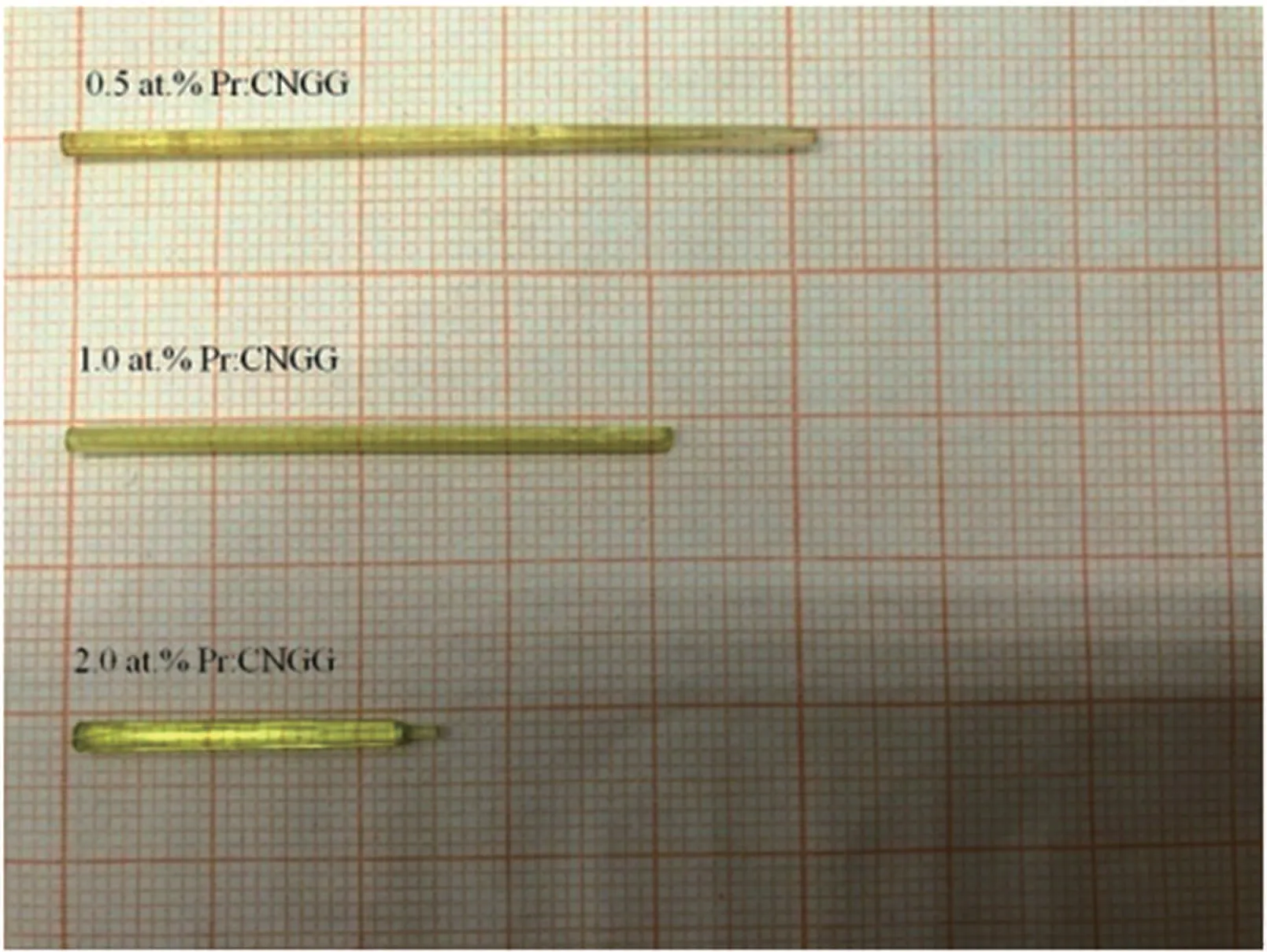
Fig.1. As-grown Pr:CNGG single crystals.
2.2. Characterizations
To identify the structure of the grown Pr:CNGG crystals, the x-ray diffraction (XRD) analysis was carried out in the 2θ ranging from 10°to 90°using an automated Ultima IV diffractometer(Cu target,Kα,Rigaku,Japan)with a scan width of 0.014°at room temperature. Samples with a thickness of 1.07 mm were cut perpendicularly to the growth orientation 〈111〉 and their faces were optically polished for the spectroscopic measurements. The absorption spectra with a resolution of 1 nm were measured from 400 nm to 2500 nm by a spectrophotometer(Cary5000,UV-VIS-IR).The fluorescence spectra and decay curves of the crystals were obtained by an FLS980 fluorescence spectrometer (Edinburgh Company, England). The exciting source was a xenon lamp. All the measurements were carried out at room temperature.
3. Results and discussion
3.1. XRD pattern
The samples are cut from the as-grown crystals and grounded into powder for XRD measurement. Figure 2 shows the XRD patterns of Pr:CNGG crystals. The diffraction peak positions and relative intensity of samples are in good agreement with those of the undoped CNGG crystal and ICSD Card No. 261821,[18]and no other phase is found in the lattice structure after Pr3+ions have been doped into CNGG crystals, which implies that the Pr:CNGG crystals have the same crystallographic structure as pure CNGG crystal and belong to the cubic phase(Ia3d)garnet-type structure.
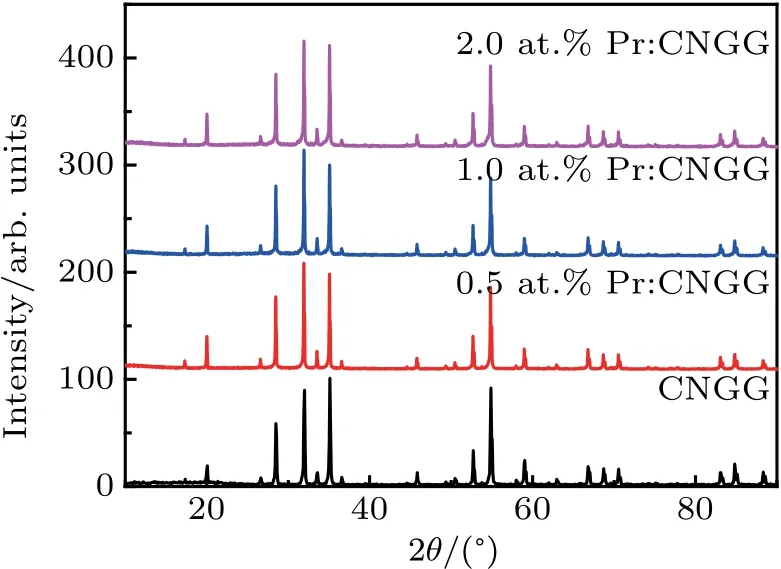
Fig.2. XRD patterns of Pr:CNGG crystals.
3.2. Spectral properties
Figure 3 shows the absorption spectra of the Pr:CNGG crystals with different dopant concentrations in the range of 420 nm-620 nm and 1200 nm-2500 nm.The absorption spectra consist of seven prominent absorption bands, which correspond to the transitions from ground state3H4to excited states3P2,3P1+1I6,3P0,1D2,3F3+3F4,3F2,and3H6,respectively. The absorption coefficients of 0.5, 1.0, and 2.0 at.%Pr:CNGG crystals at 449 nm are 1.26 cm-1, 2.88 cm-1, and 4.80 cm-1, respectively. The full widths at half-maximum(FWHMs)of the absorption peak at 449 nm for different concentrations are similar, which is about 7 nm. The full width at half-maximum(FWHM)of Pr:CNGG crystal is larger than that of Pr:LiLuF4(1.7 nm),[19]Pr:LiYF4(1.8 nm),[19]and Pr:LaF3(5 nm),[20]which makes Pr:CNGG crystal more suitable to be pumped by the GaN/InGaN LD.
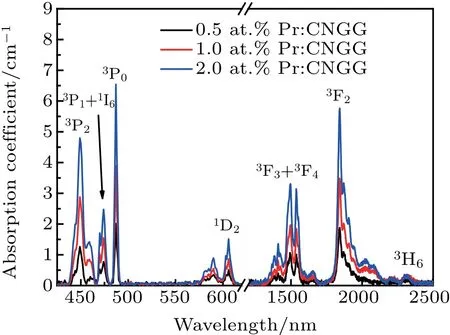
Fig.3. Absorption spectra of Pr:CNGG crystals.
The fluorescence spectra of the Pr:CNGG crystals in the visible range under excitation at 449 nm and in the nearinfrared(NIR)range under excitation at 606 nm are presented in Fig.4. The emission bands in the visible range mainly correspond to the transition from3P0and1D2energy level to lower levels. In the NIR range, there are two intensive fluorescence bands centered at 824 nm and 1082 nm,corresponding to the transitions from excited state1D2to3H6+3F2and3F3+3F4,respectively.
Obvious differences could be found when the doping concentration of Pr3+increases from 0.5 at.%to 2.0 at.%. Firstly,0.5-at.% Pr:CNGG crystal shows a larger fluorescence ratio of1D2→3H4and1D2→3H5transition centered at 606 nm and 632 nm than other Pr:CNGG crystals with higher Pr3+concentration. There are two kinds of cross relaxation processes between Pr3+ions[21]in Pr:CNGG crystal as shown in Fig. 5. The populations accumulate on the1D2energy level by the multi-phonon relaxation from3P0energy level and the cross relaxation between3P0→1D2and3H4→3H6(CR1).As the Pr3+concentration increases,the cross relaxation between1D2→1G4and3H4→3F4(CR2) increases, resulting in the fluorescence quenching of1D2energy level. Thus, 0.5-at.%Pr:CNGG crystal shows relatively large fluorescence ratio of emission bands centered 606 nm and 632 nm, derived from the transition of1D2energy level. The result of multi-phonon relaxation and CR1 is that the fluorescence intensity centered at 617 nm, corresponding to the transition from3P0to3H6,is very weak. The most intensive fluorescence band of 2.0-at.% Pr:CNGG crystal is centered at 654 nm in the red spectral region.A similar phenomenon has been reported in Pr3+-doped phosphate glasses.[21]Secondly,1.0-at.%and 2.0-at.%Pr:CNGG crystals show similar fluorescence ratios in the NIR range. The FWHMs of the fluorescence bands centered at 606 nm and 654 nm are both about 7 nm, which are larger than that of Pr:LiLuF4, Pr:LiYF4,[19]and Pr:YAlO3.[22]The FWHM of the emission band centered at 1082 nm is about 41 nm, indicating that a tunable and ultrafast laser around 1082 nm may be realized in Pr:CNGG crystal.

Fig.4. Fluorescence spectra of the Pr:CNGG crystals in the visible and NIR range.
The fluorescence decay curves at 606 nm corresponding to the1D2energy level,under excitation at 449 nm are shown in Fig.6. The fluorescence lifetime of the1D2energy level in the 0.5, 1.0, and 2.0-at.% Pr:CNGG crystals are estimated at 47.52μs,37.63μs,and 26.24μs,which are smaller than that of 0.5% Pr:YAG (110 μs),[23]1% Pr:GGG (118 μs),[24]but larger than that of 1% Pr:YAP (28 μs).[25]The fluorescence lifetime decreases from 47.52 μs to 26.24 μs when the doping concentration of Pr3+increases from 0.5 at.%to 2.0 at.%,which is mainly due to the depopulation of the1D2level,caused by CR2 as shown in Fig.5 and concentration quenching effect.[26,27]
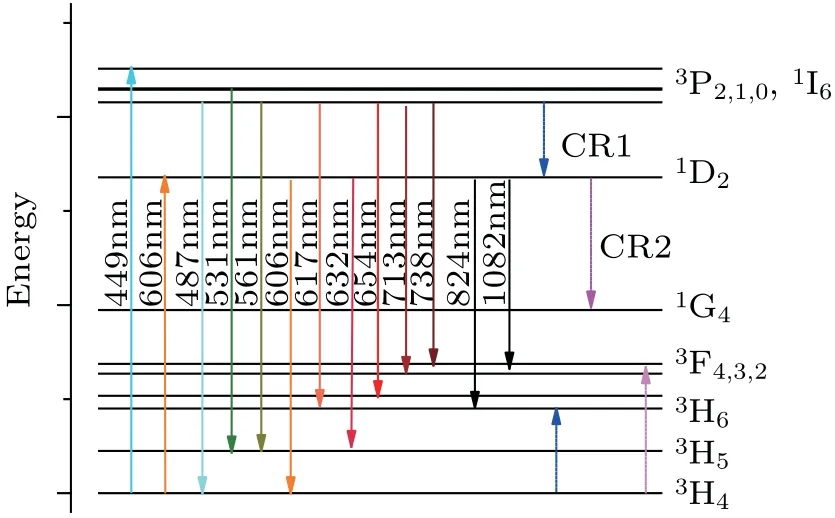
Fig.5. Simple diagram of energy configuration of Pr3+ in CNGG crystal and cross relaxation processes.
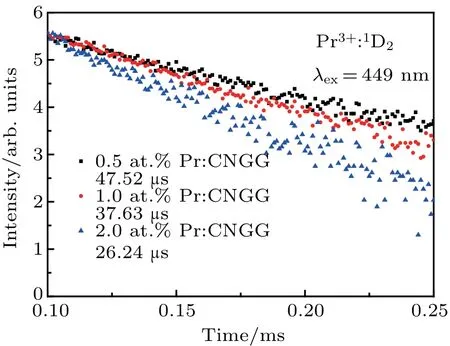
Fig. 6. Intensity decaying with time of 1D2 energy level of Pr:CNGG crystals.
4. Conclusions
The CNGG crystals doped with 0.5-, 1.0-, and 2.0-at.%Pr3+ions are successfully grown by the μ-PD method. The doping of Pr3+does not influence the lattice structure of CNGG. The spectral properties are studied at room temperature. The Pr:CNGG crystals have higher absorption coefficient and broader absorption band width at 449 nm,which are suitable for LD pumping. For the 0.5-at.%Pr:CNGG crystal,the orange emission band at 606 nm is more marked while the most intensive fluorescence band of 2.0-at.%Pr:CNGG crystal is centered at 654 nm in the red spectral region. In the NIR range,1.0-at.%and 2.0-at.%Pr:CNGG crystals exhibit similar fluorescence ratios. The room temperature fluorescence lifetimes of1D2energy level are fitted to be 47.52μs, 37.63μs,and 26.24 μs for 0.5-, 1.0-, and 2.0-at.% Pr:CNGG crystals,respectively. Results of this work demonstrate that Pr:CNGG crystal owes good spectral properties and may be a potential candidate for solid-state laser operation.

- Chinese Physics B的其它文章
- Exploring alkylthiol additives in PBDB-T:ITIC blended active layers for solar cell applications?
- Study on the nitridation of β-Ga2O3 films?
- Thin-film growth behavior of non-planar vanadium oxidephthalocyanine?
- Monolithic semi-polar(1ˉ101)InGaN/GaN near white light-emitting diodes on micro-striped Si(100)substrate?
- Quaternary antiferromagnetic Ba2BiFeS5 with isolated FeS4 tetrahedra
- Effects of oxygen vacancy concentration and temperature on memristive behavior of SrRuO3/Nb:SrTiO3 junctions?