不同飼養(yǎng)方式對雛鵝夜間采食行為的影響
2019-07-29 03:24:36何航熊子標(biāo)首雅瀟謝清謝和芳
中國農(nóng)業(yè)科學(xué) 2019年13期
何航,熊子標(biāo),首雅瀟,謝清,謝和芳
不同飼養(yǎng)方式對雛鵝夜間采食行為的影響
何航1,2,熊子標(biāo)1,首雅瀟1,謝清1,謝和芳1
(1西南大學(xué)動物科學(xué)學(xué)院,重慶 402460;2重慶三峽職業(yè)學(xué)院動物科技學(xué)院,重慶 404155)
探究兩種飼養(yǎng)方式對0—3周齡雛鵝夜間采食行為的影響,分析夜間采食行為與生產(chǎn)性能的關(guān)系,以期為生產(chǎn)中安排飼喂模式提供參考。將120只體重基本一致((97.78±2.67)g)的1日齡四川白鵝隨機(jī)分為兩組(公母各半),即網(wǎng)上平養(yǎng)(net rearing,NR)組和地面平養(yǎng)(floor rearing,F(xiàn)R)組,每組設(shè)6個重復(fù),每個重復(fù)10只鵝。試驗于2016年8月在西南大學(xué)畜禽養(yǎng)殖基地進(jìn)行,試驗期共21 d,平均溫度為(28.72±2.16)℃,相對濕度為(85.76±8.73)%。參照美國NRC(1994)鵝的營養(yǎng)需要配制日糧,代謝能為11.97 MJ·kg-1,粗蛋白質(zhì)含量為20.43%,試驗期自由采食和飲水。記錄日采食量,于7、14和21日齡稱重,參照中華人民共和國農(nóng)業(yè)行業(yè)標(biāo)準(zhǔn)-家禽生產(chǎn)性能名詞術(shù)語和度量統(tǒng)計方法(NY/T 823-2004)測定試驗期平均日采食量、平均日增重和料重比;在試驗結(jié)束前3d,利用紅外高清監(jiān)控攝像系統(tǒng)進(jìn)行錄像采集,將視頻采集后,利用視頻軟件,參照雞和小鼠夜間行為觀察的方法加以改進(jìn),每間隔10 min設(shè)定為一個視頻段,共72個視頻段,重復(fù)觀察鵝的夜間采食行為,觀察時間為18:00至次日6:00,記錄鵝夜間采食行為時間。NR組平均每只鵝夜間采食行為持續(xù)時間為19.07 min,F(xiàn)R組平均每只鵝夜間采食行為持續(xù)時間14.26 min,二者間差異極顯著(<0.01)。兩種飼養(yǎng)方式下雛鵝初始體重差異不顯著(>0.05),NR組鵝末重顯著高于FR組(<0.05),NR組平均日采食量極顯著高于FR組(<0.01),平均日增重顯著高于FR組(<0.05),料重比二者間差異不顯著(>0.05)。對夜間采食行為持續(xù)時間與生產(chǎn)性能相關(guān)性分析可知,NR組夜間采食行為持續(xù)時間與平均日采食量呈顯著正相關(guān)(=0.796,<0.05),與平均日增重也呈顯著正相關(guān)(=0.807,<0.05),與料重比呈顯著負(fù)相關(guān)(=-0.816,<0.05);FR組夜間采食行為持續(xù)時間與平均日采食呈極顯著正相關(guān)(=0.950,<0.01),與平均日增重呈顯著正相關(guān)(=0.801,<0.05),與料重比之間沒有顯著相關(guān)性(=-0.573,>0.05)。通過建立夜間采食行為持續(xù)時間與生產(chǎn)性能間回歸方程可知,NR組平均日采食量1(g·d-1)、平均日增重2(g·d-1)和料重比3與夜間采食行為持續(xù)時間1(min/12h)的回歸方程分別為:1=-222.70+29.961-0.7821(2=0.956,=0.009)、2=6.73+1.461(2=0.650,=0.043)、3=2.83-0.051(2=0.654,=0.050);由于FR組料重比與夜間采食行為持續(xù)時間之間沒有顯著相關(guān)性,固不能建立回歸方程。因此,F(xiàn)R組平均日采食量4(g·d-1)、平均日增重5(g·d-1)與夜間采食行為持續(xù)時間2(min/12h)的回歸方程分別為:4=-10.10+4.132(2=0.904,=0.004)、5=-39.82+4.832(2=0.644,=0.045)。兩種飼養(yǎng)方式下,NR組鵝夜間采食行為持續(xù)時間高于FR組,且夜間采食行為的增加提高了鵝的生產(chǎn)性能。因此,建議生產(chǎn)中采用網(wǎng)上育雛方式,同時要保證夜間飼糧的供應(yīng),滿足雛鵝的夜間采食活動。
飼養(yǎng)方式;鵝;夜間采食行為
0 引言
【研究意義】動物的采食活動是其生存的基本活動之一,與動物的生長有緊密聯(lián)系[1-2]。探究不同飼養(yǎng)方式對動物夜間采食行為的影響,分析夜間采食行為與生產(chǎn)性能的關(guān)系,對生產(chǎn)過程中合理安排飼喂模式具有重要意義。【前人研究進(jìn)展】影響動物采食的因素較多[3-4],關(guān)于飼養(yǎng)方式對動物采食的影響報道差異較大。有研究發(fā)現(xiàn),飼養(yǎng)方式對動物的采食行為存在顯著影響[5-6]。散養(yǎng)蛋雞采食行為發(fā)生次數(shù)顯著低于籠養(yǎng)蛋雞[7]。Kabir肉雞在傳統(tǒng)飼養(yǎng)系統(tǒng)下總的采食行為持續(xù)時間要顯著低于有機(jī)飼養(yǎng)系統(tǒng)[8]。火雞在放養(yǎng)模式下,其采食行為持續(xù)時間顯著高于限養(yǎng)模式[9]。但也有研究表明飼養(yǎng)方式對采食行為無顯著影響,CHOW等[10]的研究發(fā)現(xiàn),緬甸紅野雞在籠養(yǎng)與散養(yǎng)條件下,其采食行為發(fā)生次數(shù)差異不顯著。ROLL等[11]研究表明,籠養(yǎng)和地面平養(yǎng)蛋雞的采食行為持續(xù)時間差異不顯著。【本研究切入點】目前,關(guān)于鵝的采食行為研究較少,梁艷娟等[12]報道稱,鵝有夜間采食的習(xí)慣。育雛階段是家禽生長過程中的關(guān)鍵時期,對后期生長有重要影響。但關(guān)于不同飼養(yǎng)方式下雛鵝夜間采食行為及其與生產(chǎn)性能的關(guān)系尚未見報道。【擬解決的關(guān)鍵問題】本試驗以0—3周齡雛鵝為對象,研究不同飼養(yǎng)方式對雛鵝夜間采食行為的影響,分析夜間采食行為與生產(chǎn)性能的關(guān)系,旨在為生產(chǎn)中是否保證雛鵝夜間采食提供基礎(chǔ)數(shù)據(jù)。
1 材料與方法
試驗于2016年8月在西南大學(xué)畜禽養(yǎng)殖基地進(jìn)行,試驗期平均溫度為(28.72±2.16)℃,相對濕度為(85.76±8.73)%。
1.1 試驗設(shè)計及飼養(yǎng)管理
選擇1日齡,體重為(97.78±2.67)g的四川白鵝120只,公母各60只,將公母鵝分別隨機(jī)分為網(wǎng)上平養(yǎng)(net rearing,NR)和地面平養(yǎng)(floor rearing,F(xiàn)R)兩個組,每組6個重復(fù),每個重復(fù)10只鵝,重復(fù)內(nèi)公母各半。每重復(fù)試驗鵝飼養(yǎng)面積均為3.5 m×3.0 m。其中,網(wǎng)上平養(yǎng)為鐵條材質(zhì),地面平養(yǎng)為水泥地板材質(zhì),整個圈舍為磚混結(jié)構(gòu),每個圈舍外有3.5 m×4.0 m的運動場。NR組和FR組均安裝有2個食槽和2個飲水槽,試驗日糧參照美國NRC(1994)鵝的營養(yǎng)需要配制[13],飼糧組成及營養(yǎng)水平見表1。試驗開始前對鵝舍全面消毒,以后每周用百毒殺消毒一次,試驗期自由采食和飲水,用紅外保溫?zé)暨M(jìn)行保溫,按照常規(guī)免疫程序免疫。
1.2 測定指標(biāo)
1.2.1 夜間采食行為持續(xù)時間 行為錄像采集前,在每個圈舍上方2.5 m處安裝1臺紅外高清攝像頭(海康威視DS-2CD3310D-I,杭州海康威視數(shù)字技術(shù)有限公司),用于采集鵝的行為。參照呂敏思[14]、卞宏生[15]觀察雞和小鼠夜間行為的方法加以改進(jìn),在試驗結(jié)束前3 d,采集鵝在18:00至次日6:00的采食行為,利用視頻軟件(VSPalyer V7.2.0,杭州海康威視數(shù)字技術(shù)有限公司)每間隔10 min設(shè)定為一個視頻段,共72個視頻段。在觀察錄像時,按重復(fù)記錄鵝只在12 h內(nèi)的采食行為持續(xù)時間,最后以12 h內(nèi)采食行為持續(xù)時間除以重復(fù)內(nèi)鵝只數(shù)進(jìn)行統(tǒng)計。
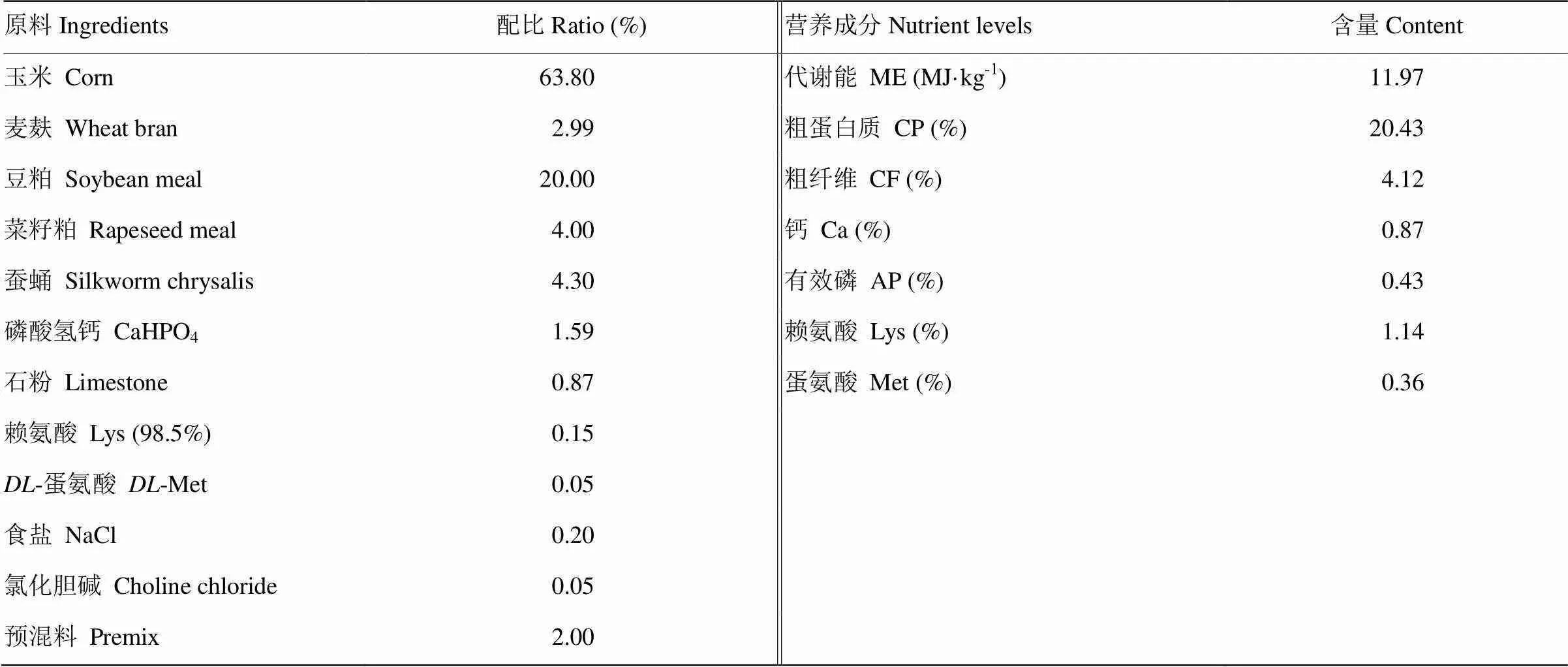
表1 試驗飼糧組成及營養(yǎng)水平(風(fēng)干基礎(chǔ))
預(yù)混料為每千克飼糧提供:維生素A 2000 IU,維生素D31000 IU,維生素E 3000 mg,維生素K3200 mg,維生素B1100 mg,維生素B21200 mg,維生素B6200 mg,維生素B122.5 mg,煙酸600 mg,泛酸1800 mg,葉酸200 mg,生物素20 mg,鐵 6 g,銅0.2 g,錳15 g,鋅8 g,碘10 mg,硒30 mg
The premix provide the following per kg of diets: VA 2000 IU, VD31000 IU, VE 3000 mg, VK3200 mg, VB1100 mg, VB21200 mg, VB6200 mg, VB122.5 mg, nicotinic acid 600 mg, pantothenic acid 1800 mg, folic acid 200 mg, biotin 20 mg, Fe 6 g, Cu 0.2 g, Mn 15 g, Zn 8 g, I 10 mg, Se 30 mg
1.2.2 生產(chǎn)性能指標(biāo) 參照農(nóng)業(yè)行業(yè)標(biāo)準(zhǔn)(NY/T 823—2004)[16]測定生產(chǎn)性能。以重復(fù)為單位,每天早上第一次喂料前記錄耗料量;試驗第0、7、14、21天早上對每只鵝空腹稱重,以重復(fù)為單位計算平均日采食量、平均日增重和料重比。
平均日采食量(g·d-1)=總采食量/(每重復(fù)鵝只數(shù)×試驗天數(shù));
平均日增重(g·d-1)=總增重/(每重復(fù)鵝只數(shù)×試驗天數(shù));
料重比(F/G)=平均日采食/平均日增重。
1.3 統(tǒng)計分析
數(shù)據(jù)經(jīng)Excel 2010初步整理后,用SPSS 22.0統(tǒng)計分析軟件中Independent Samples T-test 程序作檢驗,用Excel軟件作圖,試驗結(jié)果以“平均數(shù)±標(biāo)準(zhǔn)差”表示。
2 結(jié)果
2.1 飼養(yǎng)方式對夜間采食行為持續(xù)時間的影響
從圖1可以看出,NR組平均每只鵝夜間采食行為持續(xù)時間極顯著高于FR組(<0.01)。
2.2 夜間采食行為持續(xù)時間與生產(chǎn)性能相關(guān)性分析
兩種飼養(yǎng)方式下雛鵝的生產(chǎn)性能列于表2。由表2可知,兩種飼養(yǎng)方式下雛鵝初始體重和料重比差異不顯著(>0.05),NR組鵝末重和平均日增重顯著高于FR組(<0.05),NR組鵝平均日采食量極顯著高于FR組(<0.01)。夜間采食行為持續(xù)時間與生產(chǎn)性能的相關(guān)分析結(jié)果列于表3。由表3可知,NR組鵝夜間采食行為持續(xù)時間與平均日采食量和平均日增重呈顯著正相關(guān)(<0.05),與料重比呈顯著負(fù)相關(guān)(<0.05)。FR組鵝夜間采食行為持續(xù)時間與平均日采食量呈極顯著正相關(guān)(<0.01),與平均日增重呈顯著正相關(guān)(<0.05),但與料重比之間沒有顯著相關(guān)性(>0.05)。
2.3 夜間采食行為與生產(chǎn)性能回歸分析
夜間采食行為持續(xù)時間與生產(chǎn)性能之間的回歸方程列于表4。從表4可知,F(xiàn)R組夜間采食行為持續(xù)時間與料重比之間沒有顯著相關(guān)性,故二者不存在回歸關(guān)系。對表4中5個回歸方程進(jìn)行顯著性檢驗可知,方程的回歸關(guān)系均顯著(≤0.05)。通過分析可知,隨著夜間采食行為持續(xù)時間的增大,平均日采食量和平均日增重均增大,料重比則減小。

圖1 平均每只鵝夜間采食時間(n=6)
3 討論
3.1 飼養(yǎng)方式對夜間采食行為的影響
采食行為的表現(xiàn)受飼養(yǎng)方式的影響很大[17-18]。BOSCO等[19]研究發(fā)現(xiàn),籠養(yǎng)條件下兔發(fā)生攝食行為的比例顯著高于秸稈墊料平養(yǎng)和金屬網(wǎng)上平養(yǎng),這是由于籠養(yǎng)條件下的高密度和籠具尺寸較小可能減少了其活動引起的。研究表明,發(fā)酵床飼養(yǎng)生長豬比漏縫地板飼養(yǎng)的生長豬其單次采食行為持續(xù)時間顯著提高[20-21],其原因在于發(fā)酵床飼養(yǎng)條件下環(huán)境豐富,會誘發(fā)豬產(chǎn)生更多的探究行為,特別是翻拱,激發(fā)豬的食欲,進(jìn)而延長采食持續(xù)時間。本試驗中,NR組平均每只鵝夜間12 h內(nèi)采食行為持續(xù)時間為19.27 min,這與吳德國等[22]報道的平均每只雛鵝白天12 h的采食時間18.80 min基本一致。而FR組平均每只鵝夜間12 h內(nèi)采食行為持續(xù)時間僅為14.26 min,極顯著低于NR組,這與姜旭明等[23]的研究結(jié)果存在一定差異,他們研究發(fā)現(xiàn),地面平養(yǎng)雞在采食行為上花費的時間占比要高于網(wǎng)上平養(yǎng)。是因為地面平養(yǎng)添加有墊料,豐富了圈舍環(huán)境,能激發(fā)雞的探究行為,由于探究行為能增加動物的感覺輸入,被稱為“刺激饑餓”[1],進(jìn)而引起雞的食欲增加,同時,墊料飼養(yǎng)下的雞,其舒適度和福利也得到大大提高,故雞的采食時間占比要高于網(wǎng)上平養(yǎng)。BOLHUIS等[24]也研究表明,有墊料組的豬,其攝食行為時間占比顯著高于無墊料飼養(yǎng)組。本試驗與前人研究存在差異的可能原因一是物種不同;二是本試驗中地面平養(yǎng)沒有添加墊料,相比添加墊料的環(huán)境下,鵝的探究行為會減少,它的減少有可能導(dǎo)致其采食行為的發(fā)生減少,同時地面平養(yǎng)為水泥地面,舒適度較差,鵝易產(chǎn)生不舒適感,進(jìn)而影響采食。圈舍環(huán)境的優(yōu)劣,對家禽的采食也會產(chǎn)生一定的影響,WATHES[25]研究表明,家禽與排泄物接觸過多易發(fā)生“氨灼傷”,引起舒適度降低,導(dǎo)致其采食減少。本試驗中,地面平養(yǎng)為水泥地面,相比網(wǎng)上平養(yǎng),鵝更容易與排泄物直接接觸,其發(fā)生“氨灼傷”的幾率也有可能增加,進(jìn)而導(dǎo)致其舒適度降低,影響夜間采食行為持續(xù)時間。

表2 飼養(yǎng)方式對鵝生產(chǎn)性能的影響(n=6)

表3 生產(chǎn)性能與采食時間相關(guān)性(n=6)
標(biāo)注有“**”表示差異極顯著(<0.01),“*”表示差異顯著(<0.05),沒有標(biāo)注“*”表示差異不顯著(>0.05)
Marked “**” means very significant difference (<0.01), “*” means significant difference (<0.05), no marked “*” mean no significant difference (>0.05)

表4 采食時間回歸分析結(jié)果(n=6)
1和2分別表示NR組和FR組夜間采食行為持續(xù)時間(min/12h);1和2分別表示NR組和FR組的平均日采食量(g·d-1);3和4分別表示NR和FR組的平均日增重(g·d-1);5表示NR組料重比
1and2represent the duration of nocturnal feeding behavior time (min/12h) in the NR group and the FR group, respectively;1and2represent the average daily feed intake (g·d-1) of the NR group and the FR group, respectively;3and4represent the average daily gain (g·d-1) of the NR group and the FR group, respectively;5represents the feed/gain ratio of the NR group
3.2 夜間采食行為與生產(chǎn)性能相關(guān)回歸關(guān)系
動物的生產(chǎn)性能常用ADFI、ADG、F/G來衡量[26]。本試驗中,NR組鵝的生產(chǎn)性能優(yōu)于FR組,這與前人[27-28]的研究結(jié)果基本一致。艾曉杰等[29]研究指出,鵝采食時受條件和非條件反射影響,其胰液的分泌以神經(jīng)和體液分泌并存,而一旦采食停止,機(jī)體胰液分泌則以體液分泌為主,其胰液分泌速度和胰蛋白酶活性均顯著降低。本試驗中,在兩種飼養(yǎng)方式下,平均日采食量和平均日增重都與夜間采食行為持續(xù)時間呈顯著正相關(guān)關(guān)系,NR組鵝夜間采食行為持續(xù)時間與料重比呈顯著負(fù)相關(guān)。同時,從表4的回歸方程也可得知,隨著夜間采食行為持續(xù)時間的增大,平均日采食量和平均日增重均增大,料重比則減小。這充分說明夜間采食有利于雛鵝生產(chǎn)性能的提升。其原因可能與夜間采食活動促進(jìn)了消化液的分泌有關(guān),鵝一般采食后2—4 h食物就可通過腸道排出[30],如果消化液的分泌不足,食物會來不及消化吸收就直接排出體外,進(jìn)而影響生產(chǎn)性能的提升。采食活動的增加,促進(jìn)了消化液的分泌,增強(qiáng)了鵝對食物的消化吸收能力,從而提升其生產(chǎn)性能。
4 結(jié)論
兩種飼養(yǎng)方式下,網(wǎng)上平養(yǎng)鵝的夜間采食行為持續(xù)時間高于地面平養(yǎng),其生產(chǎn)性能也優(yōu)于地面平養(yǎng)。同時,夜間采食有利于生產(chǎn)性能的提升。因此,建議生產(chǎn)中采用網(wǎng)上育雛方式,同時要保證夜間飼糧的供應(yīng),滿足雛鵝的夜間采食活動。
[1] 包軍. 家畜行為學(xué). 北京: 高等教育出版社, 2008.
BAO J.. Beijing: Higher Education Press, 2008. (in Chinese)
[2] 李志娟, 顧紹鋒. 大河烏豬采食特性與生長性能的關(guān)聯(lián)性分析. 養(yǎng)豬, 2016(5): 55-56.
LI Z J, GU S F. Correlation analysis the feed intake characteristic with the growth performance in Dahe Black pig., 2016(5): 55-56. (in Chinese)
[3] 時超. 杜洛克、長白、大白豬采食特性與生長性能研究[D]. 昆明: 云南農(nóng)業(yè)大學(xué), 2016.
SHI C. Feeding characteristics and growth performance of Duroc, Landrace and Large white pigs[D]. Kunming: Yunnan Agriculture University, 2016. (in Chinese)
[4] WEERD H A V D, DOCKING C M, DAY J E L,BREURE K, EDWARDS S A. Effects of species-relevant environmental enrichment on the behaviour and productivity of finishing pigs., 2006, 99(3): 230-247.
[5] 姜永彬. 福利飼養(yǎng)技術(shù)對肉仔雞生產(chǎn)性能和福利狀態(tài)的影響[D]. 泰安: 山東農(nóng)業(yè)大學(xué), 2010.
JIANG Y B. Effects of welfare rearing techniques on the performance and welfare of broilers[D]. Taian: Shandong Agriculture University, 2010. (in Chinese)
[6] COZZI G, GOTTARDO F. Feeding behaviour and diet selection of finishing Limousin bulls under intensive rearing system., 2005, 91(3/4):181-192.
[7] 李林. 飼養(yǎng)方式對蛋雞行為、血液指標(biāo)及發(fā)育的影響[D]. 哈爾濱: 東北農(nóng)業(yè)大學(xué), 2009.
LI L. Effects of feeding models on behaviours, blood indicators and body development of laying hens[D]. Harbin: Northeast Agriculture University, 2009. (in Chinese)
[8] BRANCIARI R, MUGNAI C, MAMMOLI R, MIRAGLIA D, RANUCCI D, DAL B A, CASTELLINI C. Effect of genotype and rearing system on chicken behavior and muscle fiber characteristics., 2009, 87(12): 4109-4117.
[9] IRFAN, JAVID A, ASHRAF M, MAHMUD A, ALTAF M, HUSSAIN S M, AZMAT H, IQBAL K J. Time-budgets of turkeys () reared under confinement and free range rearing systems .2016, 48(6): 1951-1956.
[10] CHOW A, HOGAN J A. The development of feather pecking in Burmese red junglefowl: the influence of early experience with exploratory-rich environments., 2005, 93(3): 283-294.
[11] Roll V F B, LEVRINO G A M, BRIZ R C. Rearing system and behavioural adaptation of laying hens to furnished cages., 2008, 38(7): 1997-2003.
[12] 梁艷娟, 李廣愛, 程雷, 王亞成. 鵝的飼養(yǎng)管理與生活特點及習(xí)性相關(guān)性觀察. 吉林畜牧獸醫(yī), 2013, 34(3): 40-41.
LIANG Y J, LI G A, CHENG L,WANG Y C. Relationship between feeding and management of geese and life characteristics and habits., 2013, 34(3): 40-41. (in Chinese)
[13] 蘭云賢. 動物飼養(yǎng)標(biāo)準(zhǔn). 重慶: 西南師范大學(xué)出版社, 2008.
LAN Y X.. Chongqing: Southwest Normal University Press, 2008. (in Chinese)
[14] 呂敏思. LED光環(huán)境下光照強(qiáng)度對肉雞行為特性及生產(chǎn)性能的影響[D]. 杭州: 浙江大學(xué), 2014.
LV M S. Effects of LED light intensities on behavioral and production performances of broilers[D]. Hangzhou: Zhejiang University, 2014. (in Chinese)
[15] 卞宏生. 晝夜節(jié)律對大鼠的睡眠模式和能量代謝的影響及褪黑素的干預(yù)作用研究[D]. 哈爾濱: 黑龍江中醫(yī)藥大學(xué), 2015.
BIAN H S. The effect of circadian rhythm and melatonin intervention on sleep pattern and energy metabolism of rat[D]. Harbin: Heilongjiang University of Chinese Medicine, 2015. (in Chinese)
[16] NY/T 823-2004. 中華人民共和國農(nóng)業(yè)行業(yè)標(biāo)準(zhǔn)-家禽生產(chǎn)性能名詞術(shù)語和度量統(tǒng)計方法. 北京: 中華人民共和國農(nóng)業(yè)部: 2006.
NY/T 823-2004. People's Republic of China agricultural industry standards-poultry production performance terminology and measurement statistics. Beijing: Ministry of Agriculture of the People's Republic of China, 2006. (in Chinese)
[17] DAWKINS M S, DONNELLY C A, JONES T A. Chicken welfare is influenced more by housing conditions than by stocking density., 2004, 427(6972):342-344.
[18] Broom D M, Fraser A F.Domestic Animal Behaviour and Welfare 4 Edition. CABI, 2007.
[19] BOSCO A D, CASTELLINI C, MUGNAI C. Rearing rabbits on a wire net floor or straw litter: behaviour, growth and meat qualitative traits., 2002, 75(2): 149-156.
[20] 朱洪龍, 楊杰, 李健, 潘孝春, 秦楓, 周忠凱, 馮國興, 顧紅如. 兩種飼養(yǎng)方式下仔豬生產(chǎn)性能、行為和唾液皮質(zhì)醇水平的對比分析. 中國農(nóng)業(yè)科學(xué), 2016, 49(7): 1382-1390.
ZHU H L, YANG J, LI J, PAN X C, QIN F, ZHOU Z K, FENG G X, GU H R. Comparative analysis of growth performance , behavior, and salivary cortisol hormone of piglets housed in two rearing environments., 2016, 49(7): 1382-1390. (in Chinese)
[21] MORRISON R S, HEMSWORTH P H, CRONIN G M, CAMPBELL R G. The social and feeding behaviour of growing pigs in deep-litter, large group housing systems., 2003, 82(3): 173-188.
[22] 吳德國, 穆玉云. 小群舍飼浙東白鵝的行為觀察. 畜牧與獸醫(yī), 1986(4): 169-170.
WU D G, MU Y Y. Observation on the behavior of Eastern Zhejiang White Geese in small groups., 1986(4): 169-170. (in Chinese)
[23] 姜旭明, 齊智利, 齊德生, 盧慶萍, 張宏福. 不同飼養(yǎng)方式對肉仔雞健康狀況和行為的影響. 動物營養(yǎng)學(xué)報, 2009, 21(2): 160-164.
JIANG X M, QI Z L, QI D S, LU Q P, ZHANG H F. Effects of difference rearing pattern on health and behavior in broilers., 2009, 21(2): 160-164. (in Chinese)
[24] BOLHUIS J E, SCHOUTEN W G P, SCHRAMA J W, WIEGANT V M. Effects of rearing and housing environment on behaviour and performance of pigs with different coping characteristics., 2006, 101(1): 68-85.
[25] WATHES C M. Aerial emissions from poultry production., 1998, 54(3): 241-251.
[26] Bai S P, Wu A M, Ding X M, LEI Y, BAI J, ZHANG K Y, CHIO J S. Effects of probiotic-supplemented diets on growth performance and intestinal immune characteristics of broiler chickens., 2013, 92(3): 663-670.
[27] 劉安芳, 楊遠(yuǎn)新, 袁樹楷, 廖元才, 謝和芳, 向釗, 李琴, 蔣雨. 飼養(yǎng)方式對四川白鵝生產(chǎn)及屠宰性能的影響. 中國家禽, 2011, 33(6): 60-64.
LIU A F, YANG Y X, YUAN S K, LIAO Y C, XIE H F, XIANG Z, LI Q, JIANG Y. Effects of feeding modes on production and slaughter performance of Sichuan White Geese., 2011, 33(6): 60-64. (in Chinese)
[28] 孫利亞, 汪勇, 謝和芳. 飼養(yǎng)方式和低營養(yǎng)水平對5-8周齡肉鵝生長性能和血清生化指標(biāo)的影響. 動物營養(yǎng)學(xué)報, 2015, 27(3): 740-748.
SUN L Y, WANG Y, XIE H F. Effects of feeding modes and low nutrient levels on growth performance and serum biochemical indexes of meat geese aged from 5 to 8 weeks., 2015, 27(3): 740-748. (in Chinese)
[29] 艾曉杰, 韓正康. 半胱胺對鵝胰液分泌及其蛋白酶活性的影響. 畜牧獸醫(yī)學(xué)報, 2002, 33(6): 533-536.
AI X J, HAN Z K. Effect of cysteamine on the pancreatic secretion and trypsin activity of geese., 2002, 33(6): 533-536. (in Chinese)
[30] 陳國宏, 王繼文, 何大乾, 王志躍, 王寶維. 中國養(yǎng)鵝學(xué). 北京: 中國農(nóng)業(yè)出版社, 2013.
CHEN G H, WANG J W, HE D Q, WANG Z Y, WANG B W.. Beijing: China Agriculture Press, 2013. (in Chinese)
Effects of Rearing Modes on Nocturnal Feeding Behavior in Goslings
HE Hang1,2, XIONG ZiBiao1, SHOU YaXiao1, XIE Qing1, XIE HeFang1
(1College of Animal Science, Southwest University, Chongqing 402460;2College of Animal Science and Technology, Chongqing Three Gorges Vocational College, Chongqing 404155)
This study was carried out to investigate the effects of rearing modes on nocturnal feeding behavior of goslings aged from 0 to 3 weeks, and to analyze the relationship between nocturnal feeding behavior and production performance.A total of 120 Sichuan white geese at 1 day (the initial body weight was (97.78±2.67) g), with equal amount of male and female, were randomly allocated into two groups, net rearing (NR) and floor rearing (FR) , with 6 replicates and 10 geese each. The experiment was conducted at the Livestock and Poultry Breeding Base of Southwest University in August 2016; the experiment lasted for 21 days. And the average temperature during the experiment period was (28.72±2.16)℃, and the relative humidity was (85.76±8.73)%. According to the nutritional needs of the US NRC (1994) geese, the diet has a metabolic energy of 11.97 MJ·kg-1and a crude protein value of 20.43%. Geese had access to feed and waterin the experiment period. We recorded daily feed intake during the trial and weighed at 7 days, 14 days, and 21 days. And according to the agricultural industry standard of the People’s Republic of China - Poultry Production Performance Terminology and Metric Statistical Method (NY/T 823-2004) to determine the average daily feed intake, average daily gain and feed-to-weight ratio during the experiment period. And the nocturnal feeding behavior of goslings at days 19, 20 and 21, from 18:00 to the next day 6:00, was used infrared high-definition surveillance camera system for video capture. After the video was collected, the video software (VSPalyer V7.2.0, Hangzhou Hikvision Digital Technology Co., Ltd.) was used to improve the nocturnal behavior observation method of chicken and mice, and set to a video segment at intervals of 10 minutes. The totals of video segments were 72. We observed the nocturnal feeding behavior of the geese and recorded the nocturnal feeding behavior time of the geese.Data showed that the duration of nocturnal feeding behavior and the average daily feed intake of geese in group NR were highly significant difference from those of animals in group FR (<0.01), and the average daily gain and final weight of NR was significantly higher than that of FR (<0.05), while there were no significant difference in the feed/gain ratio and initial weight (>0.05) . Correlation analysis revealed that there was a significant positive correlation between nocturnal feeding behavior and production performance except for feed/gain ratio in group FR. The correlation coefficients between the duration of nocturnal feeding behavior and the average daily feed intake, the average daily gain, and feed/gain ratio were 0.796 (<0.05), 0.807 (<0.05), and -0.816 (<0.05) in group NR, and 0.950 (<0.01), 0.801 (<0.05), and -0.573 (>0.05) in group FR, respectively. Regression analysis, with the duration of nocturnal feeding behavior as the independent variable, also demonstrated that there was either a linear regression or a quadratic regression between nocturnal feeding behavior and production performance except feed/gain ratio in group FR. The regression equations of average daily feed intake1(g·d-1), average daily gain2(g·d-1) and feed/gain ratio3and nocturnal feeding behavior time1(min/12h) were2=-222.70+ 29.961-0.7821(2=0.956,=0.009),2=6.73+1.461(2=0.650,=0.043),3=2.83-0.051(2=0.654,=0.050)in group NR, respectively. Since there was no significant correlation between the feed/gain ratio of the FR group and the duration of the nocturnal feeding behavior, it was impossible to establish a regression equation. Therefore, the regression equations of average daily feed intake4(g·d-1), average daily gain5(g·d-1) and nocturnal feeding behavior time2(min/12h) were4=-10.10+4.132(2=0.904,=0.004),5=-39.82+4.832(2=0.644,=0.045) in group FR, respectively.This finding suggested that the duration of nocturnal feeding behavior of goslings in group NR should be higher than that of animals in group FR, and that the nocturnal feeding behavior could increase the production performance of geese. Therefore, we recommended the net rearing methods as well as ensuring the supplies of nocturnal food at night in production were used to meet the nocturnal feeding activities of goslings.
rearing modes; geese; nocturnal feeding behavior
10.3864/j.issn.0578-1752.2019.13.013
2017-11-07;
2019-05-10
重慶更尚科技有限公司基金(2015001)
何航,E-mail:1017124932@qq.com。
謝和芳,E-mail:xiehefang@163.com
(責(zé)任編輯 林鑒非)
猜你喜歡
中學(xué)生數(shù)理化·八年級物理人教版(2022年3期)2022-03-16 05:55:08
當(dāng)代陜西(2021年2期)2021-03-29 07:41:24
小學(xué)科學(xué)(學(xué)生版)(2020年10期)2020-10-28 07:52:12
中國化肥信息(2020年7期)2020-03-19 01:54:02
中國軍轉(zhuǎn)民(2017年6期)2018-01-31 02:22:28
媽媽寶寶(2017年3期)2017-02-21 01:22:28
中國塑料(2016年3期)2016-06-15 20:30:00
通信電源技術(shù)(2016年3期)2016-03-26 07:13:38
汽車零部件(2014年11期)2014-09-18 11:57:16
機(jī)械制造文摘(焊接分冊)(2014年5期)2014-03-20 13:57:44